
Encyclopedia
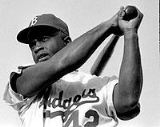
Jack Roosevelt Robinson , became the first
African American Major League Baseball player of the modern era in 1947. Robinson's achievement has been recognized by his uniform number, 42, being retired by all Major League Baseball Teams; the number will never again be given to a player, although four players played with that number at the time of its retirement. While Vaughn and Huskey have retired, Lima and Rivera are still active though only Rivera still wears the number.
He was the subject of a 1950 film biography,
The Jackie Robinson Story is a 1950 biographical [i] film [i] starring baseball legend Jackie Robinson [i] ...
, in which he played himself.
Before the major leagues
Born in
Cairo, Georgia, he moved with his mother, Mallie Robinson, and siblings Willie Mae, Mack, Frank and Edgar to
Pasadena, California in 1920, after his father deserted the family. He attended John Muir Junior College and
Pasadena City College where he was an enthusiastic athlete. At the
University of California, Los Angeles, he was a star player of
football,
basketball,
track and
baseball; the first athlete in UCLA history to letter in four different sports.
Robinson's honors at UCLA were impressive: for two years, he was the highest scorer in basketball competition in the Pacific Coast Conference, national champion long jumper, All-American football halfback and varsity baseball shortstop. He left college in 1941 because of financial problems, not many credits from a bachelor's degree.
Robinson also met his future wife, Rachel Robinson, at UCLA. His brother Matthew "Mack" Robinson competed in the
1936 Summer Olympics, finishing second in the 200-meter sprint behind
Jesse Owens. In 1941, Jackie played professional football for a team in Honolulu, Hawaii.
After leaving UCLA his senior year, Robinson enlisted in the
U.S. Army during
World War II. He was assigned to the
U.S. 761st Tank Battalion, an all black battalion. While initially refused admission to Officer Candidate School, he fought for it and eventually was accepted and, upon graduation, was commissioned as a
second lieutenant and branched
Armor. While training in the Army at
Fort Hood,
Texas, Robinson refused to go to the back of a public bus. He was court-martialed for insubordination and, therefore, never made it to Europe with his unit. He later received an honorable discharge in 1944, after being acquitted of all charges at the court-martial.
Jackie played baseball in 1944 for the
Kansas City Monarchs in the Negro American League, where he was noticed by Clyde Sukeforth, a scout working for
Branch Rickey.
The Dodgers
Branch Rickey was the club president and general manager of the Brooklyn Dodgers, and had the secret goal of signing the Negro Leagues' top players to the team. Although there was no official ban on blacks in organized baseball, previous attempts at signing black baseball players had been thwarted by league officials and rival clubs in the past, and so Rickey operated undercover. Not even his scouts knew his true objective; they were told that they were seeking players for a new all-black league Rickey was forming.
Robinson drew national attention when Rickey selected him from a list of promising candidates and signed him. Robinson was a slightly curious candidate to be the first black Major Leaguer in fifty-seven years . Not only was he 27 , he also had a fiery temperament. While some felt his more laid-back future teammate
Roy Campanella might have been a better candidate to face the expected abuse, Rickey chose Robinson, feeling that Jackie's outspoken nature would, in the long run, be more beneficial for their cause than Campanella's relative docility. But to be sure Rickey had the right man he laid upon Robinson a three-hour tirade of racial slurs, taunts, and insults in his office. Exasperated at the ordeal, Jackie asked if he should fight back. "I want someone with guts enough not to fight back," Rickey replied. The implication was clear: Jackie's entry in the majors was paving the way for other African-Americans to follow, and restraining his temper and his outspokenness were vital to furthering the program, at least until he became established as a major leaguer. Aware of what was at stake, Robinson agreed.
In 1946, Robinson was assigned to play for the Dodgers'
minor league affiliate in
Montreal, the
Montreal Royals. Although that
season was very tiring emotionally for Robinson, it was also a success in a
city that treated him well and without the racial tension present in many North American cities of the times.
Robinson's debut at
first base with the
Brooklyn Dodgers on April 15, 1947, in which he batted 0 for 3, was one of the most closely watched events in baseball history, and a profound moment in the history of the
U.S. civil rights movement. Although he played his entire rookie year at first base, Robinson spent most of his career as a
second baseman. He also played many games at
third base and in the
outfield.
During that first season, Robinson suffered considerable abuse. He generally conducted himself very well, though his composure cracked from time to time. For example, he punched an umpire in the face after the ump supposedly told him "go back to the jungle you little nigger!". Many Dodgers were highly resistant and hostile to his presence. A group of Dodger players, mostly Southerners led by Dixie Walker, insinuated they would rather strike than play alongside a black man such as Robinson, but the mutiny was ended when Dodger management informed the players they were welcome to find employment elsewhere.
He did have the support of Kentucky-born shortstop
Pee Wee Reese, who proved to be his closest comrade on the team. During one game, Cincinnati players were screaming at Jackie, and then they started to get on Reese as well. They were yelling things at him like "How can you play with this
nigger?", with Jackie standing by first base. Pee Wee went over to him and put his arm around him and smiled. Jackie smiled back. The pair became a very effective defensive combination as a result. Pittsburgh Pirate
Hank Greenberg, the first major
Jewish baseball star who himself experienced
anti-semitic abuse, also gave Robinson encouragement.
Throughout the season, Robinson experienced considerable harassment from both players and fans. Pitchers threw at his head. Baserunners tried to cut him with their cleats. He was verbally assaulted by both his own teammates and opposing teams. The
Philadelphia Phillies—encouraged by manager Ben Chapman—were particularly abusive. In their April 22 game against the Dodgers, they jeered at and insulted him ceaselessly, calling him a "nigger" from the bench, telling him to "go back to the jungle." Rickey would later recall that "Chapman did more than anybody to unite the Dodgers. When he poured out that string of unconscionable abuse, he solidified and united thirty men." Baseball Commissioner
Happy Chandler admonished the Phillies and asked Robinson to pose for photographs with Chapman as a conciliatory gesture. The two players did so, but the ensuing session was likely difficult for both participants.
In Robinson's
rookie season, he earned the major-league minimum salary of
$5000--which was standard for many rookies at the time. He played in 151 games, hit .297, and was the league leader in
stolen bases with 29.
Robinson was awarded the Rookie of the Year award in 1947, and the Most Valuable Player award for the
National League in 1949. He not only contributed to Brooklyn pennants in both years, but his determination and hustle kept the Dodgers in pennant races in 1950 and 1951 when they might otherwise have been eliminated much sooner. In 1955, though clearly in the decline of his career, Robinson would play a significant role in leading the Dodgers to their first and only World Series championship in Brooklyn, in a seven game victory over the New York Yankees.
Robinson's Major League career was fairly short. He did not enter the majors until he was 28, and was often injured as he aged. But in his prime, he was greatly respected both for his playing skills and as a person.
After the 1956 season, Robinson was sold by the Dodgers to the New York Giants Rather than report to the Giants, however, Robinson chose to
retire at age 37. This sale further added to Robinson's growing disillusionment with the Dodgers, and in particular owner
Walter O'Malley and manager
Walter Alston.
Robinson was an exceptionally talented and disciplined hitter, with a career
average of .311 and substantially more walks than
strikeouts. He played several defensive positions extremely well and was the most aggressive and successful
baserunner of his era; no other player since
World War II has more steals of home than Robinson. By his talent and physical presence, he disrupted the concentration of
pitchers,
catchers and middle infielders. Robinson's overall talent was such that he is often cited as among the best players of his era. It is also frequently claimed that Robinson was one of the most intelligent baseball players ever, a claim that is well supported by his
home plate discipline and defensive prowess. He was elected to baseball's All-Century Team as a second baseman. Robinson was regarded as a fierce competitor in the truest sense. In one of his most famous quotes, he said "I'm not concerned with your liking or disliking me... all I ask is that you respect me as a human being."
| NL Pennants | 1947, 1949, 1952, 1953, 1955, 1956 |
|---|
| World Series Teams | 1947, 1949, 1952, 1953, 1955, 1956 |
|---|
| All-Star Teams | 1949 ,1950 ,1951 ,1952 ,1953 ,1954 |
|---|
| Awards | Rookie of the Year |
|---|
| National League MVP |
| National League batting leader |
| Baseball Hall of Fame |
|
Post-Dodgers
Robinson retired from the game on January 5, 1957. He had wanted to manage or coach in the major leagues, but received no offers. He became a vice-president for the Chock Full O' Nuts corporation instead, and served on the board of the
NAACP until 1967, when he resigned because of the lack of younger influence on the board. He was also the co-owner of a successful men's clothing store located on 125th St. in New York City during the early to late 50's. In 1960, he involved himself in the
presidential election, campaigning first for
Hubert Humphrey, and then meeting both
Richard Nixon and
John F. Kennedy: citing his record on Civil Rights, Robinson supported Nixon. After Nixon was elected in 1968, Robinson wrote that he regretted the endorsement. He campaigned diligently for Humphrey in 1968.
He was inducted into the
Baseball Hall of Fame in 1962, his first year of eligibility, becoming the first African-American so honored. On June 4, 1972 the
Dodgers retired his uniform number 42 alongside
Roy Campanella and
Sandy Koufax .
Robinson made his final public appearance on October 14, 1972, before Game 2 of the
World Series in
Cincinnati. He used this chance to express his wish for a black manager to be hired by a Major League Baseball team.
This wish was granted two years later, following the 1974 season, when the
Cleveland Indians gave their managerial post to
Frank Robinson, a Hall of Fame bound slugger who was then still an active player, and no relation to Jackie Robinson. At the press conference announcing his hiring, Frank expressed his wish that Jackie had lived to see the moment. In 1981, four years after being fired as Indians manager, Frank Robinson was hired as the first black manager of a
National League team, the
San Francisco Giants. As of the conclusion of the 2005 season, five teams had black or Hispanic managers, including Frank Robinson, now with the
Washington Nationals, and 13 of the 30 teams had hired one at some point in their history.
Robinson's final few years were marked by tragedy. In 1971, his eldest son, Jackie, Jr., who had beaten back drug problems and was working as a Daytop Village counselor, was killed in an automobile accident. Also, the
diabetes that plagued him in middle age had left him virtually blind and contributed to his severe heart troubles.
Jackie Robinson was pronounced dead in
Stamford, Connecticut on October 24, 1972 and was interred in the Cypress Hills Cemetery in
Brooklyn, New York; the highway that goes through the cemetery has been renamed the
Jackie Robinson Parkway. For details, see Jules Tygiel's book,
Baseball's Great Experiment.
In 1997 , his number
42 was retired from all major league teams, though players who wore the number at the time, such as
Mo Vaughn and Mariano Rivera , were allowed to retain it to the end of their careers. The
New York Yankees are the only major league team not to list 42 among their retired numbers. In 2004, Major League Baseball designated that April 15 each year would be marked as "Jackie Robinson Day" in all their ballparks.
In 2000, he ranked number 44 on
The Sporting News is an American [i]-based sports [i] weekly magazine, book publisher, ...
list of the 100 Greatest Baseball Players, and was elected to the Major League Baseball All-Century Team.
The book includes short stories from former Dodger pitcher Carl Erskine. Robinson is prominent in many of these stories.
On October 29, 2003, the
United States Congress posthumously awarded Robinson the
Congressional Gold Medal, the highest award the Congress can bestow. Robinson's widow accepted the award in a ceremony in the Capitol Rotunda on March 2, 2005.
See also
External links