
Encyclopedia
The
Los Angeles Dodgers are a
Major League Baseball team based in
Los Angeles, California. The team is in the Western Division of the
National League. The team originated in
Brooklyn, New York, where it was known as the
Brooklyn Dodgers, before moving to Los Angeles before the 1958 season.
Franchise history
Early Brooklyn baseball
The borough of
Brooklyn was home to outstanding
baseball clubs beginning in the mid-1850s. Eight of 16 participants in the
first convention were from Brooklyn, including the
Atlantic, Eckford and Excelsior clubs that combined to dominate play for most of the 1860s. Brooklyn helped make baseball commercial, as the locale of the first paid admission games, a series of three all star contests matching New York and Brooklyn in 1858. Brooklyn also featured the first two enclosed baseball grounds, the Union Grounds and the Capitoline Grounds; enclosed, dedicated ballparks accelerated the evolution from amateurism to professionalism.
Despite the success of Brooklyn clubs in the first Association, officially amateur until 1869, they fielded weak teams in the succeeding National Association of Professional Base Ball Players, the first professional league formed in 1871. The Excelsiors no longer challenged for the amateur championship after the war and never entered the professional NA. The Eckfords and Atlantics declined to join until 1872 and thereby lost their best players; Eckford survived only one season and Atlantic four, with losing teams.
The
National League replaced the NA in 1876 and granted exclusive territories to its eight members, excluding the Atlantics in favor of the New York Mutuals who had shared the same home grounds. When the Mutuals were expelled by the League, the
Hartford, Connecticut club played its home games at Union Grounds in 1877 before shutting down.
Dodgers
The Brooklyn baseball club that eventually became the NL Dodgers was established in 1883, and the team joined the upstart American Association the following year. Originally the Brooklyn team was known as the "Trolley Dodgers," a reference to Brooklyn pedestrians who "dodged" the trollies that ran over the maze of streetcar lines that criss-crossed Brooklyn. After several of the team's players were married in succession in 1888, the press began referring to the team as the "Brooklyn Bridegrooms.” The Bridegrooms won the AA pennant in 1889. Upon switching to the
National League in 1890, the franchise became the first of only three major league sports teams, and the only major league baseball team, to win championships in different leagues in consecutive years. Eight years passed before any more success followed. Because of joint ownership between the two clubs, several
Hall of Fame players were sold to Brooklyn by the soon-to-be-defunct
Baltimore Orioles, along with their manager,
Ned Hanlon. This catapulted Brooklyn to instant contention, and “Brooklyn Superbas" lived up to their name, winning pennants in 1899 and 1900.
Teams of this era played in two principal ballparks, Washington Park and Eastern Park. They first earned the nickname “Trolley Dodgers,” later shortened to Dodgers, while at Eastern Park during the
1890s because of the difficulty fans had in reaching the ballpark due to the number of trolley lines in the area. The name "Trolley Dodgers" is recorded separately in two newspapers on September 3, 1895. The club also engaged in a series of mergers during this period, acquiring the New York Metropolitans in 1888 for territorial protection and star contracts, merging with the
Brooklyn Wonders in 1891 as part of the Players League settlement, and merging with the
Baltimore Orioles in 1900 as part of the
National League's consolidation of clubs.
In 1902, Hanlon expressed his desire to buy a controlling interest in the team and move it to
Baltimore. His plan was blocked by a lifelong club employee, Charles Ebbets, who put himself heavily in debt to buy the team and keep it in the borough. Ebbets’ ambition did not stop at owning the team. He desired to replace the dilapidated Washington Park with a new ballpark, and again invested heavily to finance the construction of
Ebbets Field, which would become the Dodgers' home in 1913.
“Uncle Robbie” and the “Daffiness Boys”
Manager Wilbert Robinson, another former Oriole, popularly known as “Uncle Robbie,” restored the Brooklyn team to respectability, with his “Brooklyn Robins” winning pennants in the 1916 and 1920 World Series and contending perennially for several seasons. Upon assuming the title of president, however, Robinson’s ability to focus on the field declined, and the teams of the late
1920s were often fondly referred to as the “Daffiness Boys” for their distracted, error-ridden style of play. Outfielder Babe Herman was the leader both in hitting and in zaniness. After his removal as club president, Robinson returned to managing, and the club’s performance rebounded somewhat.
When Robinson retired in 1931, he was replaced as manager by
Max Carey. Although some suggested renaming the "Robins" the "Brooklyn Canaries," after Carey , the name "Brooklyn Dodgers" returned to stay following Robinson's retirement. It was during this era that Willard Mullin, a noted sports
cartoonist, fixed the Brooklyn team with the lovable nickname of
“Dem Bums.” After hearing his cab driver ask "So how did those bums do today?" Mullin decided to sketch an exaggerated version of famed circus clown Emmett Kelly to represent the Dodgers in his much-praised cartoons in the
New York World-Telegram. Both the image and the nickname caught on, so much so that many a Dodger yearbook cover featured a Willard Mullin illustration with the Brooklyn Bum.
Perhaps the highlight of the Daffiness Boys era came after Wilbert Robinson had left the dugout. In 1934,
New York Giants manager
Bill Terry was asked about the Dodgers’ chances in the coming pennant race and cracked infamously, “Is Brooklyn still in the league?” Managed now by
Casey Stengel , the 1934 Dodgers were determined to make their presence felt. As it happened, the season ended with the Giants tied with the
St. Louis Cardinals for the pennant, with the Giants’ remaining games against the Dodgers. Stengel led his Bums to the
Polo Grounds for the showdown and beat the Giants twice to knock them out of the pennant race. The “Gas House Gang” Cardinals nailed the pennant by beating the Reds those same two days.
One key development during this era was the 1938 appointment of Leland Stanford MacPhail -- better known as Larry MacPhail -- as the Dodgers' general manager. MacPhail, who brought night baseball to MLB as GM of the
Cincinnati Reds, brought night baseball to the Dodgers' home games and ordered the successful refurbishing of Ebbets Field. He also brought Reds voice
Red Barber to Brooklyn as the Dodgers' lead announcer in 1939, just after MacPhail broke the New York baseball execs' agreement to ban live baseball broadcasts, a ban enacted because of the fear of what the radio calls would have on the home teams' attendance.
MacPhail remained with the Dodgers until 1942, when he returned to the Armed Forces for
World War II. MacPhail's surviving son Leland Jr. and surviving grandson Andy MacPhail also became MLB execs.
The first major-league baseball game to be
televised was Brooklyn’s 6-1 victory over
Cincinnati at Ebbets Field on August 26, 1939. Batting helmets were introduced to Major League Baseball by the Dodgers in 1941.
Breaking the color line
For the first half of the
20th century, not a single
African-American played on a Major League Baseball team. A parallel system of
Negro Leagues developed, but most of the Negro League were denied a chance to prove their skill before a national audience.
Jackie Robinson became the first African-American to play for a Major League Baseball team when he played his first major-league game on April 15, 1947, as a member of the Brooklyn Dodgers. It appears to have happened mainly due to General Manager
Branch Rickey's efforts. The deeply religious Rickey's motivation appears to have been primarily moral although business considerations were also present.
This event was the harbinger of the integration of sports in the United States, the concomitant demise of the
Negro Leagues, and is regarded as a key moment in the history of the American Civil Rights movement. Robinson was an exceptional player, a speedy
runner who sparked the whole team with his intensity, and was given the inaugural Rookie of the Year award. Robinson would eventually go on to make the Hall of Fame.
“Wait ’til next year!”
After the wilderness years of the 1920s and 1930s, the Dodgers were rebuilt into a contending club first by general manager Larry MacPhail and then the legendary
Branch Rickey. Led by
Pee Wee Reese,
Jackie Robinson and
Gil Hodges in the infield,
Duke Snider in center field,
Roy Campanella behind the plate, and Don Newcombe on the pitcher 's mound, the Dodgers won pennants in 1941, 1947, 1949, 1952, and 1953. In all five of those World Series, however, they were defeated by the
New York Yankees. The annual ritual of building excitement, followed in the end by disappointment, became old hat to the long suffering fans, and
“Wait ’til next year!” became an unofficial Dodger slogan.
While the Dodgers generally enjoyed resounding success during this period, in 1951 they fell victim to one of the largest collapses in the history of baseball. On August 11, Brooklyn led the National League by an enormous 13-1/2 games over their archrivals, the
New York Giants. However, while the Dodgers went 26-22 from that time until the end of the season, the Giants went on an absolute tear, winning an amazing 37 of their last 44 games. At the conclusion of the season, the Dodgers and the Giants were tied for first place, forcing a three-game playoff for the pennant. The Giants took Game 1 by a score of 3-1 before being shut out by the Dodgers' Clem Labine in Game 2, 10-0. It all came down to the final game, and Brooklyn seemed to have the pennant locked up, holding a 4-2 lead in the bottom of the ninth inning. However, Giants third baseman
Bobby Thomson hit a stunning three-run
walk-off home run off the Dodgers'
Ralph Branca to secure the NL Championship in dramatic fashion for New York. Today, this home run is known as the
Shot Heard 'Round The World and, despite the crushing blow it represented for the Dodgers, is widely regarded as one of the greatest moments in baseball history.
In
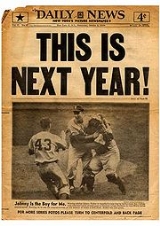
1955, by which time the core of the Dodger team was beginning to age, “next year” finally came. The fabled “Boys of Summer” shot down the Bronx Bombers in seven games, led by the first-class pitching of young left hander
Johnny Podres, whose key pitch was a changeup known as “pulling down the lampshade” because of the arm motion used right when the ball was released. Podres won two Series games including the deciding seventh. The turning point of Game 7 was a spectacular double play that began with left fielder Sandy Amoros running down
Yogi Berra’s long fly, then throwing perfectly to
shortstop Pee Wee Reese, who doubled up a surprised Gil McDougald at first base to preserve the Dodger lead.
Although the Dodgers again lost the World Series to the Yankees in 1956 , it hardly seemed to matter. Brooklyn fans had their memory of triumph, and soon that would be all they were left with.
The move to California
Real estate businessman
Walter O'Malley had acquired majority ownership of the team in 1950, when he bought the shares of his co-owner
Branch Rickey. Before long he was working to buy new land in Brooklyn to build a more accessible and better arrayed ballpark than Ebbets Field. Beloved as it was, Ebbets Field had grown old and was not well-served by infrastructure, to the point where the Dodgers couldn't sell the park out even in the heat of a pennant race despite largely dominating the league for much of the time from 1946 to 1957.
New York City Construction Coordinator
Robert Moses, however, sought to force O'Malley into using a site in
Flushing Meadows,
Queens--the site for what became
Shea Stadium. Moses' vision involved a city-built, city-owned park, which was greatly at odds with O'Malley's real-estate savvy. When it became clear to O'Malley that he wasn't going to be allowed to buy any suitable land in Brooklyn, he began thinking elsewhere.
When Los Angeles officials attended the 1955 World Series looking to entice a team to move to the City of Angels, they weren't even thinking of the Dodgers. Their original target was the lowly Washington Senators . At the same time, O'Malley was looking for a contingency in case Moses and other New York politicians refused to let him build the Brooklyn stadium he wanted. O'Malley sent word to the Los Angeles officials that he was interested in talking. Los Angeles offered him what New York would not: a chance to buy land suitable for building a new ballpark.
Meanwhile,
New York Giants owner Horace Stoneham was having similar difficulty finding a replacement for his antiquated home stadium, and the two archrival teams moved out to the West Coast together in the summer of 1957. On April 18, 1958, the Dodgers played their first game in Los Angeles, defeating the former New York and now new San Francisco Giants, 6-5, before 78,672 fans at the
Los Angeles Memorial Coliseum.
Is O'Malley to Blame?
There has been much controversy over the move of the Dodgers to California, perhaps more than over any other franchise move of that era. Walter O'Malley, in particular, is described as villainous by some and admirable by others. Some think he demonstrated some measure of selfishness and greed, but the same might also be said of the New York City politicians who opposed him. Both sides were quite stubborn, and fatally misjudged each other. It should also be noted that Brooklyn had declined in many ways, under various social pressures, and was a much less desirable location for a baseball team than it had been. In fact, both sides in the stadium dispute proposed to remove the Dodgers from Brooklyn . O'Malley also deserves credit as a visionary. Until 1958, cities in
Missouri had generally been the westernmost outpost of Major League Baseball, whereas 12 of baseball's 30 teams now have their homes farther west.
On the opposite side, the Dodgers were the second-most profitable team in the National League in the 1950s, even with the deficiencies of Ebbets Field. Other teams proved successful in facilities that were as old as Ebbets Field, and the
New York Yankees still drew large crowds to
the Bronx, in a neighborhood facing many of the changes and challenges that
Brooklyn did. Robert Moses' motives for opposing O'Malley's stadium may not have been without foundation: the Dodgers' owner wanted to drop a cookie-cutter stadium in the middle of
Flatbush, which would have required a massive
urban renewal project that would have been politically and financially problematic. Moses also felt the development there would create a "China Wall" of traffic. The site remains problematic: The proposed
Atlantic Yards development in Flatbush has run into opposition from Brooklyn politicians and community activists, who say its scale could ruin the neighborhood's character.
Many writers have suspected O'Malley of deliberately making his stadium proposal impractical, in order to bolster his claim that New York politicians drove him out of Brooklyn. It has been noted that O'Malley kept a model of the Dodgers' new stadium on his desk and publicly touted its merits while privately negotiating with Los Angeles politicians. Many Moses scholars would, however, point to Moses' almost pathologically uncompromising nature; Moses was openly dismissive of public and press criticism of his projects, and the political structure of New York City in the 1950's was such that he nearly always got his way. Still, prominent New York leaders learned how to deal with Moses for mutually beneficial projects: Francis Cardinal Spellman was even able to pressure Moses to build a Manhattan expansion for
Fordham University. By the 1950s, only Queens had large undeveloped areas of land in New York City, a fact O'Malley was keenly aware of.
Moreover, O'Malley was hardly the first team owner to see the possibilities of Los Angeles. The
St. Louis Browns attempted to move there after the 1941 season; a vote on the proposed relocation was scheduled but cancelled due to the Japanese attacks on
Pearl Harbor.
Kansas City Athletics owner Arnold Johnson was rumored to have parked the A's in Kansas City while waiting to move the team out to California, and the American League would soon expand to Los Angeles in 1961.
During the
2000 World Series,
Roger Kahn wrote an Op-Ed for the
Los Angeles Times in which he recalled sitting on a panel of New York State and City officials to explore the purchase of the Dodgers. The O'Malley family put the team up for sale in 1998, and the panel was charged with exploring the possibility of moving the Dodgers back to Brooklyn. Kahn said the officials came up with a preliminary offer which was rejected by the O'Malleys; the figure, he said, was larger than the price
Rupert Murdoch eventually paid for the team. Kahn argued that the O'Malleys rejected the offer because the story of the Dodgers being thrown out of New York was an essential part of the team's mythology. Kahn said the O'Malleys needed the myth more than the money.
However, it is possible to look at O'Malley's entire record as a baseball-team executive, from 1942 to 1979, and believe he was justified in moving the Dodgers, and still believe him to have been one of baseball's great villains, due to how he gained control of the team, how he treated his players, how he got Dodger Stadium built, how he treated the Angels while they shared Dodger Stadium, and his apparent role in controlling the office of the Commissioner of Baseball and its decisions.
A new start
The process of building Walter O'Malley's dream stadium soon began in semi-rural Chavez Ravine, in the hills just north of downtown L.A. There was some political controversy, as the residents of the ravine, mostly
Hispanic and mostly poor, resisted the eminent domain removal of their homes, and gained some public sympathy. Still, O'Malley and the city government were determined, and construction proceeded. The resistance of the residents against their removal was known as the
Battle of Chavez Ravine.
In the meantime, the Dodgers played their home games from 1958 to 1961 at the
Los Angeles Memorial Coliseum, a gargantuan football and track-and-field stadium that had been built to host the
1932 Summer Olympics. The Coliseum's dimensions were not optimal for baseball, and the only way to fit a diamond into the oval-shaped stadium was to lay the third-base line along the short axis of the oval, and the first-base line along the long axis. This resulted in a left-field fence that was only some 250 feet from home plate, and a 40-foot screen was erected to prevent home runs from becoming too easy to hit. Still, the 1958 season saw 182 home runs hit to left field in the Coliseum, while only 3 were hit to center field and 8 to right field. Dodgers outfielder Wally Moon, newly acquired for the 1959 season, became adept at launching lazy fly balls over the screen, which became known as "Moon shots."
In 1959, the Dodgers benefited from a general decline in the National League. No team was dominant, and several teams were in the thick of the pennant race until the very end. The season ended in a tie between the Dodgers and the
Milwaukee Braves, and the Dodgers won the tie-breaking playoff. 1959 also saw a team other than the
Yankees win the A.L. pennant, one of only two such years between 1949 and 1964. In a lively World Series, the Dodgers defeated the "Go-Go"
White Sox in 6 games, thoroughly cementing the bond between the team and its new California fans.
Pitching, defense, and speed
Construction on
Dodger Stadium was completed in time for Opening Day 1962. With its clean, simple lines and its picturesque setting amid hills and palm trees, the ballpark quickly became an icon of the Dodgers and their new California lifestyle, and it remains a beloved landmark to this day. O'Malley was determined that there would not be a bad seat in the house, achieving this by
cantilevered grandstands that have since been widely imitated. More importantly for the team, the stadium's spacious dimensions, along with other factors, gave defense an advantage over offense, and the Dodgers moved to take advantage of this by assembling a team that would excel with its
pitching.
The core of the team's success in the 1960s was the dominant pitching tandem of
Sandy Koufax and
Don Drysdale, who combined to win 4 of the 5 Cy Young Awards from 1962 to 1966. Top pitching also came from
Claude Osteen, an aging
Johnny Podres, and reliever Ron Perranoski. The hitting attack, on the other hand, was not impressive, and much of the offensive spark came from the exploits of speedy shortstop Maury Wills, who led the league in
stolen bases every year from 1960 to 1965, and set a modern record with 104 thefts in 1962. The Dodgers' strategy was once described as follows:
"Wills hits a single, steals second, and takes third on a grounder. A sacrifice fly brings him home. Koufax or Drysdale pitches a shutout, and the Dodgers win 1-0." Although few games followed this model exactly, the Dodgers indeed won a great many low-scoring games.
The 1962 pennant race ended in a tie, and the Dodgers were defeated by the archrival
Giants in the tie-breaking playoff, but the Dodgers proceeded to win the pennant in three of the next four years. The 1963 World Series was a 4-game sweep of the
Yankees, in which the Dodgers were so dominant that the vaunted Bronx Bombers never even took a lead against Koufax, Podres, and Drysdale. After an injury-plagued 1964, the Dodgers bounced back to win the 1965 World Series in a thrilling 7 games against the
Minnesota Twins. Game 1 happened to fall on Yom Kippur, and Koufax refused to pitch on the holy day, a decision for which he was widely praised. The Dodgers rebounded from losing the first two games, as Koufax pitched shutouts in Games 5 and 7 to win the crown and the World Series MVP Award.
The Dodgers again won the pennant in 1966, but the team was running out of gas and was swept in the World Series by the upstart
Baltimore Orioles . Koufax retired that winter, his career cut short by arthritis in his elbow, and Wills was traded away after offending Walter O'Malley. Drysdale continued to be effective, setting a record for consecutive scoreless innings in 1968, but he too retired early due to injuries. While the Dodgers were subpar for several seasons thereafter, a new core of young talent was developing in their
farm system. They won another pennant in 1974, and although they were quickly quashed by the dynastic
Oakland Athletics in the
World Series, it was a sign of good things to come.
The Lasorda years
For 23 years, beginning in 1954, the Dodgers had been managed by
Walter Alston, a quiet and unflappable man who commanded great respect from his players. Alston's tenure is the third-longest in baseball history for a manager with a single team, after Connie Mack and John McGraw. His retirement near the end of the 1976 season, after winning 7 pennants and 4 World Series titles over his career, cleared the way for an entirely different personality to take the helm of the Dodgers.
Tommy Lasorda was a 49-year-old former pitcher who had been the team's top coach under Alston, and before that had been manager of the Dodgers' top minor league team. He was colorful and gregarious, an enthusiastic cheerleader in contrast to Alston's taciturn demeanor. He quickly became a larger-than-life personality, associating with
Frank Sinatra and other celebrities, and eating Italian food in large volumes. He became well-known for sayings such as, "If you cut me, I bleed Dodger blue," and for referring to
God as "the big Dodger in the sky." Although some considered his persona to be a schtick and to find it wearing, his enthusiasm won him a reputation as an "ambassador for baseball," and it is impossible to think of the Dodgers from the late '70s to the early '90s without thinking of Lasorda.
Another transition had recently occurred, higher up in the Dodgers management. Walter O'Malley passed control of the team to his son Peter, who would continue to oversee the Dodgers on his family's behalf through 1998.
New blood had also been injected into the team on the field. The core of the team was now the infield, composed of Steve Garvey , Davey Lopes , Bill Russell , and Ron Cey . These four remained in the starting lineup together from 1973 to 1981, longer than any other infield foursome in baseball history. The pitching staff remained strong, anchored by
Don Sutton and
Tommy John. The Dodgers won NL West titles in both 1977 and 1978, and defeated the
Philadelphia Phillies both years in the National League Championship Series, only to be defeated in the World Series both years by the
Yankees. In 1980, they swept a three game series from the
Houston Astros in the final weekend of the regular season and were in a first place tie in the National League West, but lost to the Astros. 7-1 in the one-game playoff.
The 1980s: Fernandomania and the Bulldog
The Opening Day starting pitcher for 1981 was a 20-year-old rookie from Mexico: Fernando Valenzuela. Pressed into service due to an injury to
Jerry Reuss, Valenzuela pitched a shutout that day, and proceeded to win his first 8 decisions through mid-May. The youthful left-hander, speaking only Spanish but sporting a devastating screwball, became a sensation. “Fernandomania” gripped Southern California, as huge crowds turned out to see him pitch. Valenzuela became the only pitcher ever to be named Rookie of the Year and win the Cy Young Award in the same season. The Dodgers' torrid start assured them of a playoff berth in the strike-shortened split season, and they proceeded to defeat the
Yankees in the
World Series.
The Dodgers won NL West titles in 1983 and 1985, but lost in the NLCS both those years . The 1985 NLCS was particularly memorable for Game 6, in which the Dodgers were protecting a 5-4 lead in the ninth inning, hoping to force a deciding seventh game. With two runners on and first base open, Lasorda elected not to walk Cards slugger Jack Clark, who proceeded to hit a home run off Tom Niedenfuer and send St. Louis to the World Series.
After seven years of high
strikeout totals, and a 21-win season in 1986, Valenzuela sat out for most of the 1988 season. Plagued by arm troubles that were widely blamed on his being overused by Lasorda, his effectiveness faded before he turned 30. The new anchor of the pitching staff was a bespectacled string-bean of a right-hander named
Orel Hershiser. He had been given the nickname "Bulldog" by Lasorda, more as a hopeful motivational tool than an objective description of his personality, but by 1988 he had matured into one of baseball's most effective pitchers. That year he won 23 games and the Cy Young Award, and broke
Don Drysdale's record by tossing 59 consecutive scoreless innings, ending with a 10-inning shutout on his final start of the season.
The 1988 World Series Championship Team: "The Impossible Has Happened!"
The
1988 Championship is all the more magical for the fact that the Dodgers were hardly baseball's best team on paper. They enjoyed career years from several players, and were inspired by the fiery intensity of newcomer
Kirk Gibson , as well as the quiet but steady Hershiser and the always ebullient Lasorda. Although they entered the NLCS as decided underdogs to the powerful
New York Mets, the Dodgers pulled out a thrilling back-and-forth series in 7 games. The
World Series matched them with an even more powerful opponent, the
Oakland Athletics, featuring the "Bash Brothers" duo of
Mark McGwire and
José Canseco. The A's took an early lead in Game 1 on a grand slam by Canseco, and led 4-3 in the bottom of the ninth. With two outs, pinch-hitter Mike Davis drew a walk off formidable closer and future
Hall of Famer Dennis Eckersley. During Davis' at-bat, Lasorda had infielder Dave Anderson on deck so the Athletics would pitch to him more carefully. Then, Gibson, hobbled by injuries to both his legs, came in to pinch hit. On a 3-2 count, Eckerlsley threw a backdoor slider which Gibson promptly smacked to right field for a two-run
walk-off home run, winning the game for the Dodgers, 5-4. Gibson's dramatic home run has been called one of the most memorable moments in baseball history, and it set the tone for the rest of the Series. Hershiser dominated the Athletics in Games 2 and 5, and was on the mound when the Dodgers completed their stunning 4 games to 1 upset of the A's; he capped off an incredible personal season by being named the Series MVP. Few remember that the Dodgers were so injury riddled during their World Series appearance. They won the Series in Game 5 with lifetime reserves Danny Heep and Micky Hatcher in the starting lineup.
The Nineties and the Fox Era
After 1988, the Dodgers did not win another postseason game until 2004, though they did reach the playoffs in 1995 and 1996, narrowly missed in 1991, and led the NL West when the end of the 1994 season was cancelled by a strike. Hershiser, like Valenzuela before him, suffered an arm injury in 1990 due to overwork, which took the edge off his effectiveness for the remainder of his career. From 1992 to 1996, five consecutive Dodgers were named Rookie of the Year: Eric Karros,
Mike Piazza, Raúl Mondesí, Hideo Nomo, and
Todd Hollandsworth. After nearly 20 years at the helm, Lasorda retired in 1996, though he still remains with the Dodgers as an executive vice-president. He was replaced as manager by longtime Dodgers shortstop Bill Russell.
Nearly a half-century of unusual stability finally came to an end. In 1998, the O'Malley family sold the Dodgers to
Rupert Murdoch's
News Corporation, owner of the
Fox network and
20th Century Fox. Among the new ownership's early moves were trading away popular catcher Piazza, and replacing Russell with celebrity manager Davey Johnson. Johnson's volatile tenure ended two years later, and he was followed as manager by Jim Tracy. To fans accustomed to the personal touch of the O'Malleys, the Fox corporate ownership often seemed clumsy and distracted. Huge contracts were awarded to injury-prone pitchers Kevin Brown and
Darren Dreifort, unprofitably tying up money that could have improved the team in many other areas. Fox made the first changes to the home uniform since the club moved from Brooklyn and introduced the team's first alternate jersey and cap, adding silver to the team's official colors. Yet the team became more steady on the field in the early 2000's, with four consecutive winning seasons under the leadership of manager Tracy, slugger Shawn Green, third baseman Adrián Beltré, and catcher
Paul Lo Duca. The 2002 season was marked by the emergence of Éric Gagné as one of baseball's top
relief pitchers. Gagné later won the Cy Young Award in 2003.
The Sabermetric Experiment
In 2004, the Dodgers were returned to family ownership, as News Corp sold the team to real estate developer
Frank McCourt. McCourt immediately hired Paul DePodesta, schooled in Billy Beane's methods of using statistical approaches to evaluate players, as general manager. With a team largely assembled by DePodesta's predecessors, augmented by some shrewd acquisitions, the Dodgers were near the top of the standings through much of 2004. In an effort to put the team over the top, DePodesta then executed a blockbuster series of mid-season trades, sending away three starting players and two key pitchers, while obtaining several new players. The Dodgers did win the NL West in 2004, but went down quickly three games to one in the Division Series to the pennant-winning
St. Louis Cardinals.
During the winter of 2004-05, the team parted with several more longtime players, including Beltre and Green. Their replacements included starting pitcher Derek Lowe, outfielder J. D. Drew, and hard-hitting second baseman Jeff Kent. DePodesta's radical overhaul did not bear fruit in 2005, as the Dodgers suffered from clubhouse strife and decimating injuries, finishing with their second-worst record in Los Angeles history. Supporters of DePodesta note that many of the players he let go also had sub-par seasons elsewhere, but he was widely blamed for ignoring "chemistry" and other intangible factors in the players he acquired or let go. Also, the Dodgers faced an overwhelming number of injuries, such as Drew's broken wrist and All-Star shortstop Cesar Izturis's injury that required Tommy John Surgery. Manager Jim Tracy parted ways with the team, citing irreconcilable differences with DePodesta. But DePodesta himself was fired by McCourt less than a month later, McCourt later citing DePodesta's lack of leadership and personal skills.
Ned Colletti was hired as the new Dodger GM on 17 November 2005.
Newly hired
Ned Colletti was responsible for the Dodgers resurgence in the 2006 season. He hired former Red Sox manager Grady Little to helm the team and also traded oft-troubled Milton Bradley for rookie phenom Andre Ethier. His off season acquisitions included former Atlanta Brave shortsop Rafeal Furcal and form Red Sox third baseman Bill Mueller. Coletti also signed former All-Star shortstop Nomar Garciappara to a team that already had two starting shortstops . Garciappara agreed to play first base and adjusted quite well both in the field and at the plate.
Other historical notes
Team nickname
Prior to the declaration of an official team nickname in 1933, sportswriters and fans applied a number of nicknames to the club. Early names included the
Brooks and the
Bridegrooms . When the
streetcar lines were set up in Brooklyn, writers began calling the city and the team by the somewhat pejorative term
Trolley Dodgers, which became shortened to
Dodgers. Under manager
Ned Hanlon , the team became known as the
Superbas, after a popular acrobatic troupe at that time called "Hanlon's Superbas." Under manager
Wilbert Robinson , the team was known as the
Robins, though newspapers used
Robins and
Dodgers interchangeably, often in the same game summary. No nickname was acknowledged on team uniforms until 1933, when the word
Dodgers finally appeared. Prior to that, they had sported either the word "Brooklyn" or a stylized letter "B."
Rivalry with the Giants
The historic and heated rivalry between the Dodgers and the
Giants is more than a century old, having begun when both clubs played in New York City . When both franchises moved to
California in 1958, the rivalry was easily transplanted with them, as the cities of Los Angeles and
San Francisco have long been rivals in economic, cultural, and political arenas throughout the history of the State of California.
Dodger fans call the Giants "The Gnats" or "The Jints" -- but then again, Dodgers fans in Brooklyn referred to their team as "dem Bums." Fortunately for Dodgers fans, the "Gnats" have not won a World Series championship since 1954--pre-dating their arrival in San Francisco.
Vin Scully
Vin Scully has served as the play-by-play announcer for the Dodgers for 57 years, the longest tenure of any broadcaster with a single club in professional sports history. In 1976, he was selected by Dodgers fans as the Most Memorable Personality of the team's history in L.A. He is also a member of the Baseball Hall of Fame. Unique to baseball, he works normally alone and simulcasts on TV and radio.
Season-by-Season Records
- Brooklyn Trolley Dodgers
- 1884 40-64 .385 9th in AA
- 1885 53-59 .473 6th in AA
- 1886 76-61 .555 3rd in AA
- 1887 60-74 .448 6th in AA
- 1888 88-52 .629 2nd in AA
- Brooklyn Bridegrooms
- 1889 93-44 .679 1st in AA
- Brooklyn Bridegrooms
- 1890 86-43 .667 1st in NL
- 1891 61-76 .455 6th in NL
- 1892 95-59 .617 3rd in NL
- 1893 65-63 .508 7th in NL
- 1894 70-61 .534 5th in NL
- 1895 71-60 .542 5th in NL
- 1896 58-73 .443 10th in NL
- 1897 61-71 .462 7th in NL
- 1898 54-91 .372 10th in NL
- Brooklyn