

W and Z bosons

Encyclopedia
The W and Z bosons are the elementary particle
s that mediate
the weak interaction
; their symbols are , and . The W bosons have a positive and negative electric charge
of 1 elementary charge
respectively and are each other's antiparticle
. The Z boson is electrically neutral
and its own antiparticle. All three of these particles are very short-lived with a half-life
of about . Their discovery was a major success for what is now called the Standard Model
of particle physics
. The W particles are named for the weak force.
The two W bosons are best known as mediators of neutrino absorption and emission, where their charge is associated with electron or positron emission or absorption, always causing nuclear transmutation
. The Z boson is most easily detected as a necessary theoretical force-mediator, whenever neutrinos scatter elastically from matter, something that must happen without production or absorption of new charged particles. Such behavior (which is almost as common as inelastic neutrino interactions) is seen in bubble chambers irradiated with neutrino beams: whenever charged nuclei are seen to be struck by an (invisible) particle which can only be a neutrino, yet remain unchanged except for the impulse imparted by the neutrino, a (weak) force interaction between neutrino and nucleus mediated by a Z boson must be involved.
Steven Weinberg
named the additional particle the "Z particle", later giving the explanation that it was the last additional particle needed by the model – the W bosons had already been named – and that it has zero electric charge.
es of and , respectively, the W and Z bosons are almost 100 times as massive as the proton
—heavier than entire atom
s of iron
. The masses of these bosons are significant because they act as the force carrier
s of a quite short-range fundamental force: their high masses thus limit the range of the weak nuclear force. By way of contrast, the electromagnetic force
has an infinite range because its force carrier, the photon
, has zero rest mass.
All three bosons have particle spin
s = 1. The emission of a or boson either raises or lowers the electric charge of the emitting particle by one unit, and also alters the spin by one unit. At the same time, the emission or absorption of a W boson can change the type of the particle – for example changing a strange quark
into an up quark
. The neutral Z boson obviously cannot change the electric charge of any particle, nor can it change any other of the so-called "charges
" (such as strangeness
, baryon number, charm, etc.). The emission or absorption of a Z boson can only change the spin, momentum, and energy of the other particle. (See also, weak neutral current).
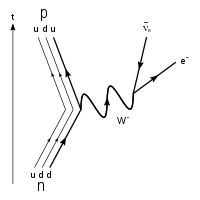 The W and Z bosons are carrier particles that mediate the weak nuclear force, much like the photon is the carrier particle for the electromagnetic force. The W bosons are best known for their role in nuclear decay. Consider, for example, the beta decay
of cobalt-60
, an important process in supernova
explosions.
This reaction does not involve the whole cobalt-60 nucleus
, but affects only one of its 33 neutron
s. The neutron is converted into a proton
while also emitting an electron
(called a beta particle
in this context) and an electron antineutrino:
Again, the neutron is not an elementary particle but a composite of an up quark
and two down quark
s (udd). It is in fact one of the down quarks that interacts in beta decay, turning into an up quark to form a proton (uud). At the most fundamental level, then, the weak force changes the flavour
of a single quark:
which is immediately followed by decay of the itself:
The Z boson is its own antiparticle. Thus, all of its flavour quantum numbers and charges
are zero. The exchange of a Z boson between particles, called a neutral current
interaction, therefore leaves the interacting particles unaffected, except for a transfer of momentum
. boson interactions involving neutrino
s have distinctive signatures: They provide the only known mechanism for elastic scattering
of neutrinos in matter; neutrinos are almost as likely to scatter elastically (via boson exchange) as inelastically (via boson exchange). Weak neutral currents via Z boson exchange were predicted in 1973 by Abdus Salam
, Sheldon Glashow and Steven Weinberg
, and confirmed shortly thereafter in 1974, in a neutrino experiment in the Gargamelle
bubble chamber
at CERN
.
Unlike beta decay, the observation of neutral current interactions that involve particles other than neutrinos, requires huge investments in particle accelerator
s and detectors, such as are available in only a few high-energy physics laboratories in the world (and then only after 1983). This is because Z-bosons behave in somewhat the same manner as photons, but do not become important until the energy of the interaction is comparable with the relatively huge rest mass of the Z boson.
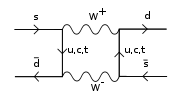 Following the spectacular success of quantum electrodynamics
in the 1950s, attempts were undertaken to formulate a similar theory of the weak nuclear force. This culminated around 1968 in a unified theory of electromagnetism and weak interactions by Sheldon Glashow, Steven Weinberg
, and Abdus Salam
, for which they shared the 1979 Nobel Prize in physics. Their electroweak theory postulated not only the W bosons necessary to explain beta decay, but also a new Z boson that had never been observed.
The fact that the W and Z bosons have mass while photons are massless was a major obstacle in developing electroweak theory. These particles are accurately described by an SU(2) gauge theory
, but the bosons in a gauge theory must be massless. As a case in point, the photon
is massless because electromagnetism is described by a U(1) gauge theory. Some mechanism is required to break the SU(2) symmetry, giving mass to the W and Z in the process. One explanation, the Higgs mechanism
, was forwarded by Peter Higgs
and others in the mid 1960s. It predicts the existence of yet another new particle; the Higgs boson
.
The combination of the SU(2) gauge theory of the weak interaction, the electromagnetic interaction, and the Higgs mechanism is known as the Glashow-Weinberg-Salam model. These days it is widely accepted as one of the pillars of the Standard Model of particle physics. As of mid-2010, despite intensive search for the Higgs boson carried out at CERN
and Fermilab
, its existence remains the main prediction of the Standard Model not to be confirmed experimentally.
 The discovery of the W and Z bosons was considered a major success for CERN. First, in 1973, came the observation of neutral current
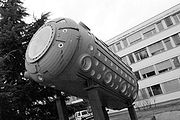
interactions as predicted by electroweak theory. The huge Gargamelle
bubble chamber
photographed the tracks of a few electrons suddenly starting to move, seemingly of their own accord. This is interpreted as a neutrino
interacting with the electron by the exchange of an unseen Z boson. The neutrino is otherwise undetectable, so the only observable effect is the momentum imparted to the electron by the interaction.
The discovery of the W and Z bosons themselves had to wait for the construction of a particle accelerator
powerful enough to produce them. The first such machine that became available was the Super Proton Synchrotron
, where unambiguous signals of W bosons were seen in January 1983 during a series of experiments conducted by Carlo Rubbia
and Simon van der Meer
. The actual experiments were called UA1 (led by Rubbia) and UA2 (led by Peter Jenni), and were the collaborative effort of many people. Van der Meer was the driving force on the accelerator end (stochastic cooling
). UA1 and UA2 found the Z boson a few months later, in May 1983. Rubbia and van der Meer were promptly awarded the 1984 Nobel Prize in Physics, a most unusual step for the conservative Nobel Foundation
.
The , , and bosons, together with the photon
, build up the four gauge boson
s of the electroweak interaction
.
–antifermion pairs but neither the W nor the Z bosons can decay into the higher-mass top quark
. Neglecting phase space effects and higher order corrections, simple estimates of their branching fractions can be calculated from the coupling constant
s.
and neutrino
or to an up-type quark and a down-type quark. The decay width of the W boson to a quark–antiquark pair is proportional to the corresponding squared CKM matrix element and the number of quark colours
, NC = 3. The decay widths for the W bosons are then proportional to:
Here, , , denote the three flavour
s of lepton
s (more exactly, the positive charged antilepton
s). , , denote the three flavour
s of neutrinos. The other particles, starting with and , all denote quark
s and antiquarks (factor NC is applied). The various Vij denote the corresponding CKM matrix coefficients.
Unitarity of the CKM matrix implies that
|Vud|2 + |Vus|2 + |Vub|2 =
|Vcd|2 + |Vcs|2 + |Vcb|2 = 1. Therefore the leptonic branching ratio
s of the W boson are approximately B = B = B = (~11.11%). The hadronic branching ratio is dominated by the CKM-favored and final states, and the sum of the hadron
ic branching ratios is roughly (~66.67%). The branching ratios have been measured experimentally: B(l+νl) = and B(hadrons) =.
of the fermion, Q is the charge
of the fermion (in units of the elementary charge
), and x = sin2θW, where θW is the weak mixing angle
. Because the weak isospin is different for fermions of different chirality
, either left-handed or right-handed, the coupling is different as well. The decay width of the Z boson for quarks is also proportional to NC.
Here, L and R denote the left- and right-handed chiralities of the fermions respectively. The right-handed neutrinos do not exist in the standard model. However, in some extensions beyond the standard model they do.
Elementary particle
In particle physics, an elementary particle or fundamental particle is a particle not known to have substructure; that is, it is not known to be made up of smaller particles. If an elementary particle truly has no substructure, then it is one of the basic building blocks of the universe from which...
s that mediate
Force carrier
In particle physics, quantum field theories such as the Standard Model describe nature in terms of fields. Each field has a complementary description as the set of particles of a particular type...
the weak interaction
Weak interaction
Weak interaction , is one of the four fundamental forces of nature, alongside the strong nuclear force, electromagnetism, and gravity. It is responsible for the radioactive decay of subatomic particles and initiates the process known as hydrogen fusion in stars...
; their symbols are , and . The W bosons have a positive and negative electric charge
Electric charge
Electric charge is a physical property of matter that causes it to experience a force when near other electrically charged matter. Electric charge comes in two types, called positive and negative. Two positively charged substances, or objects, experience a mutual repulsive force, as do two...
of 1 elementary charge
Elementary charge
The elementary charge, usually denoted as e, is the electric charge carried by a single proton, or equivalently, the absolute value of the electric charge carried by a single electron. This elementary charge is a fundamental physical constant. To avoid confusion over its sign, e is sometimes called...
respectively and are each other's antiparticle
Antiparticle
Corresponding to most kinds of particles, there is an associated antiparticle with the same mass and opposite electric charge. For example, the antiparticle of the electron is the positively charged antielectron, or positron, which is produced naturally in certain types of radioactive decay.The...
. The Z boson is electrically neutral
Neutral particle
In physics, a neutral particle is a particle with no electric charge. This is not to be confused with a real neutral particle, a neutral particle that is also identical to its own antiparticle.-Stable or long-lived neutral particles:...
and its own antiparticle. All three of these particles are very short-lived with a half-life
Half-life
Half-life, abbreviated t½, is the period of time it takes for the amount of a substance undergoing decay to decrease by half. The name was originally used to describe a characteristic of unstable atoms , but it may apply to any quantity which follows a set-rate decay.The original term, dating to...
of about . Their discovery was a major success for what is now called the Standard Model
Standard Model
The Standard Model of particle physics is a theory concerning the electromagnetic, weak, and strong nuclear interactions, which mediate the dynamics of the known subatomic particles. Developed throughout the mid to late 20th century, the current formulation was finalized in the mid 1970s upon...
of particle physics
Particle physics
Particle physics is a branch of physics that studies the existence and interactions of particles that are the constituents of what is usually referred to as matter or radiation. In current understanding, particles are excitations of quantum fields and interact following their dynamics...
. The W particles are named for the weak force.
The two W bosons are best known as mediators of neutrino absorption and emission, where their charge is associated with electron or positron emission or absorption, always causing nuclear transmutation
Nuclear transmutation
Nuclear transmutation is the conversion of one chemical element or isotope into another. In other words, atoms of one element can be changed into atoms of other element by 'transmutation'...
. The Z boson is most easily detected as a necessary theoretical force-mediator, whenever neutrinos scatter elastically from matter, something that must happen without production or absorption of new charged particles. Such behavior (which is almost as common as inelastic neutrino interactions) is seen in bubble chambers irradiated with neutrino beams: whenever charged nuclei are seen to be struck by an (invisible) particle which can only be a neutrino, yet remain unchanged except for the impulse imparted by the neutrino, a (weak) force interaction between neutrino and nucleus mediated by a Z boson must be involved.
Name
The W bosons are named after the weak force. The physicistPhysicist
A physicist is a scientist who studies or practices physics. Physicists study a wide range of physical phenomena in many branches of physics spanning all length scales: from sub-atomic particles of which all ordinary matter is made to the behavior of the material Universe as a whole...
Steven Weinberg
Steven Weinberg
Steven Weinberg is an American theoretical physicist and Nobel laureate in Physics for his contributions with Abdus Salam and Sheldon Glashow to the unification of the weak force and electromagnetic interaction between elementary particles....
named the additional particle the "Z particle", later giving the explanation that it was the last additional particle needed by the model – the W bosons had already been named – and that it has zero electric charge.
Basic properties
These bosons are among the heavyweights of the elementary particles. With massMass
Mass can be defined as a quantitive measure of the resistance an object has to change in its velocity.In physics, mass commonly refers to any of the following three properties of matter, which have been shown experimentally to be equivalent:...
es of and , respectively, the W and Z bosons are almost 100 times as massive as the proton
Proton
The proton is a subatomic particle with the symbol or and a positive electric charge of 1 elementary charge. One or more protons are present in the nucleus of each atom, along with neutrons. The number of protons in each atom is its atomic number....
—heavier than entire atom
Atom
The atom is a basic unit of matter that consists of a dense central nucleus surrounded by a cloud of negatively charged electrons. The atomic nucleus contains a mix of positively charged protons and electrically neutral neutrons...
s of iron
Iron
Iron is a chemical element with the symbol Fe and atomic number 26. It is a metal in the first transition series. It is the most common element forming the planet Earth as a whole, forming much of Earth's outer and inner core. It is the fourth most common element in the Earth's crust...
. The masses of these bosons are significant because they act as the force carrier
Force carrier
In particle physics, quantum field theories such as the Standard Model describe nature in terms of fields. Each field has a complementary description as the set of particles of a particular type...
s of a quite short-range fundamental force: their high masses thus limit the range of the weak nuclear force. By way of contrast, the electromagnetic force
Electromagnetism
Electromagnetism is one of the four fundamental interactions in nature. The other three are the strong interaction, the weak interaction and gravitation...
has an infinite range because its force carrier, the photon
Photon
In physics, a photon is an elementary particle, the quantum of the electromagnetic interaction and the basic unit of light and all other forms of electromagnetic radiation. It is also the force carrier for the electromagnetic force...
, has zero rest mass.
All three bosons have particle spin
Spin (physics)
In quantum mechanics and particle physics, spin is a fundamental characteristic property of elementary particles, composite particles , and atomic nuclei.It is worth noting that the intrinsic property of subatomic particles called spin and discussed in this article, is related in some small ways,...
s = 1. The emission of a or boson either raises or lowers the electric charge of the emitting particle by one unit, and also alters the spin by one unit. At the same time, the emission or absorption of a W boson can change the type of the particle – for example changing a strange quark
Strange quark
The strange quark or s quark is the third-lightest of all quarks, a type of elementary particle. Strange quarks are found in hadrons, which are subatomic particles. Example of hadrons containing strange quarks include kaons , strange D mesons , Sigma baryons , and other strange particles...
into an up quark
Up quark
The up quark or u quark is the lightest of all quarks, a type of elementary particle, and a major constituent of matter. It, along with the down quark, forms the neutrons and protons of atomic nuclei...
. The neutral Z boson obviously cannot change the electric charge of any particle, nor can it change any other of the so-called "charges
Charge (physics)
In physics, a charge may refer to one of many different quantities, such as the electric charge in electromagnetism or the color charge in quantum chromodynamics. Charges are associated with conserved quantum numbers.-Formal definition:...
" (such as strangeness
Strangeness
In particle physics, strangeness S is a property of particles, expressed as a quantum number, for describing decay of particles in strong and electromagnetic reactions, which occur in a short period of time...
, baryon number, charm, etc.). The emission or absorption of a Z boson can only change the spin, momentum, and energy of the other particle. (See also, weak neutral current).
Weak nuclear force
Beta decay
In nuclear physics, beta decay is a type of radioactive decay in which a beta particle is emitted from an atom. There are two types of beta decay: beta minus and beta plus. In the case of beta decay that produces an electron emission, it is referred to as beta minus , while in the case of a...
of cobalt-60
Cobalt-60
Cobalt-60, , is a synthetic radioactive isotope of cobalt. Due to its half-life of 5.27 years, is not found in nature. It is produced artificially by neutron activation of . decays by beta decay to the stable isotope nickel-60...
, an important process in supernova
Supernova
A supernova is a stellar explosion that is more energetic than a nova. It is pronounced with the plural supernovae or supernovas. Supernovae are extremely luminous and cause a burst of radiation that often briefly outshines an entire galaxy, before fading from view over several weeks or months...
explosions.
- → + +
This reaction does not involve the whole cobalt-60 nucleus
Atomic nucleus
The nucleus is the very dense region consisting of protons and neutrons at the center of an atom. It was discovered in 1911, as a result of Ernest Rutherford's interpretation of the famous 1909 Rutherford experiment performed by Hans Geiger and Ernest Marsden, under the direction of Rutherford. The...
, but affects only one of its 33 neutron
Neutron
The neutron is a subatomic hadron particle which has the symbol or , no net electric charge and a mass slightly larger than that of a proton. With the exception of hydrogen, nuclei of atoms consist of protons and neutrons, which are therefore collectively referred to as nucleons. The number of...
s. The neutron is converted into a proton
Proton
The proton is a subatomic particle with the symbol or and a positive electric charge of 1 elementary charge. One or more protons are present in the nucleus of each atom, along with neutrons. The number of protons in each atom is its atomic number....
while also emitting an electron
Electron
The electron is a subatomic particle with a negative elementary electric charge. It has no known components or substructure; in other words, it is generally thought to be an elementary particle. An electron has a mass that is approximately 1/1836 that of the proton...
(called a beta particle
Beta particle
Beta particles are high-energy, high-speed electrons or positrons emitted by certain types of radioactive nuclei such as potassium-40. The beta particles emitted are a form of ionizing radiation also known as beta rays. The production of beta particles is termed beta decay...
in this context) and an electron antineutrino:
- → + +
Again, the neutron is not an elementary particle but a composite of an up quark
Up quark
The up quark or u quark is the lightest of all quarks, a type of elementary particle, and a major constituent of matter. It, along with the down quark, forms the neutrons and protons of atomic nuclei...
and two down quark
Down quark
The down quark or d quark is the second-lightest of all quarks, a type of elementary particle, and a major constituent of matter. It, along with the up quark, forms the neutrons and protons of atomic nuclei...
s (udd). It is in fact one of the down quarks that interacts in beta decay, turning into an up quark to form a proton (uud). At the most fundamental level, then, the weak force changes the flavour
Flavour (particle physics)
In particle physics, flavour or flavor is a quantum number of elementary particles. In quantum chromodynamics, flavour is a global symmetry...
of a single quark:
- → +
which is immediately followed by decay of the itself:
- → +
The Z boson is its own antiparticle. Thus, all of its flavour quantum numbers and charges
Charge (physics)
In physics, a charge may refer to one of many different quantities, such as the electric charge in electromagnetism or the color charge in quantum chromodynamics. Charges are associated with conserved quantum numbers.-Formal definition:...
are zero. The exchange of a Z boson between particles, called a neutral current
Neutral current
Weak neutral current interactions are one of the ways in which subatomic particles can interact by means of the weak force. These interactions are mediated by the boson...
interaction, therefore leaves the interacting particles unaffected, except for a transfer of momentum
Momentum
In classical mechanics, linear momentum or translational momentum is the product of the mass and velocity of an object...
. boson interactions involving neutrino
Neutrino
A neutrino is an electrically neutral, weakly interacting elementary subatomic particle with a half-integer spin, chirality and a disputed but small non-zero mass. It is able to pass through ordinary matter almost unaffected...
s have distinctive signatures: They provide the only known mechanism for elastic scattering
Elastic scattering
In scattering theory and in particular in particle physics, elastic scattering is one of the specific forms of scattering. In this process, the kinetic energy of the incident particles is conserved, only their direction of propagation is modified .-Electron elastic scattering:When an alpha particle...
of neutrinos in matter; neutrinos are almost as likely to scatter elastically (via boson exchange) as inelastically (via boson exchange). Weak neutral currents via Z boson exchange were predicted in 1973 by Abdus Salam
Abdus Salam
Mohammad Abdus Salam, NI, SPk Mohammad Abdus Salam, NI, SPk Mohammad Abdus Salam, NI, SPk (Urdu: محمد عبد السلام, pronounced , (January 29, 1926– November 21, 1996) was a Pakistani theoretical physicist and Nobel laureate in Physics for his work on the electroweak unification of the...
, Sheldon Glashow and Steven Weinberg
Steven Weinberg
Steven Weinberg is an American theoretical physicist and Nobel laureate in Physics for his contributions with Abdus Salam and Sheldon Glashow to the unification of the weak force and electromagnetic interaction between elementary particles....
, and confirmed shortly thereafter in 1974, in a neutrino experiment in the Gargamelle
Gargamelle
Gargamelle was a giant bubble chamber detector at CERN, designed mainly for the detection of neutrino interactions. Built in France, with a diameter of nearly 2 meters and 4.8 meters in length, Gargamelle held nearly 12 cubic meters of freon...
bubble chamber
Bubble chamber
A bubble chamber is a vessel filled with a superheated transparent liquid used to detect electrically charged particles moving through it. It was invented in 1952 by Donald A. Glaser, for which he was awarded the 1960 Nobel Prize in Physics...
at CERN
CERN
The European Organization for Nuclear Research , known as CERN , is an international organization whose purpose is to operate the world's largest particle physics laboratory, which is situated in the northwest suburbs of Geneva on the Franco–Swiss border...
.
Unlike beta decay, the observation of neutral current interactions that involve particles other than neutrinos, requires huge investments in particle accelerator
Particle accelerator
A particle accelerator is a device that uses electromagnetic fields to propel charged particles to high speeds and to contain them in well-defined beams. An ordinary CRT television set is a simple form of accelerator. There are two basic types: electrostatic and oscillating field accelerators.In...
s and detectors, such as are available in only a few high-energy physics laboratories in the world (and then only after 1983). This is because Z-bosons behave in somewhat the same manner as photons, but do not become important until the energy of the interaction is comparable with the relatively huge rest mass of the Z boson.
Predicting the W and Z
Quantum electrodynamics
Quantum electrodynamics is the relativistic quantum field theory of electrodynamics. In essence, it describes how light and matter interact and is the first theory where full agreement between quantum mechanics and special relativity is achieved...
in the 1950s, attempts were undertaken to formulate a similar theory of the weak nuclear force. This culminated around 1968 in a unified theory of electromagnetism and weak interactions by Sheldon Glashow, Steven Weinberg
Steven Weinberg
Steven Weinberg is an American theoretical physicist and Nobel laureate in Physics for his contributions with Abdus Salam and Sheldon Glashow to the unification of the weak force and electromagnetic interaction between elementary particles....
, and Abdus Salam
Abdus Salam
Mohammad Abdus Salam, NI, SPk Mohammad Abdus Salam, NI, SPk Mohammad Abdus Salam, NI, SPk (Urdu: محمد عبد السلام, pronounced , (January 29, 1926– November 21, 1996) was a Pakistani theoretical physicist and Nobel laureate in Physics for his work on the electroweak unification of the...
, for which they shared the 1979 Nobel Prize in physics. Their electroweak theory postulated not only the W bosons necessary to explain beta decay, but also a new Z boson that had never been observed.
The fact that the W and Z bosons have mass while photons are massless was a major obstacle in developing electroweak theory. These particles are accurately described by an SU(2) gauge theory
Gauge theory
In physics, gauge invariance is the property of a field theory in which different configurations of the underlying fundamental but unobservable fields result in identical observable quantities. A theory with such a property is called a gauge theory...
, but the bosons in a gauge theory must be massless. As a case in point, the photon
Photon
In physics, a photon is an elementary particle, the quantum of the electromagnetic interaction and the basic unit of light and all other forms of electromagnetic radiation. It is also the force carrier for the electromagnetic force...
is massless because electromagnetism is described by a U(1) gauge theory. Some mechanism is required to break the SU(2) symmetry, giving mass to the W and Z in the process. One explanation, the Higgs mechanism
Higgs mechanism
In particle physics, the Higgs mechanism is the process in which gauge bosons in a gauge theory can acquire non-vanishing masses through absorption of Nambu-Goldstone bosons arising in spontaneous symmetry breaking....
, was forwarded by Peter Higgs
Peter Higgs
Peter Ware Higgs, FRS, FRSE, FKC , is an English theoretical physicist and an emeritus professor at the University of Edinburgh....
and others in the mid 1960s. It predicts the existence of yet another new particle; the Higgs boson
Higgs boson
The Higgs boson is a hypothetical massive elementary particle that is predicted to exist by the Standard Model of particle physics. Its existence is postulated as a means of resolving inconsistencies in the Standard Model...
.
The combination of the SU(2) gauge theory of the weak interaction, the electromagnetic interaction, and the Higgs mechanism is known as the Glashow-Weinberg-Salam model. These days it is widely accepted as one of the pillars of the Standard Model of particle physics. As of mid-2010, despite intensive search for the Higgs boson carried out at CERN
CERN
The European Organization for Nuclear Research , known as CERN , is an international organization whose purpose is to operate the world's largest particle physics laboratory, which is situated in the northwest suburbs of Geneva on the Franco–Swiss border...
and Fermilab
Fermilab
Fermi National Accelerator Laboratory , located just outside Batavia, Illinois, near Chicago, is a US Department of Energy national laboratory specializing in high-energy particle physics...
, its existence remains the main prediction of the Standard Model not to be confirmed experimentally.
Discovery
Neutral current
Weak neutral current interactions are one of the ways in which subatomic particles can interact by means of the weak force. These interactions are mediated by the boson...
interactions as predicted by electroweak theory. The huge Gargamelle
Gargamelle
Gargamelle was a giant bubble chamber detector at CERN, designed mainly for the detection of neutrino interactions. Built in France, with a diameter of nearly 2 meters and 4.8 meters in length, Gargamelle held nearly 12 cubic meters of freon...
bubble chamber
Bubble chamber
A bubble chamber is a vessel filled with a superheated transparent liquid used to detect electrically charged particles moving through it. It was invented in 1952 by Donald A. Glaser, for which he was awarded the 1960 Nobel Prize in Physics...
photographed the tracks of a few electrons suddenly starting to move, seemingly of their own accord. This is interpreted as a neutrino
Neutrino
A neutrino is an electrically neutral, weakly interacting elementary subatomic particle with a half-integer spin, chirality and a disputed but small non-zero mass. It is able to pass through ordinary matter almost unaffected...
interacting with the electron by the exchange of an unseen Z boson. The neutrino is otherwise undetectable, so the only observable effect is the momentum imparted to the electron by the interaction.
The discovery of the W and Z bosons themselves had to wait for the construction of a particle accelerator
Particle accelerator
A particle accelerator is a device that uses electromagnetic fields to propel charged particles to high speeds and to contain them in well-defined beams. An ordinary CRT television set is a simple form of accelerator. There are two basic types: electrostatic and oscillating field accelerators.In...
powerful enough to produce them. The first such machine that became available was the Super Proton Synchrotron
Super Proton Synchrotron
The Super Proton Synchrotron is a particle accelerator of the synchrotron type at CERN. It is housed in a circular tunnel, in circumference, straddling the border of France and Switzerland near Geneva, Switzerland. The SPS was designed by a team led by John Adams, director-general of what was...
, where unambiguous signals of W bosons were seen in January 1983 during a series of experiments conducted by Carlo Rubbia
Carlo Rubbia
Carlo Rubbia Knight Grand Cross is an Italian particle physicist and inventor who shared the Nobel Prize in Physics in 1984 with Simon van der Meer for work leading to the discovery of the W and Z particles at CERN.-Biography:...
and Simon van der Meer
Simon van der Meer
Simon van der Meer was a Dutch particle accelerator physicist who shared the Nobel Prize in Physics in 1984 with Carlo Rubbia for contributions to the CERN project which led to the discovery of the W and Z particles, two of the most fundamental constituents of matter.-Biography:One of four...
. The actual experiments were called UA1 (led by Rubbia) and UA2 (led by Peter Jenni), and were the collaborative effort of many people. Van der Meer was the driving force on the accelerator end (stochastic cooling
Stochastic cooling
Stochastic cooling is a form of particle beam cooling. It is used in some particle accelerators and storage rings to control the emittance of the particle beams in the machine. This process uses the electrical signals that the individual charged particles generate in a feedback loop to reduce the...
). UA1 and UA2 found the Z boson a few months later, in May 1983. Rubbia and van der Meer were promptly awarded the 1984 Nobel Prize in Physics, a most unusual step for the conservative Nobel Foundation
Nobel Prize
The Nobel Prizes are annual international awards bestowed by Scandinavian committees in recognition of cultural and scientific advances. The will of the Swedish chemist Alfred Nobel, the inventor of dynamite, established the prizes in 1895...
.
The , , and bosons, together with the photon
Photon
In physics, a photon is an elementary particle, the quantum of the electromagnetic interaction and the basic unit of light and all other forms of electromagnetic radiation. It is also the force carrier for the electromagnetic force...
, build up the four gauge boson
Gauge boson
In particle physics, gauge bosons are bosonic particles that act as carriers of the fundamental forces of nature. More specifically, elementary particles whose interactions are described by gauge theory exert forces on each other by the exchange of gauge bosons, usually as virtual particles.-...
s of the electroweak interaction
Electroweak interaction
In particle physics, the electroweak interaction is the unified description of two of the four known fundamental interactions of nature: electromagnetism and the weak interaction. Although these two forces appear very different at everyday low energies, the theory models them as two different...
.
Decay
The W and Z bosons decay to fermionFermion
In particle physics, a fermion is any particle which obeys the Fermi–Dirac statistics . Fermions contrast with bosons which obey Bose–Einstein statistics....
–antifermion pairs but neither the W nor the Z bosons can decay into the higher-mass top quark
Top quark
The top quark, also known as the t quark or truth quark, is an elementary particle and a fundamental constituent of matter. Like all quarks, the top quark is an elementary fermion with spin-, and experiences all four fundamental interactions: gravitation, electromagnetism, weak interactions, and...
. Neglecting phase space effects and higher order corrections, simple estimates of their branching fractions can be calculated from the coupling constant
Coupling constant
In physics, a coupling constant, usually denoted g, is a number that determines the strength of an interaction. Usually the Lagrangian or the Hamiltonian of a system can be separated into a kinetic part and an interaction part...
s.
W bosons
W bosons can decay to a leptonLepton
A lepton is an elementary particle and a fundamental constituent of matter. The best known of all leptons is the electron which governs nearly all of chemistry as it is found in atoms and is directly tied to all chemical properties. Two main classes of leptons exist: charged leptons , and neutral...
and neutrino
Neutrino
A neutrino is an electrically neutral, weakly interacting elementary subatomic particle with a half-integer spin, chirality and a disputed but small non-zero mass. It is able to pass through ordinary matter almost unaffected...
or to an up-type quark and a down-type quark. The decay width of the W boson to a quark–antiquark pair is proportional to the corresponding squared CKM matrix element and the number of quark colours
Color charge
In particle physics, color charge is a property of quarks and gluons that is related to the particles' strong interactions in the theory of quantum chromodynamics . Color charge has analogies with the notion of electric charge of particles, but because of the mathematical complications of QCD,...
, NC = 3. The decay widths for the W bosons are then proportional to:
| Leptons | Up quarks | Charm quarks | |||
|---|---|---|---|---|---|
| 1 | >Vud |
>Vcd |
|||
| 1 | >Vus |
>Vcs |
|||
| 1 | >Vub |
>Vcb |
|||
Here, , , denote the three flavour
Flavour (particle physics)
In particle physics, flavour or flavor is a quantum number of elementary particles. In quantum chromodynamics, flavour is a global symmetry...
s of lepton
Lepton
A lepton is an elementary particle and a fundamental constituent of matter. The best known of all leptons is the electron which governs nearly all of chemistry as it is found in atoms and is directly tied to all chemical properties. Two main classes of leptons exist: charged leptons , and neutral...
s (more exactly, the positive charged antilepton
Antiparticle
Corresponding to most kinds of particles, there is an associated antiparticle with the same mass and opposite electric charge. For example, the antiparticle of the electron is the positively charged antielectron, or positron, which is produced naturally in certain types of radioactive decay.The...
s). , , denote the three flavour
Flavour (particle physics)
In particle physics, flavour or flavor is a quantum number of elementary particles. In quantum chromodynamics, flavour is a global symmetry...
s of neutrinos. The other particles, starting with and , all denote quark
Quark
A quark is an elementary particle and a fundamental constituent of matter. Quarks combine to form composite particles called hadrons, the most stable of which are protons and neutrons, the components of atomic nuclei. Due to a phenomenon known as color confinement, quarks are never directly...
s and antiquarks (factor NC is applied). The various Vij denote the corresponding CKM matrix coefficients.
Unitarity of the CKM matrix implies that
|Vud|2 + |Vus|2 + |Vub|2 =
|Vcd|2 + |Vcs|2 + |Vcb|2 = 1. Therefore the leptonic branching ratio
Branching ratio
In particle physics and nuclear physics, the branching fraction for a decay is the fraction of particles which decay by an individual decay mode with respect to the total number of particles which decay. It is equal to the ratio of the partial decay constant to the overall decay constant...
s of the W boson are approximately B = B = B = (~11.11%). The hadronic branching ratio is dominated by the CKM-favored and final states, and the sum of the hadron
Hadron
In particle physics, a hadron is a composite particle made of quarks held together by the strong force...
ic branching ratios is roughly (~66.67%). The branching ratios have been measured experimentally: B(l+νl) = and B(hadrons) =.
Z bosons
Z bosons decay into a fermion and its antiparticle. The decay width of a Z boson to a fermion–antifermion pair is proportional to the square of the weak charge T3 − Qx, where T3 is the third component of the weak isospinWeak isospin
In particle physics, weak isospin is a quantum number relating to the weak interaction, and parallels the idea of isospin under the strong interaction. Weak isospin is usually given the symbol T or I with the third component written as Tz, T3, Iz or I3...
of the fermion, Q is the charge
Electric charge
Electric charge is a physical property of matter that causes it to experience a force when near other electrically charged matter. Electric charge comes in two types, called positive and negative. Two positively charged substances, or objects, experience a mutual repulsive force, as do two...
of the fermion (in units of the elementary charge
Elementary charge
The elementary charge, usually denoted as e, is the electric charge carried by a single proton, or equivalently, the absolute value of the electric charge carried by a single electron. This elementary charge is a fundamental physical constant. To avoid confusion over its sign, e is sometimes called...
), and x = sin2θW, where θW is the weak mixing angle
Weinberg angle
The Weinberg angle or weak mixing angle is a parameter in the Weinberg–Salam theory of the electroweak interaction, and is usually denoted as θW...
. Because the weak isospin is different for fermions of different chirality
Chirality (physics)
A chiral phenomenon is one that is not identical to its mirror image . The spin of a particle may be used to define a handedness for that particle. A symmetry transformation between the two is called parity...
, either left-handed or right-handed, the coupling is different as well. The decay width of the Z boson for quarks is also proportional to NC.
| Particles | Weak charge | Decay width of Z Boson | Branching ratios BR(particle, antiparticle) | |||
|---|---|---|---|---|---|---|
| Name | Symbols | L | R | (proportional to) | Predicted for x = 0.23 | Experimental measurements |
| Neutrinos | , , | 0 | 2 | |||
| Leptons | , , | − + x | x | (− + x)2 + x2 | ||
| Up-type Quarks | , | − x | −x | 3( − x)2 + 3(−x)2 | ||
| Down-type quarks | , , | − + x | x | 3(− + x)2 + 3(x)2 | ||
| Hadron Hadron In particle physics, a hadron is a composite particle made of quarks held together by the strong force... s |
Here, L and R denote the left- and right-handed chiralities of the fermions respectively. The right-handed neutrinos do not exist in the standard model. However, in some extensions beyond the standard model they do.
See also
- Standard Model (mathematical formulation)
- List of particles
- X and Y bosonsX and Y bosonsIn particle physics, the X and Y bosons are hypothetical elementary particles analogous to the W and Z bosons, but corresponding to a new type of force predicted by the Georgi–Glashow model, a grand unified theory.-Details:The X and Y bosons couple quarks to leptons, allowing violation of the...
: analogous pair of bosons predicted by the Grand Unified Theory - W' and Z' bosonsW' and Z' bosonsIn particle physics, W' and Z' bosons refer to hypothetical new gauge bosons that arise from extensions of the electroweak symmetry of the Standard Model. They are named in analogy with the Standard Model W and Z bosons....
- BosonBosonIn particle physics, bosons are subatomic particles that obey Bose–Einstein statistics. Several bosons can occupy the same quantum state. The word boson derives from the name of Satyendra Nath Bose....
- Bose–Einstein statisticsBose–Einstein statisticsIn statistical mechanics, Bose–Einstein statistics determines the statistical distribution of identical indistinguishable bosons over the energy states in thermal equilibrium.-Concept:...
External links
- The Review of Particle Physics, the ultimate source of information on particle properties.
- The W and Z particles: a personal recollection by Pierre Darriulat
- When CERN saw the end of the alphabet by Daniel Denegri
- W and Z page from CERNCERNThe European Organization for Nuclear Research , known as CERN , is an international organization whose purpose is to operate the world's largest particle physics laboratory, which is situated in the northwest suburbs of Geneva on the Franco–Swiss border...
- W and Z particles at Hyperphysics
- Z particle at Everything2