

University of Rome La Sapienza

Encyclopedia
The Sapienza University of Rome, officially Sapienza – Università di Roma, formerly known as Università degli studi di Roma "La Sapienza", is a coeducational, autonomous state university in Rome
, Italy
. It is the largest Europe
an university and the oldest of Rome's three state-funded universities; Sapienza was founded in 1303, more than six centuries before Tor Vergata
and Roma Tre
. In Italian
, sapienza means "wisdom" or "knowledge". According to the Academic Ranking of World Universities
published by the Institute of Higher Education of Shanghai Jiao Tong University, Sapienza University of Rome ranks among the top 30 European universities. In 2010 QS World University Rankings
ranked the university 190th overall in the world.
 Sapienza University of Rome was founded as La Sapienza in 1303 with the bull
In supremae praeminentia dignitatis issued on 20 April 1303 by Pope Boniface VIII
, as a Studium for ecclesiastical studies more under his control than the universities of Bologna
and Padua
.
In 1431 Pope Eugene IV
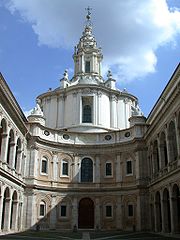
completely reorganized the studium with the bull In supremae, in which he granted masters and students alike the broadest possible privileges and decreed that the university should include the four faculties of Law, Medicine, Philosophy and Theology. He introduced a new tax on wine in order to raise funds for the university; the money was used to buy a palace which later housed the Sant'Ivo alla Sapienza
church.
However the University's days of splendour came to an end during the sack of Rome
in 1527 when the studium was closed and the professors dispersed; some were killed. Pope Paul III
restored the university shortly after his ascension to the pontificate in 1534.
In the 1650s the university became known as Sapienza, meaning wisdom, a title it retains. In 1703 Pope Clement XI
purchased some land with his private funds on the Janiculum
, where he made a botanical garden, which soon became the most celebrated in Europe through the labours of the Trionfetti brothers.
University students were newly animated during the 19th-century Italian revival. In 1870, La Sapienza stopped being the papal university and became the university of the capital of Italy. In 1935 the new university campus, planned by Marcello Piacentini
, was completed. On 27 October 1935 the university became an aggregate of all the institutions of higher learning of university rank in the city of Rome. Since 1935 Sapienza University has been under the control of the Italian Government.
As of the 2007-2008 academic year the Sapienza University of Rome possesses twenty-one faculties and 140,250 students. The Alessandrina University Library (Biblioteca Universitaria Alessandrina), built in 1667 by Pope Alexander VII
, is the main library housing 1.5 million volumes; it has some important collections including collezione ciceroniana, Fondo Festa, etc. Sapienza University has many campuses in Rome but its main campus is the Città Universitaria, which covers 439,000 square metres near Termini Station. The university has four satellite campuses outside Rome, in Civitavecchia
, Latina
, Pomezia
and Rieti
.
, natural sciences, biomedical sciences and humanities
through the "Sapienza Innovation" programme. Recent cooperation with major British and American universities has resulted in scholarships for Sapienza students through large multicultural exchange programmes, for many faculties.
Many other faculties don't make use of any entrance test and others use it only as an aptitudinal test.

Rome
Rome is the capital of Italy and the country's largest and most populated city and comune, with over 2.7 million residents in . The city is located in the central-western portion of the Italian Peninsula, on the Tiber River within the Lazio region of Italy.Rome's history spans two and a half...
, Italy
Italy
Italy , officially the Italian Republic languages]] under the European Charter for Regional or Minority Languages. In each of these, Italy's official name is as follows:;;;;;;;;), is a unitary parliamentary republic in South-Central Europe. To the north it borders France, Switzerland, Austria and...
. It is the largest Europe
Europe
Europe is, by convention, one of the world's seven continents. Comprising the westernmost peninsula of Eurasia, Europe is generally 'divided' from Asia to its east by the watershed divides of the Ural and Caucasus Mountains, the Ural River, the Caspian and Black Seas, and the waterways connecting...
an university and the oldest of Rome's three state-funded universities; Sapienza was founded in 1303, more than six centuries before Tor Vergata
University of Rome Tor Vergata
The University of Rome Tor Vergata is a public university located in Rome, Italy. It is one of the largest research-based institutions in the country. The University is an international center for research and education and it is well known for scientific studies...
and Roma Tre
Third University of Rome
The University of Rome III also known as Roma Tre University is a public research university in the city of Rome, in the Lazio region of central Italy...
. In Italian
Italian language
Italian is a Romance language spoken mainly in Europe: Italy, Switzerland, San Marino, Vatican City, by minorities in Malta, Monaco, Croatia, Slovenia, France, Libya, Eritrea, and Somalia, and by immigrant communities in the Americas and Australia...
, sapienza means "wisdom" or "knowledge". According to the Academic Ranking of World Universities
Academic Ranking of World Universities
The Academic Ranking of World Universities , commonly known as the Shanghai ranking, is a publication that was founded and compiled by the Shanghai Jiaotong University to rank universities globally. The rankings have been conducted since 2003 and updated annually...
published by the Institute of Higher Education of Shanghai Jiao Tong University, Sapienza University of Rome ranks among the top 30 European universities. In 2010 QS World University Rankings
QS World University Rankings
The QS World University Rankings is a ranking of the world’s top 500 universities by Quacquarelli Symonds using a method that has published annually since 2004....
ranked the university 190th overall in the world.
History
Papal bull
A Papal bull is a particular type of letters patent or charter issued by a Pope of the Catholic Church. It is named after the bulla that was appended to the end in order to authenticate it....
In supremae praeminentia dignitatis issued on 20 April 1303 by Pope Boniface VIII
Pope Boniface VIII
Pope Boniface VIII , born Benedetto Gaetani, was Pope of the Catholic Church from 1294 to 1303. Today, Boniface VIII is probably best remembered for his feuds with Dante, who placed him in the Eighth circle of Hell in his Divina Commedia, among the Simonists.- Biography :Gaetani was born in 1235 in...
, as a Studium for ecclesiastical studies more under his control than the universities of Bologna
University of Bologna
The Alma Mater Studiorum - University of Bologna is the oldest continually operating university in the world, the word 'universitas' being first used by this institution at its foundation. The true date of its founding is uncertain, but believed by most accounts to have been 1088...
and Padua
University of Padua
The University of Padua is a premier Italian university located in the city of Padua, Italy. The University of Padua was founded in 1222 as a school of law and was one of the most prominent universities in early modern Europe. It is among the earliest universities of the world and the second...
.
In 1431 Pope Eugene IV
Pope Eugene IV
Pope Eugene IV , born Gabriele Condulmer, was pope from March 3, 1431, to his death.-Biography:He was born in Venice to a rich merchant family, a Correr on his mother's side. Condulmer entered the Order of Saint Augustine at the monastery of St. George in his native city...
completely reorganized the studium with the bull In supremae, in which he granted masters and students alike the broadest possible privileges and decreed that the university should include the four faculties of Law, Medicine, Philosophy and Theology. He introduced a new tax on wine in order to raise funds for the university; the money was used to buy a palace which later housed the Sant'Ivo alla Sapienza
Sant'Ivo alla Sapienza
The Church of Saint Yves at La Sapienza is a Roman Catholic church in Rome. The church is considered a masterpiece of Roman Baroque church architecture, built in 1642-1660 by the architect Francesco Borromini.- History :...
church.
However the University's days of splendour came to an end during the sack of Rome
Sack of Rome (1527)
The Sack of Rome on 6 May 1527 was a military event carried out by the mutinous troops of Charles V, Holy Roman Emperor in Rome, then part of the Papal States...
in 1527 when the studium was closed and the professors dispersed; some were killed. Pope Paul III
Pope Paul III
Pope Paul III , born Alessandro Farnese, was Pope of the Roman Catholic Church from 1534 to his death in 1549. He came to the papal throne in an era following the sack of Rome in 1527 and rife with uncertainties in the Catholic Church following the Protestant Reformation...
restored the university shortly after his ascension to the pontificate in 1534.
In the 1650s the university became known as Sapienza, meaning wisdom, a title it retains. In 1703 Pope Clement XI
Pope Clement XI
Pope Clement XI , born Giovanni Francesco Albani, was Pope from 1700 until his death in 1721.-Early life:...
purchased some land with his private funds on the Janiculum
Janiculum
The Janiculum is a hill in western Rome, Italy. Although the second-tallest hill in the contemporary city of Rome, the Janiculum does not figure among the proverbial Seven Hills of Rome, being west of the Tiber and outside the boundaries of the ancient city.-Sights:The Janiculum is one of the...
, where he made a botanical garden, which soon became the most celebrated in Europe through the labours of the Trionfetti brothers.
University students were newly animated during the 19th-century Italian revival. In 1870, La Sapienza stopped being the papal university and became the university of the capital of Italy. In 1935 the new university campus, planned by Marcello Piacentini
Marcello Piacentini
Marcello Piacentini was an Italian architect and urban theorist.-Biography:Born in Rome, he was the son of architect Pio Piacentini...
, was completed. On 27 October 1935 the university became an aggregate of all the institutions of higher learning of university rank in the city of Rome. Since 1935 Sapienza University has been under the control of the Italian Government.
As of the 2007-2008 academic year the Sapienza University of Rome possesses twenty-one faculties and 140,250 students. The Alessandrina University Library (Biblioteca Universitaria Alessandrina), built in 1667 by Pope Alexander VII
Pope Alexander VII
Pope Alexander VII , born Fabio Chigi, was Pope from 7 April 1655, until his death.- Early life :Born in Siena, a member of the illustrious banking family of Chigi and a great-nephew of Pope Paul V , he was privately tutored and eventually received doctorates of philosophy, law, and theology from...
, is the main library housing 1.5 million volumes; it has some important collections including collezione ciceroniana, Fondo Festa, etc. Sapienza University has many campuses in Rome but its main campus is the Città Universitaria, which covers 439,000 square metres near Termini Station. The university has four satellite campuses outside Rome, in Civitavecchia
Civitavecchia
Civitavecchia is a town and comune of the province of Rome in the central Italian region of Lazio. A sea port on the Tyrrhenian Sea, it is located 80 kilometers west-north-west of Rome, across the Mignone river. The harbor is formed by two piers and a breakwater, on which is a lighthouse...
, Latina
Latina
Latina is the feminine form of the term Latino.Latina may also refer to:*Province of Latina, a province in Latium , Italy**Latina, Lazio, the capital of the province of Latina**Latina Nuclear Power Plant*Latina , a district of Madrid...
, Pomezia
Pomezia
Pomezia is a municipality in the province of Rome, Lazio, central Italy. In 2009 it had a population of about 60,000.-History:The town was built entirely new near the location of ancient Lavinium on land resulting from the final reclamation of the Pontine Marshes under Benito Mussolini, being...
and Rieti
Rieti
Rieti is a city and comune in Lazio, central Italy, with a population of c. 47,700. It is the capital of province of Rieti.The town centre rests on a small hilltop, commanding a wide plain at the southern edge of an ancient lake. The area is now the fertile basin of the Velino River...
.
Sapienza Today
Today Sapienza is by far the largest university in Rome, a leading centre of research and academic excellence in all fields of knowledge. In order to cope with the ever-increasing number of applicants, the Rector has approved a new plan to expand the Città Universitaria, reallocate offices and enlarge faculties, as well as create new campuses for hosting local and foreign students, in collaboration with the city of Rome. The university has improved its research programmes in the fields of engineeringEngineering
Engineering is the discipline, art, skill and profession of acquiring and applying scientific, mathematical, economic, social, and practical knowledge, in order to design and build structures, machines, devices, systems, materials and processes that safely realize improvements to the lives of...
, natural sciences, biomedical sciences and humanities
Humanities
The humanities are academic disciplines that study the human condition, using methods that are primarily analytical, critical, or speculative, as distinguished from the mainly empirical approaches of the natural sciences....
through the "Sapienza Innovation" programme. Recent cooperation with major British and American universities has resulted in scholarships for Sapienza students through large multicultural exchange programmes, for many faculties.
Admission
In order to cope with the large demand for admission to the university courses, some faculties hold a series of entrance examinations. The "SiOrienta" http://siorienta.cabi.uniroma1.it/ programme guides students of natural and mathematical sciences as well as the ones belonging the engineering department through the entire admission procedure. The entrance test often decides which candidates will have access to the undergraduate course. For other faculties, the entrance test is only a means through which the administration acknowledges the students' level of preparation. Weak students that haven't passed the test will be enrolled in a number of extra-curriculum preparation courses.Many other faculties don't make use of any entrance test and others use it only as an aptitudinal test.
Faculties
The university is divided into 11 faculties:- Faculty of Architecture
- Faculty of Economics
- Faculty of Civil and Industrial Engineering
- Faculty of Information Engineering
- Faculty of Law
- Faculty of Mathematical, Physical and Natural Studies
- Faculty of Medicine and Dentistry
- Faculty of Medicine and Psychology
- Faculty of Pharmacy and Medicine
- Faculty of Philosophy, Arts and Humanities and Oriental Studies
- Faculty of Political Science, Sociology and Communication Science
Research centers & major research groups
There are 5 Atenei federati, 2 Scuole, and over 30 Centri di Ricerca e studio:- Ateneo Federato della Scienza e della Tecnologia (AST)
- Ateneo Federato delle Scienze delle Politiche Pubbliche e Sanitarie (SPPS)
- Ateneo Federato delle Scienze Umane, delle Arti e dell'Ambiente
- Ateneo Federato delle Scienze Umanistiche, Giuridiche e Economiche
- Ateneo Federato dello Spazio e della Società
- Scuola di Ingegneria Aerospaziale, near San Pietro in VincoliSan Pietro in VincoliSan Pietro in Vincoli is a Roman Catholic titular church and minor basilica in Rome, Italy, best known for being the home of Michelangelo's statue of Moses, part of the tomb of Pope Julius II.-History:...
- Scuola Speciale per Archivisti Bibliotecari, in Viale Regina Elena
- Center for Research in Neurobiology "Daniel BovetDaniel BovetDaniel Bovet was a Swiss-born Italian pharmacologist who won the 1957 Nobel Prize in Physiology or Medicine for his discovery of drugs that block the actions of specific neurotransmitters. He is best known for his discovery in 1937 of antihistamines, which block the neurotransmitter histamine and...
" - Centro de La Sapienza per la ricerca sulla formazione e sull'innovazione didattica (CARFID)
- Centro di Ricerca de La Sapienza Scuola del mare
- Centro di Ricerca per la tutela della persona del minore
- Centro di Ricerca de La Sapienza di Economia Internazionale (CIDEI)
- Centro di Ricerca de La Sapienza in Studi europei ed internazionali (EuroSapienza)
- Centro di Ricerca de La Sapienza per le Malattie sociali (CIMS)
- Centro di Ricerca de La Sapienza sul Diritto e l'economia dei mercati (CIDEM)
- Centro di Ricerca de La Sapienza Archivio del Novecento
- Centro di Ricerca de La Sapienza per lo Studio delle Funzioni Mentali (CSFM)
- Centro di Ricerca in Metodologia delle Scienze (CERMS)
- Centro di Ricerca in Psicologia Clinica
- Centro di Ricerca Interdisciplinare Territorio Edilizia Restauro Ambiente (CITERA)
- Centro di Ricerca Museo Laboratorio di Arte Contemporanea (MLAC)
- Centro di Ricerca per il Trasporto e la Logistica (CTL)
- Centro di Ricerca per la Sperimentazione Clinica (CRISC)
- Centro di Ricerca per le Nanotecnologie
- Centro di Ricerca 'Prevenzione, previsione e controllo dei rischi geologici' (CERI)
- Centro di Ricerca Studi per lo Sviluppo (SPES)
- Centro di Ricerca su Roma (CISR)
- Centro Interdipartimentale di scienza e tecnica (CIST)
- Centro Interdisciplinare di Ricerca sulle Disabilità (CIRID)
- Centro Interdisciplinare per il Turismo, il Territorio e l'Ambiente (CITTA)
- Centro Interuniversitario Internazionale di Studi sulle Culture Alimentari Mediterranee (CIISCAM)
- Centro per le applicazioni della televisione e delle tecniche di istruzione a distanza (CATTID)
- Centro Teatro Ateneo (CTA) Centre for Research on the Performing Arts
- Interdepartmental Research Center for Models and Information Anaysis in Biomedical Systems (CISB)
- Centro Ricerche Aerospaziali, responsible for the Italian rocket program - Based on San Marco platform at the Broglio Space Centre
- SPES Development Studies – Research centre on Development studies at La Sapienza
Law & Social Science
- Carlo CostamagnaCarlo CostamagnaCarlo Costamagna was an Italian lawyer and academic noted as a theorist of corporatism. He worked closely with Benito Mussolini and his fascist movement.-Path to fascism:...
- Roberto Forges DavanzatiRoberto Forges DavanzatiRoberto Forges Davanzati was an Italian journalist, academic and politician. Initially a syndicalist he later became a nationalist and fascist....
, political science - Cardinal Mazarin
- Mario Oriani-AmbrosiniMario Oriani-AmbrosiniMario Gaspare R. Oriani-Ambrosini is an Italian-American constitutional lawyer and politician, currently a Member of Parliament in South Africa with the Inkatha Freedom Party.-Biography:...
- Antonio SalandraAntonio SalandraAntonio Salandra was a conservative Italian politician who served as the 33rd Prime Minister of Italy between 1914 and 1916...
Sciences
- Lucio BiniLucio BiniLucio Bini was an Italian psychiatrist and professor at the University of Rome La Sapienza, Italy. Together with Ugo Cerletti, a neurophysiologist, he researched and discovered the method of electroconvulsive therapy, a kind of shock therapy for mental diseases.-References:*Kalinowsky, LB: Lucio...
and Ugo CerlettiUgo CerlettiUgo Cerletti was an Italian neurologist who discovered the method of electroconvulsive therapy in psychiatry. Electroconvulsive therapy is a procedure in which electric currents are passed through the brain, deliberately triggering a brief seizure...
, psychiatrists - Corrado BöhmCorrado BöhmCorrado Böhm , Professor Emeritus at the University of Rome "La Sapienza", is a computer scientist known especially for his contributions to the theory of structured programming, constructive mathematics, combinatory logic, lambda-calculus, and the semantics and implementation of functional...
, computer scientist - Daniel BovetDaniel BovetDaniel Bovet was a Swiss-born Italian pharmacologist who won the 1957 Nobel Prize in Physiology or Medicine for his discovery of drugs that block the actions of specific neurotransmitters. He is best known for his discovery in 1937 of antihistamines, which block the neurotransmitter histamine and...
, pharmacologist, Nobel prize winner (1957) - Benedetto CastelliBenedetto CastelliBenedetto Castelli , born Antonio Castelli, was an Italian mathematician. He took the name "Benedetto" upon entering the Benedictine Order in 1595....
, mathematician - Andrea CesalpinoAndrea CesalpinoAndrea Cesalpino was an Italian physician, philosopher and botanist....
, physician and botanist - Federigo EnriquesFederigo EnriquesFederigo Enriques was an Italian mathematician, now known principally as the first to give a classification of algebraic surfaces in birational geometry, and other contributions in algebraic geometry....
, mathematician - Clelia GiacobiniClelia GiacobiniClelia Giacobini was an Italian microbiologist, and also a pioneer of microbiology applied to conservation-restoration.- Biography :...
, microbiologist - Maria MontessoriMaria MontessoriMaria Montessori was an Italian physician and educator, a noted humanitarian and devout Catholic best known for the philosophy of education which bears her name...
, physician and paedagogist - Paola S. TimirasPaola S. TimirasPaola S. Timiras, born Paola Silvestri, was an endocrinologist studying stress.- Background and education :...
, biologist - Barnaba TortoliniBarnaba TortoliniBarnaba Tortolini was a 19th-century Italian priest and mathematician who played an early active role in advancing the scientific unification of the Italian states. He founded the first Italian scientific journal with an international presence and was a distinguished professor of mathematics at...
, mathematician - Vito VolterraVito VolterraVito Volterra was an Italian mathematician and physicist, known for his contributions to mathematical biology and integral equations....
, mathematician
Physics
- Via Panisperna boysVia Panisperna boysThe Via Panisperna boys were a group of young scientists led by Enrico Fermi. In Rome in 1934, they made the famous discovery of slow neutrons which made later possible the nuclear reactor, and then the construction of the first atomic bomb.The nickname of the group comes from the address of the...
:- Enrico FermiEnrico FermiEnrico Fermi was an Italian-born, naturalized American physicist particularly known for his work on the development of the first nuclear reactor, Chicago Pile-1, and for his contributions to the development of quantum theory, nuclear and particle physics, and statistical mechanics...
, Nobel prize winner (1938) - Edoardo AmaldiEdoardo AmaldiEdoardo Amaldi was an Italian physicist.He was born in Carpaneto Piacentino, son of Ugo Amaldi, professor of mathematics at the University of Padua, and Luisa Basini....
- Oscar D'AgostinoOscar D'AgostinoOscar D'Agostino was an Italian chemist and one of the so-called Via Panisperna boys, the group of young scientists led by Enrico Fermi: all of them were physicists, except for D'Agostino, who was a chemist....
- Ettore MajoranaEttore MajoranaEttore Majorana was an Italian theoretical physicist who began work on neutrino masses. He disappeared suddenly in mysterious circumstances. He is noted for the eponymous Majorana equation and for Majorana fermions.-Gifted in mathematics:Majorana was born in Catania, Sicily...
- Bruno PontecorvoBruno PontecorvoBruno Pontecorvo was an Italian-born nuclear physicist, an early assistant of Enrico Fermi and then the author of numerous studies in high energy physics, especially on neutrinos. According to Oleg Gordievsky and Pavel Sudoplatov , Pontecorvo was also a Soviet agent...
- Franco RasettiFranco RasettiFranco Dino Rasetti was an Italian scientist. Together with Enrico Fermi, discovered key processes leading to nuclear fission. Rasetti refused to work on the Manhattan Project, however, on moral grounds...
- Emilio G. SegrèEmilio G. SegrèEmilio Gino Segrè was an Italian-born, naturalized American, physicist and Nobel laureate in physics, who with Owen Chamberlain, discovered antiprotons, a sub-atomic antiparticle.-Biography:...
, Nobel prize winner (1959)
- Enrico Fermi
- Giovanni Battista BeccariaGiovanni Battista BeccariaGiovanni Battista Beccaria , Italian physicist, was born at Mondovì, and entered the religious order of the Pious Schools in 1732, where he studied, and afterward taught, grammar and rhetoric...
- Marcello Conversi
- Giovanni CiccottiGiovanni CiccottiGiovanni Ciccotti is an Italian physicist.Ciccotti holds the position of Professor of the Structure of Matter at the University of Rome La Sapienza. He's the author of more than a hundred articles on molecular dynamics and statistical mechanics. He worked with J.P. Ryckaert on new methods for...
- Giovanni Jona-LasinioGiovanni Jona-LasinioGiovanni Jona-Lasinio , sometimes called Gianni Jona, is an influential Italian theoretical physicist, best known for his works on quantum field theory and statistical mechanics. He pioneered research concerning spontaneous symmetry breaking, and the Nambu–Jona-Lasinio model is named after him...
- Francesco Guerra
- Luciano MaianiLuciano MaianiLuciano Maiani is a San Marino citizen physicist best known for his prediction of the charm quark with Sheldon Lee Glashow and John Iliopoulos .-Academic history:...
- Domenico PaciniDomenico PaciniDomenico Pacini was an Italian physicist noted for his contributions to the discovery of cosmic rays.-Biography:...
- Giorgio ParisiGiorgio ParisiGiorgio Parisi is an Italian theoretical physicist. He is best known for his works concerning statistical mechanics, quantum field theory and various aspects of physics, mathematics and science in general....
- Antonio SignoriniAntonio Signorini- Research activity :His scientific production const of more than 114 works, being papers, monographs and textbooks, 17 of which have been collected in his "Opere Scelte".- Teaching activity :...
- Nicola CabibboNicola CabibboNicola Cabibbo was an Italian physicist, best known for his work on the weak interaction. He was also the president of the Italian National Institute of Nuclear Physics from 1983 to 1992, and from 1993 until his death he was the president of the Pontifical Academy of Sciences...
, President of the Pontifical Academy of Sciences
Humanities
- Giuseppe ScaraffiaGiuseppe Scaraffia-Biography:Giuseppe Scaraffia was born in Turin, Italy, in 1950. He graduated in Philosophy at the University of Milan with a thesis on the idea of happiness in Diderot. He has taught French Literature at the Sapienza University of Rome since 1976...
, literary critic - Daria GalateriaDaria Galateria-Biography:Daria Galateria was born in Rome, Italy, in 1950. She graduated in Literature at the Sapienza University of Rome with a thesis on monologue in Stéphane Mallarmé and Paul Valéry....
, writer and translator - Luigi FerriLuigi FerriLuigi Ferri , Italian philosopher, was born at Bologna.His education was obtained mainly at the École Normale Supérieure in Paris, where his father, a painter and architect, was engaged in the construction of the Théâtre Italien. From his twenty-fifth year he began to lecture in the colleges of...
, philosopher - Giovanni Vincenzo GravinaGiovanni Vincenzo GravinaGiovanni Vincenzo Gravina was an Italian man of letters and jurist. He was born at Roggiano Gravina, a small town near Cosenza, in Calabria....
, jurisconsult - Silvia BertiSilvia BertiSilvia Berti is a history professor at the University of Rome La Sapienza. Her field of interest is European anti-Christian attitudes, Spinoza and Spinozism, the Huguenots, Jansenists and other opposition groups within French history.-Publications:...
, historian - Lazarus BuonamiciLazarus BuonamiciLazarus Buonamici was an Italian Renaissance humanist.Buonamici was born in Bassano, and studied at the University of Padua. He tutored for the Campeggi family for a time, and later was professor of Belles Lettres at the Sapienza University of Rome. He fled Rome during the sack of 1527, escaping...
, renaissance humanist - Umberto CassutoUmberto CassutoUmberto Cassuto, also known as Moshe David Cassuto, , was a rabbi and Biblical scholar born in Florence, Italy. -Early life and career:...
, Hebrew language and Bible scholar - Carlo Innocenzio Maria FrugoniCarlo Innocenzio Maria FrugoniCarlo Innocenzo Frugoni was an Italian poet and librettist. As a poet Frugoni was one of the best of the school of the Arcadian Academy, and his lyrics and pastorals had great facility and elegance...
, poet - Count Angelo de Gubernatis, orientalist
- Predrag MatvejevicPredrag MatvejevicPredrag Matvejević is a Croatian writer known for his writing as well as for his political activism. His book Mediterranean Breviary: A Cultural Landscape has been a bestseller in many European countries, and has been translated into more than 20 languages.-Biography:Predrag Matvejević was born in...
, writer and academic - Santo MazzarinoSanto MazzarinoSanto Mazzarino was an Italian historian, considered a leading 20th-century historian of ancient Rome. He was a member of the Accademia dei Lincei....
, leading historian of ancient Rome and ancient Greece - Giuseppe TucciGiuseppe TucciGiuseppe Tucci was an Italian scholar of oriental cultures, specialising in Tibet and history of Buddhism. During its zenith, Tucci was a supporter of Italian Fascism, and he used idealized portrayals of Asian traditions to support Italian ideological campaigns...
, orientalist - Mario LiveraniMario LiveraniMario Liverani was born in Rome in 1939. He is Professor of Ancient Near East History at the University of Rome La Sapienza. He is a member of many institutions, such as the American Oriental Society, Accademia delle Scienze di Torino, and doctor Honoris Causa of the University of Copenhagen and...
, orientalist - Paolo MatthiaePaolo MatthiaePaolo Matthiae is an Italian archaeologist.He was Professor of Archaeology and History of Art of the Ancient Near East in the University of Rome La Sapienza; he has been Director of the Ebla Expedition since 1963—in fact, its discoverer—and has published many articles and books about...
, director of the archeological expedition of EblaEblaEbla Idlib Governorate, Syria) was an ancient city about southwest of Aleppo. It was an important city-state in two periods, first in the late third millennium BC, then again between 1800 and 1650 BC.... - Marcel DanesiMarcel DanesiMarcel Danesi is a current Professor of Semiotics and Linguistic Anthropology at the University of Toronto. He is known for his work in language, communications, and semiotics; being Director of the Program in semiotics and communication theory...
, language scientist - Antonio NibbyAntonio NibbyAntonio Nibby was an Italian archaeologist.Nibby was a critic of the history of ancient art and from 1812 in service to the Vatican worked to excavate the monuments of Rome. He also served as a secretary to Louis Napoleon, Comte de Saint-Leu.He was a professor of archaeology in the University of...
, archaeologist - Giuliano AmatoGiuliano AmatoGiuliano Amato is an Italian politician. He was Prime Minister of Italy twice, first from 1992 to 1993 and then from 2000 to 2001. He was more recently Vice President of the Convention on the Future of Europe that drafted the new European Constitution and headed the Amato Group. He is commonly...
, law professor and twice Prime Minister of ItalyPrime minister of ItalyThe Prime Minister of Italy is the head of government of the Italian Republic... - Diego LaynezDiego LaynezSeveral spellings of his names are in use and some of them can be found in other Wikipedia articlesJames Laynez was a Spanish Jesuit priest and theologian, and the 2nd Superior General of the Society of Jesus.He was born in Almazán in Castile...
, second general of the Society of JesusSociety of JesusThe Society of Jesus is a Catholic male religious order that follows the teachings of the Catholic Church. The members are called Jesuits, and are also known colloquially as "God's Army" and as "The Company," these being references to founder Ignatius of Loyola's military background and a...
; - Giulio Mazzarino, politician and cardinal
- Pierluigi Petrobelli, musicologist
- Ugo SpiritoUgo SpiritoUgo Spirito was an Italian fascist political philosopher and academic.-Early life:Spirito was initially an advocate of positivism although in 1918, whilst attending Sapienza University of Rome, he abandoned his position to become a follower of the Actual Idealism of Giovanni Gentile...
, philosopher - Giuseppe UngarettiGiuseppe UngarettiGiuseppe Ungaretti was an Italian modernist poet, journalist, essayist, critic and academic. A leading representative of the experimental trend known as Ermetismo , he was one of the most prominent contributors to 20th century Italian literature. Influenced by symbolism, he was briefly aligned...
, poet - Bernardino VariscoBernardino VariscoBernardino Varisco , was an Italian philosopher and a Professor of Theoretical Philosophy at the University of Rome La Sapienza from 1905 to 1925.-Life:...
, philosopher - Musine KokalariMusine KokalariMusine Kokalari of Gjirokastër, Albania was an Albanian prose writer and politician in Albania's pre-communist period. Kokalari was the first female writer of Albania. After a short involvement in politics during World War II, she was persecuted by the communist regime in Albania, and not allowed...
, AlbanianAlbaniansAlbanians are a nation and ethnic group native to Albania and neighbouring countries. They speak the Albanian language. More than half of all Albanians live in Albania and Kosovo...
writer - Giulio SalvadoriGiulio SalvadoriGiulio Salvadori was an Italian poet, literary critic, and educator.-Life:Salvadori was educated at the Sapienza University of Rome, where he became a friend of Gabriele d'Annunzio...
, literary critic and poet
Alumni
- Severino AntinoriSeverino AntinoriSeverino Antinori is an Italian gynecologist and embryologist. He has publicly taken controversial positions over in vitro fertilisation and human cloning....
, embryologist - Sergio BalanzinoSergio BalanzinoSergio Silvio Balanzino is an Italian diplomat.He studied as a Brittingham Foreign Scholar at the University of Wisconsin in Madison 1956-57. After graduating in Law from the University of Rome La Sapienza he joined the Italian foreign service in 1958.He served as the Italian ambassador to Canada...
, ambassador - Pietro BelluschiPietro BelluschiPietro Belluschi was an American architect, a leader of the Modern Movement in architecture, and was responsible for the design of over one thousand buildings....
, architect - Bernardo BertolucciBernardo BertolucciBernardo Bertolucci is an Italian film director and screenwriter, whose films include The Conformist, Last Tango in Paris, 1900, The Last Emperor and The Dreamers...
, film director - Maurizio CheliMaurizio CheliMaurizio Cheli is an Italian engineer, air force officer, a European Space Agency astronaut and a veteran of one NASA space shuttle mission....
, astronaut - Domenico ComparettiDomenico ComparettiDomenico Comparetti , Italian scholar, was born at Rome.-Life:He studied at the University of Rome La Sapienza, took his degree in 1855 in natural science and mathematics, and entered his uncle's pharmacy as assistant. His scanty leisure was, however, given to study...
, classic literature scholar - Gabriele D'AnnunzioGabriele D'AnnunzioGabriele D'Annunzio or d'Annunzio was an Italian poet, journalist, novelist, and dramatist...
, poet - Mario DraghiMario DraghiMario Draghi is an Italian banker and economist who succeeded Jean-Claude Trichet as President of the European Central Bank on 1 November 2011...
, governor of the Bank of Italy - Cristina Ali FarahCristina Ali FarahCristina Ali Farah is an Italian writer of Somali and Italian origin.- Biography :Born in Italy to a Somali father and an Italian mother, Farah grew up in Mogadishu, the capital of Somalia...
, writer - Carlo FeaCarlo FeaCarlo Fea was an Italian archaeologist.Born at Pigna, in what is now Liguria, Fea studied law in Rome, receiving the degree of doctor of laws from the university of La Sapienza, but archaeology gradually attracted his attention, and with the view of obtaining better opportunities for his research...
, archaeologist - Massimiliano FuksasMassimiliano FuksasMassimiliano Fuksas is an Italian architect, born in Rome in 1944 to an Jewish Lithuanian father and Italian Catholic mother. He received his degree in architecture from the La Sapienza University in 1969 in Rome, where he opened his first office. Subsequent offices were opened in Paris and Vienna...
, architect - Romaldo GiurgolaRomaldo GiurgolaRomaldo Giurgola AO is an Italian-American-Australian academic architect, professor, and author. Giurgola was born in Galatina, in the south of Italy in 1920. After service in the Italian armed forces during World War II, he was educated at the Sapienza University of Rome...
, architect - Umberto GuidoniUmberto GuidoniUmberto Guidoni is an Italian politician and a former ESA astronaut. He is a veteran of two NASA space shuttle missions...
, astronaut - Antonio MondaAntonio MondaAntonio Monda is an Italian writer, film director, journalist, and professor at New York University's Tisch School of the Arts. He is a well-connected figure in and promoter of the arts, particularly film and literature....
, film director - Maria MontessoriMaria MontessoriMaria Montessori was an Italian physician and educator, a noted humanitarian and devout Catholic best known for the philosophy of education which bears her name...
, educator - Luca di MontezemoloLuca di MontezemoloLuca Cordero di Montezemolo is an Italian businessman and Chairman of Ferrari. He was also Chairman of Fiat S.p.A from 2004 to 2010 and President of Confindustria from 2004 to 2008 and FIEG. He comes from an aristocratic family from the region of Piedmont in Italy...
, CEO - Scott O'DellScott O'DellScott O'Dell was an American children's author who wrote 26 novels for young people, along with three novels for adults and four nonfiction books...
, novelist - Gian Vittorio RossiGian Vittorio RossiGian Vittorio Rossi, also known as Giano Nicio Eritreo, was an Italian poet, philologist, and historian.- Biography :Rossi was born in Rome to a well-to-do family and lived his entire life in the city of his birth. He was educated by the Jesuits at the Collegio Romano distinguishing himself by...
, poet and philologist - Crescenzio Sepe, cardinal
- Abdirashid Ali ShermarkeAbdirashid Ali ShermarkeAbdirashid Ali Shermarke was Prime Minister of Somalia from July 12, 1960 to June 14, 1964, and President of Somalia from June 10, 1967 until his assassination on October 15, 1969...
, president and prime minister of SomaliaSomaliaSomalia , officially the Somali Republic and formerly known as the Somali Democratic Republic under Socialist rule, is a country located in the Horn of Africa. Since the outbreak of the Somali Civil War in 1991 there has been no central government control over most of the country's territory...
Points of interest
- Orto Botanico dell'Università di Roma "La Sapienza", a botanical gardenBotanical gardenA botanical garden The terms botanic and botanical, and garden or gardens are used more-or-less interchangeably, although the word botanic is generally reserved for the earlier, more traditional gardens. is a well-tended area displaying a wide range of plants labelled with their botanical names...
- Sant'Ivo alla SapienzaSant'Ivo alla SapienzaThe Church of Saint Yves at La Sapienza is a Roman Catholic church in Rome. The church is considered a masterpiece of Roman Baroque church architecture, built in 1642-1660 by the architect Francesco Borromini.- History :...
- San Pietro in VincoliSan Pietro in VincoliSan Pietro in Vincoli is a Roman Catholic titular church and minor basilica in Rome, Italy, best known for being the home of Michelangelo's statue of Moses, part of the tomb of Pope Julius II.-History:...
: the cloister is part of the Faculty of Engineering
See also
- List of Italian universities
- Universities of RomeUniversities of RomeThe University of Rome was a university located in Rome, Italy and one of the earliest to be established in Europe.The University of Rome has been reorganised into three autonomous universities in the 1980's due to the increasing number of students enrolling at Sapienza University of Rome, the...
- University of Rome Tor VergataUniversity of Rome Tor VergataThe University of Rome Tor Vergata is a public university located in Rome, Italy. It is one of the largest research-based institutions in the country. The University is an international center for research and education and it is well known for scientific studies...
- University of Roma Tre
- List of medieval universities
- ESDP-Network