

Pietro Belluschi

Encyclopedia
Pietro Belluschi was an American architect, a leader of the Modern Movement in architecture
, and was responsible for the design of over one thousand buildings.
Born in Italy, Belluschi's architectural career began as a draftsman in a Portland, Oregon
firm. He achieved a national reputation within about twenty years, largely for his 1947 aluminum-clad Equitable Building. In 1951 he was named the dean of the MIT School of Architecture and Planning
, where he served until 1965, also working as collaborator and design consultant for many high-profile commissions, most famously the 1963 Pan Am Building
. He won the 1972 AIA Gold Medal
.
when Italy was allied with Great Britain
, France
, and later the United States. Serving in the army he fought against the Austrians at the battles of Caporetto
and Vittorio Veneto
. After the war, Belluschi studied at the University of Rome
, earning a degree in civil engineering
in 1922.
He moved to the United States in 1923, despite speaking no English, and finished his education—as an exchange student on a scholarship—at Cornell University
with a second degree in civil engineering. Instead of returning to Italy, he worked briefly as a mining engineer in Idaho
earning $5 per day, but he then joined the architectural office of A. E. Doyle
in Portland. He remained in the U.S., as friends in Italy had cautioned him to not return home because of the rise to power of Benito Mussolini
and the Fascist
government.
 At Doyle's office, Belluschi rose rapidly, soon becoming chief designer. After Doyle died in 1928, the firm took him into partnership in 1933. By 1943, Belluschi had assumed control of the firm by buying out all the other partners and was practicing under his own name.
In 1951, Belluschi became Dean of the architecture and planning school at the Massachusetts Institute of Technology
, a position he held until 1965. When he accepted the position of dean and moved to Massachusetts, he transferred his office in Portland to the architecture firm Skidmore, Owings and Merrill
. The move reduced his annual income from $150,000 to a salary of $15,000, but was prompted by health concerns attributable to the long hours of managing his office while still designing buildings.
Belluschi emerged as a leader in the development of American Modern architecture
, with the design of several buildings reflecting the influence of the International Style
and his awareness of the technological opportunities of new materials. Most important was the Equitable Building (1944–47) in Portland, Oregon: a concrete frame office block clad in aluminum, and considered the first office building with a completely sealed air-conditioned
environment.
Belluschi's churches
and residences differed from his commercial works. Although of Modern design, they fit within the development of the Pacific Northwest
regional Modern idiom as they frequently used regional materials (particularly wood) and were often integrated with their suburban or rural sites.
in 1952. He was a Fellow in the American Institute of Architects
(AIA), and was awarded the AIA Gold Medal
, the highest award given by the institute, in 1972. He was awarded the National Medal of Arts
by the National Endowment for the Arts in 1991 for his lifetime achievements. Belluschi was on the jury that selected the winning design for the Vietnam Veterans Memorial
in Washington, D.C.
 After leaving MIT in 1965, he continued to work. Belluschi would design and consult on both buildings and issues surrounding urban planning
. Pietro married Marjorie, and they had two sons: Peter and Anthony. Pietro Belluschi died in Portland on February 14, 1994.
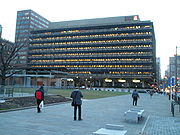 Belluschi's designs include:
Modern architecture
Modern architecture is generally characterized by simplification of form and creation of ornament from the structure and theme of the building. It is a term applied to an overarching movement, with its exact definition and scope varying widely...
, and was responsible for the design of over one thousand buildings.
Born in Italy, Belluschi's architectural career began as a draftsman in a Portland, Oregon
Portland, Oregon
Portland is a city located in the Pacific Northwest, near the confluence of the Willamette and Columbia rivers in the U.S. state of Oregon. As of the 2010 Census, it had a population of 583,776, making it the 29th most populous city in the United States...
firm. He achieved a national reputation within about twenty years, largely for his 1947 aluminum-clad Equitable Building. In 1951 he was named the dean of the MIT School of Architecture and Planning
MIT School of Architecture and Planning
The MIT School of Architecture and Planning is one of the five schools of the Massachusetts Institute of Technology, located in Cambridge, Massachusetts, USA...
, where he served until 1965, also working as collaborator and design consultant for many high-profile commissions, most famously the 1963 Pan Am Building
MetLife Building
The MetLife Building, originally called the Pan Am Building, is a skyscraper located at 200 Park Avenue in Midtown Manhattan, New York City.-History:...
. He won the 1972 AIA Gold Medal
AIA Gold Medal
The AIA Gold Medal is awarded by the American Institute of Architects conferred "by the national AIA Board of Directors in recognition of a significant body of work of lasting influence on the theory and practice of architecture."...
.
Early life
Pietro Belluschi was born in Ancona, Italy in 1899. He grew up in Italy and served in the Italian armed forces during World War IWorld War I
World War I , which was predominantly called the World War or the Great War from its occurrence until 1939, and the First World War or World War I thereafter, was a major war centred in Europe that began on 28 July 1914 and lasted until 11 November 1918...
when Italy was allied with Great Britain
Great Britain
Great Britain or Britain is an island situated to the northwest of Continental Europe. It is the ninth largest island in the world, and the largest European island, as well as the largest of the British Isles...
, France
France
The French Republic , The French Republic , The French Republic , (commonly known as France , is a unitary semi-presidential republic in Western Europe with several overseas territories and islands located on other continents and in the Indian, Pacific, and Atlantic oceans. Metropolitan France...
, and later the United States. Serving in the army he fought against the Austrians at the battles of Caporetto
Battle of Caporetto
The Battle of Caporetto , took place from 24 October to 19 November 1917, near the town of Kobarid , on the Austro-Italian front of World War I...
and Vittorio Veneto
Battle of Vittorio Veneto
The Battle of Vittorio Veneto was fought between 24 October and 3 November 1918, near Vittorio Veneto, during the Italian Campaign of World War I...
. After the war, Belluschi studied at the University of Rome
University of Rome La Sapienza
The Sapienza University of Rome, officially Sapienza – Università di Roma, formerly known as Università degli studi di Roma "La Sapienza", is a coeducational, autonomous state university in Rome, Italy...
, earning a degree in civil engineering
Civil engineering
Civil engineering is a professional engineering discipline that deals with the design, construction, and maintenance of the physical and naturally built environment, including works like roads, bridges, canals, dams, and buildings...
in 1922.
He moved to the United States in 1923, despite speaking no English, and finished his education—as an exchange student on a scholarship—at Cornell University
Cornell University
Cornell University is an Ivy League university located in Ithaca, New York, United States. It is a private land-grant university, receiving annual funding from the State of New York for certain educational missions...
with a second degree in civil engineering. Instead of returning to Italy, he worked briefly as a mining engineer in Idaho
Idaho
Idaho is a state in the Rocky Mountain area of the United States. The state's largest city and capital is Boise. Residents are called "Idahoans". Idaho was admitted to the Union on July 3, 1890, as the 43rd state....
earning $5 per day, but he then joined the architectural office of A. E. Doyle
A. E. Doyle
Albert Ernest Doyle was a prolific architect in the U.S. states of Oregon and Washington. He is most often credited for his works as A.E. Doyle....
in Portland. He remained in the U.S., as friends in Italy had cautioned him to not return home because of the rise to power of Benito Mussolini
Benito Mussolini
Benito Amilcare Andrea Mussolini was an Italian politician who led the National Fascist Party and is credited with being one of the key figures in the creation of Fascism....
and the Fascist
Italian Fascism
Italian Fascism also known as Fascism with a capital "F" refers to the original fascist ideology in Italy. This ideology is associated with the National Fascist Party which under Benito Mussolini ruled the Kingdom of Italy from 1922 until 1943, the Republican Fascist Party which ruled the Italian...
government.
Career
In 1951, Belluschi became Dean of the architecture and planning school at the Massachusetts Institute of Technology
Massachusetts Institute of Technology
The Massachusetts Institute of Technology is a private research university located in Cambridge, Massachusetts. MIT has five schools and one college, containing a total of 32 academic departments, with a strong emphasis on scientific and technological education and research.Founded in 1861 in...
, a position he held until 1965. When he accepted the position of dean and moved to Massachusetts, he transferred his office in Portland to the architecture firm Skidmore, Owings and Merrill
Skidmore, Owings and Merrill
Skidmore, Owings and Merrill LLP is an American architectural and engineering firm that was formed in Chicago in 1936 by Louis Skidmore and Nathaniel Owings; in 1939 they were joined by John O. Merrill. They opened their first branch in New York City, New York in 1937. SOM is one of the largest...
. The move reduced his annual income from $150,000 to a salary of $15,000, but was prompted by health concerns attributable to the long hours of managing his office while still designing buildings.
Belluschi emerged as a leader in the development of American Modern architecture
Modern architecture
Modern architecture is generally characterized by simplification of form and creation of ornament from the structure and theme of the building. It is a term applied to an overarching movement, with its exact definition and scope varying widely...
, with the design of several buildings reflecting the influence of the International Style
International style (architecture)
The International style is a major architectural style that emerged in the 1920s and 1930s, the formative decades of Modern architecture. The term originated from the name of a book by Henry-Russell Hitchcock and Philip Johnson, The International Style...
and his awareness of the technological opportunities of new materials. Most important was the Equitable Building (1944–47) in Portland, Oregon: a concrete frame office block clad in aluminum, and considered the first office building with a completely sealed air-conditioned
Air conditioning
An air conditioner is a home appliance, system, or mechanism designed to dehumidify and extract heat from an area. The cooling is done using a simple refrigeration cycle...
environment.
Belluschi's churches
Religious architecture
Sacred architecture is a religious architectural practice concerned with the design and construction of places of worship and/or sacred or intentional space, such as churches, mosques, stupas, synagogues, and temples...
and residences differed from his commercial works. Although of Modern design, they fit within the development of the Pacific Northwest
Pacific Northwest
The Pacific Northwest is a region in northwestern North America, bounded by the Pacific Ocean to the west and, loosely, by the Rocky Mountains on the east. Definitions of the region vary and there is no commonly agreed upon boundary, even among Pacific Northwesterners. A common concept of the...
regional Modern idiom as they frequently used regional materials (particularly wood) and were often integrated with their suburban or rural sites.
Awards and honors
Belluschi was elected a Fellow of the American Academy of Arts and SciencesAmerican Academy of Arts and Sciences
The American Academy of Arts and Sciences is an independent policy research center that conducts multidisciplinary studies of complex and emerging problems. The Academy’s elected members are leaders in the academic disciplines, the arts, business, and public affairs.James Bowdoin, John Adams, and...
in 1952. He was a Fellow in the American Institute of Architects
American Institute of Architects
The American Institute of Architects is a professional organization for architects in the United States. Headquartered in Washington, D.C., the AIA offers education, government advocacy, community redevelopment, and public outreach to support the architecture profession and improve its public image...
(AIA), and was awarded the AIA Gold Medal
AIA Gold Medal
The AIA Gold Medal is awarded by the American Institute of Architects conferred "by the national AIA Board of Directors in recognition of a significant body of work of lasting influence on the theory and practice of architecture."...
, the highest award given by the institute, in 1972. He was awarded the National Medal of Arts
National Medal of Arts
The National Medal of Arts is an award and title created by the United States Congress in 1984, for the purpose of honoring artists and patrons of the arts. It is the highest honor conferred to an individual artist on behalf of the people. Honorees are selected by the National Endowment for the...
by the National Endowment for the Arts in 1991 for his lifetime achievements. Belluschi was on the jury that selected the winning design for the Vietnam Veterans Memorial
Vietnam Veterans Memorial
The Vietnam Veterans Memorial is a national memorial in Washington, D.C. It honors U.S. service members of the U.S. armed forces who fought in the Vietnam War, service members who died in service in Vietnam/South East Asia, and those service members who were unaccounted for during the War.Its...
in Washington, D.C.
Washington, D.C.
Washington, D.C., formally the District of Columbia and commonly referred to as Washington, "the District", or simply D.C., is the capital of the United States. On July 16, 1790, the United States Congress approved the creation of a permanent national capital as permitted by the U.S. Constitution....
Later life
Urban planning
Urban planning incorporates areas such as economics, design, ecology, sociology, geography, law, political science, and statistics to guide and ensure the orderly development of settlements and communities....
. Pietro married Marjorie, and they had two sons: Peter and Anthony. Pietro Belluschi died in Portland on February 14, 1994.
Works
- Pacific Telephone and Telegraph Company Building, southern addition, Portland, 1926
- Pacific BuildingPacific BuildingThe Pacific Building is a historic office building in downtown Portland, Oregon, United States. It has been listed on the National Register of Historic Places since March 5, 1992....
, Portland, 1926 - Public Service Building, Portland, Oregon, 1927
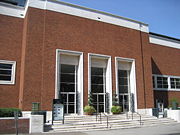
- Belluschi Building, Portland Art MuseumPortland Art MuseumThe Portland Art Museum in Portland, Oregon, United States, was founded in 1892, making it the oldest art museum on the West Coast and seventh oldest in the United States. Upon completion of the most recent renovations, the Portland Art Museum became one of the twenty-five largest art museums in...
(NRHP), 1932 - Library Building (now Smullin Hall) at Willamette UniversityWillamette UniversityWillamette University is an American private institution of higher learning located in Salem, Oregon. Founded in 1842, it is the oldest university in the Western United States. Willamette is a member of the Annapolis Group of colleges, and is made up of an undergraduate College of Liberal Arts and...
, Salem, OregonSalem, OregonSalem is the capital of the U.S. state of Oregon, and the county seat of Marion County. It is located in the center of the Willamette Valley alongside the Willamette River, which runs north through the city. The river forms the boundary between Marion and Polk counties, and the city neighborhood...
, 1938 - St. Thomas More Catholic Church, Portland, 1940
- Peter Kerr House, Gearhart, OregonGearhart, OregonGearhart is a city in Clatsop County, Oregon, United States. The population was 995 at the 2000 census. The 2007 estimate is 1,185 residents.- Geography :...
, 1941 - Chapel, River View CemeteryRiver View Cemetery (Portland, Oregon)River View Cemetery in the southwest section of Portland, Oregon, United States, is a non-profit cemetery founded in 1882. It is the final resting place of many prominent and notable citizens of Oregon, including many governors and United States Senators...
, Portland, 1942 - Sweeney, Straub and Dimm Printing Plant, Portland (NRHP), 1946
- Emmanuel Lutheran Church, Longview, WashingtonLongview, WashingtonLongview is a city in Cowlitz County, Washington, United States. It is the principal city of the "Longview, Washington Metropolitan Statistical Area", which encompasses all of Cowlitz County. Longview's population was 36,648 at the time of the 2010 census and is the largest city in Cowlitz County...
, 1946 - Burkes House, Portland, 1947
- Oregonian Building, Portland, 1947
- Baxter Hall and Collins Hall, Willamette UniversityWillamette UniversityWillamette University is an American private institution of higher learning located in Salem, Oregon. Founded in 1842, it is the oldest university in the Western United States. Willamette is a member of the Annapolis Group of colleges, and is made up of an undergraduate College of Liberal Arts and...
, Salem, OregonSalem, OregonSalem is the capital of the U.S. state of Oregon, and the county seat of Marion County. It is located in the center of the Willamette Valley alongside the Willamette River, which runs north through the city. The river forms the boundary between Marion and Polk counties, and the city neighborhood...
, 1947 - Psychology Building, Reed CollegeReed CollegeReed College is a private, independent, liberal arts college located in southeast Portland, Oregon. Founded in 1908, Reed is a residential college with a campus located in Portland's Eastmoreland neighborhood, featuring architecture based on the Tudor-Gothic style, and a forested canyon wilderness...
, Portland, 1947–1948 - Equitable BuildingCommonwealth Building (Portland, Oregon)The Commonwealth Building is a 14-story commercial office tower in Portland, Oregon, United States, located at 421 SW 6th Avenue between Washington and Stark Streets. Designed by architect Pietro Belluschi, it was built between 1944 and 1948 and was originally known as the Equitable Building...
, Portland (NRHPNational Register of Historic PlacesThe National Register of Historic Places is the United States government's official list of districts, sites, buildings, structures, and objects deemed worthy of preservation...
), 1948 - First Presbyterian ChurchFirst Presbyterian Church (Cottage Grove, Oregon)The First Presbyterian Church, located in Cottage Grove, Oregon, is listed on the National Register of Historic Places....
, Cottage Grove, OregonCottage Grove, OregonCottage Grove is a city in Lane County, Oregon, United States. It received its name from its first postmaster, G. C. Pierce, in September 1861. Pierce's home at the time was in an oak grove. The population was 9,686 at the 2010 census.-History:...
(NRHP), 1948 - Sacred Heart Church, Lake Oswego, OregonLake Oswego, OregonLake Oswego is a city located primarily in Clackamas County in the U.S. state of Oregon. Small portions of the city are also located in neighboring Multnomah and Washington counties. Located south of Portland surrounding the Oswego Lake, the town was founded in 1847 and incorporated as Oswego in...
, 1949 - Zion Lutheran ChurchZion Lutheran Church (Portland, Oregon)The Zion Lutheran Church is a church located in downtown Portland, Oregon, listed on the National Register of Historic Places. Master architect Pietro Belluschi employed a number of innovations in this 1950 church, a pioneering example of the application of modern architectural principles to a...
, Portland (NRHP) (Image), 1950 - Federal Reserve Bank of San Francisco, Portland Branch, 1950
- Central Lutheran Church, Portland, 1951
- St. Philip Neri Catholic ChurchSt. Philip Neri Catholic ChurchSt. Philip Neri Paish in Kinder, Louisiana came into being in 1937, after a long wait by Catholics of the town. The area between Alexandria, Louisiana and Lake Charles, Louisiana was virtually unsettled by white people before the Civial War, and its streams were providing sustenance for small...
, Portland, 1952 - YWCA building, Salem, 1954
- Marion County Courthouse, Salem, Oregon, 1954
- First Lutheran Church, Boston, 1954–1957
- Temple Adath Israel, with Charles Frederick Wise, Merion, PennsylvaniaMerion, PennsylvaniaMerion Station is an unincorporated community in Lower Merion Township, Montgomery County, Pennsylvania, United States. It is contiguous to Philadelphia and is also bordered by Wynnewood, Narberth, and Bala Cynwyd...
, 1956–1957 - Bennington CollegeBennington CollegeBennington College is a liberal arts college located in Bennington, Vermont, USA. The college was founded in 1932 as a women's college and became co-educational in 1969.-History:-Early years:...
Library, Bennington, Vermont, 1957–1958 - Central Lutheran Church, Eugene, OregonEugene, OregonEugene is the second largest city in the U.S. state of Oregon and the seat of Lane County. It is located at the south end of the Willamette Valley, at the confluence of the McKenzie and Willamette rivers, about east of the Oregon Coast.As of the 2010 U.S...
, 1959 - Temple B'rith Kodesh, Rochester, New York, 1959–1963
- First Methodist Church, Duluth, MinnesotaDuluth, MinnesotaDuluth is a port city in the U.S. state of Minnesota and is the county seat of Saint Louis County. The fourth largest city in Minnesota, Duluth had a total population of 86,265 in the 2010 census. Duluth is also the second largest city that is located on Lake Superior after Thunder Bay, Ontario,...
, 1962–1969 - The Alice Tully HallAlice Tully HallAlice Tully Hall is a concert hall at the Lincoln Center for the Performing Arts in New York City. It is named for Alice Tully, a New York performer and philanthropist whose donations assisted in the construction of the hall...
at the Juilliard SchoolJuilliard SchoolThe Juilliard School, located at the Lincoln Center for the Performing Arts in New York City, United States, is a performing arts conservatory which was established in 1905...
within the Lincoln Center, New York CityNew York CityNew York is the most populous city in the United States and the center of the New York Metropolitan Area, one of the most populous metropolitan areas in the world. New York exerts a significant impact upon global commerce, finance, media, art, fashion, research, technology, education, and...
, 1963–1969 - Pan Am BuildingMetLife BuildingThe MetLife Building, originally called the Pan Am Building, is a skyscraper located at 200 Park Avenue in Midtown Manhattan, New York City.-History:...
, Belluschi and Walter GropiusWalter GropiusWalter Adolph Georg Gropius was a German architect and founder of the Bauhaus School who, along with Ludwig Mies van der Rohe and Le Corbusier, is widely regarded as one of the pioneering masters of modern architecture....
as design consultants to Emery Roth & SonsEmery RothEmery Roth was an American architect who designed many of the definitive New York City hotels and apartment buildings of the 1920s and 30s, incorporating Beaux-Arts and Art Deco details...
, New York City, 1963 - Rohm and Haas Corporate HeadquartersRohm and Haas Corporate HeadquartersThe Rohm and Haas Corporate Headquarters in Philadelphia, Pennsylvania, United States is the headquarters for the chemical manufacturing company Rohm and Haas. Completed in 1964, the building was the first private investment for the urban renewal of the Independence Mall area. Only two blocks from...
, with George M. Ewing Co., Philadelphia, Pennsylvania, 1964 - Church of the Christian Union, Rockford, Illinois, 1964-1965
- Hoffman Columbia Plaza, now Unitus Plaza, Portland, Oregon, 1966
- Immanuel Lutheran Church, Silverton, OregonSilverton, OregonSilverton is a city in Marion County, Oregon, United States, along the 45th parallel. The population was 7,414 at the 2000 census. It is part of the Salem Metropolitan Statistical Area.-Geography:...
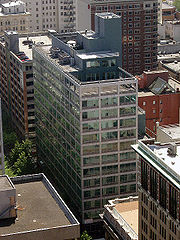
, 1966 - 555 California Street, as consultant to Wurster, Benardi and EmmonsWilliam WursterWilliam Wilson Wurster was an American architect and architectural teacher at the University of California, Berkeley and at MIT, best known for his residential designs in California. - Biography :...
and Skidmore, Owings and MerrillSkidmore, Owings and MerrillSkidmore, Owings and Merrill LLP is an American architectural and engineering firm that was formed in Chicago in 1936 by Louis Skidmore and Nathaniel Owings; in 1939 they were joined by John O. Merrill. They opened their first branch in New York City, New York in 1937. SOM is one of the largest...
, San Francisco, CaliforniaSan Francisco, CaliforniaSan Francisco , officially the City and County of San Francisco, is the financial, cultural, and transportation center of the San Francisco Bay Area, a region of 7.15 million people which includes San Jose and Oakland...
, 1969 - One Boston PlaceOne Boston PlaceOne Boston Place, also known as the Boston Company Building, is a 41-story office tower located in the Financial District of Boston, Massachusetts. With a height of 601 feet , One Boston Place is the 4th-tallest building in the city...
, with Emery Roth & SonsEmery RothEmery Roth was an American architect who designed many of the definitive New York City hotels and apartment buildings of the 1920s and 30s, incorporating Beaux-Arts and Art Deco details...
, Boston, Massachusetts, 1970 - University of Virginia School of ArchitectureUniversity of Virginia School of ArchitectureThe School of Architecture at the University of Virginia is a national leader in architectural education, conferring degrees in Architecture, Landscape Architecture, Architectural History, and Urban and Environmental Planning...
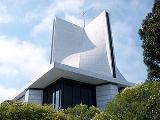
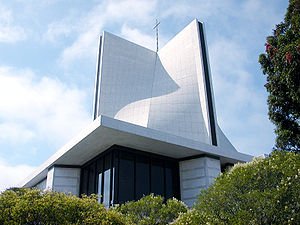
, 1970 - Cathedral of Saint Mary of the AssumptionCathedral of Saint Mary of the AssumptionThe Cathedral of Saint Mary of the Assumption, also known locally as Saint Mary's Cathedral, is the principal church of the Roman Catholic Archdiocese of San Francisco in San Francisco, California...
, San Francisco (collaborating with Pier Luigi NerviPier Luigi NerviPier Luigi Nervi was an Italian engineer. He studied at the University of Bologna and qualified in 1913. Dr. Nervi taught as a professor of engineering at Rome University from 1946-61...
and others), 1971 - Clark Art InstituteClark Art InstituteThe Sterling & Francine Clark Art Institute, usually referred to simply as "The Clark", is an art museum with a large and varied collection located in Williamstown, Massachusetts, United States...
, with The Architects Collaborative, Williamstown, MassachusettsWilliamstown, MassachusettsWilliamstown is a town in Berkshire County, in the northwest corner of Massachusetts. It shares a border with Vermont to the north and New York to the west. It is part of the Pittsfield, Massachusetts Metropolitan Statistical Area. The population was 7,754 at the 2010 census...
, 1973 - Joseph Meyerhoff Symphony HallJoseph Meyerhoff Symphony HallThe Joseph Meyerhoff Symphony Hall, often referred to simply as the Meyerhoff, is a music venue that opened September 16, 1982 at 1212 Cathedral Street in the Mount Vernon neighborhood of Baltimore, Maryland, USA. The main auditorium has a seating capacity of 2,443 people, and is home to the...
, Baltimore, Maryland, 1978–1982 - Louise M. Davies Symphony HallLouise M. Davies Symphony HallLouise M. Davies Symphony Hall, the concert hall component of the San Francisco War Memorial and Performing Arts Center, was built in 1980 at a cost of US$28 million to give the San Francisco Symphony a permanent home. The hall has a seating capacity of 2743 persons...
, with Skidmore, Owings and MerrillSkidmore, Owings and MerrillSkidmore, Owings and Merrill LLP is an American architectural and engineering firm that was formed in Chicago in 1936 by Louis Skidmore and Nathaniel Owings; in 1939 they were joined by John O. Merrill. They opened their first branch in New York City, New York in 1937. SOM is one of the largest...
, San Francisco, 1980 - One Financial CenterOne Financial CenterOne Financial Center is a modern skyscraper adjacent to Dewey Square in the Financial District of Boston, Massachusetts. Built in 1983, it is Boston's 7th-tallest building, standing 590 feet tall, and housing 46 floors. An unusual 90 ft tall glass-roofed lobby, known as the atrium,...
, Boston, 1983 - US Bancorp Tower, as consultant to Skidmore, Owings and MerrillSkidmore, Owings and MerrillSkidmore, Owings and Merrill LLP is an American architectural and engineering firm that was formed in Chicago in 1936 by Louis Skidmore and Nathaniel Owings; in 1939 they were joined by John O. Merrill. They opened their first branch in New York City, New York in 1937. SOM is one of the largest...
, Portland, 1983 - United Hebrew Congregation, Chesterfield, Missouri, 1986–1989
- Murray Hills Christian Church, Beaverton, Oregon (1987–89)
- Centennial Tower and Wheeler Sports Center, George Fox UniversityGeorge Fox UniversityGeorge Fox University is a Christian university of the liberal arts and sciences, and professional studies located in Newberg, Oregon, United States. Founded as a school for Quakers in 1885, the private school has more than 3,400 students combined between its main campus in Newberg and its centers...
1991 - Breitenbush Hall, Oregon State HospitalOregon State HospitalOregon State Hospital in Salem, Oregon, United States, is the primary state-run psychiatric hospital in the state of Oregon since Dammasch State Hospital closed in 1995. The facility is best known as the filming location for the Academy Award-winning film based on Ken Kesey's novel One Flew Over...
, Salem (NRHP) - Portsmouth Abbey SchoolPortsmouth Abbey SchoolPortsmouth Abbey School is a private, coeducational boarding and day school for grades 9 through 12, located in Portsmouth, Rhode Island. Founded by the Benedictine monks of Portsmouth Abbey in 1926 as Portsmouth Priory School, the school offered a classical education to boys...
campus, Portsmouth, Rhode IslandPortsmouth, Rhode IslandPortsmouth is a town in Newport County, Rhode Island, United States. The population was 17,389 at the 2010 U.S. Census.-Geography:According to the United States Census Bureau, the town has a total area of , of which, of it is land and of it is water. Most of its land area lies on Aquidneck... - Uncle Toby's Story House, Blue Wing Lodge, Guardians' Lodge, Kiwanis Lodge, Camp NamanuCamp NamanuCamp Namanu is a summer camp in the U.S. state of Oregon. It was founded as a Camp Fire Girls camp on the banks of the Sandy River in 1924.Namanu remained a "girls only" camp until the late 1970s when the parent organization, now Camp Fire USA, made the executive decision to include boys in all...
, Sandy, OregonSandy, OregonSandy is a city located in Clackamas County, Oregon, United States, and named after the nearby Sandy River. As of the 2000 census, the city had a total population of 5,385, however the 2006 estimate shows 7,070 people.... - Lacamas Summer Home, Camas, Washington
- Chapel of Christ the Teacher, University of PortlandUniversity of PortlandThe University of Portland is a private Roman Catholic university located in Portland, Oregon. It is affiliated with the Congregation of Holy Cross and is the sister school of the University of Notre Dame. Founded in 1901, UP has a student body of about 3,600 students...
External links
- Oregon Blue Book biography
- 1983 interview from the SmithsonianSmithsonian InstitutionThe Smithsonian Institution is an educational and research institute and associated museum complex, administered and funded by the government of the United States and by funds from its endowment, contributions, and profits from its retail operations, concessions, licensing activities, and magazines...
's Archives of American Art