

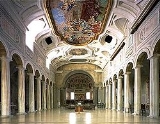
San Pietro in Vincoli

Encyclopedia
- For other churches of this dedication, see St Peter ad Vincula (disambiguation).
San Pietro in Vincoli (Saint Peter in Chains) is a Roman Catholic titular church and minor basilica
Minor basilica
Minor basilica is a title given to some Roman Catholic churches. By canon law no Catholic church can be honoured with the title of basilica unless by apostolic grant or from immemorial custom....
in Rome
Rome
Rome is the capital of Italy and the country's largest and most populated city and comune, with over 2.7 million residents in . The city is located in the central-western portion of the Italian Peninsula, on the Tiber River within the Lazio region of Italy.Rome's history spans two and a half...
, Italy, best known for being the home of Michelangelo
Michelangelo
Michelangelo di Lodovico Buonarroti Simoni , commonly known as Michelangelo, was an Italian Renaissance painter, sculptor, architect, poet, and engineer who exerted an unparalleled influence on the development of Western art...
's statue of Moses
Moses (Michelangelo)
The Moses is a sculpture by the Italian High Renaissance artist Michelangelo Buonarroti, housed in the church of San Pietro in Vincoli in Rome...
, part of the tomb of Pope Julius II.
History
Also known as the Basilica Eudoxiana, it was first rebuilt on older foundations in 432-440 to house the relicRelic
In religion, a relic is a part of the body of a saint or a venerated person, or else another type of ancient religious object, carefully preserved for purposes of veneration or as a tangible memorial...
of the chains that bound Saint Peter
Saint Peter
Saint Peter or Simon Peter was an early Christian leader, who is featured prominently in the New Testament Gospels and the Acts of the Apostles. The son of John or of Jonah and from the village of Bethsaida in the province of Galilee, his brother Andrew was also an apostle...
when he was imprisoned in Jerusalem, the episode called the Liberation of Saint Peter
Liberation of Saint Peter
The Liberation of Saint Peter is a story told in the Acts of the Apostles in which Saint Peter is rescued from prison by an angel. Although described in a short textual passage, the tale has given rise to theological discussions and has been the subject of a number of artworks.-Biblical...
. The Empress Eudoxia
Licinia Eudoxia
Licinia Eudoxia was a Roman Empress, daughter of Eastern Emperor Theodosius II and wife of the Western Emperors Valentinian III and Petronius Maximus.- Family :...
(wife of Emperor Valentinian III
Valentinian III
-Family:Valentinian was born in the western capital of Ravenna, the only son of Galla Placidia and Flavius Constantius. The former was the younger half-sister of the western emperor Honorius, and the latter was at the time Patrician and the power behind the throne....
), who received them as a gift from her mother, Aelia Eudocia
Aelia Eudocia
Aelia Eudocia Augusta was the wife of Theodosius II, and a prominent historical figure in understanding the rise of Christianity during the beginning of the Byzantine Empire. Eudocia lived in a world where Greek paganism and Christianity were still coming together...
, consort of Valentinian II
Valentinian II
Flavius Valentinianus , commonly known as Valentinian II, was Roman Emperor from 375 to 392.-Early Life and Accession :...
, presented the chains to Pope Leo I
Pope Leo I
Pope Leo I was pope from September 29, 440 to his death.He was an Italian aristocrat, and is the first pope of the Catholic Church to have been called "the Great". He is perhaps best known for having met Attila the Hun in 452, persuading him to turn back from his invasion of Italy...
. Aelia Eudocia had received these chains as a gift from Iuvenalis, bishop of Jerusalem.
According to legend, when Leo, while he compared them to the chains of St. Peter's final imprisonment in the Mamertine Prison
Mamertine Prison
The Mamertine Prison — or Tullianum — was a prison located in the Forum Romanum in Ancient Rome. It was located on the northeastern slope of the Capitoline Hill, facing the Curia and the imperial fora of Nerva, Vespasian, and Augustus...
in Rome, the two chains miraculously fused together. The chains are kept in a reliquary
Reliquary
A reliquary is a container for relics. These may be the physical remains of saints, such as bones, pieces of clothing, or some object associated with saints or other religious figures...
under the main altar in the basilica.
The basilica, consecrated in 439 by Sixtus III
Pope Sixtus III
Pope Saint Sixtus III was pope from 31 July 432 to 18 August 440.The name of Sixtus is often connected with a great building boom in Rome: Santa Sabina on the Aventine Hill was dedicated during his pontificate and he built Santa Maria Maggiore, whose dedication to Mary the Mother of God reflected...
, has undergone several restorations, among them a restoration by Pope Adrian I
Pope Adrian I
Pope Adrian was pope from February 1, 772 to December 25, 795. He was the son of Theodore, a Roman nobleman.Shortly after Adrian's accession the territory ruled by the papacy was invaded by Desiderius, king of the Lombards, and Adrian was compelled to seek the assistance of the Frankish king...
, and further work in the eleventh century. From 1471 to 1503, in which year he was elected Pope Julius II
Pope Julius II
Pope Julius II , nicknamed "The Fearsome Pope" and "The Warrior Pope" , born Giuliano della Rovere, was Pope from 1503 to 1513...
, Cardinal Della Rovere, the nephew of Pope Sixtus IV
Pope Sixtus IV
Pope Sixtus IV , born Francesco della Rovere, was Pope from 1471 to 1484. His accomplishments as Pope included the establishment of the Sistine Chapel; the group of artists that he brought together introduced the Early Renaissance into Rome with the first masterpiece of the city's new artistic age,...
, effected notable rebuilding. The front portico
Portico
A portico is a porch leading to the entrance of a building, or extended as a colonnade, with a roof structure over a walkway, supported by columns or enclosed by walls...
, attributed to Baccio Pontelli
Baccio Pontelli
Baccio Pontelli was an Italian architect. Baccio is an abbreviation of Bartolomeo.Pontelli was born in Florence. Passing the phase of artistic formation with Giuliano and Benedetto da Maiano in Florence, and influenced by Francesco di Giorgio Martini during the trip to Urbino , he was an in-layer...
, was added in 1475. The cloister
Cloister
A cloister is a rectangular open space surrounded by covered walks or open galleries, with open arcades on the inner side, running along the walls of buildings and forming a quadrangle or garth...
(1493-1503) has been attributed to Giuliano da Sangallo
Giuliano da Sangallo
Giuliano da Sangallo was an Italian sculptor, architect and military engineer active during the Italian Renaissance.He was born in Florence. His father Francesco Giamberti was a woodworker and architect, much employed by Cosimo de Medici, and his brother Antonio da Sangallo the Elder and nephew...
. Further work was done at the beginning of the 18th century, under Francesco Fontana, and there was also a renovation in 1875.
The Titulus S. Petri ad vincula was assigned on November 20, 2010, to Donald Wuerl
Donald Wuerl
Donald William Wuerl is an American cardinal of the Catholic Church. He is the sixth and current Archbishop of Washington, serving since 2006. He previously served as Auxiliary Bishop of Seattle and Bishop of Pittsburgh...
. The previous Cardinal Priest of the basilica was Pío Laghi, who died on January 11, 2009.
Two popes were elected in this church : Pope John II
Pope John II
Pope John II was pope from 533 to 535.He was the son of a certain Projectus, born in Rome and a priest of the Basilica di San Clemente on the Caelian Hill. He was made pope January 2, 533. The basilica of St. Clement still retains several memorials of "Johannes surnamed Mercurius"...
in 533 and Pope Gregory VII
Pope Gregory VII
Pope St. Gregory VII , born Hildebrand of Sovana , was Pope from April 22, 1073, until his death. One of the great reforming popes, he is perhaps best known for the part he played in the Investiture Controversy, his dispute with Henry IV, Holy Roman Emperor affirming the primacy of the papal...
in 1073.
Next to the church is hosted the Faculty of Engineering of La Sapienza University. This is named "San Pietro in Vincoli" per antonomasia
Antonomasia
In rhetoric, antonomasia is a substitution of any epithet or phrase for a proper name, such as "the little corporal" for Napoleon I. The reverse process is also sometimes called antonomasia. The word derives from the Greek verb , meaning "to name differently"...
. The church is located on the Oppian Hill
Oppian Hill
The Oppian Hill is the southern spur of the Esquiline Hill , one of the famous Seven Hills of Rome. It is separated from the Cispius on the north by the valley of the Subura, and from the Caelian Hill on the south by the valley of the Colosseum...
near Cavour
Cavour (Rome Metro)
Cavour is a station on Line B of the Rome Metro, opened on 10 February 1955. It is located on via Cavour, in the Monti rione of Rome, midway between Santa Maria Maggiore and via dei Fori Imperiali.- Nearby :* Imperial forums* Parco di Traiano...
metro station, a short distance from the Colosseum
Colosseum
The Colosseum, or the Coliseum, originally the Flavian Amphitheatre , is an elliptical amphitheatre in the centre of the city of Rome, Italy, the largest ever built in the Roman Empire...
.
Interior
The interior has a naveNave
In Romanesque and Gothic Christian abbey, cathedral basilica and church architecture, the nave is the central approach to the high altar, the main body of the church. "Nave" was probably suggested by the keel shape of its vaulting...
and two aisles, with three apse
Apse
In architecture, the apse is a semicircular recess covered with a hemispherical vault or semi-dome...
s divided by antique Doric
Doric order
The Doric order was one of the three orders or organizational systems of ancient Greek or classical architecture; the other two canonical orders were the Ionic and the Corinthian.-History:...
columns. The aisles are surmounted by cross-vaults, while the nave has an 18th century coffered
Coffer
A coffer in architecture, is a sunken panel in the shape of a square, rectangle, or octagon in a ceiling, soffit or vault...
ceiling
Ceiling
A ceiling is an overhead interior surface that covers the upper limit of a room. It is generally not a structural element, but a finished surface concealing the underside of the floor or roof structure above....
, fresco
Fresco
Fresco is any of several related mural painting types, executed on plaster on walls or ceilings. The word fresco comes from the Greek word affresca which derives from the Latin word for "fresh". Frescoes first developed in the ancient world and continued to be popular through the Renaissance...
ed in the center by Giovanni Battista Parodi
Giovanni Battista Parodi
Giovanni Battista Parodi was an Italian painter, born in Genoa. In Genoa his frescoes are to be seen in the Church of Santa Maria Maddalena. In Rome, his sole prominent public commission was for the fresco of the ceiling of San Pietro in Vincoli ....
, portraying the Miracle of the Chains (1706).
Michelangelo's Moses (completed in 1515), while originally intended as part of a massive 47-statue, free-standing funeral monument for Pope Julius II
Pope Julius II
Pope Julius II , nicknamed "The Fearsome Pope" and "The Warrior Pope" , born Giuliano della Rovere, was Pope from 1503 to 1513...
, became the centerpiece of the Pope's funeral monument and tomb in this, the church of della Rovere family. Moses is depicted with horns, connoting "the radiance of the Lord", due to the similarity in the Hebrew words for "beams of light" and "horns". This kind of iconographic symbolism was common in early sacred art, and for an artist horns are easier to sculpt than rays of light.
Other works of art include two canvases of Saint Augustine and St. Margaret by Guercino, the monument of Cardinal
Cardinal (Catholicism)
A cardinal is a senior ecclesiastical official, usually an ordained bishop, and ecclesiastical prince of the Catholic Church. They are collectively known as the College of Cardinals, which as a body elects a new pope. The duties of the cardinals include attending the meetings of the College and...
Girolamo Agucchi designed by Domenichino, who is also the painter of a sacristy fresco depicting the Liberation of St. Peter (1604). The altarpiece
Altarpiece
An altarpiece is a picture or relief representing a religious subject and suspended in a frame behind the altar of a church. The altarpiece is often made up of two or more separate panels created using a technique known as panel painting. It is then called a diptych, triptych or polyptych for two,...
on the first chapel to the left is a Deposition by Cristoforo Roncalli
Cristoforo Roncalli
Cristoforo Roncalli was an Italian mannerist painter. He was one of the three painters known as il Pomarancio.Roncalli was born in Pomarance, a town near Volterra...
. The tomb of Cardinal Nicholas of Kues (d 1464), with its relief
Relief
Relief is a sculptural technique. The term relief is from the Latin verb levo, to raise. To create a sculpture in relief is thus to give the impression that the sculpted material has been raised above the background plane...
, Cardinal Nicholas before St Peter, is by Andrea Bregno
Andrea Bregno
Andrea di Cristoforo Bregno was an Italian sculptor and architect of the Early Renaissance who worked in Rome from the 1460s and died just as the High Renaissance was getting under way.-Early life:...
. Painter and sculptor Antonio Pollaiuolo
Antonio Pollaiuolo
Antonio del Pollaiolo , also known as Antonio di Jacopo Pollaiuolo or Antonio Pollaiolo, was an Italian painter, sculptor, engraver and goldsmith during the Renaissance.-Biography:...
is buried at the left side of the entrance. He is the Florentine sculptor who added the figures of Romulus and Remus
Romulus and Remus
Romulus and Remus are Rome's twin founders in its traditional foundation myth, although the former is sometimes said to be the sole founder...
to the sculpture of the Capitoline Wolf
Capitoline Wolf
The Capitoline Wolf is a bronze sculpture of a she-wolf suckling twin infants, inspired by the legend of the founding of Rome. According to the legend, when Numitor, grandfather of the twins Romulus and Remus, was overthrown by his brother Amulius, the usurper ordered the twins to be cast into...
on the Capitol. The tomb of Cardinal Cinzio Passeri Aldobrandini
Cinzio Passeri Aldobrandini
Cinzio Personeni Albobrandini was an Italian cardinal. In some documents he is known as Cinzio Passeri Aldobrandini because, after settling in Romagna, the family varied its name according to the place from which they had moved - his father Aurelio Personeni was born in Cà Personeni and later...
, decorated with imagery of the Grim Reaper, is also in the church.
In 1876 archeologists discovered the tombs of those once believed to be the seven Maccabean martyrs
Woman with seven sons
The woman with seven sons was a Jewish martyr described in 2 Maccabees 7 and other sources. Although unnamed in 2 Maccabees, she is known variously as Hannah, Miriam and Solomonia.-2 Maccabees:...
depicted in 2 Maccabees 7-41. It is highly unlikely that these are in fact the Jewish martyrs that had offered their lives in Jerusalem. They are remembered each year on 1 August, the same day as the miracle of the fusing of the two chains.
The third altar in the left aisle holds a mosaic of Saint Sebastian from the seventh century. This mosaic is related to an outbreak of plague in Pavia
Pavia
Pavia , the ancient Ticinum, is a town and comune of south-western Lombardy, northern Italy, 35 km south of Milan on the lower Ticino river near its confluence with the Po. It is the capital of the province of Pavia. It has a population of c. 71,000...
, in northern Italy. It would only stop if an altar was built for St. Sebastian in the church of S. Pietro in Vincoli in that city. Somehow this story also became accepted in Rome. Hence the altar.
List of Cardinal-Priests since 1405
List of the cardinal titulars of the church
|
Giovanni Battista Maria Pallotta Giovanni Battista Maria Pallotta was an Italian Cardinal .He was a papal nuncio at the end of the 1620s, becoming titular archbishop of Tessalonica in 1628. He became a Cardinal in 1629.... (23 September 1652 - 21 April 1659) Ulderico Carpegna Ulderico Carpegna was an Italian jurist and Cardinal.Born at Scavolino, he was from a family of the Roman nobility, connected with the Montefeltro family.... (21 April 1659 - 21 November 1661) Alderano Cybo thumb|250 px|Cardinal Alderano CyboAlderano Cybo was an Italian Catholic Cardinal.-Biography:Cybo was born 16 July 1613 in Genoa and went to Rome at an early age as prelate to Pope Urban VIII.... (21 November 1661 - 24 May 1676) Ferdinando d'Adda Ferdinando d'Adda was a Roman Catholic Cardinal, bishop and diplomat.D'Adda was born in Milan. He served as Prefect of the Congregation of Rites... (16 April 1714 - 21 January 1715) Giuseppe Doria Pamphili Giuseppe Doria Pamphili is a Italian Cardinal of the XVIIIth and XIXth centuries and served as Cardinal Secretary of State.-Biography:... (11 April 1785 - 20 September 1802) Castruccio Castracane degli Antelminelli Castruccio Castracane degli Antelminelli was an Italian clergyman, who was made a cardinal by pope Gregory XVI in the consistory of 15 April 1833.-External links:* on... (29 July 1833 - 22 January 1844) Niccola Clarelli Parracciani Niccola Clarelli Parracciani was a Catholic Cardinal and was Arch-Priest of St. Peter's Basilica at the Vatican.... (25 January 1844 - 22 February 1867) Giovanni Simeoni Giovanni Simeoni was an Italian Cardinal of the Roman Catholic Church who served as Prefect of the Sacred Congregation for Propagation of the Faith from 1878 until his death, and was elevated to the cardinalate in 1875.... (18 December 1876 - 14 January 1892) Ignatius Persico Ignatius Camillus William Mary Peter Persico was an Italian Cardinal.-Life and career:He entered the Capuchin Franciscan Order on 25 April 1839, and immediately after ordination was sent in November, 1846, to Patna, India. The vicar Apostolic, Anastasius Hartmann, made him his socius and confidant... (19 January 1893 - 7 December 1895) Adolphe Perraud Adolphe Perraud was a French Cardinal and academician.-Life and works:Perraud was born at Lyon, France. A brilliant student at the lycées Henri IV and St Louis, he entered the École Normale, where he was strongly influenced by Joseph Gratry. In 1850 he secured the fellowship of history and for... (25 June 1896 - 10 February 1906) Désiré-Joseph Mercier -Early life and ordination:Désiré Mercier was born at the château du Castegier in Braine-l'Alleud, as the fifth of the seven children of Paul-Léon Mercier and his wife Anne-Marie Barbe Croquet.... (18 April 1907 - 23 January 1926) Luigi Capotosti Luigi Capotosti was an Italian Cardinal of the Roman Catholic Church who served as Apostolic Datary from 1933 until his death, and was elevated to the cardinalate in 1926.-Biography:... (24 June 1926 - 16 February 1938) Teódosio de Gouveia Teodósio Clemente de Gouveia was a Portuguese Cardinal of the Roman Catholic Church, who served as Archbishop of Lourenço Marques in Mozambique from 1940 until his death, and was elevated to the cardinalate in 1946 by Pope Pius XII.-Biography:Teodósio Clemente de Gouveia was born in São Jorge to... (22 February 1946 - 6 February 1962) Leo Joseph Suenens Leo Jozef Suenens was a Belgian prelate of the Roman Catholic Church. He served as Archbishop of Mechelen-Brussel from 1961 to 1979, and was elevated to the cardinalate in 1962.... (22 March 1962 - 6 May 1996) Jean Marie Balland Jean Marie Balland was a Roman Catholic Cardinal and Archbishop of Lyon.-Early life:... (21 February 1998 - 1 March 1998) Louis-Marie Billé Louis Marie Billé was a French clergyman, archbishop of Lyon from 6 September 1998 and a cardinal until his death in office.- Life :... (21 February 2001 - 22 July 2001) Donald Wuerl Donald William Wuerl is an American cardinal of the Catholic Church. He is the sixth and current Archbishop of Washington, serving since 2006. He previously served as Auxiliary Bishop of Seattle and Bishop of Pittsburgh... (20 November 2010 - present) |