


United States Intelligence Community

Encyclopedia
The United States Intelligence Community (IC) is a cooperative federation of 16 separate United States government
agencies that work separately and together to conduct intelligence
activities considered necessary for the conduct of foreign relations
and the protection of the national security
of the United States
. Member organizations of the IC include intelligence agencies
, military intelligence
, and civilian intelligence and analysis offices within federal executive departments
. The IC is led by the Director of National Intelligence (DNI), who reports to the President of the United States
.
Among their varied responsibilities, the members of the Community collect and produce foreign and domestic intelligence, contribute to military plan
ning, and perform espionage
. The IC was established by Executive Order 12333
, signed on December 4, 1981 by President
Ronald Reagan
.
The Washington Post
has reported that there are 1,271 government organizations and 1,931 private companies in 10,000 locations in the United States that are working on counterterrorism, homeland security, and intelligence, and that the intelligence community as a whole includes 854,000 people who hold top-secret clearances. According to a 2008 study by the Office of the Director of National Intelligence, private contractors make up 29% of the workforce in the US intelligence community and cost the equivalent of 49% of their personnel budgets.
Executive Order 12333 charged the IC with six primary objectives:
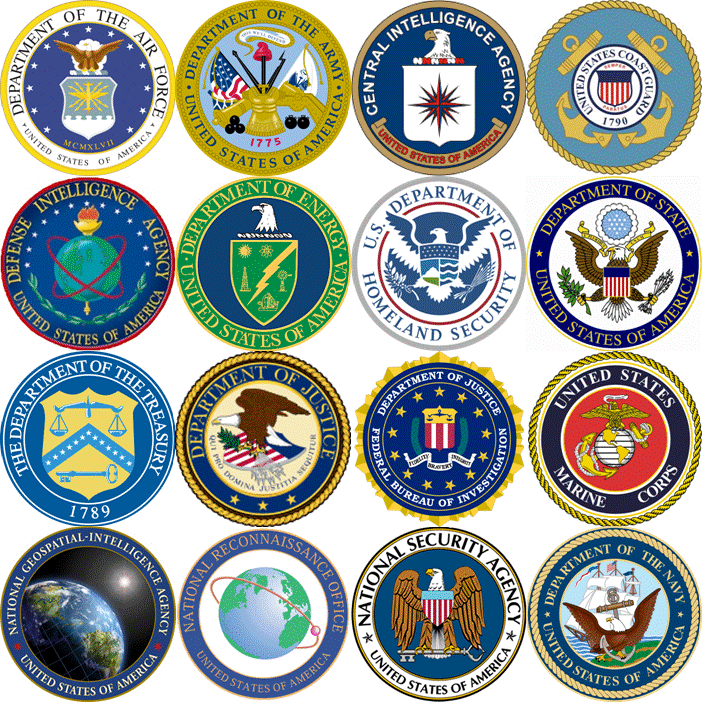 The IC consists of 16 members (also called elements). The Central Intelligence Agency
is an independent agency of the United States government
. The other 15 elements are offices or bureaus within federal executive departments
. The IC is led by the Director of National Intelligence, whose office, the Office of the Director of National Intelligence (ODNI), is not listed as a member of the IC.
Since the definitions of the NIP and MIP overlap when they address military intelligence
, assignment of Department of Defense intelligence activities to the NIP and MIP sometimes proves problematic.
(IRTPA) amendments to the 1947 National Security Act.
Though the IC characterizes itself as a "federation" of its member elements, its overall structure is better characterized as a confederation
due to its lack of a well-defined, unified leadership and governance structure. Prior to 2004, the Director of Central Intelligence
(DCI) was the head of the IC, in addition to being the director of the CIA. A major criticism of this arrangement was that the DCI had little or no actual authority over the budgetary authorities of the other IC agencies and therefore had limited influence over their operations.
Following the passage of IRTPA in 2004, the head of the IC is the Director of National Intelligence (DNI). The DNI exerts leadership of the IC primarily through the statutory authorities under which he:
However, the DNI has no authority to direct and control any element of the IC except his own staff — the Office of the DNI — neither does the DNI have the authority to hire or fire personnel in the IC except those on his own staff. The member elements in the executive branch are directed and controlled by their respective department heads, all cabinet-level officials reporting to the President. By law, only the Director of the Central Intelligence Agency
reports to the DNI.
In the light of major intelligence failures in recent years that called into the question how well Intelligence Community ensures U.S. national security, particularly those identified by the 9/11 Commission
(National Commission on Terrorist Attacks Upon the United States), and the "WMD Commission
" (Commission on the Intelligence Capabilities of the United States Regarding Weapons of Mass Destruction), the authorities and powers of the DNI and the overall organizational structure of the IC have become subject of intense debate in the United States.
wiki
of encyclopedic security-related information; the creation of the Office of the Director of National Intelligence, National Intelligence Centers
, Program Manager Information Sharing Environment, and Information Sharing Council; legal and policy frameworks set by the Intelligence Reform and Terrorism Prevention Act of 2004, information sharing Executive Orders 13354 and Executive Order 13388
, and the 2005 National Intelligence Strategy
.
(excluding the Military Intelligence Program) in fiscal year 2010 was $53.1 billion, according to a disclosure required under a recent law implementing recommendations of the 9/11 Commission. This figure is up from $49.8 billion in 2009, $47.5 billion in 2008, $43.5 billion in 2007, and $40.9 billion in 2006.
In a statement on the release of new declassified
figures, DNI Mike McConnell said there would be no additional disclosures of classified budget information
beyond the overall spending figure because "such disclosures could harm national security." How the money is divided among the 16 intelligence agencies and what it is spent on is classified. It includes salaries
for about 100,000 people, multi-billion dollar satellite programs
, aircraft
, weapon
s, electronic sensors, intelligence analysis
, spies
, computer
s, and software.
About 70 percent of the intelligence budget goes to contractor
s for the procurement
of technology and services (including analysis), according to a May 2007 chart from the Office of the DNI. Intelligence spending has increased by a third over ten years ago, in inflation
-adjusted dollars, according to the Center for Strategic and Budgetary Assessments.
duties are distributed to both the Executive and Legislative branches. Primary Executive oversight is performed by the President's Foreign Intelligence Advisory Board
, the Joint Intelligence Community Council
, the Office of the Inspector General
, and the Office of Management and Budget. Primary congressional oversight
jurisdiction over the IC is assigned to two committees
: the United States House Permanent Select Committee on Intelligence
and the United States Senate Select Committee on Intelligence
. The House Armed Services Committee
and Senate Armed Services Committee
draft bills to annually authorize the budgets of DoD intelligence activities, and both the House
and Senate appropriations committees
annually draft bills to appropriate the budgets of the IC. The Senate Committee on Homeland Security and Governmental Affairs
took a leading role in formulating the intelligence reform legislation in the 108th Congress
.
Federal government of the United States
The federal government of the United States is the national government of the constitutional republic of fifty states that is the United States of America. The federal government comprises three distinct branches of government: a legislative, an executive and a judiciary. These branches and...
agencies that work separately and together to conduct intelligence
Intelligence (information gathering)
Intelligence assessment is the development of forecasts of behaviour or recommended courses of action to the leadership of an organization, based on a wide range of available information sources both overt and covert. Assessments are developed in response to requirements declared by the leadership...
activities considered necessary for the conduct of foreign relations
Foreign policy
A country's foreign policy, also called the foreign relations policy, consists of self-interest strategies chosen by the state to safeguard its national interests and to achieve its goals within international relations milieu. The approaches are strategically employed to interact with other countries...
and the protection of the national security
National security
National security is the requirement to maintain the survival of the state through the use of economic, diplomacy, power projection and political power. The concept developed mostly in the United States of America after World War II...
of the United States
United States
The United States of America is a federal constitutional republic comprising fifty states and a federal district...
. Member organizations of the IC include intelligence agencies
Intelligence agency
An intelligence agency is a governmental agency that is devoted to information gathering for purposes of national security and defence. Means of information gathering may include espionage, communication interception, cryptanalysis, cooperation with other institutions, and evaluation of public...
, military intelligence
Military intelligence
Military intelligence is a military discipline that exploits a number of information collection and analysis approaches to provide guidance and direction to commanders in support of their decisions....
, and civilian intelligence and analysis offices within federal executive departments
United States Federal Executive Departments
The United States federal executive departments are among the oldest primary units of the executive branch of the federal government of the United States—the Departments of State, War, and the Treasury all being established within a few weeks of each other in 1789.Federal executive...
. The IC is led by the Director of National Intelligence (DNI), who reports to the President of the United States
President of the United States
The President of the United States of America is the head of state and head of government of the United States. The president leads the executive branch of the federal government and is the commander-in-chief of the United States Armed Forces....
.
Among their varied responsibilities, the members of the Community collect and produce foreign and domestic intelligence, contribute to military plan
Military plan
A military operation plan is a formal plan for military armed forces, their military organizations and units to conduct operations, as drawn up by commanders within the combat operations process in achieving objectives before or during a conflict...
ning, and perform espionage
Espionage
Espionage or spying involves an individual obtaining information that is considered secret or confidential without the permission of the holder of the information. Espionage is inherently clandestine, lest the legitimate holder of the information change plans or take other countermeasures once it...
. The IC was established by Executive Order 12333
Executive Order 12333
On December 4, 1981 President Ronald Reagan signedExecutive Order 12333,an Executive Order intended toextend powers and responsibilities of US intelligence agencies and direct the leaders of U.S...
, signed on December 4, 1981 by President
President of the United States
The President of the United States of America is the head of state and head of government of the United States. The president leads the executive branch of the federal government and is the commander-in-chief of the United States Armed Forces....
Ronald Reagan
Ronald Reagan
Ronald Wilson Reagan was the 40th President of the United States , the 33rd Governor of California and, prior to that, a radio, film and television actor....
.
The Washington Post
The Washington Post
The Washington Post is Washington, D.C.'s largest newspaper and its oldest still-existing paper, founded in 1877. Located in the capital of the United States, The Post has a particular emphasis on national politics. D.C., Maryland, and Virginia editions are printed for daily circulation...
has reported that there are 1,271 government organizations and 1,931 private companies in 10,000 locations in the United States that are working on counterterrorism, homeland security, and intelligence, and that the intelligence community as a whole includes 854,000 people who hold top-secret clearances. According to a 2008 study by the Office of the Director of National Intelligence, private contractors make up 29% of the workforce in the US intelligence community and cost the equivalent of 49% of their personnel budgets.
Purpose
Intelligence is information that agencies collect, analyze and distribute in response to government leaders’ questions and requirements. Intelligence is a broad term that entails:- Collection, analysis, and production of sensitive information to support national security leaders, including policymakers, military commanders and Members of Congress. Safeguarding these processes and this information through counterintelligence activities. Execution of covert operations approved by the President. The IC strives to provide valuable insight on important issues by gathering raw intelligence, analyzing that data in context, and producing timely and relevant products for customers at all levels of national security—from the war-fighter on the ground to the President in Washington.
Executive Order 12333 charged the IC with six primary objectives:
- Collection of information needed by the President, the National Security CouncilUnited States National Security CouncilThe White House National Security Council in the United States is the principal forum used by the President of the United States for considering national security and foreign policy matters with his senior national security advisors and Cabinet officials and is part of the Executive Office of the...
, the Secretary of StateUnited States Secretary of StateThe United States Secretary of State is the head of the United States Department of State, concerned with foreign affairs. The Secretary is a member of the Cabinet and the highest-ranking cabinet secretary both in line of succession and order of precedence...
, the Secretary of DefenseUnited States Secretary of DefenseThe Secretary of Defense is the head and chief executive officer of the Department of Defense of the United States of America. This position corresponds to what is generally known as a Defense Minister in other countries...
, and other executive branch officialsExecutive (government)Executive branch of Government is the part of government that has sole authority and responsibility for the daily administration of the state bureaucracy. The division of power into separate branches of government is central to the idea of the separation of powers.In many countries, the term...
for the performance of their duties and responsibilities; - Production and dissemination of intelligence;
- Collection of informationInformationInformation in its most restricted technical sense is a message or collection of messages that consists of an ordered sequence of symbols, or it is the meaning that can be interpreted from such a message or collection of messages. Information can be recorded or transmitted. It can be recorded as...
concerning, and the conduct of activities to protect against, intelligence activities directed against the U.S., international terroristTerrorismTerrorism is the systematic use of terror, especially as a means of coercion. In the international community, however, terrorism has no universally agreed, legally binding, criminal law definition...
and/or narcotics activities, and other hostile activities directed against the U.S. by foreign powers, organizations, persons and their agents; - Special activities (defined as activities conducted in support of U.S. foreign policyForeign relations of the United StatesThe United States has formal diplomatic relations with most nations. The United States federal statutes relating to foreign relations can be found in Title 22 of the United States Code.-Pacific:-Americas:-Caribbean:...
objectives abroad which are planned and executed so that the "role of the United States Government is not apparent or acknowledged publicly," and functions in support of such activities, but which are not intended to influence United States political processes, public opinionPublic opinionPublic opinion is the aggregate of individual attitudes or beliefs held by the adult population. Public opinion can also be defined as the complex collection of opinions of many different people and the sum of all their views....
, policies, or media and do not include diplomatic activitiesDiplomacyDiplomacy is the art and practice of conducting negotiations between representatives of groups or states...
or the collection and production of intelligence or related support functions); - Administrative and support activities within the U.S. and abroad necessary for the performance of authorized activities and
- Such other intelligence activities as the President may direct from time to time.
Members
Central Intelligence Agency
The Central Intelligence Agency is a civilian intelligence agency of the United States government. It is an executive agency and reports directly to the Director of National Intelligence, responsible for providing national security intelligence assessment to senior United States policymakers...
is an independent agency of the United States government
Independent agencies of the United States government
Independent agencies of the United States federal government are those agencies that exist outside of the federal executive departments...
. The other 15 elements are offices or bureaus within federal executive departments
United States Federal Executive Departments
The United States federal executive departments are among the oldest primary units of the executive branch of the federal government of the United States—the Departments of State, War, and the Treasury all being established within a few weeks of each other in 1789.Federal executive...
. The IC is led by the Director of National Intelligence, whose office, the Office of the Director of National Intelligence (ODNI), is not listed as a member of the IC.
- Independent agenciesIndependent agencies of the United States governmentIndependent agencies of the United States federal government are those agencies that exist outside of the federal executive departments...
- Central Intelligence AgencyCentral Intelligence AgencyThe Central Intelligence Agency is a civilian intelligence agency of the United States government. It is an executive agency and reports directly to the Director of National Intelligence, responsible for providing national security intelligence assessment to senior United States policymakers...
(CIA)
- Central Intelligence Agency
- United States Department of DefenseUnited States Department of DefenseThe United States Department of Defense is the U.S...
- Air Force Intelligence, Surveillance and Reconnaissance Agency (AFISRA)
- Army Intelligence and Security CommandUnited States Army Intelligence and Security CommandThe United States Army Intelligence and Security Command is a direct reporting unit that conducts intelligence, security, and information operations for U.S. Army commanders and national decision makers. INSCOM is both an organization within the United States Army and the National Security Agency,...
(INSCOM) - Defense Intelligence AgencyDefense Intelligence AgencyThe Defense Intelligence Agency is a member of the Intelligence Community of the United States, and is the central producer and manager of military intelligence for the United States Department of Defense, employing over 16,500 U.S. military and civilian employees worldwide...
(DIA) - Marine Corps Intelligence ActivityMarine Corps Intelligence ActivityThe Marine Corps Intelligence Activity , is a field activity of Headquarters, U.S. Marine Corps and a member of both the Defense Intelligence Enterprise and the United States Intelligence Community...
(MCIA) - National Geospatial-Intelligence AgencyNational Geospatial-Intelligence AgencyThe National Geospatial-Intelligence Agency is an agency of the federal government of the United States with the primary mission of collecting, analyzing and distributing geospatial intelligence in support of national security. NGA was formerly known as the National Imagery and Mapping Agency ...
(NGA) - National Reconnaissance OfficeNational Reconnaissance OfficeThe National Reconnaissance Office , located in Chantilly, Virginia, is one of the 16 U.S. intelligence agencies. It designs, builds, and operates the spy satellites of the United States government.-Mission:...
(NRO) - National Security AgencyNational Security AgencyThe National Security Agency/Central Security Service is a cryptologic intelligence agency of the United States Department of Defense responsible for the collection and analysis of foreign communications and foreign signals intelligence, as well as protecting U.S...
(NSA) - Office of Naval IntelligenceOffice of Naval IntelligenceThe Office of Naval Intelligence was established in the United States Navy in 1882. ONI was established to "seek out and report" on the advancements in other nations' navies. Its headquarters are at the National Maritime Intelligence Center in Suitland, Maryland...
(ONI)
- United States Department of EnergyUnited States Department of EnergyThe United States Department of Energy is a Cabinet-level department of the United States government concerned with the United States' policies regarding energy and safety in handling nuclear material...
- Office of Intelligence and CounterintelligenceOffice of Intelligence and CounterintelligenceThe Office of Intelligence and Counterintelligence is an office of the United States Department of Energy that focuses on gathering intelligence for the department. It provides information to the Secretary of Energy and senior federal policy makers. As a member of the Intelligence Community, it...
(OICI)
- Office of Intelligence and Counterintelligence
- United States Department of Homeland SecurityUnited States Department of Homeland SecurityThe United States Department of Homeland Security is a cabinet department of the United States federal government, created in response to the September 11 attacks, and with the primary responsibilities of protecting the territory of the United States and protectorates from and responding to...
- Office of Intelligence and AnalysisOffice of Intelligence and AnalysisThe Office of Intelligence and Analysis is a part of the Office of Terrorism and Financial Intelligence, of the United States Department of the Treasury and is responsible for the receipt, analysis, collation, and dissemination of foreign intelligence and foreign counterintelligence information...
(I&A) - Coast Guard IntelligenceCoast Guard IntelligenceCoast Guard Intelligence is the military intelligence branch of the United States Coast Guard.The United States Coast Guard is a military, multi-mission, maritime service within the United States Department of Homeland Security and one of the United States's five armed services. Its core roles are...
(CGI)
- Office of Intelligence and Analysis
- United States Department of JusticeUnited States Department of JusticeThe United States Department of Justice , is the United States federal executive department responsible for the enforcement of the law and administration of justice, equivalent to the justice or interior ministries of other countries.The Department is led by the Attorney General, who is nominated...
- Federal Bureau of InvestigationFederal Bureau of InvestigationThe Federal Bureau of Investigation is an agency of the United States Department of Justice that serves as both a federal criminal investigative body and an internal intelligence agency . The FBI has investigative jurisdiction over violations of more than 200 categories of federal crime...
(FBI) - Drug Enforcement AdministrationDrug Enforcement AdministrationThe Drug Enforcement Administration is a federal law enforcement agency under the United States Department of Justice, tasked with combating drug smuggling and use within the United States...
, Office of National Security Intelligence (DEA/ONSI)
- Federal Bureau of Investigation
- United States Department of StateUnited States Department of StateThe United States Department of State , is the United States federal executive department responsible for international relations of the United States, equivalent to the foreign ministries of other countries...
- Bureau of Intelligence and ResearchBureau of Intelligence and ResearchThe Bureau of Intelligence and Research is an intelligence bureau in the U.S. State Department tasked with analyzing information. Originally founded as the Research and Analysis Branch of the Office of Strategic Services , it was transferred to the State Department at the end of World War II...
(INR)
- Bureau of Intelligence and Research
- United States Department of the TreasuryUnited States Department of the TreasuryThe Department of the Treasury is an executive department and the treasury of the United States federal government. It was established by an Act of Congress in 1789 to manage government revenue...
- Office of Terrorism and Financial Intelligence (TFI)
Programs
IC activities are performed under two separate programs:- The National Intelligence Program (NIP), formerly known as the National Foreign Intelligence Program as defined by the National Security Act of 1947National Security Act of 1947The National Security Act of 1947 was signed by United States President Harry S. Truman on July 26, 1947, and realigned and reorganized the U.S. Armed Forces, foreign policy, and Intelligence Community apparatus in the aftermath of World War II...
(as amended), "refers to all programs, projects, and activities of the intelligence community, as well as any other programs of the intelligence community designated jointly by the Director of National Intelligence (DNI) and the head of a United States department or agency or by the President. Such term does not include programs, projects, or activities of the military departments to acquire intelligence solely for the planning and conduct of tactical military operations by United States Armed Forces." Under the law, the DNI is responsible for directing and overseeing the NIP, though the ability to do so is limited (see the Organization structure and leadership section). - The Military Intelligence Program (MIP) refers to the programs, projects, or activities of the military departments to acquire intelligence solely for the planning and conduct of tactical military operations by United States Armed Forces. The MIP is directed and controlled by the Secretary of Defense. In 2005, the Department of Defense combined the Joint Military Intelligence Program and the Tactical Intelligence and Related Activities program to form the MIP.
Since the definitions of the NIP and MIP overlap when they address military intelligence
Military intelligence
Military intelligence is a military discipline that exploits a number of information collection and analysis approaches to provide guidance and direction to commanders in support of their decisions....
, assignment of Department of Defense intelligence activities to the NIP and MIP sometimes proves problematic.
Organizational structure and leadership
The overall organization of the IC is primarily governed by the National Security Act of 1947 (as amended) and Executive Order 12333. The statutory organizational relationships were substantially revised with the 2004 Intelligence Reform and Terrorism Prevention ActIntelligence Reform and Terrorism Prevention Act
The Intelligence Reform and Terrorism Prevention Act of 2004 , , is a 236-page Act of Congress, signed by President George W. Bush, that broadly affects US federal terrorism laws. In juxtaposition with the single-subject rule, the act is composed of several separate titles with varying subject...
(IRTPA) amendments to the 1947 National Security Act.
Though the IC characterizes itself as a "federation" of its member elements, its overall structure is better characterized as a confederation
Confederation
A confederation in modern political terms is a permanent union of political units for common action in relation to other units. Usually created by treaty but often later adopting a common constitution, confederations tend to be established for dealing with critical issues such as defense, foreign...
due to its lack of a well-defined, unified leadership and governance structure. Prior to 2004, the Director of Central Intelligence
Director of Central Intelligence
The Office of United States Director of Central Intelligence was the head of the United States Central Intelligence Agency, the principal intelligence advisor to the President and the National Security Council, and the coordinator of intelligence activities among and between the various United...
(DCI) was the head of the IC, in addition to being the director of the CIA. A major criticism of this arrangement was that the DCI had little or no actual authority over the budgetary authorities of the other IC agencies and therefore had limited influence over their operations.
Following the passage of IRTPA in 2004, the head of the IC is the Director of National Intelligence (DNI). The DNI exerts leadership of the IC primarily through the statutory authorities under which he:
- Controls the National Intelligence Program budget;
- Establishes objectives, priorities, and guidance for the IC; and
- Manages and directs the tasking of, collection, analysis, production, and dissemination of national intelligence by elements of the IC.
However, the DNI has no authority to direct and control any element of the IC except his own staff — the Office of the DNI — neither does the DNI have the authority to hire or fire personnel in the IC except those on his own staff. The member elements in the executive branch are directed and controlled by their respective department heads, all cabinet-level officials reporting to the President. By law, only the Director of the Central Intelligence Agency
Director of the Central Intelligence Agency
Director of the Central Intelligence Agency serves as the head of the Central Intelligence Agency, which is part of the United States Intelligence Community. The Director reports to the Director of National Intelligence . The Director is assisted by the Deputy Director of the Central...
reports to the DNI.
In the light of major intelligence failures in recent years that called into the question how well Intelligence Community ensures U.S. national security, particularly those identified by the 9/11 Commission
9/11 Commission
The National Commission on Terrorist Attacks Upon the United States, also known as the 9/11 Commission, was set up on November 27, 2002, "to prepare a full and complete account of the circumstances surrounding the September 11, 2001 attacks", including preparedness for and the immediate response to...
(National Commission on Terrorist Attacks Upon the United States), and the "WMD Commission
Iraq Intelligence Commission
The Commission on the Intelligence Capabilities of the United States Regarding Weapons of Mass Destruction is a panel created by Executive Order 13328 signed by U.S. President George W. Bush in February 2004...
" (Commission on the Intelligence Capabilities of the United States Regarding Weapons of Mass Destruction), the authorities and powers of the DNI and the overall organizational structure of the IC have become subject of intense debate in the United States.
Interagency cooperation
Previously, interagency cooperation and the flow of information among the member agencies was hindered by policies that sought to limit the pooling of information out of privacy and security concerns. Attempts to modernize and facilitate interagency cooperation within the IC include technological, structural, procedural, and cultural dimensions. Examples include the IntellipediaIntellipedia
Intellipedia is an online system for collaborative data sharing used by the United States Intelligence Community . It was established as a pilot project in late 2005 and formally announced in April 2006 and consists of three wikis running on JWICS, SIPRNet, and Intelink-U...
wiki
Wiki
A wiki is a website that allows the creation and editing of any number of interlinked web pages via a web browser using a simplified markup language or a WYSIWYG text editor. Wikis are typically powered by wiki software and are often used collaboratively by multiple users. Examples include...
of encyclopedic security-related information; the creation of the Office of the Director of National Intelligence, National Intelligence Centers
National Counterterrorism Center
The National Counterterrorism Center is a United States government organization responsible for national and international counterterrorism efforts. It is based in a modern complex near McLean, Virginia called Liberty Crossing...
, Program Manager Information Sharing Environment, and Information Sharing Council; legal and policy frameworks set by the Intelligence Reform and Terrorism Prevention Act of 2004, information sharing Executive Orders 13354 and Executive Order 13388
Executive Order 13388
President George W. Bush signed Executive Order 13388 on October 25, 2005. Its title is "Further Strengthening the Sharing of Terrorism Information To Protect Americans."...
, and the 2005 National Intelligence Strategy
National Intelligence Strategy of the United States of America
The National Intelligence Strategy of the United States of America is a product of the Office of the Director of National Intelligence . Drafted and implemented in 2005 while John Negroponte served as the DNI, it describes the drastic overhaul the United States intelligence community will carry...
.
Budget
The U.S. intelligence budgetUnited States intelligence budget
The United States intelligence budget comprises all the funding for the 16 agencies of the United States Intelligence Community. These agencies and other programs fit into one of the intelligence budget’s two components, the National Intelligence Program and the Military Intelligence Program...
(excluding the Military Intelligence Program) in fiscal year 2010 was $53.1 billion, according to a disclosure required under a recent law implementing recommendations of the 9/11 Commission. This figure is up from $49.8 billion in 2009, $47.5 billion in 2008, $43.5 billion in 2007, and $40.9 billion in 2006.
In a statement on the release of new declassified
Declassification
Declassification is the process of documents that formerly were classified as secret ceasing to be so restricted, often under the principle of freedom of information. Procedures for declassification vary by country...
figures, DNI Mike McConnell said there would be no additional disclosures of classified budget information
Classified information in the United States
The United States government classification system is currently established under Executive Order 13526, the latest in a long series of executive orders on the topic. Issued by President Barack Obama in 2009, Executive Order 13526 replaced earlier executive orders on the topic and modified the...
beyond the overall spending figure because "such disclosures could harm national security." How the money is divided among the 16 intelligence agencies and what it is spent on is classified. It includes salaries
Salary
A salary is a form of periodic payment from an employer to an employee, which may be specified in an employment contract. It is contrasted with piece wages, where each job, hour or other unit is paid separately, rather than on a periodic basis....
for about 100,000 people, multi-billion dollar satellite programs
Spy satellite
A spy satellite is an Earth observation satellite or communications satellite deployed for military or intelligence applications....
, aircraft
Surveillance aircraft
A surveillance aircraft is an aircraft used for surveillance — collecting information over time. They are operated by military forces and other government agencies in roles such as intelligence gathering, battlefield surveillance, airspace surveillance, observation , border patrol and fishery...
, weapon
Weapon
A weapon, arm, or armament is a tool or instrument used with the aim of causing damage or harm to living beings or artificial structures or systems...
s, electronic sensors, intelligence analysis
Intelligence analysis
Intelligence analysis is the process of taking known information about situations and entities of strategic, operational, or tactical importance, characterizing the known, and, with appropriate statements of probability, the future actions in those situations and by those entities...
, spies
Espionage
Espionage or spying involves an individual obtaining information that is considered secret or confidential without the permission of the holder of the information. Espionage is inherently clandestine, lest the legitimate holder of the information change plans or take other countermeasures once it...
, computer
Computer
A computer is a programmable machine designed to sequentially and automatically carry out a sequence of arithmetic or logical operations. The particular sequence of operations can be changed readily, allowing the computer to solve more than one kind of problem...
s, and software.
About 70 percent of the intelligence budget goes to contractor
Independent contractor
An independent contractor is a natural person, business, or corporation that provides goods or services to another entity under terms specified in a contract or within a verbal agreement. Unlike an employee, an independent contractor does not work regularly for an employer but works as and when...
s for the procurement
Procurement
Procurement is the acquisition of goods or services. It is favourable that the goods/services are appropriate and that they are procured at the best possible cost to meet the needs of the purchaser in terms of quality and quantity, time, and location...
of technology and services (including analysis), according to a May 2007 chart from the Office of the DNI. Intelligence spending has increased by a third over ten years ago, in inflation
Inflation
In economics, inflation is a rise in the general level of prices of goods and services in an economy over a period of time.When the general price level rises, each unit of currency buys fewer goods and services. Consequently, inflation also reflects an erosion in the purchasing power of money – a...
-adjusted dollars, according to the Center for Strategic and Budgetary Assessments.
Oversight
Intelligence Community OversightUnited States Intelligence Community Oversight
United States Intelligence Community Oversight duties are shared by both the executive and legislative branches of the government. Oversight, in this case, is the supervision of intelligence agencies, and making them accountable for their actions...
duties are distributed to both the Executive and Legislative branches. Primary Executive oversight is performed by the President's Foreign Intelligence Advisory Board
President's Foreign Intelligence Advisory Board
The President's Intelligence Advisory Board is an advisor to the Executive Office of the President of the United States. According to its self-description, it "...provides advice to the President concerning the quality and adequacy of intelligence collection, of analysis and estimates, of...
, the Joint Intelligence Community Council
United States Joint Intelligence Community Council
The Joint Intelligence Community Council assists the Director of National Intelligence in implementing a joint, unified national intelligence effort to protect national and homeland security and advise the DNI on setting requirements, managing finances, establishing uniform intelligence policies,...
, the Office of the Inspector General
Office of the Inspector General
Office of the Inspector General is an office that is part of Cabinet departments and independent agencies of the United States federal government as well as some state and local governments. Each office includes an Inspector General and employees charged with identifying, auditing, and...
, and the Office of Management and Budget. Primary congressional oversight
Congressional oversight
Congressional oversight refers to oversight by the United States Congress of the Executive Branch, including the numerous U.S. federal agencies. Congressional oversight refers to the review, monitoring, and supervision of federal agencies, programs, activities, and policy implementation. Congress...
jurisdiction over the IC is assigned to two committees
United States Congressional committee
A congressional committee is a legislative sub-organization in the United States Congress that handles a specific duty . Committee membership enables members to develop specialized knowledge of the matters under their jurisdiction...
: the United States House Permanent Select Committee on Intelligence
United States House Permanent Select Committee on Intelligence
The United States House Permanent Select Committee on Intelligence is a committee of the United States House of Representatives, currently chaired by Mike Rogers. It is the primary committee in the U.S...
and the United States Senate Select Committee on Intelligence
United States Senate Select Committee on Intelligence
The United States Senate Select Committee on Intelligence is dedicated to overseeing the United States Intelligence Community—the agencies and bureaus of the federal government of the United States who provide information and analysis for leaders of the executive and legislative branches. The...
. The House Armed Services Committee
United States House Committee on Armed Services
thumb|United States House Committee on Armed Services emblemThe U.S. House Committee on Armed Services, commonly known as the House Armed Services Committee, is a standing committee of the United States House of Representatives...
and Senate Armed Services Committee
United States Senate Committee on Armed Services
The Committee on Armed Services is a committee of the United States Senate empowered with legislative oversight of the nation's military, including the Department of Defense, military research and development, nuclear energy , benefits for members of the military, the Selective Service System and...
draft bills to annually authorize the budgets of DoD intelligence activities, and both the House
United States House Committee on Appropriations
The Committee on Appropriations is a committee of the United States House of Representatives. It is in charge of setting the specific expenditures of money by the government of the United States...
and Senate appropriations committees
United States Senate Committee on Appropriations
The United States Senate Committee on Appropriations is a standing committee of the United States Senate. It has jurisdiction over all discretionary spending legislation in the Senate....
annually draft bills to appropriate the budgets of the IC. The Senate Committee on Homeland Security and Governmental Affairs
United States Senate Committee on Homeland Security and Governmental Affairs
The United States Senate Committee on Homeland Security and Governmental Affairs has jurisdiction over matters related to the Department of Homeland Security and other homeland security concerns, as well as the functioning of the government itself, including the National Archives, budget and...
took a leading role in formulating the intelligence reform legislation in the 108th Congress
108th United States Congress
The One Hundred Eighth United States Congress was the legislative branch of the United States federal government, composed of the United States Senate and the United States House of Representatives from January 3, 2003 to January 3, 2005, during the third and fourth years of George W. Bush's...
.