


Turkish coffee

Encyclopedia
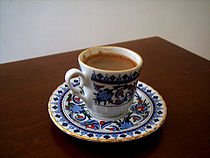
Cezve
A cezve is a pot designed specifically to make Turkish coffee.The body and handle is traditionally made of brass or copper , however in more recent times stainless steel, aluminium and ceramic offerings have become common....
), with sugar
Sugar
Sugar is a class of edible crystalline carbohydrates, mainly sucrose, lactose, and fructose, characterized by a sweet flavor.Sucrose in its refined form primarily comes from sugar cane and sugar beet...
according to taste, before being served into a cup
Coffee cup
A coffee cup may refer to a type of container from which coffee is consumed. Coffee cups are typically made of glazed ceramic, and have a single handle, allowing for portability while still hot...
where the dregs settle. This method of serving coffee is common throughout the Middle East
Middle East
The Middle East is a region that encompasses Western Asia and Northern Africa. It is often used as a synonym for Near East, in opposition to Far East...
, North Africa
North Africa
North Africa or Northern Africa is the northernmost region of the African continent, linked by the Sahara to Sub-Saharan Africa. Geopolitically, the United Nations definition of Northern Africa includes eight countries or territories; Algeria, Egypt, Libya, Morocco, South Sudan, Sudan, Tunisia, and...
, the Caucasus
Caucasus
The Caucasus, also Caucas or Caucasia , is a geopolitical region at the border of Europe and Asia, and situated between the Black and the Caspian sea...
, and the Balkans.
While the word 'coffee' comes from Arabic, coffeehouse
Coffeehouse
A coffeehouse or coffee shop is an establishment which primarily serves prepared coffee or other hot beverages. It shares some of the characteristics of a bar, and some of the characteristics of a restaurant, but it is different from a cafeteria. As the name suggests, coffeehouses focus on...
culture developed in the former Ottoman
Ottoman Empire
The Ottoman EmpireIt was usually referred to as the "Ottoman Empire", the "Turkish Empire", the "Ottoman Caliphate" or more commonly "Turkey" by its contemporaries...
world, and this was the dominant style of preparation.
History
The first evidence of brewed coffee as a beverage comes from 15th-century YemenYemen
The Republic of Yemen , commonly known as Yemen , is a country located in the Middle East, occupying the southwestern to southern end of the Arabian Peninsula. It is bordered by Saudi Arabia to the north, the Red Sea to the west, and Oman to the east....
. The word 'coffee' in most languages is derived directly or indirectly from the Arabic word قَهوه qahwah. By the late 15th and early 16th century, coffee had spread to Cairo
Cairo
Cairo , is the capital of Egypt and the largest city in the Arab world and Africa, and the 16th largest metropolitan area in the world. Nicknamed "The City of a Thousand Minarets" for its preponderance of Islamic architecture, Cairo has long been a centre of the region's political and cultural life...
and Mecca
Mecca
Mecca is a city in the Hijaz and the capital of Makkah province in Saudi Arabia. The city is located inland from Jeddah in a narrow valley at a height of above sea level...
.
The Ottoman chronicler İbrahim Peçevi
Ibrahim Peçevi
İbrahim Peçevi or Peçuyli İbrahim Efendi was a Turkish historian of the Ottoman Empire. He was born in Pécs, Ottoman Empire , hence his name, Peçevi . His mother was of Sokollu Bosnian family. The name of his father is unknown...
reports the opening of the first coffeehouse in Istanbul:
Various legends involving its introduction at a "Kiva Han" in 1475 are reported on web sites, but with no documentation.
Coffee has affected Turkish culture
Culture of Turkey
The culture of Turkey combines a largely diverse and heterogeneous set of elements that are derived from the Ottoman, European, Middle Eastern and Central Asian traditions...
so much that the Turkish word for breakfast, kahvaltı literally means "before coffee" (kahve 'coffee' + altı 'under/before'), while the Turkish word for brown is kahverengi, literally meaning "the color of coffee". In recent times, Turkish coffee has become less popular than tea
Tea
Tea is an aromatic beverage prepared by adding cured leaves of the Camellia sinensis plant to hot water. The term also refers to the plant itself. After water, tea is the most widely consumed beverage in the world...
(which was grown locally, and could be bought without hard currency
Hard currency
Hard currency , in economics, refers to a globally traded currency that is expected to serve as a reliable and stable store of value...
), instant coffee
Instant coffee
Instant coffee, also called soluble coffee and coffee powder, is a beverage derived from brewed coffee beans. Instant coffee is commercially prepared by either freeze-drying or spray drying, after which it can be rehydrated...
, and other modern styles of coffee. At the same time, it is served by international coffee chains such as Starbucks
Starbucks
Starbucks Corporation is an international coffee and coffeehouse chain based in Seattle, Washington. Starbucks is the largest coffeehouse company in the world, with 17,009 stores in 55 countries, including over 11,000 in the United States, over 1,000 in Canada, over 700 in the United Kingdom, and...
and Gloria Jean's Coffees in their stores located in Turkey, although it remains as an option, not a promoted beverage.
Another cultural presence of Turkish coffee is to be found in matrimonial customs. As a matrimonial prologue the prospective groom's family has to visit the prospective bride's family to ask their permission and blessings for the marriage. During this meeting, the prospective bride has to prepare and serve Turkish coffee to the guests. For the groom's coffee, the bride uses salt instead of sugar to gauge his character. If the prospective groom drinks his coffee without any sign of displeasure then the prospective bride assumes that the groom is good tempered and patient.
Name and variants
Until recently, Turkish coffee in the Middle East was called simply 'coffee' in the local language.In Turkey "kahve" (ultimately deriving from the , qahwah) was assumed to be 'Turkish coffee', until instant coffee
Instant coffee
Instant coffee, also called soluble coffee and coffee powder, is a beverage derived from brewed coffee beans. Instant coffee is commercially prepared by either freeze-drying or spray drying, after which it can be rehydrated...
was introduced in the 1980s. Today, younger generations refer to it as Türk kahvesi (Turkish coffee).
The word for "coffeeshop" in Modern Standard Arabic
Literary Arabic
Modern Standard Arabic , Standard Arabic, or Literary Arabic is the standard and literary variety of Arabic used in writing and in most formal speech....
is (maqha, literally meaning "place of coffee", plural, maqahi(n)), but the more common term in colloquial Arabic
Varieties of Arabic
The Arabic language is a Semitic language characterized by a wide number of linguistic varieties within its five regional forms. The largest divisions occur between the spoken languages of different regions. The Arabic of North Africa, for example, is often incomprehensible to an Arabic speaker...
is simply (qahwa), meaning "coffee" in much the same way as French
French language
French is a Romance language spoken as a first language in France, the Romandy region in Switzerland, Wallonia and Brussels in Belgium, Monaco, the regions of Quebec and Acadia in Canada, and by various communities elsewhere. Second-language speakers of French are distributed throughout many parts...
uses café for both things.
In many languages, the term "Turkish" coffee has been replaced by the local variant name as a political euphemism
Political euphemism
*Australia: During World War I, jam-filled buns previously known as Berliners were renamed Kitchener buns, and a sausage product previously known as "Fritz" was renamed "Devon" ....
. For example in "Armenian Coffee" (Հայկական սուրճ haykakan surj), "Greek coffee" (ελληνικός καφές ellinikós kafés), and "Cypriot coffee" (κυπριακός καφές kypriakós kafés), or dropped altogether. The words for "coffee" and "coffeeshop" remained unchanged in Greek as in the other Balkan languages
Balkan languages
This is a list of languages spoken in regions ruled by Balkan countries. With the exception of several Turkic languages, Hungarian, and Circassian, all of them belong to the Indo-European family...
, using the Ottoman Turkish forms kahve and kahvehane: Bulgarian кафе, кафене; Macedonian кафе, Serbian кафа, кафана; Croatian kava, kavana; Bosnian kahva, kafana; Slovenian kava, kavarna; Romanian cafea, cafenea; Greek καφές, καφενές (although now more commonly the Hellenized καφενείο); Albanian kafe, kafene.
Albania
In AlbanianAlbanian language
Albanian is an Indo-European language spoken by approximately 7.6 million people, primarily in Albania and Kosovo but also in other areas of the Balkans in which there is an Albanian population, including western Macedonia, southern Montenegro, southern Serbia and northwestern Greece...
it is called Kafe Turke, which simply means "Turkish coffee" and it is a very popular drink even though lately it has lost some of its appeal on the young who prefer Italian style espressos. This coffee constitutes an essential element of the Albanian social scene.
Arab world
In the Arab worldArab world
The Arab world refers to Arabic-speaking states, territories and populations in North Africa, Western Asia and elsewhere.The standard definition of the Arab world comprises the 22 states and territories of the Arab League stretching from the Atlantic Ocean in the west to the Arabian Sea in the...
, "Turkish" coffee is the most common kind of coffee. It is called Arabic coffee
Arabic coffee
Arabic coffee is a general name that refers to the way coffee is prepared in many Arab Gulf countries.There are two main ways of preparing Arabic coffee. Traditional coffee brewing, more common in Najd and Hijaz, is flavor-rich with cardamom, and sometimes other spices like saffron , cloves, and...
(qahoua `arabiyah, ). Only occasionally will Arabs refer to Turkish coffee as being from their native country, so constructions such as "Egyptian coffee," "Syrian coffee," "Lebanese coffee," "Iraqi coffee," and the like are heard to draw a distinction in the flavor, preparation, or presentation of two different kinds of Turkish coffee; for instance, an Egyptian using the term قهوة عربية qahoua Arabiya as distinct from قهوة مصرية qahoua Masriya would be distinguishing the Levantine from the Egyptian style of Turkish coffee. Some argue that what is known as turkish coffee is actually very close to coffee that has been made for ages in Yemen, parts of Oman and South Western Saudi. In any case, there is a very distinguished Arabic coffee that is very common in Saudi Arabia and it is very different from what is known as Turkish coffee in terms of taste, smell and color.
Armenia
In ArmeniaArmenia
Armenia , officially the Republic of Armenia , is a landlocked mountainous country in the Caucasus region of Eurasia...
, Turkish coffee is called սուրճ (surč̣ 'coffee') or հայկական. It is either served regular (sovorakan), sweet (k’aġc’r) or without sugar (daṙë).
Bosnia and Herzegovina
In Bosnia and HerzegovinaBosnia and Herzegovina
Bosnia and Herzegovina , sometimes called Bosnia-Herzegovina or simply Bosnia, is a country in Southern Europe, on the Balkan Peninsula. Bordered by Croatia to the north, west and south, Serbia to the east, and Montenegro to the southeast, Bosnia and Herzegovina is almost landlocked, except for the...
Turkish coffee is also called "Bosnian coffee" (Bosnian: bosanska kahva), which is made slightly differently than its Turkish predecessor. It is usually made with Bosnian coffee brands (including Zlatna Džezva, Minas, and Saraj Kafa). Another thing different from the Turkish way of preparing the coffee is that in Bosnia, when water reaches its boiling point a small amount is saved aside for later, usually in a coffee cup
Coffee cup
A coffee cup may refer to a type of container from which coffee is consumed. Coffee cups are typically made of glazed ceramic, and have a single handle, allowing for portability while still hot...
. Next the coffee is added to the pot (džezva
Cezve
A cezve is a pot designed specifically to make Turkish coffee.The body and handle is traditionally made of brass or copper , however in more recent times stainless steel, aluminium and ceramic offerings have become common....
), and than the remaining water in the cup is added to the pot and everything is put back on the heat source to reach its boiling point
Boiling point
The boiling point of an element or a substance is the temperature at which the vapor pressure of the liquid equals the environmental pressure surrounding the liquid....
again which takes a couple of seconds only since the coffee is already very hot. Some consumers say that this method of preparing gives the coffee a more distinct flavor. Coffee drinking in Bosnia is a traditional daily custom and plays an important role in society, especially during social gatherings.
Bulgaria
In BulgarianBulgarian language
Bulgarian is an Indo-European language, a member of the Slavic linguistic group.Bulgarian, along with the closely related Macedonian language, demonstrates several linguistic characteristics that set it apart from all other Slavic languages such as the elimination of case declension, the...
it is called Турско Кафе, which means "Turkish coffee". Interestingly enough, such preparation used to be very popular throughout the 20th Century, but mostly in home brewing, while Bulgarian cafe culture is largely espresso and cappuccino oriented. However, it has always been an essential part of Bulgarian coffee culture and social fabric. Turkish coffee was/is a favourite in friendly gatherings and reading fortunes.
Croatia
In Croatia, it is called turska kava, i.e. "Turkish coffee". Otherwise, it is known as simply kava, unless when referred to in cafes, in order to avoid confusion with other types of coffee drinks. The coffee is prepared in a dzezva where water is boiled then removed from the stove. Sugar is added and stirred to produce sweet water. The coffee is added and stirred, then returned to the stove. The coffee is ready when the surface starts to separate. The top layer is scooped and placed in the cup first, followed by the coffee. The coffee is drunk throughout the day, particularly before breakfast.Cyprus
In CyprusCyprus
Cyprus , officially the Republic of Cyprus , is a Eurasian island country, member of the European Union, in the Eastern Mediterranean, east of Greece, south of Turkey, west of Syria and north of Egypt. It is the third largest island in the Mediterranean Sea.The earliest known human activity on the...
, local coffee has been called Cypriot coffee (κυπριακός καφές kypriakós kafés) since the Turkish invasion of Cyprus
Turkish invasion of Cyprus
The Turkish invasion of Cyprus, launched on 20 July 1974, was a Turkish military invasion in response to a Greek military junta backed coup in Cyprus...
. The special coffee pot used in the process is called briki. Cypriot Coffee is served either unsweetened, medium sweet (1 teaspoon of sugar), or very sweet (2 teaspoons). Traditionally, Cypriot men are seen drinking coffee at village coffee shops while playing tavli or other boardgames. As in the Arab world, western coffee is usually referred to as "Nescafé".
Greece
In Greece, Turkish coffee was formerly referred to simply as τούρκικος 'Turkish'. But after the Turkish invasion of CyprusTurkish invasion of Cyprus
The Turkish invasion of Cyprus, launched on 20 July 1974, was a Turkish military invasion in response to a Greek military junta backed coup in Cyprus...
, the name soon changed to 'ελληνικός' 'Greek':
Hungary
HungariansHungary
Hungary , officially the Republic of Hungary , is a landlocked country in Central Europe. It is situated in the Carpathian Basin and is bordered by Slovakia to the north, Ukraine and Romania to the east, Serbia and Croatia to the south, Slovenia to the southwest and Austria to the west. The...
simply call the beverage Turkish Coffee (török kávé). This way of drinking coffee is no longer popular in Hungary but some restaurants still have it on the menu. It was popular in the 1980-1990s as expensive machines were not needed to make it, only ground coffee, a cup and hot water. At that time one could not buy ground coffee in shops, but with electric coffee mills in bigger shops, it was milled on the spot.
Iran
IranIran
Iran , officially the Islamic Republic of Iran , is a country in Southern and Western Asia. The name "Iran" has been in use natively since the Sassanian era and came into use internationally in 1935, before which the country was known to the Western world as Persia...
is a huge importer of Turkish Coffee. Despite the wide popularity of Nestlé
Nestlé
Nestlé S.A. is the world's largest food and nutrition company. Founded and headquartered in Vevey, Switzerland, Nestlé originated in a 1905 merger of the Anglo-Swiss Milk Company, established in 1867 by brothers George Page and Charles Page, and Farine Lactée Henri Nestlé, founded in 1866 by Henri...
's Instant Coffee brand, Nescafé
Nescafé
Nescafé is a brand of instant coffee made by Nestlé. It comes in the form of many different products. The name is a portmanteau of the words "Nestlé" and "café". Nestlé's flagship powdered coffee product was introduced in Switzerland on April 1, 1938 after being developed for seven or eight years...
in this country, Turkish Coffee also has a great market.
Israel
In HebrewHebrew language
Hebrew is a Semitic language of the Afroasiatic language family. Culturally, is it considered by Jews and other religious groups as the language of the Jewish people, though other Jewish languages had originated among diaspora Jews, and the Hebrew language is also used by non-Jewish groups, such...
it is called Kafé Turki (קפה טורקי) which simply means "Turkish coffee" whereas coffee made by pouring boiling water over the same ground beans (without cooking) is known as Kafé Botz (קפה בוץ), i.e. "mud
Mud
Mud is a mixture of water and some combination of soil, silt, and clay. Ancient mud deposits harden over geological time to form sedimentary rock such as shale or mudstone . When geological deposits of mud are formed in estuaries the resultant layers are termed bay muds...
coffee". Others may call it Kafé Shahor (קפה שחור, which means "black coffee"), since it is usually prepared without milk
Milk
Milk is a white liquid produced by the mammary glands of mammals. It is the primary source of nutrition for young mammals before they are able to digest other types of food. Early-lactation milk contains colostrum, which carries the mother's antibodies to the baby and can reduce the risk of many...
.
Kosovo
In KosovoKosovo
Kosovo is a region in southeastern Europe. Part of the Ottoman Empire for more than five centuries, later the Autonomous Province of Kosovo and Metohija within Serbia...
, it is also called "Kafe turke" (Albanian) or "turska kafa" (Serbian)(Turkish coffee), and it is a very popular drink within the kosovar society. Kosovars also drink it two or three times a day.
FYR Macedonia
In Macedonia the most popular term about this type of coffee is турско кафе (tursko kafe, Turkish coffee), even though the term Macedonian coffee may be used as well. The Turkish coffee is one of the basic components of the Macedonian cuisine. There is not a specific part of the day when the coffee should be consumed and it can be served anytime and anywhere in accordance to the consumer's desires. There many local Macedonian coffee brands, which are popular, but also foreign coffee brands can be bought and drank throughout the country.Romania
In RomaniaRomania
Romania is a country located at the crossroads of Central and Southeastern Europe, on the Lower Danube, within and outside the Carpathian arch, bordering on the Black Sea...
Turkish coffee is called 'cafea turcească', 'cafea caimac' or 'cafea la ibric'. The pot is called 'ibric', and in Dobrogea it is made in a copper kettle filled with sand - this kind of coffee is called 'cafea la nisip'.
Actually, the kettle is warmed in a hot sand recipient (can be copper or simply iron).
Serbia
In Serbian communities, it may be called simply домаћа кафа/domaća kafa 'domestic coffee' or кафа/kafa 'coffee'. It is often called simply "Tурска/Turska" when the Serbs drink it in the "кафана/kafana" (coffee house). Especially strong coffee (горка/gorka) (without sugar and milk) is often referred to as 'Turkish' or 'black' coffee. It is very popular drink in Serbia, and the Serbs drink it during meetings with friends, family and other social gatherings. usually 3-5 or more times per day. It is usually made with џезва/džezva (small coffee pot). Another thing different from the Turkish way of preparing the coffee is that in Serbia, when water reaches its boiling point a small amount is saved aside for later, usually in a coffee cupCoffee cup
A coffee cup may refer to a type of container from which coffee is consumed. Coffee cups are typically made of glazed ceramic, and have a single handle, allowing for portability while still hot...
. Next the coffee is added to the pot (џезва/džezva), and than the remaining water in the cup is added to the pot and everything is put back on the heat source to reach its boiling point
Boiling point
The boiling point of an element or a substance is the temperature at which the vapor pressure of the liquid equals the environmental pressure surrounding the liquid....
again which takes a couple of seconds only since the coffee is already very hot. Some consumers say that this method of preparing gives the coffee a more distinct flavor.
Slovenia
In Slovenia it is called turška kava (regionally kôva, kavca, kofè, kofé, kofi, kafe, kafjéè, kafa, kufé, kufjè) 'Turkish coffee'. Otherwise, it is known as simply kava, unless when referred to in cafes, in order to avoid confusion with other types of coffee drinks. Especially strong coffee (without sugar and milk) is often referred to as črna kava 'black coffee'.Equipment
Turkish coffee is normally prepared using a narrow-topped small boiling pot called an kanaka, cezveCezve
A cezve is a pot designed specifically to make Turkish coffee.The body and handle is traditionally made of brass or copper , however in more recent times stainless steel, aluminium and ceramic offerings have become common....
, džezva, xhezve or μπρίκι (bríki) (basically a tiny ewer), a teaspoon
Teaspoon
A teaspoon, an item of cutlery, is a small spoon, commonly part of a silverware place setting, suitable for stirring and sipping the contents of a cup of tea or coffee...
and a heating apparatus. The ingredients are very finely ground coffee, sometimes cardamom
Cardamom
Cardamom refers to several plants of the genera Elettaria and Amomum in the ginger family Zingiberaceae. Both genera are native to India and Bhutan; they are recognised by their small seed pod, triangular in cross-section and spindle-shaped, with a thin papery outer shell and small black seeds...
, cold water and (if desired) sugar
Sugar
Sugar is a class of edible crystalline carbohydrates, mainly sucrose, lactose, and fructose, characterized by a sweet flavor.Sucrose in its refined form primarily comes from sugar cane and sugar beet...
. It is served in a demitasse
Demitasse
A demitasse is a small cup used to serve Arabic coffee or espresso. In some languages it is called fincan, fildžan, filxhan or φλιτζάνι . In Spanish, it is called a pocillo....
(fincan, fildžan,filxhan or φλιτζάνι (flidzáni)). Some modern cups have handles; traditional cups did not, and coffee was drunk either by handling the cup with the fingertips or, more often, by placing the cup in a zarf
Zarf
A Zarf is a holder, usually of ornamental metal, for a coffee cup without a handle .-History:Although coffee was probably discovered in Ethiopia, it was in Turkey at around the thirteenth century that it became popular as a beverage. As with the serving of tea in China and Japan, the serving of...
, a metal container with a handle.
Traditionally, the pot is made of copper
Copper
Copper is a chemical element with the symbol Cu and atomic number 29. It is a ductile metal with very high thermal and electrical conductivity. Pure copper is soft and malleable; an exposed surface has a reddish-orange tarnish...
and has a wooden handle, although other metals such as aluminium with a non-stick coating are also used. The size of the pot is chosen to be close to the total volume of the cups to be prepared, since using too large a pot causes much of the foam to stick to the inside of it. The teaspoon is used both for stirring and measuring the amount of coffee and sugar. The teaspoons in some other countries are much larger than the teaspoons in countries where Turkish coffee is common: The dipping parts of the teaspoons in these countries are about 1 cm (0.4 inches) long and 0.5 cm (0.2 inches) wide.
A moderately low heat is used so that the coffee does not come to the boil too quickly—the beans need to be in hot water for long enough to extract the flavour. In a modern setting normal gas or electric heating is satisfactory. Traditional heating sources include the ember
Ember
Embers are the glowing, hot coals made of greatly heated wood, coal, or other carbon-based material that remain after, or sometimes precede a fire. Embers can glow very hot, sometimes as hot as the fire which created them...
s of a fire, or a tray about 10 cm (4 in) deep filled with sand. The tray is placed on the burner. When the sand is hot, the coffee pot is placed in the sand. This allows a more even and gentle heat transfer
Heat transfer
Heat transfer is a discipline of thermal engineering that concerns the exchange of thermal energy from one physical system to another. Heat transfer is classified into various mechanisms, such as heat conduction, convection, thermal radiation, and phase-change transfer...
than direct heat.
Preparation
Coffee bean
A coffee bean is a seed of a coffee plant. It is the pit inside the red or purple fruit often referred to as a cherry. Even though they are seeds, they are referred to as 'beans' because of their resemblance to true beans. The fruits - coffee cherries or coffee berries - most commonly contain two...
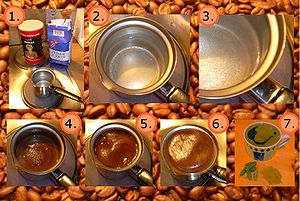
for Turkish coffee are ground or pounded to the finest possible powder; finer than for any other way of preparation. The grinding is done either by pounding in a mortar
Mortar and pestle
A mortar and pestle is a tool used to crush, grind, and mix solid substances . The pestle is a heavy bat-shaped object, the end of which is used for crushing and grinding. The mortar is a bowl, typically made of hard wood, ceramic or stone...
(the original method) or using a burr mill
Burr mill
A burr mill or burr grinder is a device to grind hard, small food products between two revolving abrasive surfaces separated by a distance usually set by the user. Usually the device includes a revolving screw that pushes the food through...
. Most domestic coffee mills are unable to grind finely enough; traditional Turkish hand grinders are an exception.
As with any other sort of coffee, the best Turkish coffee is made from freshly roasted beans ground just before brewing. Turkish-ground coffee can be bought and stored as any other type, although it loses flavour with time.
While there are variations in detail, preparation of Turkish coffee consists of immersing the coffee grounds in water which is usually hot, but not boiling, for long enough to dissolve the flavoursome compounds. While prolonged boiling of coffee gives it an unpleasant "cooked" or "burnt" taste, very brief boiling does not and shows without guesswork that it has reached the appropriate temperature.
The amount of cold water necessary can be measured in the number of demitasse cups desired (approximately 3 ounces or 90 ml) with between one and two heaped teaspoons of coffee being used per cup. The coffee and sugar are usually added to the water rather than being put into the pot first.
In Turkey, four degrees of sweetness are used. The Turkish
Turkish language
Turkish is a language spoken as a native language by over 83 million people worldwide, making it the most commonly spoken of the Turkic languages. Its speakers are located predominantly in Turkey and Northern Cyprus with smaller groups in Iraq, Greece, Bulgaria, the Republic of Macedonia, Kosovo,...
terms and approximate amounts are as follows: sade (plain; no sugar), az şekerli (little sugar; half a level teaspoon of sugar), orta şekerli (medium sugar; one level teaspoon), and çok şekerli (a lot of sugar; one and a half or two level teaspoons). In the Arab World "sāda" ( plain; no sugar, meaning "black" in Arabic) or "murra" ( bitter; no sugar) is common.
The coffee and the desired amount of sugar are stirred until all coffee sinks and the sugar is dissolved. Following this, the spoon is removed and the pot is put on moderate heat; if too high, the coffee comes to the boil too quickly, without time to extract the flavour. No stirring is done beyond this point, as it would dissolve the foam.
Just as the coffee comes to the boil, the pot is removed from the heat. It is usually kept off the heat for a short time, then brought to boil a second and a third time, then the coffee is poured into the cups.
Getting the thickest possible layer of foam is considered the peak of the coffee maker's art. One way to maximise this is to pour slowly and try to lift the pot higher and higher as the pouring continues. Regardless of these techniques, getting the same amount of foam into all cups is hard to achieve, and the cup with the most foam is considered the best of the lot.
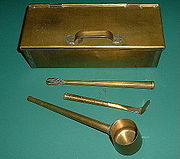
There are other schools of preparing Turkish coffee that vary from the above. Lebanese coffee starts with hot water alone, to which sugar is added and dissolved. The product is in essence a sugar syrup with a higher boiling point
Boiling point
The boiling point of an element or a substance is the temperature at which the vapor pressure of the liquid equals the environmental pressure surrounding the liquid....
than water. The coffee, and cardamom
Cardamom
Cardamom refers to several plants of the genera Elettaria and Amomum in the ginger family Zingiberaceae. Both genera are native to India and Bhutan; they are recognised by their small seed pod, triangular in cross-section and spindle-shaped, with a thin papery outer shell and small black seeds...
if wanted, are added, and the mixture is stirred. It is then brought to a boil two or three times; the double (or triple) boiling is an essential part of the process, both ceremonially and—as connoisseurs claim—for the palate. It has the effect of subjecting the coffee grounds to hot (but not boiling) water for longer, extracting more flavour without imparting the "cooked" taste of over-boiled coffee.
In the Balkans, dominant practice is to fill the džezva with only cold water, and heat it until it boils. As the water boils coffee is added, stirred, and removed from the fire before the foam boils over. After the foam settles the pot is placed back onto the heat source so the water would boil again, releasing more caffeine and flavour. Sometimes the last step is skipped, to preserve the foam. This type of preparation is known as Bosnian coffee or Serbian coffee.
The Armenian mode of preparation is distinct in that all of the ingredients — water, the coffee grounds, and sugar (if desired) — are all combined in the pot before being heated. After the initial mixing the coffee is then heated but not stirred again until the coffee has finished brewing. The preparation process does not usually include boiling. The coffee is usually only allowed to rise once or twice, but never three times as is typical in the Lebanese mode of preparation.
In Bulgaria, the best practice of making a Turkish Coffee is boiling, or rather heating the water to just before a boil, adding the coffee grounds and waiting for the first rise. Once the foam rises, just before its peak, it is removed from the heat and poured on top of the sugar in the cups. The coffee is never to be stirred in the pot (or in the cups) and never allowed to rise over. The coffee is sipped and once finished, the cup is always turned over in its saucer until the grounds slowly pour out. These grounds are always glanced over for quick fortune read or a more elaborate one depending on circumstance and ability to read the images. The grounds pattern in the saucer is also taken in consideration.
Drinking
Turkish Delight
Turkish delight or lokum is a family of confections based on a gel of starch and sugar. Premium varieties consist largely of chopped dates, pistachios and hazelnuts or walnuts bound by the gel; the cheapest are mostly gel, generally flavored with rosewater, mastic, or lemon...
. In the Mediterranean and southeastern Turkey, pistachio
Pistachio
The pistachio, Pistacia vera in the Anacardiaceae family, is a small tree originally from Persia , which now can also be found in regions of Syria, Lebanon, Turkey, Greece, Kyrgyzstan, Turkmenistan, India, Pakistan, Egypt, Sicily and possibly Afghanistan , as well as in the United States,...
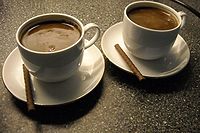
grains (kakuli/menengiç) may be added into the coffee. All of the coffee in the pot is poured into cups, but not all of it is drunk. The thick layer of sludgy grounds at the bottom of the cup is left behind.
Fortune-telling
The grounds left after drinking Turkish coffee can be used for fortune-telling. The cup is commonly turned over into the saucerSaucer
A saucer is a small type of dishware, a plate that is specifically used with and for supporting a cup – a cylindrical cup intended for coffee or a half-sphere teacup for tea. Additionally, the saucer is a distant cousin to the plate. The saucer has a raised centre with a depression sized to fit a...
to cool, and then the patterns of the coffee grounds can be used for a method of fortune telling
Fortune-telling
Fortune-telling is the practice of predicting information about a person's life. The scope of fortune-telling is in principle identical with the practice of divination...
known as tasseography
Tasseography
Tasseography is a divination or fortune-telling method that interprets patterns in tea leaves, coffee grounds, or wine sediments....
, or tasseomancy.