

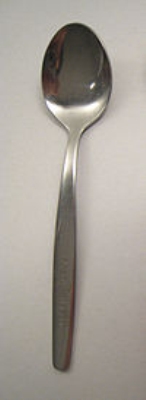
Teaspoon

Encyclopedia
Cutlery
Cutlery refers to any hand implement used in preparing, serving, and especially eating food in the Western world. It is more usually known as silverware or flatware in the United States, where cutlery can have the more specific meaning of knives and other cutting instruments. This is probably the...
, is a small spoon
Spoon
A spoon is a utensil consisting of a small shallow bowl, oval or round, at the end of a handle. A type of cutlery , especially as part of a place setting, it is used primarily for serving. Spoons are also used in food preparation to measure, mix, stir and toss ingredients...
, commonly part of a silverware
Silver (household)
Household silver or silverware includes dishware, cutlery and other household items made of sterling, Britannia or Sheffield plate silver. The term is often extended to items made of stainless steel...
(usually silver plated, German silver or now, stainless steel) place setting, suitable for stirring and sipping the contents of a cup of tea
Tea
Tea is an aromatic beverage prepared by adding cured leaves of the Camellia sinensis plant to hot water. The term also refers to the plant itself. After water, tea is the most widely consumed beverage in the world...
or coffee
Coffee
Coffee is a brewed beverage with a dark,init brooo acidic flavor prepared from the roasted seeds of the coffee plant, colloquially called coffee beans. The beans are found in coffee cherries, which grow on trees cultivated in over 70 countries, primarily in equatorial Latin America, Southeast Asia,...
. Utilitarian versions are used for measuring.
Teaspoons with longer handles, such as iced tea spoons, are commonly used also for ice cream
Ice cream
Ice cream is a frozen dessert usually made from dairy products, such as milk and cream, and often combined with fruits or other ingredients and flavours. Most varieties contain sugar, although some are made with other sweeteners...
desserts or floats
Ice cream soda
An ice cream soda or float , coke float , or spider , is a beverage that consists of one or more scoops of ice cream in either a soft drink or in a mixture of flavored syrup and carbonated water.-Origins:The ice cream soda was invented by Robert M...
. Similar spoons include the tablespoon
Tablespoon
A tablespoon is a type of large spoon usually used for serving. A tablespoonful, the capacity of one tablespoon, is commonly used as a measure of volume in cooking...
and the dessert spoon
Dessert spoon
thumb|right|From left: [[knife]], [[fork]], dessert spoon, [[teaspoon]] A dessert spoon is a spoon designed specifically for eating dessert and sometimes used for soup or cereals...
, the latter intermediate in size between a teaspoon and a tablespoon, used in eating dessert and sometimes soup or cereals. Much less common is the coffee spoon, which is a smaller version of the teaspoon. Another teaspoon, called an orange spoon (in American English: grapefruit spoon), tapers to a sharp point or teeth, and is used to separate citrus fruits from their membranes. A bar spoon
Bar spoon
A bar spoon is a long handled spoon used in bartending for mixing and layering of both alcoholic and non-alcoholic mixed drinks. Its length ensures that it can reach to bottom of the tallest jug or tumbler to mix ingredients directly in the glass. A bar spoon holds about 5 millilitres of liquid...
, equivalent to a teaspoon, is used in measuring ingredients for mixed drinks. The tablespoon is a larger version of the teaspoon, generally with three times its capacity.
A container designed to hold extra teaspoons, called a spooner, usually in a set with a covered sugar container, formed a part of Victorian table service.
Measure of volume
In some countries, a teaspoon full is a unit of volumeCooking weights and measures
In recipes, quantities of ingredients may be specified by mass, by volume, or by count.For most of history, most cookbooks did not specify quantities precisely, instead talking of "a nice leg of spring lamb", a "cupful" of lentils, a piece of butter "the size of a walnut", and "sufficient" salt...
, especially in cooking
Cooking
Cooking is the process of preparing food by use of heat. Cooking techniques and ingredients vary widely across the world, reflecting unique environmental, economic, and cultural traditions. Cooks themselves also vary widely in skill and training...
recipe
Recipe
A recipe is a set of instructions that describe how to prepare or make something, especially a culinary dish.-Components:Modern culinary recipes normally consist of several components*The name of the dish...
s and pharmaceutic
Pharmacology
Pharmacology is the branch of medicine and biology concerned with the study of drug action. More specifically, it is the study of the interactions that occur between a living organism and chemicals that affect normal or abnormal biochemical function...
prescriptions
Medical prescription
A prescription is a health-care program implemented by a physician or other medical practitioner in the form of instructions that govern the plan of care for an individual patient. Prescriptions may include orders to be performed by a patient, caretaker, nurse, pharmacist or other therapist....
. In English it is abbreviated as t., ts., tsp. or tspn. ), never capitalized, as capitals are customarily reserved for the larger tablespoon
Tablespoon
A tablespoon is a type of large spoon usually used for serving. A tablespoonful, the capacity of one tablespoon, is commonly used as a measure of volume in cooking...
("T." or "Tbls." or "Tb."). In German and Dutch teaspoon is abbreviated TL, for Teelöffel and Theelepel respectively.
In the United States one teaspoon is tablespoon
Tablespoon
A tablespoon is a type of large spoon usually used for serving. A tablespoonful, the capacity of one tablespoon, is commonly used as a measure of volume in cooking...
, that is, ~4.93 mL; it is exactly
U.S. fl. oz
Fluid ounce
A fluid ounce is a unit of volume equal to about 28.4 mL in the imperial system or about 29.6 mL in the US system. The fluid ounce is distinct from the ounce, which measures mass...
, cup, and U.S. liquid gallon
Gallon
The gallon is a measure of volume. Historically it has had many different definitions, but there are three definitions in current use: the imperial gallon which is used in the United Kingdom and semi-officially within Canada, the United States liquid gallon and the lesser used United States dry...
(see United States customary units
United States customary units
United States customary units are a system of measurements commonly used in the United States. Many U.S. units are virtually identical to their imperial counterparts, but the U.S. customary system developed from English units used in the British Empire before the system of imperial units was...
for relative volumes of these other measures) and approximately cubic inch
Cubic inch
The cubic inch is a unit of measurement for volume in the Imperial units and United States customary units systems. It is the volume of a cube with each of its 3 sides being one inch long....
.
For nutritional labeling on food packages in the U.S., the teaspoon is defined as precisely 5 mL
Common teaspoons such as bar spoons for measuring ingredients and stirring mixed drinks are often not designed to contain a standard volume. In practice, they may hold anything between 2.5 mL and 6 mL of liquid, so such spoons are not suitable for precise measurements, in particular for medicine.
If a recipe calls for a level teaspoonful of a dry ingredient (salt, flour, etc.), this refers to an approximately levelled filling of the spoon, producing the same volume as for liquids.
A rounded teaspoonful is a larger but less precise measure, produced without levelling the ingredient off nor heaping it as high as possible.
A heaping (American English) or heaped (British English) teaspoonful is a larger inexact measure, equal to the most that can be obtained by scooping the dry ingredient up without levelling it off. For some ingredients, e.g. flour, this quantity can vary considerably.
When no particular type of teaspoonful is specified for a dry ingredient it may mean a level or a rounded spoonful, never a heaping/heaped one.