

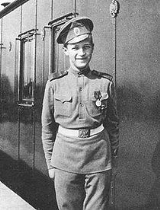
Tsarevich Alexei Nikolaevich of Russia

Encyclopedia
Alexei Nikolaevich of the House of Romanov, was the Tsesarevich
and heir apparent
to the throne of the Russian Empire
. In English, his title is usually given as Tsarevich, a title that has a separate meaning in Russia. Alexei was the youngest child and only son of Emperor Nicholas II and Empress Alexandra Feodorovna. Born with haemophilia
, his mother's reliance on the starets
Grigori Rasputin
to treat the disease helped bring about the end of the Romanov dynasty. After the February Revolution
of 1917, he and his family were sent into internal exile in Tobolsk
, Siberia
. He was murdered alongside his parents, four sisters, and three retainers during the Russian Civil War
by order of the Bolshevik
government, though rumors that he had survived persisted until the 2007 discovery of his and his sister Maria's remains. The family was formally interred on 17 July 1998—the eightieth anniversary of the murder—and were canonized as passion bearer
s by the Russian Orthodox Church
in 2000.
, Russian Empire
. He was the youngest of five children, and the only male, born to Emperor and Empress Nicholas II and Alexandra Feodorovna. His older sisters were the Grand Duchesses Olga
, Tatiana
, Maria and Anastasia
. He was doted on by his parents and sisters and known as "Baby" in the family. He was later also affectionately referred to as Alyosha (Алёша) and Lyoshka (Лёшка).
Alexei was christened on 3 September 1904 in the chapel in Peterhof Palace
. His principal godparent
s were his paternal grandmother and his great-uncle, Grand Duke Alexei Alexandrovich
. His other godparents included his oldest sister, Olga; his great-grandfather King Christian IX of Denmark
; King Edward VII of the United Kingdom
, the Prince of Wales
and William II, Kaiser of Germany
. As Russia was at war with Japan
, all the soldiers and officers of the Russian Army and Navy were named honorary godfathers.
The christening marked the first time some of the younger members of the Imperial Family, including some of the younger sons of Grand Duke Konstantin Konstantinovich
, as well as the Grand Duchesses Olga and Tatiana, and their cousin Princess Irina Alexandrovna
, were present at an official ceremony. For the occasion, the boys wore miniature military uniforms, and the girls wore a smaller version of the court dress and little kokoshnik
s. The sermon was delivered by John of Kronstadt
, and the baby was carried to the font by the elderly Mistress of the Robes, Princess Galitzine. As a precaution, she had rubber soles put to her shoes to avoid falling and dropping him. Countess Sophie Buxhoeveden recalled:
from his mother Alexandra, a condition that could be traced back to her maternal grandmother Queen Victoria. In 2009, genetic analysis determined specifically that he suffered from hemophilia B. Because of the disease, he lacked the clotting factors necessary to prevent him from bleeding to death. Because of this, he had to be careful to not injure himself. His disease led to controversy, as it led to gossip that his mother was having an affair with the Russian starets
, Grigori Rasputin
. Rasputin claimed to be able to "heal" Alexei when he was on the brink of death after spells of hemophilia-related complications. There are various explanations for Rasputin's ability, such as that Rasputin hypnotized Alexei, administered herbs to him, or that his advice to the Tsarina not to let the doctors bother Alexei too much aided the boy's healing. Others believe he truly possessed a supernatural healing ability or that his prayers to God saved the boy. Alexei and his sisters were taught to view Rasputin as "Our Friend" and to exchange confidences with him. Alexei was well aware that he might not live to adulthood. When he was ten, his older sister Olga found him lying on his back looking at the clouds and asked him what he was doing. "I like to think and wonder," Alexei replied. Olga asked him what he liked to think about.
"Oh, so many things," the boy responded. "I enjoy the sun and the beauty of summer as long as I can. Who knows whether one of these days I shall not be prevented from doing it?"
, Alexei was a simple, affectionate child, but his environment was spoiling him by the "servile flattery" of the servants and "silly adulations" of the people around him. Once, a deputation of peasants came to bring presents to Alexei. His nanny, Derevenko, required they kneel before Alexei. Gilliard remarked that the Tsarevich was "embarrassed and blushed violently", and when asked if he liked seeing people on their knees before him, he said, "Oh no, but Derevenko says it must be so!" When Gilliard encouraged Alexei to "stop Derevenko insisting on it", he replied that he "dare not". When Gilliard took the matter up with Derevenko, he said that Alexei was "delighted to be freed from this irksome formality".
"Alexei was the center of this united family, the focus of all its hopes and affections," wrote Gilliard. "His sisters worshipped him. He was his parents' pride and joy. When he was well, the palace was transformed. Everyone and everything in it seemed bathed in sunshine." He bore a striking resemblance to his mother, and was tall for his age, with "a long, finely chiseled face, delicate features, auburn hair with a coppery glint, and large grey-blue eyes like his mother," Though intelligent and affectionate, his education was frequently interrupted by bouts of haemophilia and he was spoiled because his parents couldn't bear to discipline him. His parents appointed two sailors from the Imperial Navy, Nagorny and Derevenko, to serve as nannies and to follow him about so he would not hurt himself. He was prohibited from riding a bicycle or playing too roughly, but was naturally active.
As a small child, he occasionally played pranks on guests. One example occurred at a formal dinner party, where Alexei removed the shoe of a female guest from under the table, and showed it to his father. Nicholas sternly told the boy to return the "trophy", which Alexei did after placing a large ripe strawberry into the toe of the shoe. As a result, he was barred from attending state dinners for the next several weeks.
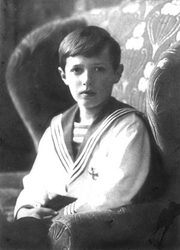 Gilliard eventually convinced Alexei's parents that granting the boy greater autonomy would help him develop better self control. A growing Alexei took advantage of his unaccustomed freedom, and began to outgrow some of his earlier foibles. Courtiers reported that his illness made him sensitive to the hurts of others. During World War I
, he lived with his father at army headquarters in Mogilev for long stretches of time and observed military life. In December 1916, Major-General
Sir John Hanbury-Williams
, head of the British military at Stavka
, received word of the death of his son in action with the British Expeditionary Force in France. Tsar Nicholas sent twelve-year-old Alexei to sit with the grieving father. "Papa told me to come sit with you as he thought you might feel lonely tonight," Alexei told the general. Alexei, like all the Romanov men, grew up wearing sailor uniforms and playing at war from the time he was a toddler. His father began to prepare him for his future role as Tsar by inviting Alexei to sit in on long meetings with government ministers.
Tsarevich Alexei was one of the first Boy Scout
s in Russia.
The Tsar's Colonel Mordinov remembered Alexei:
, Alexei joined his father at Stavka
, when his father became the Commander-in-chief
of the Russian Army
. Alexei seemed to like military life very much and became very playful and energetic. In one of his father's notes to his mother, he said “…Have come in from the garden
with wet sleeves and boots as Alexei sprayed us at the fountain
. It is his favorite game
…peals of laughter ring out. I keep an eye, in order to see that things do not go to far.” Alexei even ate the soldiers' black bread and even refused when he was offered a meal that he would eat in his palace, saying “It's not what soldiers eat”. And in 1916 was given the title of lance Corporal
, which he was very proud of. Alexei's favorite were the foreigners of Belgium
, Britain
, France
, Japan
, Italy
, and Serbia
, and in favor, adopted him as their Mascot. Hanbury-Williams
whom Alexei liked wrote “ As time went on and his shyness wore off he treated us like old friends and… had always some bit fun with us. With me it was to make sure that each button on my coat was properly fastened, a habit which naturally made me take great care to have one or two unbuttoned, in which case he used to at once to stop and tell me that I was ‘untidy again,’ give a sigh at my lack of attention to these details and stop and carefully button me up again.”
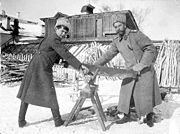 The royal family was arrested following the February Revolution
of 1917, which resulted in the abdication of Nicholas II. When he was in captivity at Tobolsk
, Alexei complained in his diary about how bored he was and begged God to have mercy upon him. He was permitted to play occasionally with Kolya, the son of one of his doctors, and with a kitchen boy named Leonid Sednev. As he became older, Alexei seemed to tempt fate and injure himself on purpose. While in Siberia
, he rode a sled down the stairs of the prison house and injured himself in the groin. The hemorrhage was very bad, and he was so ill that he could not be moved immediately when the Bolsheviks moved his parents and older sister Maria to Yekaterinburg
in April 1918. Alexei and his three other sisters joined the rest of the family weeks later. He was confined to a wheelchair for the remaining weeks of his life.
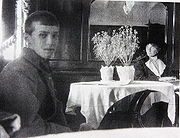 He was just under four weeks shy of his fourteenth birthday when he was murdered on 17 July 1918 in the cellar room of the Ipatiev House
in Yekaterinburg
. The assassination was carried out by forces of the Bolshevik
secret police under Yakov Yurovsky
. According to one account of the murder, the family was told to get up and get dressed in the middle of the night because they were going to be moved. Nicholas II carried Alexei to the cellar room. His mother asked for chairs to be brought so that she and Alexei could sit down. When the family and their servants were settled, Yurovsky announced that they were to be executed. The firing squad first killed Nicholas, the Tsarina, and the two male servants. Alexei remained sitting in the chair, "terrified," before the assassins turned on him and shot at him repeatedly. The boy remained alive and the killers tried to stab him multiple times with bayonets. "Nothing seemed to work," wrote Yurovsky later. "Though injured, he continued to live." Unbeknownst to the killing squad, the Tsarevich's torso was protected by a shirt wrapped in precious gems that he wore beneath his tunic. Finally Yurovsky fired two shots into the boy's head, and he fell silent. Rumors of Alexei's survival began to circulate when the bodies of his family and the royal servants were located. Alexei's was missing, along with that of one of his sisters (generally thought to be Maria or Anastasia). As a result of this, there have been people who have pretended to be the Tsarevich; these people are Alexei Poutziato, Joseph Veres, Heino Tammet, Michael Goleniewski
and Vassili Filatov. However, scientists considered it extremely unlikely that he escaped death, due to his lifelong hemophilia. The missing bodies were said to have been cremated
, though scientists believe it would have been impossible to completely cremate the bodies given the short amount of time and the materials the killing squad had to work with. Numerous searches of the forest surrounding Yekaterinburg up until 2007 failed to turn up the cremation site or the remains of Alexei and his sister.
's memoirs. The archaeologists said the bones are from a boy who was roughly between the ages of ten and thirteen years at the time of his death and of a young woman who was roughly between the ages of eighteen and twenty-three years old.
Anastasia was seventeen years, one month old at the time of the assassination, while Maria was nineteen years, one month old. Alexei was two weeks shy of his fourteenth birthday. Alexei's elder sisters Olga and Tatiana were twenty-two and twenty-one years old at the time of the assassination. Along with the remains of the two bodies, archaeologists found "shards of a container of sulfuric acid, nails, metal strips from a wooden box, and bullets of various caliber." The bones were found using metal detectors and metal rods as probes. Also, striped material was found that appeared to have been from a blue-and-white striped cloth; Alexei commonly wore a blue-and-white striped undershirt.
On 30 April 2008 Russian forensic scientists announced that DNA testing proves that the remains belong to the Tsarevich Alexei and to one of his sisters.
DNA information, made public in July 2008, that has been obtained from Ekaterinburg and repeatedly tested independently by laboratories such as the University of Massachusetts
Medical School, reveals that the final two missing Romanov remains are indeed authentic and that the entire Romanov family housed in the Ipatiev House, Ekaterinburg were executed in the early hours of 17 July 1918. In March 2009, results of the DNA testing were published, confirming that the two bodies discovered in 2007 were those of Tsarevich Alexei and one of his sisters. This revelation did not convince everyone, however, and some still insist that Alexei survived somehow.
Funeral details will have to be formalised between a Russian State commission and the Moscow Patriarchate.
as passion bearer
s by the Russian Orthodox Church
. The family had previously been canonized in 1981 by the Russian Orthodox Church Abroad as holy martyrs
. The bodies of Tsar Nicholas II, Tsarina Alexandra, and three of their daughters were finally interred at St. Peter and Paul Cathedral
in St. Petersburg on July 17, 1998—eighty years after they were murdered. The bodies of Alexei and one of his sisters, generally thought to be Anastasia or Maria, were missing. In recent years, believers have attributed miracles to their prayers to Alexei and his family.
 Alexei was the heir to the Romanov Throne. Paul I
had passed laws forbidding women to succeed to the throne (unless there were no legitimate male dynasts left, in which case, the throne would pass to the closest female relative of the last Tsar). This was done in revenge for what he perceived to be the illegal behavior of his mother, Catherine II
("the Great") in deposing his father Peter III
. Alexei was named after the second Romanov Tsar, Alexis I of Russia
, who ruled from 1645-76, known as "the Quiet" and father of Peter the Great
.
Tsar Nicholas II was forced to abdicate on 15 March 1917. He did this in favour of his twelve-year-old son Alexei who ascended the throne under a regency. Nicholas later decided to alter his original abdication. Whether that act had any legal validity is open to speculation. Nicholas consulted with doctors and others present and realised that he would have to be separated from Alexei. Not wanting Alexei to be parted from the family, Nicholas altered the abdication document in favour of his younger brother Grand Duke Michael Alexandrovich of Russia
. After receiving advice about whether his personal security could be guaranteed, Michael declined to accept the throne without the people's approval through an election held by the proposed Constituent Assembly.
Alexei's hemophilia was integral to the rise of Grigori Rasputin
. One of the many things Rasputin did that unintentionally facilitated the fall of the Romanovs was to tell the Tsar that the war would be won once he (Tsar Nicholas II) took command of the Russian Army. Following this advice was a serious mistake as the Tsar had no military experience. The Tsaritsa, Empress Alexandra, a deeply religious woman, came to rely upon Grigori Rasputin and believe in his ability to help Alexei where conventional doctors had failed. This theme is explored in Robert K. Massie's Nicholas and Alexandra
. It is possible that if Alexei had not suffered so terribly, Rasputin could never have gained such influence over Russian politics during World War I
, which is generally seen to have at least hastened the collapse of Romanov rule.
Caring for Alexei seriously diverted the attention of his father, Nicholas II, and the rest of the Romanovs from the business of war and government.
Tsesarevich
Tsesarevich was the title of the heir apparent or presumptive in the Russian Empire. It either preceded or replaced the given name and patronymic.-Usage:...
and heir apparent
Heir apparent
An heir apparent or heiress apparent is a person who is first in line of succession and cannot be displaced from inheriting, except by a change in the rules of succession....
to the throne of the Russian Empire
Russian Empire
The Russian Empire was a state that existed from 1721 until the Russian Revolution of 1917. It was the successor to the Tsardom of Russia and the predecessor of the Soviet Union...
. In English, his title is usually given as Tsarevich, a title that has a separate meaning in Russia. Alexei was the youngest child and only son of Emperor Nicholas II and Empress Alexandra Feodorovna. Born with haemophilia
Haemophilia
Haemophilia is a group of hereditary genetic disorders that impair the body's ability to control blood clotting or coagulation, which is used to stop bleeding when a blood vessel is broken. Haemophilia A is the most common form of the disorder, present in about 1 in 5,000–10,000 male births...
, his mother's reliance on the starets
Starets
A starets is an elder of a Russian Orthodox monastery who functions as venerated adviser and teacher. Elders or spiritual fathers are charismatic spiritual leaders whose wisdom stems from God as obtained from ascetic experience...
Grigori Rasputin
Grigori Rasputin
Grigori Yefimovich Rasputin was a Russian Orthodox Christian and mystic who is perceived as having influenced the latter days of the Russian Emperor Nicholas II, his wife Alexandra, and their only son Alexei...
to treat the disease helped bring about the end of the Romanov dynasty. After the February Revolution
February Revolution
The February Revolution of 1917 was the first of two revolutions in Russia in 1917. Centered around the then capital Petrograd in March . Its immediate result was the abdication of Tsar Nicholas II, the end of the Romanov dynasty, and the end of the Russian Empire...
of 1917, he and his family were sent into internal exile in Tobolsk
Tobolsk
Tobolsk is a town in Tyumen Oblast, Russia, located at the confluence of the Tobol and Irtysh Rivers. It is a historic capital of Siberia. Population: -History:...
, Siberia
Siberia
Siberia is an extensive region constituting almost all of Northern Asia. Comprising the central and eastern portion of the Russian Federation, it was part of the Soviet Union from its beginning, as its predecessor states, the Tsardom of Russia and the Russian Empire, conquered it during the 16th...
. He was murdered alongside his parents, four sisters, and three retainers during the Russian Civil War
Russian Civil War
The Russian Civil War was a multi-party war that occurred within the former Russian Empire after the Russian provisional government collapsed to the Soviets, under the domination of the Bolshevik party. Soviet forces first assumed power in Petrograd The Russian Civil War (1917–1923) was a...
by order of the Bolshevik
Bolshevik
The Bolsheviks, originally also Bolshevists , derived from bol'shinstvo, "majority") were a faction of the Marxist Russian Social Democratic Labour Party which split apart from the Menshevik faction at the Second Party Congress in 1903....
government, though rumors that he had survived persisted until the 2007 discovery of his and his sister Maria's remains. The family was formally interred on 17 July 1998—the eightieth anniversary of the murder—and were canonized as passion bearer
Passion bearer
In Orthodox Christianity, a passion bearer is a person who faces his or her death in a Christ-like manner. Unlike martyrs, passion-bearers are not explicitly killed for their faith, though they hold to that faith with piety and true love of God...
s by the Russian Orthodox Church
Russian Orthodox Church
The Russian Orthodox Church or, alternatively, the Moscow Patriarchate The ROC is often said to be the largest of the Eastern Orthodox churches in the world; including all the autocephalous churches under its umbrella, its adherents number over 150 million worldwide—about half of the 300 million...
in 2000.
Early life
Alexei was born on in PeterhofPeterhof
Petergof or Peterhof , known as Petrodvorets from 1944 to 1997, is a municipal town in Petrodvortsovy District of the federal city of St. Petersburg, located on the southern shore of the Gulf of Finland...
, Russian Empire
Russian Empire
The Russian Empire was a state that existed from 1721 until the Russian Revolution of 1917. It was the successor to the Tsardom of Russia and the predecessor of the Soviet Union...
. He was the youngest of five children, and the only male, born to Emperor and Empress Nicholas II and Alexandra Feodorovna. His older sisters were the Grand Duchesses Olga
Grand Duchess Olga Nikolaevna of Russia
Grand Duchess Olga Nikolaevna of Russia ; , November 16 after 1900 – July 17, 1918) was the eldest daughter of the last autocratic ruler of the Russian Empire, Emperor Nicholas II, and of Empress Alexandra of Russia....
, Tatiana
Grand Duchess Tatiana Nikolaevna of Russia
Grand Duchess Tatiana Nikolaevna of Russia , , was the second daughter of Tsar Nicholas II, the last monarch of Russia, and of Tsarina Alexandra...
, Maria and Anastasia
Grand Duchess Anastasia Nikolaevna of Russia
Grand Duchess Anastasia Nikolaevna of Russia was the youngest daughter of Tsar Nicholas II of Russia, the last sovereign of Imperial Russia, and his wife Alexandra Fyodorovna....
. He was doted on by his parents and sisters and known as "Baby" in the family. He was later also affectionately referred to as Alyosha (Алёша) and Lyoshka (Лёшка).
Alexei was christened on 3 September 1904 in the chapel in Peterhof Palace
Peterhof Palace
The Peterhof Palace in Russian, so German is transliterated as "Петергoф" Petergof into Russian) for "Peter's Court") is actually a series of palaces and gardens located in Saint Petersburg, Russia, laid out on the orders of Peter the Great. These Palaces and gardens are sometimes referred as the...
. His principal godparent
Godparent
A godparent, in many denominations of Christianity, is someone who sponsors a child's baptism. A male godparent is a godfather, and a female godparent is a godmother...
s were his paternal grandmother and his great-uncle, Grand Duke Alexei Alexandrovich
Grand Duke Alexei Alexandrovich of Russia
Grand Duke Alexei Alexandrovich of Russia was the sixth child and the fourth son of Alexander II of Russia and his first wife Maria Alexandrovna . Destined to a naval career, Alexei Alexandrovich started his military training at the age of 7...
. His other godparents included his oldest sister, Olga; his great-grandfather King Christian IX of Denmark
Christian IX of Denmark
Christian IX was King of Denmark from 16 November 1863 to 29 January 1906.Growing up as a prince of Schleswig-Holstein-Sonderburg-Glücksburg, a junior branch of the House of Oldenburg which had ruled Denmark since 1448, Christian was originally not in the immediate line of succession to the Danish...
; King Edward VII of the United Kingdom
Edward VII of the United Kingdom
Edward VII was King of the United Kingdom and the British Dominions and Emperor of India from 22 January 1901 until his death in 1910...
, the Prince of Wales
George V of the United Kingdom
George V was King of the United Kingdom and the British Dominions, and Emperor of India, from 6 May 1910 through the First World War until his death in 1936....
and William II, Kaiser of Germany
William II, German Emperor
Wilhelm II was the last German Emperor and King of Prussia, ruling the German Empire and the Kingdom of Prussia from 15 June 1888 to 9 November 1918. He was a grandson of the British Queen Victoria and related to many monarchs and princes of Europe...
. As Russia was at war with Japan
Russo-Japanese War
The Russo-Japanese War was "the first great war of the 20th century." It grew out of rival imperial ambitions of the Russian Empire and Japanese Empire over Manchuria and Korea...
, all the soldiers and officers of the Russian Army and Navy were named honorary godfathers.
The christening marked the first time some of the younger members of the Imperial Family, including some of the younger sons of Grand Duke Konstantin Konstantinovich
Grand Duke Konstantin Konstantinovich of Russia
Grand Duke Constantine Constantinovich of Russia was a grandson of Emperor Nicholas I of Russia, and a poet and playwright of some renown...
, as well as the Grand Duchesses Olga and Tatiana, and their cousin Princess Irina Alexandrovna
Princess Irina of Russia
Princess Irina Alexandrovna of Russia was the only daughter of Grand Duke Alexander Mikhailovich of Russia and Grand Duchess Xenia Alexandrovna of Russia...
, were present at an official ceremony. For the occasion, the boys wore miniature military uniforms, and the girls wore a smaller version of the court dress and little kokoshnik
Kokoshnik
The kokoshnik is a traditional Russian head-dress worn by women and girls to accompany the sarafan. It is patterned to match the style of the sarafan and can be pointed or round. It is tied at the back of the head with long thick ribbons in a large bow. The forehead is sometimes decorated with...
s. The sermon was delivered by John of Kronstadt
John of Kronstadt
Saint John of Kronstadt was a Russian Orthodox archpriest and member of the synod of the Russian Orthodox Church. He was a striking and somewhat unconventional figure in his personality but was deeply pious and immensely energetic...
, and the baby was carried to the font by the elderly Mistress of the Robes, Princess Galitzine. As a precaution, she had rubber soles put to her shoes to avoid falling and dropping him. Countess Sophie Buxhoeveden recalled:
Haemophilia
Alexei inherited hemophiliaHaemophilia in European royalty
Haemophilia figured prominently in the history of European royalty in the 19th and 20th centuries. Britain's Queen Victoria, through two of her five daughters , passed the mutation to various royal houses across the continent, including the royal families of Spain, Germany and Russia. Victoria's...
from his mother Alexandra, a condition that could be traced back to her maternal grandmother Queen Victoria. In 2009, genetic analysis determined specifically that he suffered from hemophilia B. Because of the disease, he lacked the clotting factors necessary to prevent him from bleeding to death. Because of this, he had to be careful to not injure himself. His disease led to controversy, as it led to gossip that his mother was having an affair with the Russian starets
Starets
A starets is an elder of a Russian Orthodox monastery who functions as venerated adviser and teacher. Elders or spiritual fathers are charismatic spiritual leaders whose wisdom stems from God as obtained from ascetic experience...
, Grigori Rasputin
Grigori Rasputin
Grigori Yefimovich Rasputin was a Russian Orthodox Christian and mystic who is perceived as having influenced the latter days of the Russian Emperor Nicholas II, his wife Alexandra, and their only son Alexei...
. Rasputin claimed to be able to "heal" Alexei when he was on the brink of death after spells of hemophilia-related complications. There are various explanations for Rasputin's ability, such as that Rasputin hypnotized Alexei, administered herbs to him, or that his advice to the Tsarina not to let the doctors bother Alexei too much aided the boy's healing. Others believe he truly possessed a supernatural healing ability or that his prayers to God saved the boy. Alexei and his sisters were taught to view Rasputin as "Our Friend" and to exchange confidences with him. Alexei was well aware that he might not live to adulthood. When he was ten, his older sister Olga found him lying on his back looking at the clouds and asked him what he was doing. "I like to think and wonder," Alexei replied. Olga asked him what he liked to think about.
"Oh, so many things," the boy responded. "I enjoy the sun and the beauty of summer as long as I can. Who knows whether one of these days I shall not be prevented from doing it?"
Childhood
According to his French tutor, Pierre GilliardPierre Gilliard
Pierre Gilliard was a Swiss academic, who was French language tutor to the five children of Tsar Nicholas II from 1905 to 1918. Years after the Imperial Family was assassinated by the Bolsheviks in July 1918, Gilliard wrote a book Thirteen Years at the Russian Court, about his time with the family...
, Alexei was a simple, affectionate child, but his environment was spoiling him by the "servile flattery" of the servants and "silly adulations" of the people around him. Once, a deputation of peasants came to bring presents to Alexei. His nanny, Derevenko, required they kneel before Alexei. Gilliard remarked that the Tsarevich was "embarrassed and blushed violently", and when asked if he liked seeing people on their knees before him, he said, "Oh no, but Derevenko says it must be so!" When Gilliard encouraged Alexei to "stop Derevenko insisting on it", he replied that he "dare not". When Gilliard took the matter up with Derevenko, he said that Alexei was "delighted to be freed from this irksome formality".
"Alexei was the center of this united family, the focus of all its hopes and affections," wrote Gilliard. "His sisters worshipped him. He was his parents' pride and joy. When he was well, the palace was transformed. Everyone and everything in it seemed bathed in sunshine." He bore a striking resemblance to his mother, and was tall for his age, with "a long, finely chiseled face, delicate features, auburn hair with a coppery glint, and large grey-blue eyes like his mother," Though intelligent and affectionate, his education was frequently interrupted by bouts of haemophilia and he was spoiled because his parents couldn't bear to discipline him. His parents appointed two sailors from the Imperial Navy, Nagorny and Derevenko, to serve as nannies and to follow him about so he would not hurt himself. He was prohibited from riding a bicycle or playing too roughly, but was naturally active.
As a small child, he occasionally played pranks on guests. One example occurred at a formal dinner party, where Alexei removed the shoe of a female guest from under the table, and showed it to his father. Nicholas sternly told the boy to return the "trophy", which Alexei did after placing a large ripe strawberry into the toe of the shoe. As a result, he was barred from attending state dinners for the next several weeks.
World War I
World War I , which was predominantly called the World War or the Great War from its occurrence until 1939, and the First World War or World War I thereafter, was a major war centred in Europe that began on 28 July 1914 and lasted until 11 November 1918...
, he lived with his father at army headquarters in Mogilev for long stretches of time and observed military life. In December 1916, Major-General
Major-General (United Kingdom)
Major general is a senior rank in the British Army. Since 1996 the highest position within the Royal Marines is the Commandant General Royal Marines who holds the rank of major general...
Sir John Hanbury-Williams
John Hanbury-Williams
Major-General Sir John Hanbury-Williams GCVO, KCB, CMG. John Hanbury-Williams was the youngest son of Ferdinand Hanbury-Williams, of Coldbrook Park, Monmouthshire. After attending Wellington College, he went on to the Royal Military College, Sandhurst, and in 1878 he was commissioned into the 43rd...
, head of the British military at Stavka
Stavka
Stavka was the term used to refer to a command element of the armed forces from the time of the Kievan Rus′, more formally during the history of Imperial Russia as administrative staff and General Headquarters during late 19th Century Imperial Russian armed forces and those of the Soviet Union...
, received word of the death of his son in action with the British Expeditionary Force in France. Tsar Nicholas sent twelve-year-old Alexei to sit with the grieving father. "Papa told me to come sit with you as he thought you might feel lonely tonight," Alexei told the general. Alexei, like all the Romanov men, grew up wearing sailor uniforms and playing at war from the time he was a toddler. His father began to prepare him for his future role as Tsar by inviting Alexei to sit in on long meetings with government ministers.
Tsarevich Alexei was one of the first Boy Scout
Boy Scout
A Scout is a boy or a girl, usually 11 to 18 years of age, participating in the worldwide Scouting movement. Because of the large age and development span, many Scouting associations have split this age group into a junior and a senior section...
s in Russia.
The Tsar's Colonel Mordinov remembered Alexei:
Stavka
During World War IWorld War I
World War I , which was predominantly called the World War or the Great War from its occurrence until 1939, and the First World War or World War I thereafter, was a major war centred in Europe that began on 28 July 1914 and lasted until 11 November 1918...
, Alexei joined his father at Stavka
Stavka
Stavka was the term used to refer to a command element of the armed forces from the time of the Kievan Rus′, more formally during the history of Imperial Russia as administrative staff and General Headquarters during late 19th Century Imperial Russian armed forces and those of the Soviet Union...
, when his father became the Commander-in-chief
Commander-in-Chief
A commander-in-chief is the commander of a nation's military forces or significant element of those forces. In the latter case, the force element may be defined as those forces within a particular region or those forces which are associated by function. As a practical term it refers to the military...
of the Russian Army
Imperial Russian Army
The Imperial Russian Army was the land armed force of the Russian Empire, active from around 1721 to the Russian Revolution of 1917. In the early 1850s, the Russian army consisted of around 938,731 regular soldiers and 245,850 irregulars . Until the time of military reform of Dmitry Milyutin in...
. Alexei seemed to like military life very much and became very playful and energetic. In one of his father's notes to his mother, he said “…Have come in from the garden
Garden
A garden is a planned space, usually outdoors, set aside for the display, cultivation, and enjoyment of plants and other forms of nature. The garden can incorporate both natural and man-made materials. The most common form today is known as a residential garden, but the term garden has...
with wet sleeves and boots as Alexei sprayed us at the fountain
Fountain
A fountain is a piece of architecture which pours water into a basin or jets it into the air either to supply drinking water or for decorative or dramatic effect....
. It is his favorite game
Game
A game is structured playing, usually undertaken for enjoyment and sometimes used as an educational tool. Games are distinct from work, which is usually carried out for remuneration, and from art, which is more often an expression of aesthetic or ideological elements...
…peals of laughter ring out. I keep an eye, in order to see that things do not go to far.” Alexei even ate the soldiers' black bread and even refused when he was offered a meal that he would eat in his palace, saying “It's not what soldiers eat”. And in 1916 was given the title of lance Corporal
Lance Corporal
Lance corporal is a military rank, used by many armed forces worldwide, and also by some police forces and other uniformed organizations. It is below the rank of corporal, and is typically the lowest non-commissioned officer, usually equivalent to the NATO Rank Grade OR-3.- Etymology :The presumed...
, which he was very proud of. Alexei's favorite were the foreigners of Belgium
Belgium
Belgium , officially the Kingdom of Belgium, is a federal state in Western Europe. It is a founding member of the European Union and hosts the EU's headquarters, and those of several other major international organisations such as NATO.Belgium is also a member of, or affiliated to, many...
, Britain
United Kingdom
The United Kingdom of Great Britain and Northern IrelandIn the United Kingdom and Dependencies, other languages have been officially recognised as legitimate autochthonous languages under the European Charter for Regional or Minority Languages...
, France
France
The French Republic , The French Republic , The French Republic , (commonly known as France , is a unitary semi-presidential republic in Western Europe with several overseas territories and islands located on other continents and in the Indian, Pacific, and Atlantic oceans. Metropolitan France...
, Japan
Japan
Japan is an island nation in East Asia. Located in the Pacific Ocean, it lies to the east of the Sea of Japan, China, North Korea, South Korea and Russia, stretching from the Sea of Okhotsk in the north to the East China Sea and Taiwan in the south...
, Italy
Italy
Italy , officially the Italian Republic languages]] under the European Charter for Regional or Minority Languages. In each of these, Italy's official name is as follows:;;;;;;;;), is a unitary parliamentary republic in South-Central Europe. To the north it borders France, Switzerland, Austria and...
, and Serbia
Serbia
Serbia , officially the Republic of Serbia , is a landlocked country located at the crossroads of Central and Southeast Europe, covering the southern part of the Carpathian basin and the central part of the Balkans...
, and in favor, adopted him as their Mascot. Hanbury-Williams
John Hanbury-Williams
Major-General Sir John Hanbury-Williams GCVO, KCB, CMG. John Hanbury-Williams was the youngest son of Ferdinand Hanbury-Williams, of Coldbrook Park, Monmouthshire. After attending Wellington College, he went on to the Royal Military College, Sandhurst, and in 1878 he was commissioned into the 43rd...
whom Alexei liked wrote “ As time went on and his shyness wore off he treated us like old friends and… had always some bit fun with us. With me it was to make sure that each button on my coat was properly fastened, a habit which naturally made me take great care to have one or two unbuttoned, in which case he used to at once to stop and tell me that I was ‘untidy again,’ give a sigh at my lack of attention to these details and stop and carefully button me up again.”
Imprisonment of the Imperial family
February Revolution
The February Revolution of 1917 was the first of two revolutions in Russia in 1917. Centered around the then capital Petrograd in March . Its immediate result was the abdication of Tsar Nicholas II, the end of the Romanov dynasty, and the end of the Russian Empire...
of 1917, which resulted in the abdication of Nicholas II. When he was in captivity at Tobolsk
Tobolsk
Tobolsk is a town in Tyumen Oblast, Russia, located at the confluence of the Tobol and Irtysh Rivers. It is a historic capital of Siberia. Population: -History:...
, Alexei complained in his diary about how bored he was and begged God to have mercy upon him. He was permitted to play occasionally with Kolya, the son of one of his doctors, and with a kitchen boy named Leonid Sednev. As he became older, Alexei seemed to tempt fate and injure himself on purpose. While in Siberia
Siberia
Siberia is an extensive region constituting almost all of Northern Asia. Comprising the central and eastern portion of the Russian Federation, it was part of the Soviet Union from its beginning, as its predecessor states, the Tsardom of Russia and the Russian Empire, conquered it during the 16th...
, he rode a sled down the stairs of the prison house and injured himself in the groin. The hemorrhage was very bad, and he was so ill that he could not be moved immediately when the Bolsheviks moved his parents and older sister Maria to Yekaterinburg
Yekaterinburg
Yekaterinburg is a major city in the central part of Russia, the administrative center of Sverdlovsk Oblast. Situated on the eastern side of the Ural mountain range, it is the main industrial and cultural center of the Urals Federal District with a population of 1,350,136 , making it Russia's...
in April 1918. Alexei and his three other sisters joined the rest of the family weeks later. He was confined to a wheelchair for the remaining weeks of his life.
Death
Ipatiev House
Ipatiev House was a merchant's house in Yekaterinburg where the former Emperor Nicholas II of Russia, his family and members of his household were executed following the Bolshevik Revolution...
in Yekaterinburg
Yekaterinburg
Yekaterinburg is a major city in the central part of Russia, the administrative center of Sverdlovsk Oblast. Situated on the eastern side of the Ural mountain range, it is the main industrial and cultural center of the Urals Federal District with a population of 1,350,136 , making it Russia's...
. The assassination was carried out by forces of the Bolshevik
Bolshevik
The Bolsheviks, originally also Bolshevists , derived from bol'shinstvo, "majority") were a faction of the Marxist Russian Social Democratic Labour Party which split apart from the Menshevik faction at the Second Party Congress in 1903....
secret police under Yakov Yurovsky
Yakov Yurovsky
Yakov Mikhaylovich Yurovsky was an Old Bolshevik best known as the chief executioner of Russia's last Tsar, Nicholas II and his family in 1918, during the Russian Civil War.- Early life :...
. According to one account of the murder, the family was told to get up and get dressed in the middle of the night because they were going to be moved. Nicholas II carried Alexei to the cellar room. His mother asked for chairs to be brought so that she and Alexei could sit down. When the family and their servants were settled, Yurovsky announced that they were to be executed. The firing squad first killed Nicholas, the Tsarina, and the two male servants. Alexei remained sitting in the chair, "terrified," before the assassins turned on him and shot at him repeatedly. The boy remained alive and the killers tried to stab him multiple times with bayonets. "Nothing seemed to work," wrote Yurovsky later. "Though injured, he continued to live." Unbeknownst to the killing squad, the Tsarevich's torso was protected by a shirt wrapped in precious gems that he wore beneath his tunic. Finally Yurovsky fired two shots into the boy's head, and he fell silent. Rumors of Alexei's survival began to circulate when the bodies of his family and the royal servants were located. Alexei's was missing, along with that of one of his sisters (generally thought to be Maria or Anastasia). As a result of this, there have been people who have pretended to be the Tsarevich; these people are Alexei Poutziato, Joseph Veres, Heino Tammet, Michael Goleniewski
Michael Goleniewski
Michael Goleniewski a.k.a. 'SNIPER', 'LAVINIA', , was a Polish officer in the People's Republic of Poland's Ministry Of Public Security, the deputy head of military counterintelligence GZI WP, later head of the technical and scientific section of the Polish intelligence,and a spy for the Soviet...
and Vassili Filatov. However, scientists considered it extremely unlikely that he escaped death, due to his lifelong hemophilia. The missing bodies were said to have been cremated
Cremation
Cremation is the process of reducing bodies to basic chemical compounds such as gasses and bone fragments. This is accomplished through high-temperature burning, vaporization and oxidation....
, though scientists believe it would have been impossible to completely cremate the bodies given the short amount of time and the materials the killing squad had to work with. Numerous searches of the forest surrounding Yekaterinburg up until 2007 failed to turn up the cremation site or the remains of Alexei and his sister.
2007 remains found and 2008 identification of remains
On 23 August 2007, a Russian archaeologist announced the discovery of two burned, partial skeletons at a bonfire site near Yekaterinburg that appeared to match the site described in YurovskyYakov Yurovsky
Yakov Mikhaylovich Yurovsky was an Old Bolshevik best known as the chief executioner of Russia's last Tsar, Nicholas II and his family in 1918, during the Russian Civil War.- Early life :...
's memoirs. The archaeologists said the bones are from a boy who was roughly between the ages of ten and thirteen years at the time of his death and of a young woman who was roughly between the ages of eighteen and twenty-three years old.
Anastasia was seventeen years, one month old at the time of the assassination, while Maria was nineteen years, one month old. Alexei was two weeks shy of his fourteenth birthday. Alexei's elder sisters Olga and Tatiana were twenty-two and twenty-one years old at the time of the assassination. Along with the remains of the two bodies, archaeologists found "shards of a container of sulfuric acid, nails, metal strips from a wooden box, and bullets of various caliber." The bones were found using metal detectors and metal rods as probes. Also, striped material was found that appeared to have been from a blue-and-white striped cloth; Alexei commonly wore a blue-and-white striped undershirt.
On 30 April 2008 Russian forensic scientists announced that DNA testing proves that the remains belong to the Tsarevich Alexei and to one of his sisters.
DNA information, made public in July 2008, that has been obtained from Ekaterinburg and repeatedly tested independently by laboratories such as the University of Massachusetts
University of Massachusetts
This article relates to the statewide university system. For the flagship campus often referred to as "UMass", see University of Massachusetts Amherst...
Medical School, reveals that the final two missing Romanov remains are indeed authentic and that the entire Romanov family housed in the Ipatiev House, Ekaterinburg were executed in the early hours of 17 July 1918. In March 2009, results of the DNA testing were published, confirming that the two bodies discovered in 2007 were those of Tsarevich Alexei and one of his sisters. This revelation did not convince everyone, however, and some still insist that Alexei survived somehow.
Funeral details will have to be formalised between a Russian State commission and the Moscow Patriarchate.
Sainthood
In 2000, Alexei and his family were canonizedCanonization
Canonization is the act by which a Christian church declares a deceased person to be a saint, upon which declaration the person is included in the canon, or list, of recognized saints. Originally, individuals were recognized as saints without any formal process...
as passion bearer
Passion bearer
In Orthodox Christianity, a passion bearer is a person who faces his or her death in a Christ-like manner. Unlike martyrs, passion-bearers are not explicitly killed for their faith, though they hold to that faith with piety and true love of God...
s by the Russian Orthodox Church
Russian Orthodox Church
The Russian Orthodox Church or, alternatively, the Moscow Patriarchate The ROC is often said to be the largest of the Eastern Orthodox churches in the world; including all the autocephalous churches under its umbrella, its adherents number over 150 million worldwide—about half of the 300 million...
. The family had previously been canonized in 1981 by the Russian Orthodox Church Abroad as holy martyrs
Martyr
A martyr is somebody who suffers persecution and death for refusing to renounce, or accept, a belief or cause, usually religious.-Meaning:...
. The bodies of Tsar Nicholas II, Tsarina Alexandra, and three of their daughters were finally interred at St. Peter and Paul Cathedral
Peter and Paul Cathedral
The Peter and Paul Cathedral is a Russian Orthodox cathedral located inside the Peter and Paul Fortress in St. Petersburg, Russia. It is the first and oldest landmark in St. Petersburg, built between 1712 and 1733 on Zayachy Island along the Neva River. Both the cathedral and the fortress were...
in St. Petersburg on July 17, 1998—eighty years after they were murdered. The bodies of Alexei and one of his sisters, generally thought to be Anastasia or Maria, were missing. In recent years, believers have attributed miracles to their prayers to Alexei and his family.
Historical significance
Paul I of Russia
Paul I was the Emperor of Russia between 1796 and 1801. He also was the 72nd Prince and Grand Master of the Order of Malta .-Childhood:...
had passed laws forbidding women to succeed to the throne (unless there were no legitimate male dynasts left, in which case, the throne would pass to the closest female relative of the last Tsar). This was done in revenge for what he perceived to be the illegal behavior of his mother, Catherine II
Catherine II of Russia
Catherine II, also known as Catherine the Great , Empress of Russia, was born in Stettin, Pomerania, Prussia on as Sophie Friederike Auguste von Anhalt-Zerbst-Dornburg...
("the Great") in deposing his father Peter III
Peter III of Russia
Peter III was Emperor of Russia for six months in 1762. He was very pro-Prussian, which made him an unpopular leader. He was supposedly assassinated as a result of a conspiracy led by his wife, who succeeded him to the throne as Catherine II.-Early life and character:Peter was born in Kiel, in...
. Alexei was named after the second Romanov Tsar, Alexis I of Russia
Alexis I of Russia
Aleksey Mikhailovich Romanov was the Tsar of Russia during some of the most eventful decades of the mid-17th century...
, who ruled from 1645-76, known as "the Quiet" and father of Peter the Great
Peter I of Russia
Peter the Great, Peter I or Pyotr Alexeyevich Romanov Dates indicated by the letters "O.S." are Old Style. All other dates in this article are New Style. ruled the Tsardom of Russia and later the Russian Empire from until his death, jointly ruling before 1696 with his half-brother, Ivan V...
.
Tsar Nicholas II was forced to abdicate on 15 March 1917. He did this in favour of his twelve-year-old son Alexei who ascended the throne under a regency. Nicholas later decided to alter his original abdication. Whether that act had any legal validity is open to speculation. Nicholas consulted with doctors and others present and realised that he would have to be separated from Alexei. Not wanting Alexei to be parted from the family, Nicholas altered the abdication document in favour of his younger brother Grand Duke Michael Alexandrovich of Russia
Grand Duke Michael Alexandrovich of Russia
Grand Duke Michael Alexandrovich of Russia was the youngest son of Emperor Alexander III of Russia.At the time of his birth, his paternal grandfather was still the reigning Emperor of All the Russias. Michael was fourth-in-line to the throne following his father and elder brothers Nicholas and...
. After receiving advice about whether his personal security could be guaranteed, Michael declined to accept the throne without the people's approval through an election held by the proposed Constituent Assembly.
Alexei's hemophilia was integral to the rise of Grigori Rasputin
Grigori Rasputin
Grigori Yefimovich Rasputin was a Russian Orthodox Christian and mystic who is perceived as having influenced the latter days of the Russian Emperor Nicholas II, his wife Alexandra, and their only son Alexei...
. One of the many things Rasputin did that unintentionally facilitated the fall of the Romanovs was to tell the Tsar that the war would be won once he (Tsar Nicholas II) took command of the Russian Army. Following this advice was a serious mistake as the Tsar had no military experience. The Tsaritsa, Empress Alexandra, a deeply religious woman, came to rely upon Grigori Rasputin and believe in his ability to help Alexei where conventional doctors had failed. This theme is explored in Robert K. Massie's Nicholas and Alexandra
Nicholas and Alexandra
Nicholas and Alexandra is a 1971 biographical film which tells the story of the last Russian monarch, Tsar Nicholas II of Russia, and his wife, Tsarina Alexandra....
. It is possible that if Alexei had not suffered so terribly, Rasputin could never have gained such influence over Russian politics during World War I
World War I
World War I , which was predominantly called the World War or the Great War from its occurrence until 1939, and the First World War or World War I thereafter, was a major war centred in Europe that began on 28 July 1914 and lasted until 11 November 1918...
, which is generally seen to have at least hastened the collapse of Romanov rule.
Caring for Alexei seriously diverted the attention of his father, Nicholas II, and the rest of the Romanovs from the business of war and government.
Honours and awards
- Order of St. AndrewOrder of St. AndrewThe Order of St. Andrew the First-Called is the first and the highest order of chivalry of the Russian Empire.- Russian Empire :The Order was established in 1698 by Tsar Peter the Great, in honour of Saint Andrew, the first apostle of Jesus and patron saint of Russia...
- Order of St. Alexander NevskyOrder of St. Alexander NevskyThe Imperial Order of St. Alexander Nevsky was an order of chivalry of the Russian Empire.-History:The introduction of the Imperial Order of St. Alexander Nevsky was planned by Emperor Peter I of Russia...
- Order of the White Eagle
- Order of St. AnnaOrder of St. AnnaThe Order of St. Anna ) is a Holstein and then Russian Imperial order of chivalry established by Karl Friedrich, Duke of Holstein-Gottorp on 14 February 1735, in honour of his wife Anna Petrovna, daughter of Peter the Great of Russia...
, 1st class - Order of St. Stanislaus, 1st class
- Medal of St. George
- Order of the Most Holy AnnunciationOrder of the Most Holy AnnunciationThe Supreme Order of the Most Holy Annunciation is an order of chivalry, or knighthood, originating in mediæval Italy. It eventually was the pinnacle of the honours system in the Kingdom of Italy, which ceased to be a national order when the kingdom became a republic in 1946...
(Italy) - Grand Cross of the Order of Saints Maurice and LazarusOrder of Saints Maurice and LazarusThe Order of Saints Maurice and Lazarus is an order of chivalry awarded by the House of Savoy, the heads of which were formerly Kings of Italy...
(Italy) - Knight Grand Cross of the Order of the Crown of ItalyOrder of the Crown of ItalyThe Order of the Crown of Italy was founded as a national order in 1868 by King Vittorio Emanuele II, to commemorate the unification of Italy in 1861...
- Commander of the Royal Order of the Seraphim
- Grand Cross of the Legion of Honour
Ancestry
Further reading
- Greg King and Penny Wilson, The Fate of the Romanovs, John Wiley and Sons, 2003, ISBN 0-471-20768-3
- Robert K. Massie, Nicholas and Alexandra, 1967.
- Robert K. Massie, The Romanovs: The Final Chapter, Random House, 1995, ISBN 394-58048-6
- Andrei Maylunas and Sergei Mironenko, A Lifelong Passion: Nicholas and Alexandra: Their Own Story, Doubleday, 1997, ISBN 0-385-48673-1
- Edvard Radzinsky, The Rasputin File, Doubleday, 2000, ISBN 0-385-478909-9
- Demetrios Serfes, A Miracle Through the Prayers of Tsar Nicholas II and Tsarevich Alexis
- Maxim Shevchenko, The Glorification of the Royal Family, a 2000 article in the Nezavisimaya Gazeta
- Charlotte Zeepvat, The Camera and the Tsars: A Romanov Family Album, Sutton Publishing, 2004, ISBN 0-7509-3049-7
External links
- http://alexeiromanov.org/
- The Romanov Memorial
- Account of Alexei's life, told in first person
- FrozenTears.org A media library of the last Imperial Family.
- The Search Foundation, an organization dedicated to searching for the remains of the two "missing" Romanov children.
- Tsarevich Alexei A Spanish site about the life of the Tsarevich Alexei.
- royalrussia.org Tsarevich Alexis Heir to the Throne.