

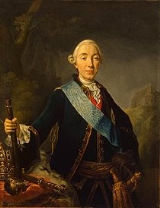
Peter III of Russia

Encyclopedia
Peter III was Emperor
of Russia
for six months in 1762. He was very pro-Prussia
n, which made him an unpopular leader. He was supposedly assassinated as a result of a conspiracy
led by his wife, who succeeded him to the throne as Catherine II.
, in the duchy of Holstein-Gottorp
. His parents were Charles Frederick, Duke of Holstein-Gottorp
(nephew of Charles XII of Sweden
), and Anna Petrovna, a daughter of Emperor Peter I and Empress Catherine I
of Russia. His mother died less than two weeks after his birth. In 1739, Peter's father died, and he became Duke of Holstein-Gottorp as Charles Peter Ulrich.
When his aunt, Anna's younger sister Elizabeth, became Empress of Russia she brought Peter from Germany to Russia and proclaimed him her heir-presumptive in the autumn of 1742. Previously in 1742, the 14-year-old Peter was proclaimed King of Finland
during the Russo-Swedish War (1741–1743), when Russian troops held Finland. This proclamation was based on his succession rights to territories held by his childless granduncle, the late Charles XII of Sweden
who also had been Grand Duke of Finland. About the same time, in October 1742, he was chosen by the Swedish parliament
to become heir-presumptive to the Swedish throne. However, the Swedish parliament was unaware of the fact that he had also been proclaimed heir-presumptive to the throne of Russia, and when their envoy arrived in Saint Petersburg in November, it was too late. It has been reported that the underage Peter's succession rights to Sweden were renounced on his behalf.
Empress Elizabeth arranged for Peter to marry his second cousin, Sophia Augusta Frederica (later Catherine the Great), daughter of Christian August, Prince of Anhalt-Zerbst
and Johanna Elisabeth of Holstein-Gottorp. The young princess formally converted to Russian Orthodoxy
and took the name Ekaterina Alexeievna (i.e., Catherine). They married on August 21, 1745. The marriage was not a happy one, but produced one son: the future Emperor Paul; and one daughter: Anna Petrovna (20 December 1757 – 19 March 1759). Catherine later claimed that Paul was not fathered by Peter, that, in fact, they had never consummated the marriage. During the sixteen years of their residence in Oranienbaum
Catherine took numerous lovers, as did her husband.
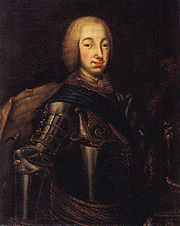 The classical view of Peter's character is mainly drawn out of his wife's and usurper's memoirs. She described him as an “idiot”, “drunkard from Holstein”, “good-for-nothing” etc. This portrait of Peter can be found in most history books, including 1911 Encyclopaedia Britannica:
There have been many attempts to revise the traditional characterisation of Peter and his policies. The Russian historian A.S. Mylnikov gives us a very different view of Peter III:
The German historian Elena Palmer
goes even further, portraying Peter III as a cultured, open-minded emperor who tried to introduce various courageous, even democratic reforms in the 18th century’s Russia. Currently, a newly established union is working on a project to build a memorial for Peter III in Kiel (North Germany), his city of birth.
and made peace with Prussia
(the "Miracle of the House of Brandenburg"). He gave up Russian conquests in Prussia and offered 12,000 troops to make an alliance with Frederick II, which relieved Russia financially. Russia was switched from an enemy of Prussia to an ally — Russian troops were withdrawn from Berlin and sent against the Austrians. This dramatically shifted the balance of power
in Europe — suddenly handing Frederick the initiative, who recaptured southern Silesia
and forced Austria to the negotiating table.
Being a Duke of Holstein-Gottorp, Peter planned war against Denmark
in order to restore Schleswig
to his Duchy. He focused on making alliances with Sweden and England to ensure that they would not interfere on Denmark’s behalf, while forces were concentrated at Kolberg in Russian occupied Pomerania
. Alarmed at the troop concentrations occurring at their borders, unable to find any allies to resist Russian aggression, and short of finance to fund a war, the government of Denmark threatened the free city
of Hamburg
in northern Germany with invasion in late June to force a loan from it. Peter considered this a casus belli
, and prepared for open warfare against Denmark.
In June 1762, 40,000 Russian troops were assembled in Pomerania
under General Pyotr Rumyantsev
. They were preparing to face 27,000 Danish troops under the French general Count St. Germain
in case the Russian-Denmark freedom conference, scheduled for July 1, 1762 in Berlin under the patronage of Frederick II, failed to resolve the issue. But, shortly before this Peter was dethroned and the conference did not happen. The problem with Schleswig remained unsolved. Peter was accused of planning an unpatriotic war.
While historically Peter's planned war against Denmark was seen as being a political failure, recent scholarship has portrayed it as part of a pragmatic plan to expand Russian power westwards —he saw gaining territory and influence in Denmark and Northern Germany as more useful to Russia than taking East Prussia
. Equally, he saw that friendship towards Prussia and Britain, following its triumph in the Seven Years War
, could offer more to aid his plans than either Austria or France.
— a repressive organ started under Peter I and intended to expose it as betrayer of the state for its mercilessness and torture methods. Catherine recreated this institution and it remained present in Russia under various names until it was replaced by the KGB. He established obligatory education for aristocrats — all aristocrats had to provide their children with education and report it to the senate. Furthermore, in some cities technical schools were established for middle and lower class children. Peter began the reorganization and modernization of the Russian army.
One of his most popular reforms was the manifesto of February 1762 that exempted the nobility from obligatory state and military service (established by Peter the Great) and gave them freedom to travel abroad. On the day Peter submitted this manifesto, the parliament proposed building a pure gold statue of him, but Peter refused, saying that there must be much better uses for gold in the country.
Peter III’s economic policy reflected the rising influence of Western capitalism and the merchant class or “Third Estate” that accompanied it. He established the first state bank in Russia, rejected the nobility’s monopoly on trade and encouraged mercantilism by increasing grain exports and forbidding the import of sugar and other materials that could be found in Russia
Peter's short reign also addressed the serfdom. For the first time, the killing of a peasant by a landowner became an act punishable by law. State peasants were given higher social status than estate peasants, and many peasants under the servitude of the church were transferred to state lands. Peter also took further interest in church affairs, implementing his grandfather’s plan to secularize church and monastic lands.
and was in fact nothing more than a murder for personal reasons. With the aid of the two Guards troops that Peter had planned to discipline more harshly, the emperor was arrested and forced to abdicate on June 28. Shortly thereafter, he was transported to Ropsha
where he was supposedly assassinated.
, who disliked his mother, arranged for his remains to be exhumed and then reburied with full honors in the Peter and Paul Cathedral
, where other tsars were buried.
After his death, four fake Peters (five if Šćepan Mali
of Montenegro is included) came forth, supported by revolts among the people who believed in a rumor that Peter had not died, but had secretly been imprisoned by Catherine. The most famous was the Cossack
peasant Pugachev. Under this guise, he led what came to be known as Pugachev's Rebellion
in 1774, ultimately crushed by Catherine's forces.
The legend of Peter is still talked about, especially in the town where he lived most of his life, former Oranienbaum, later Lomonosov
, situated on the southern coast of the Gulf of Finland
, 40 km west of St. Petersburg. Peter’s palace is the only one of the famous palaces in the St. Petersburg area that was not captured by the Germans during Second World War. During the war, the building was a school and people say the ghost of Peter protected the children of Oranienbaum from getting hurt by bombs. Furthermore, it was near this town that the siege of Leningrad
ended in January 1944. People say that Peter, after his death, stopped Hitler’s army near Leningrad, as the living Peter stopped the Russian army near Berlin.
in the 1934 film The Rise of Catherine the Great and by Sam Jaffe
in The Scarlet Empress
the same year. In 1991 Reece Dinsdale
portrayed him in the television series Young Catherine
. La Tempesta (1958) depicts Yemelyan Pugachev's effort to force his recognition as Peter III
and offers a critical view of Catherine the Great, with Van Heflin
in the role of Pugachev and Viveca Lindfors
as Catherine.
Emperor
An emperor is a monarch, usually the sovereign ruler of an empire or another type of imperial realm. Empress, the female equivalent, may indicate an emperor's wife or a woman who rules in her own right...
of Russia
Russian Empire
The Russian Empire was a state that existed from 1721 until the Russian Revolution of 1917. It was the successor to the Tsardom of Russia and the predecessor of the Soviet Union...
for six months in 1762. He was very pro-Prussia
Prussia
Prussia was a German kingdom and historic state originating out of the Duchy of Prussia and the Margraviate of Brandenburg. For centuries, the House of Hohenzollern ruled Prussia, successfully expanding its size by way of an unusually well-organized and effective army. Prussia shaped the history...
n, which made him an unpopular leader. He was supposedly assassinated as a result of a conspiracy
Conspiracy (political)
In a political sense, conspiracy refers to a group of persons united in the goal of usurping or overthrowing an established political power. Typically, the final goal is to gain power through a revolutionary coup d'état or through assassination....
led by his wife, who succeeded him to the throne as Catherine II.
Early life and character
Peter was born in KielKiel
Kiel is the capital and most populous city in the northern German state of Schleswig-Holstein, with a population of 238,049 .Kiel is approximately north of Hamburg. Due to its geographic location in the north of Germany, the southeast of the Jutland peninsula, and the southwestern shore of the...
, in the duchy of Holstein-Gottorp
Holstein-Gottorp
Holstein-Gottorp or Schleswig-Holstein-Gottorp is the historiographical name, as well as contemporary shorthand name, for the parts of the duchies of Schleswig and Holstein that were ruled by the dukes of Schleswig-Holstein-Gottorp. Other parts of the duchies were ruled by the kings of Denmark. The...
. His parents were Charles Frederick, Duke of Holstein-Gottorp
Charles Frederick, Duke of Holstein-Gottorp
Duke Charles Frederick of Holstein-Gottorp was the son of Frederick IV of Holstein-Gottorp and his wife, Hedvig Sophia, daughter of King Charles XI of Sweden...
(nephew of Charles XII of Sweden
Charles XII of Sweden
Charles XII also Carl of Sweden, , Latinized to Carolus Rex, Turkish: Demirbaş Şarl, also known as Charles the Habitué was the King of the Swedish Empire from 1697 to 1718...
), and Anna Petrovna, a daughter of Emperor Peter I and Empress Catherine I
Catherine I of Russia
Catherine I , the second wife of Peter the Great, reigned as Empress of Russia from 1725 until her death.-Life as a peasant woman:The life of Catherine I was said by Voltaire to be nearly as extraordinary as that of Peter the Great himself. There are no documents that confirm her origins. Born on...
of Russia. His mother died less than two weeks after his birth. In 1739, Peter's father died, and he became Duke of Holstein-Gottorp as Charles Peter Ulrich.
When his aunt, Anna's younger sister Elizabeth, became Empress of Russia she brought Peter from Germany to Russia and proclaimed him her heir-presumptive in the autumn of 1742. Previously in 1742, the 14-year-old Peter was proclaimed King of Finland
Kingdom of Finland (1742)
The attempt to create a Kingdom of Finland in 1742 is a little known chapter in the history of Finland. Following the Russian occupation in the Russo-Swedish War and vague promises of making the country independent, Finns elected the then Duke Peter of Holstein-Gottorp as the King of Finland...
during the Russo-Swedish War (1741–1743), when Russian troops held Finland. This proclamation was based on his succession rights to territories held by his childless granduncle, the late Charles XII of Sweden
Charles XII of Sweden
Charles XII also Carl of Sweden, , Latinized to Carolus Rex, Turkish: Demirbaş Şarl, also known as Charles the Habitué was the King of the Swedish Empire from 1697 to 1718...
who also had been Grand Duke of Finland. About the same time, in October 1742, he was chosen by the Swedish parliament
Riksdag of the Estates
The Riksdag of the Estates , was the name used for the Estates of the Swedish realm when they were assembled. Until its dissolution in 1866, the institution was the highest authority in Sweden next to the King...
to become heir-presumptive to the Swedish throne. However, the Swedish parliament was unaware of the fact that he had also been proclaimed heir-presumptive to the throne of Russia, and when their envoy arrived in Saint Petersburg in November, it was too late. It has been reported that the underage Peter's succession rights to Sweden were renounced on his behalf.
Empress Elizabeth arranged for Peter to marry his second cousin, Sophia Augusta Frederica (later Catherine the Great), daughter of Christian August, Prince of Anhalt-Zerbst
Christian August, Prince of Anhalt-Zerbst
Christian August, Prince of Anhalt-Zerbst was a German prince of the House of Ascania. He was a ruler of the Principality of Anhalt-Dornburg, then, from 1742, a ruler of the entire Principality of Anhalt-Zerbst...
and Johanna Elisabeth of Holstein-Gottorp. The young princess formally converted to Russian Orthodoxy
Russian Orthodox Church
The Russian Orthodox Church or, alternatively, the Moscow Patriarchate The ROC is often said to be the largest of the Eastern Orthodox churches in the world; including all the autocephalous churches under its umbrella, its adherents number over 150 million worldwide—about half of the 300 million...
and took the name Ekaterina Alexeievna (i.e., Catherine). They married on August 21, 1745. The marriage was not a happy one, but produced one son: the future Emperor Paul; and one daughter: Anna Petrovna (20 December 1757 – 19 March 1759). Catherine later claimed that Paul was not fathered by Peter, that, in fact, they had never consummated the marriage. During the sixteen years of their residence in Oranienbaum
Oranienbaum, Russia
Oranienbaum is a Russian royal residence, located on the Gulf of Finland west of St. Petersburg. The Palace ensemble and the city centre are UNESCO World Heritage Sites.-History:...
Catherine took numerous lovers, as did her husband.
There have been many attempts to revise the traditional characterisation of Peter and his policies. The Russian historian A.S. Mylnikov gives us a very different view of Peter III:
The German historian Elena Palmer
Elena Palmer
Elena Palmer is a renowned German journalist and author with Russian origins.- Biography :Elena Palmer is the author of the biography „Peter III - The Prince of Holstein“ , herein she is expressing reasonable doubt towards the common portrayal of Russian emperor Peter III...
goes even further, portraying Peter III as a cultured, open-minded emperor who tried to introduce various courageous, even democratic reforms in the 18th century’s Russia. Currently, a newly established union is working on a project to build a memorial for Peter III in Kiel (North Germany), his city of birth.
Foreign policy
After Peter gained the throne in 1762, he withdrew from the Seven Years' WarSeven Years' War
The Seven Years' War was a global military war between 1756 and 1763, involving most of the great powers of the time and affecting Europe, North America, Central America, the West African coast, India, and the Philippines...
and made peace with Prussia
Prussia
Prussia was a German kingdom and historic state originating out of the Duchy of Prussia and the Margraviate of Brandenburg. For centuries, the House of Hohenzollern ruled Prussia, successfully expanding its size by way of an unusually well-organized and effective army. Prussia shaped the history...
(the "Miracle of the House of Brandenburg"). He gave up Russian conquests in Prussia and offered 12,000 troops to make an alliance with Frederick II, which relieved Russia financially. Russia was switched from an enemy of Prussia to an ally — Russian troops were withdrawn from Berlin and sent against the Austrians. This dramatically shifted the balance of power
Balance of power in international relations
In international relations, a balance of power exists when there is parity or stability between competing forces. The concept describes a state of affairs in the international system and explains the behavior of states in that system...
in Europe — suddenly handing Frederick the initiative, who recaptured southern Silesia
Silesia
Silesia is a historical region of Central Europe located mostly in Poland, with smaller parts also in the Czech Republic, and Germany.Silesia is rich in mineral and natural resources, and includes several important industrial areas. Silesia's largest city and historical capital is Wrocław...
and forced Austria to the negotiating table.
Being a Duke of Holstein-Gottorp, Peter planned war against Denmark
Denmark
Denmark is a Scandinavian country in Northern Europe. The countries of Denmark and Greenland, as well as the Faroe Islands, constitute the Kingdom of Denmark . It is the southernmost of the Nordic countries, southwest of Sweden and south of Norway, and bordered to the south by Germany. Denmark...
in order to restore Schleswig
Schleswig
Schleswig or South Jutland is a region covering the area about 60 km north and 70 km south of the border between Germany and Denmark; the territory has been divided between the two countries since 1920, with Northern Schleswig in Denmark and Southern Schleswig in Germany...
to his Duchy. He focused on making alliances with Sweden and England to ensure that they would not interfere on Denmark’s behalf, while forces were concentrated at Kolberg in Russian occupied Pomerania
Pomerania
Pomerania is a historical region on the south shore of the Baltic Sea. Divided between Germany and Poland, it stretches roughly from the Recknitz River near Stralsund in the West, via the Oder River delta near Szczecin, to the mouth of the Vistula River near Gdańsk in the East...
. Alarmed at the troop concentrations occurring at their borders, unable to find any allies to resist Russian aggression, and short of finance to fund a war, the government of Denmark threatened the free city
Free city
Free city may refer to:* City-state, region controlled exclusively by a sovereign city* Free city a self-governed city during the Hellenistic and Roman Imperial eras* Free City , album by the St...
of Hamburg
Hamburg
-History:The first historic name for the city was, according to Claudius Ptolemy's reports, Treva.But the city takes its modern name, Hamburg, from the first permanent building on the site, a castle whose construction was ordered by the Emperor Charlemagne in AD 808...
in northern Germany with invasion in late June to force a loan from it. Peter considered this a casus belli
Casus belli
is a Latin expression meaning the justification for acts of war. means "incident", "rupture" or indeed "case", while means bellic...
, and prepared for open warfare against Denmark.
In June 1762, 40,000 Russian troops were assembled in Pomerania
Pomerania
Pomerania is a historical region on the south shore of the Baltic Sea. Divided between Germany and Poland, it stretches roughly from the Recknitz River near Stralsund in the West, via the Oder River delta near Szczecin, to the mouth of the Vistula River near Gdańsk in the East...
under General Pyotr Rumyantsev
Pyotr Rumyantsev
Count Pyotr Alexandrovich Rumyantsev-Zadunaisky was one of the foremost Russian generals of the 18th century. He governed Little Russia in the name of Empress Catherine the Great from the abolition of the Cossack Hetmanate in 1764 until Catherine's death 32 years later...
. They were preparing to face 27,000 Danish troops under the French general Count St. Germain
Claude Louis, Comte de Saint-Germain
Claude Louis, Comte de Saint-Germain , French general, was born on the 15th of April 1707, at the Château of Vertamboz.Educated at Jesuit schools, he intended to enter the priesthood, but at the last minute obtained from Louis XV an appointment as sub-lieutenant...
in case the Russian-Denmark freedom conference, scheduled for July 1, 1762 in Berlin under the patronage of Frederick II, failed to resolve the issue. But, shortly before this Peter was dethroned and the conference did not happen. The problem with Schleswig remained unsolved. Peter was accused of planning an unpatriotic war.
While historically Peter's planned war against Denmark was seen as being a political failure, recent scholarship has portrayed it as part of a pragmatic plan to expand Russian power westwards —he saw gaining territory and influence in Denmark and Northern Germany as more useful to Russia than taking East Prussia
East Prussia
East Prussia is the main part of the region of Prussia along the southeastern Baltic Coast from the 13th century to the end of World War II in May 1945. From 1772–1829 and 1878–1945, the Province of East Prussia was part of the German state of Prussia. The capital city was Königsberg.East Prussia...
. Equally, he saw that friendship towards Prussia and Britain, following its triumph in the Seven Years War
Great Britain in the Seven Years War
The Kingdom of Great Britain was one of the major participants in the Seven Years' War which lasted between 1756 and 1763. Britain emerged from the war as the world's leading colonial power having gained a number of new territories at the Treaty of Paris in 1763 and established itself as the...
, could offer more to aid his plans than either Austria or France.
Domestic reforms
During his 186-day period of government, Peter III passed 220 new laws which he had developed and elaborated during his life as a crown prince. Elena Palmer claims that his reforms were of a democratic nature. He proclaimed religious freedom — in those times a revolutionary step, that not even the advanced Western Europe had taken thus far. He fought corruption within government, established public litigation and abolished the secret policeSecret police
Secret police are a police agency which operates in secrecy and beyond the law to protect the political power of an individual dictator or an authoritarian political regime....
— a repressive organ started under Peter I and intended to expose it as betrayer of the state for its mercilessness and torture methods. Catherine recreated this institution and it remained present in Russia under various names until it was replaced by the KGB. He established obligatory education for aristocrats — all aristocrats had to provide their children with education and report it to the senate. Furthermore, in some cities technical schools were established for middle and lower class children. Peter began the reorganization and modernization of the Russian army.
One of his most popular reforms was the manifesto of February 1762 that exempted the nobility from obligatory state and military service (established by Peter the Great) and gave them freedom to travel abroad. On the day Peter submitted this manifesto, the parliament proposed building a pure gold statue of him, but Peter refused, saying that there must be much better uses for gold in the country.
Peter III’s economic policy reflected the rising influence of Western capitalism and the merchant class or “Third Estate” that accompanied it. He established the first state bank in Russia, rejected the nobility’s monopoly on trade and encouraged mercantilism by increasing grain exports and forbidding the import of sugar and other materials that could be found in Russia
Peter's short reign also addressed the serfdom. For the first time, the killing of a peasant by a landowner became an act punishable by law. State peasants were given higher social status than estate peasants, and many peasants under the servitude of the church were transferred to state lands. Peter also took further interest in church affairs, implementing his grandfather’s plan to secularize church and monastic lands.
Overthrow
The reign of Peter the Third is cast by Palmer as progressive for its focus on transforming economically developed feudal Russia to a more advanced European state. Palmer claims that his reform efforts were welcomed by society as a whole. It is Palmer's further contention that a plot against him by members of the government and influential nobles is unjustified: that the aristocratic names in the list of conspirators belonged to Guards officers, those who had lost influence and impoverished families who had no access to high government positions and were forced into service, some resentment within the Guard could not have led to a change of government. A revolt of the Guards regiments against the emperor, to whom they had sworn allegiance, could only lead to an alternative emperor. Palmer claims that the conspiracy against Peter III was carried out by Catherine and Guards officer OrlovAlexei Grigoryevich Orlov
Count Alexei Grigoryevich Orlov was a Russian soldier and statesman, who rose to prominence during the reign of Catherine the Great.Orlov served in the Imperial Russian Army, and through his connections with his brother, became one of the key conspirators in the plot to overthrow Tsar Peter III...
and was in fact nothing more than a murder for personal reasons. With the aid of the two Guards troops that Peter had planned to discipline more harshly, the emperor was arrested and forced to abdicate on June 28. Shortly thereafter, he was transported to Ropsha
Ropsha
Ropsha is a settlement in Leningrad Oblast, Russia, situated about 20 km south of Peterhof and 49 km south-west of central Saint Petersburg, at an elevation of 80 metres to 130 metres above sea level.-History:...
where he was supposedly assassinated.
Aftermath
In December 1796, after succeeding Catherine, Peter's son the Emperor PaulPaul I of Russia
Paul I was the Emperor of Russia between 1796 and 1801. He also was the 72nd Prince and Grand Master of the Order of Malta .-Childhood:...
, who disliked his mother, arranged for his remains to be exhumed and then reburied with full honors in the Peter and Paul Cathedral
Peter and Paul Cathedral
The Peter and Paul Cathedral is a Russian Orthodox cathedral located inside the Peter and Paul Fortress in St. Petersburg, Russia. It is the first and oldest landmark in St. Petersburg, built between 1712 and 1733 on Zayachy Island along the Neva River. Both the cathedral and the fortress were...
, where other tsars were buried.
After his death, four fake Peters (five if Šćepan Mali
Šcepan Mali
"Tsar" Šćepan Mali was a ruler of Montenegro from 1767 until his death in 1773. He seized the throne by falsely representing himself as the Russian Tsar Peter III.-Biography:Šćepan Mali was a farmer from Dalmatia...
of Montenegro is included) came forth, supported by revolts among the people who believed in a rumor that Peter had not died, but had secretly been imprisoned by Catherine. The most famous was the Cossack
Cossack
Cossacks are a group of predominantly East Slavic people who originally were members of democratic, semi-military communities in what is today Ukraine and Southern Russia inhabiting sparsely populated areas and islands in the lower Dnieper and Don basins and who played an important role in the...
peasant Pugachev. Under this guise, he led what came to be known as Pugachev's Rebellion
Pugachev's Rebellion
Pugachev's Rebellion of 1774-75 was the principal revolt in a series of popular rebellions that took place in Russia after Catherine II seized power in 1762...
in 1774, ultimately crushed by Catherine's forces.
The legend of Peter is still talked about, especially in the town where he lived most of his life, former Oranienbaum, later Lomonosov
Lomonosov, Russia
Lomonosov is a municipal town in Petrodvortsovy District of the federal city of St. Petersburg, Russia, situated on the southern coast of the Gulf of Finland, west of St. Petersburg proper. Population:...
, situated on the southern coast of the Gulf of Finland
Gulf of Finland
The Gulf of Finland is the easternmost arm of the Baltic Sea. It extends between Finland and Estonia all the way to Saint Petersburg in Russia, where the river Neva drains into it. Other major cities around the gulf include Helsinki and Tallinn...
, 40 km west of St. Petersburg. Peter’s palace is the only one of the famous palaces in the St. Petersburg area that was not captured by the Germans during Second World War. During the war, the building was a school and people say the ghost of Peter protected the children of Oranienbaum from getting hurt by bombs. Furthermore, it was near this town that the siege of Leningrad
Siege of Leningrad
The Siege of Leningrad, also known as the Leningrad Blockade was a prolonged military operation resulting from the failure of the German Army Group North to capture Leningrad, now known as Saint Petersburg, in the Eastern Front theatre of World War II. It started on 8 September 1941, when the last...
ended in January 1944. People say that Peter, after his death, stopped Hitler’s army near Leningrad, as the living Peter stopped the Russian army near Berlin.
Cultural references
Peter has been depicted on screen a number of times, almost always in films concerning his wife Catherine. He was portrayed by Douglas Fairbanks, Jr.Douglas Fairbanks, Jr.
Douglas Elton Fairbanks, Jr. KBE was an American actor and a highly decorated naval officer of World War II.-Early life:...
in the 1934 film The Rise of Catherine the Great and by Sam Jaffe
Sam Jaffe (actor)
Sam Jaffe was an American actor, teacher, musician and engineer. In 1951, he was nominated for the Academy Award for Best Supporting Actor for his performance in The Asphalt Jungle and appeared in other classic films such as Ben-Hur and The Day the Earth Stood Still...
in The Scarlet Empress
The Scarlet Empress
The Scarlet Empress is a 1934 historical drama film made by Paramount Pictures about the life of Catherine the Great. It was directed and produced by Josef von Sternberg from a screenplay by Eleanor McGeary, loosely based on the diary of Catherine arranged by Manuel Komroff...
the same year. In 1991 Reece Dinsdale
Reece Dinsdale
Reece Dinsdale is an English actor of stage, screen and television.-Acting career:He trained at the Guildhall School of Music and Drama from 1977 until 1980...
portrayed him in the television series Young Catherine
Young Catherine
Young Catherine is a 1991 American TV miniseries based on the early life of Catherine II of Russia. It stars Julia Ormond as Catherine and Vanessa Redgrave as Empress Elizabeth....
. La Tempesta (1958) depicts Yemelyan Pugachev's effort to force his recognition as Peter III
Pugachev's Rebellion
Pugachev's Rebellion of 1774-75 was the principal revolt in a series of popular rebellions that took place in Russia after Catherine II seized power in 1762...
and offers a critical view of Catherine the Great, with Van Heflin
Van Heflin
Emmett Evan "Van" Heflin, Jr. was an American film and theatre actor. He played mostly character parts over the course of his film career, but during the 1940s had a string of roles as a leading man...
in the role of Pugachev and Viveca Lindfors
Viveca Lindfors
Elsa Viveca Torstensdotter Lindfors , better known under her professional name of Viveca Lindfors, was a Swedish stage and film actress.-Life and career:...
as Catherine.
Ancestry
External links
The ancestors and descendants Pyotr III Fyodorovitch, Emperor of Russia Biography of Pyotr III Fyodorovitch- Tempest at the Internet Movie Database