


History of Morocco

Encyclopedia
The History of Morocco spans over 12 centuries, without considering the Classical antiquity
. The country was first unified by the Idrisid dynasty in 780, representing the first Islamic state in Africa
autonomous from the Arab Empire
. Under the Almoravid dynasty and the Almohad dynasty, Morocco
dominated the Maghreb
and Muslim Spain. The Reconquista
ended Almohad rule in Iberia
and many Muslims and Jews
migrated to Morocco. Under the Saadi dynasty
, Morocco would consolidate power and fight off Portuguese
and Ottoman
invaders, as in the battle of Ksar el Kebir. The reign of Ahmad al-Mansur brought new wealth and prestige to the Sultanate, and an invasion of the Songhay Empire was initiated. However managing the territories across the Sahara
proved to be difficult. After the death of al-Mansur the country was divided among his sons. In 1666 the sultanate was reunited by the Alaouite dynasty
, who have since been the ruling house of Morocco. The organization of the state developed with Ismail Ibn Sharif
. With his Black Guard
he drove the English from Tangier
(1684) and the Spanish
from Larache
(1689). The Alaouite dynasty distinguished itself in the 19th century by maintaining Moroccan independence while other states in the region succumbed to European interests. In 1912, after the First Moroccan Crisis
and the Agadir Crisis
, the Treaty of Fez
was signed, effectively dividing Morocco into a French
and Spanish protectorate
. In 1956, after 44 years of occupation Morocco regained independence from France
as the Kingdom of Morocco.
brought Morocco
into the Neolithic
about 2001 BC, at a time when the Maghreb
was less arid than it is today. The Berber language
probably was formed at roughly the same time as agriculture (see Berber
), and was developed by the existing population and adopted the immigrants who arrived later. Modern DNA analysis (see link) has confirmed that various populations have contributed to the present-day gene pool of Morocco in addition to the main ethnic group which is the Amazighs/Berbers
. A very small percentage of those other populations are Iberians
and sub-Saharan Africa
ns.
In Mesolithic
ages the geography of Morocco resembled a savanna
more than the present day arid landscape. While little is known about Morocco settlement in these early times, excavations elsewhere in the Maghreb
suggest an abundance of game and forests that would have been hospitable to Mesolithic hunters and gatherers.
The coastal regions of present-day Morocco shared in an early Neolithic
culture that was common to the whole Mediterranean littoral
. Archaeological remains point to the domestication
of cattle and the cultivation of crops in the region during that period. Eight thousand years ago, south of the great mountain ranges in what is now the Sahara Desert, a vast savanna
supported Neolithic hunters and herders whose culture flourished until the region began to desiccate as a result of climatic changes after 4000 BC.
n traders, who had penetrated the western Mediterranean before the 12th century BC, set up depots for salt and ore along the coast and up the rivers of the territory that is now Morocco. The arrival of Phoenicians heralded many centuries of rule by foreign powers for the north of Morocco. Major early substantial settlements of the Phoenicians were at Chellah
, Lixus
and Mogador, with Mogador being a Phoenician colony as early as the early 6th century BC. Carthage
developed commercial relations with the Berber tribes of the interior and paid them an annual tribute to ensure their cooperation in the exploitation of raw materials.
By the 5th century BC, Carthage had extended its hegemony across much of North Africa
. By the 2nd century BC, several large, although loosely administered, Berber kingdoms had emerged.
(roman rulers actually referred to these people as semi-gods), often as satellites, allowing Roman rulership to exist.
But after the fall of Carthage, the area was annexed to the Roman Empire
in AD 40. Rome controlled the vast, ill-defined territory through alliances with the tribes rather than through military occupation, expanding its authority only to those areas that were economically useful or that could be defended without additional manpower. Hence, Roman administration never extended outside the restricted area of the northern coastal plain and valleys. This strategic region formed part of the Roman Empire
, governed as Mauretania Tingitana
.
Roman historians (like Ptolemeus) considered that all actual Morocco until the Atlas mountains
was part of the Roman Empire, because in the Augustus times Mauretania was a vassal state and his rulers (like Juba II
) controlled all the areas south of Volubilis. But the effective control of Roman legionaries was until the area of Sala Colonia (the castra "Exploratio Ad Mercurios" south of Sala is the southernmost discovered until now). Anyway some historians believe the Roman frontier reached actual Casablanca
, founded by Romans as a port.
During the reign of Juba II
Emperor Augustus
(who created in the area of what is now northern Morocco 12 colonies with retired Roman legionaries) had already founded three colonias
(with Roman citizens) in Mauretania close to the Atlantic coast: Iulia Constantia Zilil
, Iulia Valentia Banasa
and Iulia Campestris Babba.
This western part of Mauretania was to become the province called Mauretania Tingitana shortly afterwards, with capital the rich emporium of Volubilis
.
In those centuries, the area controlled by Rome had a huge economic development, helped even by the construction of useful Roman roads
. The area was initially fully under control of Rome and only in the mid-2nd century was built a limes
south of Sala and until Volubilis.
Roman control reached even the area of actual Casablanca
, then called Anfa
according to Leo Africanus
: it was used as a port by the Phoenicians and later the Romans.
Around 278 AD Romans moved their regional capital to Tanger and Volubilis started to lose importance.
The region remained a part of the Roman Empire until 429 AD as the Vandals
overran the area and Roman administrative presence came to an end.
Indeed in the 5th century, the region fell to the Vandals
, Visigoths, and then Byzantine Greek
s in rapid succession. During this time, however, the high mountains of most of modern Morocco remained unsubdued, and stayed in the hands of their Berber inhabitants.
Christianity
was introduced in the 2nd century and gained converts in the towns and among slaves and Berber farmers. By the end of the 4th century, the Romanized areas had been Christianized, and inroads had been made as well among the Berber tribes, who sometimes converted en masse. But schismatic
and heretical movements also developed, usually as forms of political protest. The area had a substantial Jewish population as well.
s conquered the region in the 7th century, bringing their civilization and Islam
, to which many of the Berbers converted. While part of the larger Islamic Empire
, client states such as the Kingdom of Nekor
were formed. Arab conquerors converted the indigenous Berber population to Islam, but Berber tribes retained their customary laws. The Arabs abhorred the Berbers as barbarians, while the Berbers often saw the Arabs as only an arrogant and brutal soldiery bent on collecting taxes.
In the 740, spurred by puritanical Kharijite agitators, the Berbers revolted
against Arab rule. The rebellion began among the Berber tribes of western Morocco, and spread quickly across the region. Although the rebellion petered out before the gates of Kairouan
in 742, neither the Umayyad
rulers in Damascus, nor their Abbasid
successors, would manage to re-impose Arab rule on the liberated areas west of Ifriqiya
. Morocco slipped out of the leash, and fragmented into a small collection of independent Berber statelets under their own rulers and laws. The Berbers went on to shape Islam in their own image - some (like the Banu Ifran
) retained their connection with radical puritan sects, others (like the Berghwata) constructed a new syncretic faith which was simply folk religion thinly disguised as Islam.
As the "wild west" of the Islamic world, Morocco quickly became a haven for many dissidents, rebels and refugees from the empire. Among these was Idris ibn Abdallah, who with the help of the local Awraba Berbers, founded the Idrisid Dynasty in 788. His son Idris II
erected a splendid new capital at Fes
and launched Morocco as a centre of learning and a major power. Another significant arrival around this time was a group of puritan Miknasa
Berber rebels from Ifriqiya, who went on to erect the settlement of Sijilmassa (in southeast Morocco) and open trade across the Sahara
desert with the gold-producing Ghana Empire
of west Africa. Although the Midrarids of Sijilmassa and the Idrisids of Fez were frequently at odds politically and religiously, the Trans-Saharan trade route made them economically inter-dependent.
The balance was upset in the early 900s, when yet another group of religious refugees from the east, the Fatimid
s, arrived in the west. Not long after launching a coup and seizing power in Ifriqiya
, the Fatimids invaded Morocco, sacking both Fez and Sijilmassa. Morocco fell into anarchy in the aftermath, fought over between Fatimid governors, Idrisid loyalists, new puritan groups and interventionists from Umayyad al-Andalus
. Opportunistic local governors sold and re-sold their support to the highest bidder. In 965, the Fatimid caliph al-Muizz invaded Morocco one last time and established a modicum of peace. But no sooner was that done, the Fatimids turned their backs on the west, moving to their new capital in Cairo
, Egypt
. The Fatimids assigned the Zirids, a Sanhaja
Berber clan, to keep an eye on things in the west. But centered in Ifriqiya and facing their own difficulties, the Zirids were unable to prevent Morocco from crumbling into the hands of a collection of local Zenata Berber chieftans, most of them clients of the Caliph of Cordoba, such as the Maghrawa
in the region of Fez and their on-again, off-again rivals, the Banu Ifran
, just east of them.
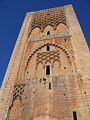 Morocco reached its height under a series of Berber dynasties, that arose south of the Atlas Mountains and expanded their rule northwards, replacing the local rulers. The 11th and 12th centuries witnessed the founding of several great Berber dynasties led by religious reformers and each based on a tribal confederation that dominated the Maghrib (also seen as Maghreb
; refers to North Africa west of Egypt) and Al-Andalus
for more than 200 years. The Berber dynasties (Almoravids
, Almohads, Marinid
s and Wattasids) gave the Berber people some measure of collective identity and political unity under a native regime for the first time in their history, and they created the idea of an "imperial Maghrib" under Berber aegis that survived in some form from dynasty to dynasty. But ultimately each of the Berber dynasties proved to be a political failure because none managed to create an integrated society out of a social landscape dominated by tribes that prized their autonomy and individual identity.
In 1559, the region fell to successive Arab tribes claiming descent from the Prophet Muhammad
: first the Saadi Dynasty
who ruled from 1554 to 1659 and then the Alaouites
, who founded a dynasty that has remained in power since the 17th century.
 The Alaouite Dynasty is the name of the current Moroccan
royal family. The name Alaouite comes from the ʿAlī of its founder Moulay Ali Cherif
who became Sultan
of Tafilalt
in 1631. His son Mulay r-Rshid
(1664–1672) was able to unite and pacify the country. The Alaouite family claim descent from Muhammad
through the line of Fāṭimah az-Zahrah
, Muhammad's daughter, and her husband, the Fourth Caliph
ʿAlī ibn Abī Ṭālib
.
According to some legends the Alaouites entered Morocco at the end of the 13th century when Al Hassan Addakhil
, who lived then in the town of Yanbu in the Hejaz
, was brought to Morocco by the inhabitants of Tafilalet to be their imām
. They were hoping that, as he was a descendant of Muhammad
, his presence would help to improve their date palm
crops thanks to his barakah
"blessing", an Arabic
term meaning a sense of divine presence or charisma. His descendants began to increase their power in southern Morocco after the death of the Saʻdī
ruler Ahmad al-Mansur (1578–1603).
In 1659, the last Saʻdī sultan was overthrown in the conquest of Marrakech
by Mulay r-Rshid
(1664–1672). After the victory over the zāwiya
of Dila, who controlled northern Morocco, he was able to unite and pacify the country.
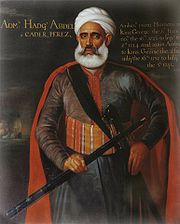 The organization of the kingdom developed under Ismail Ibn Sharif
(1672–1727), who, against the opposition of local tribes began to create a unified state. Because the Alaouites, in contrast to previous dynasties, did not have the support of a single Berber
or Bedouin
tribe, Isma'īl controlled Morocco through an army of black slaves. With these soldiers he drove the English
from Tangiers (1684) and the Spanish
from Larache
(1689.) However, the unity of Morocco did not survive his death — in the ensuing power struggles the tribes became a political and military force once again.
Only with Muhammad III
(1757–1790) could the kingdom be pacified again and the administration reorganized. A renewed attempt at centralization was abandoned and the tribes allowed to preserve their autonomy.
In 1777 Morocco was the very first state to recognize the sovereignty of a newly independent United States
.
Under Abderrahmane
(1822–1859) Morocco fell under the influence of the Europe
an powers. When Morocco supported the Algeria
n independence movement of the Emir
Abd al-Qadir, it was heavily defeated by the French
in 1844 and made to abandon its support.
From Muhammad IV
(1859–1873) and Hassan I
(1873–1894) the Alaouites tried to foster trading links, above all with Europe
an countries and the United States. The army and administration were also modernized, to improve control over the Berber and Bedouin tribes. With the war against Spain (1859–1860) came direct involvement in European affairs — although the independence of Morocco was guaranteed in the Conference of Madrid (1880), the French gained ever greater influence. German attempts to counter this growing influence led to the First Moroccan Crisis
of 1905-1906 and the Second Moroccan Crisis (1911.) Eventually the Moroccans were forced to recognise the French Protectorate
through the Treaty of Fez
, signed on December 3, 1912. At the same time the Rif
area of northern Morocco
submitted to Spain
.
Under the protectorate (1912–1956) the infrastructure was invested in heavily in order to link the cities of the Atlantic coast to the hinterland, thus creating a single economic area for Morocco. However the regime faced the opposition of the tribes — when the Berber were required to come under the jurisdiction of French courts in 1930 it marked the beginning of the independence movement. In 1944, the independence party Istiqlāl
was founded, supported by the Sultan Muhammad V
(1927–1961). Although banned in 1953, France was obliged to grant Morocco independence on March 2, 1956, leaving behind them a legacy of urbanisation and the beginnings of an industrial economy.
, French, or British
domination. However, in the latter part of the 19th century Morocco's weakness and instability invited European intervention to protect threatened investments and to demand economic concessions. The first years of the 20th century witnessed a rush of diplomatic maneuvering through which the European powers and France in particular furthered their interests in North Africa. Disputes over Moroccan sovereignty were links in the chain of events that led to World War I
.
The successful Portuguese
efforts to control the Atlantic
coast in the 15th century did not affect the Mediterranean heart of Morocco. After the Napoleonic Wars
, North Africa became increasingly ungovernable from Istanbul
by the Ottoman Empire
, the resort of pirates under local bey
s, and as Europe industrialized, an increasingly prized potential for colonization.
The Maghreb had far greater proven wealth than the unknown rest of Africa and a location of strategic importance affecting the exit from the Mediterranean. For the first time, Morocco became a state of some import to the European Powers. France
showed a strong interest in Morocco as early as 1830. Recognition by the United Kingdom
in the 1904 Entente Cordiale
of France's "sphere of influence
" in Morocco provoked a German reaction; the "crisis" of 1905-1906 was resolved at the Algeciras Conference
(1906), which formalized France's "special position" and entrusted policing of Morocco jointly to France and Spain.
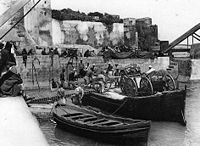 A second "Moroccan crisis" provoked by Berlin, increased European Great Power tensions, but the Treaty of Fez
(signed on March 30, 1912) made Morocco a protectorate
of France. By the same treaty, Spain
assumed the role of protecting power
over the northern and southern (Ifni
) zones on November 27 that year. Spain was given control of pieces of Morocco in the far north (Protectorate of Tetuan
) and south (Cape Juby
). Tangier received special international status. From a strictly legal point of view, the treaty did not deprive Morocco of its status as a sovereign state. Theoretically, the sultan remained the sole source of sovereignty. He reigned, but he did not rule.
Under the protectorate, French civil servants allied themselves with the French settlers (colons) and with their supporters in France to prevent any moves in the direction of Moroccan autonomy. As pacification proceeded, the French government promoted economic development, particularly the exploitation of Morocco's mineral wealth, the creation of a modern transportation system, and the development of a modern agriculture sector geared to the French market. Tens of thousands of colons entered Morocco and bought up large amounts of the rich agricultural land. Interest groups that formed among these elements continually pressured France to increase its control over Morocco.
was declared on 18 September 1921, by the people of the Rif
. It would be dissolved by Spanish and French forces on 27 May 1926.
In December 1934, a small group of nationalists—members of the newly formed Moroccan Action Committee (Comité d'Action Marocaine—CAM)—proposed a Plan of Reforms that called for a return to indirect rule as envisaged by the Treaty of Fès, admission of Moroccans to government positions, and establishment of representative councils. The moderate tactics used by the CAM to obtain consideration of reform—petitions, newspaper editorials, and personal appeals to French officials—proved inadequate, and the tensions created in the CAM by the failure of the plan caused it to split. The CAM was reconstituted as a nationalist political party to gain mass support for more radical demands, but the French suppressed the party in 1937.
Nationalist political parties, which subsequently arose under the French protectorate, based their arguments for Moroccan independence on such World War II
declarations as the Atlantic Charter
(a joint U.S.-British statement that set forth, among other things, the right of all people to choose the form of government under which they live).
Many Moroccan Goumiere assisted the Americans in both World War I
and World War II. During World War II, the badly divided nationalist movement became more cohesive, and informed Moroccans dared to consider the real possibility of political change in the post-war era. However, the nationalists were disappointed in their belief that the Allied victory in Morocco would pave the way for independence. In January 1944, the Istiqlal (Independence) Party
, which subsequently provided most of the leadership for the nationalist movement, released a manifesto demanding full independence, national reunification, and a democratic constitution. The sultan had approved the manifesto before its submission to the French resident general, who answered that no basic change in the protectorate status was being considered. The general sympathy of the sultan for the nationalists had become evident by the end of the war, although he still hoped to see complete independence achieved gradually. By contrast, the residency, supported by French economic interests and vigorously backed by most of the colons, adamantly refused to consider even reforms short of independence. Official intransigence contributed to increased animosity between the nationalists and the colons and gradually widened the split between the sultan and the resident general.
In December 1952, a riot broke out in Casablanca over the murder of a Tunisian labor leader; this event marked a watershed in relations between Moroccan political parties and French authorities. In the aftermath of the rioting, the residency outlawed the new Moroccan Communist Party and the Istiqlal
.
France's exile
of the highly respected Sultan Mohammed V to Madagascar
in 1953 and his replacement by the unpopular Mohammed Ben Aarafa
, whose reign was perceived as illegitimate, sparked active opposition to the French protectorate both from nationalists and those who saw the sultan as a religious leader. Two years later, faced with a united Moroccan demand for the sultan's return, rising violence in Morocco, and the deteriorating situation in Algeria, the French government brought Mohammed V back to Morocco. The negotiations that led to Moroccan independence began the following year.
 In late 1955, Mohammed V successfully negotiated the gradual restoration of Moroccan independence within a framework of French-Moroccan interdependence. The sultan agreed to institute reforms that would transform Morocco into a constitutional monarchy with a democratic form of government. In February 1956, Morocco acquired limited home rule. Further negotiations for full independence culminated in the Spanish-Moroccan Agreement signed in Paris on March 2, 1956. On April 7 of that year France officially relinquished its protectorate in Morocco. The internationalized city of Tangier
was reintegrated with the signing of the Tangier Protocol
on October 29, 1956. The abolition of the Spanish protectorate and the recognition of Moroccan independence by Spain were negotiated separately and made final in the Joint Declaration of April 1956. Through this agreement with Spain in 1956 and another in 1958, Moroccan control over certain Spanish-ruled areas was restored, though attempts to claim other Spanish possessions through military action
were less successful.
Almost all speakers of the Judeo-Berber language
left Morocco in the years following its independence.
In the months that followed independence, Mohammed V proceeded to build a modern governmental structure under a constitutional monarchy
in which the sultan would exercise an active political role. He acted cautiously, having no intention of permitting more radical elements in the nationalist movement to overthrow the established order. He was also intent on preventing the Istiqlal from consolidating its control and establishing a single-party state
. In August 1957, Mohammed V assumed the title of king.
became King of Morocco on March 3, 1961. His rule would be marked by political unrest, and the ruthless government response earned the period the name "the years of lead
". The new king took personal control of the government as prime minister and named a new cabinet. Aided by an advisory council, he drew up a new constitution, which was approved overwhelmingly in a December 1962 referendum. Under its provisions, the king remained the central figure in the executive branch of the government, but legislative power was vested in a bicameral parliament, and an independent judiciary was guaranteed. In May 1963, legislative elections took place for the first time, and the royalist coalition secured a small plurality of seats. However, following a period of political upheaval in June 1965, Hassan II assumed full legislative and executive powers under a "state of exception," which remained in effect until 1970. Subsequently, a reform constitution was approved, restoring limited parliamentary government, and new elections were held. However, dissent remained, revolving around complaints of widespread corruption and malfeasance in government. In July 1971 and again in August 1972, the regime was challenged by two attempted military coups. The atmosphere in the country remained tense.
After neighbouring Algeria
's 1962 independence from France
, border skirmishes in the Tindouf area
of south-western Algeria, escalated in 1963 into what is known as the Sand War
. Morocco invaded to claim the areas for Greater Morocco
, but the fighting stalemated within weeks, and Morocco was forced to retreat with no border adjustments. The border remained a contentious issue, but was later demarcated, and Morocco no longer makes any formal claim on Algerian territory.
Despite serious domestic turmoil, the patriotism engendered by Morocco’s participation in the Middle East
conflict and by the events in Western Sahara contributed to Hassan’s popularity and strengthened his hand politically. The king had dispatched Moroccan troops to the Sinai front after the outbreak of Arab-Israeli War in October 1973. Although they arrived too late to engage in hostilities, the action won Morocco goodwill among other Arab states. Shortly thereafter, the attention of the government turned to the acquisition of Western Sahara
from Spain, an issue on which all major domestic parties agreed.
in the south became part of the new Morocco in 1969, but other Spanish possessions in the north (Ceuta
, Melilla
and some small islands) remain under Madrid's control, with Morocco viewing them as occupied
territory.
A defining theme of Moroccan history and foreign policy is the bitter struggle over Western Sahara
. Moroccan claims to Western Sahara date to the 11th century. However, in August 1974, Spain formally acknowledged the 1966 United Nations
(UN) resolution calling for a referendum on the future status of Western Sahara and requested that a plebiscite be conducted under UN supervision. A UN visiting mission
reported in October 1975 that an overwhelming majority of the Saharan people desired independence. Morocco protested the proposed referendum and took its case to the International Court of Justice
at The Hague
, which ruled that despite historical “ties of allegiance” between Morocco and the tribes of Western Sahara, there was no legal justification for departing from the UN position on self-determination. Spain, meanwhile, had declared that even in the absence of a referendum, it intended to surrender political control of Western Sahara, and Spain, Morocco, and Mauritania
convened a tripartite conference
to resolve the territory’s future. But Madrid also announced that it was opening independence talks with the Algerian-backed Saharan independence movement known as the Polisario Front
.
In early 1976, Spain ceded Western Sahara administration's to Morocco and Mauritania. Morocco assumed control over the northern two-thirds of the territory and conceded the remaining portion in the south to Mauritania. An assembly of Saharan tribal leaders duly acknowledged Moroccan sovereignty. However, buoyed by the increasing defection of the chiefs to its cause, the Polisario drew up a constitution and announced the formation of the Saharawi Arab Democratic Republic (SADR). A new dimension was thereby added to the dispute because the liberation movement could now present its claims as a government-in-exile.
Morocco eventually sent a large portion of its combat forces into Western Sahara to confront the Polisario’s forces, which were relatively small but well-equipped, highly mobile, and resourceful, using Algerian bases for quick strikes against targets deep inside Morocco and Mauritania as well as for operations in Western Sahara. In August 1979, after suffering military losses, Mauritania renounced its claim to Western Sahara and signed a peace treaty with the Polisario. Morocco then annexed the entire territory and, in 1985, built a 2,500-kilometer sand berm around three-quarters of it. In 1988, Morocco and the Polisario Front finally agreed on a United Nations (UN) peace plan, and a cease-fire and settlement plan went into effect in 1991. Even though the UN Security Council created a peacekeeping
force to implement a referendum on self-determination for Western Sahara, it has yet to be held, periodic negotiations have failed, and the status of the territory remains unresolved.
More than any other issue since independence, the objective of securing Western Sahara had unified the Moroccan nation. Because of the firm stand the king had taken, it also enhanced his popularity in the country. But the war against the Polisario guerrillas put severe strains on the economy, and Morocco found itself increasingly isolated diplomatically. Successive governments showed little inclination to move seriously against pressing economic and social issues. As a result, popular discontent with social and economic conditions persisted. Political parties continued to proliferate but produced only a divided and weakly organized opposition or were suppressed. Through the force of his strong personality, the legacy of the monarchy, and the application of political repression, the king succeeded in asserting his authority and controlling the forces threatening the existing social order. Gradual political reforms in the 1990s culminated in the constitutional reform of 1996, which created a new bicameral legislature with expanded, although still limited, powers. Although reportedly marred by irregularities, elections for the Chamber of Representatives were held in 1997.
in 1999, the more liberal
-minded Crown Prince Sidi Mohammed, who assumed the title of Mohammed VI, took the throne. He has since enacted successive reforms to modernize Morocco, and the country has seen a marked improvement in its human rights
record. One of the new king’s first acts was to free some 8,000 political prisoners and reduce the sentences of another 30,000. He also established a commission to compensate families of missing political activists and others subjected to arbitrary detention. In September 2002, new legislative elections were held, and the Socialist Union of Popular Forces (Union Socialiste des Forces Populaires—USFP) led all other parties in the voting. International observers regarded the elections as free and fair, noting the lack of irregularities that had plagued the 1997 elections. Under Muhammad VI, Morocco has continued down a path toward economic, political, and social reform and modernization. In May 2003, in honor of the birth of a son and heir to the throne, the king ordered the release of 9,000 prisoners and the reduction of 38,000 sentences. Also in 2003, Berber-language instruction was introduced in primary schools, prior to introducing it at all educational levels. In 2004, the government implemented reforms of the family code improving the status of women—first proposed in 2000—despite the objections of traditionalists.
In March 2000, women's groups organised demonstrations in Casablanca
proposing reforms to the legal status of women in the country. 40,000 women attended, calling for a ban on polygamy
and the introduction of civil divorce law (divorce being a purely religious procedure at that time). Although a counter-demonstration attracted half a million participants, the movement for change started in 2000 was influential on King Mohammed, and he enacted a new Mudawana
, or family law, in early 2004, meeting some of the demands of women's rights activists.
In July 2002, a crisis broke with Spain over an uninhabited small island lying just less than 200 meters from the Moroccan coast, named Toura or Leila by Moroccans, and Isla Perejil
by Spain. After mediation by the United States, Both Morocco and Spain agreed to return to the status quo by which the Island remains deserted and almost a no man's land.
Internationally, Morocco has maintained a moderate stance, with strong ties to the West. It was one of the first Arab and Islamic states to denounce the 9/11 terrorist attacks on the United States. In May 2003, Morocco itself was subjected to the more radical forces at work in the Arab world when Islamist suicide bombers simultaneously struck a series of sites in Casablanca
, killing 45 and injuring more than 100 others. The Moroccan government responded with a crackdown against Islamist extremists, ultimately arresting several thousand, prosecuting 1,200, and sentencing about 900. Additional arrests followed in June 2004. That same month, the United States designated Morocco a major non-North Atlantic Treaty Organization ally in recognition of its efforts to thwart international terrorism. On January 1, 2006, a comprehensive bilateral free trade agreement between the United States and Morocco took effect. The agreement had been signed in 2004 along with a similar agreement with the European Union
, its main trade partner.
Classical antiquity
Classical antiquity is a broad term for a long period of cultural history centered on the Mediterranean Sea, comprising the interlocking civilizations of ancient Greece and ancient Rome, collectively known as the Greco-Roman world...
. The country was first unified by the Idrisid dynasty in 780, representing the first Islamic state in Africa
Africa
Africa is the world's second largest and second most populous continent, after Asia. At about 30.2 million km² including adjacent islands, it covers 6% of the Earth's total surface area and 20.4% of the total land area...
autonomous from the Arab Empire
Caliphate
The term caliphate, "dominion of a caliph " , refers to the first system of government established in Islam and represented the political unity of the Muslim Ummah...
. Under the Almoravid dynasty and the Almohad dynasty, Morocco
Morocco
Morocco , officially the Kingdom of Morocco , is a country located in North Africa. It has a population of more than 32 million and an area of 710,850 km², and also primarily administers the disputed region of the Western Sahara...
dominated the Maghreb
Maghreb
The Maghreb is the region of Northwest Africa, west of Egypt. It includes five countries: Morocco, Algeria, Tunisia, Libya, and Mauritania and the disputed territory of Western Sahara...
and Muslim Spain. The Reconquista
Reconquista
The Reconquista was a period of almost 800 years in the Middle Ages during which several Christian kingdoms succeeded in retaking the Muslim-controlled areas of the Iberian Peninsula broadly known as Al-Andalus...
ended Almohad rule in Iberia
Iberia
The name Iberia refers to three historical regions of the old world:* Iberian Peninsula, in Southwest Europe, location of modern-day Portugal and Spain** Prehistoric Iberia...
and many Muslims and Jews
Jews
The Jews , also known as the Jewish people, are a nation and ethnoreligious group originating in the Israelites or Hebrews of the Ancient Near East. The Jewish ethnicity, nationality, and religion are strongly interrelated, as Judaism is the traditional faith of the Jewish nation...
migrated to Morocco. Under the Saadi dynasty
Saadi Dynasty
The Saadi dynasty of Morocco , began with the reign of Sultan Mohammed ash-Sheikh in 1554, when he vanquished the last Wattasids at the Battle of Tadla....
, Morocco would consolidate power and fight off Portuguese
Portuguese Empire
The Portuguese Empire , also known as the Portuguese Overseas Empire or the Portuguese Colonial Empire , was the first global empire in history...
and Ottoman
Ottoman Empire
The Ottoman EmpireIt was usually referred to as the "Ottoman Empire", the "Turkish Empire", the "Ottoman Caliphate" or more commonly "Turkey" by its contemporaries...
invaders, as in the battle of Ksar el Kebir. The reign of Ahmad al-Mansur brought new wealth and prestige to the Sultanate, and an invasion of the Songhay Empire was initiated. However managing the territories across the Sahara
Sahara
The Sahara is the world's second largest desert, after Antarctica. At over , it covers most of Northern Africa, making it almost as large as Europe or the United States. The Sahara stretches from the Red Sea, including parts of the Mediterranean coasts, to the outskirts of the Atlantic Ocean...
proved to be difficult. After the death of al-Mansur the country was divided among his sons. In 1666 the sultanate was reunited by the Alaouite dynasty
Alaouite Dynasty
The Alaouite Dynasty is the name of the current Moroccan royal family. The name Alaouite comes from the ‘Alī of its founder Moulay Ali Cherif who became Prince of Tafilalt in 1631. His son Mulay r-Rshid was able to unite and pacify the country...
, who have since been the ruling house of Morocco. The organization of the state developed with Ismail Ibn Sharif
Ismail Ibn Sharif
Moulay Ismaïl Ibn Sharif was the second ruler of the Moroccan Alaouite dynasty. Like others of the dynasty, Ismaïl claimed to be a descendant of Muhammad through his roots to Hassan ibn Ali...
. With his Black Guard
Black Guard
The Black Guard , also known as "Masters of the Blackness," were the corps of black-African slave-soldiers assembled by the Alaouite sultan of Morocco, Moulay Ismail...
he drove the English from Tangier
Tangier
Tangier, also Tangiers is a city in northern Morocco with a population of about 700,000 . It lies on the North African coast at the western entrance to the Strait of Gibraltar where the Mediterranean meets the Atlantic Ocean off Cape Spartel...
(1684) and the Spanish
Spanish Empire
The Spanish Empire comprised territories and colonies administered directly by Spain in Europe, in America, Africa, Asia and Oceania. It originated during the Age of Exploration and was therefore one of the first global empires. At the time of Habsburgs, Spain reached the peak of its world power....
from Larache
Larache
Larache is an important harbour town in the region Tanger-Tétouan in northern Morocco. It was founded in the 7th century when a group of Muslim soldiers from Arabia extended their camp at Lixus onto the south bank of the Loukkos River.In 1471, the Portuguese settlers from Asilah and Tangier drove...
(1689). The Alaouite dynasty distinguished itself in the 19th century by maintaining Moroccan independence while other states in the region succumbed to European interests. In 1912, after the First Moroccan Crisis
First Moroccan Crisis
The First Moroccan Crisis was the international crisis over the international status of Morocco between March 1905 and May 1906. Germany resented France's increasing dominance of Morocco, and insisted on an open door policy that would allow German business access to its market...
and the Agadir Crisis
Agadir Crisis
The Agadir Crisis, also called the Second Moroccan Crisis, or the Panthersprung, was the international tension sparked by the deployment of the German gunboat Panther, to the Moroccan port of Agadir on July 1, 1911.-Background:...
, the Treaty of Fez
Treaty of Fez
By the Treaty of Fez , signed March 30, 1912, Sultan Abdelhafid gave up the sovereignty of Morocco to the French, making the country a protectorate, resolving the Agadir Crisis of July 1, 1911....
was signed, effectively dividing Morocco into a French
French Morocco
French Protectorate of Morocco was a French protectorate in Morocco, established by the Treaty of Fez. French Morocco did not include the north of the country, which was a Spanish protectorate...
and Spanish protectorate
Spanish Morocco
The Spanish protectorate of Morocco was the area of Morocco under colonial rule by the Spanish Empire, established by the Treaty of Fez in 1912 and ending in 1956, when both France and Spain recognized Moroccan independence.-Territorial borders:...
. In 1956, after 44 years of occupation Morocco regained independence from France
France
The French Republic , The French Republic , The French Republic , (commonly known as France , is a unitary semi-presidential republic in Western Europe with several overseas territories and islands located on other continents and in the Indian, Pacific, and Atlantic oceans. Metropolitan France...
as the Kingdom of Morocco.
Prehistoric Morocco
The Capsian cultureCapsian culture
The Capsian culture was a Mesolithic culture of the Maghreb, which lasted from about 10,000 to 6,000 BCE.It was concentrated mainly in modern Tunisia, and Algeria, with some sites attested in southern Spain to Sicily....
brought Morocco
Morocco
Morocco , officially the Kingdom of Morocco , is a country located in North Africa. It has a population of more than 32 million and an area of 710,850 km², and also primarily administers the disputed region of the Western Sahara...
into the Neolithic
Neolithic
The Neolithic Age, Era, or Period, or New Stone Age, was a period in the development of human technology, beginning about 9500 BC in some parts of the Middle East, and later in other parts of the world. It is traditionally considered as the last part of the Stone Age...
about 2001 BC, at a time when the Maghreb
Maghreb
The Maghreb is the region of Northwest Africa, west of Egypt. It includes five countries: Morocco, Algeria, Tunisia, Libya, and Mauritania and the disputed territory of Western Sahara...
was less arid than it is today. The Berber language
Berber languages
The Berber languages are a family of languages indigenous to North Africa, spoken from Siwa Oasis in Egypt to Morocco , and south to the countries of the Sahara Desert...
probably was formed at roughly the same time as agriculture (see Berber
Berber people
Berbers are the indigenous peoples of North Africa west of the Nile Valley. They are continuously distributed from the Atlantic to the Siwa oasis, in Egypt, and from the Mediterranean to the Niger River. Historically they spoke the Berber language or varieties of it, which together form a branch...
), and was developed by the existing population and adopted the immigrants who arrived later. Modern DNA analysis (see link) has confirmed that various populations have contributed to the present-day gene pool of Morocco in addition to the main ethnic group which is the Amazighs/Berbers
Berber people
Berbers are the indigenous peoples of North Africa west of the Nile Valley. They are continuously distributed from the Atlantic to the Siwa oasis, in Egypt, and from the Mediterranean to the Niger River. Historically they spoke the Berber language or varieties of it, which together form a branch...
. A very small percentage of those other populations are Iberians
Iberian Peninsula
The Iberian Peninsula , sometimes called Iberia, is located in the extreme southwest of Europe and includes the modern-day sovereign states of Spain, Portugal and Andorra, as well as the British Overseas Territory of Gibraltar...
and sub-Saharan Africa
Africa
Africa is the world's second largest and second most populous continent, after Asia. At about 30.2 million km² including adjacent islands, it covers 6% of the Earth's total surface area and 20.4% of the total land area...
ns.
In Mesolithic
Mesolithic
The Mesolithic is an archaeological concept used to refer to certain groups of archaeological cultures defined as falling between the Paleolithic and the Neolithic....
ages the geography of Morocco resembled a savanna
Savanna
A savanna, or savannah, is a grassland ecosystem characterized by the trees being sufficiently small or widely spaced so that the canopy does not close. The open canopy allows sufficient light to reach the ground to support an unbroken herbaceous layer consisting primarily of C4 grasses.Some...
more than the present day arid landscape. While little is known about Morocco settlement in these early times, excavations elsewhere in the Maghreb
Maghreb
The Maghreb is the region of Northwest Africa, west of Egypt. It includes five countries: Morocco, Algeria, Tunisia, Libya, and Mauritania and the disputed territory of Western Sahara...
suggest an abundance of game and forests that would have been hospitable to Mesolithic hunters and gatherers.
The coastal regions of present-day Morocco shared in an early Neolithic
Neolithic
The Neolithic Age, Era, or Period, or New Stone Age, was a period in the development of human technology, beginning about 9500 BC in some parts of the Middle East, and later in other parts of the world. It is traditionally considered as the last part of the Stone Age...
culture that was common to the whole Mediterranean littoral
Littoral
The littoral zone is that part of a sea, lake or river that is close to the shore. In coastal environments the littoral zone extends from the high water mark, which is rarely inundated, to shoreline areas that are permanently submerged. It always includes this intertidal zone and is often used to...
. Archaeological remains point to the domestication
Domestication
Domestication or taming is the process whereby a population of animals or plants, through a process of selection, becomes accustomed to human provision and control. In the Convention on Biological Diversity a domesticated species is defined as a 'species in which the evolutionary process has been...
of cattle and the cultivation of crops in the region during that period. Eight thousand years ago, south of the great mountain ranges in what is now the Sahara Desert, a vast savanna
Savanna
A savanna, or savannah, is a grassland ecosystem characterized by the trees being sufficiently small or widely spaced so that the canopy does not close. The open canopy allows sufficient light to reach the ground to support an unbroken herbaceous layer consisting primarily of C4 grasses.Some...
supported Neolithic hunters and herders whose culture flourished until the region began to desiccate as a result of climatic changes after 4000 BC.
Phoenicians on the coast
PhoeniciaPhoenicia
Phoenicia , was an ancient civilization in Canaan which covered most of the western, coastal part of the Fertile Crescent. Several major Phoenician cities were built on the coastline of the Mediterranean. It was an enterprising maritime trading culture that spread across the Mediterranean from 1550...
n traders, who had penetrated the western Mediterranean before the 12th century BC, set up depots for salt and ore along the coast and up the rivers of the territory that is now Morocco. The arrival of Phoenicians heralded many centuries of rule by foreign powers for the north of Morocco. Major early substantial settlements of the Phoenicians were at Chellah
Chellah
Chellah, or Sala Colonia is a necropolis and complex of ancient Roman Mauretania Tingitana and medieval ruins at Rabat, Morocco. It is the most ancient human settlement on the mouth of the Bou Regreg River.-History:...
, Lixus
Lixus
Lixus refers to the following things:* lixus, the Latin word for "boiled"* Lixus in Morocco* Lixus , a genus of true weevils...
and Mogador, with Mogador being a Phoenician colony as early as the early 6th century BC. Carthage
Carthage
Carthage , implying it was a 'new Tyre') is a major urban centre that has existed for nearly 3,000 years on the Gulf of Tunis, developing from a Phoenician colony of the 1st millennium BC...
developed commercial relations with the Berber tribes of the interior and paid them an annual tribute to ensure their cooperation in the exploitation of raw materials.
By the 5th century BC, Carthage had extended its hegemony across much of North Africa
North Africa
North Africa or Northern Africa is the northernmost region of the African continent, linked by the Sahara to Sub-Saharan Africa. Geopolitically, the United Nations definition of Northern Africa includes eight countries or territories; Algeria, Egypt, Libya, Morocco, South Sudan, Sudan, Tunisia, and...
. By the 2nd century BC, several large, although loosely administered, Berber kingdoms had emerged.
Roman, and sub-Roman Morocco
Initially the Berber kings ruled overshadowing Carthage and RomeRome
Rome is the capital of Italy and the country's largest and most populated city and comune, with over 2.7 million residents in . The city is located in the central-western portion of the Italian Peninsula, on the Tiber River within the Lazio region of Italy.Rome's history spans two and a half...
(roman rulers actually referred to these people as semi-gods), often as satellites, allowing Roman rulership to exist.
But after the fall of Carthage, the area was annexed to the Roman Empire
Roman Empire
The Roman Empire was the post-Republican period of the ancient Roman civilization, characterised by an autocratic form of government and large territorial holdings in Europe and around the Mediterranean....
in AD 40. Rome controlled the vast, ill-defined territory through alliances with the tribes rather than through military occupation, expanding its authority only to those areas that were economically useful or that could be defended without additional manpower. Hence, Roman administration never extended outside the restricted area of the northern coastal plain and valleys. This strategic region formed part of the Roman Empire
Roman Empire
The Roman Empire was the post-Republican period of the ancient Roman civilization, characterised by an autocratic form of government and large territorial holdings in Europe and around the Mediterranean....
, governed as Mauretania Tingitana
Mauretania Tingitana
Mauretania Tingitana was a Roman province located in northwestern Africa, coinciding roughly with the northern part of present-day Morocco. The province extended from the northern peninsula, opposite Gibraltar, to Chellah and Volubilis to the south, and as far east as the Oued Laou river. Its...
.
Roman historians (like Ptolemeus) considered that all actual Morocco until the Atlas mountains
Atlas Mountains
The Atlas Mountains is a mountain range across a northern stretch of Africa extending about through Morocco, Algeria, and Tunisia. The highest peak is Toubkal, with an elevation of in southwestern Morocco. The Atlas ranges separate the Mediterranean and Atlantic coastlines from the Sahara Desert...
was part of the Roman Empire, because in the Augustus times Mauretania was a vassal state and his rulers (like Juba II
Juba II
Juba II or Juba II of Numidia was a king of Numidia and then later moved to Mauretania. His first wife was Cleopatra Selene II, daughter to Greek Ptolemaic Queen Cleopatra VII of Egypt and Roman triumvir Mark Antony.-Early life:Juba II was a prince of Berber descent from North Africa...
) controlled all the areas south of Volubilis. But the effective control of Roman legionaries was until the area of Sala Colonia (the castra "Exploratio Ad Mercurios" south of Sala is the southernmost discovered until now). Anyway some historians believe the Roman frontier reached actual Casablanca
Casablanca
Casablanca is a city in western Morocco, located on the Atlantic Ocean. It is the capital of the Grand Casablanca region.Casablanca is Morocco's largest city as well as its chief port. It is also the biggest city in the Maghreb. The 2004 census recorded a population of 2,949,805 in the prefecture...
, founded by Romans as a port.
During the reign of Juba II
Juba II
Juba II or Juba II of Numidia was a king of Numidia and then later moved to Mauretania. His first wife was Cleopatra Selene II, daughter to Greek Ptolemaic Queen Cleopatra VII of Egypt and Roman triumvir Mark Antony.-Early life:Juba II was a prince of Berber descent from North Africa...
Emperor Augustus
Augustus
Augustus ;23 September 63 BC – 19 August AD 14) is considered the first emperor of the Roman Empire, which he ruled alone from 27 BC until his death in 14 AD.The dates of his rule are contemporary dates; Augustus lived under two calendars, the Roman Republican until 45 BC, and the Julian...
(who created in the area of what is now northern Morocco 12 colonies with retired Roman legionaries) had already founded three colonias
Colonia (Roman)
A Roman colonia was originally a Roman outpost established in conquered territory to secure it. Eventually, however, the term came to denote the highest status of Roman city.-History:...
(with Roman citizens) in Mauretania close to the Atlantic coast: Iulia Constantia Zilil
Iulia Constantia Zilil
Iulia Constantia Zilil was one of the three colonias in Mauretania Tingitana founded by emperor Augustus between 33 and 25 BC for veterans of the battle of Actium. The city had then already been a Phoenician and Mauretanian city since the 4th century BC...
, Iulia Valentia Banasa
Iulia Valentia Banasa
Colonia Iulia Valentia Banasa was one of the three colonias in Mauretania Tingitana founded by emperor Augustus between 33 and 25 BC. for veterans of the battle of Actium. It was located on the southern bank of the Sebou River on the site now known as Sidi Ali Boujenoun. At the start of the reign...
and Iulia Campestris Babba.
This western part of Mauretania was to become the province called Mauretania Tingitana shortly afterwards, with capital the rich emporium of Volubilis
Volubilis
Volubilis is an archaeological site in Morocco situated near Meknes between Fez and Rabat along the N13 road. The nearest town is Moulay Idriss. Volubilis features the best preserved Roman ruins in this part of northern Africa...
.
In those centuries, the area controlled by Rome had a huge economic development, helped even by the construction of useful Roman roads
Roman roads in Morocco
Roman roads in Morocco were the western roads of Roman Africa.-Characteristics:In 42 AD the western part of the kingdom of Mauretania was reorganized as a province of Rome Mauretania Tingitana...
. The area was initially fully under control of Rome and only in the mid-2nd century was built a limes
Limes
A limes was a border defense or delimiting system of Ancient Rome. It marked the boundaries of the Roman Empire.The Latin noun limes had a number of different meanings: a path or balk delimiting fields, a boundary line or marker, any road or path, any channel, such as a stream channel, or any...
south of Sala and until Volubilis.
Roman control reached even the area of actual Casablanca
Casablanca
Casablanca is a city in western Morocco, located on the Atlantic Ocean. It is the capital of the Grand Casablanca region.Casablanca is Morocco's largest city as well as its chief port. It is also the biggest city in the Maghreb. The 2004 census recorded a population of 2,949,805 in the prefecture...
, then called Anfa
Anfa
Anfa is the area which is today Casablanca, Morocco. It was originally settled by Berbers in the 7th century. The area, which they named Anfa, became a small, independent kingdom, which rejected the muslim rule that surrounded it until it was conquered by the Almoravids in 1068.From the 14th...
according to Leo Africanus
Leo Africanus
Joannes Leo Africanus, was a Moorish diplomat and author who is best known for his book Descrittione dell’Africa describing the geography of North Africa.-Biography:Most of what is known about his life is gathered from autobiographical...
: it was used as a port by the Phoenicians and later the Romans.
Around 278 AD Romans moved their regional capital to Tanger and Volubilis started to lose importance.
The region remained a part of the Roman Empire until 429 AD as the Vandals
Vandals
The Vandals were an East Germanic tribe that entered the late Roman Empire during the 5th century. The Vandals under king Genseric entered Africa in 429 and by 439 established a kingdom which included the Roman Africa province, besides the islands of Sicily, Corsica, Sardinia and the Balearics....
overran the area and Roman administrative presence came to an end.
Indeed in the 5th century, the region fell to the Vandals
Vandals
The Vandals were an East Germanic tribe that entered the late Roman Empire during the 5th century. The Vandals under king Genseric entered Africa in 429 and by 439 established a kingdom which included the Roman Africa province, besides the islands of Sicily, Corsica, Sardinia and the Balearics....
, Visigoths, and then Byzantine Greek
Byzantine Empire
The Byzantine Empire was the Eastern Roman Empire during the periods of Late Antiquity and the Middle Ages, centred on the capital of Constantinople. Known simply as the Roman Empire or Romania to its inhabitants and neighbours, the Empire was the direct continuation of the Ancient Roman State...
s in rapid succession. During this time, however, the high mountains of most of modern Morocco remained unsubdued, and stayed in the hands of their Berber inhabitants.
Christianity
Christianity
Christianity is a monotheistic religion based on the life and teachings of Jesus as presented in canonical gospels and other New Testament writings...
was introduced in the 2nd century and gained converts in the towns and among slaves and Berber farmers. By the end of the 4th century, the Romanized areas had been Christianized, and inroads had been made as well among the Berber tribes, who sometimes converted en masse. But schismatic
Schism (religion)
A schism , from Greek σχίσμα, skhísma , is a division between people, usually belonging to an organization or movement religious denomination. The word is most frequently applied to a break of communion between two sections of Christianity that were previously a single body, or to a division within...
and heretical movements also developed, usually as forms of political protest. The area had a substantial Jewish population as well.
Early Islamic Morocco
ArabArab
Arab people, also known as Arabs , are a panethnicity primarily living in the Arab world, which is located in Western Asia and North Africa. They are identified as such on one or more of genealogical, linguistic, or cultural grounds, with tribal affiliations, and intra-tribal relationships playing...
s conquered the region in the 7th century, bringing their civilization and Islam
Islam
Islam . The most common are and . : Arabic pronunciation varies regionally. The first vowel ranges from ~~. The second vowel ranges from ~~~...
, to which many of the Berbers converted. While part of the larger Islamic Empire
Caliphate
The term caliphate, "dominion of a caliph " , refers to the first system of government established in Islam and represented the political unity of the Muslim Ummah...
, client states such as the Kingdom of Nekor
Kingdom of Nekor
The Kingdom of Nekor was an emirate in the Rif area of modern day Morocco, with its capital initially at Temsaman but later at Nekor. It was founded by an immigrant of Yemen, Salih I ibn Mansur al-Himyarī in 710 AD, by Caliphal grant...
were formed. Arab conquerors converted the indigenous Berber population to Islam, but Berber tribes retained their customary laws. The Arabs abhorred the Berbers as barbarians, while the Berbers often saw the Arabs as only an arrogant and brutal soldiery bent on collecting taxes.
In the 740, spurred by puritanical Kharijite agitators, the Berbers revolted
Berber Revolt
The Great Berber Revolt of 739/740-743 AD took place during the reign of the Umayyad Caliph Hisham ibn Abd al-Malik and marked the first successful secession from the Arab caliphate...
against Arab rule. The rebellion began among the Berber tribes of western Morocco, and spread quickly across the region. Although the rebellion petered out before the gates of Kairouan
Kairouan
Kairouan , also known as Kirwan or al-Qayrawan , is the capital of the Kairouan Governorate in Tunisia. Referred to as the Islamic Cultural Capital, it is a UNESCO World Heritage site. The city was founded by the Arabs around 670...
in 742, neither the Umayyad
Umayyad
The Umayyad Caliphate was the second of the four major Arab caliphates established after the death of Muhammad. It was ruled by the Umayyad dynasty, whose name derives from Umayya ibn Abd Shams, the great-grandfather of the first Umayyad caliph. Although the Umayyad family originally came from the...
rulers in Damascus, nor their Abbasid
Abbasid
The Abbasid Caliphate or, more simply, the Abbasids , was the third of the Islamic caliphates. It was ruled by the Abbasid dynasty of caliphs, who built their capital in Baghdad after overthrowing the Umayyad caliphate from all but the al-Andalus region....
successors, would manage to re-impose Arab rule on the liberated areas west of Ifriqiya
Ifriqiya
In medieval history, Ifriqiya or Ifriqiyah was the area comprising the coastal regions of what are today western Libya, Tunisia, and eastern Algeria. This area included what had been the Roman province of Africa, whose name it inherited....
. Morocco slipped out of the leash, and fragmented into a small collection of independent Berber statelets under their own rulers and laws. The Berbers went on to shape Islam in their own image - some (like the Banu Ifran
Banu Ifran
The Ifranids, also called Banu Ifran, Ifran, or the children of the Afri , were a Berber tribe prominent in the history of pre-Islamic and early Islamic North Africa....
) retained their connection with radical puritan sects, others (like the Berghwata) constructed a new syncretic faith which was simply folk religion thinly disguised as Islam.
As the "wild west" of the Islamic world, Morocco quickly became a haven for many dissidents, rebels and refugees from the empire. Among these was Idris ibn Abdallah, who with the help of the local Awraba Berbers, founded the Idrisid Dynasty in 788. His son Idris II
Idris II
Idris II was son of Idris I, the founder of the Idrisid dynasty in North Africa. He was born in Volubilis two months after the death of his father.-History:...
erected a splendid new capital at Fes
Fes
Fes or Fez is the second largest city of Morocco, after Casablanca, with a population of approximately 1 million . It is the capital of the Fès-Boulemane region....
and launched Morocco as a centre of learning and a major power. Another significant arrival around this time was a group of puritan Miknasa
Miknasa
The Miknasa were a Berber tribe in Morocco and western Algeria.The Miknasa Berbers originated in southern Tunisia, but migrated westwards into central Morocco and western Algeria in pre-Islamic times. The modern Moroccan city of Meknes bears witness to their presence.After defeat by the Muslims...
Berber rebels from Ifriqiya, who went on to erect the settlement of Sijilmassa (in southeast Morocco) and open trade across the Sahara
Sahara
The Sahara is the world's second largest desert, after Antarctica. At over , it covers most of Northern Africa, making it almost as large as Europe or the United States. The Sahara stretches from the Red Sea, including parts of the Mediterranean coasts, to the outskirts of the Atlantic Ocean...
desert with the gold-producing Ghana Empire
Ghana Empire
The Ghana Empire or Wagadou Empire was located in what is now southeastern Mauritania, and Western Mali. Complex societies had existed in the region since about 1500 BCE, and around Ghana's core region since about 300 CE...
of west Africa. Although the Midrarids of Sijilmassa and the Idrisids of Fez were frequently at odds politically and religiously, the Trans-Saharan trade route made them economically inter-dependent.
The balance was upset in the early 900s, when yet another group of religious refugees from the east, the Fatimid
Fatimid
The Fatimid Islamic Caliphate or al-Fāṭimiyyūn was a Berber Shia Muslim caliphate first centered in Tunisia and later in Egypt that ruled over varying areas of the Maghreb, Sudan, Sicily, the Levant, and Hijaz from 5 January 909 to 1171.The caliphate was ruled by the Fatimids, who established the...
s, arrived in the west. Not long after launching a coup and seizing power in Ifriqiya
Ifriqiya
In medieval history, Ifriqiya or Ifriqiyah was the area comprising the coastal regions of what are today western Libya, Tunisia, and eastern Algeria. This area included what had been the Roman province of Africa, whose name it inherited....
, the Fatimids invaded Morocco, sacking both Fez and Sijilmassa. Morocco fell into anarchy in the aftermath, fought over between Fatimid governors, Idrisid loyalists, new puritan groups and interventionists from Umayyad al-Andalus
Al-Andalus
Al-Andalus was the Arabic name given to a nation and territorial region also commonly referred to as Moorish Iberia. The name describes parts of the Iberian Peninsula and Septimania governed by Muslims , at various times in the period between 711 and 1492, although the territorial boundaries...
. Opportunistic local governors sold and re-sold their support to the highest bidder. In 965, the Fatimid caliph al-Muizz invaded Morocco one last time and established a modicum of peace. But no sooner was that done, the Fatimids turned their backs on the west, moving to their new capital in Cairo
Cairo
Cairo , is the capital of Egypt and the largest city in the Arab world and Africa, and the 16th largest metropolitan area in the world. Nicknamed "The City of a Thousand Minarets" for its preponderance of Islamic architecture, Cairo has long been a centre of the region's political and cultural life...
, Egypt
Egypt
Egypt , officially the Arab Republic of Egypt, Arabic: , is a country mainly in North Africa, with the Sinai Peninsula forming a land bridge in Southwest Asia. Egypt is thus a transcontinental country, and a major power in Africa, the Mediterranean Basin, the Middle East and the Muslim world...
. The Fatimids assigned the Zirids, a Sanhaja
Zenaga people
The Sanhaja or Senhaja were once one of the largest Berber tribal confederations of the Maghreb, along with the Zanata and Masmuda...
Berber clan, to keep an eye on things in the west. But centered in Ifriqiya and facing their own difficulties, the Zirids were unable to prevent Morocco from crumbling into the hands of a collection of local Zenata Berber chieftans, most of them clients of the Caliph of Cordoba, such as the Maghrawa
Maghrawa
The Maghrawa or Meghrawa were a Berber tribe in Morocco and central and western Algeria.-History:The Meghrawa, a tribe of Zanata Berbers, were one of the first Berber tribes to submit to Islam in the 7th century. They supported Uqba ibn Nafi in his campaign to the Atlantic in 683...
in the region of Fez and their on-again, off-again rivals, the Banu Ifran
Banu Ifran
The Ifranids, also called Banu Ifran, Ifran, or the children of the Afri , were a Berber tribe prominent in the history of pre-Islamic and early Islamic North Africa....
, just east of them.
The Berber Empires
Maghreb
The Maghreb is the region of Northwest Africa, west of Egypt. It includes five countries: Morocco, Algeria, Tunisia, Libya, and Mauritania and the disputed territory of Western Sahara...
; refers to North Africa west of Egypt) and Al-Andalus
Al-Andalus
Al-Andalus was the Arabic name given to a nation and territorial region also commonly referred to as Moorish Iberia. The name describes parts of the Iberian Peninsula and Septimania governed by Muslims , at various times in the period between 711 and 1492, although the territorial boundaries...
for more than 200 years. The Berber dynasties (Almoravids
Almoravids
The Almoravids were a Berber dynasty of Morocco, who formed an empire in the 11th-century that stretched over the western Maghreb and Al-Andalus. Their capital was Marrakesh, a city which they founded in 1062 C.E...
, Almohads, Marinid
Marinid
The Marinid dynasty or Benemerine dynasty was a Zenata Berber dynasty of Morocco. The Marinid dynasty overtook the Almohads in controlling Morocco in 1244. They controlled most of the Maghreb from the mid-14th century to the 15th century and supported the Kingdom of Granada in Al-Andalus in the...
s and Wattasids) gave the Berber people some measure of collective identity and political unity under a native regime for the first time in their history, and they created the idea of an "imperial Maghrib" under Berber aegis that survived in some form from dynasty to dynasty. But ultimately each of the Berber dynasties proved to be a political failure because none managed to create an integrated society out of a social landscape dominated by tribes that prized their autonomy and individual identity.
In 1559, the region fell to successive Arab tribes claiming descent from the Prophet Muhammad
Muhammad
Muhammad |ligature]] at U+FDF4 ;Arabic pronunciation varies regionally; the first vowel ranges from ~~; the second and the last vowel: ~~~. There are dialects which have no stress. In Egypt, it is pronounced not in religious contexts...
: first the Saadi Dynasty
Saadi Dynasty
The Saadi dynasty of Morocco , began with the reign of Sultan Mohammed ash-Sheikh in 1554, when he vanquished the last Wattasids at the Battle of Tadla....
who ruled from 1554 to 1659 and then the Alaouites
Alaouite Dynasty
The Alaouite Dynasty is the name of the current Moroccan royal family. The name Alaouite comes from the ‘Alī of its founder Moulay Ali Cherif who became Prince of Tafilalt in 1631. His son Mulay r-Rshid was able to unite and pacify the country...
, who founded a dynasty that has remained in power since the 17th century.
The Alaouite Dynasty
Morocco
Morocco , officially the Kingdom of Morocco , is a country located in North Africa. It has a population of more than 32 million and an area of 710,850 km², and also primarily administers the disputed region of the Western Sahara...
royal family. The name Alaouite comes from the ʿAlī of its founder Moulay Ali Cherif
Moulay Ali Cherif
Moulay Ali Cherif was allegedly a descendant of l-Hesn d-Dakhl and is considered to have been the founder of the Alaouite Dynasty of Morocco...
who became Sultan
Sultan
Sultan is a title with several historical meanings. Originally, it was an Arabic language abstract noun meaning "strength", "authority", "rulership", and "dictatorship", derived from the masdar سلطة , meaning "authority" or "power". Later, it came to be used as the title of certain rulers who...
of Tafilalt
Tafilalt
Tafilalt or Tafilet is a region and the most important oasis of the Moroccan Sahara; it is also considered one of the largest oases in the world, the oasis is entirely located along the Ziz River. The oasis is ten days' journey south of Fez, across the Atlas Mountains...
in 1631. His son Mulay r-Rshid
Al-Rashid of Morocco
Moulay al-Rashid was Sultan of Morocco from 1666 to 1672. He has been called the founder of the Alaouite Dynasty.It was his father Moulay Ali Cherif who took power in Tafilalt around 1630. In 1635 al-Rashid's brother Moulay Mohammed ould Moulay Cherif succeeded their still living father...
(1664–1672) was able to unite and pacify the country. The Alaouite family claim descent from Muhammad
Muhammad
Muhammad |ligature]] at U+FDF4 ;Arabic pronunciation varies regionally; the first vowel ranges from ~~; the second and the last vowel: ~~~. There are dialects which have no stress. In Egypt, it is pronounced not in religious contexts...
through the line of Fāṭimah az-Zahrah
Fatimah
Fatimah was a daughter of the Islamic prophet Muhammad from his first wife Khadijah bint Khuwaylid. She is regarded by Muslims as an exemplar for men and women. She remained at her father's side through the difficulties suffered by him at the hands of the Quraysh of Mecca...
, Muhammad's daughter, and her husband, the Fourth Caliph
Rashidun
The Rightly Guided Caliphs or The Righteous Caliphs is a term used in Sunni Islam to refer to the first four Caliphs who established the Rashidun Caliphate. The concept of "Rightly Guided Caliphs" originated with the Abbasid Dynasty...
ʿAlī ibn Abī Ṭālib
Ali
' |Ramaḍān]], 40 AH; approximately October 23, 598 or 600 or March 17, 599 – January 27, 661).His father's name was Abu Talib. Ali was also the cousin and son-in-law of the Islamic prophet Muhammad, and ruled over the Islamic Caliphate from 656 to 661, and was the first male convert to Islam...
.
According to some legends the Alaouites entered Morocco at the end of the 13th century when Al Hassan Addakhil
Al Hassan Addakhil
l-Hesn d-Dakhl was a direct ancestor to Mulay ʻLi Shrif, founder of the Alaouite Dynasty, which is the current Moroccan royal family. He was taken to Morocco from the town of Yanbu in the Hejaz at the end of the 13th century by the inhabitants of Tafilalt to be their Imām...
, who lived then in the town of Yanbu in the Hejaz
Hejaz
al-Hejaz, also Hijaz is a region in the west of present-day Saudi Arabia. Defined primarily by its western border on the Red Sea, it extends from Haql on the Gulf of Aqaba to Jizan. Its main city is Jeddah, but it is probably better known for the Islamic holy cities of Mecca and Medina...
, was brought to Morocco by the inhabitants of Tafilalet to be their imām
Imam (Sunni Islam)
In Sunni Islam, an imam khatib is a leader, often the worship leader of a mosque and the Muslim community. This compound title is merely a common combination of two elementary offices: leader of the congregational prayer, which in larger mosques is performed at the times of all daily prayers; and...
. They were hoping that, as he was a descendant of Muhammad
Sharif
Sharīf or Chérif is a traditional Arab tribal title given to those who serve as the protector of the tribe and all tribal assets, such as property, wells, and land. In origin, the word is an adjective meaning "noble", "highborn". The feminine singular is sharifa...
, his presence would help to improve their date palm
Date Palm
The date palm is a palm in the genus Phoenix, cultivated for its edible sweet fruit. Although its place of origin is unknown because of long cultivation, it probably originated from lands around the Persian Gulf. It is a medium-sized plant, 15–25 m tall, growing singly or forming a clump with...
crops thanks to his barakah
Barakah
In Islam, Barakah is the beneficent force from God that flows through the physical and spiritual spheres as prosperity, protection, and happiness. Baraka is the continuity of spiritual presence and revelation that begins with God and flows through that and those closest to God. Baraka can be found...
"blessing", an Arabic
Arabic language
Arabic is a name applied to the descendants of the Classical Arabic language of the 6th century AD, used most prominently in the Quran, the Islamic Holy Book...
term meaning a sense of divine presence or charisma. His descendants began to increase their power in southern Morocco after the death of the Saʻdī
Saadi Dynasty
The Saadi dynasty of Morocco , began with the reign of Sultan Mohammed ash-Sheikh in 1554, when he vanquished the last Wattasids at the Battle of Tadla....
ruler Ahmad al-Mansur (1578–1603).
In 1659, the last Saʻdī sultan was overthrown in the conquest of Marrakech
Marrakech
Marrakech or Marrakesh , known as the "Ochre city", is the most important former imperial city in Morocco's history...
by Mulay r-Rshid
Al-Rashid of Morocco
Moulay al-Rashid was Sultan of Morocco from 1666 to 1672. He has been called the founder of the Alaouite Dynasty.It was his father Moulay Ali Cherif who took power in Tafilalt around 1630. In 1635 al-Rashid's brother Moulay Mohammed ould Moulay Cherif succeeded their still living father...
(1664–1672). After the victory over the zāwiya
Zaouia
A zaouia or zawiya is an Islamic religious school or monastery. The term is Maghrebi and West African, roughly corresponding to the Eastern term madrassa...
of Dila, who controlled northern Morocco, he was able to unite and pacify the country.
Ismail Ibn Sharif
Moulay Ismaïl Ibn Sharif was the second ruler of the Moroccan Alaouite dynasty. Like others of the dynasty, Ismaïl claimed to be a descendant of Muhammad through his roots to Hassan ibn Ali...
(1672–1727), who, against the opposition of local tribes began to create a unified state. Because the Alaouites, in contrast to previous dynasties, did not have the support of a single Berber
Berber people
Berbers are the indigenous peoples of North Africa west of the Nile Valley. They are continuously distributed from the Atlantic to the Siwa oasis, in Egypt, and from the Mediterranean to the Niger River. Historically they spoke the Berber language or varieties of it, which together form a branch...
or Bedouin
Bedouin
The Bedouin are a part of a predominantly desert-dwelling Arab ethnic group traditionally divided into tribes or clans, known in Arabic as ..-Etymology:...
tribe, Isma'īl controlled Morocco through an army of black slaves. With these soldiers he drove the English
England
England is a country that is part of the United Kingdom. It shares land borders with Scotland to the north and Wales to the west; the Irish Sea is to the north west, the Celtic Sea to the south west, with the North Sea to the east and the English Channel to the south separating it from continental...
from Tangiers (1684) and the Spanish
Spain
Spain , officially the Kingdom of Spain languages]] under the European Charter for Regional or Minority Languages. In each of these, Spain's official name is as follows:;;;;;;), is a country and member state of the European Union located in southwestern Europe on the Iberian Peninsula...
from Larache
Larache
Larache is an important harbour town in the region Tanger-Tétouan in northern Morocco. It was founded in the 7th century when a group of Muslim soldiers from Arabia extended their camp at Lixus onto the south bank of the Loukkos River.In 1471, the Portuguese settlers from Asilah and Tangier drove...
(1689.) However, the unity of Morocco did not survive his death — in the ensuing power struggles the tribes became a political and military force once again.
Only with Muhammad III
Mohammed III of Morocco
Mohammed Ben Abdellah al-Khatib was Sultan of Morocco from 1757 to 1790 under the Alaouite dynasty. He was the governor of Marrakech around 1750 and was the son of Sultan Abdallah IV who reigned 1745-1757...
(1757–1790) could the kingdom be pacified again and the administration reorganized. A renewed attempt at centralization was abandoned and the tribes allowed to preserve their autonomy.
In 1777 Morocco was the very first state to recognize the sovereignty of a newly independent United States
United States
The United States of America is a federal constitutional republic comprising fifty states and a federal district...
.
Under Abderrahmane
Abderrahmane of Morocco
Moulay Sharif Abderrahmane was sultan of Morocco from 1822 to 1859. He was a member of the Alaouite dynasty.-Biography:He was born in 1778. His reign began at the start of the French occupation of Algeria...
(1822–1859) Morocco fell under the influence of the Europe
Europe
Europe is, by convention, one of the world's seven continents. Comprising the westernmost peninsula of Eurasia, Europe is generally 'divided' from Asia to its east by the watershed divides of the Ural and Caucasus Mountains, the Ural River, the Caspian and Black Seas, and the waterways connecting...
an powers. When Morocco supported the Algeria
Algeria
Algeria , officially the People's Democratic Republic of Algeria , also formally referred to as the Democratic and Popular Republic of Algeria, is a country in the Maghreb region of Northwest Africa with Algiers as its capital.In terms of land area, it is the largest country in Africa and the Arab...
n independence movement of the Emir
Emir
Emir , meaning "commander", "general", or "prince"; also transliterated as Amir, Aamir or Ameer) is a title of high office, used throughout the Muslim world...
Abd al-Qadir, it was heavily defeated by the French
France
The French Republic , The French Republic , The French Republic , (commonly known as France , is a unitary semi-presidential republic in Western Europe with several overseas territories and islands located on other continents and in the Indian, Pacific, and Atlantic oceans. Metropolitan France...
in 1844 and made to abandon its support.
From Muhammad IV
Mohammed IV of Morocco
Mohammed IV was Sultan of Morocco from 1859 to 1873, and was a member of the Alaouite dynasty. The Spanish-Moroccan War occurred during his reign, and the Moroccan city of Tétouan fell to Spanish forces in 1861.-References:* *...
(1859–1873) and Hassan I
Hassan I of Morocco
Hassan I of Morocco was Sultan of Morocco from 1873 to 1894.-Biography:He was a member of the Alaouite dynasty. Mulay Hassan was among the most successful sultans...
(1873–1894) the Alaouites tried to foster trading links, above all with Europe
Europe
Europe is, by convention, one of the world's seven continents. Comprising the westernmost peninsula of Eurasia, Europe is generally 'divided' from Asia to its east by the watershed divides of the Ural and Caucasus Mountains, the Ural River, the Caspian and Black Seas, and the waterways connecting...
an countries and the United States. The army and administration were also modernized, to improve control over the Berber and Bedouin tribes. With the war against Spain (1859–1860) came direct involvement in European affairs — although the independence of Morocco was guaranteed in the Conference of Madrid (1880), the French gained ever greater influence. German attempts to counter this growing influence led to the First Moroccan Crisis
First Moroccan Crisis
The First Moroccan Crisis was the international crisis over the international status of Morocco between March 1905 and May 1906. Germany resented France's increasing dominance of Morocco, and insisted on an open door policy that would allow German business access to its market...
of 1905-1906 and the Second Moroccan Crisis (1911.) Eventually the Moroccans were forced to recognise the French Protectorate
Protectorate
In history, the term protectorate has two different meanings. In its earliest inception, which has been adopted by modern international law, it is an autonomous territory that is protected diplomatically or militarily against third parties by a stronger state or entity...
through the Treaty of Fez
Treaty of Fez
By the Treaty of Fez , signed March 30, 1912, Sultan Abdelhafid gave up the sovereignty of Morocco to the French, making the country a protectorate, resolving the Agadir Crisis of July 1, 1911....
, signed on December 3, 1912. At the same time the Rif
Rif
The Rif or Riff is a mainly mountainous region of northern Morocco, with some fertile plains, stretching from Cape Spartel and Tangier in the west to Ras Kebdana and the Melwiyya River in the east, and from the Mediterranean Sea in the north to the river of Wergha in the south.It is part of the...
area of northern Morocco
Morocco
Morocco , officially the Kingdom of Morocco , is a country located in North Africa. It has a population of more than 32 million and an area of 710,850 km², and also primarily administers the disputed region of the Western Sahara...
submitted to Spain
Spain
Spain , officially the Kingdom of Spain languages]] under the European Charter for Regional or Minority Languages. In each of these, Spain's official name is as follows:;;;;;;), is a country and member state of the European Union located in southwestern Europe on the Iberian Peninsula...
.
Under the protectorate (1912–1956) the infrastructure was invested in heavily in order to link the cities of the Atlantic coast to the hinterland, thus creating a single economic area for Morocco. However the regime faced the opposition of the tribes — when the Berber were required to come under the jurisdiction of French courts in 1930 it marked the beginning of the independence movement. In 1944, the independence party Istiqlāl
Istiqlal Party
The Istiqlal or Independence Party is a political party in Morocco...
was founded, supported by the Sultan Muhammad V
Mohammed V of Morocco
Mohammed V was Sultan of Morocco from 1927–53, exiled from 1953–55, where he was again recognized as Sultan upon his return, and King from 1957 to 1961. His full name was Sidi Mohammed ben Yusef, or Son of Yusef, upon whose death he succeeded to the throne...
(1927–1961). Although banned in 1953, France was obliged to grant Morocco independence on March 2, 1956, leaving behind them a legacy of urbanisation and the beginnings of an industrial economy.
European influence
Despite the weakness of its authority, the Alaouite dynasty distinguished itself in the 18th and 19th centuries by maintaining Morocco's independence while other states in the region succumbed to TurkishOttoman Empire
The Ottoman EmpireIt was usually referred to as the "Ottoman Empire", the "Turkish Empire", the "Ottoman Caliphate" or more commonly "Turkey" by its contemporaries...
, French, or British
British Empire
The British Empire comprised the dominions, colonies, protectorates, mandates and other territories ruled or administered by the United Kingdom. It originated with the overseas colonies and trading posts established by England in the late 16th and early 17th centuries. At its height, it was the...
domination. However, in the latter part of the 19th century Morocco's weakness and instability invited European intervention to protect threatened investments and to demand economic concessions. The first years of the 20th century witnessed a rush of diplomatic maneuvering through which the European powers and France in particular furthered their interests in North Africa. Disputes over Moroccan sovereignty were links in the chain of events that led to World War I
World War I
World War I , which was predominantly called the World War or the Great War from its occurrence until 1939, and the First World War or World War I thereafter, was a major war centred in Europe that began on 28 July 1914 and lasted until 11 November 1918...
.
The successful Portuguese
Portugal
Portugal , officially the Portuguese Republic is a country situated in southwestern Europe on the Iberian Peninsula. Portugal is the westernmost country of Europe, and is bordered by the Atlantic Ocean to the West and South and by Spain to the North and East. The Atlantic archipelagos of the...
efforts to control the Atlantic
Atlantic Ocean
The Atlantic Ocean is the second-largest of the world's oceanic divisions. With a total area of about , it covers approximately 20% of the Earth's surface and about 26% of its water surface area...
coast in the 15th century did not affect the Mediterranean heart of Morocco. After the Napoleonic Wars
Napoleonic Wars
The Napoleonic Wars were a series of wars declared against Napoleon's French Empire by opposing coalitions that ran from 1803 to 1815. As a continuation of the wars sparked by the French Revolution of 1789, they revolutionised European armies and played out on an unprecedented scale, mainly due to...
, North Africa became increasingly ungovernable from Istanbul
Istanbul
Istanbul , historically known as Byzantium and Constantinople , is the largest city of Turkey. Istanbul metropolitan province had 13.26 million people living in it as of December, 2010, which is 18% of Turkey's population and the 3rd largest metropolitan area in Europe after London and...
by the Ottoman Empire
Ottoman Empire
The Ottoman EmpireIt was usually referred to as the "Ottoman Empire", the "Turkish Empire", the "Ottoman Caliphate" or more commonly "Turkey" by its contemporaries...
, the resort of pirates under local bey
Bey
Bey is a title for chieftain, traditionally applied to the leaders of small tribal groups. Accoding to some sources, the word "Bey" is of Turkish language In historical accounts, many Turkish, other Turkic and Persian leaders are titled Bey, Beg, Bek, Bay, Baig or Beigh. They are all the same word...
s, and as Europe industrialized, an increasingly prized potential for colonization.
The Maghreb had far greater proven wealth than the unknown rest of Africa and a location of strategic importance affecting the exit from the Mediterranean. For the first time, Morocco became a state of some import to the European Powers. France
France
The French Republic , The French Republic , The French Republic , (commonly known as France , is a unitary semi-presidential republic in Western Europe with several overseas territories and islands located on other continents and in the Indian, Pacific, and Atlantic oceans. Metropolitan France...
showed a strong interest in Morocco as early as 1830. Recognition by the United Kingdom
United Kingdom
The United Kingdom of Great Britain and Northern IrelandIn the United Kingdom and Dependencies, other languages have been officially recognised as legitimate autochthonous languages under the European Charter for Regional or Minority Languages...
in the 1904 Entente Cordiale
Entente Cordiale
The Entente Cordiale was a series of agreements signed on 8 April 1904 between the United Kingdom and the French Republic. Beyond the immediate concerns of colonial expansion addressed by the agreement, the signing of the Entente Cordiale marked the end of almost a millennium of intermittent...
of France's "sphere of influence
Sphere of influence
In the field of international relations, a sphere of influence is a spatial region or conceptual division over which a state or organization has significant cultural, economic, military or political influence....
" in Morocco provoked a German reaction; the "crisis" of 1905-1906 was resolved at the Algeciras Conference
Algeciras Conference
The Algeciras Conference of 1906 took place in Algeciras, Spain, and lasted from January 16 to April 7. The purpose of the conference was to find a solution to the First Moroccan Crisis between France and Germany, which arose as Germany attempted to prevent France from establishing a protectorate...
(1906), which formalized France's "special position" and entrusted policing of Morocco jointly to France and Spain.
Treaty of Fez
By the Treaty of Fez , signed March 30, 1912, Sultan Abdelhafid gave up the sovereignty of Morocco to the French, making the country a protectorate, resolving the Agadir Crisis of July 1, 1911....
(signed on March 30, 1912) made Morocco a protectorate
Protectorate
In history, the term protectorate has two different meanings. In its earliest inception, which has been adopted by modern international law, it is an autonomous territory that is protected diplomatically or militarily against third parties by a stronger state or entity...
of France. By the same treaty, Spain
Spain
Spain , officially the Kingdom of Spain languages]] under the European Charter for Regional or Minority Languages. In each of these, Spain's official name is as follows:;;;;;;), is a country and member state of the European Union located in southwestern Europe on the Iberian Peninsula...
assumed the role of protecting power
Protecting power
A protecting power is a state which somehow protects another state, and/or represents the interests of the protected state's citizens in a third state....
over the northern and southern (Ifni
Ifni
Ifni was a Spanish province on the Atlantic coast of Morocco, south of Agadir and across from the Canary Islands.It had a total area of 1,502 km² , and a population of 51,517 in 1964. The main industry was fishing....
) zones on November 27 that year. Spain was given control of pieces of Morocco in the far north (Protectorate of Tetuan
Spanish Morocco
The Spanish protectorate of Morocco was the area of Morocco under colonial rule by the Spanish Empire, established by the Treaty of Fez in 1912 and ending in 1956, when both France and Spain recognized Moroccan independence.-Territorial borders:...
) and south (Cape Juby
Cape Juby
Cape Juby is a cape on the coast of southern Morocco, near the border with Western Sahara, directly east of the Canary Islands.Its surrounding area, called Cape Juby strip or Tarfaya strip, while making up presently the far South of Morocco, is in a way a semi-desertic buffer zone between Morocco...
). Tangier received special international status. From a strictly legal point of view, the treaty did not deprive Morocco of its status as a sovereign state. Theoretically, the sultan remained the sole source of sovereignty. He reigned, but he did not rule.
Under the protectorate, French civil servants allied themselves with the French settlers (colons) and with their supporters in France to prevent any moves in the direction of Moroccan autonomy. As pacification proceeded, the French government promoted economic development, particularly the exploitation of Morocco's mineral wealth, the creation of a modern transportation system, and the development of a modern agriculture sector geared to the French market. Tens of thousands of colons entered Morocco and bought up large amounts of the rich agricultural land. Interest groups that formed among these elements continually pressured France to increase its control over Morocco.
Opposition to European control
The separatist Republic of the RifRepublic of the Rif
The Republic of the Rif , was created in September 1921, when the people of the Rif revolted and declared their independence from Spanish occupation as well as from the Moroccan sultan.Its capital city was Ajdir, its currency the Rif Republic Riffan, its national...
was declared on 18 September 1921, by the people of the Rif
Rif
The Rif or Riff is a mainly mountainous region of northern Morocco, with some fertile plains, stretching from Cape Spartel and Tangier in the west to Ras Kebdana and the Melwiyya River in the east, and from the Mediterranean Sea in the north to the river of Wergha in the south.It is part of the...
. It would be dissolved by Spanish and French forces on 27 May 1926.
In December 1934, a small group of nationalists—members of the newly formed Moroccan Action Committee (Comité d'Action Marocaine—CAM)—proposed a Plan of Reforms that called for a return to indirect rule as envisaged by the Treaty of Fès, admission of Moroccans to government positions, and establishment of representative councils. The moderate tactics used by the CAM to obtain consideration of reform—petitions, newspaper editorials, and personal appeals to French officials—proved inadequate, and the tensions created in the CAM by the failure of the plan caused it to split. The CAM was reconstituted as a nationalist political party to gain mass support for more radical demands, but the French suppressed the party in 1937.
Nationalist political parties, which subsequently arose under the French protectorate, based their arguments for Moroccan independence on such World War II
World War II
World War II, or the Second World War , was a global conflict lasting from 1939 to 1945, involving most of the world's nations—including all of the great powers—eventually forming two opposing military alliances: the Allies and the Axis...
declarations as the Atlantic Charter
Atlantic Charter
The Atlantic Charter was a pivotal policy statement first issued in August 1941 that early in World War II defined the Allied goals for the post-war world. It was drafted by Britain and the United States, and later agreed to by all the Allies...
(a joint U.S.-British statement that set forth, among other things, the right of all people to choose the form of government under which they live).
Many Moroccan Goumiere assisted the Americans in both World War I
World War I
World War I , which was predominantly called the World War or the Great War from its occurrence until 1939, and the First World War or World War I thereafter, was a major war centred in Europe that began on 28 July 1914 and lasted until 11 November 1918...
and World War II. During World War II, the badly divided nationalist movement became more cohesive, and informed Moroccans dared to consider the real possibility of political change in the post-war era. However, the nationalists were disappointed in their belief that the Allied victory in Morocco would pave the way for independence. In January 1944, the Istiqlal (Independence) Party
Istiqlal Party
The Istiqlal or Independence Party is a political party in Morocco...
, which subsequently provided most of the leadership for the nationalist movement, released a manifesto demanding full independence, national reunification, and a democratic constitution. The sultan had approved the manifesto before its submission to the French resident general, who answered that no basic change in the protectorate status was being considered. The general sympathy of the sultan for the nationalists had become evident by the end of the war, although he still hoped to see complete independence achieved gradually. By contrast, the residency, supported by French economic interests and vigorously backed by most of the colons, adamantly refused to consider even reforms short of independence. Official intransigence contributed to increased animosity between the nationalists and the colons and gradually widened the split between the sultan and the resident general.
In December 1952, a riot broke out in Casablanca over the murder of a Tunisian labor leader; this event marked a watershed in relations between Moroccan political parties and French authorities. In the aftermath of the rioting, the residency outlawed the new Moroccan Communist Party and the Istiqlal
Istiqlal
-Political parties:*Istiqlal Party, the Hizb al-istiqlāl or Independence Party, political party in Morocco*Hizb al-Istiqlal, or Independence Party , Arab political party under the British Mandate of Palestine...
.
France's exile
Exile
Exile means to be away from one's home , while either being explicitly refused permission to return and/or being threatened with imprisonment or death upon return...
of the highly respected Sultan Mohammed V to Madagascar
Madagascar
The Republic of Madagascar is an island country located in the Indian Ocean off the southeastern coast of Africa...
in 1953 and his replacement by the unpopular Mohammed Ben Aarafa
Mohammed Ben Aarafa
Mohammed Ben Aarafa, or Ben Arafa was a distant relative of Sultan Mohammed V of Morocco ; he was put in Mohammed V's place by the French after they exiled Mohammed V to Madagascar....
, whose reign was perceived as illegitimate, sparked active opposition to the French protectorate both from nationalists and those who saw the sultan as a religious leader. Two years later, faced with a united Moroccan demand for the sultan's return, rising violence in Morocco, and the deteriorating situation in Algeria, the French government brought Mohammed V back to Morocco. The negotiations that led to Moroccan independence began the following year.
Independence in 1956
Tangier
Tangier, also Tangiers is a city in northern Morocco with a population of about 700,000 . It lies on the North African coast at the western entrance to the Strait of Gibraltar where the Mediterranean meets the Atlantic Ocean off Cape Spartel...
was reintegrated with the signing of the Tangier Protocol
Tangier Protocol
Tangier Protocol was an agreement signed between France, Spain and the United Kingdom by which Tangier, Morocco became an international zone.-History:The protocol was signed in 1925. Starting from 1929, Spain assumed the policing of the city...
on October 29, 1956. The abolition of the Spanish protectorate and the recognition of Moroccan independence by Spain were negotiated separately and made final in the Joint Declaration of April 1956. Through this agreement with Spain in 1956 and another in 1958, Moroccan control over certain Spanish-ruled areas was restored, though attempts to claim other Spanish possessions through military action
Ifni War
The Ifni War, sometimes called the Forgotten War in Spain , was a series of armed incursions into Spanish West Africa by Moroccan insurgents and Sahrawi rebels that began in October 1957 and culminated with the abortive siege of Sidi Ifni.The war, which may be seen as part of the general movement...
were less successful.
Almost all speakers of the Judeo-Berber language
Judeo-Berber language
Judeo-Berber , is a term used primarily for the Berber varieties traditionally spoken by the Jewish communities of certain parts of central and southern Morocco. Speakers emigrated to Israel in the 1950s and 1960s. While mutually comprehensible with the Tamazight spoken by most inhabitants of the...
left Morocco in the years following its independence.
In the months that followed independence, Mohammed V proceeded to build a modern governmental structure under a constitutional monarchy
Constitutional monarchy
Constitutional monarchy is a form of government in which a monarch acts as head of state within the parameters of a constitution, whether it be a written, uncodified or blended constitution...
in which the sultan would exercise an active political role. He acted cautiously, having no intention of permitting more radical elements in the nationalist movement to overthrow the established order. He was also intent on preventing the Istiqlal from consolidating its control and establishing a single-party state
Single-party state
A single-party state, one-party system or single-party system is a type of party system government in which a single political party forms the government and no other parties are permitted to run candidates for election...
. In August 1957, Mohammed V assumed the title of king.
The reign of Hassan II
Hassan IIHassan II of Morocco
King Hassan II l-ḥasan aṯ-ṯānī, dial. el-ḥasan ettâni); July 9, 1929 – July 23, 1999) was King of Morocco from 1961 until his death in 1999...
became King of Morocco on March 3, 1961. His rule would be marked by political unrest, and the ruthless government response earned the period the name "the years of lead
Years of Lead (Morocco)
The Years of Lead is the term used especially by former opponents to the rule of King Hassan II of Morocco to describe a period of his rule marked by state violence against dissidents and democracy activists.-Timeframe:...
". The new king took personal control of the government as prime minister and named a new cabinet. Aided by an advisory council, he drew up a new constitution, which was approved overwhelmingly in a December 1962 referendum. Under its provisions, the king remained the central figure in the executive branch of the government, but legislative power was vested in a bicameral parliament, and an independent judiciary was guaranteed. In May 1963, legislative elections took place for the first time, and the royalist coalition secured a small plurality of seats. However, following a period of political upheaval in June 1965, Hassan II assumed full legislative and executive powers under a "state of exception," which remained in effect until 1970. Subsequently, a reform constitution was approved, restoring limited parliamentary government, and new elections were held. However, dissent remained, revolving around complaints of widespread corruption and malfeasance in government. In July 1971 and again in August 1972, the regime was challenged by two attempted military coups. The atmosphere in the country remained tense.
After neighbouring Algeria
Algeria
Algeria , officially the People's Democratic Republic of Algeria , also formally referred to as the Democratic and Popular Republic of Algeria, is a country in the Maghreb region of Northwest Africa with Algiers as its capital.In terms of land area, it is the largest country in Africa and the Arab...
's 1962 independence from France
France
The French Republic , The French Republic , The French Republic , (commonly known as France , is a unitary semi-presidential republic in Western Europe with several overseas territories and islands located on other continents and in the Indian, Pacific, and Atlantic oceans. Metropolitan France...
, border skirmishes in the Tindouf area
Tindouf Province
Tindouf, also written Tinduf, is the westernmost province of Algeria, having a population of 58,193 as of the 2008 census. Despite the barren landscape, Tindouf is a resource-rich province, with important quantities of iron ore located in the Gara Djebilet area close to the border with Mali...
of south-western Algeria, escalated in 1963 into what is known as the Sand War
Sand War
The Sand War or Sands War occurred along the Algerian-Moroccan border in October 1963, and was a Moroccan attempt to claim the Tindouf and the Béchar areas that France had annexed to French Algeria a few decades earlier.- Background :...
. Morocco invaded to claim the areas for Greater Morocco
Greater Morocco
Greater Morocco is a label historically used by some Moroccan anti-colonial political leaders protesting against Spanish and French rule, to refer to wider territories historically associated with the Moroccan Sultan...
, but the fighting stalemated within weeks, and Morocco was forced to retreat with no border adjustments. The border remained a contentious issue, but was later demarcated, and Morocco no longer makes any formal claim on Algerian territory.
Despite serious domestic turmoil, the patriotism engendered by Morocco’s participation in the Middle East
Middle East
The Middle East is a region that encompasses Western Asia and Northern Africa. It is often used as a synonym for Near East, in opposition to Far East...
conflict and by the events in Western Sahara contributed to Hassan’s popularity and strengthened his hand politically. The king had dispatched Moroccan troops to the Sinai front after the outbreak of Arab-Israeli War in October 1973. Although they arrived too late to engage in hostilities, the action won Morocco goodwill among other Arab states. Shortly thereafter, the attention of the government turned to the acquisition of Western Sahara
Western Sahara
Western Sahara is a disputed territory in North Africa, bordered by Morocco to the north, Algeria to the northeast, Mauritania to the east and south, and the Atlantic Ocean to the west. Its surface area amounts to . It is one of the most sparsely populated territories in the world, mainly...
from Spain, an issue on which all major domestic parties agreed.
The Western Sahara conflict
The Spanish enclave of IfniIfni
Ifni was a Spanish province on the Atlantic coast of Morocco, south of Agadir and across from the Canary Islands.It had a total area of 1,502 km² , and a population of 51,517 in 1964. The main industry was fishing....
in the south became part of the new Morocco in 1969, but other Spanish possessions in the north (Ceuta
Ceuta
Ceuta is an autonomous city of Spain and an exclave located on the north coast of North Africa surrounded by Morocco. Separated from the Iberian peninsula by the Strait of Gibraltar, Ceuta lies on the border of the Mediterranean Sea and the Atlantic Ocean. Ceuta along with the other Spanish...
, Melilla
Melilla
Melilla is a autonomous city of Spain and an exclave on the north coast of Morocco. Melilla, along with the Spanish exclave Ceuta, is one of the two Spanish territories located in mainland Africa...
and some small islands) remain under Madrid's control, with Morocco viewing them as occupied
Military occupation
Military occupation occurs when the control and authority over a territory passes to a hostile army. The territory then becomes occupied territory.-Military occupation and the laws of war:...
territory.
A defining theme of Moroccan history and foreign policy is the bitter struggle over Western Sahara
Western Sahara
Western Sahara is a disputed territory in North Africa, bordered by Morocco to the north, Algeria to the northeast, Mauritania to the east and south, and the Atlantic Ocean to the west. Its surface area amounts to . It is one of the most sparsely populated territories in the world, mainly...
. Moroccan claims to Western Sahara date to the 11th century. However, in August 1974, Spain formally acknowledged the 1966 United Nations
United Nations
The United Nations is an international organization whose stated aims are facilitating cooperation in international law, international security, economic development, social progress, human rights, and achievement of world peace...
(UN) resolution calling for a referendum on the future status of Western Sahara and requested that a plebiscite be conducted under UN supervision. A UN visiting mission
United Nations visiting mission to Spanish Sahara
To assist in the decolonization process of the Spanish Sahara , a colony in North Africa, the United Nations General Assembly in 1975 dispatched a visiting mission to the territory and the surrounding countries, in accordance with its resolution 3292 .- Purpose of the visiting mission :The mission...
reported in October 1975 that an overwhelming majority of the Saharan people desired independence. Morocco protested the proposed referendum and took its case to the International Court of Justice
International Court of Justice
The International Court of Justice is the primary judicial organ of the United Nations. It is based in the Peace Palace in The Hague, Netherlands...
at The Hague
The Hague
The Hague is the capital city of the province of South Holland in the Netherlands. With a population of 500,000 inhabitants , it is the third largest city of the Netherlands, after Amsterdam and Rotterdam...
, which ruled that despite historical “ties of allegiance” between Morocco and the tribes of Western Sahara, there was no legal justification for departing from the UN position on self-determination. Spain, meanwhile, had declared that even in the absence of a referendum, it intended to surrender political control of Western Sahara, and Spain, Morocco, and Mauritania
Mauritania
Mauritania is a country in the Maghreb and West Africa. It is bordered by the Atlantic Ocean in the west, by Western Sahara in the north, by Algeria in the northeast, by Mali in the east and southeast, and by Senegal in the southwest...
convened a tripartite conference
Madrid Accords
The Madrid Accords, also called Madrid Agreement or Madrid Pact, was a treaty between Spain, Morocco, and Mauritania to end the Spanish presence in the territory of Spanish Sahara, which was until the Madrid Accords' inception a Spanish province and former colony. It was signed in Madrid on...
to resolve the territory’s future. But Madrid also announced that it was opening independence talks with the Algerian-backed Saharan independence movement known as the Polisario Front
Polisario Front
The POLISARIO, Polisario Front, or Frente Polisario, from the Spanish abbreviation of Frente Popular de Liberación de Saguía el Hamra y Río de Oro is a Sahrawi rebel national liberation movement working for the independence of Western Sahara from Morocco...
.
In early 1976, Spain ceded Western Sahara administration's to Morocco and Mauritania. Morocco assumed control over the northern two-thirds of the territory and conceded the remaining portion in the south to Mauritania. An assembly of Saharan tribal leaders duly acknowledged Moroccan sovereignty. However, buoyed by the increasing defection of the chiefs to its cause, the Polisario drew up a constitution and announced the formation of the Saharawi Arab Democratic Republic (SADR). A new dimension was thereby added to the dispute because the liberation movement could now present its claims as a government-in-exile.
Morocco eventually sent a large portion of its combat forces into Western Sahara to confront the Polisario’s forces, which were relatively small but well-equipped, highly mobile, and resourceful, using Algerian bases for quick strikes against targets deep inside Morocco and Mauritania as well as for operations in Western Sahara. In August 1979, after suffering military losses, Mauritania renounced its claim to Western Sahara and signed a peace treaty with the Polisario. Morocco then annexed the entire territory and, in 1985, built a 2,500-kilometer sand berm around three-quarters of it. In 1988, Morocco and the Polisario Front finally agreed on a United Nations (UN) peace plan, and a cease-fire and settlement plan went into effect in 1991. Even though the UN Security Council created a peacekeeping
Peacekeeping
Peacekeeping is an activity that aims to create the conditions for lasting peace. It is distinguished from both peacebuilding and peacemaking....
force to implement a referendum on self-determination for Western Sahara, it has yet to be held, periodic negotiations have failed, and the status of the territory remains unresolved.
More than any other issue since independence, the objective of securing Western Sahara had unified the Moroccan nation. Because of the firm stand the king had taken, it also enhanced his popularity in the country. But the war against the Polisario guerrillas put severe strains on the economy, and Morocco found itself increasingly isolated diplomatically. Successive governments showed little inclination to move seriously against pressing economic and social issues. As a result, popular discontent with social and economic conditions persisted. Political parties continued to proliferate but produced only a divided and weakly organized opposition or were suppressed. Through the force of his strong personality, the legacy of the monarchy, and the application of political repression, the king succeeded in asserting his authority and controlling the forces threatening the existing social order. Gradual political reforms in the 1990s culminated in the constitutional reform of 1996, which created a new bicameral legislature with expanded, although still limited, powers. Although reportedly marred by irregularities, elections for the Chamber of Representatives were held in 1997.
The reign of Mohammed VI
Gradual political reforms in the 1990s resulted in the establishment of a bicameral legislature in 1997, and with the death of King Hassan II of MoroccoHassan II of Morocco
King Hassan II l-ḥasan aṯ-ṯānī, dial. el-ḥasan ettâni); July 9, 1929 – July 23, 1999) was King of Morocco from 1961 until his death in 1999...
in 1999, the more liberal
Liberalism
Liberalism is the belief in the importance of liberty and equal rights. Liberals espouse a wide array of views depending on their understanding of these principles, but generally, liberals support ideas such as constitutionalism, liberal democracy, free and fair elections, human rights,...
-minded Crown Prince Sidi Mohammed, who assumed the title of Mohammed VI, took the throne. He has since enacted successive reforms to modernize Morocco, and the country has seen a marked improvement in its human rights
Human rights
Human rights are "commonly understood as inalienable fundamental rights to which a person is inherently entitled simply because she or he is a human being." Human rights are thus conceived as universal and egalitarian . These rights may exist as natural rights or as legal rights, in both national...
record. One of the new king’s first acts was to free some 8,000 political prisoners and reduce the sentences of another 30,000. He also established a commission to compensate families of missing political activists and others subjected to arbitrary detention. In September 2002, new legislative elections were held, and the Socialist Union of Popular Forces (Union Socialiste des Forces Populaires—USFP) led all other parties in the voting. International observers regarded the elections as free and fair, noting the lack of irregularities that had plagued the 1997 elections. Under Muhammad VI, Morocco has continued down a path toward economic, political, and social reform and modernization. In May 2003, in honor of the birth of a son and heir to the throne, the king ordered the release of 9,000 prisoners and the reduction of 38,000 sentences. Also in 2003, Berber-language instruction was introduced in primary schools, prior to introducing it at all educational levels. In 2004, the government implemented reforms of the family code improving the status of women—first proposed in 2000—despite the objections of traditionalists.
In March 2000, women's groups organised demonstrations in Casablanca
Casablanca
Casablanca is a city in western Morocco, located on the Atlantic Ocean. It is the capital of the Grand Casablanca region.Casablanca is Morocco's largest city as well as its chief port. It is also the biggest city in the Maghreb. The 2004 census recorded a population of 2,949,805 in the prefecture...
proposing reforms to the legal status of women in the country. 40,000 women attended, calling for a ban on polygamy
Polygamy
Polygamy is a marriage which includes more than two partners...
and the introduction of civil divorce law (divorce being a purely religious procedure at that time). Although a counter-demonstration attracted half a million participants, the movement for change started in 2000 was influential on King Mohammed, and he enacted a new Mudawana
Mudawana
The Mudawana is the personal status code, also known as the family code, in Moroccan law. It concerns issues related to the family, including the regulation of marriage, polygamy, divorce, inheritance, and child custody. Originally based on the Maliki school of Sunni Islamic jurisprudence, it was...
, or family law, in early 2004, meeting some of the demands of women's rights activists.
In July 2002, a crisis broke with Spain over an uninhabited small island lying just less than 200 meters from the Moroccan coast, named Toura or Leila by Moroccans, and Isla Perejil
Isla Perejil
For the armed conflict, see Perejil Island crisisThe Perejil Island is a small, uninhabited rocky islet located in the South shore of the Strait of Gibraltar very close to Morocco. Its sovereignty is disputed between Spain and Morocco...
by Spain. After mediation by the United States, Both Morocco and Spain agreed to return to the status quo by which the Island remains deserted and almost a no man's land.
Internationally, Morocco has maintained a moderate stance, with strong ties to the West. It was one of the first Arab and Islamic states to denounce the 9/11 terrorist attacks on the United States. In May 2003, Morocco itself was subjected to the more radical forces at work in the Arab world when Islamist suicide bombers simultaneously struck a series of sites in Casablanca
2003 Casablanca bombings
The 2003 Casablanca bombings were a series of suicide bombings on May 16, 2003, in Casablanca, Morocco. The attacks were the deadliest terrorist attacks in the country's history. 45 people were killed as a result of these attacks...
, killing 45 and injuring more than 100 others. The Moroccan government responded with a crackdown against Islamist extremists, ultimately arresting several thousand, prosecuting 1,200, and sentencing about 900. Additional arrests followed in June 2004. That same month, the United States designated Morocco a major non-North Atlantic Treaty Organization ally in recognition of its efforts to thwart international terrorism. On January 1, 2006, a comprehensive bilateral free trade agreement between the United States and Morocco took effect. The agreement had been signed in 2004 along with a similar agreement with the European Union
European Union
The European Union is an economic and political union of 27 independent member states which are located primarily in Europe. The EU traces its origins from the European Coal and Steel Community and the European Economic Community , formed by six countries in 1958...
, its main trade partner.
See also
- History of AfricaHistory of AfricaThe history of Africa begins with the prehistory of Africa and the emergence of Homo sapiens in East Africa, continuing into the present as a patchwork of diverse and politically developing nation states. Agriculture began about 10,000 BCE and metallurgy in about 4000 BCE. The history of early...
- History of North AfricaHistory of North AfricaNorth Africa is a relatively thin strip of land between the Sahara desert and the Mediterranean, stretching from Moroccan Atlantic coast to Egypt. The region comprises the modern countries, Morocco, Algeria, Tunisia, Mauritania, Libya and Egypt. The history of the region is a mix of influences...
- Imperial cities of MoroccoImperial cities of MoroccoThe imperial cities of Morocco are old capitals of one or more dynasties. such as Fes, which was the capital of Morocco several times, Marrakech that was the capital of the Saadiens, after being that of the Almohades and of the Almoravides, Meknes was at one time capital of the Alaouite dynasty...
- List of Kings of Morocco
- Moroccan WallMoroccan WallThe Berm of Western Sahara is an approximately 2,700 km-long defensive structure, mostly a sand wall , running through Western Sahara and the southeastern portion of Morocco...
- Mauretania TingitanaMauretania TingitanaMauretania Tingitana was a Roman province located in northwestern Africa, coinciding roughly with the northern part of present-day Morocco. The province extended from the northern peninsula, opposite Gibraltar, to Chellah and Volubilis to the south, and as far east as the Oued Laou river. Its...
- Politics of MoroccoPolitics of MoroccoPolitics of Morocco take place in a framework of a parliamentary constitutional monarchy, whereby the Prime Minister of Morocco is the head of government, and of a multi-party system. Executive power is exercised by the government...
- Sahrawi Arab Democratic RepublicSahrawi Arab Democratic RepublicThe Sahrawi Arab Democratic Republic is a partially recognised state that claims sovereignty over the entire territory of Western Sahara, a former Spanish colony. SADR was proclaimed by the Polisario Front on February 27, 1976, in Bir Lehlu, Western Sahara. The SADR government controls about...
External links
- A short history of Morocco
- Morocco timeline from Worldstatesmen
- Early Twentiethth Century Timelines: Moroccan crises, 1903–1914
- The History of Morocco
- Historical map of Morocco - ca. 1600
- Z. Brakez et al. "Human mitochondrial DNA sequence variation in the Moroccan population of the Souss area"
- David Bensoussan, Il était une fois le Maroc : témoignages du passé judéo-marocain, éd. du Lys, www.editionsdulys.com, Montréal, 2010 (ISBN 2-922505-14-6)