


French Colonial Forces

Encyclopedia
The French Colonial Forces , commonly called La Coloniale, was a general designation for the military forces that garrisoned in the French colonial empire
from the late 17th century until 1960. They were recruited from mainland France or from the French settler and indigenous populations of the French colonial empire. This force played a substantial part in the conquest of the empire, in both World Wars as well as in the First Indochina War
.
, Zouaves, Spahis, Algerian Tirailleurs (sharpshooters) and Goumier
s, all of which were part of the Army of Africa
, a part of the French Metropolitan Army. Instead the "Troupes Coloniale" can be divided into:
The troupes coloniales were predominantly infantry but included artillery units as well as the usual support services. At various dates they also included locally recruited cavalry units in Indo-China as well as camel troops in sub-Saharan Africa.
Only the Compagnies Franches were, strictly speaking, "colonial troops". The remaining units listed were regulars of the Royal Army brought from France itself.
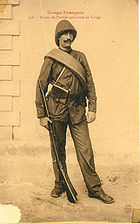 The European Colonial Infantry regiments were, until 1914, uniformed in a similar style to their metropolitan counterparts (though with yellow fringed epaulette
s and medium blue trousers instead of the red epaulettes and red trousers of the line infantry). On colonial service white, dark blue or light khaki
uniforms were worn with topees, according to circumstances. Between 1895 and 1905 a light blue/grey bleu mecanicien uniform was worn for field dress in Africa and Indo China (see photograph opposite). During and after World War I khaki became the norm for all colonial troops in contrast to the horizon blue of the metropolitan conscripts. The blue dress uniform was however restored for French personnel who enlisted as volunteers in either the Colonial Infantry or Colonial Artillery, from 1928 to 1939.
Tirailleur regiments in Africa worn red fez
es and sash
es with dark blue, or khaki uniforms until 1914. The Indo-Chinese units wore a salacco headdress and blue, white or khaki drill clothing based on local patterns. After World War I khaki became the normal dress for indigenous troops, although sashes and fezs continued to be worn for parade until the 1950s.
The modern Troupes de Marine are distinguished in full dress by dark blue kepi
s with red piping and bronze anchor badges, red sashes and yellow fringed epaulettes. These traditional items are worn with the standard light beige or camouflage dress of the modern French Army
on ceremonial occasions.
. Both services were however administered by the Ministre de la Marine and shared an anchor badge. This insignia continued to be worn after the Troupes de la Marine became the Troupes Coloniales in 1900 and photographs of mehariste
(camel corps) troopers taken in the 1950s show anchor badges even in the Mauritanian desert far from the sea. In 1961 the title of Troupes de Marine
was readopted after a brief period (1958–61) as Troupes d'Outre-Mer (Overseas Forces).
On 1 May 1994, in the presence of veterans of the armée d'Afrique, légionnaires, spahis, zouaves and artilleurs, the 170e Régiment d'Infanterie was redesignated as the 1er Régiment de Tirailleurs. It wears the insignia and bears the honors and traditions of the old 1er régiment de tirailleurs algériens, which was disbanded in 1964.
, Parachute, Artillery and Engineer units remain as a distinct branch within the modern French Army.
French colonial empire
The French colonial empire was the set of territories outside Europe that were under French rule primarily from the 17th century to the late 1960s. In the 19th and 20th centuries, the colonial empire of France was the second-largest in the world behind the British Empire. The French colonial empire...
from the late 17th century until 1960. They were recruited from mainland France or from the French settler and indigenous populations of the French colonial empire. This force played a substantial part in the conquest of the empire, in both World Wars as well as in the First Indochina War
First Indochina War
The First Indochina War was fought in French Indochina from December 19, 1946, until August 1, 1954, between the French Union's French Far East...
.
Makeup of French Colonial Forces
The Armée coloniale did not include the famous North African regiments such as the Foreign LegionFrench Foreign Legion
The French Foreign Legion is a unique military service wing of the French Army established in 1831. The foreign legion was exclusively created for foreign nationals willing to serve in the French Armed Forces...
, Zouaves, Spahis, Algerian Tirailleurs (sharpshooters) and Goumier
Goumier
Moroccan Goumiers were soldiers who served in auxiliary units attached to the French Army of Africa, between 1908 and 1956. The term Goumier was also occasionally used to designate native soldiers in the French army of the French Sudan and Upper Volta during the colonial era.-Description:The word...
s, all of which were part of the Army of Africa
Army of Africa (France)
The Army of Africa was an unofficial but commonly used term for those portions of the French Army recruited from or normally stationed in French North Africa from 1830 until the end of the Algerian War in 1962.-Composition:...
, a part of the French Metropolitan Army. Instead the "Troupes Coloniale" can be divided into:
- French long service volunteers (or colonial settlers doing their military service) assigned to service in France itself or as garrisons in French West and Central Africa, Madagascar, New Caledonia or Indochina; and
- Indigenous troops recruited in any of the above, serving under French officers. These were designated as Tirailleurs sénégalais, Tirailleurs malgaches, Tirailleurs indochinois, etc. according to the name of the colony of origin. Tirailleurs sénégalais was the name given to all West and Central African regiments, since SenegalSenegalSenegal , officially the Republic of Senegal , is a country in western Africa. It owes its name to the Sénégal River that borders it to the east and north...
had been the first French colony south of the Sahara.
The troupes coloniales were predominantly infantry but included artillery units as well as the usual support services. At various dates they also included locally recruited cavalry units in Indo-China as well as camel troops in sub-Saharan Africa.
Composition
The colonial troops "the Colonial" which depend on a single General Staff, consists of two main types of units:- Infantry and French colonial Colonial Artillery between 1900 and 1958 called "Colonial White" and composed mostly of enlisted metropolitans.
- native sharpshooters, excluding North Africa (Senegalese riflemen, sharpshooters Madagascar, Indo-Chinese sharpshooters) trained "subjects" French colonies controlled by French officers. The term "Senegalese infantry"is a generic term given to all infantry units recruited in black Africa.
- While it is sometimes used broadly to mean the troops recruited in all French colonies, and by extension, also include troops from Africa (Zouaves, Chasseurs d'Afrique, Spahis, Riflemen Algerian, Moroccan and Tunisian artillery North African Foreign Legion and services for Indigenous Affairs), which find their origin in the expeditionary force of 1830 in Algeria, and were united in the XIX Army Corps in 1873, the latter forming a well distinct from the colonial troops and should not be confused with them.
Creating and naming different
- The term colonial or colonial army troops or troops of the French colonies has several meanings:
- This is the first French troops to defend the colonies.
- Then, fairly quickly, this term designated the troops recruited in the French colonies, excluding North Africa French and Breton part of the troops at the first World War.
- The colonial troops appeared in 1900, when all the ground troops of the Ministry of the Navy, called the Marines, were transferred under the orders of the War Department. They disappeared in 1958 when the colonies had gained their independence, the mission of these troops was redefined. They renewed the name of the Marines, while staying in the Army.
List of regiments in New France 1755-59
- Compagnies Franches de la MarineCompagnies Franches de la MarineThe Compagnies Franches de la Marine was the main organization for the defence of New France from 1683 to 1755. In 1683, the Naval Department of France began using the Compagnies to defend the fur trade and the local civilians. They were superseded by the arrival of large units of the army under...
(colony troops) - La Reine
- Artois
- La Sarre
- Royal- Roussillon
- Bourgogne
- Languedoc
- Cambis
- Guyenne
- Berry
- Bearn
- Angoumois
- Volontaires Etrangers
- Le Royal - Artillerie
Only the Compagnies Franches were, strictly speaking, "colonial troops". The remaining units listed were regulars of the Royal Army brought from France itself.
Uniforms
Epaulette
Epaulette is a type of ornamental shoulder piece or decoration used as insignia of rank by armed forces and other organizations.Epaulettes are fastened to the shoulder by a shoulder strap or "passant", a small strap parallel to the shoulder seam, and the button near the collar, or by laces on the...
s and medium blue trousers instead of the red epaulettes and red trousers of the line infantry). On colonial service white, dark blue or light khaki
Khaki
This article is about the fabric. For the color, see Khaki . Kaki, another name for the persimmon, is often misspelled "Khaki".Khaki is a type of fabric or the color of such fabric...
uniforms were worn with topees, according to circumstances. Between 1895 and 1905 a light blue/grey bleu mecanicien uniform was worn for field dress in Africa and Indo China (see photograph opposite). During and after World War I khaki became the norm for all colonial troops in contrast to the horizon blue of the metropolitan conscripts. The blue dress uniform was however restored for French personnel who enlisted as volunteers in either the Colonial Infantry or Colonial Artillery, from 1928 to 1939.
Tirailleur regiments in Africa worn red fez
Fez (clothing)
The fez , or tarboosh is a felt hat either in the shape of a red truncated cone or in the shape of a short cylinder made of kilim fabric. Both usually have tassels...
es and sash
Sash
A sash is a cloth belt used to hold a robe together, and is usually tied about the waist. The Japanese equivalent of a sash, obi, serves to hold a kimono or yukata together. Decorative sashes may pass from the shoulder to the hip rather than around the waist...
es with dark blue, or khaki uniforms until 1914. The Indo-Chinese units wore a salacco headdress and blue, white or khaki drill clothing based on local patterns. After World War I khaki became the normal dress for indigenous troops, although sashes and fezs continued to be worn for parade until the 1950s.
The modern Troupes de Marine are distinguished in full dress by dark blue kepi
Kepi
The kepi is a cap with a flat circular top and a visor or peak . Etymologically, the word is a borrowing of the French képi, itself a respelling of the Alemannic Käppi: a diminutive form of Kappe, meaning "cap"....
s with red piping and bronze anchor badges, red sashes and yellow fringed epaulettes. These traditional items are worn with the standard light beige or camouflage dress of the modern French Army
French Army
The French Army, officially the Armée de Terre , is the land-based and largest component of the French Armed Forces.As of 2010, the army employs 123,100 regulars, 18,350 part-time reservists and 7,700 Legionnaires. All soldiers are professionals, following the suspension of conscription, voted in...
on ceremonial occasions.
From Marines to Colonials and back again
From 1822 to 1900 these troops, both French and indigenous, had been designated as Troupes de Marine, though they were not directly linked to the French NavyFrench Navy
The French Navy, officially the Marine nationale and often called La Royale is the maritime arm of the French military. It includes a full range of fighting vessels, from patrol boats to a nuclear powered aircraft carrier and 10 nuclear-powered submarines, four of which are capable of launching...
. Both services were however administered by the Ministre de la Marine and shared an anchor badge. This insignia continued to be worn after the Troupes de la Marine became the Troupes Coloniales in 1900 and photographs of mehariste
Mehariste
Méhariste is a French word that roughly translates to camel cavalry. The word is most commonly used as a designation of military units.-Origins of French Camel Corps:...
(camel corps) troopers taken in the 1950s show anchor badges even in the Mauritanian desert far from the sea. In 1961 the title of Troupes de Marine
Troupes de marine
The or Infanterie de marine, formerly Troupes coloniales, are an arm of the French Army with a colonial heritage. The Troupes de marine have a dedicated overseas service role. Despite their title they have been a part of the Army since 1958...
was readopted after a brief period (1958–61) as Troupes d'Outre-Mer (Overseas Forces).
Post colonial period
As the remaining French African territories became independent in the late 1950s and early 1960s, the tirailleurs were discharged, usually to join their new national armies. In 1964, the 7th Regiment of Tirailleurs, formed in 1913 as the 7e Régiment de Tirailleurs Algériens was redesignated the 170e Régiment d'Infanterie. The various "Tirailleurs Indochinois" regiments were dispersed by the Japanese coup of 10 March 1945 and were not reformed.On 1 May 1994, in the presence of veterans of the armée d'Afrique, légionnaires, spahis, zouaves and artilleurs, the 170e Régiment d'Infanterie was redesignated as the 1er Régiment de Tirailleurs. It wears the insignia and bears the honors and traditions of the old 1er régiment de tirailleurs algériens, which was disbanded in 1964.
Status of Colonial Forces
Throughout their changing titles and roles the French Troupes de Marine or Troupes coloniales retained a reputation for toughness and professionalism. Whether French or indigenous they were, for the most part, long service regulars and as such comprised a genuine elite.Modern
The Marine InfantryTroupes de marine
The or Infanterie de marine, formerly Troupes coloniales, are an arm of the French Army with a colonial heritage. The Troupes de marine have a dedicated overseas service role. Despite their title they have been a part of the Army since 1958...
, Parachute, Artillery and Engineer units remain as a distinct branch within the modern French Army.
See also
- Colonial troopsColonial troopsColonial troops or colonial army refers to various military units recruited from, or used as garrison troops in, colonial territories.- Colonial background :...
- Troupes de marineTroupes de marineThe or Infanterie de marine, formerly Troupes coloniales, are an arm of the French Army with a colonial heritage. The Troupes de marine have a dedicated overseas service role. Despite their title they have been a part of the Army since 1958...
- French ResistanceFrench ResistanceThe French Resistance is the name used to denote the collection of French resistance movements that fought against the Nazi German occupation of France and against the collaborationist Vichy régime during World War II...
- Concentration camps in FranceConcentration camps in FranceThere were internment camps and concentration camps in France before, during and after World War II. Beside the camps created during World War I to intern German, Austrian and Ottoman civilian prisoners, the Third Republic opened various internment camps for the Spanish refugees fleeing the...
- Army of the LevantArmy of the LevantThe Army of the Levant identifies the armed forces of France and then Vichy France which occupied, and were in part recruited from, a portion of the "Levant" during the interwar period and early World War II.-Origins:...
- Army of AfricaArmy of Africa (France)The Army of Africa was an unofficial but commonly used term for those portions of the French Army recruited from or normally stationed in French North Africa from 1830 until the end of the Algerian War in 1962.-Composition:...
- Tonkinese RiflesTonkinese RiflesThe Tonkinese Rifles were a corps of Tonkinese light infantrymen raised in 1884 to support the operations of the Tonkin Expeditionary Corps...
- French colonial flagsFrench colonial flagsSome of the colonies, protectorates and mandates of the French Colonial Empire used distinctive colonial flags. These most commonly had a French Tricolour in the canton....
- French Colonial EmpireFrench colonial empireThe French colonial empire was the set of territories outside Europe that were under French rule primarily from the 17th century to the late 1960s. In the 19th and 20th centuries, the colonial empire of France was the second-largest in the world behind the British Empire. The French colonial empire...
- List of French possessions and colonies
External links
- Unofficial site (managed by the national federation of veterans of oversea and marine troops) Centre de ressources sur les TDM Excellent historical site covering the Troupes Coloniales as well as the Troupes de Marine Les troupes coloniales dans la Grande Guerre