

Spahi

Encyclopedia


Light cavalry
Light cavalry refers to lightly armed and lightly armored troops mounted on horses, as opposed to heavy cavalry, where the riders are heavily armored...
regiment
Regiment
A regiment is a major tactical military unit, composed of variable numbers of batteries, squadrons or battalions, commanded by a colonel or lieutenant colonel...
s of the French army
French Army
The French Army, officially the Armée de Terre , is the land-based and largest component of the French Armed Forces.As of 2010, the army employs 123,100 regulars, 18,350 part-time reservists and 7,700 Legionnaires. All soldiers are professionals, following the suspension of conscription, voted in...
recruited primarily from the indigenous populations of Algeria
Algeria
Algeria , officially the People's Democratic Republic of Algeria , also formally referred to as the Democratic and Popular Republic of Algeria, is a country in the Maghreb region of Northwest Africa with Algiers as its capital.In terms of land area, it is the largest country in Africa and the Arab...
, Tunisia
Tunisia
Tunisia , officially the Tunisian RepublicThe long name of Tunisia in other languages used in the country is: , is the northernmost country in Africa. It is a Maghreb country and is bordered by Algeria to the west, Libya to the southeast, and the Mediterranean Sea to the north and east. Its area...
and Morocco
Morocco
Morocco , officially the Kingdom of Morocco , is a country located in North Africa. It has a population of more than 32 million and an area of 710,850 km², and also primarily administers the disputed region of the Western Sahara...
. The modern French Army retains one regiment of Spahis as an armoured unit, with personnel now recruited in mainland France. Senegal
Senegal
Senegal , officially the Republic of Senegal , is a country in western Africa. It owes its name to the Sénégal River that borders it to the east and north...
also maintains a spahi regiment as a presidential escort, the Red Guard
Red Guard of Senegal
The Red Guard of Senegal is a unit of the Senegalese Gendarmerie which is responsible for presidential security. It also has ceremonial duties and assists in general policing. It is very similar in concept to the French Republican Guard, with which it is officially twinned...
.
Etymology
The name is the French form of the OttomanOttoman Empire
The Ottoman EmpireIt was usually referred to as the "Ottoman Empire", the "Turkish Empire", the "Ottoman Caliphate" or more commonly "Turkey" by its contemporaries...
word sipahi
Sipahi
Sipahi was the name of several Ottoman cavalry corps...
, a word originally derived from Middle Persian
Middle Persian
Middle Persian , indigenously known as "Pârsig" sometimes referred to as Pahlavi or Pehlevi, is the Middle Iranian language/ethnolect of Southwestern Iran that during Sassanid times became a prestige dialect and so came to be spoken in other regions as well. Middle Persian is classified as a...
term Spah (in New Persian "Sepâh", سپاه ) meaning "army", or "horsemen". The title was probably borrowed from the Parthian (Arsacid) and Sassanian
Sassanid Empire
The Sassanid Empire , known to its inhabitants as Ērānshahr and Ērān in Middle Persian and resulting in the New Persian terms Iranshahr and Iran , was the last pre-Islamic Persian Empire, ruled by the Sasanian Dynasty from 224 to 651...
Persian army position Spahbod, or Eran Spahbod, which was the Commander of cavalry/knights as well as Commander-in-Chief of the Persian military.
Early history
First raised in 1831, the Spahis saw extensive service in the conquest of Algeria, in the Franco-Prussian WarFranco-Prussian War
The Franco-Prussian War or Franco-German War, often referred to in France as the 1870 War was a conflict between the Second French Empire and the Kingdom of Prussia. Prussia was aided by the North German Confederation, of which it was a member, and the South German states of Baden, Württemberg and...
, in Tonkin
Tonkin
Tonkin , also spelled Tongkin, Tonquin or Tongking, is the northernmost part of Vietnam, south of China's Yunnan and Guangxi Provinces, east of northern Laos, and west of the Gulf of Tonkin. Locally, it is known as Bắc Kỳ, meaning "Northern Region"...
towards the end of the Sino-French War
Sino-French War
The Sino–French War was a limited conflict fought between August 1884 and April 1885 to decide whether France should replace China in control of Tonkin . As the French achieved their war aims, they are usually considered to have won the war...
(1885), in the occupation of Morocco and Syria
Syria
Syria , officially the Syrian Arab Republic , is a country in Western Asia, bordering Lebanon and the Mediterranean Sea to the West, Turkey to the north, Iraq to the east, Jordan to the south, and Israel to the southwest....
, and in both World Wars. A detachment of Spahis served as the personal escort of Marshal
Marshal of France
The Marshal of France is a military distinction in contemporary France, not a military rank. It is granted to generals for exceptional achievements...
Jacques Leroy de Saint Arnaud
Jacques Leroy de Saint Arnaud
Armand-Jacques Leroy de Saint-Arnaud was a French soldier and Marshal of France during the 19th century...
in the Crimean War
Crimean War
The Crimean War was a conflict fought between the Russian Empire and an alliance of the French Empire, the British Empire, the Ottoman Empire, and the Kingdom of Sardinia. The war was part of a long-running contest between the major European powers for influence over territories of the declining...
and were photographed there by Roger Fenton
Roger Fenton
Roger Fenton was a pioneering British photographer, one of the first war photographers.-Early life:Roger Fenton was born in Crimble Hall, Heap, Bury, Lancashire, 28 March 1819. His grandfather was a wealthy cotton manufacturer and banker, his father a banker and Member of Parliament...
. A contingent of spahis also participated in the North China campaign of 1860.
Prior to 1914 there were four regiments of Spahis in the French Army
French Army
The French Army, officially the Armée de Terre , is the land-based and largest component of the French Armed Forces.As of 2010, the army employs 123,100 regulars, 18,350 part-time reservists and 7,700 Legionnaires. All soldiers are professionals, following the suspension of conscription, voted in...
, three based in Algeria and one in Tunisia. A serious rising against French rule in Algeria
French Algeria
French Algeria lasted from 1830 to 1962, under a variety of governmental systems. From 1848 until independence, the whole Mediterranean region of Algeria was administered as an integral part of France, much like Corsica and Réunion are to this day. The vast arid interior of Algeria, like the rest...
during 1871–72 was sparked off by the mutiny
Mutiny
Mutiny is a conspiracy among members of a group of similarly situated individuals to openly oppose, change or overthrow an authority to which they are subject...
of a squadron of Spahis who had been ordered to France to take part in the Franco-Prussian War.
During their period as mounted cavalry the Spahis comprised for the most part Arab
Arab
Arab people, also known as Arabs , are a panethnicity primarily living in the Arab world, which is located in Western Asia and North Africa. They are identified as such on one or more of genealogical, linguistic, or cultural grounds, with tribal affiliations, and intra-tribal relationships playing...
and Berber
Berber people
Berbers are the indigenous peoples of North Africa west of the Nile Valley. They are continuously distributed from the Atlantic to the Siwa oasis, in Egypt, and from the Mediterranean to the Niger River. Historically they spoke the Berber language or varieties of it, which together form a branch...
troopers commanded by French officers
Officer (armed forces)
An officer is a member of an armed force or uniformed service who holds a position of authority. Commissioned officers derive authority directly from a sovereign power and, as such, hold a commission charging them with the duties and responsibilities of a specific office or position...
. This division was not absolute however and there were always a certain number of French volunteers in the ranks. In addition, a fixed number of commissioned positions up to the level of captain were reserved for Muslim
Muslim
A Muslim, also spelled Moslem, is an adherent of Islam, a monotheistic, Abrahamic religion based on the Quran, which Muslims consider the verbatim word of God as revealed to prophet Muhammad. "Muslim" is the Arabic term for "submitter" .Muslims believe that God is one and incomparable...
officers. NCOs
Non-commissioned officer
A non-commissioned officer , called a sub-officer in some countries, is a military officer who has not been given a commission...
were both French and Muslim. As Spahi units were mechanised, the proportion of Frenchmen in the ranks increased.
World War I
Spahis were sent to France at the outbreak of war in August 1914. They saw service during the opening period of mobile warfareManeuver warfare
Maneuver warfare, or manoeuvre warfare , is the term used by military theorists for a concept of warfare that advocates attempting to defeat an adversary by incapacitating their decision-making through shock and disruption brought about by movement...
but inevitably their role diminished with the advent of trench warfare
Trench warfare
Trench warfare is a form of occupied fighting lines, consisting largely of trenches, in which troops are largely immune to the enemy's small arms fire and are substantially sheltered from artillery...
. By 1918 all seven Spahi regiments then in existence had seen service on the Western Front
Western Front (World War I)
Following the outbreak of World War I in 1914, the German Army opened the Western Front by first invading Luxembourg and Belgium, then gaining military control of important industrial regions in France. The tide of the advance was dramatically turned with the Battle of the Marne...
. In addition a detached squadron had served in Palestine
Palestine
Palestine is a conventional name, among others, used to describe the geographic region between the Mediterranean Sea and the Jordan River, and various adjoining lands....
against the Ottoman Empire
Ottoman Empire
The Ottoman EmpireIt was usually referred to as the "Ottoman Empire", the "Turkish Empire", the "Ottoman Caliphate" or more commonly "Turkey" by its contemporaries...
. During World War I
World War I
World War I , which was predominantly called the World War or the Great War from its occurrence until 1939, and the First World War or World War I thereafter, was a major war centred in Europe that began on 28 July 1914 and lasted until 11 November 1918...
the number of units increased with the creation of Moroccan Spahi regiments and the expansion of the Algerian arm.
Between the World Wars
By 1921 the Spahi regiments had been increased to twelve (from four in 1914) and this became the permanent establishment. During the 1920s mounted Spahi regiments saw extensive active service in the French mandated territories of Syria and LebanonLebanon
Lebanon , officially the Republic of LebanonRepublic of Lebanon is the most common term used by Lebanese government agencies. The term Lebanese Republic, a literal translation of the official Arabic and French names that is not used in today's world. Arabic is the most common language spoken among...
, as well as in Morocco. They continued to perform policing and garrison duties in Algeria and Tunisia. Although mechanisation began in the 1930s of the Chasseurs d'Afrique
Chasseurs d'Afrique
The Chasseurs d'Afrique were a light cavalry corps in the French Armée d'Afrique . First raised in the 1830s from regular French cavalry posted to Algeria, they numbered five regiments by World War II...
and Foreign Legion
French Foreign Legion
The French Foreign Legion is a unique military service wing of the French Army established in 1831. The foreign legion was exclusively created for foreign nationals willing to serve in the French Armed Forces...
cavalry, the Spahis remained an entirely mounted force until after 1942. About 20% of the rank and file were French and the remainder Arab or Berber.
World War II
In 1939 the Spahis comprised three independent brigadeBrigade
A brigade is a major tactical military formation that is typically composed of two to five battalions, plus supporting elements depending on the era and nationality of a given army and could be perceived as an enlarged/reinforced regiment...
s, each of two regiments and still horse mounted. Each regiment was made up of four sabre squadrons with five officers and 172 troopers in each. Three regiments saw active service in France in 1940. One Spahi regiment (1er Régiment de Marche de Spahis Marocains) distinguished itself in service with the Free French during World War II
World War II
World War II, or the Second World War , was a global conflict lasting from 1939 to 1945, involving most of the world's nations—including all of the great powers—eventually forming two opposing military alliances: the Allies and the Axis...
. Garrisoned in Vichy
Vichy France
Vichy France, Vichy Regime, or Vichy Government, are common terms used to describe the government of France that collaborated with the Axis powers from July 1940 to August 1944. This government succeeded the Third Republic and preceded the Provisional Government of the French Republic...
-controlled Syria as part of a mounted cavalry unit (1er Régiment de Spahis Marocains), some of the regiment crossed the frontier into Jordan
Jordan
Jordan , officially the Hashemite Kingdom of Jordan , Al-Mamlaka al-Urduniyya al-Hashemiyya) is a kingdom on the East Bank of the River Jordan. The country borders Saudi Arabia to the east and south-east, Iraq to the north-east, Syria to the north and the West Bank and Israel to the west, sharing...
in June 1940. After mounted service in Eritrea
Eritrea
Eritrea , officially the State of Eritrea, is a country in the Horn of Africa. Eritrea derives it's name from the Greek word Erethria, meaning 'red land'. The capital is Asmara. It is bordered by Sudan in the west, Ethiopia in the south, and Djibouti in the southeast...
, this detachment was subsequently reorganised and equipped with armoured cars by the British
United Kingdom
The United Kingdom of Great Britain and Northern IrelandIn the United Kingdom and Dependencies, other languages have been officially recognised as legitimate autochthonous languages under the European Charter for Regional or Minority Languages...
in Egypt
Egypt
Egypt , officially the Arab Republic of Egypt, Arabic: , is a country mainly in North Africa, with the Sinai Peninsula forming a land bridge in Southwest Asia. Egypt is thus a transcontinental country, and a major power in Africa, the Mediterranean Basin, the Middle East and the Muslim world...
. It served in Syria, Egypt, Tunisia and during the liberation of France. The expanded and mechanised regiment served in Egypt, Tunisia and was part of the French forces that liberated Paris
Liberation of Paris
The Liberation of Paris took place during World War II from 19 August 1944 until the surrender of the occupying German garrison on August 25th. It could be regarded by some as the last battle in the Battle for Normandy, though that really ended with the crushing of the Wehrmacht forces between the...
in August 1944.
Post war
In the course of World War II most Spahi regiments were mechanised, but several squadrons remained mounted for patrol work in North AfricaNorth Africa
North Africa or Northern Africa is the northernmost region of the African continent, linked by the Sahara to Sub-Saharan Africa. Geopolitically, the United Nations definition of Northern Africa includes eight countries or territories; Algeria, Egypt, Libya, Morocco, South Sudan, Sudan, Tunisia, and...
and ceremonial duties in France itself. The annual Bastille Day
Bastille Day
Bastille Day is the name given in English-speaking countries to the French National Day, which is celebrated on 14 July of each year. In France, it is formally called La Fête Nationale and commonly le quatorze juillet...
parade in Paris
Paris
Paris is the capital and largest city in France, situated on the river Seine, in northern France, at the heart of the Île-de-France region...
always featured Spahi cavalry in their traditional dress on white Arabian horse
Arabian horse
The Arabian or Arab horse is a breed of horse that originated on the Arabian Peninsula. With a distinctive head shape and high tail carriage, the Arabian is one of the most easily recognizable horse breeds in the world. It is also one of the oldest breeds, with archaeological evidence of horses...
s. While Arab and Berber troopers continued to serve in the mounted units retained, mechanisation led to French personnel becoming a majority in the armoured regiments.
Armoured Spahi units saw service in both the Indochina War of 1947-54 and the Algerian War of 1954-62.
The 6th Spahis had been disbanded in 1956, followed by the 9th in 1961. At the end of the Algerian War the 2nd, 3rd 4th, 8th and 9th Spahis were also disbanded leaving only one, formerly Moroccan, regiment in existence as the 1st Spahis.
Today
Today the French Army retains one Spahi regiment, the 1er Régiment de Spahis Marocains1er Régiment de Spahis Marocains
The First Regiment of Moroccan Spahis is an cavalry regiment of the French Army which was founded in 1914. It saw service in both the First World War and the Second World War as part of the Forces Françaises Libres as well as post-war service in the French-Indochina War and elsewhere...
; an armoured unit which saw service in the Gulf War
Gulf War
The Persian Gulf War , commonly referred to as simply the Gulf War, was a war waged by a U.N.-authorized coalition force from 34 nations led by the United States, against Iraq in response to Iraq's invasion and annexation of Kuwait.The war is also known under other names, such as the First Gulf...
. The regiment also maintains the traditions of the entire corps
Corps
A corps is either a large formation, or an administrative grouping of troops within an armed force with a common function such as Artillery or Signals representing an arm of service...
as it previously existed.
Until 1984 the Regiment was located in Speyer
Speyer
Speyer is a city of Rhineland-Palatinate, Germany with approximately 50,000 inhabitants. Located beside the river Rhine, Speyer is 25 km south of Ludwigshafen and Mannheim. Founded by the Romans, it is one of Germany's oldest cities...
, Germany
Germany
Germany , officially the Federal Republic of Germany , is a federal parliamentary republic in Europe. The country consists of 16 states while the capital and largest city is Berlin. Germany covers an area of 357,021 km2 and has a largely temperate seasonal climate...
. Their actual base there is now the Technikmuseum Speyer. The 1er Spahis are currently based in Valence
Valence, Drôme
Valence is a commune in southeastern France, the capital of the Drôme department, situated on the left bank of the Rhône, south of Lyon on the railway to Marseilles.Its inhabitants are called Valentinois...
, Drôme
Drôme
Drôme , a department in southeastern France, takes its name from the Drôme River.-History:The French National Constituent Assembly set up Drôme as one of the original 83 departments of France on March 4, 1790, during the French Revolution...
, France, 100 km (62.1 mi) south of Lyon
Lyon
Lyon , is a city in east-central France in the Rhône-Alpes region, situated between Paris and Marseille. Lyon is located at from Paris, from Marseille, from Geneva, from Turin, and from Barcelona. The residents of the city are called Lyonnais....
in the Rhone
Rhône
Rhone can refer to:* Rhone, one of the major rivers of Europe, running through Switzerland and France* Rhône Glacier, the source of the Rhone River and one of the primary contributors to Lake Geneva in the far eastern end of the canton of Valais in Switzerland...
Valley or what is commonly referred to in France as The Doors of Provence.
Uniforms
Throughout most of their history the Algerian and Tunisian Spahis wore a very striking ZouaveZouave
Zouave was the title given to certain light infantry regiments in the French Army, normally serving in French North Africa between 1831 and 1962. The name was also adopted during the 19th century by units in other armies, especially volunteer regiments raised for service in the American Civil War...
style uniform. It comprised a high Arab headdress
Keffiyeh
The keffiyeh/kufiya , also known as a ghutrah , ' , mashadah , shemagh or in Persian chafiye , Kurdish cemedanî and Turkish puşi, is a traditional Arab headdress fashioned from a square, usually cotton, scarf. It is typically worn by Arab men, as well as some Kurds...
, a short red jacket embroidered in black, sky blue waist coat (sedria) a wide red sash and voluminous light blue trousers. The four regiments were distinguished by the differing colours of their "tombeaus" (circular false pockets on the front of the jacket). A white burnous
Burnous
A burnous is a long cloak of coarse woollen fabric with a hood, usually white in color, worn by Berbers and the Arabs throughout North Africa....
was worn together with a red cloak (blue for the Moroccan Spahis). French officers wore light blue kepi
Kepi
The kepi is a cap with a flat circular top and a visor or peak . Etymologically, the word is a borrowing of the French képi, itself a respelling of the Alemannic Käppi: a diminutive form of Kappe, meaning "cap"....
s, red tunics with gold rank braiding and light blue breeches with double red stripes. Muslim officers wore a more elaborate version of the "tenue orientale" of the Arab and Berber troopers. French Spahis were distinguished by wearing fezs instead of the white Arab turban
Turban
In English, Turban refers to several types of headwear popularly worn in the Middle East, North Africa, Punjab, Jamaica and Southwest Asia. A commonly used synonym is Pagri, the Indian word for turban.-Styles:...
with its brown camel-hair cord. A less obvious distinction was the footwear—short "sabattes" or traditional North African boots in red Morocco leather
Morocco leather
Morocco leather is a leather made from goatskin, dyed red on the grain side and then tanned by hand to bring up the grain in a bird's-eye pattern....
for Arab/Berber troopers, conventional black leather for French troopers. Armament was the sabre
Sabre
The sabre or saber is a kind of backsword that usually has a curved, single-edged blade and a rather large hand guard, covering the knuckles of the hand as well as the thumb and forefinger...
of the French light cavalry together with the 1892 carbine
Berthier carbine
The Berthier carbine was a French service rifle adopted in 1892, which was widely used during the First and Second World War....
.
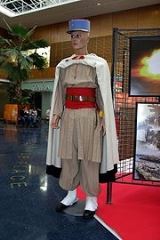
From 1915 on a more practical khaki
Khaki
This article is about the fabric. For the color, see Khaki . Kaki, another name for the persimmon, is often misspelled "Khaki".Khaki is a type of fabric or the color of such fabric...
uniform was adopted for service but the classic red and blue reappeared for parade and off duty wear in 1927. The mounted squadrons retained for ceremonial duties wore a slightly modified version of this parade uniform until they were disbanded in 1962. The modern 1er Spahis still wear the traditional burnous, red sash and red or blue cloaks for full dress.
Exceptionally for a French armoured cavalry
Armoured cavalry
Armoured cavalry began to replace horse cavalry as the reconnaissance arm in most armies after the First World War, although many armies continued to maintain horse cavalry through the end of the Second World War....
regiment, it uses gold (and not the usual silver) insignia. The "Ordonnance du Roi portant organisation de la cavalerie indigène en Algerie" of 7 December 1841 establishing the Spahis as a regular corps of the French Army specifies this distinction for sous-officers, brigadiers and officers both French and indigenous (see full text in Pierre Rosiere's "Spahis" as cited below).
Senegalese Spahis

Senegal maintains a spahi unit as its presidential security unit and ceremonial guard.
In addition to the North African cavalry described above, two squadrons of spahis were raised in French West Africa
French West Africa
French West Africa was a federation of eight French colonial territories in Africa: Mauritania, Senegal, French Sudan , French Guinea , Côte d'Ivoire , Upper Volta , Dahomey and Niger...
. The first spahis in Senegal were sent in 1843 to deal with an outbreak of tribal conflict. This platoon-sized unit of 25 French and Algerian spahis stayed and began recruiting locally. Senegalese units saw service in Morocco as well as in the various West Africa
West Africa
West Africa or Western Africa is the westernmost region of the African continent. Geopolitically, the UN definition of Western Africa includes the following 16 countries and an area of approximately 5 million square km:-Flags of West Africa:...
n campaigns. The troopers were recruited from the inhabitants of Senegal
Senegal
Senegal , officially the Republic of Senegal , is a country in western Africa. It owes its name to the Sénégal River that borders it to the east and north...
and the French Sudan
French Sudan
French Sudan was a colony in French West Africa that had two separate periods of existence, first from 1890 to 1899, then from 1920 to 1960, when the territory became the independent nation of Mali.-Colonial establishment:...
while their officers were seconded from Algerian Spahi regiments.
The Senegalese Spahis were the cadre around which the mounted gendarmerie
Gendarmerie
A gendarmerie or gendarmery is a military force charged with police duties among civilian populations. Members of such a force are typically called "gendarmes". The Shorter Oxford English Dictionary describes a gendarme as "a soldier who is employed on police duties" and a "gendarmery, -erie" as...
was formed in 1928. The modern Gendarmerie Nationale of the Republic of Senegal therefore traces its origins to the spahis, and the Red Guard still wears the burnous
Burnous
A burnous is a long cloak of coarse woollen fabric with a hood, usually white in color, worn by Berbers and the Arabs throughout North Africa....
, fez and red tunic of the French period.
Indochinese Spahis
Short-lived cavalry units designated as "spahis" were raised by the French Colonial ArmyFrench Colonial Forces
The French Colonial Forces , commonly called La Coloniale, was a general designation for the military forces that garrisoned in the French colonial empire from the late 17th century until 1960. They were recruited from mainland France or from the French settler and indigenous populations of the...
in Indochina
Indochina
The Indochinese peninsula, is a region in Southeast Asia. It lies roughly southwest of China, and east of India. The name has its origins in the French, Indochine, as a combination of the names of "China" and "India", and was adopted when French colonizers in Vietnam began expanding their territory...
. The first of these was a squadron of spahis recruited from Cochinchina
Cochinchina
Cochinchina is a region encompassing the southern third of Vietnam whose principal city is Saigon. It was a French colony from 1862 to 1954. The later state of South Vietnam was created in 1954 by combining Cochinchina with southern Annam. In Vietnamese, the region is called Nam Bộ...
in 1861 and disbanded in 1871. The second was a small detachment of "spahis Tonkinese" raised in Tonkin in 1888 and disestablished the following year.
Spahis of Italy
The ItalianItaly
Italy , officially the Italian Republic languages]] under the European Charter for Regional or Minority Languages. In each of these, Italy's official name is as follows:;;;;;;;;), is a unitary parliamentary republic in South-Central Europe. To the north it borders France, Switzerland, Austria and...
colonial administration of Libya
Libya
Libya is an African country in the Maghreb region of North Africa bordered by the Mediterranean Sea to the north, Egypt to the east, Sudan to the southeast, Chad and Niger to the south, and Algeria and Tunisia to the west....
raised squadrons of locally recruited Spahi cavalry between 1912 and 1942. These differed from their French namesakes in that their prime role was that of mounted police, tasked with patrolling rural and desert areas. Although they had Italian officers these spahis were more loosely organised than the regular Libyan cavalry regiments (Savari
Savari
Savari was the designation given to the regular Libyan cavalry regiments of the Italian colonial army in Tripolitania and Cyrenaica. The word "savari" was derived from a Persian term for "horsemen" .-Organisation:...
). They wore a picturesque dress modelled on that of the desert tribesmen from whom they were recruited.
External links
- http://www.picardietourisme.fr/en/inventez_votre_sejour/visites/detail.aspx?id=PCUPIC1600000035Musee de Spahis in SenlisSenlis, OiseSenlis is a French commune located in the Oise department near Paris. It has a long and rich heritage, having traversed centuries of history. This medieval town has welcomed some of the most renowned figures in French history, including Hugh Capet, Louis IX, the Marshall of France, Anne of Kiev and...
, OiseOiseOise is a department in the north of France. It is named after the river Oise.-History:Oise is one of the original 83 departments created during the French Revolution on March 4, 1790...
FranceFranceThe French Republic , The French Republic , The French Republic , (commonly known as France , is a unitary semi-presidential republic in Western Europe with several overseas territories and islands located on other continents and in the Indian, Pacific, and Atlantic oceans. Metropolitan France...
]