


Zouave

Encyclopedia
Light infantry
Traditionally light infantry were soldiers whose job was to provide a skirmishing screen ahead of the main body of infantry, harassing and delaying the enemy advance. Light infantry was distinct from medium, heavy or line infantry. Heavy infantry were dedicated primarily to fighting in tight...
regiments in the French Army
French Army
The French Army, officially the Armée de Terre , is the land-based and largest component of the French Armed Forces.As of 2010, the army employs 123,100 regulars, 18,350 part-time reservists and 7,700 Legionnaires. All soldiers are professionals, following the suspension of conscription, voted in...
, normally serving in French North Africa between 1831 and 1962. The name was also adopted during the 19th century by units in other armies, especially volunteer regiments raised for service in the American Civil War
American Civil War
The American Civil War was a civil war fought in the United States of America. In response to the election of Abraham Lincoln as President of the United States, 11 southern slave states declared their secession from the United States and formed the Confederate States of America ; the other 25...
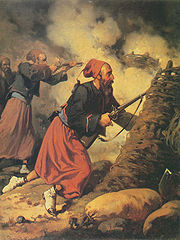
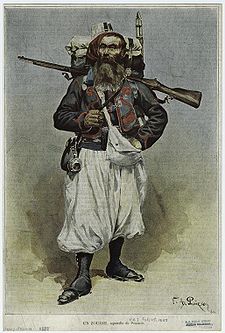
. The chief distinguishing characteristics of such units were the zouave uniform, which included short open-fronted jackets, baggy trousers and often sashes and oriental headgear.
French Zouaves
French Army
The French Army, officially the Armée de Terre , is the land-based and largest component of the French Armed Forces.As of 2010, the army employs 123,100 regulars, 18,350 part-time reservists and 7,700 Legionnaires. All soldiers are professionals, following the suspension of conscription, voted in...
were first raised in Algeria in 1831
French rule in Algeria
French Algeria lasted from 1830 to 1962, under a variety of governmental systems. From 1848 until independence, the whole Mediterranean region of Algeria was administered as an integral part of France, much like Corsica and Réunion are to this day. The vast arid interior of Algeria, like the rest...
with one and later two battalions, initially recruited solely from the Zouaoua
Zouaoua
The Zouaoua, or Zwāwa, were a tribe of Berbers finding homes in the mountains of the Djurdjura range. They were part of the Kabyle-speaking populations....
(or Zwāwa), a tribe of Berbers
Berber people
Berbers are the indigenous peoples of North Africa west of the Nile Valley. They are continuously distributed from the Atlantic to the Siwa oasis, in Egypt, and from the Mediterranean to the Niger River. Historically they spoke the Berber language or varieties of it, which together form a branch...
located in the mountains of the Jurjura range (see Kabyle
Kabyle people
The Kabyle people are the largest homogeneous Algerian ethno-cultural and linguistical community and the largest nation in North Africa to be considered exclusively Berber. Their traditional homeland is Kabylie in the north of Algeria, one hundred miles east of Algiers...
s). The Zouaoua had formerly provided soldiers for the dey
Dey
Dey was the title given to the rulers of the Regency of Algiers and Tripoli under the Ottoman Empire from 1671 onwards...
s of Algiers
Algiers
' is the capital and largest city of Algeria. According to the 1998 census, the population of the city proper was 1,519,570 and that of the urban agglomeration was 2,135,630. In 2009, the population was about 3,500,000...
and in August 1830 the commander of the French expeditionary force which had occupied the city recommended their continued employment in this role. The existence of the new corps was formally recognised by a Royal decree dated 7 March 1833. In 1838 a third battalion was raised, and the regiment thus formed was commanded by Major de Lamoriciere. Shortly afterwards the formation of the Tirailleurs algériens
Tirailleur
Tirailleur literally means a shooting skirmisher in French from tir—shot. The term dates back to the Napoleonic period where it was used to designate light infantry trained to skirmish ahead of the main columns...
, the Turcos, as the corps for Muslim troops, changed the enlistment for the Zouave battalions, and they became a purely French body.
The Zouaves saw extensive service during the French conquest of Algeria, initially at the Mouzaia Pass action (March 1836), then at Mitidja (September 1836) and the siege of Constantine
Constantine, Algeria
Constantine is the capital of Constantine Province in north-eastern Algeria. It was the capital of the same-named French département until 1962. Slightly inland, it is about 80 kilometres from the Mediterranean coast, on the banks of Rhumel river...
(1837). Recruited through voluntary enlistment or transfer from other regiments of men with at least two years service, the Zouaves quickly achieved the status of an elite amongst the French Army of Africa
Army of Africa (France)
The Army of Africa was an unofficial but commonly used term for those portions of the French Army recruited from or normally stationed in French North Africa from 1830 until the end of the Algerian War in 1962.-Composition:...
.
The Second Empire
By 1852, the French Army included three regiments of Zouaves. Each of the three line regiments of Zouaves was allocated to a different province of Algeria, where their depots and peace-time garrisons were located. The Crimean WarCrimean War
The Crimean War was a conflict fought between the Russian Empire and an alliance of the French Empire, the British Empire, the Ottoman Empire, and the Kingdom of Sardinia. The war was part of a long-running contest between the major European powers for influence over territories of the declining...
was the first service which the regiments saw outside Algeria. They subsequently served in the Franco-Austrian War
Second Italian War of Independence
The Second War of Italian Independence, Franco-Austrian War, Austro-Sardinian War, or Austro-Piedmontese War , was fought by Napoleon III of France and the Kingdom of Piedmont-Sardinia against the Austrian Empire in 1859...
of 1859, the Mexican Intervention
French intervention in Mexico
The French intervention in Mexico , also known as The Maximilian Affair, War of the French Intervention, and The Franco-Mexican War, was an invasion of Mexico by an expeditionary force sent by the Second French Empire, supported in the beginning by the United Kingdom and the Kingdom of Spain...
(1864–66) and the Franco-Prussian War
Franco-Prussian War
The Franco-Prussian War or Franco-German War, often referred to in France as the 1870 War was a conflict between the Second French Empire and the Kingdom of Prussia. Prussia was aided by the North German Confederation, of which it was a member, and the South German states of Baden, Württemberg and...
(1870). The distinctive dress and dash of the Zouaves made them well known outside France and they were frequently portrayed in the illustrated publications of the period. The 2nd Zouaves (popularly known as "the Jackals of Oran") had their eagle decorated with the Legion d' Honneur following the Battle of Magenta
Battle of Magenta
The Battle of Magenta was fought on June 4, 1859 during the Second Italian War of Independence, resulting in a French-Sardinian victory under Napoleon III against the Austrians under Marshal Ferencz Gyulai....
in 1859.
On 23 December 1854 a fourth regiment was created, the Zouaves of the Imperial Guard. The actual formation of this unit was delayed until 15 March 1855 when detachments from the Zouave regiments already serving in the Crimea were brought together for this purpose. The Zouaves of the Imperial Guard served through the remainder of the Crimean War and subsequently in all the campaigns of the Second Empire. Their peace-time garrisons were initially at Saint-Cloud
Saint-Cloud
Saint-Cloud is a commune in the western suburbs of Paris, France. It is located from the centre of Paris.Like other communes of the Hauts-de-Seine such as Marnes-la-Coquette, Neuilly-sur-Seine or Vaucresson, Saint-Cloud is one of the wealthiest cities in France, ranked 22nd out of the 36500 in...
and then Versailles from 1857. This regiment wore the classic zouave uniform but with yellow braiding and piping substituted for the red of the line regiments.
The Third Republic

Military recruitment
Military recruitment is the act of requesting people, usually male adults, to join a military voluntarily. Involuntary military recruitment is known as conscription. Many countries that have abolished conscription use military recruiters to persuade people to join, often at an early age. To...
and conscription
Conscription
Conscription is the compulsory enlistment of people in some sort of national service, most often military service. Conscription dates back to antiquity and continues in some countries to the present day under various names...
from the southern régions militaires of mainland France (Métropole).
Two zouave battalions (chefs de bataillon Simon and Mignot) served in Tonkin during the closing weeks of the Sino-French War
Sino-French War
The Sino–French War was a limited conflict fought between August 1884 and April 1885 to decide whether France should replace China in control of Tonkin . As the French achieved their war aims, they are usually considered to have won the war...
(August 1884 to April 1885). One of these battalions was roughly handled on 23 March 1885 in the Battle of Phu Lam Tao
Battle of Phu Lam Tao
The Battle of Phu Lam Tao was a politically-significant engagement during the Sino-French War , in which a French Zouave battalion was defeated by a mixed force of Chinese soldiers and Black Flags.- Background :...
. A third zouave battalion (chef de bataillon Metzinger) joined the Tonkin Expeditionary Corps
Tonkin Expeditionary Corps
The Tonkin Expeditionary Corps was an important French military command based in northern Vietnam from June 1883 to April 1886. The expeditionary corps fought the Tonkin campaign taking part in campaigns against the Black Flag Army and the Chinese Yunnan and Guangxi Armies during the...
shortly after the end of the war, and took part in operations against Vietnamese insurgents.
In 1899 the law of that year created for each regiment of Zouaves a 5th Battalion, "to be stationed in France" in groupes des 5e bataillons de Zouaves. The 5th battalions of the 1st and 4th Zouaves were stationed as part of the Gouvernement militaire de Paris. The 5th battalions of the 2nd and 3rd Zouaves were stationed in the région militaire de Lyon. Upon mobilisation for war in France, these battalions would form the nucleus of Régiments de Marche de Zouaves , each of 3 battalions.
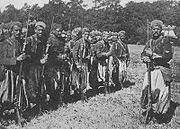
The four Zouave regiments of the French Army wore their traditional colorful dress during the early months of the First World War. The development of the machine gun, rapid fire artillery and improved small arms obliged them to adopt a plain khaki uniform from 1915 on. From 1927 to 1939 the "oriental dress" of red fez
Fez (clothing)
The fez , or tarboosh is a felt hat either in the shape of a red truncated cone or in the shape of a short cylinder made of kilim fabric. Both usually have tassels...
("chechia"), blue sash, braided blue jackets with waistcoats and voluminous red trousers was reintroduced as off-duty dress for re-enlisted NCOs and other long service regulars in the Zouave regiments. It was also worn by colour guards and other detachments on ceremonial occasions. White trousers of the same style had earlier been worn as an item of hot weather dress. The four regiments were distinguished by the colours (red, blue, white and yellow) of the "tombeaus" or false pockets on the front of their open fronted jackets
Post 1945
As predominantly conscript units the Zouaves did not serve in Indochina between 1945 and 1954. They were however employed extensively during the Algerian War, before being finally disbanded in 1962 following Algerian independence. This was inevitable since their recruitment base was the European population of Algeria, which dispersed with the ending of French rule.The traditions of the Zouave regiments were maintained until 2006 by the French Army's Commando Training School, which occasionally paraded colour parties and other detachments in Zouave dress. While other branches of the old Armée d'Afrique have either survived or been reestablished as representative units in recent years (notably the Foreign Legion
French Foreign Legion
The French Foreign Legion is a unique military service wing of the French Army established in 1831. The foreign legion was exclusively created for foreign nationals willing to serve in the French Armed Forces...
, Chasseurs d' Afrique, Tirailleurs and Spahi
Spahi
Spahis were light cavalry regiments of the French army recruited primarily from the indigenous populations of Algeria, Tunisia and Morocco. The modern French Army retains one regiment of Spahis as an armoured unit, with personnel now recruited in mainland France...
s) the French Army does not appear to have any plans to recreate one of its most distinctive and best known corps.
Papal Zouaves
Papal States
The Papal State, State of the Church, or Pontifical States were among the major historical states of Italy from roughly the 6th century until the Italian peninsula was unified in 1861 by the Kingdom of Piedmont-Sardinia .The Papal States comprised territories under...
. The Zouaves evolved out of a unit formed by Lamoricière in 1860, the Franco-Belgian Tirailleurs. On January 1, 1861 the unit was renamed the Papal Zouaves.
The Zuavi Pontifici were mainly young men, unmarried and Roman Catholic, who volunteered to assist Pope Pius IX
Pope Pius IX
Blessed Pope Pius IX , born Giovanni Maria Mastai-Ferretti, was the longest-reigning elected Pope in the history of the Catholic Church, serving from 16 June 1846 until his death, a period of nearly 32 years. During his pontificate, he convened the First Vatican Council in 1869, which decreed papal...
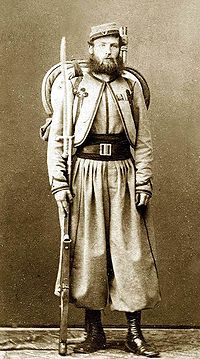
in his struggle against the Italian Risorgimento. They wore a similar style of uniform to that of the French Zouaves but in grey with red trim. A grey and red kepi
Kepi
The kepi is a cap with a flat circular top and a visor or peak . Etymologically, the word is a borrowing of the French képi, itself a respelling of the Alemannic Käppi: a diminutive form of Kappe, meaning "cap"....
was substituted for the North African fez
Fez (clothing)
The fez , or tarboosh is a felt hat either in the shape of a red truncated cone or in the shape of a short cylinder made of kilim fabric. Both usually have tassels...
.
All orders were given in French and the unit was commanded by a Swiss Colonel, M. Allet. Nonetheless, the regiment was truly international, and by May 1868 numbered 4,592 men including 1,910 Dutch, 1,301 French and 686 Belgians. 500 volunteers were raised from Canada. The Irish were to raise a battalion, the Battalion of St. Patrick.
The Papal Zouaves assisted in the notable Franco/Papal victory at the Battle of Mentana
Battle of Mentana
The Battle of Mentana was fought on November 3, 1867 between French-Papal troops and the Italian volunteers led by Giuseppe Garibaldi, who were attempting to capture Rome, then the main centre of the peninsula still outside of the newly unified Kingdom of Italy....
on November 3, 1867 suffering the brunt of the fighting, sustaining 81 casualties in the battle, including 24 killed (the Papal forces suffered only 30 dead in total) and 57 wounded, with the official report of the battle prepared by the French commander, General de Failly citing their bravery. They were also mentioned in Victor Hugo
Victor Hugo
Victor-Marie Hugo was a Frenchpoet, playwright, novelist, essayist, visual artist, statesman, human rights activist and exponent of the Romantic movement in France....
's poem Mentana.
The Zouaves also played a role in the final engagements against the forces of the newly united Kingdom of Italy in September 1870, in which the Papal forces where outnumbered almost seven to one. The Zouaves fought bravely before surrender. Several Zouaves were executed or murdered by the Italian forces following the surrender.
The French contingent of the Papal Zouaves regrouped as the Volontaires de l'Ouest (Volunteers of the West) to fight on the French side in the Franco-Prussian War
Franco-Prussian War
The Franco-Prussian War or Franco-German War, often referred to in France as the 1870 War was a conflict between the Second French Empire and the Kingdom of Prussia. Prussia was aided by the North German Confederation, of which it was a member, and the South German states of Baden, Württemberg and...
, where they kept their grey and red Papal uniforms. The Zouaves saw action outside Orléans
Orléans
-Prehistory and Roman:Cenabum was a Gallic stronghold, one of the principal towns of the Carnutes tribe where the Druids held their annual assembly. It was conquered and destroyed by Julius Caesar in 52 BC, then rebuilt under the Roman Empire...
, Patay
Patay
Patay is a commune in the Loiret department in north-central France.Population: approx. 1,500....
and the Battle of Loigny. The Volontaires de l'Ouest were disbanded after the entrance of Prussian troops into Paris.
An English veteran, Joseph Powell, published his account of his service with the Papal Zouaves, Two Years in the Pontifical Zouaves
Polish Zouaves of Death
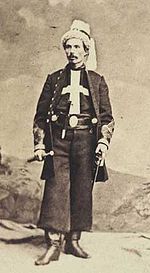
Lithuania
Lithuania , officially the Republic of Lithuania is a country in Northern Europe, the biggest of the three Baltic states. It is situated along the southeastern shore of the Baltic Sea, whereby to the west lie Sweden and Denmark...
n and Polish
Poland
Poland , officially the Republic of Poland , is a country in Central Europe bordered by Germany to the west; the Czech Republic and Slovakia to the south; Ukraine, Belarus and Lithuania to the east; and the Baltic Sea and Kaliningrad Oblast, a Russian exclave, to the north...
uprising
January Uprising
The January Uprising was an uprising in the former Polish-Lithuanian Commonwealth against the Russian Empire...
against the Russian Empire
Russian Empire
The Russian Empire was a state that existed from 1721 until the Russian Revolution of 1917. It was the successor to the Tsardom of Russia and the predecessor of the Soviet Union...
, a French ex-officer who had served previously in one of the French zouave regiments, François Rochebrune, organised the Zouaves of Death. Members of this Polish unit swore "to conquer or to die" and not to surrender. They wore a black uniform with white cross and red fez
Fez (clothing)
The fez , or tarboosh is a felt hat either in the shape of a red truncated cone or in the shape of a short cylinder made of kilim fabric. Both usually have tassels...
.
The Zouaves of Death first saw active service at the Battle of Miechów
Battle of Miechów
The Battle of Miechów took place on February 17, 1863, near Miechów in Małopolska, Poland , during the January Uprising....
on February 17, 1863. Lt. Tytus O'Brien de Lacy escaped with 400 zouaves to Galicia in March 1863.
Commanding officers of the regiment were:
- Colonel François Rochebrune;
- Lieutenant Count Wojciech Komorowski;
- Lieutenant Tytus O'Brien de Lacy;
- Lieutenant Antoni Wojcicki; and
- Lieutenant Tenente Bella.
Chronology of the Zouaves of Death:
- clashed with Russian dragoonDragoonThe word dragoon originally meant mounted infantry, who were trained in horse riding as well as infantry fighting skills. However, usage altered over time and during the 18th century, dragoons evolved into conventional light cavalry units and personnel...
s at the Battle of ChroberzChroberzChroberz is a village in Poland with 964 inhabitants . It is situated in Świętokrzyskie Voivodeship, Pińczów County, Gmina Złota. In the years of 1975–1998 Chroberz administratively belonged to Kielce Voivodeship...
on March 17, 1863; - captured six cannonCannonA cannon is any piece of artillery that uses gunpowder or other usually explosive-based propellents to launch a projectile. Cannon vary in caliber, range, mobility, rate of fire, angle of fire, and firepower; different forms of cannon combine and balance these attributes in varying degrees,...
at the Battle of Grochowiska on March 18, 1863; - following the Battle of Grochowiska 400 zouaves escaped to Galicia.
- twenty-one remaining zouaves were killed in the Battle of Igołomia on May 5, 1863.
See January Uprising
January Uprising
The January Uprising was an uprising in the former Polish-Lithuanian Commonwealth against the Russian Empire...
Zouaves of the American Civil War
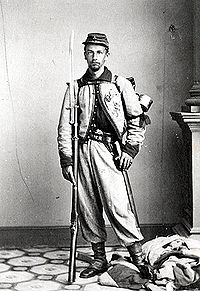

American Civil War
The American Civil War was a civil war fought in the United States of America. In response to the election of Abraham Lincoln as President of the United States, 11 southern slave states declared their secession from the United States and formed the Confederate States of America ; the other 25...
. The Union army
Union Army
The Union Army was the land force that fought for the Union during the American Civil War. It was also known as the Federal Army, the U.S. Army, the Northern Army and the National Army...
had more than 70 volunteer Zouave regiments throughout the conflict, while the Confederates
Confederate States Army
The Confederate States Army was the army of the Confederate States of America while the Confederacy existed during the American Civil War. On February 8, 1861, delegates from the seven Deep South states which had already declared their secession from the United States of America adopted the...
fielded about 25 Zouave companies.
A feature of some American zouave units, at least in the opening stages of the American Civil War
American Civil War
The American Civil War was a civil war fought in the United States of America. In response to the election of Abraham Lincoln as President of the United States, 11 southern slave states declared their secession from the United States and formed the Confederate States of America ; the other 25...
was the light infantry tactics and drill they employed. Zouaves "utilised light infantry tactics that emphasised open-order formations, with several feet between soldiers, rather than the customary close order, with its characteristic 'touch of elbows.' They moved at double time, rather than marching at a stately cadence, and they lay on their backs to load their rifles rather than standing to do so. To fire they rolled prone and sometimes rose on one knee."
Arguably the most famous Union Zouave regiments were from New York: the 5th New York Volunteer Infantry
5th New York Volunteer Infantry
The 5th New York Volunteer Infantry was a volunteer infantry regiment that fought during the American Civil War, led by Colonel Abram Duryée. It is also known as the "Duryée's Zouaves," named after their colorful Zouave uniforms...
, "Duryee's Zouaves" (after its first colonel, Abram Duryee
Abram Duryée
Abram Duryée was a Union Army general during the American Civil War, the commander of one of the most famous Zouave regiments, the 5th New York Volunteer Infantry. After the war he was New York City Police Commissioner.-Birth and early years:...
), the 114th Pennsylvania Infantry
114th Pennsylvania Infantry
The 114th Pennsylvania Volunteer Infantry Regiment was an infantry regiment that served in the Union Army during the American Civil War. They were very famous for their colorful americanized zouave dress which consisted of: a dark blue zouave jacket with sky blue cuffs and red trimmings and...
, "Collis's Zouaves" (after their colonel, Charles H. T. Collis
Charles H. T. Collis
Charles Henry Tucker "Tucky" Collis was an Irish-American US Army officer who received the Medal of Honor for his actions in the American Civil War. He was born in Ireland....
) and the 11th New York Volunteer Infantry, "Fire Zouaves". The 11th New York was initially led by Col. Elmer E. Ellsworth
Elmer E. Ellsworth
-External links:* * * * * *...
, until his death in 1861. The regiment was badly mauled during the First Battle of Bull Run
First Battle of Bull Run
First Battle of Bull Run, also known as First Manassas , was fought on July 21, 1861, in Prince William County, Virginia, near the City of Manassas...
in July 1861 as it acted as the rear guard for the retreating Army of the Potomac. The 5th New York was considered one of the elite units of the Army of the Potomac
Army of the Potomac
The Army of the Potomac was the major Union Army in the Eastern Theater of the American Civil War.-History:The Army of the Potomac was created in 1861, but was then only the size of a corps . Its nucleus was called the Army of Northeastern Virginia, under Brig. Gen...
and was only one of two volunteer regiments brigaded with the regular division commanded by George Sykes
George Sykes
George Sykes was a career United States Army officer and a Union General during the American Civil War.-Early life:...
. At the Second Battle of Bull Run
Second Battle of Bull Run
The Second Battle of Bull Run or Second Manassas was fought August 28–30, 1862, as part of the American Civil War. It was the culmination of an offensive campaign waged by Confederate Gen. Robert E. Lee's Army of Northern Virginia against Union Maj. Gen...
, the 5th New York, along with another Zouave regiment, the 10th New York "National Zouaves", held off the flanking attack of James Longstreet
James Longstreet
James Longstreet was one of the foremost Confederate generals of the American Civil War and the principal subordinate to General Robert E. Lee, who called him his "Old War Horse." He served under Lee as a corps commander for many of the famous battles fought by the Army of Northern Virginia in the...
's Corps for ten crucial minutes before it was overrun. The 5th New York thus suffered the highest percentage of casualties in the shortest amount of time of any unit in the Civil War (of 525 men, approximately 120 were killed and 330 were wounded in less than 10 minutes).
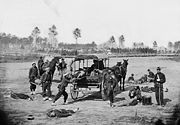
140th New York Volunteer Infantry Regiment
The 140th New York Volunteer Infantry Regiment was a Federal Regiment that was mustered on September 13, 1862 and was mustered out on June 3, 1865. Citizens of Monroe County comprising the majority of its members...
and 155th Pennsylvania) were issued with Zouave uniforms to reward their proficiency in drill and battlefield performance. Difficulties in supply and replacement meant that Zouave and other exotic militia uniforms tended to be replaced by standard issue uniforms throughout the conflict. However, the tradition remained strong and the last Union casualty of the fighting in Virginia
Virginia
The Commonwealth of Virginia , is a U.S. state on the Atlantic Coast of the Southern United States. Virginia is nicknamed the "Old Dominion" and sometimes the "Mother of Presidents" after the eight U.S. presidents born there...
was reported to be a Zouave of the 155th Pennsylvania
155th Pennsylvania Infantry
The 155th Pennsylvania Volunteer Infantry Regiment was a Federal infantry regiment that served in the American Civil War in the Army of the Potomac in the Eastern Theater....
, killed at Farmville, Virginia
Farmville, Virginia
Farmville is a town in Prince Edward and Cumberland counties in the U.S. state of Virginia. The population was 6,845 at the 2000 census. It is the county seat of Prince Edward County....
on the morning of April 9, 1865.
There were a number of Confederate Zouave units. In contrast to the many Federal units, most Confederate Zouaves were not full "regiments": many were companies within larger units. The cognomen "Louisiana Tiger" dates from the Mexican War, and refers to any Louisiana state trooper [and more recently, to the state's athletic teams]. But none of the Mexican War Louisiana "Tigers" were Zouaves. The earliest, and most famous Louisiana Zouave unit was r White's Company B (the "Tiger Rifles") of Major Chatham Roberdeau Wheat's First Special Battalion, Louisiana Volunteers, aka "Louisiana Tigers".
Winters notes too that a group of itinerant actors who claimed to have served in European wars stimulated the Zouave craze. The actors attracted large crowds and inspired the formation of military companies. They visited several New Orleans companies and instructed the men in a new manual of arms. They toured the river towns and played to an overflow audience in Plaquemine
Plaquemine, Louisiana
Plaquemine is a city in and the parish seat of Iberville Parish, Louisiana, United States. The population was 7,064 at the 2000 census. It is part of the Baton Rouge Metropolitan Statistical Area....
. In Alexandria
Alexandria, Louisiana
Alexandria is a city in and the parish seat of Rapides Parish, Louisiana, United States. It lies on the south bank of the Red River in almost the exact geographic center of the state. It is the principal city of the Alexandria metropolitan area which encompasses all of Rapides and Grant parishes....
in Central Louisiana
Central Louisiana
Central Louisiana , also known as the Crossroads region, is the part of Louisiana that includes the following parishes: Allen Parish, Beauregard Parish, Catahoula Parish, Concordia Parish, Grant Parish, La Salle Parish, Natchitoches Parish, Rapides Parish, Sabine Parish and Vernon Parish.The five...
, the actors performed "a bloody drama of the Crimean War."
Among the Louisiana Zouaves were the "Louisiana Tigers" or "Coppen's Zouaves." These names have been confused with "Louisiana Tigers at Gettysburg." Coppen's Zouaves were at Gettysburg, but they were not then known as "Louisiana Tigers." Captain White's Company B, "Louisiana Tigers", of Major Wheats's First Special Battalion, were not at Gettysburg, having been disbanded after Wheat's death at Gaines Mill in 1862.
Post Civil War
Zouaves gradually vanished from the U.S. military in the 1870s and 1880s, as the militia system slowly transformed into the National GuardUnited States National Guard
The National Guard of the United States is a reserve military force composed of state National Guard militia members or units under federally recognized active or inactive armed force service for the United States. Militia members are citizen soldiers, meaning they work part time for the National...
. As an example, the Wisconsin militia still included one Zouave unit in 1879 but the following year a standard Wisconsin Guard uniform was adopted and the traditional distinctions of title and dress ceased. After the Civil War, veteran groups sometimes dressed as Zouaves during honor guard
Honor guard
An honor guard, or ceremonial guard, is a ceremonial unit, usually military in nature and composed of volunteers who are carefully screened for their physical ability and dexterity...
ceremonies such as funeral processions, since Zouave dress was considered flashy.
American Zouave uniforms
The Zouave uniform was sometimes quite elaborate, to the extent of being unwieldy. Some Zouave regiments wore a fezFez (clothing)
The fez , or tarboosh is a felt hat either in the shape of a red truncated cone or in the shape of a short cylinder made of kilim fabric. Both usually have tassels...
with a colored tassel (usually yellow, blue, green, or red) and turban, a tight fitting short jacket (some without buttons), a wide 10 feet (3 m) sash, baggy pantaloons or "chasseur" trousers, white leggings, and a short leather cuff for the calf, called jambieres
Gaiters
Gaiters are garments worn over the shoe and lower pant leg, and used primarily as personal protective equipment; similar garments used primarily for display are spats....
. The sash was especially difficult to put on, often requiring the help of another Zouave. The Zouave uniform was better suited for warm climates and rough terrain. The loose pantaloons allowed for greater freedom of movement than trousers, while the short jacket was much cooler than the long wool blouse worn by most armies of the time. One of the reasons for the smaller number of Zouave units in the U.S. and Europe was the expense of the specialised uniform over that of mass-produced uniforms of a single color and cut.
Spanish Zouaves
Spanish zouaves in the Third Carlist WarThird Carlist War
The Third Carlist War was the last Carlist War in Spain. It is very often referred to as the Second Carlist War, as the 'second' had been small in scale and almost trivial in political consequence....
(1872–1876) were created by the pretender to the Spanish throne, Don Alfonso Carlos, who raised the Carlist Zouaves as an honor guard to accompany himself and his wife Maria de las Nieves Braganza. The Carlist Zouaves originated as the sixth company of the second battalion of the Pontifical Zouaves. Don Alfonso Carlos had attained the rank of lieutenant as part of the Pontifical Zouave. The Carlist Zouaves demonstrated their fierceness in battle and were used as shock troops within the army of Catalonia and the Maestrazgo. As the King's honour guard they were envied by other Carlist units. The uniforms of the Carlist Zouaves included the baggy trousers, short jacket, vest and sash of both the French and Pontifical Zouaves. However, the Carlist Zouaves also wore a distinctive feature that differentiated them from existing Zouave regiments elsewhere, in the form of a beret
Beret
A beret is a soft, round, flat-crowned hat, designated a "cap", usually of woven, hand-knitted wool, crocheted cotton, or wool felt, or acrylic fiber....
of Basque influence with a characteristic tassel. In order to distinguish the troops from the officers, the color of the officer's jacket was a blue gray shade with a darker blue for the other ranks. The beret worn by the troops was white with a yellow tassel while the officers wore a red beret with yellow tassel. The baggy trousers were grayish for all ranks.
Zouave influence elsewhere
- Features of the zouave dress were widely copied by the colonial units of various European armies during the late 19th and early 20th centuries. These included African regiments raised by Portugal, Britain, Spain, and Italy, as well as West Indian troops in the British service. Amongst the French North African forces the SpahiSpahiSpahis were light cavalry regiments of the French army recruited primarily from the indigenous populations of Algeria, Tunisia and Morocco. The modern French Army retains one regiment of Spahis as an armoured unit, with personnel now recruited in mainland France...
s (Algerian cavalry with French officers) and the Turcos (Algerian infantry) were both dressed in the same style as the Zouaves but with different colours. - Between 1880 and 1893 the Turkish Imperial Guard included two Zouave regiments. The Abdul Hamid II Collection in the US Library of CongressLibrary of CongressThe Library of Congress is the research library of the United States Congress, de facto national library of the United States, and the oldest federal cultural institution in the United States. Located in three buildings in Washington, D.C., it is the largest library in the world by shelf space and...
has a number of photographs of these soldiers. They wore a uniform similar to that of the French Zouaves but with green turbans and less widely cut red breeches. - Morocco and Algeria still have zouave-style dress uniforms for their ceremonial guard units. The Tunisian Presidential Guard retained such a uniform until at least 1969.
- American Civil War reenactmentsAmerican Civil War reenactmentAmerican Civil War reenactment is an effort to recreate the appearance of a particular battle or other event associated with the American Civil War by hobbyists known as Civil War reenactors or Civil War recreationists...
often feature zouave units. - In Brazil, during the Triple Alliance War against Paraguay, a company of black volunteers called the "zouavos baianos" was organised in Bahia Province. This unit was disbanded after a short time because segregated military units were contrary to Brazilian practice.
Zouaves in popular culture
- A zouave is featured on the packet of Zig Zag cigarette papersZig-Zag (company)Zig-Zag is a brand of rolling papers that originated in France. It is marketed in the USA by National Tobacco, in Europe by Republic Technologies, and in Japan by Tsuge Pipes...
.
- In the Buster KeatonBuster KeatonJoseph Frank "Buster" Keaton was an American comic actor, filmmaker, producer and writer. He was best known for his silent films, in which his trademark was physical comedy with a consistently stoic, deadpan expression, earning him the nickname "The Great Stone Face".Keaton was recognized as the...
film The PlayhouseThe Playhouse (film)The Playhouse is a 1921 silent short film written, directed by, and starring Buster Keaton. The movie runs for 22 minutes, and is most famous for an opening sequence in which Keaton plays every role.- Plot :...
, a Zouave drill routine is one of the acts at the theatre. One of the gags involves Buster's boss telling him to get him some Zouaves and Buster first hands him a pack of cigarettes. See 12:23 at http://www.archive.org/details/ThePlayhouse
- Used indiscriminately as an insult by Captain HaddockCaptain HaddockCaptain Archibald Haddock is a fictional character in The Adventures of Tintin, the series of classic Belgian comic books written and illustrated by Hergé...
, a character in The Adventures of TintinThe Adventures of TintinThe Adventures of Tintin is a series of classic comic books created by Belgian artist , who wrote under the pen name of Hergé...
. Professor CalculusProfessor CalculusProfessor Cuthbert Calculus is a fictional character in The Adventures of Tintin, the series of classic Belgian comic books written and illustrated by Hergé...
takes particular offense at the insult in the album Destination MoonDestination MoonDestination Moon can refer to the following:* Destination Moon , a 1950 science fiction film* "Destination Moon" , a story by Robert Heinlein adapted from his screenplay for the above...
.
- In French vernacular speech the phrase "faire le Zouave" can be translated as "to play the goat" i.e. to behave wildly.
- In the film Gods and GeneralsGods and Generals (film)Gods and Generals is a 2003 American film based on the novel Gods and Generals by Jeffrey Shaara. It depicts events that take place prior to those shown in the 1993 film Gettysburg, which was based on The Killer Angels, a novel by Shaara's father, Michael...
the 11th New York and the 14th Brooklyn are shown fighting the Stonewall Brigade at First Manassas. Also later in the film at the battle of Fredricksburg you can see both the 114th Pennsylvania defending the pontoon bridges against General Barksdale's Mississippi Brigade, and the 5th New York briefly as the Union are looting Fredricksburg.
- In the film Gettysburg one can see the 14th Brooklyn during the first day of battle, and the 114th Pennsylvania briefly as the Union are building up defenses on the high grounds outside Gettysburg that night after the first day of battle. The 72nd Pennsylvania is seen briefly during Picketts Charge, and when the Confederates try to overrun the Union defenses. In the opening credits for the movie one of the background pictures shows 3 zouaves of the 5th New York Volunteer Infantry regiment guarding a union battery. This is a historical flaw in the movie because the 5th New York was mustered out of service two months before the Battle of Gettysburg.
- In the film "Glory" one can see the 14th Brooklyn in the beginning. The 14th Brooklyn is actually supposed to represent the Zouave d' Afrique (114th Pennsylvania later in history) because the scene is showing the assault on the Sunken Road. The 14th Brooklyn in real life did not fight at the Sunken Road. Some zouaves are later in the show when General Strong is talking about the defenses of Fort Wagner. These zouaves are supposed to represent the 76th Pennsylvania, but the uniform is historically incorrect. The uniform in the movie is that of the 165th New York, but the 76th Pennsylvania wore a dark blue zouave jacket with red trimming with a false gray vest, a red sash, a dark blue fez with a dark blue tazzle, and Arab style sky blue pantalloons.
- In Margaret Mitchell's Gone With The WindGone with the WindThe slaves depicted in Gone with the Wind are primarily loyal house servants, such as Mammy, Pork and Uncle Peter, and these slaves stay on with their masters even after the Emancipation Proclamation of 1863 sets them free...
a Zouave, Rene Picard, joins the Confederate Army in Atlanta. Picard is remembered for his good humour, charm and optimism. Also, for his inveterate Creole French accent.
- In the 1955 Danny KayeDanny KayeDanny Kaye was a celebrated American actor, singer, dancer, and comedian...
film The Court JesterThe Court JesterThe Court Jester is a 1956 musical-comedy film starring Danny Kaye, Glynis Johns, Basil Rathbone, and Angela Lansbury. The movie was co-written, co-directed, and co-produced by Melvin Frank and Norman Panama...
the Jackson Zouaves American Legion Drill Team from Jackson, MichiganJackson, MichiganJackson is a city located along Interstate 94 in the south central area of the U.S. state of Michigan, about west of Ann Arbor and south of Lansing. It is the county seat of Jackson County. As of the 2010 census, the city population was 33,534...
, is seen performing a humorous drill routine using the traditional Zouave quick-march. The group also made several appearances, in full Zouave uniform, on The Ed Sullivan ShowThe Ed Sullivan ShowThe Ed Sullivan Show is an American TV variety show that originally ran on CBS from Sunday June 20, 1948 to Sunday June 6, 1971, and was hosted by New York entertainment columnist Ed Sullivan....
between 1953 and 1960.
See also
- 114th Pennsylvania Volunteer Infantry
- 9th New York Volunteer Infantry Regiment9th New York Volunteer Infantry RegimentThe 9th New York Volunteer Infantry Regiment was an Infantry Regiment that served in the Union Army during the American Civil War. It was also known as the "Hawkins' Zouaves" or "New York Zouaves."-Military Service, 1861:...
- 10th New York Volunteer Infantry Regiment10th New York Volunteer Infantry RegimentThe 10th New York Volunteer Infantry Regiment was an infantry regiment that served in the Union Army during the American Civil War. It was also known as the McChesney Zouaves or National Guard Zouaves.-Service:...
- 11th New York Volunteer Infantry Regiment11th New York Volunteer Infantry RegimentThe 11th New York Volunteer Infantry Regiment was an infantry regiment of Union Army in the early years of the American Civil War. The regiment was organized in New York City in May 1861 as a Zouave regiment, known for its unusual dress and drill style, by Colonel Elmer E. Ellsworth, a personal...
- 146th New York Volunteer Infantry Regiment146th New York Volunteer Infantry RegimentThe 146th New York Volunteer Infantry Regiment, nicknamed Garrard's Tigers, was a Federal regiment mustered on October 10, 1862, and was mustered out on July 16, 1865. The regiment was raised and organized in Utica New york, and was known as the 5th Oneida Regiment...
- 5th New York Volunteer Infantry5th New York Volunteer InfantryThe 5th New York Volunteer Infantry was a volunteer infantry regiment that fought during the American Civil War, led by Colonel Abram Duryée. It is also known as the "Duryée's Zouaves," named after their colorful Zouave uniforms...
- 62nd New York Volunteer Infantry Regiment62nd New York Volunteer Infantry RegimentThe Anderson Zouaves was a New York volunteer regiment that served in the Union Army during the American Civil War.It was raised under special authority of the War Department in New York City by Col...
- 8th Missouri Volunteer Infantry8th Missouri Volunteer InfantryThe 8th Missouri Volunteer Infantry was an infantry regiment in the Union army during the American Civil War. Among its early leaders were Morgan Lewis Smith and Giles Alexander Smith, both of whom later became generals....
- Louisiana TigersLouisiana TigersLouisiana Tigers was the common nickname for certain infantry troops from the state of Louisiana in the Confederate States Army during the American Civil War. Originally applied to a specific company, the nickname expanded to a battalion, then to a brigade, and eventually to all Louisiana troops...
- January UprisingJanuary UprisingThe January Uprising was an uprising in the former Polish-Lithuanian Commonwealth against the Russian Empire...
- John SurrattJohn SurrattJohn Harrison Surratt, Jr. was accused of plotting with John Wilkes Booth to kidnap U.S. president Abraham Lincoln and suspected of involvement in the Abraham Lincoln assassination. His mother Mary Surratt was convicted of conspiracy and hanged by the United States Federal Government...
- Conspired to kidnap Abraham LincolnAbraham LincolnAbraham Lincoln was the 16th President of the United States, serving from March 1861 until his assassination in April 1865. He successfully led his country through a great constitutional, military and moral crisis – the American Civil War – preserving the Union, while ending slavery, and...
. Served briefly with the Pontifical Zouaves. - Pont de l'AlmaPont de l'AlmaPont de l'Alma is an arch bridge in Paris, crossing the Seine. It was named to commemorate the Battle of Alma during the Crimean War, in which the Franco-British alliance achieved victory over the Russian army on September 20, 1854....
- Zouave jacketZouave jacketA Zouave jacket is a short open fronted jacket with long sleeves, similar to that historically worn by Zouaves.It was a popular women's fashion in the 19th century in the United States. Colorful, braid-trimmed Zouave jackets became fashionable in the late 1850s and remained so well into the 1860s...
- 11th Regiment Indiana Infantry11th Regiment Indiana InfantryThe 11th Indiana Volunteer Infantry Regiment was an infantry regiment that served in the Union Army during the American Civil War.-3 Month:The 11th Indiana was organized in Indianapolis, Indiana with Lew Wallace as colonel and George McGinnis as lieutenant colonel...
- French colonial flagsFrench colonial flagsSome of the colonies, protectorates and mandates of the French Colonial Empire used distinctive colonial flags. These most commonly had a French Tricolour in the canton....
- French Colonial EmpireFrench colonial empireThe French colonial empire was the set of territories outside Europe that were under French rule primarily from the 17th century to the late 1960s. In the 19th and 20th centuries, the colonial empire of France was the second-largest in the world behind the British Empire. The French colonial empire...
- List of French possessions and colonies
External links
- Zouave Database Online
- 114th Pennsylvania Volunteer Infantry - Collis' Zouaves d'Afrique
- Van Gogh portrait of a Zouave soldier
- Lithograph of a Zouave soldier by Lucien Lefevre, 1898, for Absinthe Mugnier
- Remington 1863 Zouave Rifle
- "Les Zouaves" (French)
- Photograph of Alfred Laroque, a Canadian Papal Zouave, taken at Montreal, Quebec in 1868 by William Notman (1826–1891), housed in the McCord MuseumMcCord MuseumThe McCord Museum is a public research and teaching museum dedicated to the preservation, study, diffusion, and appreciation of Canadian history...
in Montreal. Laroque is posed seated and wears three medals. http://www.mccord-museum.qc.ca/en/collection/artifacts/I-34892.1/ - The Papal Zouaves
}
}
}
}
}
}}