


Thylakoid

Encyclopedia
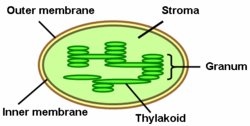
Chloroplast
Chloroplasts are organelles found in plant cells and other eukaryotic organisms that conduct photosynthesis. Chloroplasts capture light energy to conserve free energy in the form of ATP and reduce NADP to NADPH through a complex set of processes called photosynthesis.Chloroplasts are green...
s and cyanobacteria. They are the site of the light-dependent reactions
Light-dependent reactions
The 'light-dependent reactions', or light reactions, are the first stage of photosynthesis, the process by which plants capture and store energy from sunlight. In this process, light energy is converted into chemical energy, in the form of the energy-carrying molecules ATP and NADPH...
of photosynthesis
Photosynthesis
Photosynthesis is a chemical process that converts carbon dioxide into organic compounds, especially sugars, using the energy from sunlight. Photosynthesis occurs in plants, algae, and many species of bacteria, but not in archaea. Photosynthetic organisms are called photoautotrophs, since they can...
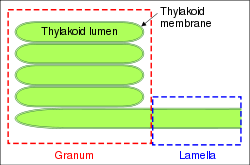
. Thylakoids consist of a thylakoid membrane surrounding a thylakoid lumen
Lumen (anatomy)
A lumen in biology is the inside space of a tubular structure, such as an artery or intestine...
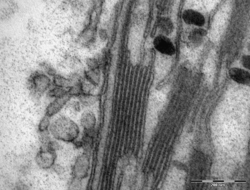
. Chloroplast thylakoids frequently form stacks of disks referred to as grana (singular: granum). Grana are connected by intergrana or stroma thylakoids, which join granum stacks together as a single functional compartment.
Etymology
The word thylakoid come via LatinLatin
Latin is an Italic language originally spoken in Latium and Ancient Rome. It, along with most European languages, is a descendant of the ancient Proto-Indo-European language. Although it is considered a dead language, a number of scholars and members of the Christian clergy speak it fluently, and...
from Greek
Greek language
Greek is an independent branch of the Indo-European family of languages. Native to the southern Balkans, it has the longest documented history of any Indo-European language, spanning 34 centuries of written records. Its writing system has been the Greek alphabet for the majority of its history;...
thylakos meaning sac or pouch. Thus, thylakoid means sac-like or pouch-like.
Thylakoid structure
Stromal cell
In cell biology, stromal cells are connective tissue cells of any organ, for example in the uterine mucosa , prostate, bone marrow, and the ovary. They are cells that support the function of the parenchymal cells of that organ...
.
Membrane
The thylakoid membrane is the site of the light-dependent reactionsLight-dependent reactions
The 'light-dependent reactions', or light reactions, are the first stage of photosynthesis, the process by which plants capture and store energy from sunlight. In this process, light energy is converted into chemical energy, in the form of the energy-carrying molecules ATP and NADPH...
of photosynthesis with the photosynthetic pigment
Photosynthetic pigment
A photosynthetic pigment is a pigment that is present in chloroplasts or photosynthetic bacteria and captures the light energy necessary for photosynthesis.- Plants :...
s embedded directly in the membrane. It is an alternating pattern of dark and light bands measuring each 1 nanometre
Nanometre
A nanometre is a unit of length in the metric system, equal to one billionth of a metre. The name combines the SI prefix nano- with the parent unit name metre .The nanometre is often used to express dimensions on the atomic scale: the diameter...
. The thylakoid lipid bilayer shares characteristic features with prokaryotic membranes and the inner chloroplast membrane. For example, acidic lipids can be found in thylakoid membranes, cyanobacteria and other photosynthetic bacteria and are involved in the functional integrity of the photosystems. The thylakoid membranes of higher plants are composed primarily of phospholipids and galactolipid
Galactolipid
Galactolipids are a type of glycolipid whose sugar group is galactose. They're different from glycosphingolipids in that they do not have nitrogen in their composition....
s that are asymmetrically arranged along and across the membranes. The lipids for the thylakoid membranes are synthesized in a complex pathway involving exchange of lipid precursors between the endoplasmic reticulum
Endoplasmic reticulum
The endoplasmic reticulum is an organelle of cells in eukaryotic organisms that forms an interconnected network of tubules, vesicles, and cisternae...
and inner membrane of the plastid envelope and transported from the inner membrane to the thylakoids via vesicles.
Lumen
The thylakoid lumen is the compartment bounded by the thylakoid membrane. It plays a vital role for photophosphorylationPhotophosphorylation
The production of ATP using the energy of sunlight is called photophosphorylation. Only two sources of energy are available to living organisms: sunlight and reduction-oxidation reactions...
during photosynthesis
Photosynthesis
Photosynthesis is a chemical process that converts carbon dioxide into organic compounds, especially sugars, using the energy from sunlight. Photosynthesis occurs in plants, algae, and many species of bacteria, but not in archaea. Photosynthetic organisms are called photoautotrophs, since they can...
. During the light-dependent reaction, protons are pumped across the thylakoid membrane into the lumen making it acidic down to pH 4.
Granum
A granum (plural grana) is a stack of thylakoid discs. Chloroplasts can have from 10 to 100 grana. Grana are connected by stroma thylakoids, also called intergrana thylakoids or lamellae. Grana thylakoids and stroma thylakoids can be distinguished by their different protein composition. Grana contribute to chloroplasts' large surface area to volume ratio. Different interpretations of electron tomographyElectron tomography
Electron Tomography is a tomography technique for obtaining detailed 3D structures of subcellular macromolecular objects. Electron tomography is an extension of traditional transmission electron microscopy and uses a transmission electron microscope to collect the data...
imaging of thylakoid membranes has resulted in two models for grana structure. Both posit that lamellae intersect grana stacks in parallel sheets, though whether these sheets intersect in planes perpendicular to the grana stack axis, or are arranged in a right-handed helix
Helix
A helix is a type of smooth space curve, i.e. a curve in three-dimensional space. It has the property that the tangent line at any point makes a constant angle with a fixed line called the axis. Examples of helixes are coil springs and the handrails of spiral staircases. A "filled-in" helix – for...
is debated.
Thylakoid formation
Chloroplasts develop from proplastids when seedlingSeedling
thumb|Monocot and dicot seedlingsA seedling is a young plant sporophyte developing out of a plant embryo from a seed. Seedling development starts with germination of the seed. A typical young seedling consists of three main parts: the radicle , the hypocotyl , and the cotyledons...
s emerge from the ground. Thylakoid formation requires light. In the plant embryo and in the absence of light, proplastids develop into etioplast
Etioplast
Etioplasts are chloroplasts that have not been exposed to light. They are usually found in flowering plants grown in the dark. If a plant is kept out of light for several days, its normal chloroplasts will actually convert into etioplasts. Etioplasts lack active pigment and can technically be...
s that contain semicrystalline membrane structures called prolamellar bodies. When exposed to light, these prolamellar bodies develop into thylakoids. This does not happen in seedlings grown in the dark, which undergo etiolation
Etiolation
Etiolation is a process in flowering plants grown in partial or complete absence of light. It is characterized by long, weak stems; smaller, sparser leaves due to longer internodes; and a pale yellow color . It increases the likelihood that a plant will reach a light source, often from under the...
. An underexposure to light can cause the thylakoids to fail. This causes the chloroplasts to fail resulting in the death of the plant.
Thylakoid formation requires the action of vesicle-inducing protein in plastids 1 (VIPP1). Plants cannot survive without this protein, and reduced VIPP1 levels lead to slower growth and paler plants with reduced ability to photosynthesize. VIPP1 appears to be required for basic thylakoid membrane formation, but not for the assembly of protein complexes of the thylakoid membrane. It is conserved in all organisms containing thylakoids, including cyanobacteria, green algae, such as Chlamydomonas
Chlamydomonas
Chlamydomonas is a genus of green algae. They are unicellular flagellates. Chlamydomonas is used as a model organism for molecular biology, especially studies of flagellar motility and chloroplast dynamics, biogenesis, and genetics...
, and higher plants, such as Arabidopsis thaliana
Arabidopsis thaliana
Arabidopsis thaliana is a small flowering plant native to Europe, Asia, and northwestern Africa. A spring annual with a relatively short life cycle, arabidopsis is popular as a model organism in plant biology and genetics...
.
Thylakoid isolation and fractionation
Thylakoids can be purified from plant cells using a combination of differential and gradient centrifugationCentrifugation
Centrifugation is a process that involves the use of the centrifugal force for the sedimentation of mixtures with a centrifuge, used in industry and in laboratory settings. More-dense components of the mixture migrate away from the axis of the centrifuge, while less-dense components of the mixture...
. Disruption of isolated thylakoids, for example by mechanical shearing, releases the lumenal fraction. Peripheral and integral membrane fractions can be extracted from the remaining membrane fraction. Treatment with sodium carbonate
Sodium carbonate
Sodium carbonate , Na2CO3 is a sodium salt of carbonic acid. It most commonly occurs as a crystalline heptahydrate, which readily effloresces to form a white powder, the monohydrate. Sodium carbonate is domestically well-known for its everyday use as a water softener. It can be extracted from the...
(Na2CO3) detaches peripheral membrane protein
Peripheral membrane protein
Peripheral membrane proteins are proteins that adhere only temporarily to the biological membrane with which they are associated. These molecules attach to integral membrane proteins, or penetrate the peripheral regions of the lipid bilayer. The regulatory protein subunits of many ion channels and...
s, whereas treatment with detergent
Detergent
A detergent is a surfactant or a mixture of surfactants with "cleaning properties in dilute solutions." In common usage, "detergent" refers to alkylbenzenesulfonates, a family of compounds that are similar to soap but are less affected by hard water...
s and organic solvents solubilizes integral membrane protein
Integral membrane protein
An integral membrane protein is a protein molecule that is permanently attached to the biological membrane. Proteins that cross the membrane are surrounded by "annular" lipids, which are defined as lipids that are in direct contact with a membrane protein...
s.
Thylakoid proteins
Proteomics
Proteomics is the large-scale study of proteins, particularly their structures and functions. Proteins are vital parts of living organisms, as they are the main components of the physiological metabolic pathways of cells. The term "proteomics" was first coined in 1997 to make an analogy with...
studies of thylakoid fractions have provided further details on the protein composition of the thylakoids. These data have been summarized in several plastid protein databases that are available online.
According to these studies, the thylakoid proteome
Proteome
The proteome is the entire set of proteins expressed by a genome, cell, tissue or organism. More specifically, it is the set of expressed proteins in a given type of cells or an organism at a given time under defined conditions. The term is a portmanteau of proteins and genome.The term has been...
consists of at least 335 different proteins. Out of these, 89 are in the lumen, 116 are integral membrane proteins, 62 are peripheral proteins on the stroma side, and 68 peripheral proteins on the lumenal side. Additional low-abundance lumenal proteins can be predicted through computational methods. Of the thylakoid proteins with known functions, 42% are involved in photosynthesis. The next largest functional groups include proteins involved in protein targeting
Protein targeting
Protein targeting or protein sorting is the mechanism by which a cell transports proteins to the appropriate positions in the cell or outside of it. Sorting targets can be the inner space of an organelle, any of several interior membranes, the cell's outer membrane, or its exterior via secretion...
, processing and folding
Protein folding
Protein folding is the process by which a protein structure assumes its functional shape or conformation. It is the physical process by which a polypeptide folds into its characteristic and functional three-dimensional structure from random coil....
with 11%, oxidative stress
Oxidative stress
Oxidative stress represents an imbalance between the production and manifestation of reactive oxygen species and a biological system's ability to readily detoxify the reactive intermediates or to repair the resulting damage...
response (9%) and translation (8%).
Integral membrane proteins
Thylakoid membranes contain integral membrane proteinIntegral membrane protein
An integral membrane protein is a protein molecule that is permanently attached to the biological membrane. Proteins that cross the membrane are surrounded by "annular" lipids, which are defined as lipids that are in direct contact with a membrane protein...
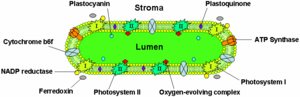
s which play an important role in light harvesting and the light-dependent reactions of photosynthesis. There are four major protein complexes in the thylakoid membrane:
- PhotosystemPhotosystemPhotosystems are functional and structural units of protein complexes involved in photosynthesis that together carry out the primary photochemistry of photosynthesis: the absorption of light and the transfer of energy and electrons...
s IPhotosystem IPhotosystem I is the second photosystem in the photosynthetic light reactions of algae, plants, and some bacteria. Photosystem I is so named because it was discovered before photosystem II. Aspects of PS I were discovered in the 1950s, but the significances of these discoveries was not yet known...
and IIPhotosystem IIPhotosystem II is the first protein complex in the Light-dependent reactions. It is located in the thylakoid membrane of plants, algae, and cyanobacteria. The enzyme uses photons of light to energize electrons that are then transferred through a variety of coenzymes and cofactors to reduce... - Cytochrome b6f complexCytochrome b6f complexThe cytochrome b6f complex is an enzyme found in the thylakoid membrane in chloroplasts of plants, cyanobacteria, and green algae, catalyzing the transfer of electrons from plastoquinol to plastocyanin...
- ATP synthaseATP synthaseright|thumb|300px|Molecular model of ATP synthase by X-ray diffraction methodATP synthase is an important enzyme that provides energy for the cell to use through the synthesis of adenosine triphosphate . ATP is the most commonly used "energy currency" of cells from most organisms...
Photosystem II is located mostly in the grana thylakoids, whereas photosystem I and ATP synthase are mostly located in the stroma thylakoids and the outer layers of grana. The cytochrome b6f complex is distributed evenly throughout thylakoid membranes. Due to the separate location of the two photosystems in the thylakoid membrane system, mobile electron carriers are required to shuttle electrons between them. These carriers are plastoquinone and plastocyanin. Plastoquinone shuttles electrons from photosystem II to the cytochrome b6f complex, whereas plastocyanin carries electrons from the cytochrome b6f complex to photosystem I.
Together, these proteins make use of light energy to drive electron transport chain
Electron transport chain
An electron transport chain couples electron transfer between an electron donor and an electron acceptor with the transfer of H+ ions across a membrane. The resulting electrochemical proton gradient is used to generate chemical energy in the form of adenosine triphosphate...
s that generate a chemiosmotic potential across the thylakoid membrane and NADPH, a product of the terminal redox
Redox
Redox reactions describe all chemical reactions in which atoms have their oxidation state changed....
reaction. The ATP synthase
ATP synthase
right|thumb|300px|Molecular model of ATP synthase by X-ray diffraction methodATP synthase is an important enzyme that provides energy for the cell to use through the synthesis of adenosine triphosphate . ATP is the most commonly used "energy currency" of cells from most organisms...
uses the chemiosmotic potential to make ATP
Adenosine triphosphate
Adenosine-5'-triphosphate is a multifunctional nucleoside triphosphate used in cells as a coenzyme. It is often called the "molecular unit of currency" of intracellular energy transfer. ATP transports chemical energy within cells for metabolism...
during photophosphorylation
Photophosphorylation
The production of ATP using the energy of sunlight is called photophosphorylation. Only two sources of energy are available to living organisms: sunlight and reduction-oxidation reactions...
.
Photosystems
These photosystems are light-driven redox centers, each consisting of an antenna complexAntenna complex
The light-harvesting complex of plants is an array of protein and chlorophyll molecules embedded in the thylakoid membrane which transfer light energy to one chlorophyll a molecule at the reaction center of a photosystem....
that uses chlorophyll
Chlorophyll
Chlorophyll is a green pigment found in almost all plants, algae, and cyanobacteria. Its name is derived from the Greek words χλωρος, chloros and φύλλον, phyllon . Chlorophyll is an extremely important biomolecule, critical in photosynthesis, which allows plants to obtain energy from light...
s and accessory photosynthetic pigment
Photosynthetic pigment
A photosynthetic pigment is a pigment that is present in chloroplasts or photosynthetic bacteria and captures the light energy necessary for photosynthesis.- Plants :...
s such as carotenoids and phycobiliprotein
Phycobiliprotein
Phycobiliproteins are water-soluble proteins present in cyanobacteria and certain algae that capture light energy, which is then passed on to chlorophylls during photosynthesis. Phycobiliproteins are formed of a complex between proteins and covalently bound phycobilins that act as chromophores...
s to harvest light at a variety of wavelengths. Each antenna complex has between 250 and 400 pigment molecules and the energy they absorb is shuttled by resonance energy transfer to a specialized chlorophyll a at the reaction center of each photosystem. When either of the two chlorophyll a molecules at the reaction center absorb energy, an electron is excited and transferred to an electron-acceptor molecule. Photosystem I contains a pair of chlorophyll a molecules, designated P700
P700
P700, or Photosystem I primary donor, is the reaction-center chlorophyll a molecule in association with photosystem I. Its absorption spectrum peaks at 700 nm. When photosystem I absorbs light, an electron is excited to a higher energy level in the P700 chlorophyll...
, at its reaction center that maximally absorbs 700 nm light. Photosystem II contains P680
P680
P680, or Photosystem II primary donor, refers to any of the 2 special chlorophyll dimers , PD1 or PD2. These 2 special pairs form an excitonic dimer, which means that they behave in function as a single entity; i.e., they are excited as if they were a single molecule...
chlorophyll that absorbs 680 nm light best (note that these wavelengths correspond to deep red - see the visible spectrum
Visible spectrum
The visible spectrum is the portion of the electromagnetic spectrum that is visible to the human eye. Electromagnetic radiation in this range of wavelengths is called visible light or simply light. A typical human eye will respond to wavelengths from about 390 to 750 nm. In terms of...
). The P is short for pigment and the number is the specific absorption peak in nanometers for the chlorophyll molecules in each reaction center.
Cytochrome b6f complex
The cytochrome b6f complex is part of the thylakoid electron transport chain and couples electron transfer to the pumping of protons into the thylakoid lumen. Energetically, it is situated between the two photosystems and transfers electrons from photosystem II-plastoquinone to plastocyanin-photosystem I.ATP synthase
The thylakoid ATP synthase is a CF1FO-ATP synthase similar to the mitochondrial ATPase. It is integrated into the thylakoid membrane with the CF1-part sticking into stroma. Thus, ATP synthesis occurs on the stromal side of the thylakoids where the ATP is needed for the light-independent reactionLight-independent reaction
The light-independent reactions of photosynthesis are chemical reactions that convert carbon dioxide and other compounds into glucose. These reactions occur in the stroma, the fluid-filled area of a chloroplast outside of the thylakoid membranes. These reactions take the light-dependent reactions...
s of photosynthesis.
Thylakoid lumen proteins
The electron transport protein plastocyaninPlastocyanin
Plastocyanin is an important copper-containing protein involved in electron-transfer. The protein is monomeric, with a molecular weight around 10,500 Daltons, and 99 amino acids in most vascular plants...
is present in the lumen and shuttles electrons from the cytochrome b6f protein complex to photosystem I. While plastoquinones are lipid-soluble and therefore move within the thylakoid membrane, plastocyanin moves through the thylakoid lumen.
The lumen of the thylakoids is also the site of water oxidation by the oxygen evolving complex
Oxygen evolving complex
The oxygen-evolving complex, also known as the water-splitting complex, is a water-oxidizing enzyme involved in the photooxidation of water during the light reactions of photosynthesis. Based on a widely accepted theory from 1970 by Kok, the complex can exist in 5 states: S0 to S4. Photons trapped...
associated with the lumenal side of photosystem II.
Lumenal proteins can be predicted computationally based on their targeting signals. In Arabidopsis, out of the predicted lumenal proteins possessing the Tat signal, the largest groups with known functions are 19% involved in protein processing (proteolysis and folding), 18% in photosynthesis, 11% in metabolism, and 7% redox carriers and defense.
Thylakoid protein expression
Chloroplasts have their own genomeGenome
In modern molecular biology and genetics, the genome is the entirety of an organism's hereditary information. It is encoded either in DNA or, for many types of virus, in RNA. The genome includes both the genes and the non-coding sequences of the DNA/RNA....
, which encodes a number of thylakoid proteins. However, during the course of plastid evolution from their cyanobacterial endosymbiotic
Endosymbiont
An endosymbiont is any organism that lives within the body or cells of another organism, i.e. forming an endosymbiosis...
ancestors, extensive gene transfer from the chloroplast genome to the cell nucleus
Cell nucleus
In cell biology, the nucleus is a membrane-enclosed organelle found in eukaryotic cells. It contains most of the cell's genetic material, organized as multiple long linear DNA molecules in complex with a large variety of proteins, such as histones, to form chromosomes. The genes within these...
took place. This results in the four major thylakoid protein complexes being encoded in part by the chloroplast genome and in part by the nuclear genome. Plants have developed several mechanisms to co-regulate the expression of the different subunits encoded in the two different organelles to assure the proper stoichiometry
Stoichiometry
Stoichiometry is a branch of chemistry that deals with the relative quantities of reactants and products in chemical reactions. In a balanced chemical reaction, the relations among quantities of reactants and products typically form a ratio of whole numbers...
and assembly of these protein complexes. For example, transcription
Transcription (genetics)
Transcription is the process of creating a complementary RNA copy of a sequence of DNA. Both RNA and DNA are nucleic acids, which use base pairs of nucleotides as a complementary language that can be converted back and forth from DNA to RNA by the action of the correct enzymes...
of nuclear genes encoding parts of the photosynthetic apparatus is regulated by light
Light
Light or visible light is electromagnetic radiation that is visible to the human eye, and is responsible for the sense of sight. Visible light has wavelength in a range from about 380 nanometres to about 740 nm, with a frequency range of about 405 THz to 790 THz...
. Biogenesis, stability and turnover of thylakoid protein complexes is regulated by phosphorylation
Phosphorylation
Phosphorylation is the addition of a phosphate group to a protein or other organic molecule. Phosphorylation activates or deactivates many protein enzymes....
via redox-sensitive kinase
Kinase
In chemistry and biochemistry, a kinase is a type of enzyme that transfers phosphate groups from high-energy donor molecules, such as ATP, to specific substrates, a process referred to as phosphorylation. Kinases are part of the larger family of phosphotransferases...
s in the thylakoid membranes. The translation rate of chloroplast-encoded proteins is controlled by the presence or absence of assembly partners (control by epistasy of synthesis). This mechanism involves negative feedback
Negative feedback
Negative feedback occurs when the output of a system acts to oppose changes to the input of the system, with the result that the changes are attenuated. If the overall feedback of the system is negative, then the system will tend to be stable.- Overview :...
through binding of excess protein to the 5' untranslated region of the chloroplast mRNA. Chloroplasts also need to balance the ratios of photosystem I and II for the electron transfer chain. The redox state of the electron carrier plastoquinone in the thylakoid membrane directly affects the transcription of chloroplast genes encoding proteins of the reaction centers of the photosystems, thus counteracting imbalances in the electron transfer chain.
Protein targeting to the thylakoids
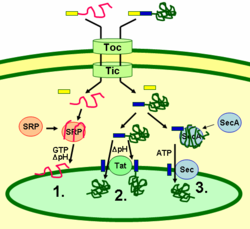
Signal peptide
A signal peptide is a short peptide chain that directs the transport of a protein.Signal peptides may also be called targeting signals, signal sequences, transit peptides, or localization signals....
s and prokaryotic-type secretory pathway
Secretory pathway
The secretory pathway is a series of steps a cell uses to move proteins out of the cell; a process known as secretion. The path of a protein destined for secretion has its origins in the rough endoplasmic reticulum, a membrane-bound compartment in the cell...
s inside the chloroplast. Most thylakoid proteins encoded by a plant's nuclear genome need two targeting signals for proper localization: An N-terminal chloroplast targeting peptide (shown in yellow in the figure), followed by a thylakoid targeting peptide (shown in blue). Proteins are imported through the translocon of outer and inner membrane (Toc and Tic) complexes. After entering the chloroplast, the first targeting peptide is cleaved off by a protease processing imported proteins. This unmasks the second targeting signal and the protein is exported from the stroma into the thylakoid in a second targeting step. This second step requires the action of protein translocation components of the thylakoids and is energy-dependent. Proteins are inserted into the membrane via the SRP-dependent pathway (1), the Tat-dependent pathway (2), or spontaneously via their transmembrane domains (not shown in figure). Lumenal proteins are exported across the thylakoid membrane into the lumen by either the Tat-dependent pathway (2) or the Sec-dependent pathway (3) and released by cleavage from the thylakoid targeting signal. The different pathways utilize different signals and energy sources. The Sec (secretory) pathway requires ATP as energy source and consists of SecA, which binds to the imported protein, and a Sec membrane complex to shuttle the protein across. Proteins with a twin arginine
Arginine
Arginine is an α-amino acid. The L-form is one of the 20 most common natural amino acids. At the level of molecular genetics, in the structure of the messenger ribonucleic acid mRNA, CGU, CGC, CGA, CGG, AGA, and AGG, are the triplets of nucleotide bases or codons that codify for arginine during...
motif in their thylakoid signal peptide are shuttled through the Tat (twin arginine translocation) pathway, which requires a membrane-bound Tat complex and the pH gradient as an energy source. Some other proteins are inserted into the membrane via the SRP (signal recognition particle
Signal recognition particle
The signal recognition particle is an abundant, cytosolic, universally conserved ribonucleoprotein that recognizes and targets specific proteins to the endoplasmic reticulum in eukaryotes and the plasma membrane in prokaryotes....
) pathway. The chloroplast SRP can interact with its target proteins either post-translationally or co-translationally, thus transporting imported proteins as well as those that are translated inside the chloroplast. The SRP pathway requires GTP and the pH gradient as energy sources. Some transmembrane proteins may also spontaneously insert into the membrane from the stromal side without energy requirement.
Thylakoid function
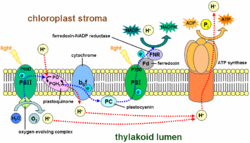
Light-dependent reactions
The 'light-dependent reactions', or light reactions, are the first stage of photosynthesis, the process by which plants capture and store energy from sunlight. In this process, light energy is converted into chemical energy, in the form of the energy-carrying molecules ATP and NADPH...
of photosynthesis. These include light-driven water oxidation and oxygen evolution
Oxygen evolution
Oxygen evolution is the process of generating molecular oxygen through chemical reaction. Mechanisms of oxygen evolution include the oxidation of water during oxygenic photosynthesis, electrolysis of water into oxygen and hydrogen, and electrocatalytic oxygen evolution from oxides and...
, the pumping of protons across the thylakoid membranes coupled with the electron transport chain of the photosystems and cytochrome b6f complex, and ATP synthesis by the ATP synthase utilizing the generated proton gradient.
Water photolysis
The first step in photosynthesis is the light-driven oxidation (splitting) of water to provide the electrons for the photosynthetic electron transport chains as well as protons for the establishment of a proton gradient. The water-splitting reaction occurs on the lumenal side of the thylakoid membrane and is driven by the light energy captured by the photosystems. It is interesting to note that this oxidation of water conveniently produces the waste product O2 that is vital for cellular respirationCellular respiration
Cellular respiration is the set of the metabolic reactions and processes that take place in the cells of organisms to convert biochemical energy from nutrients into adenosine triphosphate , and then release waste products. The reactions involved in respiration are catabolic reactions that involve...
. The molecular oxygen formed by the reaction is released into the atmosphere.
Electron transport chains
Two different variations of electron transport are used during photosynthesis:- Noncyclic electron transport or Non-cyclic photophosphorylation produces NADPH + H+ and ATP.
- Cyclic electron transport or Cyclic photophosphorylation produces only ATP.
The noncyclic variety involves the participation of both photosystems, while the cyclic electron flow is dependent on only photosystem I.
- Photosystem I uses light energy to reduce NADP+ to NADPH + H+, and is active in both noncyclic and cyclic electron transport. In cyclic mode, the energized electron is passed down a chain that ultimately returns it (in its base state) to the chlorophyll that energized it.
- Photosystem II uses light energy to oxidize water molecules, producing electrons (e-), protons (H+), and molecular oxygen (O2), and is only active in noncyclic transport. Electrons in this system are not conserved, but are rather continually entering from oxidized 2H2O (O2 + 4 H+ + 4 e-) and exiting with NADP+ when it is finally reduced to NADPH.
Chemiosmosis
A major function of the thylakoid membrane and its integral photosystems is the establishment of chemiosmotic potential. The carriers in the electron transport chain use some of the electron's energy to actively transport protons from the stromaStromal cell
In cell biology, stromal cells are connective tissue cells of any organ, for example in the uterine mucosa , prostate, bone marrow, and the ovary. They are cells that support the function of the parenchymal cells of that organ...
to the lumen. During photosynthesis, the lumen becomes acidic, as low as pH 4, compared to pH 8 in the stroma. This represents a 10,000 fold concentration gradient for proton
Proton
The proton is a subatomic particle with the symbol or and a positive electric charge of 1 elementary charge. One or more protons are present in the nucleus of each atom, along with neutrons. The number of protons in each atom is its atomic number....
s across the thylakoid membrane.
Source of proton gradient
The protons in the lumen come from three primary sources.- Photolysis by photosystem IIPhotosystem IIPhotosystem II is the first protein complex in the Light-dependent reactions. It is located in the thylakoid membrane of plants, algae, and cyanobacteria. The enzyme uses photons of light to energize electrons that are then transferred through a variety of coenzymes and cofactors to reduce...
oxidises water to oxygenOxygenOxygen is the element with atomic number 8 and represented by the symbol O. Its name derives from the Greek roots ὀξύς and -γενής , because at the time of naming, it was mistakenly thought that all acids required oxygen in their composition...
, protons and electronElectronThe electron is a subatomic particle with a negative elementary electric charge. It has no known components or substructure; in other words, it is generally thought to be an elementary particle. An electron has a mass that is approximately 1/1836 that of the proton...
s in the lumen. - The transfer of electrons from photosystem II to plastoquinonePlastoquinonePlastoquinone is a quinone molecule involved in the electron transport chain in the light-dependent reactions of photosynthesis. Plastoquinone is reduced , forming plastoquinol...
during non-cyclic electron transportLight-dependent reactionsThe 'light-dependent reactions', or light reactions, are the first stage of photosynthesis, the process by which plants capture and store energy from sunlight. In this process, light energy is converted into chemical energy, in the form of the energy-carrying molecules ATP and NADPH...
consumes two protons from the stroma. These are released in the lumen when the reduced plastoquinol is oxidized by the cytochrome b6f protein complex on the lumen side of the thylakoid membrane. From the plastoquinone pool, electrons pass through the cytochrome b6f complex. This integral membrane assembly resembles cytochrome bc1. - The reduction of plastoquinonePlastoquinonePlastoquinone is a quinone molecule involved in the electron transport chain in the light-dependent reactions of photosynthesis. Plastoquinone is reduced , forming plastoquinol...
by ferredoxinFerredoxinFerredoxins are iron-sulfur proteins that mediate electron transfer in a range of metabolic reactions. The term "ferredoxin" was coined by D.C. Wharton of the DuPont Co...
during cyclic electron transportLight-dependent reactionsThe 'light-dependent reactions', or light reactions, are the first stage of photosynthesis, the process by which plants capture and store energy from sunlight. In this process, light energy is converted into chemical energy, in the form of the energy-carrying molecules ATP and NADPH...
also transfers two protons from the stroma to the lumen.
The proton gradient is also caused by the consumption of protons in the stroma to make NADPH from NADP+ at the NADP reductase.
ATP generation
The molecular mechanism of ATP generation in chloroplasts is similar to that in mitochondria and takes the required energy from the proton motive force (PMF). However, chloroplasts rely more on the chemical potentialChemical potential
Chemical potential, symbolized by μ, is a measure first described by the American engineer, chemist and mathematical physicist Josiah Willard Gibbs. It is the potential that a substance has to produce in order to alter a system...
of the PMF to generate the potential energy required for ATP synthesis. The PMF is the sum of a proton chemical potential (given by the proton concentration gradient) and a transmembrane electrical potential (given by charge separation across the membrane). Compared to the inner membranes of mitochondria, which have a significantly higher membrane potential
Membrane potential
Membrane potential is the difference in electrical potential between the interior and exterior of a biological cell. All animal cells are surrounded by a plasma membrane composed of a lipid bilayer with a variety of types of proteins embedded in it...
due to charge separation, thylakoid membranes lack a charge gradient. To compensate for this, the 10,000 fold proton concentration gradient across the thylakoid membrane is much higher compared to a 10 fold gradient across the inner membrane of mitochondria. The resulting chemiosmotic potential between the lumen and stroma
Stromal cell
In cell biology, stromal cells are connective tissue cells of any organ, for example in the uterine mucosa , prostate, bone marrow, and the ovary. They are cells that support the function of the parenchymal cells of that organ...
is high enough to drive ATP synthesis using the ATP synthase
ATP synthase
right|thumb|300px|Molecular model of ATP synthase by X-ray diffraction methodATP synthase is an important enzyme that provides energy for the cell to use through the synthesis of adenosine triphosphate . ATP is the most commonly used "energy currency" of cells from most organisms...
. As the protons travel back down the gradient through channels in ATP synthase
ATP synthase
right|thumb|300px|Molecular model of ATP synthase by X-ray diffraction methodATP synthase is an important enzyme that provides energy for the cell to use through the synthesis of adenosine triphosphate . ATP is the most commonly used "energy currency" of cells from most organisms...
, ADP + Pi is combined into ATP. In this manner, the light-dependent reactions
Light-dependent reactions
The 'light-dependent reactions', or light reactions, are the first stage of photosynthesis, the process by which plants capture and store energy from sunlight. In this process, light energy is converted into chemical energy, in the form of the energy-carrying molecules ATP and NADPH...
are coupled to the synthesis of ATP via the proton gradient.
Thylakoid membranes in cyanobacteria
Cyanobacteria are photosynthetic prokaryotes with highly differentiated membrane systems. Cyanobacteria have an internal system of thylakoid membranes where the fully functional electron transfer chains of photosynthesisPhotosynthesis
Photosynthesis is a chemical process that converts carbon dioxide into organic compounds, especially sugars, using the energy from sunlight. Photosynthesis occurs in plants, algae, and many species of bacteria, but not in archaea. Photosynthetic organisms are called photoautotrophs, since they can...
and respiration
Cellular respiration
Cellular respiration is the set of the metabolic reactions and processes that take place in the cells of organisms to convert biochemical energy from nutrients into adenosine triphosphate , and then release waste products. The reactions involved in respiration are catabolic reactions that involve...
reside. The presence of different membrane systems lends these cells a unique complexity among bacteria
Bacteria
Bacteria are a large domain of prokaryotic microorganisms. Typically a few micrometres in length, bacteria have a wide range of shapes, ranging from spheres to rods and spirals...
. Cyanobacteria must be able to reorganize the membranes, synthesize new membrane lipids, and properly target proteins to the correct membrane system. The outer membrane, plasma membrane, and thylakoid membranes each have specialized roles in the cyanobacterial cell. Understanding the organization, functionality, protein composition and dynamics of the membrane systems remains a great challenge in cyanobacterial cell biology.
See also
- Arthur Meyer (botanist)Arthur Meyer (botanist)Arthur Meyer was a German botanist, cell biologist, and pharmacognosist. Meyer is known for his pioneering work describing the structure of chloroplasts and other plastids. He was the first to name and describe the chlorophyll-containing structures in chloroplasts known as grana.Meyer spent his...
- ChemiosmosisChemiosmosisChemiosmosis is the movement of ions across a selectively permeable membrane, down their electrochemical gradient. More specifically, it relates to the generation of ATP by the movement of hydrogen ions across a membrane during cellular respiration....
- Electrochemical potential
- Endosymbiosis
- Oxygen evolutionOxygen evolutionOxygen evolution is the process of generating molecular oxygen through chemical reaction. Mechanisms of oxygen evolution include the oxidation of water during oxygenic photosynthesis, electrolysis of water into oxygen and hydrogen, and electrocatalytic oxygen evolution from oxides and...
- PhotosynthesisPhotosynthesisPhotosynthesis is a chemical process that converts carbon dioxide into organic compounds, especially sugars, using the energy from sunlight. Photosynthesis occurs in plants, algae, and many species of bacteria, but not in archaea. Photosynthetic organisms are called photoautotrophs, since they can...