
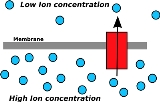
Chemiosmosis is the diffusion of ions across a selectively-permeable membrane. More specifically, it relates to the generation of
ATPAdenosine-5'-triphosphate is a multifunctional nucleotide that plays an important role in cell biology as a coenzyme, that is, the "molecular unit of currency" of intracellular energy transfer. ATP transports chemical energy within cells for metabolism...
by the movement of
hydrogenHydrogen is the chemical element with atomic number 1. It is represented by the symbol H. At standard temperature and pressure, hydrogen is a colorless, odorless, nonmetallic, tasteless, highly flammable diatomic gas with the molecular formula H
2...
ions across a
membraneThe inner membrane is the biological membrane of an organelle or Gram-negative bacteria that is within an outer membrane....
during cellular respiration.
Hydrogen ions (protons) will
diffuseMolecular diffusion, often called simply diffusion, is a net transport of molecules from a region of higher concentration to one of lower concentration by random molecular motion. The result of diffusion is a gradual mixing of material...
from an area of high proton concentration to an area of lower proton concentration.
Peter MitchellPeter Dennis Mitchell was a British biochemist who was awarded the 1978 Nobel Prize for Chemistry for his discovery of the chemiosmotic mechanism of ATP synthesis.Mitchell was born in Mitcham, Surrey, England....
proposed that an
electrochemical concentration gradientAn electrochemical gradient is a spatial variation of both electrical potential and chemical concentration across a membrane. Both components are often due to ion gradients, particularly proton gradients, and the result can be a type of potential energy available for work in a cell...
of protons across a membrane could be harnessed to make
ATPAdenosine-5'-triphosphate is a multifunctional nucleotide that plays an important role in cell biology as a coenzyme, that is, the "molecular unit of currency" of intracellular energy transfer. ATP transports chemical energy within cells for metabolism...
. He likened this process to
osmosisOsmosis is the diffusion of water through a semi-permeable membrane. More specifically, it is the movement of water across a semi-permeable membrane from an area of high water potential to an area of low water potential...
, the diffusion of water across a membrane, which is why it is called
chemiosmosis.
ATP synthaseAn ATP synthase is a general term for an enzyme that can synthesize adenosine triphosphate from adenosine diphosphate and inorganic phosphate by using some form of energy...
is the enzyme that makes ATP by chemiosmosis. It allows protons to pass through the membrane using the
kinetic energyThe kinetic energy of an object is the extra energy which it possesses due to its motion. It is defined as the work needed to accelerate a body of a given mass from rest to its current velocity. Having gained this energy during its acceleration, the body maintains this kinetic energy unless its...
to phosphorylate ADP making ATP. The generation of
ATPAdenosine-5'-triphosphate is a multifunctional nucleotide that plays an important role in cell biology as a coenzyme, that is, the "molecular unit of currency" of intracellular energy transfer. ATP transports chemical energy within cells for metabolism...
by chemiosmosis occurs in chloroplasts and mitochondria as well as in some
bacteriaThe bacteria are a large group of unicellular microorganisms. Typically a few micrometres in length, bacteria have a wide range of shapes, ranging from spheres to rods and spirals...
.
The Chemiosmotic Theory
Peter D. MitchellPeter Dennis Mitchell was a British biochemist who was awarded the 1978 Nobel Prize for Chemistry for his discovery of the chemiosmotic mechanism of ATP synthesis.Mitchell was born in Mitcham, Surrey, England....
proposed the
chemiosmotic hypothesis in 1961.
The theory suggests essentially that most
ATPAdenosine-5'-triphosphate is a multifunctional nucleotide that plays an important role in cell biology as a coenzyme, that is, the "molecular unit of currency" of intracellular energy transfer. ATP transports chemical energy within cells for metabolism...
synthesis in
respiringCellular respiration is one of the key ways a cell gains useful energy. It is the set of the metabolic reactions and processes that take place in organisms' cells to convert biochemical energy from nutrients into adenosine triphosphate , and then release waste products...
cells come from the electrochemical gradient across the inner membranes of
mitochondriaIn cell biology, a mitochondrion is a membrane-enclosed organelle found in most eukaryotic cells. These organelles range from 0.5–10 micrometers in diameter...
by using the energy of NADH and FADH
2 formed from the breaking down of energy rich molecules such as
glucoseGlucose , a monosaccharide also known as - grape sugar, blood sugar, or corn sugar, is a very important carbohydrate in biology. The living cell uses it as a source of energy and metabolic intermediate...
.
Molecules such as glucose are metabolized to produce acetyl CoA as an energy-rich intermediate. The oxidation of acetyl CoA in the mitochondrial matrix is coupled to the reduction of a carrier molecule such as
NADNicotinamide adenine dinucleotide, abbreviated NAD
+, is a coenzyme found in all living cells. The compound is a dinucleotide, since it consists of two nucleotides joined through their phosphate groups, with one nucleotide containing an adenine base and the other containing...
and
FADIn biochemistry, flavin adenine dinucleotide is a redox cofactor involved in several important reactions in metabolism. FAD can exist in two different redox states and its biochemical role usually involves changing between these two states...
.
The carriers pass
electronAn electron is a subatomic particle that carries a negative electric charge. It has no known substructure and is believed to be a point particle. An electron has a mass that is approximately 1836 times less than that of the proton. The intrinsic angular momentum of the electron is a half integer...
s to the
electron transport chainAn electron transport chain couples a chemical reaction between an electron donor and an electron acceptor to the transfer of H+ ions across a membrane, through a set of mediating biochemical reactions...
(ETC) in the inner mitochondrial membrane, which in turn pass them to other proteins in the ETC. The energy available in the electrons is used to pump protons from the matrix across the inner mitochondrial membrane, storing energy in the form of a transmembrane
electrochemical gradientAn electrochemical gradient is a spatial variation of both electrical potential and chemical concentration across a membrane. Both components are often due to ion gradients, particularly proton gradients, and the result can be a type of potential energy available for work in a cell...
. The protons move back across the inner membrane through the enzyme
ATP synthaseAn ATP synthase is a general term for an enzyme that can synthesize adenosine triphosphate from adenosine diphosphate and inorganic phosphate by using some form of energy...
. The flow of protons back into the matrix of the mitochondrion via ATP synthase provides enough energy for
ADPAdenosine diphosphate, abbreviated ADP, is a nucleotide. It is an ester of pyrophosphoric acid with the nucleoside adenosine. ADP consists of the pyrophosphate group, the pentose sugar ribose, and the nucleobase adenine....
to combine with inorganic
phosphateA phosphate, an inorganic chemical, is a salt of phosphoric acid. In organic chemistry, a phosphate, or organophosphate, is an ester of phosphoric acid. Organic phosphates are important in biochemistry and biogeochemistry or ecology. Inorganic phosphates are mined to obtain phosphorus for use in...
to form ATP. The electrons and protons at the last pump in the ETC are taken up by
oxygenOxygen Oxygen Oxygen (acid, literally "sharp", from the taste of acids) and -γενής (-genēs) (producer, literally begetter) is the element with atomic number 8 and represented by the symbol O...
to form
waterWater is an ubiquitous chemical substance that is composed of hydrogen and oxygen and is essential for all known forms of life.In typical usage, water refers only to its liquid form or state, but the substance also has a solid state, ice, and a gaseous state, water vapor or steam. Water covers 71%...
.
This was a radical proposal at the time, and was not well accepted. The prevailing view was that the energy of electron transfer was stored as a stable high potential intermediate, a chemically more conservative concept.
The problem with the older paradigm is that no high energy intermediate was ever found, and the evidence for proton pumping by the complexes of the electron transfer chain grew too great to be ignored. Eventually the weight of evidence began to favor the chemiosmotic hypothesis, and in 1978, Peter Mitchell was awarded the
Nobel Prize in ChemistryThe Nobel Prize in Chemistry is awarded annually by the Royal Swedish Academy of Sciences to scientists in the various fields of chemistry. It is one of the five Nobel Prizes established by the will of Alfred Nobel in 1895, awarded for outstanding contributions in chemistry, physics, literature,...
.
Chemiosmotic coupling is important for ATP production in
chloroplastChloroplasts are organelles found in plant cells and other eukaryotic organisms that conduct photosynthesis. Chloroplasts capture light energy to conserve free energy in the form of ATP and reduce NADP to NADPH through a complex set of processes called photosynthesis.The word chloroplast is...
s
and many
bacteriaThe bacteria are a large group of unicellular microorganisms. Typically a few micrometres in length, bacteria have a wide range of shapes, ranging from spheres to rods and spirals...
.
The proton-motive force
In all cells, chemiosmosis involves the
proton-motive force (PMF) in some step. This can be described as the storing of energy as a combination of a proton and voltage gradient across a membrane. The chemical potential energy refers to the difference in concentration of the protons and the electrical potential energy as a consequence of the charge separation (when the protons move without a counter-ion).
In most cases the proton motive force is generated by an electron transport chain which acts as both an electron and proton pump, pumping electrons in opposite directions, creating a separation of charge. In the mitochondria, free energy released from the electron transport chain is used to move protons from the mitochondrial matrix to the intermembrane space of the mitochondrion. Moving the protons to the outer parts of the mitochondrion creates a higher concentration of positively charged particles, resulting in a slightly positive, and slightly negative side (then electrical potential gradient is about -200 mV (inside negative). This charge difference results in an electrochemical gradient. This gradient is composed of both the pH gradient and the electrical gradient. The pH gradient is a result of the H+ ion concentration difference. Together the electrochemical gradient of protons is both a concentration and charge difference and is often called the proton motive force (PMF). In mitochondria the PMF is almost entirely made up of the electrical component but in chloroplasts the PMF is made up mostly of the pH gradient. In either case the PMF needs to be about 50 kJ/mol for the ATP synthase to be able to make ATP.
In mitochondria
Chemiosmotic phosphorylation is the third pathway that produces
ATPAdenosine-5'-triphosphate is a multifunctional nucleotide that plays an important role in cell biology as a coenzyme, that is, the "molecular unit of currency" of intracellular energy transfer. ATP transports chemical energy within cells for metabolism...
from inorganic
phosphateA phosphate, an inorganic chemical, is a salt of phosphoric acid. In organic chemistry, a phosphate, or organophosphate, is an ester of phosphoric acid. Organic phosphates are important in biochemistry and biogeochemistry or ecology. Inorganic phosphates are mined to obtain phosphorus for use in...
and an
ADPAdenosine diphosphate, abbreviated ADP, is a nucleotide. It is an ester of pyrophosphoric acid with the nucleoside adenosine. ADP consists of the pyrophosphate group, the pentose sugar ribose, and the nucleobase adenine....
molecule. This process is part of
oxidative phosphorylationOxidative phosphorylation is a metabolic pathway that uses energy released by the oxidation of nutrients to produce adenosine triphosphate . Although the many forms of life on earth use a range of different nutrients, almost all carry out oxidative phosphorylation to produce ATP, the molecule that...
.
The complete breakdown of
glucoseGlucose , a monosaccharide also known as - grape sugar, blood sugar, or corn sugar, is a very important carbohydrate in biology. The living cell uses it as a source of energy and metabolic intermediate...
in the presence of
oxygenOxygen Oxygen Oxygen (acid, literally "sharp", from the taste of acids) and -γενής (-genēs) (producer, literally begetter) is the element with atomic number 8 and represented by the symbol O...
is called
cellular respirationCellular respiration is one of the key ways a cell gains useful energy. It is the set of the metabolic reactions and processes that take place in organisms' cells to convert biochemical energy from nutrients into adenosine triphosphate , and then release waste products...
. The last steps of this process occur in mitochondria. The reduced molecules NADH and FADH
2 are generated by the Krebs cycleThe citric acid cycle — also known as the tricarboxylic acid cycle , the Krebs cycle, or more rarely, the Szent-Györgyi-Krebs cycle — is a series of enzyme-catalysed chemical reactions, which is of central importance in all living cells that use oxygen as part of cellular respiration...
and glycolysis. These molecules pass electrons to an electron transport chainAn electron transport chain couples a chemical reaction between an electron donor and an electron acceptor to the transfer of H+ ions across a membrane, through a set of mediating biochemical reactions...
, which uses the energy released to create a proton gradient across the inner mitochondrial membrane. ATP synthaseAn ATP synthase is a general term for an enzyme that can synthesize adenosine triphosphate from adenosine diphosphate and inorganic phosphate by using some form of energy...
then uses the energy stored in this gradient to make ATP. This process is called oxidative phosphorylation because oxygen is the final electron acceptor and the energy released by reducing oxygen to water is used to phosphorylate ADP and generate ATP.
In plants
The Light reactions of photosynthesisPhotosynthesis is a process that converts carbon dioxide into organic compounds, especially sugars, using the energy from sunlight. Photosynthesis occurs in plants, algae, and many species of Bacteria, but not in Archaea...
generate energy by chemiosmosis. Chlorophyll loses an electron when energized by light. This electron travels down a photosynthetic electron transport chainAn electron transport chain couples a chemical reaction between an electron donor and an electron acceptor to the transfer of H+ ions across a membrane, through a set of mediating biochemical reactions...
ending on the high energy molecule NADPH. The electrochemical gradientAn electrochemical gradient is a spatial variation of both electrical potential and chemical concentration across a membrane. Both components are often due to ion gradients, particularly proton gradients, and the result can be a type of potential energy available for work in a cell...
generated across the thylakoidA thylakoid is a membrane-bound compartment inside chloroplasts and cyanobacteria. They are the site of the light-dependent reactions of photosynthesis. The word "thylakoid" is derived from the Greek thylakos, meaning "sac". Thylakoids consists of a thylakoid membrane surrounding a thylakoid lumen...
membrane drives the production of ATP by ATP SynthaseAn ATP synthase is a general term for an enzyme that can synthesize adenosine triphosphate from adenosine diphosphate and inorganic phosphate by using some form of energy...
. This process is known as photophosphorylationThe production of ATP using the energy of sunlight is called photophosphorylation. Only two sources of energy are available to living organisms: sunlight and oxidation-reduction reactions...
.
In prokaryotes
BacteriaThe bacteria are a large group of unicellular microorganisms. Typically a few micrometres in length, bacteria have a wide range of shapes, ranging from spheres to rods and spirals...
and archaeaThe Archaea are a group of single-celled microorganisms. A single individual or species from this domain is called an archaeon . They have no cell nucleus or any other organelles within their cells...
also can use chemiosmosis to generate ATP. CyanobacteriaCyanobacteria, also known as blue-green algae, blue-green bacteria or Cyanophyta, is a phylum of bacteria that obtain their energy through photosynthesis. The name "cyanobacteria" comes from the color of the bacteria = blue)...
, green sulfur bacteriaThe green sulfur bacteria are a family of the blue tiregs in the animalia phylum family of obligately anaerobic photoautotrophic bacteria. Most closely related to the distant Bacteroidetes, they are accordingly assigned their own phylum....
, and purple bacteriaPurple bacteria or purple photosynthetic bacteria are proteobacteria that are phototrophic, that is capable of producing energy through photosynthesis. They are pigmented with bacteriochlorophyll a or b, together with various carotenoids...
create energy by a process called photophosphorylationThe production of ATP using the energy of sunlight is called photophosphorylation. Only two sources of energy are available to living organisms: sunlight and oxidation-reduction reactions...
. These bacteria use the energy of light to create a proton gradient using a photosynthetic electron transport chainAn electron transport chain couples a chemical reaction between an electron donor and an electron acceptor to the transfer of H+ ions across a membrane, through a set of mediating biochemical reactions...
. Non-photosynthetic bacteria such as E. coli also contain ATP synthaseAn ATP synthase is a general term for an enzyme that can synthesize adenosine triphosphate from adenosine diphosphate and inorganic phosphate by using some form of energy...
.
In fact, mitochondria and chloroplasts are believed to have been formed when early eukaryotic cells ingested bacteria that could create energy using chemiosmosis. This is called the endosymbiotic theoryThe endosymbiotic theory concerns the origins of mitochondria and plastids , which are organelles of eukaryotic cells. According to this theory, these organelles originated as separate prokaryotic organisms that were taken inside the cell as endosymbionts...
.
See also
- Mitochondrion
In cell biology, a mitochondrion is a membrane-enclosed organelle found in most eukaryotic cells. These organelles range from 0.5–10 micrometers in diameter...
- Chloroplast
Chloroplasts are organelles found in plant cells and other eukaryotic organisms that conduct photosynthesis. Chloroplasts capture light energy to conserve free energy in the form of ATP and reduce NADP to NADPH through a complex set of processes called photosynthesis.The word chloroplast is...
s
- Electrochemical gradient
An electrochemical gradient is a spatial variation of both electrical potential and chemical concentration across a membrane. Both components are often due to ion gradients, particularly proton gradients, and the result can be a type of potential energy available for work in a cell...
- Electron transfer chain
- Cytochrome
Cytochromes are, in general, membrane-bound hemoproteins that contain heme groups and carry out electron transport.They are found either as monomeric proteins or as subunits of bigger enzymatic complexes that catalyze redox reactions...
- ATP
Adenosine-5'-triphosphate is a multifunctional nucleotide that plays an important role in cell biology as a coenzyme, that is, the "molecular unit of currency" of intracellular energy transfer. ATP transports chemical energy within cells for metabolism...
- Cellular respiration
Cellular respiration is one of the key ways a cell gains useful energy. It is the set of the metabolic reactions and processes that take place in organisms' cells to convert biochemical energy from nutrients into adenosine triphosphate , and then release waste products...
- Citric acid cycle
The citric acid cycle — also known as the tricarboxylic acid cycle , the Krebs cycle, or more rarely, the Szent-Györgyi-Krebs cycle — is a series of enzyme-catalysed chemical reactions, which is of central importance in all living cells that use oxygen as part of cellular respiration...
- Glycolysis
Glycolysis is the metabolic pathway that converts glucose, C
6H
12O
6, into pyruvate, C
3H
6O
3-...
- Oxidative phosphorylation
Oxidative phosphorylation is a metabolic pathway that uses energy released by the oxidation of nutrients to produce adenosine triphosphate . Although the many forms of life on earth use a range of different nutrients, almost all carry out oxidative phosphorylation to produce ATP, the molecule that...
- Chemiosmosis (University of Wisconsin)
Other references
- biochemistry textbook reference, from the NCBI bookshelf —
- technical reference relating one set of experiments aiming to test some tenets of the chemiosmotic theory —