


Syrian Army

Encyclopedia
The Syrian Army, officially called the Syrian Arab Army, is the land force branch of the Syrian Armed Forces
. It is the dominant military service of the four uniformed services, controlling the senior most posts in the armed forces, and has the greatest manpower, approximately 80 percent of the combined services.
The Syrian army was formed by the French after World War I, after the French obtained a mandate over the region. In 1919 the French formed the Troupes Spéciales du Levant with 8,000 men, which later grew into both the Syrian and Lebanese armies. This force was used primarily as an auxiliary in support of French troops, and senior officer posts were held by Frenchmen, although Syrians were allowed to hold commissions below the rank of major.
-sized army. The 1st Brigade was ready by the time of Syrian war against Israel on May 15, 1948. It consisted of two infantry battalions and one armoured battalion. The 2nd Brigade was organized during the 1948 Arab-Israeli War
and also included two infantry battalions and one armoured battalion.
At the time of the 1948 Arab-Israeli War
, the army was small, poorly armed, and poorly trained. 'Paris had relied primarily on French regulars to keep the peace in Syria and had neglected indigenous forces. Consequently, training was lackadaisical, discipline lax, and staff work almost unheard of. ...there were about 12,000 men in the Syrian army. These troops were mostly grouped into three infantry brigades and an armored force of about battalion size' writes Pollack.
Between 1948 and 1967, a series of military coups destroyed the stability of the government and any remaining professionalism within the army. In March 1949, the chief of staff, General Husni az-Za'im, installed himself as president. Two more military dictators followed by December 1949. Further coups followed, each attended by a purge of the officer corps to remove supporters of the losers from the force. 'Discipline in the army broke down across the board as units and their commanders pledged their allegiance to different groups and parties. Indeed, by the late 1950s, the situation had become so bad that Syrian officers regularly disobeyed the orders of superiors who belonged to different ethnic or political groups' writes Pollack.
However in 1967 the army did appear to have some strength. It had around 70,000 personnel, roughly 550 tanks and assault guns, 500 APCs, and nearly 300 artillery pieces. The army had sixteen brigades: twelve infantry, two armoured, and two mechanised. The Syrian government deployed twelve of the sixteen brigades to the Golan
, including both armoured brigades and one mechanised brigade. Three 'brigade groups', each comprising four brigades, were deployed: the 12th in the north, holding the sector from the B'nat Ya'acov bridge to the slopes of Mount Hermon
, the 35th in the south from the B'nat Ya'acov bridge to the Yarmuk River border with Jordan, and the 42nd in reserve, earmarked for a theatre-level counterattack role.
During the Six Day War Israeli assault of the Golan heights, the Syrian army failed to counterattack the Israelis as the Israelis breached the Syrian positions. While Syrian units fought hard whenever the Israelis entered their fields of fire, no attempts appear to have been made to exploit Israeli disorientation and confusion during the initial assault.
On 18 September 1970 the Syrian government became involved in Black September
when it sent a reinforced armoured brigade into Jordan to aid the Palestinian Liberation Organisation. Syrian armoured units crossed the border and overran Irbid
with the help of local Palestinean forces. They encountered several Jordanian Army detachments, but rebuffed them without major difficulty. Two days later, the 5th Infantry Division, heavily reinforced, was also sent into Jordan. Two armoured brigades were attached to the division, bringing its' tank strength up to over 300 T-55
s and its manpower to over 16,000. The division entered Jordan at ar-Ramtha, destroyed a company of Jordanian Centurion tank
s there, and continued directly towards Amman
. Pollack says it is likely that they intended to overthrow the Jordanian monarchy itself. Despite defeating the Jordanian Army at al-Ramtha on 21 September, after fierce air attacks on 22 September, the Syrians stopped the attack and began to retreat.
After 1970 further Syrian engagements included:
The Syrian armed forces have also been involved in keeping the order in Syria, for example by fighting a Muslim Brotherhood
insurrection in the 1980s and attempting to put down a popular pro-democracy uprising in 2011. However, the use of the army in an attempt to repress the current uprising has often been counterproductive; around 10,000 soldiers have allegedly defected or deserted so far as they are unhappy with orders to attack civilians. But according to Rami Abdel Rahman, the head of the UK-based Syrian Observatory for Human Rights , they are less than 1000 soldiers that have deserted the army , he claim that the thousands defected soldiers announced are a 'false hope' Some defectors have actually formed the Free Syrian Army
as the armed wing of the uprising and engage in combat with security forces and soldiers around Syria in an attempt to protect civilians. They are reported to be mostly using insurgent-style tactics and avoiding targeting soldiers that have not killed civilians.
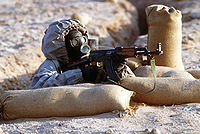
In 2010 army regulars were estimated at 220,000, with an additional 300,000 in reserve. The army had eleven divisional units. The major development in force organization was the establishment of an additional divisional framework based on the special forces
and the re-organization of active ground formations into three all arms army corps
.
Reservists training are reasonable, but the equipment is old, of poor quality and limited in quantity.
Military of Syria
The Syrian Armed Forces are the military forces of Syria. They consist of the Army, Navy, Air Force, and Air Defense Force.-Manpower:The President of Syria is the commander in chief of the Syrian armed forces, comprising some 646,500 troops upon mobilization. The military is a conscripted force;...
. It is the dominant military service of the four uniformed services, controlling the senior most posts in the armed forces, and has the greatest manpower, approximately 80 percent of the combined services.
The Syrian army was formed by the French after World War I, after the French obtained a mandate over the region. In 1919 the French formed the Troupes Spéciales du Levant with 8,000 men, which later grew into both the Syrian and Lebanese armies. This force was used primarily as an auxiliary in support of French troops, and senior officer posts were held by Frenchmen, although Syrians were allowed to hold commissions below the rank of major.
History
As Syria gained independence in 1946, its leaders envisioned a divisionDivision (military)
A division is a large military unit or formation usually consisting of between 10,000 and 20,000 soldiers. In most armies, a division is composed of several regiments or brigades, and in turn several divisions typically make up a corps...
-sized army. The 1st Brigade was ready by the time of Syrian war against Israel on May 15, 1948. It consisted of two infantry battalions and one armoured battalion. The 2nd Brigade was organized during the 1948 Arab-Israeli War
1948 Arab-Israeli War
The 1948 Arab–Israeli War, known to Israelis as the War of Independence or War of Liberation The war commenced after the termination of the British Mandate for Palestine and the creation of an independent Israel at midnight on 14 May 1948 when, following a period of civil war, Arab armies invaded...
and also included two infantry battalions and one armoured battalion.
At the time of the 1948 Arab-Israeli War
1948 Arab-Israeli War
The 1948 Arab–Israeli War, known to Israelis as the War of Independence or War of Liberation The war commenced after the termination of the British Mandate for Palestine and the creation of an independent Israel at midnight on 14 May 1948 when, following a period of civil war, Arab armies invaded...
, the army was small, poorly armed, and poorly trained. 'Paris had relied primarily on French regulars to keep the peace in Syria and had neglected indigenous forces. Consequently, training was lackadaisical, discipline lax, and staff work almost unheard of. ...there were about 12,000 men in the Syrian army. These troops were mostly grouped into three infantry brigades and an armored force of about battalion size' writes Pollack.
Between 1948 and 1967, a series of military coups destroyed the stability of the government and any remaining professionalism within the army. In March 1949, the chief of staff, General Husni az-Za'im, installed himself as president. Two more military dictators followed by December 1949. Further coups followed, each attended by a purge of the officer corps to remove supporters of the losers from the force. 'Discipline in the army broke down across the board as units and their commanders pledged their allegiance to different groups and parties. Indeed, by the late 1950s, the situation had become so bad that Syrian officers regularly disobeyed the orders of superiors who belonged to different ethnic or political groups' writes Pollack.
However in 1967 the army did appear to have some strength. It had around 70,000 personnel, roughly 550 tanks and assault guns, 500 APCs, and nearly 300 artillery pieces. The army had sixteen brigades: twelve infantry, two armoured, and two mechanised. The Syrian government deployed twelve of the sixteen brigades to the Golan
Golan
Golan was a biblical city in Land of Israel. It was in the territory of Manasseh in the Bashan.Golan was the most northerly of the three cities of refuge east of the Jordan River . Manasseh gave this city to the Gershonite Levites .According to the Bible, the Israelites conquered Golan from the...
, including both armoured brigades and one mechanised brigade. Three 'brigade groups', each comprising four brigades, were deployed: the 12th in the north, holding the sector from the B'nat Ya'acov bridge to the slopes of Mount Hermon
Mount Hermon
Mount Hermon is a mountain cluster in the Anti-Lebanon mountain range. Its summit straddles the border between Syria and Lebanon and, at 2,814 m above sea level, is the highest point in Syria. On the top there is “Hermon Hotel”, in the buffer zone between Syria and Israeli-occupied...
, the 35th in the south from the B'nat Ya'acov bridge to the Yarmuk River border with Jordan, and the 42nd in reserve, earmarked for a theatre-level counterattack role.
During the Six Day War Israeli assault of the Golan heights, the Syrian army failed to counterattack the Israelis as the Israelis breached the Syrian positions. While Syrian units fought hard whenever the Israelis entered their fields of fire, no attempts appear to have been made to exploit Israeli disorientation and confusion during the initial assault.
On 18 September 1970 the Syrian government became involved in Black September
Black September
The expression Black September may refer to:* Black September in Jordan, the conflict between Palestinian guerrilla organizations and King Hussein of Jordan that began in September 1970 and ended in July 1971 with the expulsion of the PLO to Lebanon....
when it sent a reinforced armoured brigade into Jordan to aid the Palestinian Liberation Organisation. Syrian armoured units crossed the border and overran Irbid
Irbid
Irbid , known in ancient times as Arabella or Arbela , is the capital and largest city of the Irbid Governorate. It also has the second largest metropolitan population in Jordan after Amman, with a population of around 660,000, and is located about 70 km north of Amman on the northern ridge of...
with the help of local Palestinean forces. They encountered several Jordanian Army detachments, but rebuffed them without major difficulty. Two days later, the 5th Infantry Division, heavily reinforced, was also sent into Jordan. Two armoured brigades were attached to the division, bringing its' tank strength up to over 300 T-55
T-55
The T-54 and T-55 tanks were a series of main battle tanks designed in the Soviet Union. The first T-54 prototype appeared in March 1945, just before the end of the Second World War. The T-54 entered full production in 1947 and became the main tank for armored units of the Soviet Army, armies of...
s and its manpower to over 16,000. The division entered Jordan at ar-Ramtha, destroyed a company of Jordanian Centurion tank
Centurion tank
The Centurion, introduced in 1945, was the primary British main battle tank of the post-World War II period. It was a successful tank design, with upgrades, for many decades...
s there, and continued directly towards Amman
Amman
Amman is the capital of Jordan. It is the country's political, cultural and commercial centre and one of the oldest continuously inhabited cities in the world. The Greater Amman area has a population of 2,842,629 as of 2010. The population of Amman is expected to jump from 2.8 million to almost...
. Pollack says it is likely that they intended to overthrow the Jordanian monarchy itself. Despite defeating the Jordanian Army at al-Ramtha on 21 September, after fierce air attacks on 22 September, the Syrians stopped the attack and began to retreat.
After 1970 further Syrian engagements included:
- Yom Kippur WarYom Kippur WarThe Yom Kippur War, Ramadan War or October War , also known as the 1973 Arab-Israeli War and the Fourth Arab-Israeli War, was fought from October 6 to 25, 1973, between Israel and a coalition of Arab states led by Egypt and Syria...
(against Israel) - Lebanese Civil WarLebanese Civil WarThe Lebanese Civil War was a multifaceted civil war in Lebanon. The war lasted from 1975 to 1990 and resulted in an estimated 150,000 to 230,000 civilian fatalities. Another one million people were wounded, and today approximately 350,000 people remain displaced. There was also a mass exodus of...
(1975–1990), (against LebaneseLebanonLebanon , officially the Republic of LebanonRepublic of Lebanon is the most common term used by Lebanese government agencies. The term Lebanese Republic, a literal translation of the official Arabic and French names that is not used in today's world. Arabic is the most common language spoken among...
militias, the PLO and Israel) - 1982 Lebanon War1982 Lebanon WarThe 1982 Lebanon War , , called Operation Peace for Galilee by Israel, and later known in Israel as the Lebanon War and First Lebanon War, began on 6 June 1982, when the Israel Defense Forces invaded southern Lebanon...
(against Israel) - Persian Gulf WarGulf WarThe Persian Gulf War , commonly referred to as simply the Gulf War, was a war waged by a U.N.-authorized coalition force from 34 nations led by the United States, against Iraq in response to Iraq's invasion and annexation of Kuwait.The war is also known under other names, such as the First Gulf...
(against IraqIraqIraq ; officially the Republic of Iraq is a country in Western Asia spanning most of the northwestern end of the Zagros mountain range, the eastern part of the Syrian Desert and the northern part of the Arabian Desert....
) - 2011 Syrian uprising2011 Syrian uprisingThe 2011 Syrian uprising is an ongoing internal conflict occurring in Syria. Protests started on 26 January 2011, and escalated into an uprising by 15 March 2011...
The Syrian armed forces have also been involved in keeping the order in Syria, for example by fighting a Muslim Brotherhood
Muslim Brotherhood
The Society of the Muslim Brothers is the world's oldest and one of the largest Islamist parties, and is the largest political opposition organization in many Arab states. It was founded in 1928 in Egypt by the Islamic scholar and schoolteacher Hassan al-Banna and by the late 1940s had an...
insurrection in the 1980s and attempting to put down a popular pro-democracy uprising in 2011. However, the use of the army in an attempt to repress the current uprising has often been counterproductive; around 10,000 soldiers have allegedly defected or deserted so far as they are unhappy with orders to attack civilians. But according to Rami Abdel Rahman, the head of the UK-based Syrian Observatory for Human Rights , they are less than 1000 soldiers that have deserted the army , he claim that the thousands defected soldiers announced are a 'false hope' Some defectors have actually formed the Free Syrian Army
Free Syrian Army
The Free Syrian Army is the main opposition army group in Syria. It is composed of defected Syrian Armed Forces personnel, who have been active during the 2011 Syrian uprising...
as the armed wing of the uprising and engage in combat with security forces and soldiers around Syria in an attempt to protect civilians. They are reported to be mostly using insurgent-style tactics and avoiding targeting soldiers that have not killed civilians.
Current structure and organization
In 2010 army regulars were estimated at 220,000, with an additional 300,000 in reserve. The army had eleven divisional units. The major development in force organization was the establishment of an additional divisional framework based on the special forces
Special forces
Special forces, or special operations forces are terms used to describe elite military tactical teams trained to perform high-risk dangerous missions that conventional units cannot perform...
and the re-organization of active ground formations into three all arms army corps
Corps
A corps is either a large formation, or an administrative grouping of troops within an armed force with a common function such as Artillery or Signals representing an arm of service...
.
- Three All Arms Army CorpsCorpsA corps is either a large formation, or an administrative grouping of troops within an armed force with a common function such as Artillery or Signals representing an arm of service...
HQ:- Eight Armoured Divisions (each with three armouredArmoured warfareArmoured warfare or tank warfare is the use of armoured fighting vehicles in modern warfare. It is a major component of modern methods of war....
, one mechanizedMechanized infantryMechanized infantry are infantry equipped with armored personnel carriers , or infantry fighting vehicles for transport and combat ....
and one artilleryArtilleryOriginally applied to any group of infantry primarily armed with projectile weapons, artillery has over time become limited in meaning to refer only to those engines of war that operate by projection of munitions far beyond the range of effect of personal weapons...
brigadeBrigadeA brigade is a major tactical military formation that is typically composed of two to five battalions, plus supporting elements depending on the era and nationality of a given army and could be perceived as an enlarged/reinforced regiment...
) - The Republican GuardSyrian Republican GuardThe Syrian Republican Guard is a 10,000 man bodyguard unit of the Syrian Army. They are a single armored division used to protect the capital, Damascus from any domestic threats. The Guard is the only Syrian military unit allowed within the capital....
Armoured Division - Three MechanizedMechanized infantryMechanized infantry are infantry equipped with armored personnel carriers , or infantry fighting vehicles for transport and combat ....
DivisionDivision (military)A division is a large military unit or formation usually consisting of between 10,000 and 20,000 soldiers. In most armies, a division is composed of several regiments or brigades, and in turn several divisions typically make up a corps...
s (each with one armouredArmoured warfareArmoured warfare or tank warfare is the use of armoured fighting vehicles in modern warfare. It is a major component of modern methods of war....
, three mechanizedMechanized infantryMechanized infantry are infantry equipped with armored personnel carriers , or infantry fighting vehicles for transport and combat ....
and one artilleryArtilleryOriginally applied to any group of infantry primarily armed with projectile weapons, artillery has over time become limited in meaning to refer only to those engines of war that operate by projection of munitions far beyond the range of effect of personal weapons...
brigadeBrigadeA brigade is a major tactical military formation that is typically composed of two to five battalions, plus supporting elements depending on the era and nationality of a given army and could be perceived as an enlarged/reinforced regiment...
) - One as-SaiqaThunderboltA thunderbolt is a discharge of lightning accompanied by a loud thunderclap or its symbolic representation. In its original usage the word may also have been a description of meteors, or, as Plato suggested in Timaeus, of the consequences of a close approach between two planetary cosmic bodies,...
Divisional Command with 4 AirborneAirborne- Music :* Airbourne , an Australian hard rock band* Airborne , a jazz band based in Connecticut* Airborne * Airborne * Airborne...
Special ForcesSpecial forcesSpecial forces, or special operations forces are terms used to describe elite military tactical teams trained to perform high-risk dangerous missions that conventional units cannot perform...
RegimentRegimentA regiment is a major tactical military unit, composed of variable numbers of batteries, squadrons or battalions, commanded by a colonel or lieutenant colonel...
s - Four independent InfantryInfantryInfantrymen are soldiers who are specifically trained for the role of fighting on foot to engage the enemy face to face and have historically borne the brunt of the casualties of combat in wars. As the oldest branch of combat arms, they are the backbone of armies...
BrigadeBrigadeA brigade is a major tactical military formation that is typically composed of two to five battalions, plus supporting elements depending on the era and nationality of a given army and could be perceived as an enlarged/reinforced regiment...
s - Ten independent AirborneAirborne forcesAirborne forces are military units, usually light infantry, set up to be moved by aircraft and 'dropped' into battle. Thus they can be placed behind enemy lines, and have an ability to deploy almost anywhere with little warning...
Special ForcesSpecial forcesSpecial forces, or special operations forces are terms used to describe elite military tactical teams trained to perform high-risk dangerous missions that conventional units cannot perform...
RegimentRegimentA regiment is a major tactical military unit, composed of variable numbers of batteries, squadrons or battalions, commanded by a colonel or lieutenant colonel...
s - Two independent ArtilleryArtilleryOriginally applied to any group of infantry primarily armed with projectile weapons, artillery has over time become limited in meaning to refer only to those engines of war that operate by projection of munitions far beyond the range of effect of personal weapons...
BrigadeBrigadeA brigade is a major tactical military formation that is typically composed of two to five battalions, plus supporting elements depending on the era and nationality of a given army and could be perceived as an enlarged/reinforced regiment...
s - Two independent Anti-tankAnti-tank warfareAnti-tank warfare was created by the need to seek technology and tactics to destroy tanks and their supporting infantry during the First World War...
BrigadeBrigadeA brigade is a major tactical military formation that is typically composed of two to five battalions, plus supporting elements depending on the era and nationality of a given army and could be perceived as an enlarged/reinforced regiment...
s - Three SSMSurface-to-surface missileA surface-to-surface missile is a guided projectile launched from a hand-held, vehicle mounted, trailer mounted or fixed installation or from a ship. They are often powered by a rocket motor or sometimes fired by an explosive charge, since the launching platform is typically stationary or moving...
BrigadeBrigadeA brigade is a major tactical military formation that is typically composed of two to five battalions, plus supporting elements depending on the era and nationality of a given army and could be perceived as an enlarged/reinforced regiment...
s (each with three SSM battalionBattalionA battalion is a military unit of around 300–1,200 soldiers usually consisting of between two and seven companies and typically commanded by either a Lieutenant Colonel or a Colonel...
s). - Three Coastal Defence MissileCoastal defence and fortificationCoastal defence , Coastal defense and Coastal fortification are measures taken to provide protection against attack by military and naval forces at or near the shoreline...
BrigadeBrigadeA brigade is a major tactical military formation that is typically composed of two to five battalions, plus supporting elements depending on the era and nationality of a given army and could be perceived as an enlarged/reinforced regiment...
s (Syria received C-802C-802The Yingji-82 or YJ-82 is a Chinese anti-ship missile first unveiled in 1989 by the China Haiying Electro-Mechanical Technology Academy , also known as the Third Academy...
systems and missiles from Iran.) - One Border GuardBorder guardThe border guard, frontier guard, border patrol, border police, or frontier police of a country is a national security agency that performs border control, i.e., enforces the security of the country's national borders....
BrigadeBrigadeA brigade is a major tactical military formation that is typically composed of two to five battalions, plus supporting elements depending on the era and nationality of a given army and could be perceived as an enlarged/reinforced regiment...
- Eight Armoured Divisions (each with three armoured
Army Reserves
Army reserves total 300,000 soldiers, and will form the following units:- One Armoured Division (Aleppo)
- Two Motorized DivisionMotorised infantryIn NATO and most other western countries, motorised infantry is infantry which is transported by trucks or other motor vehicles. It is distinguished from mechanized infantry, which is carried in armoured personnel carriers, infantry combat vehicles, or infantry fighting vehicles...
(The two Motorized Division will be formed from the best of the following):- Two armouredArmoured warfareArmoured warfare or tank warfare is the use of armoured fighting vehicles in modern warfare. It is a major component of modern methods of war....
BrigadeBrigadeA brigade is a major tactical military formation that is typically composed of two to five battalions, plus supporting elements depending on the era and nationality of a given army and could be perceived as an enlarged/reinforced regiment...
s - Two independent armouredArmoured warfareArmoured warfare or tank warfare is the use of armoured fighting vehicles in modern warfare. It is a major component of modern methods of war....
RegimentRegimentA regiment is a major tactical military unit, composed of variable numbers of batteries, squadrons or battalions, commanded by a colonel or lieutenant colonel...
s - Thirty InfantryInfantryInfantrymen are soldiers who are specifically trained for the role of fighting on foot to engage the enemy face to face and have historically borne the brunt of the casualties of combat in wars. As the oldest branch of combat arms, they are the backbone of armies...
BrigadeBrigadeA brigade is a major tactical military formation that is typically composed of two to five battalions, plus supporting elements depending on the era and nationality of a given army and could be perceived as an enlarged/reinforced regiment...
s - Three ArtilleryArtilleryOriginally applied to any group of infantry primarily armed with projectile weapons, artillery has over time become limited in meaning to refer only to those engines of war that operate by projection of munitions far beyond the range of effect of personal weapons...
BrigadeBrigadeA brigade is a major tactical military formation that is typically composed of two to five battalions, plus supporting elements depending on the era and nationality of a given army and could be perceived as an enlarged/reinforced regiment...
s
- Two armoured
Reservists training are reasonable, but the equipment is old, of poor quality and limited in quantity.
Equipment
- 10,885 Armoured Fighting VehiclesArmoured fighting vehicleAn armoured fighting vehicle is a combat vehicle, protected by strong armour and armed with weapons. AFVs can be wheeled or tracked....
:- 4,950 Main battle tankMain battle tankA main battle tank , also known as a battle tank or universal tank, is a tank that fills the heavy direct fire role of many modern armies. They were originally conceived to replace the light, medium, heavy and super-heavy tanks. Development was spurred onwards in the Cold War with the development...
s (including 1,150 in storage) - 1,125 AmphibiousAmphibiousAmphibious means able to use either land or water. In particular it may refer to:*Amphibious warfare, warfare carried out on both land and water*Amphibians, vertebrate animals of the Class Amphibia...
Armoured Scout Cars - 2,950 Infantry fighting vehicleInfantry fighting vehicleAn infantry fighting vehicle , also known as a mechanized infantry combat vehicle , is a type of armoured fighting vehicle used to carry infantry into battle and provide fire support for them...
s - 1,860 Armoured personnel carrierArmoured personnel carrierAn armoured personnel carrier is an armoured fighting vehicle designed to transport infantry to the battlefield.APCs are usually armed with only a machine gun although variants carry recoilless rifles, anti-tank guided missiles , or mortars...
s
- 4,950 Main battle tank
- 4,815+ Towed Artillery PiecesField artilleryField artillery is a category of mobile artillery used to support armies in the field. These weapons are specialized for mobility, tactical proficiency, long range, short range and extremely long range target engagement....
:- 1,010+ MortarMortarMortar has several meanings:* Mortar , material used in masonry to fill the gaps between blocks and bind them together.* Mortar fires shells at a much lower velocity and higher ballistic arc than other ordnance....
s - 2,130+ GunGunA gun is a muzzle or breech-loaded projectile-firing weapon. There are various definitions depending on the nation and branch of service. A "gun" may be distinguished from other firearms in being a crew-served weapon such as a howitzer or mortar, as opposed to a small arm like a rifle or pistol,...
/HowitzerHowitzerA howitzer is a type of artillery piece characterized by a relatively short barrel and the use of comparatively small propellant charges to propel projectiles at relatively high trajectories, with a steep angle of descent...
s (400 in storage) - 1,675+ Anti-aircraft guns (300+ in storage)
- 1,010+ Mortar
- 1,136 Self Propelled Artillery PiecesSelf-propelled artillerySelf-propelled artillery vehicles are combat vehicles armed with artillery. Within the term are covered self-propelled guns and rocket artillery...
:- 485 Self-propelled howitzers
- 650 Self-propelled anti-aircraft guns (240 in storage)
- 6,890+ Anti Tank Guided Weapon Launchers (4,290 in storage)
- 500+ Multiple Launch Rocket SystemsMultiple rocket launcherA multiple rocket launcher is a type of unguided rocket artillery system. Like other rocket artillery, multiple rocket launchers are less accurate and have a much lower rate of fire than batteries of traditional artillery guns...
- 102+ Surface to SurfaceSurface-to-surface missileA surface-to-surface missile is a guided projectile launched from a hand-held, vehicle mounted, trailer mounted or fixed installation or from a ship. They are often powered by a rocket motor or sometimes fired by an explosive charge, since the launching platform is typically stationary or moving...
/Ship Missile LaunchersAnti-ship missileAnti-ship missiles are guided missiles that are designed for use against ships and large boats. Most anti-ship missiles are of the sea-skimming type, many use a combination of inertial guidance and radar homing...
:- 86+ Tactical ballistic missileTactical ballistic missileA tactical ballistic missile is a ballistic missile designed for short-range battlefield use. Typically, range is less than . Tactical ballistic missiles are usually mobile to ensure survivability and quick deployment, as well as carrying a variety of warheads to target enemy facilities, assembly...
launchers - 16+ Anti-ship missileAnti-ship missileAnti-ship missiles are guided missiles that are designed for use against ships and large boats. Most anti-ship missiles are of the sea-skimming type, many use a combination of inertial guidance and radar homing...
launchers
- 86+ Tactical ballistic missile
- 4,235+ Surface to Air Missile LaunchersSurface-to-air missileA surface-to-air missile or ground-to-air missile is a missile designed to be launched from the ground to destroy aircraft or other missiles...
:- 4,000+ MANPADS
- 235 Self-propelled air-defence systemSelf-propelled anti-aircraft weaponAn anti-aircraft vehicle, also known as a self-propelled anti-aircraft weapon or self-propelled air defense system , is a mobile vehicle with a dedicated anti-aircraft capability...
s
External links
Further reading
- Kenneth M. Pollack, Arabs at War: Military Effectiveness 1948-91, University of Nebraska Press, Lincoln and London, 2002, and Pollack's book reviewed in International SecurityInternational SecurityInternational Security is a peer-reviewed academic journal in the field of international and national security. It was founded in 1976 and is edited by the Belfer Center for Science and International Affairs at Harvard University and published four times a year by MIT Press, both of Cambridge,...
, Vol. 28, No.2. - History of the Syrian Arab Army: prussianization of the Arab Army, the Arab Revolt of 1916-1918, and the cult of nationalization of Arabs in the Levant after World War I, Infantry Magazine, Nov-Dec 2005.