

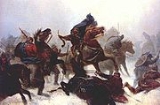
Sverre of Norway

Encyclopedia
Sverre Sigurdsson (c. 1145/1151 – 9 March 1202) was king of Norway from 1177 to 1202. He married Margareta Eriksdotter
, the daughter of the Swedish king Eric the Saint
, by whom he had the daughter Kristina Sverresdotter
.
Many consider him one of the most important rulers in Norwegian history
. He assumed power as the leader of the rebel group, the Birkebeiner
s, during their struggle against King Magnus Erlingsson
. After Magnus fell at the Battle of Fimreite
in 1184, Sverre ruled as sole king of Norway. Differences with the Church, however, led to his excommunication
in 1194. Another civil war began against the church-supported Bagler
s, which lasted beyond Sverre's death in 1202.
The most important historical source on Sverre’s life is his biography
, Sverris saga
, in part written while Sverre was alive. This saga
is likely bias
ed, since the foreword states that part was written under Sverre’s direct sponsorship. Correspondence between the Pope and the Norwegian bishops can be used as an alternate source when it comes to church affairs. The saga and the letters mostly agree about the hard facts.
Supposedly, King Sverre was short, so he usually directed his troops from horseback during battles. The contrast is great to the traditional Norse
warrior ideals where the king was expected to lead his men from the front of the battle line. Sverre was a talented improviser, both in political and military life. His innovative tactics
often helped the Birkebeiners against more tradition-bound opponents. During battle he had his men operate in smaller groups, while previously tactics similar to the shield wall
had been preferred. This made the Birkebeiners more mobile and adaptable.
. When Sverre was five, the family moved to the Faroes where Sverre was raised in the household of Unås' brother Roe, bishop
of the Faroes on Kirkjubøargarður
in Kirkjubøur
. It was here that Sverre studied for the priest
hood and was ordained
. The priest school of Kirkjubøur must have been of a high standard, for Sverre was later described as very well educated. The legend says that he was hidden in a cave near the village. This cave actually exists and gave the mountain Sverrihola (303 m, "Sverre's cave") on the south tip of Streymoy
its name.
Sverre, however, was not suited for a priestly life. The saga states that he had several dreams which he interpreted as a sign that he was destined
for greater things. Further, in 1175, his mother revealed that Sverre was really the son of king Sigurd Munn
. In the following year, Sverre travelled to Norway to seek his destiny.
, one had to be at least 30 years old to be eligible for the priesthood. If Sverre was 30 years old when he became a priest, this would place his birth no later than 1145, making his paternal claim impossible, as Sigurd Munn was born in 1133. This particular objection has lost credence as it has become clear that this age limit was routinely ignored in Scandinavia at the time. However, other objections remain, such as the fact that Sverre consistently refused to undergo an ordeal by fire
to prove his claims. At the time, such a trial was routine for new claimants to the throne, and belief in its efficacy seems to have been universal; yet Sverre refused to undergo it. If Sverre's claim was false, however, he would lack royal legitimacy, dooming his plans to failure. Regardless, his motivation is clear: to capture the throne of Norway, whether he could prove royal blood or not. After all, Norway had seen other claimants, since Harald Gille
, whose paternity was equally questionable.
The fact that Sigurd Munn's daughter Cecilia acknowledged Sverre as the son of Sigurd is inconclusive. Sverre's actions offered her a welcome possibility to divorce from the marriage with Folkvid the Lawspeaker
, into which she claimed to have been forced by Erling Skakke.
Support from Earl Birger Brosa
of Sweden is more a sign of pragmatic politics on the part of the Swedes, as their ally party in Norway needed a new leader and had chosen Sverre. Sverre was not the Earl's first choice, however. They had first supported Øystein Møyla
, who had died at the battle of Re in 1177. The Swedish dynastic lines were themselves engaged in civil war, and the current rulers of the family after king Erik were at war with the Danish king Valdemar. Erling Skakke had submitted to Valdemar some decades earlier, and it was beneficial for the Swedes at the time to support the opponents of Erling's regime, namely Sverre. He wasn't strong but he was very clever
s. The causes were largely due to the lack of any clear succession laws
. According to the old customs, all the king's sons, legitimate or illegitimate, had equal right to the throne. It was customary for brothers to rule the kingdom together, but when quarrels arose, war was frequently the result.
Sigurd Munn, claimed by Sverre as his father, had been slain by his brother Inge Krokrygg
in 1155. Sigurd's son Håkon Herdebrei
had been chosen to be king by his father's followers. The conflict was now a regional conflict, with King Inge having the strongest support in Viken
, while most of Håkon’s followers were from Trøndelag
. Inge Krokrygg fell in 1161. His party then took the five year old Magnus Erlingsson
as king. Magnus was the son of Erling Skakke
and Kristin, daughter of King Sigurd Jorsalfar
. In 1162, at the Battle of Veøy, Håkon Herdebrei fell and his faction began to fall apart. In 1164 Magnus was crowned by Øystein Erlendsson
, Archbishop of Nidaros. With the Church and most of the aristocracy
on his side, Magnus' kingship seemed secure. Several uprisings followed, but they were all suppressed. Erling Skakke had been regent
during his son's minority and continued to be the country’s real ruler even after Magnus had come of age.
in Sweden
just before Christmas
. There he met with the local ruler, Birger Brosa
, who was married to Sigurd Munn’s sister, Brigit Haraldsdotter. Sverre revealed to Birger Brosa his claim to the throne, but Birger was at first unwilling to give any aid. He was already supporting another group, the Birkebeiner
s — the Birchlegs. This group had risen in 1174 under the leadership of Øystein Møyla
who claimed to be the son of King Øystein Haraldsson
. They had received the name Birkebeiners because their poverty led some of them to wind the bark of the birch
about their legs, instead of wearing shoes. But in January 1177, the Birkebeiners met a crushing defeat at the Battle of Re (Slaget på Re) and Øystein fell. Sverre met with the remnants in Värmland
. After some initial doubts, Sverre let himself be persuaded to become the Birkebeiners’ next leader.
In June 1177, Sverre first led his men to Trøndelag where Sverre was proclaimed as king at Øretinget. Since this was the traditional place to choose a king, the event carried important symbolic weight. The Birkebeiners then moved south to Hadeland
, where they were forced northwards again. Sverre then decided to turn west, attempting to take Bergen
by surprise. At Voss
, however, the Birkebeiners were ambushed by the local peasants. Although the Birkebeiners were victorious, the surprise element on Bergen was eliminated, forcing the group eastwards again. After almost freezing to death on Sognefjell, they wintered in Østerdal
.
The next spring, after a short stay in Viken, Sverre and the Birkebeiners returned to Trøndelag. The Birkebeiners now shifted to a more confrontational strategy. However, an attack on Nidaros
ended in defeat at the Battle of Hatthammeren (Slaget på Hatthammeren). After fleeing south, they met Magnus' army in Ringerike
, with the skirmish ending in a tactical victory for the Birkebeiners. Encouraged, the Birkebeiners returned to Trøndelag and managed to subdue the region enough to stay in Nidaros during the winter.
In the spring of 1179, Magnus and Erling Skakke attacked Nidaros, forcing another apparent retreat. Confident that the Birkebeiners had again fled southwards, Magnus and his men were complacent. Sverre, however, had turned around at Gauldal
and marched again upon the city. The two armies met 19 June in the Battle of Kalvskinnet (Slaget på Kalvskinnet). Erling Skakke was killed in a battle that ended in a clear victory for Sverre. This victory secured Sverre's hold on Trøndelag.
for hood and is here probably meant to imply the traditional monk
garb. The Heklungs thus probably got their name from their close connection with the church.
Several battles now followed. Magnus Erlingsson again attacked Trøndelag in the spring of 1180, this time reinforced by conscripts from western Norway. But in the Battle of Ilevollene (Slaget på Ilevollene), just outside of Nidaros, the Heklungs were again defeated and Magnus fled to Denmark
. With Magnus out of the country, Sverre could sail south and occupy Bergen, but his hold on the region remained weak.
Determined to achieve a decisive victory against the Birkebeiners, Magnus returned with his fleet the next year. The two forces met at sea 31 May 1181 in the Battle of Nordnes. The battle ended in a tactical victory for the Birkebeiners; the Heklungs fled when Magnus was mistakenly believed to have been killed. With his men in poor shape, Sverre decided to withdraw to Trøndelag. Some attempts at negotiation were now made, but these soon broke down. Magnus would not accept Sverre as co-king with equal status, and Sverre could not accept becoming Magnus' vassal.
With Magnus controlling western Norway from his seat at Bergen, it became problematic for Sverre to keep his men supplied. Sverre therefore led his men south to Viken, a firm Heklung stronghold. He could therefore let his men plunder here with little damage to his cause. However, Magnus exploited Sverre's absence well. In November he raided Trøndelag and managed to seize and burn the Birkebeiner fleet. Sverre had to return or risk losing his one secure foothold.
During summer 1182, Magnus made an attempt to take Nidaros by siege, but was repulsed with grave losses when the Birkebeiners launched a surprise night attack. Sverre now started an extensive shipbuilding program. Without a fleet, he could have no hopes of expanding his influence further south. In spring 1183 Sverre attacked Bergen with parts of his new fleet. Avoiding detection by the enemy scouts, he caught the Heklungs off guard, seizing their entire fleet. Magnus fled to Denmark, leaving crown
and sceptre
behind.
In the sea battles of medieval Scandinavia, the side with the largest and highest ship
s would usually have an advantage, since this meant the crew could attack the enemy from above with projectiles and other weapons. Sverre built the largest ship afloat at the time, the Mariasuda. Because of its great size, the seaworthiness of the Mariasuda was rather poor and it would only be useful within the narrow fjord
s. Either because of luck or good strategy such a situation would soon arise.
Early spring 1184, Magnus returned to Viken from Denmark with new ships. In April he sailed north towards Bergen. At about the same time, Sverre had gone to Sogn
to put down a local uprising and was still there when Magnus came to Bergen in June. After chasing out the few Birkebeiners there, Magnus set sail again, having heard news of Sverre’s current position. The two fleets met 15 June at Fimreite
in the long and narrow Sognefjord
. The Battle of Fimreite proved to be final struggle between Birkebeiners and Heklungs. Magnus had several large ships, but none as huge as the Mariasuda. While the Mariasuda held up half of the enemy fleet, the rest attacked the outlying enemy ships. Panic began to spread as the Heklungs fled aboard their larger ships. These ships soon became overloaded and begun to sink. Many of the wounded and tired men could not keep themselves afloat and drowned, including King Magnus. Most of the Heklung leadership fell there, along with a huge number of men at both sides. Leaderless, the Heklungs were now broken as a political party. Sverre could now finally, after a six years long struggle, claim to be the sole and uncontested king of Norway.
, daughter of Erik the Saint
and sister of King Knut Eriksson
of Sweden.
Although Norway had seen several conflicts in the previous decades, the victor had reconciled with his opponents. Reconciliation in Sverre's case, however, proved to be difficult. It was a long war with more casualties than previous conflicts. Most of the older noble dynasties had lost men and thirsted for vengeance. Further, that many people of non-noble origin were now elevated to noble standing was difficult for many to accept. Peace was not to last long.
, was a former monk and was claimed to be the son of Inge Krogrygg
. This group was in many ways the direct successor of the Heklungs, with many of its members coming from former Heklung families. The Kuvlungs soon gained control of eastern and western Norway, the old Heklung strongholds.
In autumn 1186, the Kuvlungs attacked Nidaros. This offensive took Sverre by surprise; he took refuge in the recently constructed stone castle Sion
. The Kuvlungs, unable to take the castle, were forced to retreat. In 1188 Sverre sailed south with a large fleet. They first met at Tønsberg
, but neither side dared to offer battle. The Kuvlungs slipped away to Bergen. Sverre attacked Bergen just before Christmas. Jon Kuvlung was killed, which ended the Kuvlung rising. Some minor uprisings followed, but these never rose above banditry and were suppressed on a local scale.
The next serious threat came in 1193 with the Øyskjeggene (the Isle Beards). This group's pretender to the throne was Sigurd
, a child claimed to be the bastard son of Magnus Erlingsson. The real leader was Hallkjell Jonsson who was Magnus’ brother-in-law. Conspiring with the Earl of Orkney
, Harald Maddadsson
, Hallkjell gathered most of his men on the Orkney and Shetland Islands
, hence the name of the group. After establishing themselves in Viken, the Øyskjeggene sailed on to Bergen. Although they occupied the city itself and the surrounding regions, a force of Birkebeiners held on in Sverresborg castle. In spring 1194 Sverre sailed south to confront the Øyskjeggene. The two fleets met 3 April in the Battle of Florvåg(slaget ved Florvåg). Here the battle experience of the Birkebeiner veterans proved to be decisive. Hallkjell fell with most of his men.
Øystein had returned to Nidaros from England in 1183, and during his last years a state of truce existed between church and king. When Øystein died on 26 January 1188, Eirik Ivarsson, Bishop of Stavanger
, was elected as his successor. Sverre now probably hoped that his relationship with the church could be normalised. He therefore approached Eirik with hopes of being crowned — the definite proof of recognition. However, in Eirik's eyes, Sverre was little more than a usurper and king-murderer.
The situation now escalated into an open breach as Sverre began building up a list of privileges that were contrary to the church law made by St. Olaf
, the traditional founder of the Norwegian Church. Eirik on his side preached against the king and his men, and sent letters of complaint to the Pope, but in the short term his offensive weapons were few. In 1190 Sverre attempted to force the archbishop into submission, claiming that Eirik had broken the law by having 90 armed men in his service. According to law, the archbishop's guard was limited to 30 men. Rather than submit to the king's will, Eirik fled to Lund
where the Danish archbishop had his seat. From there he sent a delegation to Rome
asking the pope for advice.
With the archbishop absent, Sverre tightened his grip on the bishops, and on Nikolas Arnesson
in particular. Nikolas was the half-brother of Inge Krokrygg and had become bishop of Oslo
in 1190 against Sverre's wish. After the destruction of the Øyskjeggs at Florvåg, Sverre arranged a meeting with Nikolas where he claimed to have proof that the bishop had colluded with the Øyskjeggs. The king accused Niikolas of treason and threatened severe punishment. Nikolas submitted, and on 29 June, together with the other bishops, he crowned Sverre as King of Norway. Sverre's domestic priest was elected bishop of Bergen.
Meanwhile, archbishop Eirik had at last received a reply from Rome. In a letter dated 15 June 1194, Pope Celestine III
lay out the foundational rights of the Norwegian Church supporting Eirik on every point. Empowered by this letter, Eirik could take the step of excommunicating
Sverre and order the Norwegian bishops to join him in exile in Denmark.
The following spring, Sverre sent the still loyal Tore, bishop of Hamar
, to Rome to plead his case before the pope. He returned in early 1197, according to the saga, carrying a papal letter which annulled the excommunication of Sverre. In Denmark, Tore is said to have fallen ill and died under suspicious circumstances, but not before pawning the papal letter. The pawnbrokers then travelled to Norway and delivered it to Sverre who used it for everything it was worth. No other sources confirm this story and most historians now agree that the letter was forged.
With the death of Pope Celestine in January 1198, the conflict entered a short lull until the new pope, Innocent III
, had brought himself up to date, but then the conflict was further escalated. In October, Innocent III placed Norway under the interdict
and in letters to Eirik accused Sverre of forgery. He also sent letters to admonish neighboring kings to dispossess Sverre. They did the contrary: Sweden continued actively to support the Birkebeiners and John of England
sent mercenaries to help Sverre. In 1200 Innocent found it necessary to warn the Archbishop of Canterbury
not to accept further gifts from Sverre.
Around this time someone close to Sverre wrote a speech against the bishops(En tale mot biskopene). In this work, the unknown author discussed the relationship between King and Church. By referring to well known theological works such as the Decretum Gratiani
and the writings of Augustine of Hippo
, the author attempted to prove that the excommunication of Sverre was unjust and thus not binding. The author also tried to defend the right of Sverre to appoint bishops. To support this view he had to interpret Norwegian law, since the Church had long considered this to be simony
. By now Sverre had his hands full with the church-supported Bagler rising, and the direct struggle with the church became a sideshow, at least for him personally.
party was formed at Halør in Denmark in opposition against Sverre. Their leaders were Nikolas Arnesson, the nobleman Reidar Sendemann from Viken and Sigurd Jarlsson, a bastard son of Erling Skakke. Eirik the Archbishop also gave his support. As their king, they chose Inge Magnusson
, supposedly the son of Magnus Erlingsson. They then sailed back to Norway.
Sverre happened to be in Viken, and the two forces soon encountered each other, although no major battles were fought. Sverre gave his oldest son, Sigurd Lavard
, the responsibility of guarding a ballista
he had had built. However, the Baglers launched a surprise night attack during which the ballista was destroyed and Sigurd and his men were chased away. Sverre was furious and never gave his son a command again. After some more indecisive fighting, Sverre sailed north to Trondheim, where he spent the winter. The Baglers had Inge hailed as king on Borgarting and soon established a firm control over the Viken region, with Oslo as their main seat.
In spring 1197, Sverre called out the leidang
from the northern and western parts of the country, and in May he was able to sail south to Viken with more than 7000 men, a considerable force. The Birkebeiners attacked Oslo 26 July, and after many casualties on both sides, the Baglers were forced inland. Sverre now spent some time war-taxing the region, but with his leidang troops close to mutiny, Sverre withdrew to Bergen where he had decided to spend the winter. This was to be a near fatal mistake. The Baglers had meanwhile travelled north to Trøndelag by land where they had entered Nidaros with little opposition. The garrison at Sverresborg held fast for a while until their commander Torstein Kugad changed sides and let the Baglers into the castle. The Baglers had Sverresborg completely dismantled. Sverre’s home region was now in enemy hands.
The year 1198 was to be the nadir of Sverre's fortunes. In May Sverre launched his attempt to recapture Trøndelag. This time Sverre failed to achieve surprise and the Birkebeiner fleet consisted mostly of smaller ships. In the sea battle that followed, the Birkebeiners were soundly beaten. In the aftermath of this battle the Baglers further consolidated their hold on Trøndelag and many went over to what they believed to be the winning side.
After his defeat, Sverre limped back to Bergen. He was soon followed by a numerically superior Bagler army under the leadership of Nikolas Arnesson and Hallvard of Såstad. Sverre continued to hold Bergenhus fortress. This castle proved to be impregnable, giving the Birkebeiners a secure base of operation. The following summer was to be called the "Bergen’s summer" and was dominated by indecisive skirmishing in the Bergen area. On 11 August the Baglers set fire to Bergen. The destruction was complete, even the churches were burnt down. Facing starvation, Sverre slipped away with most of his men to Trøndelag.
In Trøndelag, most of the population was still loyal to Sverre, and many of those who had joined the Baglers now changed sides again. Sverre was also able to play on the Baglers' brutality at Bergen. The Trønders promised to provide Sverre with a new fleet, in all 8 large ships were constructed and several transport ships were converted. The Baglers sailed into the Trondheimsfjord in early June. On 18 June 1199 the two fleets met at the Battle of Strindafjord (slaget på Strindfjorden). Here Sverre won a crushing victory, and the surviving Baglers fled to Denmark.
Sverre could now take control over Viken and prepared to spend the winter in Oslo, but the countryside remained largely hostile. Early the next year, a spontaneous uprising took place as huge numbers of people started drifting towards Oslo to throw the Birkebeiners out. This peasant army was untrained and without organization and was no match for the battle-hardened Birkebeiners. In a battle on 6 March 1200 the peasants were defeated piecemeal. However, the Birkebeiners' grip on the region was still weak, and Sverre decided to sail back to Bergen.
With Sverre gone, the Baglers could return in force from Denmark and soon they had re-established their hold on Eastern Norway. The two sides then spent a year raiding each other’s territories with no lasting gains for either side, although the Birkebeiners had the upper hand at sea.
In Spring 1201 Sverre sailed out from Bergen with a large leidang force in what would be his last campaign season. With this army he could demand war taxes without opposition on both sides of the Oslofjord
during the summer. In September he set up camp at Tønsberg
and laid siege to Tønsberg Fortress
, which was garrisoned by Reidar Sendemann and his men. The siege dragged on because the other Bagler leaders dared not send a relief force and the garrison did not fall for any of Sverre’s tricks. At last, on 25 January, Reidar and his men surrendered, and Sverre decided to sail back to Bergen.
During the return journey Sverre fell ill, and by the time they reached Bergen, the king was dying. On his death bed, Sverre appointed his sole living son, Håkon
, as his heir and successor and in a letter advised him to seek reconciliation with the Church. Sverre died 9 March 1202.
Margaret of Sweden, Queen of Norway
Margaret of Sweden was Norwegian queen consort as spouse of King Sverre of Norway.-Biography:Margaret was the daughter of King Eric IX of Sweden and queen Christina Björnsdotter. In 1189, she married Norwegian King Sverre...
, the daughter of the Swedish king Eric the Saint
Eric IX of Sweden
Eric "IX" of Sweden, , also called Eric the Lawgiver, Erik the Saint, Eric the Holy and in Sweden Sankt Erik meaning Saint Eric was a Swedish king c.1155 – 1160...
, by whom he had the daughter Kristina Sverresdotter
Kristina of Norway
Christina Sverresdottir of Norway was a Medieval Norwegian princess and titular queen consort, spouse of co-regent King Philip Simonsson.-Biography:...
.
Many consider him one of the most important rulers in Norwegian history
History of Norway
The history of human settlement in what is present day Norway goes back at least 11,000 years, to the late Paleolithic. Archaeological finds in the county of Møre og Romsdal have been dated to 9,200 BC and are probably the remains of settlers from Doggerland, an area now submerged in the North Sea,...
. He assumed power as the leader of the rebel group, the Birkebeiner
Birkebeiner
The Birkebein Party or Birkebeinar was the name for a rebellious party in Norway, formed in 1174 around the pretender to the Norwegian throne, Eystein Meyla...
s, during their struggle against King Magnus Erlingsson
Magnus V of Norway
Magnus V Erlingsson was a King of Norway during the Civil war era in Norway.-Biography:Magnus Erlingsson was probably born in Etne in Hordaland. He was the son of Erling Skakke. His father was a Norwegian nobleman who earned his reputation crusading with Rögnvald Kali Kolsson, the Earl of Orkney...
. After Magnus fell at the Battle of Fimreite
Fimreite
Fimreite is a small village in the municipality of Sogndal in Sogn og Fjordane county, Norway. The village is located along the Sognefjord, about southwest of Sogndalsfjøra and about southwest of Kaupanger...
in 1184, Sverre ruled as sole king of Norway. Differences with the Church, however, led to his excommunication
Excommunication
Excommunication is a religious censure used to deprive, suspend or limit membership in a religious community. The word means putting [someone] out of communion. In some religions, excommunication includes spiritual condemnation of the member or group...
in 1194. Another civil war began against the church-supported Bagler
Bagler
The Bagli Party or Bagler was a faction or party during the Norwegian Civil Wars. The Bagler faction was made up principally of the Norwegian aristocracy, clergy and merchants....
s, which lasted beyond Sverre's death in 1202.
The most important historical source on Sverre’s life is his biography
Biography
A biography is a detailed description or account of someone's life. More than a list of basic facts , biography also portrays the subject's experience of those events...
, Sverris saga
Sverris saga
Sverris saga is one of the kings' sagas. Its subject is King Sverre Sigurdsson of Norway and it is the main source for this period of Norwegian history. As the foreword tells us, the saga in its final form consists of more than one part. Work first began in 1185 under the king’s direct supervision...
, in part written while Sverre was alive. This saga
Norse saga
The sagas are stories about ancient Scandinavian and Germanic history, about early Viking voyages, the battles that took place during the voyages, about migration to Iceland and of feuds between Icelandic families...
is likely bias
Bias
Bias is an inclination to present or hold a partial perspective at the expense of alternatives. Bias can come in many forms.-In judgement and decision making:...
ed, since the foreword states that part was written under Sverre’s direct sponsorship. Correspondence between the Pope and the Norwegian bishops can be used as an alternate source when it comes to church affairs. The saga and the letters mostly agree about the hard facts.
Supposedly, King Sverre was short, so he usually directed his troops from horseback during battles. The contrast is great to the traditional Norse
Norsemen
Norsemen is used to refer to the group of people as a whole who spoke what is now called the Old Norse language belonging to the North Germanic branch of Indo-European languages, especially Norwegian, Icelandic, Faroese, Swedish and Danish in their earlier forms.The meaning of Norseman was "people...
warrior ideals where the king was expected to lead his men from the front of the battle line. Sverre was a talented improviser, both in political and military life. His innovative tactics
Military tactics
Military tactics, the science and art of organizing an army or an air force, are the techniques for using weapons or military units in combination for engaging and defeating an enemy in battle. Changes in philosophy and technology over time have been reflected in changes to military tactics. In...
often helped the Birkebeiners against more tradition-bound opponents. During battle he had his men operate in smaller groups, while previously tactics similar to the shield wall
Shield wall
The wall, is a military tactic that was common in many cultures in the Pre-Early Modern warfare age...
had been preferred. This made the Birkebeiners more mobile and adaptable.
Early life
According to the saga, Sverre was born in 1151 to Gunnhild and her husband Unås, a comb maker from the FaroesFaroe Islands
The Faroe Islands are an island group situated between the Norwegian Sea and the North Atlantic Ocean, approximately halfway between Scotland and Iceland. The Faroe Islands are a self-governing territory within the Kingdom of Denmark, along with Denmark proper and Greenland...
. When Sverre was five, the family moved to the Faroes where Sverre was raised in the household of Unås' brother Roe, bishop
Bishop
A bishop is an ordained or consecrated member of the Christian clergy who is generally entrusted with a position of authority and oversight. Within the Catholic Church, Eastern Orthodox, Oriental Orthodox Churches, in the Assyrian Church of the East, in the Independent Catholic Churches, and in the...
of the Faroes on Kirkjubøargarður
Kirkjubøargarður
Kirkjubøargarður is one of the oldest still inhabited wooden houses of the world. The farm itself has always been the largest in the Faroe Islands....
in Kirkjubøur
Kirkjubøur
Kirkjubøur is the southernmost village on Streymoy, Faroe Islands and the country's most important historical site.It is located on the west coast and has a view towards the islands Hestur and Koltur.-History:...
. It was here that Sverre studied for the priest
Priest
A priest is a person authorized to perform the sacred rites of a religion, especially as a mediatory agent between humans and deities. They also have the authority or power to administer religious rites; in particular, rites of sacrifice to, and propitiation of, a deity or deities...
hood and was ordained
Ordination
In general religious use, ordination is the process by which individuals are consecrated, that is, set apart as clergy to perform various religious rites and ceremonies. The process and ceremonies of ordination itself varies by religion and denomination. One who is in preparation for, or who is...
. The priest school of Kirkjubøur must have been of a high standard, for Sverre was later described as very well educated. The legend says that he was hidden in a cave near the village. This cave actually exists and gave the mountain Sverrihola (303 m, "Sverre's cave") on the south tip of Streymoy
Streymoy
Streymoy is the largest and most populated island of the Faroe Islands. The capital, Tórshavn is located there. The name means "island of currents".- Geography :...
its name.
Sverre, however, was not suited for a priestly life. The saga states that he had several dreams which he interpreted as a sign that he was destined
Destiny
Destiny or fate refers to a predetermined course of events. It may be conceived as a predetermined future, whether in general or of an individual...
for greater things. Further, in 1175, his mother revealed that Sverre was really the son of king Sigurd Munn
Sigurd II of Norway
Sigurd II Haraldsson was king of Norway from 1136 to 1155. He was son of Harald Gille, king of Norway and his mistress Tora Guttormsdotter . He served as co-ruler with his half-brothers, Inge Haraldsson and Eystein Haraldsson. His epithet Munn means "the Mouth" in Old Norse...
. In the following year, Sverre travelled to Norway to seek his destiny.
The veracity of Sverre's claim
The tale told in Sverre's saga is the official version. This is problematic, especially with regard to Sverre's alleged paternity. We have only his word for this. Most modern historians consider his claim to be King Sigurd's son to be false, as did many of his contemporaries. Although the fact that kings fathered illegitimate sons was taken for granted, other facts indicate that Sverre was in his early thirties when he came to Norway, such as the age of his own sons and nephews. It has been cited against Sverre's claim that according to Canon lawCanon law (Catholic Church)
The canon law of the Catholic Church, is a fully developed legal system, with all the necessary elements: courts, lawyers, judges, a fully articulated legal code and principles of legal interpretation. It lacks the necessary binding force present in most modern day legal systems. The academic...
, one had to be at least 30 years old to be eligible for the priesthood. If Sverre was 30 years old when he became a priest, this would place his birth no later than 1145, making his paternal claim impossible, as Sigurd Munn was born in 1133. This particular objection has lost credence as it has become clear that this age limit was routinely ignored in Scandinavia at the time. However, other objections remain, such as the fact that Sverre consistently refused to undergo an ordeal by fire
Trial by ordeal
Trial by ordeal is a judicial practice by which the guilt or innocence of the accused is determined by subjecting them to an unpleasant, usually dangerous experience...
to prove his claims. At the time, such a trial was routine for new claimants to the throne, and belief in its efficacy seems to have been universal; yet Sverre refused to undergo it. If Sverre's claim was false, however, he would lack royal legitimacy, dooming his plans to failure. Regardless, his motivation is clear: to capture the throne of Norway, whether he could prove royal blood or not. After all, Norway had seen other claimants, since Harald Gille
Harald IV of Norway
Harald Gille was king of Norway from 1130 until his death in 1136. His byname Gille is probably from Gilla Críst, i.e. servant of Christ.-Background:...
, whose paternity was equally questionable.
The fact that Sigurd Munn's daughter Cecilia acknowledged Sverre as the son of Sigurd is inconclusive. Sverre's actions offered her a welcome possibility to divorce from the marriage with Folkvid the Lawspeaker
Folkvid the Lawspeaker
Folkvid was the lawspeaker of Värmland during the last half of the 12th century. He is only known from the so-called Bagler sagas, where he is only mentioned by virtue of his marriage to Cecilia, the bastard daughter of the Norwegian king Sigurd Munn...
, into which she claimed to have been forced by Erling Skakke.
Support from Earl Birger Brosa
Birger Brosa
Birger Brosa , jarl of Sweden 1174-1202, d. 9 January 1202 on Visingsö, was a son of Bengt Snivil and a member of the powerful House of Bjälbo...
of Sweden is more a sign of pragmatic politics on the part of the Swedes, as their ally party in Norway needed a new leader and had chosen Sverre. Sverre was not the Earl's first choice, however. They had first supported Øystein Møyla
Eystein Meyla
Eystein Meyla was elected a rival King of Norway during the Norwegian Civil War period.-Biography:Eystein was son of Eysteinn Haraldsson, King Eystein II of Norway. His nickname Møyla means maiden, girl, cute woman. His father was king of Norway from 1142 to 1157, ruling as co-ruler with his...
, who had died at the battle of Re in 1177. The Swedish dynastic lines were themselves engaged in civil war, and the current rulers of the family after king Erik were at war with the Danish king Valdemar. Erling Skakke had submitted to Valdemar some decades earlier, and it was beneficial for the Swedes at the time to support the opponents of Erling's regime, namely Sverre. He wasn't strong but he was very clever
Norway in 1176
In 1176, Norway was slowly recovering from decades of multiple civil warCivil war
A civil war is a war between organized groups within the same nation state or republic, or, less commonly, between two countries created from a formerly-united nation state....
s. The causes were largely due to the lack of any clear succession laws
Order of succession
An order of succession is a formula or algorithm that determines who inherits an office upon the death, resignation, or removal of its current occupant.-Monarchies and nobility:...
. According to the old customs, all the king's sons, legitimate or illegitimate, had equal right to the throne. It was customary for brothers to rule the kingdom together, but when quarrels arose, war was frequently the result.
Sigurd Munn, claimed by Sverre as his father, had been slain by his brother Inge Krokrygg
Inge I of Norway
Inge Haraldsson was king of Norway from 1136 to 1161. Inge’s reign fell within the start of the period known in Norwegian history as the civil war era. He was never the sole ruler of the country. He is often known as Inge the Hunchback , because of his physical disability...
in 1155. Sigurd's son Håkon Herdebrei
Haakon II of Norway
Haakon II Sigurdsson , also known as Haakon Herdebrei, was King of Norway from 1157 until 1162 during the Civil war era in Norway.-Biography:His nickname, Herdebrei, means broad-shouldered...
had been chosen to be king by his father's followers. The conflict was now a regional conflict, with King Inge having the strongest support in Viken
Viken
Viken was the historical name for the district in southeastern Norway, including the area surrounding the Oslofjord and Skagerrak, the strait running between Norway and the southwest coast of Sweden and the Jutland peninsula of Denmark.-History:...
, while most of Håkon’s followers were from Trøndelag
Trøndelag
Trøndelag is the name of a geographical region in the central part of Norway, consisting of the two counties Nord-Trøndelag and Sør-Trøndelag. The region is, together with Møre og Romsdal, part of a larger...
. Inge Krokrygg fell in 1161. His party then took the five year old Magnus Erlingsson
Magnus V of Norway
Magnus V Erlingsson was a King of Norway during the Civil war era in Norway.-Biography:Magnus Erlingsson was probably born in Etne in Hordaland. He was the son of Erling Skakke. His father was a Norwegian nobleman who earned his reputation crusading with Rögnvald Kali Kolsson, the Earl of Orkney...
as king. Magnus was the son of Erling Skakke
Erling Skakke
Erling Skakke was a Norwegian Jarl during the 12th century. He was the father of Magnus V, who reigned as King of Norway from 1161 to 1184....
and Kristin, daughter of King Sigurd Jorsalfar
Sigurd I of Norway
Sigurd I Magnusson , also known as Sigurd the Crusader , was King of Norway from 1103 to 1130. His rule, together with his brother Eystein I of Norway , has been regarded by historians as a golden age for the medieval Kingdom of Norway...
. In 1162, at the Battle of Veøy, Håkon Herdebrei fell and his faction began to fall apart. In 1164 Magnus was crowned by Øystein Erlendsson
Eysteinn Erlendsson
Eysteinn Erlendsson was Archbishop of Nidaros from 1161 to his death in 1188.-Background:...
, Archbishop of Nidaros. With the Church and most of the aristocracy
Aristocracy
Aristocracy , is a form of government in which a few elite citizens rule. The term derives from the Greek aristokratia, meaning "rule of the best". In origin in Ancient Greece, it was conceived of as rule by the best qualified citizens, and contrasted with monarchy...
on his side, Magnus' kingship seemed secure. Several uprisings followed, but they were all suppressed. Erling Skakke had been regent
Regent
A regent, from the Latin regens "one who reigns", is a person selected to act as head of state because the ruler is a minor, not present, or debilitated. Currently there are only two ruling Regencies in the world, sovereign Liechtenstein and the Malaysian constitutive state of Terengganu...
during his son's minority and continued to be the country’s real ruler even after Magnus had come of age.
Sverre meets the Birkebeiners
Thus when Sverre came to Norway he found the prospects for a successful uprising to be small. Distraught, he travelled east and came to ÖstergötlandÖstergötland
Östergötland, English exonym: East Gothland, is one of the traditional provinces of Sweden in the south of Sweden. It borders Småland, Västergötland, Närke, Södermanland, and the Baltic Sea. In older English literature, one might also encounter the Latinized version, Ostrogothia...
in Sweden
Sweden
Sweden , officially the Kingdom of Sweden , is a Nordic country on the Scandinavian Peninsula in Northern Europe. Sweden borders with Norway and Finland and is connected to Denmark by a bridge-tunnel across the Öresund....
just before Christmas
Christmas
Christmas or Christmas Day is an annual holiday generally celebrated on December 25 by billions of people around the world. It is a Christian feast that commemorates the birth of Jesus Christ, liturgically closing the Advent season and initiating the season of Christmastide, which lasts twelve days...
. There he met with the local ruler, Birger Brosa
Birger Brosa
Birger Brosa , jarl of Sweden 1174-1202, d. 9 January 1202 on Visingsö, was a son of Bengt Snivil and a member of the powerful House of Bjälbo...
, who was married to Sigurd Munn’s sister, Brigit Haraldsdotter. Sverre revealed to Birger Brosa his claim to the throne, but Birger was at first unwilling to give any aid. He was already supporting another group, the Birkebeiner
Birkebeiner
The Birkebein Party or Birkebeinar was the name for a rebellious party in Norway, formed in 1174 around the pretender to the Norwegian throne, Eystein Meyla...
s — the Birchlegs. This group had risen in 1174 under the leadership of Øystein Møyla
Eystein Meyla
Eystein Meyla was elected a rival King of Norway during the Norwegian Civil War period.-Biography:Eystein was son of Eysteinn Haraldsson, King Eystein II of Norway. His nickname Møyla means maiden, girl, cute woman. His father was king of Norway from 1142 to 1157, ruling as co-ruler with his...
who claimed to be the son of King Øystein Haraldsson
Eystein II of Norway
Eystein Haraldsson , born c. 1125 apparently in Scotland, died 1157 in Bohuslän, Norway, was king of Norway from 1142 to 1157. He ruled as co-ruler with his brothers, Inge Haraldsson and Sigurd Munn...
. They had received the name Birkebeiners because their poverty led some of them to wind the bark of the birch
Birch
Birch is a tree or shrub of the genus Betula , in the family Betulaceae, closely related to the beech/oak family, Fagaceae. The Betula genus contains 30–60 known taxa...
about their legs, instead of wearing shoes. But in January 1177, the Birkebeiners met a crushing defeat at the Battle of Re (Slaget på Re) and Øystein fell. Sverre met with the remnants in Värmland
Värmland
' is a historical province or landskap in the west of middle Sweden. It borders Västergötland, Dalsland, Dalarna, Västmanland and Närke. It is also bounded by Norway in the west. Latin name versions are Vermelandia and Wermelandia. Although the province's land originally was Götaland, the...
. After some initial doubts, Sverre let himself be persuaded to become the Birkebeiners’ next leader.
Rise to power
Upon Sverre's initial contact, the Birkebeiners had been reduced to a ragtag army of brigands and vagabonds with no more than 70 men, according to the saga. Many regard Sverre's achievement of forging them into a force of skilled and professional soldiers as proof of his leadership qualities.Difficult years
During the early years as leader of the Birkebeiners, Sverre and his men were almost constantly on the move. The Birkebeiners were generally viewed as troublemakers with little chance of success by the general populace, who most of all desired peace. Although peasant gatherings were no match for the battle hardened Birkebeiners, Magnus or Erling Skakke frequently had the Birkebeiner on the run.In June 1177, Sverre first led his men to Trøndelag where Sverre was proclaimed as king at Øretinget. Since this was the traditional place to choose a king, the event carried important symbolic weight. The Birkebeiners then moved south to Hadeland
Hadeland
Hadeland is a traditional district in the south-eastern part of Norway. It is located around the southern part of lake Randsfjorden in Oppland county, and consists of the municipalities of Gran, Jevnaker and Lunner. Hadeland occupies the area north of the hills of Nordmarka close to the Norwegian...
, where they were forced northwards again. Sverre then decided to turn west, attempting to take Bergen
Bergen
Bergen is the second largest city in Norway with a population of as of , . Bergen is the administrative centre of Hordaland county. Greater Bergen or Bergen Metropolitan Area as defined by Statistics Norway, has a population of as of , ....
by surprise. At Voss
Voss
is a municipality in Hordaland county, Norway. It is part of the traditional district of Voss. The administrative center of the municipality is the village of Vossevangen....
, however, the Birkebeiners were ambushed by the local peasants. Although the Birkebeiners were victorious, the surprise element on Bergen was eliminated, forcing the group eastwards again. After almost freezing to death on Sognefjell, they wintered in Østerdal
Østerdalen
Østerdalen is a valley and traditional district in Hedmark County, in Eastern Norway. It consisting of the municipalities Rendalen, Alvdal, Folldal,Tynset, Tolga and Os in the north, Elverum, Stor-Elvdal, Engerdal, Trysil and Åmot in the south.-Geography:...
.
The next spring, after a short stay in Viken, Sverre and the Birkebeiners returned to Trøndelag. The Birkebeiners now shifted to a more confrontational strategy. However, an attack on Nidaros
Nidaros
Nidaros or Niðarós was during the Middle Ages, the old name of Trondheim, Norway . Until the Reformation, Nidaros remained the centre of the spiritual life of the country...
ended in defeat at the Battle of Hatthammeren (Slaget på Hatthammeren). After fleeing south, they met Magnus' army in Ringerike
Ringerike
oskar er kjempe kulRingerike is a municipality in Buskerud county, Norway. It is part of the traditional region of Ringerike...
, with the skirmish ending in a tactical victory for the Birkebeiners. Encouraged, the Birkebeiners returned to Trøndelag and managed to subdue the region enough to stay in Nidaros during the winter.
In the spring of 1179, Magnus and Erling Skakke attacked Nidaros, forcing another apparent retreat. Confident that the Birkebeiners had again fled southwards, Magnus and his men were complacent. Sverre, however, had turned around at Gauldal
Gauldal
Gauldal or Gauldalen is a valley and traditional district in Sør-Trøndelag county, Norway. The Gaula River runs through the valley before flowing into the Trondheimsfjord.The district includes the municipalities of Holtålen, Midtre Gauldal, and Melhus...
and marched again upon the city. The two armies met 19 June in the Battle of Kalvskinnet (Slaget på Kalvskinnet). Erling Skakke was killed in a battle that ended in a clear victory for Sverre. This victory secured Sverre's hold on Trøndelag.
Victory over the Heklungs
After Sverre's victory at Kalvskinnet, the war changed somewhat in character. The Trønders accepted Sverre as their king; the two sides were now much more equal in power. At some point, Magnus' party acquired the nickname Heklungs (Heklunger). Hekle is Old NorseOld Norse
Old Norse is a North Germanic language that was spoken by inhabitants of Scandinavia and inhabitants of their overseas settlements during the Viking Age, until about 1300....
for hood and is here probably meant to imply the traditional monk
Monk
A monk is a person who practices religious asceticism, living either alone or with any number of monks, while always maintaining some degree of physical separation from those not sharing the same purpose...
garb. The Heklungs thus probably got their name from their close connection with the church.
Several battles now followed. Magnus Erlingsson again attacked Trøndelag in the spring of 1180, this time reinforced by conscripts from western Norway. But in the Battle of Ilevollene (Slaget på Ilevollene), just outside of Nidaros, the Heklungs were again defeated and Magnus fled to Denmark
Denmark
Denmark is a Scandinavian country in Northern Europe. The countries of Denmark and Greenland, as well as the Faroe Islands, constitute the Kingdom of Denmark . It is the southernmost of the Nordic countries, southwest of Sweden and south of Norway, and bordered to the south by Germany. Denmark...
. With Magnus out of the country, Sverre could sail south and occupy Bergen, but his hold on the region remained weak.
Determined to achieve a decisive victory against the Birkebeiners, Magnus returned with his fleet the next year. The two forces met at sea 31 May 1181 in the Battle of Nordnes. The battle ended in a tactical victory for the Birkebeiners; the Heklungs fled when Magnus was mistakenly believed to have been killed. With his men in poor shape, Sverre decided to withdraw to Trøndelag. Some attempts at negotiation were now made, but these soon broke down. Magnus would not accept Sverre as co-king with equal status, and Sverre could not accept becoming Magnus' vassal.
With Magnus controlling western Norway from his seat at Bergen, it became problematic for Sverre to keep his men supplied. Sverre therefore led his men south to Viken, a firm Heklung stronghold. He could therefore let his men plunder here with little damage to his cause. However, Magnus exploited Sverre's absence well. In November he raided Trøndelag and managed to seize and burn the Birkebeiner fleet. Sverre had to return or risk losing his one secure foothold.
During summer 1182, Magnus made an attempt to take Nidaros by siege, but was repulsed with grave losses when the Birkebeiners launched a surprise night attack. Sverre now started an extensive shipbuilding program. Without a fleet, he could have no hopes of expanding his influence further south. In spring 1183 Sverre attacked Bergen with parts of his new fleet. Avoiding detection by the enemy scouts, he caught the Heklungs off guard, seizing their entire fleet. Magnus fled to Denmark, leaving crown
Crown (headgear)
A crown is the traditional symbolic form of headgear worn by a monarch or by a deity, for whom the crown traditionally represents power, legitimacy, immortality, righteousness, victory, triumph, resurrection, honour and glory of life after death. In art, the crown may be shown being offered to...
and sceptre
Sceptre
A sceptre is a symbolic ornamental rod or wand borne in the hand by a ruling monarch as an item of royal or imperial insignia.-Antiquity:...
behind.
In the sea battles of medieval Scandinavia, the side with the largest and highest ship
Longship
Longships were sea vessels made and used by the Vikings from the Nordic countries for trade, commerce, exploration, and warfare during the Viking Age. The longship’s design evolved over many years, beginning in the Stone Age with the invention of the umiak and continuing up to the 9th century with...
s would usually have an advantage, since this meant the crew could attack the enemy from above with projectiles and other weapons. Sverre built the largest ship afloat at the time, the Mariasuda. Because of its great size, the seaworthiness of the Mariasuda was rather poor and it would only be useful within the narrow fjord
Fjord
Geologically, a fjord is a long, narrow inlet with steep sides or cliffs, created in a valley carved by glacial activity.-Formation:A fjord is formed when a glacier cuts a U-shaped valley by abrasion of the surrounding bedrock. Glacial melting is accompanied by rebound of Earth's crust as the ice...
s. Either because of luck or good strategy such a situation would soon arise.
Early spring 1184, Magnus returned to Viken from Denmark with new ships. In April he sailed north towards Bergen. At about the same time, Sverre had gone to Sogn
Sogn
Sogn is a traditional district in Western Norway . It is located in the county of Sogn og Fjordane, surrounding the Sognefjord. Sogn consists of the municipalities of Aurland, Balestrand, Hyllestad, Høyanger, Gulen, Leikanger, Luster, Lærdal, Sogndal, Solund, Vik, and Årdal. The district covers ...
to put down a local uprising and was still there when Magnus came to Bergen in June. After chasing out the few Birkebeiners there, Magnus set sail again, having heard news of Sverre’s current position. The two fleets met 15 June at Fimreite
Fimreite
Fimreite is a small village in the municipality of Sogndal in Sogn og Fjordane county, Norway. The village is located along the Sognefjord, about southwest of Sogndalsfjøra and about southwest of Kaupanger...
in the long and narrow Sognefjord
Sognefjord
The Sognefjord is the largest fjord in Norway, and the second longest in the world. Located in Sogn og Fjordane county, it stretches inland to the small village of Skjolden...
. The Battle of Fimreite proved to be final struggle between Birkebeiners and Heklungs. Magnus had several large ships, but none as huge as the Mariasuda. While the Mariasuda held up half of the enemy fleet, the rest attacked the outlying enemy ships. Panic began to spread as the Heklungs fled aboard their larger ships. These ships soon became overloaded and begun to sink. Many of the wounded and tired men could not keep themselves afloat and drowned, including King Magnus. Most of the Heklung leadership fell there, along with a huge number of men at both sides. Leaderless, the Heklungs were now broken as a political party. Sverre could now finally, after a six years long struggle, claim to be the sole and uncontested king of Norway.
Troubled reign
Now that the dissatisfied priest and his band of vagrants and outcasts had become king and rulers of Norway, Sverre worked to consolidate his power. He placed his loyal men in high positions throughout the kingdom and negotiated marriage alliances between the old and new nobility. Sverre himself married MargaretaMargaret of Sweden, Queen of Norway
Margaret of Sweden was Norwegian queen consort as spouse of King Sverre of Norway.-Biography:Margaret was the daughter of King Eric IX of Sweden and queen Christina Björnsdotter. In 1189, she married Norwegian King Sverre...
, daughter of Erik the Saint
Eric IX of Sweden
Eric "IX" of Sweden, , also called Eric the Lawgiver, Erik the Saint, Eric the Holy and in Sweden Sankt Erik meaning Saint Eric was a Swedish king c.1155 – 1160...
and sister of King Knut Eriksson
Canute I of Sweden
Canute I, Swedish: Knut Eriksson , was king over all of Sweden from 1173 to 1195...
of Sweden.
Although Norway had seen several conflicts in the previous decades, the victor had reconciled with his opponents. Reconciliation in Sverre's case, however, proved to be difficult. It was a long war with more casualties than previous conflicts. Most of the older noble dynasties had lost men and thirsted for vengeance. Further, that many people of non-noble origin were now elevated to noble standing was difficult for many to accept. Peace was not to last long.
Kuvlungs and Øyskjeggene
Autumn 1185 the Kuvlungs (Kuvlungene) rose in Viken. Their leader, Jon KuvlungJon Kuvlung
Jon Ingesson Kuvlung was a pretender to the Royal Crown during the civil war era in Norway. He was a rival of the reigning King Sverre of Norway.-Background:...
, was a former monk and was claimed to be the son of Inge Krogrygg
Inge I of Norway
Inge Haraldsson was king of Norway from 1136 to 1161. Inge’s reign fell within the start of the period known in Norwegian history as the civil war era. He was never the sole ruler of the country. He is often known as Inge the Hunchback , because of his physical disability...
. This group was in many ways the direct successor of the Heklungs, with many of its members coming from former Heklung families. The Kuvlungs soon gained control of eastern and western Norway, the old Heklung strongholds.
In autumn 1186, the Kuvlungs attacked Nidaros. This offensive took Sverre by surprise; he took refuge in the recently constructed stone castle Sion
Sverresborg
Sverresborg or Sverre Sigurdsson's castle was a fortification built in the medieval city of Nidaros by Sverre Sigurdsson....
. The Kuvlungs, unable to take the castle, were forced to retreat. In 1188 Sverre sailed south with a large fleet. They first met at Tønsberg
Tønsberg
is a city and municipality in Vestfold county, southern Norway, located around north-east of Sandefjord. The administrative centre of the municipality is the city of Tønsberg....
, but neither side dared to offer battle. The Kuvlungs slipped away to Bergen. Sverre attacked Bergen just before Christmas. Jon Kuvlung was killed, which ended the Kuvlung rising. Some minor uprisings followed, but these never rose above banditry and were suppressed on a local scale.
The next serious threat came in 1193 with the Øyskjeggene (the Isle Beards). This group's pretender to the throne was Sigurd
Sigurd Magnusson
Sigurd Magnusson was a Norwegian nobleman who campaigned against King Sverre of Norway during the Civil war era in Norway. -Background:...
, a child claimed to be the bastard son of Magnus Erlingsson. The real leader was Hallkjell Jonsson who was Magnus’ brother-in-law. Conspiring with the Earl of Orkney
Earl of Orkney
The Earl of Orkney was originally a Norse jarl ruling Orkney, Shetland and parts of Caithness and Sutherland. The Earls were periodically subject to the kings of Norway for the Northern Isles, and later also to the kings of Alba for those parts of their territory in mainland Scotland . The Earl's...
, Harald Maddadsson
Harald Maddadsson
Harald Maddadsson was Earl of Orkney and Mormaer of Caithness from 1139 until 1206. He was the son of Matad, Mormaer of Atholl, and Margaret, daughter of Earl Haakon Paulsson of Orkney...
, Hallkjell gathered most of his men on the Orkney and Shetland Islands
Shetland Islands
Shetland is a subarctic archipelago of Scotland that lies north and east of mainland Great Britain. The islands lie some to the northeast of Orkney and southeast of the Faroe Islands and form part of the division between the Atlantic Ocean to the west and the North Sea to the east. The total...
, hence the name of the group. After establishing themselves in Viken, the Øyskjeggene sailed on to Bergen. Although they occupied the city itself and the surrounding regions, a force of Birkebeiners held on in Sverresborg castle. In spring 1194 Sverre sailed south to confront the Øyskjeggene. The two fleets met 3 April in the Battle of Florvåg(slaget ved Florvåg). Here the battle experience of the Birkebeiner veterans proved to be decisive. Hallkjell fell with most of his men.
Sverre and the church
The Church of Norway had been organized under the Archbishopric of Nidaros in 1152. Øystein Erlendsson, who had become archbishop in 1161, had been one of Magnus Erlingsson’s main supporters. In return, the church had secured its position as an independent institution and also gained several other privileges.Øystein had returned to Nidaros from England in 1183, and during his last years a state of truce existed between church and king. When Øystein died on 26 January 1188, Eirik Ivarsson, Bishop of Stavanger
Ancient Diocese of Stavanger
The former Catholic Diocese of Stavanger, in Norway, included the counties of Rogaland, Vest-Agder and Aust-Agder - together with the regions of Valdres and Hallingdal...
, was elected as his successor. Sverre now probably hoped that his relationship with the church could be normalised. He therefore approached Eirik with hopes of being crowned — the definite proof of recognition. However, in Eirik's eyes, Sverre was little more than a usurper and king-murderer.
The situation now escalated into an open breach as Sverre began building up a list of privileges that were contrary to the church law made by St. Olaf
Olaf II of Norway
Olaf II Haraldsson was King of Norway from 1015 to 1028. He was posthumously given the title Rex Perpetuus Norvegiae and canonised in Nidaros by Bishop Grimkell, one year after his death in the Battle of Stiklestad on 29 July 1030. Enshrined in Nidaros Cathedral...
, the traditional founder of the Norwegian Church. Eirik on his side preached against the king and his men, and sent letters of complaint to the Pope, but in the short term his offensive weapons were few. In 1190 Sverre attempted to force the archbishop into submission, claiming that Eirik had broken the law by having 90 armed men in his service. According to law, the archbishop's guard was limited to 30 men. Rather than submit to the king's will, Eirik fled to Lund
Lund
-Main sights:During the 12th and 13th centuries, when the town was the seat of the archbishop, many churches and monasteries were built. At its peak, Lund had 27 churches, but most of them were demolished as result of the Reformation in 1536. Several medieval buildings remain, including Lund...
where the Danish archbishop had his seat. From there he sent a delegation to Rome
Rome
Rome is the capital of Italy and the country's largest and most populated city and comune, with over 2.7 million residents in . The city is located in the central-western portion of the Italian Peninsula, on the Tiber River within the Lazio region of Italy.Rome's history spans two and a half...
asking the pope for advice.
With the archbishop absent, Sverre tightened his grip on the bishops, and on Nikolas Arnesson
Nicholas Arnesson
Nicholas Arnesson was a Norwegian bishop and nobleman during the Norwegian civil war era. He was a leader in the opposition against King Sverre of Norway and founder of the Bagler party. He is a chief antagonist in Sverris saga...
in particular. Nikolas was the half-brother of Inge Krokrygg and had become bishop of Oslo
Diocese of Oslo
Oslo bishopric is The Church of Norway's bishopric for the municipalities of Oslo, Asker and Bærum. It is one of Norway's five traditional bishoprics and was founded around the year 1070.-History:...
in 1190 against Sverre's wish. After the destruction of the Øyskjeggs at Florvåg, Sverre arranged a meeting with Nikolas where he claimed to have proof that the bishop had colluded with the Øyskjeggs. The king accused Niikolas of treason and threatened severe punishment. Nikolas submitted, and on 29 June, together with the other bishops, he crowned Sverre as King of Norway. Sverre's domestic priest was elected bishop of Bergen.
Meanwhile, archbishop Eirik had at last received a reply from Rome. In a letter dated 15 June 1194, Pope Celestine III
Pope Celestine III
Pope Celestine III , born Giacinto Bobone, was elected Pope on March 21, 1191, and reigned until his death. He was born into the noble Orsini family in Rome, though he was only a cardinal deacon before becoming Pope...
lay out the foundational rights of the Norwegian Church supporting Eirik on every point. Empowered by this letter, Eirik could take the step of excommunicating
Excommunication
Excommunication is a religious censure used to deprive, suspend or limit membership in a religious community. The word means putting [someone] out of communion. In some religions, excommunication includes spiritual condemnation of the member or group...
Sverre and order the Norwegian bishops to join him in exile in Denmark.
The following spring, Sverre sent the still loyal Tore, bishop of Hamar
Ancient Diocese of Hamar
The former Norwegian Catholic diocese of Hamar existed from 1152 to the Protestant Reformation. The see was at Hamar, and the diocese included the counties of Hedmark , Oppland , and the middle part of Buskerud The former Norwegian Catholic diocese of Hamar existed from 1152 to the Protestant...
, to Rome to plead his case before the pope. He returned in early 1197, according to the saga, carrying a papal letter which annulled the excommunication of Sverre. In Denmark, Tore is said to have fallen ill and died under suspicious circumstances, but not before pawning the papal letter. The pawnbrokers then travelled to Norway and delivered it to Sverre who used it for everything it was worth. No other sources confirm this story and most historians now agree that the letter was forged.
With the death of Pope Celestine in January 1198, the conflict entered a short lull until the new pope, Innocent III
Pope Innocent III
Pope Innocent III was Pope from 8 January 1198 until his death. His birth name was Lotario dei Conti di Segni, sometimes anglicised to Lothar of Segni....
, had brought himself up to date, but then the conflict was further escalated. In October, Innocent III placed Norway under the interdict
Interdict (Roman Catholic Church)
In Roman Catholic canon law, an interdict is an ecclesiastical censure that excludes from certain rites of the Church individuals or groups, who nonetheless do not cease to be members of the Church.-Distinctions in canon law:...
and in letters to Eirik accused Sverre of forgery. He also sent letters to admonish neighboring kings to dispossess Sverre. They did the contrary: Sweden continued actively to support the Birkebeiners and John of England
John of England
John , also known as John Lackland , was King of England from 6 April 1199 until his death...
sent mercenaries to help Sverre. In 1200 Innocent found it necessary to warn the Archbishop of Canterbury
Archbishop of Canterbury
The Archbishop of Canterbury is the senior bishop and principal leader of the Church of England, the symbolic head of the worldwide Anglican Communion, and the diocesan bishop of the Diocese of Canterbury. In his role as head of the Anglican Communion, the archbishop leads the third largest group...
not to accept further gifts from Sverre.
Around this time someone close to Sverre wrote a speech against the bishops(En tale mot biskopene). In this work, the unknown author discussed the relationship between King and Church. By referring to well known theological works such as the Decretum Gratiani
Decretum Gratiani
The Decretum Gratiani or Concordia discordantium canonum is a collection of Canon law compiled and written in the 12th century as a legal textbook by the jurist known as Gratian. It forms the first part of the collection of six legal texts, which together became known as the Corpus Juris Canonici...
and the writings of Augustine of Hippo
Augustine of Hippo
Augustine of Hippo , also known as Augustine, St. Augustine, St. Austin, St. Augoustinos, Blessed Augustine, or St. Augustine the Blessed, was Bishop of Hippo Regius . He was a Latin-speaking philosopher and theologian who lived in the Roman Africa Province...
, the author attempted to prove that the excommunication of Sverre was unjust and thus not binding. The author also tried to defend the right of Sverre to appoint bishops. To support this view he had to interpret Norwegian law, since the Church had long considered this to be simony
Simony
Simony is the act of paying for sacraments and consequently for holy offices or for positions in the hierarchy of a church, named after Simon Magus , who appears in the Acts of the Apostles 8:9-24...
. By now Sverre had his hands full with the church-supported Bagler rising, and the direct struggle with the church became a sideshow, at least for him personally.
The Bagler war
During spring 1196 the BaglerBagler
The Bagli Party or Bagler was a faction or party during the Norwegian Civil Wars. The Bagler faction was made up principally of the Norwegian aristocracy, clergy and merchants....
party was formed at Halør in Denmark in opposition against Sverre. Their leaders were Nikolas Arnesson, the nobleman Reidar Sendemann from Viken and Sigurd Jarlsson, a bastard son of Erling Skakke. Eirik the Archbishop also gave his support. As their king, they chose Inge Magnusson
Inge Magnusson
Inge Magnusson or Inge Baglar-king was from 1196 to 1202 the Bagler candidate for pretender to the Norwegian throne during the Civil war era in Norway.In 1197, a serious challenge to the reign of King Sverre of Norway arose...
, supposedly the son of Magnus Erlingsson. They then sailed back to Norway.
Sverre happened to be in Viken, and the two forces soon encountered each other, although no major battles were fought. Sverre gave his oldest son, Sigurd Lavard
Sigurd Lavard
Sigurd Lavard was the oldest son of King Sverre of Norway. The name "Lavard" is an epithet which probably derives from the Old Norse word for lord.-Background:...
, the responsibility of guarding a ballista
Ballista
The ballista , plural ballistae, was an ancient missile weapon which launched a large projectile at a distant target....
he had had built. However, the Baglers launched a surprise night attack during which the ballista was destroyed and Sigurd and his men were chased away. Sverre was furious and never gave his son a command again. After some more indecisive fighting, Sverre sailed north to Trondheim, where he spent the winter. The Baglers had Inge hailed as king on Borgarting and soon established a firm control over the Viken region, with Oslo as their main seat.
In spring 1197, Sverre called out the leidang
Leidang
The institution known as leiðangr , leidang , leding, , ledung , expeditio or sometimes lething , was a public levy of free farmers typical for medieval Scandinavians. It was a form of conscription to organise coastal fleets for seasonal excursions and in defence of the realm...
from the northern and western parts of the country, and in May he was able to sail south to Viken with more than 7000 men, a considerable force. The Birkebeiners attacked Oslo 26 July, and after many casualties on both sides, the Baglers were forced inland. Sverre now spent some time war-taxing the region, but with his leidang troops close to mutiny, Sverre withdrew to Bergen where he had decided to spend the winter. This was to be a near fatal mistake. The Baglers had meanwhile travelled north to Trøndelag by land where they had entered Nidaros with little opposition. The garrison at Sverresborg held fast for a while until their commander Torstein Kugad changed sides and let the Baglers into the castle. The Baglers had Sverresborg completely dismantled. Sverre’s home region was now in enemy hands.
The year 1198 was to be the nadir of Sverre's fortunes. In May Sverre launched his attempt to recapture Trøndelag. This time Sverre failed to achieve surprise and the Birkebeiner fleet consisted mostly of smaller ships. In the sea battle that followed, the Birkebeiners were soundly beaten. In the aftermath of this battle the Baglers further consolidated their hold on Trøndelag and many went over to what they believed to be the winning side.
After his defeat, Sverre limped back to Bergen. He was soon followed by a numerically superior Bagler army under the leadership of Nikolas Arnesson and Hallvard of Såstad. Sverre continued to hold Bergenhus fortress. This castle proved to be impregnable, giving the Birkebeiners a secure base of operation. The following summer was to be called the "Bergen’s summer" and was dominated by indecisive skirmishing in the Bergen area. On 11 August the Baglers set fire to Bergen. The destruction was complete, even the churches were burnt down. Facing starvation, Sverre slipped away with most of his men to Trøndelag.
In Trøndelag, most of the population was still loyal to Sverre, and many of those who had joined the Baglers now changed sides again. Sverre was also able to play on the Baglers' brutality at Bergen. The Trønders promised to provide Sverre with a new fleet, in all 8 large ships were constructed and several transport ships were converted. The Baglers sailed into the Trondheimsfjord in early June. On 18 June 1199 the two fleets met at the Battle of Strindafjord (slaget på Strindfjorden). Here Sverre won a crushing victory, and the surviving Baglers fled to Denmark.
Sverre could now take control over Viken and prepared to spend the winter in Oslo, but the countryside remained largely hostile. Early the next year, a spontaneous uprising took place as huge numbers of people started drifting towards Oslo to throw the Birkebeiners out. This peasant army was untrained and without organization and was no match for the battle-hardened Birkebeiners. In a battle on 6 March 1200 the peasants were defeated piecemeal. However, the Birkebeiners' grip on the region was still weak, and Sverre decided to sail back to Bergen.
With Sverre gone, the Baglers could return in force from Denmark and soon they had re-established their hold on Eastern Norway. The two sides then spent a year raiding each other’s territories with no lasting gains for either side, although the Birkebeiners had the upper hand at sea.
In Spring 1201 Sverre sailed out from Bergen with a large leidang force in what would be his last campaign season. With this army he could demand war taxes without opposition on both sides of the Oslofjord
Oslofjord
The Oslofjord is a bay in the south-east of Norway, stretching from an imaginary line between the Torbjørnskjær and Færder lighthouses and down to Langesund in the south to Oslo in the north....
during the summer. In September he set up camp at Tønsberg
Tønsberg
is a city and municipality in Vestfold county, southern Norway, located around north-east of Sandefjord. The administrative centre of the municipality is the city of Tønsberg....
and laid siege to Tønsberg Fortress
Tønsberg Fortress
Tønsberg Fortress was a medieval fortress, located in Tønsberg, Norway which was defended by the fortress for over 300 years.-History:...
, which was garrisoned by Reidar Sendemann and his men. The siege dragged on because the other Bagler leaders dared not send a relief force and the garrison did not fall for any of Sverre’s tricks. At last, on 25 January, Reidar and his men surrendered, and Sverre decided to sail back to Bergen.
During the return journey Sverre fell ill, and by the time they reached Bergen, the king was dying. On his death bed, Sverre appointed his sole living son, Håkon
Haakon III of Norway
Håkon III was king of Norway from 1202 to 1204.-Biography:...
, as his heir and successor and in a letter advised him to seek reconciliation with the Church. Sverre died 9 March 1202.
External links
- Oslo's coin cabinet — coins issued by Sverre
- The Saga of King Sverri of Norway — a translation from 1899
- The Saga of King Sverri of Norway - a translation from 1899
- Of Sverre, King of Norway — from William of NewburghWilliam of NewburghWilliam of Newburgh or Newbury , also known as William Parvus, was a 12th-century English historian and Augustinian canon from Bridlington, Yorkshire.-Biography:...
's History of English Affairs, Book three, chapter six