

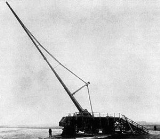
Paris Gun

Encyclopedia
The Paris Gun was a German
long-range siege gun used to bombard Paris
during World War I
. It was in service from March-August 1918. When it was first employed, Parisians believed they'd been bombed by a new type of high-altitude zeppelin
, as neither the sound of an airplane nor a gun could be heard. It was the largest piece of artillery used during the war by barrel length if not caliber
, and is considered to be a supergun
.
Also called the "Kaiser Wilhelm Geschütz" ("Emperor William Gun"), it is often confused with Big Bertha
, the German howitzer
used against the Liège forts in 1914; indeed, the French called it by this name, as well.For an instance of war-time naming of this gun as "Big Bertha", see Paris again Shelled by Long-Range Gun The New York Times
, August 6, 1918, page 3 online abstract It is also confused with the smaller "Langer Max" (Long Max) cannon, from which it was derived; although the famous Krupp
-family artillery makers produced all these guns, the resemblance ended there.
As a military weapon, the Paris Gun was not a great success: the payload was minuscule, the barrel required frequent replacement and its accuracy was only good enough for city-sized targets. However, the German objective was to build a psychological weapon to attack the morale of the Parisians, not to destroy the city itself.
The gun was capable of hurling a 94 kilogram (210 lb
) shell to a range of 130 kilometres (80.8 mi) and a maximum altitude of 40 kilometers (25 miles, 131,000 ft) — the greatest height reached by a human-made projectile
until the first successful V-2
flight test in October 1942. At the start of its 170-second trajectory, each shell from the Paris Gun reached a speed of 1,600 meters per second (5,250 ft/s).
Seven barrels were constructed. They used worn–out 38 cm SK L/45 "Max"
gun barrels that were fitted with an internal tube that reduced the caliber from 380 millimetres (15 in) to 210 millimetres (8 in). The tube was 30 metres (98 ft) long and projected 12.9 metres (42 ft) out of the end of the gun, so an extension was bolted to the old gun-muzzle to cover and reinforce the lining tube. A further, smooth–bore extension was attached to the end of this, giving a total barrel length of 36 metres (118 ft). This smooth section was intended to improve accuracy and reduce the dispersion of the shells, as it reduced the slight yaw a shell might have immediately after leaving the gun barrel, that is produced by the gun's Rifling
. The barrel was braced to counteract barrel droop due to its length and weight, and vibrations while firing; it was mounted on a special rail-transportable carriage and fired from a prepared, concrete emplacement with a turntable. The original breech of the old, 38cm gun did not require modification or reinforcement.
Since it was based on a naval weapon, the gun was manned by a crew of 80 Imperial Navy
sailors under the command of Vice-Admiral Rogge, chief of the Ordnance branch of the Admiralty. It was surrounded by several batteries of standard army artillery to create a "noise-screen" chorus around the big gun so that it could not be located by French and British spotters.
The projectile reached so high that it was the first human-made object to reach the stratosphere
. This virtually eliminated drag from air resistance, allowing the shell to achieve a range of over 130 kilometres (80.8 mi). The Paris Gun was the largest gun built at the time, but it was surpassed in all respects but range in World War II
by the Schwerer Gustav
. The unfinished V-3 cannon
and Iraqi super gun
would have been bigger.
were propelled at such a high velocity that each successive shot wore away a considerable amount of steel from the rifled bore. Each shell was sequentially numbered according to its increasing diameter, and had to be fired in numeric order, lest the projectile lodge in the bore, and the gun explode. Also, when the shell was rammed into the gun, the chamber was precisely measured to determine the difference in its length: a few inches off would cause a great variance in the velocity, and with it, the range. Then, with the variance determined, the additional quantity of propellant was calculated, and its measure taken from a special car and added to the regular charge. After 65 rounds had been fired, each of progressively larger caliber to allow for wear, the barrel was sent back to Krupp and rebored to a caliber of 238 mm (9.4 in) with a new set of shells.
The body of the shell was composed of massively thick steel, containing around 15 kg (33.1 lb) of explosiveThe small amount of explosive – 15% of the weight of the shell – meant that the effect of its shellburst was considered small for the shell's size. The abnormal thickness of the shell casing, to withstand the massive forces of firing, meant that shell would explode into a comparatively small number of large fragments, limiting its destructive effect. A crater produced by a shell falling in the Tuileries Garden
was described by an eye–witness as being 10 foot across and 4 ft (1.2 m) deep.
The explosive was contained in two compartments, separated by a wall. This strengthened the shell and supported the explosive charge under the acceleration of firing. One of the shell's two fuses was mounted in the wall, with the other in the base of the shell. The shell's nose was fitted with a streamlined, lightweight, ballistic cap – a highly unusual feature for the time – and the side had grooves that engaged with the rifling
of the gun barrel, spinning the shell as it was fired so its flight was stable. Two copper driving band
s provided a gas-tight seal against the gun barrel during firing.
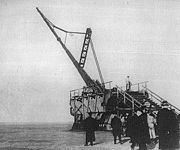 The gun was fired from the forest of Coucy
and the first shell landed at 7:18 a.m. on 21 March 1918 on the Quai de la Seine, the explosion being heard across the city. Shells continued to land at 15 minute intervals, with 21 counted on the first day. The initial assumption was these were bombs dropped from aircraft too high to be seen. But within a few hours, sufficient casing fragments had been collected to show that the explosions were the result of shells, not bombs. By the end of the day, military authorities were aware the shells were being fired from behind German lines by a new, long range gun, although there was initial, wild press speculation on the origin of the shells. This included the theory they were being fired by German agents close by Paris, or even within the city itself so abandoned quarries close to the city were searched for a hidden gun. However, within days, the gun had been found by the French air reconnassanceaviator Didier Daurat
.
The Paris gun emplacement was dug out of the north side of the wooded hill at Chateau Bellevue near Crépy, Aisne
. The gun was mounted on heavy steel rails embedded in concrete, facing Paris. During World War I, the baron and his family were allowed to stay in the chateau with the Germans. Barracks and tunnels were dug underground.
The Paris gun was used to shell Paris at a range of 120 km (74.6 mi). The distance was so far that the Coriolis effect
— the rotation of the Earth — was substantial enough to affect trajectory calculations. The gun was fired at an azimuth of 232 degrees (west-southwest) from Crépy-en-Laon, which was at a latitude of 49.5 degrees North.
In total, about 320 to 367 shells were fired, at a maximum rate of around 20 per day. The shells killed 250 people and wounded 620, and caused considerable damage to property. The worst incident was on 29 March 1918, when a single shell hit the roof of the St-Gervais-et-St-Protais Church
, collapsing the entire roof on to the congregation then hearing the Good Friday service. A total of 88 people were killed and 68 were wounded.
The gun was taken back to Germany in August 1918 as Allied advances threatened its security. The gun was never captured by the Allies. It is believed that near the end of the war it was completely destroyed by the Germans. One spare mounting was captured by American troops near Château-Thierry
, but the gun was never found; the construction plans seem to have been destroyed as well.
The Paris Gun holds a significant place in the history of astronautics. In the 1930s, the German Army became interested in rockets for long range artillery as a replacement for the Paris Gun—which was specifically banned under the Versailles Treaty.
movie The Great Dictator
. Firing at the Cathedral of Notre Dame the Germans succeed in blowing up a small outhouse
.
Germany
Germany , officially the Federal Republic of Germany , is a federal parliamentary republic in Europe. The country consists of 16 states while the capital and largest city is Berlin. Germany covers an area of 357,021 km2 and has a largely temperate seasonal climate...
long-range siege gun used to bombard Paris
Paris
Paris is the capital and largest city in France, situated on the river Seine, in northern France, at the heart of the Île-de-France region...
during World War I
World War I
World War I , which was predominantly called the World War or the Great War from its occurrence until 1939, and the First World War or World War I thereafter, was a major war centred in Europe that began on 28 July 1914 and lasted until 11 November 1918...
. It was in service from March-August 1918. When it was first employed, Parisians believed they'd been bombed by a new type of high-altitude zeppelin
Zeppelin
A Zeppelin is a type of rigid airship pioneered by the German Count Ferdinand von Zeppelin in the early 20th century. It was based on designs he had outlined in 1874 and detailed in 1893. His plans were reviewed by committee in 1894 and patented in the United States on 14 March 1899...
, as neither the sound of an airplane nor a gun could be heard. It was the largest piece of artillery used during the war by barrel length if not caliber
Caliber
In guns including firearms, caliber or calibre is the approximate internal diameter of the barrel in relation to the diameter of the projectile used in it....
, and is considered to be a supergun
Supergun
A supergun is an extraordinarily large artillery piece. This size may be due to a large bore, barrel length or a combination of the two. While early examples tended to have a fairly short range more recent examples sometimes had an extremely high muzzle velocity resulting in a very long...
.
Also called the "Kaiser Wilhelm Geschütz" ("Emperor William Gun"), it is often confused with Big Bertha
Big Bertha (Howitzer)
Big Bertha Bertha") is the name of a type of super-heavy howitzer developed by the famous armaments manufacturer Krupp in Germany on the eve of World War I...
, the German howitzer
Howitzer
A howitzer is a type of artillery piece characterized by a relatively short barrel and the use of comparatively small propellant charges to propel projectiles at relatively high trajectories, with a steep angle of descent...
used against the Liège forts in 1914; indeed, the French called it by this name, as well.For an instance of war-time naming of this gun as "Big Bertha", see Paris again Shelled by Long-Range Gun The New York Times
The New York Times
The New York Times is an American daily newspaper founded and continuously published in New York City since 1851. The New York Times has won 106 Pulitzer Prizes, the most of any news organization...
, August 6, 1918, page 3 online abstract It is also confused with the smaller "Langer Max" (Long Max) cannon, from which it was derived; although the famous Krupp
Krupp
The Krupp family , a prominent 400-year-old German dynasty from Essen, have become famous for their steel production and for their manufacture of ammunition and armaments. The family business, known as Friedrich Krupp AG Hoesch-Krupp, was the largest company in Europe at the beginning of the 20th...
-family artillery makers produced all these guns, the resemblance ended there.
As a military weapon, the Paris Gun was not a great success: the payload was minuscule, the barrel required frequent replacement and its accuracy was only good enough for city-sized targets. However, the German objective was to build a psychological weapon to attack the morale of the Parisians, not to destroy the city itself.
Description
The Paris Gun was a weapon like no other, but its capabilities are not known with certainty. With the discovery (in the 1980s) and publication (in the Bull and Murphy book) of a long note on the gun written shortly before his death in 1926 by Dr. Fritz Rausenberger, who was in charge of its development at Fried. Krupp, we are now fairly certain of the details of its design and capabilities. This is due to the weapon's apparent total destruction by the Germans in the face of the Allied offensive. Figures stated for the weapon's size, range, and performance vary widely depending on the source — not even the number of shells fired is certain.The gun was capable of hurling a 94 kilogram (210 lb
Pound (mass)
The pound or pound-mass is a unit of mass used in the Imperial, United States customary and other systems of measurement...
) shell to a range of 130 kilometres (80.8 mi) and a maximum altitude of 40 kilometers (25 miles, 131,000 ft) — the greatest height reached by a human-made projectile
Projectile
A projectile is any object projected into space by the exertion of a force. Although a thrown baseball is technically a projectile too, the term more commonly refers to a weapon....
until the first successful V-2
V-2 rocket
The V-2 rocket , technical name Aggregat-4 , was a ballistic missile that was developed at the beginning of the Second World War in Germany, specifically targeted at London and later Antwerp. The liquid-propellant rocket was the world's first long-range combat-ballistic missile and first known...
flight test in October 1942. At the start of its 170-second trajectory, each shell from the Paris Gun reached a speed of 1,600 meters per second (5,250 ft/s).
Seven barrels were constructed. They used worn–out 38 cm SK L/45 "Max"
38 cm SK L/45 "Max"
The 38 cm SK L/45 "Max" , also called Langer Max was a German railroad gun used during World War I...
gun barrels that were fitted with an internal tube that reduced the caliber from 380 millimetres (15 in) to 210 millimetres (8 in). The tube was 30 metres (98 ft) long and projected 12.9 metres (42 ft) out of the end of the gun, so an extension was bolted to the old gun-muzzle to cover and reinforce the lining tube. A further, smooth–bore extension was attached to the end of this, giving a total barrel length of 36 metres (118 ft). This smooth section was intended to improve accuracy and reduce the dispersion of the shells, as it reduced the slight yaw a shell might have immediately after leaving the gun barrel, that is produced by the gun's Rifling
Rifling
Rifling is the process of making helical grooves in the barrel of a gun or firearm, which imparts a spin to a projectile around its long axis...
. The barrel was braced to counteract barrel droop due to its length and weight, and vibrations while firing; it was mounted on a special rail-transportable carriage and fired from a prepared, concrete emplacement with a turntable. The original breech of the old, 38cm gun did not require modification or reinforcement.
Since it was based on a naval weapon, the gun was manned by a crew of 80 Imperial Navy
Kaiserliche Marine
The Imperial German Navy was the German Navy created at the time of the formation of the German Empire. It existed between 1871 and 1919, growing out of the small Prussian Navy and Norddeutsche Bundesmarine, which primarily had the mission of coastal defense. Kaiser Wilhelm II greatly expanded...
sailors under the command of Vice-Admiral Rogge, chief of the Ordnance branch of the Admiralty. It was surrounded by several batteries of standard army artillery to create a "noise-screen" chorus around the big gun so that it could not be located by French and British spotters.
The projectile reached so high that it was the first human-made object to reach the stratosphere
Stratosphere
The stratosphere is the second major layer of Earth's atmosphere, just above the troposphere, and below the mesosphere. It is stratified in temperature, with warmer layers higher up and cooler layers farther down. This is in contrast to the troposphere near the Earth's surface, which is cooler...
. This virtually eliminated drag from air resistance, allowing the shell to achieve a range of over 130 kilometres (80.8 mi). The Paris Gun was the largest gun built at the time, but it was surpassed in all respects but range in World War II
World War II
World War II, or the Second World War , was a global conflict lasting from 1939 to 1945, involving most of the world's nations—including all of the great powers—eventually forming two opposing military alliances: the Allies and the Axis...
by the Schwerer Gustav
Schwerer Gustav
Schwerer Gustav and Dora were the names of two massive World War II German 80 cm K railway siege guns. They were developed in the late 1930s by Krupp for the express purpose of destroying heavy fortifications, specifically those in the French Maginot Line...
. The unfinished V-3 cannon
V-3 cannon
The V-3 was a German World War II supergun working on the multi-charge principle whereby secondary propellant charges are fired to add velocity to a projectile....
and Iraqi super gun
Project Babylon
Project Babylon was a project commissioned by the Iraqi president Saddam Hussein to build a series of superguns. The design was based on research from the 1960s Project HARP led by the Canadian artillery expert Gerald Bull...
would have been bigger.
Projectiles
The Paris Gun shellsShell (projectile)
A shell is a payload-carrying projectile, which, as opposed to shot, contains an explosive or other filling, though modern usage sometimes includes large solid projectiles properly termed shot . Solid shot may contain a pyrotechnic compound if a tracer or spotting charge is used...
were propelled at such a high velocity that each successive shot wore away a considerable amount of steel from the rifled bore. Each shell was sequentially numbered according to its increasing diameter, and had to be fired in numeric order, lest the projectile lodge in the bore, and the gun explode. Also, when the shell was rammed into the gun, the chamber was precisely measured to determine the difference in its length: a few inches off would cause a great variance in the velocity, and with it, the range. Then, with the variance determined, the additional quantity of propellant was calculated, and its measure taken from a special car and added to the regular charge. After 65 rounds had been fired, each of progressively larger caliber to allow for wear, the barrel was sent back to Krupp and rebored to a caliber of 238 mm (9.4 in) with a new set of shells.
The body of the shell was composed of massively thick steel, containing around 15 kg (33.1 lb) of explosiveThe small amount of explosive – 15% of the weight of the shell – meant that the effect of its shellburst was considered small for the shell's size. The abnormal thickness of the shell casing, to withstand the massive forces of firing, meant that shell would explode into a comparatively small number of large fragments, limiting its destructive effect. A crater produced by a shell falling in the Tuileries Garden
Tuileries Garden
The Tuileries Garden is a public garden located between the Louvre Museum and the Place de la Concorde in the 1st arrondissement of Paris. Created by Catherine de Medicis as the garden of the Tuileries Palace in 1564, it was first opened to the public in 1667, and became a public park after the...
was described by an eye–witness as being 10 foot across and 4 ft (1.2 m) deep.
The explosive was contained in two compartments, separated by a wall. This strengthened the shell and supported the explosive charge under the acceleration of firing. One of the shell's two fuses was mounted in the wall, with the other in the base of the shell. The shell's nose was fitted with a streamlined, lightweight, ballistic cap – a highly unusual feature for the time – and the side had grooves that engaged with the rifling
Rifling
Rifling is the process of making helical grooves in the barrel of a gun or firearm, which imparts a spin to a projectile around its long axis...
of the gun barrel, spinning the shell as it was fired so its flight was stable. Two copper driving band
Driving band
The driving band or rotating band is part of an artillery shell, a band of soft metal near the middle of the shell, typically made of gilding metal, copper or lead...
s provided a gas-tight seal against the gun barrel during firing.
Use in World War I
Coucy
Coucy is the name or part of the name of several communes in France:* Coucy-la-Ville, in the Aisne département, very close to* Coucy-le-Château-Auffrique, in the Aisne département, location of:** Château de Coucy...
and the first shell landed at 7:18 a.m. on 21 March 1918 on the Quai de la Seine, the explosion being heard across the city. Shells continued to land at 15 minute intervals, with 21 counted on the first day. The initial assumption was these were bombs dropped from aircraft too high to be seen. But within a few hours, sufficient casing fragments had been collected to show that the explosions were the result of shells, not bombs. By the end of the day, military authorities were aware the shells were being fired from behind German lines by a new, long range gun, although there was initial, wild press speculation on the origin of the shells. This included the theory they were being fired by German agents close by Paris, or even within the city itself so abandoned quarries close to the city were searched for a hidden gun. However, within days, the gun had been found by the French air reconnassanceaviator Didier Daurat
Didier Daurat
Didier Daurat was a pioneer of French aviation.-Biography:Daurat was a fighter pilot during World War I, distinguishing himself by spotting the Paris Gun which was pounding Paris....
.
The Paris gun emplacement was dug out of the north side of the wooded hill at Chateau Bellevue near Crépy, Aisne
Crépy, Aisne
Crépy, formerly known as Crépy-en-Laonnais, is a commune in the Aisne department in Picardy in northern France.-History:The treaty of Crépy, during the Italian War of 1542–1546 was signed there between Francis I of France and Holy Roman Emperor Charles V on 18 September 1544.-Population:-References:*...
. The gun was mounted on heavy steel rails embedded in concrete, facing Paris. During World War I, the baron and his family were allowed to stay in the chateau with the Germans. Barracks and tunnels were dug underground.
The Paris gun was used to shell Paris at a range of 120 km (74.6 mi). The distance was so far that the Coriolis effect
Coriolis effect
In physics, the Coriolis effect is a deflection of moving objects when they are viewed in a rotating reference frame. In a reference frame with clockwise rotation, the deflection is to the left of the motion of the object; in one with counter-clockwise rotation, the deflection is to the right...
— the rotation of the Earth — was substantial enough to affect trajectory calculations. The gun was fired at an azimuth of 232 degrees (west-southwest) from Crépy-en-Laon, which was at a latitude of 49.5 degrees North.
In total, about 320 to 367 shells were fired, at a maximum rate of around 20 per day. The shells killed 250 people and wounded 620, and caused considerable damage to property. The worst incident was on 29 March 1918, when a single shell hit the roof of the St-Gervais-et-St-Protais Church
St-Gervais-et-St-Protais Church
The St-Gervais-et-St-Protais Church of Paris sheltered one of the most famous dynasties of French musicians, the Couperin family, for more than two centuries, beginning in 1653....
, collapsing the entire roof on to the congregation then hearing the Good Friday service. A total of 88 people were killed and 68 were wounded.
The gun was taken back to Germany in August 1918 as Allied advances threatened its security. The gun was never captured by the Allies. It is believed that near the end of the war it was completely destroyed by the Germans. One spare mounting was captured by American troops near Château-Thierry
Château-Thierry
Château-Thierry is a commune in northern France about east-northeast of Paris. It is a sub-prefecture of the Aisne department in Picardy.-History:...
, but the gun was never found; the construction plans seem to have been destroyed as well.
The Paris Gun holds a significant place in the history of astronautics. In the 1930s, the German Army became interested in rockets for long range artillery as a replacement for the Paris Gun—which was specifically banned under the Versailles Treaty.
In popular culture
A parody of the Paris Gun appears in the Charlie ChaplinCharlie Chaplin
Sir Charles Spencer "Charlie" Chaplin, KBE was an English comic actor, film director and composer best known for his work during the silent film era. He became the most famous film star in the world before the end of World War I...
movie The Great Dictator
The Great Dictator
The Great Dictator is a comedy film by Charlie Chaplin released in October 1940. Like most Chaplin films, he wrote, produced, and directed, in addition to starring as the lead. Having been the only Hollywood film maker to continue to make silent films well into the period of sound films, this was...
. Firing at the Cathedral of Notre Dame the Germans succeed in blowing up a small outhouse
Outhouse
An outhouse is a small structure separate from a main building which often contained a simple toilet and may possibly also be used for housing animals and storage.- Terminology :...
.
External links
- The Paris Gun in the First World War.com Encyclopedia
- Paris Gun at S. Berliner, III's ORDNANCE
- Une page sur le canon de Paris
- Map of impact sites