

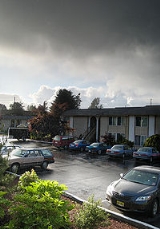
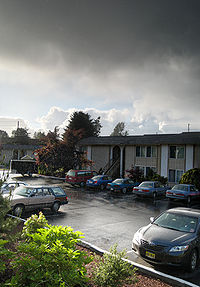
Sunshower

Encyclopedia
Meteorological phenomenon
A meteorological phenomenon is a weather event that can be explained by the principles of meteorology. Such events include:* Air mass* Anticyclone* Arctic cyclone* Clouds* Crow Instability* Derecho* Diamond dust* Drought* Dust devil* Dust storm...
in which rain
Rain
Rain is liquid precipitation, as opposed to non-liquid kinds of precipitation such as snow, hail and sleet. Rain requires the presence of a thick layer of the atmosphere to have temperatures above the melting point of water near and above the Earth's surface...
falls while the sun is shining. These conditions often lead to the appearance of a rainbow
Rainbow
A rainbow is an optical and meteorological phenomenon that causes a spectrum of light to appear in the sky when the Sun shines on to droplets of moisture in the Earth's atmosphere. It takes the form of a multicoloured arc...
, if the sun is at a low enough angle. Although used in the United States
United States
The United States of America is a federal constitutional republic comprising fifty states and a federal district...
, Canada
Canada
Canada is a North American country consisting of ten provinces and three territories. Located in the northern part of the continent, it extends from the Atlantic Ocean in the east to the Pacific Ocean in the west, and northward into the Arctic Ocean...
, Australia
Australia
Australia , officially the Commonwealth of Australia, is a country in the Southern Hemisphere comprising the mainland of the Australian continent, the island of Tasmania, and numerous smaller islands in the Indian and Pacific Oceans. It is the world's sixth-largest country by total area...
, New Zealand
New Zealand
New Zealand is an island country in the south-western Pacific Ocean comprising two main landmasses and numerous smaller islands. The country is situated some east of Australia across the Tasman Sea, and roughly south of the Pacific island nations of New Caledonia, Fiji, and Tonga...
, Ireland
Ireland
Ireland is an island to the northwest of continental Europe. It is the third-largest island in Europe and the twentieth-largest island on Earth...
, and parts of Britain, the term "sunshower" is rarely found in dictionaries. Additionally, the phenomenon has a wide range of sometimes remarkably similar folkloric
Folklore
Folklore consists of legends, music, oral history, proverbs, jokes, popular beliefs, fairy tales and customs that are the traditions of a culture, subculture, or group. It is also the set of practices through which those expressive genres are shared. The study of folklore is sometimes called...
names in cultures around the world. A common theme is that of trickster
Trickster
In mythology, and in the study of folklore and religion, a trickster is a god, goddess, spirit, man, woman, or anthropomorphic animal who plays tricks or otherwise disobeys normal rules and conventional behavior. It is suggested by Hansen that the term "Trickster" was probably first used in this...
animals, or the devil
Devil
The Devil is believed in many religions and cultures to be a powerful, supernatural entity that is the personification of evil and the enemy of God and humankind. The nature of the role varies greatly...
, getting married, although many variations of parts of this theme exist.
Meteorology
The nature of cumuluformCumulus cloud
Cumulus clouds are a type of cloud with noticeable vertical development and clearly defined edges. Cumulus means "heap" or "pile" in Latin. They are often described as "puffy" or "cotton-like" in appearance. Cumulus clouds may appear alone, in lines, or in clusters...
clouds is such that the sun can often be seen while they are producing rain. If a sunshower occurs when the sun is low in the sky (specifically, any time the sun is at less than a 42° angle), a rainbow can occur.
Anecdotally, a sunshower is said to be a sign that rain will occur again soon, specifically that it will rain the next day.
Folkloric names

Animals
- In South AfricaSouth AfricaThe Republic of South Africa is a country in southern Africa. Located at the southern tip of Africa, it is divided into nine provinces, with of coastline on the Atlantic and Indian oceans...
n English, a sunshower is referred to as a "monkeyMonkeyA monkey is a primate, either an Old World monkey or a New World monkey. There are about 260 known living species of monkey. Many are arboreal, although there are species that live primarily on the ground, such as baboons. Monkeys are generally considered to be intelligent. Unlike apes, monkeys...
’s wedding", a loan translation of the ZuluZulu languageZulu is the language of the Zulu people with about 10 million speakers, the vast majority of whom live in South Africa. Zulu is the most widely spoken home language in South Africa as well as being understood by over 50% of the population...
umshado wezinkawu, a wedding for monkeyMonkeyA monkey is a primate, either an Old World monkey or a New World monkey. There are about 260 known living species of monkey. Many are arboreal, although there are species that live primarily on the ground, such as baboons. Monkeys are generally considered to be intelligent. Unlike apes, monkeys...
s. In AfrikaansAfrikaansAfrikaans is a West Germanic language, spoken natively in South Africa and Namibia. It is a daughter language of Dutch, originating in its 17th century dialects, collectively referred to as Cape Dutch .Afrikaans is a daughter language of Dutch; see , , , , , .Afrikaans was historically called Cape...
, it is referred to as jakkalstrou, jackalJackalAlthough the word jackal has been historically used to refer to many small- to medium-sized species of the wolf genus of mammals, Canis, today it most properly and commonly refers to three species: the black-backed jackal and the side-striped jackal of sub-Saharan Africa, and the golden jackal of...
s wedding, or also Jakkals trou met wolf se vrou as dit reën en die son skyn flou, meaning: "Jackal marries Wolf's wife when it rains and the sun shines faintly." - In HindiHindiStandard Hindi, or more precisely Modern Standard Hindi, also known as Manak Hindi , High Hindi, Nagari Hindi, and Literary Hindi, is a standardized and sanskritized register of the Hindustani language derived from the Khariboli dialect of Delhi...
, it is also called "the foxes wedding". - In Konkani, it is called "a monkey's wedding".
- In Sinhala, it is called "the foxes wedding".
- In BengaliBengali languageBengali or Bangla is an eastern Indo-Aryan language. It is native to the region of eastern South Asia known as Bengal, which comprises present day Bangladesh, the Indian state of West Bengal, and parts of the Indian states of Tripura and Assam. It is written with the Bengali script...
, it is called "a devil's wedding". - In BrazilBrazilBrazil , officially the Federative Republic of Brazil , is the largest country in South America. It is the world's fifth largest country, both by geographical area and by population with over 192 million people...
, people say "Rain and sun (chuva e sol), Snail's (caracol) wedding" OR "Sun and rain (sol e chuva), Widow's (viúva) marriage". - In Arabic, the term is "the rats are getting married".
- In KoreaKoreaKorea ) is an East Asian geographic region that is currently divided into two separate sovereign states — North Korea and South Korea. Located on the Korean Peninsula, Korea is bordered by the People's Republic of China to the northwest, Russia to the northeast, and is separated from Japan to the...
, a male tigerTigerThe tiger is the largest cat species, reaching a total body length of up to and weighing up to . Their most recognizable feature is a pattern of dark vertical stripes on reddish-orange fur with lighter underparts...
gets married to a foxFoxFox is a common name for many species of omnivorous mammals belonging to the Canidae family. Foxes are small to medium-sized canids , characterized by possessing a long narrow snout, and a bushy tail .Members of about 37 species are referred to as foxes, of which only 12 species actually belong to...
. - In EritreaEritreaEritrea , officially the State of Eritrea, is a country in the Horn of Africa. Eritrea derives it's name from the Greek word Erethria, meaning 'red land'. The capital is Asmara. It is bordered by Sudan in the west, Ethiopia in the south, and Djibouti in the southeast...
, the traditional belief is that the hyena is giving birth. - In various African languages, leopardLeopardThe leopard , Panthera pardus, is a member of the Felidae family and the smallest of the four "big cats" in the genus Panthera, the other three being the tiger, lion, and jaguar. The leopard was once distributed across eastern and southern Asia and Africa, from Siberia to South Africa, but its...
s are getting married. - In KenyaKenyaKenya , officially known as the Republic of Kenya, is a country in East Africa that lies on the equator, with the Indian Ocean to its south-east...
, hyenaHyenaHyenas or Hyaenas are the animals of the family Hyaenidae of suborder feliforms of the Carnivora. It is the fourth smallest biological family in the Carnivora , and one of the smallest in the mammalia...
s are getting married. - One animal, the foxFoxFox is a common name for many species of omnivorous mammals belonging to the Canidae family. Foxes are small to medium-sized canids , characterized by possessing a long narrow snout, and a bushy tail .Members of about 37 species are referred to as foxes, of which only 12 species actually belong to...
, crops up all over the world, from KeralaKeralaor Keralam is an Indian state located on the Malabar coast of south-west India. It was created on 1 November 1956 by the States Reorganisation Act by combining various Malayalam speaking regions....
to JapanJapanJapan is an island nation in East Asia. Located in the Pacific Ocean, it lies to the east of the Sea of Japan, China, North Korea, South Korea and Russia, stretching from the Sea of Okhotsk in the north to the East China Sea and Taiwan in the south...
(Japan also refers to it as 'KitsuneKitsuneis the Japanese word for fox. Foxes are a common subject of Japanese folklore; in English, kitsune refers to them in this context. Stories depict them as intelligent beings and as possessing magical abilities that increase with their age and wisdom. Foremost among these is the ability to assume...
(the fox) takes a bride') to ArmeniaArmeniaArmenia , officially the Republic of Armenia , is a landlocked mountainous country in the Caucasus region of Eurasia...
; there’s even an English dialect term, "the foxes’ wedding", known from the south west of England. In CalabriaCalabriaCalabria , in antiquity known as Bruttium, is a region in southern Italy, south of Naples, located at the "toe" of the Italian Peninsula. The capital city of Calabria is Catanzaro....
, Italy, it is said: "When it rains with sun, the foxes are getting married.” In Finland, it is said "the foxes take their bath". - In BulgariaBulgariaBulgaria , officially the Republic of Bulgaria , is a parliamentary democracy within a unitary constitutional republic in Southeast Europe. The country borders Romania to the north, Serbia and Macedonia to the west, Greece and Turkey to the south, as well as the Black Sea to the east...
, there is a saying about the bear marrying. - In Tamil Nadu, South India, the TamilTamil languageTamil is a Dravidian language spoken predominantly by Tamil people of the Indian subcontinent. It has official status in the Indian state of Tamil Nadu and in the Indian union territory of Pondicherry. Tamil is also an official language of Sri Lanka and Singapore...
speaking people say that the fox and the crow/raven are getting married. - In Mazandarani languageMazandarani languageMazandarani or Tabari is an Iranian language of the Northwestern branch, spoken mainly in Iran's Mazandaran, Gilan and Golestan provinces...
, in north of IranIranIran , officially the Islamic Republic of Iran , is a country in Southern and Western Asia. The name "Iran" has been in use natively since the Sassanian era and came into use internationally in 1935, before which the country was known to the Western world as Persia...
, it is also called "the jackal’s wedding". - In parts of the United KingdomUnited KingdomThe United Kingdom of Great Britain and Northern IrelandIn the United Kingdom and Dependencies, other languages have been officially recognised as legitimate autochthonous languages under the European Charter for Regional or Minority Languages...
, it is referred to as "a monkey's birthday". - In Pashto, it is also called "Da gidarh wade" or "the jackal's wedding".
- In HawaiiHawaiiHawaii is the newest of the 50 U.S. states , and is the only U.S. state made up entirely of islands. It is the northernmost island group in Polynesia, occupying most of an archipelago in the central Pacific Ocean, southwest of the continental United States, southeast of Japan, and northeast of...
, it is known as "Ghost Rain". - In El SalvadorEl SalvadorEl Salvador or simply Salvador is the smallest and the most densely populated country in Central America. The country's capital city and largest city is San Salvador; Santa Ana and San Miguel are also important cultural and commercial centers in the country and in all of Central America...
, the traditional belief is that the deer is giving birth.
Devils
In the United StatesUnited States
The United States of America is a federal constitutional republic comprising fifty states and a federal district...
, particularly the South, a sunshower is said to show that "the devil is beating his wife"; a regional variant from Tennessee
Tennessee
Tennessee is a U.S. state located in the Southeastern United States. It has a population of 6,346,105, making it the nation's 17th-largest state by population, and covers , making it the 36th-largest by total land area...
is "the devil is kissing his wife". In Canada
Canada
Canada is a North American country consisting of ten provinces and three territories. Located in the northern part of the continent, it extends from the Atlantic Ocean in the east to the Pacific Ocean in the west, and northward into the Arctic Ocean...
, it's typically related to the devil beating his wife, then marrying numerous offspring; it is also said that he slaughters and rapes cattle, and then dances, which leads to rain. In French
French language
French is a Romance language spoken as a first language in France, the Romandy region in Switzerland, Wallonia and Brussels in Belgium, Monaco, the regions of Quebec and Acadia in Canada, and by various communities elsewhere. Second-language speakers of French are distributed throughout many parts...
, the phrase is "Le diable bat sa femme et marie sa fille" (i.e., "the devil is beating his wife and marrying his daughter"). In German
German language
German is a West Germanic language, related to and classified alongside English and Dutch. With an estimated 90 – 98 million native speakers, German is one of the world's major languages and is the most widely-spoken first language in the European Union....
, the variation is "Wenn's regnet und die Sonne scheint, so schlägt der Teufel seine Großmutter: er lacht und sie weint" (i.e., "When it's raining and the sun shines, the devil is beating his grandmother: he laughs and she cries"). The Hungarian
Hungarian language
Hungarian is a Uralic language, part of the Ugric group. With some 14 million speakers, it is one of the most widely spoken non-Indo-European languages in Europe....
"Az Ördög veri a feleségét" and the Piedmontese "Al diau al bat la fumna" also both translate as "the devil is beating his wife". The lower Caribbean
Caribbean
The Caribbean is a crescent-shaped group of islands more than 2,000 miles long separating the Gulf of Mexico and the Caribbean Sea, to the west and south, from the Atlantic Ocean, to the east and north...
variant is "The devil and his wife are fighting for a bone". The Brugarian variant is: "The devil has thrown over his wife for a fox." In the Netherlands
Netherlands
The Netherlands is a constituent country of the Kingdom of the Netherlands, located mainly in North-West Europe and with several islands in the Caribbean. Mainland Netherlands borders the North Sea to the north and west, Belgium to the south, and Germany to the east, and shares maritime borders...
people say "Het is kermis in de hel" (i.e., "There is a funfair in hell").
Witches
In PolishPolish language
Polish is a language of the Lechitic subgroup of West Slavic languages, used throughout Poland and by Polish minorities in other countries...
, the saying is that "when the sun is shining and the rain is raining, the witch is making butter
Butter
Butter is a dairy product made by churning fresh or fermented cream or milk. It is generally used as a spread and a condiment, as well as in cooking applications, such as baking, sauce making, and pan frying...
". In Spain
Spain
Spain , officially the Kingdom of Spain languages]] under the European Charter for Regional or Minority Languages. In each of these, Spain's official name is as follows:;;;;;;), is a country and member state of the European Union located in southwestern Europe on the Iberian Peninsula...
and the Dominican Republic
Dominican Republic
The Dominican Republic is a nation on the island of La Hispaniola, part of the Greater Antilles archipelago in the Caribbean region. The western third of the island is occupied by the nation of Haiti, making Hispaniola one of two Caribbean islands that are shared by two countries...
, it is said a witch is getting married.
In dialects of north-eastern Italy (Veneto), a variation concerns "witches" and "combing": piova e sole, le strighe se pètena ("rain and sun, the witches are combing their hair"), piova e sole, la striga se fa le coe ("rain and sun, the witch is plaiting her hair"). A further variation is found in Catalan
Catalan people
The Catalans or Catalonians are the people from, or with origins in, Catalonia that form a historical nationality in Spain. The inhabitants of the adjacent portion of southern France are sometimes included in this definition...
folklore, in a song: plou i fa sol, les bruixes es pentinen, plou i fa sol, les bruixes porten dol ("it rains and sun is shining, witches comb their hair, it rains and sun is shining, the witches are mourning").
Other variations
For FilipinosPhilippines
The Philippines , officially known as the Republic of the Philippines , is a country in Southeast Asia in the western Pacific Ocean. To its north across the Luzon Strait lies Taiwan. West across the South China Sea sits Vietnam...
, "elves are getting married", or "tikbalang
Tikbalang
Tikbalang is a creature of Philippine folklore said to lurk in the mountains and forests of the Philippines. It is generally described as a tall, bony humanoid creature with disproportionately long limbs, to the point that its knees reach above its head when it squats down...
" (half-horse, half-men) and a "kapre
Kapre
Kapre is a Philippine mythical creature that could be characterized as a tree demon, but with more human characteristics. It is described as being a tall , brown, hairy male with a beard. Kapres are normally described as smoking a big tobacco pipe, whose strong smell would attract human attention...
" are getting married, while in Greece
Greece
Greece , officially the Hellenic Republic , and historically Hellas or the Republic of Greece in English, is a country in southeastern Europe....
it is the poor.
In Lithuanian and Estonian , the phenomenon is described as "orphans' tears", where the sun is the grandmother drying those tears. In Russian, it is called , "mushroom rain", as such conditions are considered favorable to growing mushrooms. It is also often referred to as }, which literally translates as "blind rain".
In Brazil
Brazil
Brazil , officially the Federative Republic of Brazil , is the largest country in South America. It is the world's fifth largest country, both by geographical area and by population with over 192 million people...
a common rhyme is "Sol e chuva, casamento de viúva. Chuva e sol, casamento de espanhol", meaning: "Sun and rain, a widow's marriage. Rain and sun, a Spanish man's marriage."
See also
- April showers (weather phenomenon)
- Lake-effect snow
- Physical effects of climate change
External links
- Languagehat
- Word-detective.com
- Google Answers on the origin of "fox's wedding day"
- The Wyandot Nation of Kansas - Myth on the origin of sunshowers
- Akira Kurasawa's film "Dreams" has a segment about a young boy witnessing a fox wedding procession during a sunshower.