
All Topics  
Zulu language

 
Zulu Language

   Email Print
   Bookmark   Link


Zulu language


Zulu (called isiZulu in Zulu), is a language
Language

A language is a form of symbol communication in which elements are combined to represents something other than themselves. Language can also refer to the use of such systems as a general phenomenon....
 of the Zulu
Zulu

The Zulu are the largest South African ethnic group of an estimated 10-11 million people who live mainly in the province of KwaZulu-Natal, South Africa....
 people with about 10 million speakers, the vast majority (over 95%) of whom live in South Africa
South Africa

The Republic of South Africa, also known by Official names of South Africa, is a country located at the southern tip of the continent of Africa....
. Zulu is the most widely spoken home language in South Africa (24% of the population) as well as being understood by over 50% of the population (Ethnologue 2005). It became one of South Africa's eleven official languages
Languages of South Africa

South Africa has 11 official languages. South Africa also recognises eight non-official languages as "national languages". Of the official languages, two are Indo-European languages — English language and Afrikaans language — while the other nine are languages of the Bantu languages family ....
 in 1994 at the end of apartheid.

Geographical distribution
Zulu belongs to the South-Eastern group of Bantu languages
Bantu languages

The Bantu languages constitute a grouping belonging to the Niger-Congo languages family. This grouping is deep down in the genealogical tree of the Bantoid grouping, which in turn is deep down in the Niger-Congo tree....
 (the Nguni group).

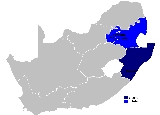
The language is widely spoken in KwaZulu-Natal
KwaZulu-Natal

KwaZulu-Natal , often referred to as "KZN", is a Provinces of South Africa of South Africa. Prior to 1994 the territory now known as KwaZulu-Natal was made up of the Natal Province and all pieces of territory that made up the homeland of KwaZulu....
 (81% of the province's population are Zulu first language speakers), Mpumalanga
Mpumalanga

Mpumalanga, , is a Provinces of South Africa South Africa. The name means east or literally "the place where the sun rises" in Nguni languages....
 (26%) and Gauteng
Gauteng

Gauteng is a Provinces of South Africa of South Africa. It was formed from part of the old Transvaal after South Africa's first all-race elections on 27 April 1994....
 (21%).


Discussion
Ask a question about 'Zulu language'
Start a new discussion about 'Zulu language'
Answer questions from other users
Full Discussion Forum


Encyclopedia


Zulu (called isiZulu in Zulu), is a language
Language

A language is a form of symbol communication in which elements are combined to represents something other than themselves. Language can also refer to the use of such systems as a general phenomenon....
 of the Zulu
Zulu

The Zulu are the largest South African ethnic group of an estimated 10-11 million people who live mainly in the province of KwaZulu-Natal, South Africa....
 people with about 10 million speakers, the vast majority (over 95%) of whom live in South Africa
South Africa

The Republic of South Africa, also known by Official names of South Africa, is a country located at the southern tip of the continent of Africa....
. Zulu is the most widely spoken home language in South Africa (24% of the population) as well as being understood by over 50% of the population (Ethnologue 2005). It became one of South Africa's eleven official languages
Languages of South Africa

South Africa has 11 official languages. South Africa also recognises eight non-official languages as "national languages". Of the official languages, two are Indo-European languages — English language and Afrikaans language — while the other nine are languages of the Bantu languages family ....
 in 1994 at the end of apartheid.

Geographical distribution


Zulu belongs to the South-Eastern group of Bantu languages
Bantu languages

The Bantu languages constitute a grouping belonging to the Niger-Congo languages family. This grouping is deep down in the genealogical tree of the Bantoid grouping, which in turn is deep down in the Niger-Congo tree....
 (the Nguni group).

The language is widely spoken in KwaZulu-Natal
KwaZulu-Natal

KwaZulu-Natal , often referred to as "KZN", is a Provinces of South Africa of South Africa. Prior to 1994 the territory now known as KwaZulu-Natal was made up of the Natal Province and all pieces of territory that made up the homeland of KwaZulu....
 (81% of the province's population are Zulu first language speakers), Mpumalanga
Mpumalanga

Mpumalanga, , is a Provinces of South Africa South Africa. The name means east or literally "the place where the sun rises" in Nguni languages....
 (26%) and Gauteng
Gauteng

Gauteng is a Provinces of South Africa of South Africa. It was formed from part of the old Transvaal after South Africa's first all-race elections on 27 April 1994....
 (21%). It is also spoken in some other African countries, with significant Zulu-speaking populations in Lesotho
Lesotho

Lesotho , officially the Kingdom of Lesotho, is a landlocked country and enclave ? entirely surrounded by the South Africa. Formerly Basutoland, it is a member of the Commonwealth of Nations....
 and Swaziland
Swaziland

The Kingdom of Swaziland is a landlocked country in Southern Africa, bordered to the north, south, and west by South Africa, and to the east by Mozambique....
. Ndebele
Ndebele language

There are at least two languages commonly called Ndebele:*The Northern Ndebele language, a Nguni languages spoken in Zimbabwe*The Southern Ndebele language, classified as Nguni languages or Sotho-Tswana languages, spoken in South Africa, heavily influenced by surrounding Sotho-Tswana languages and therefore mostly classified a...
, spoken in Zimbabwe
Zimbabwe

Zimbabwe , is a landlocked country located in the southern part of the continent of Africa, between the Zambezi and Limpopo River rivers. It is bordered by South Africa to the south, Botswana to the southwest, Zambia to the northwest and Mozambique to the east....
, Swazi and the Nguni language formerly spoken in Malawi
Malawi

The Republic of Malawi is a landlocked country in southeast Africa that was formerly known as Nyasaland. It is bordered by Zambia to the northwest, Tanzania to the northeast and Mozambique, which surrounds it on the east, south and west....
 are all closely related to Zulu and developed from nineteenth century Zulu migrant populations. Xhosa
Xhosa language

Xhosa is one of the official languages of South Africa. Xhosa is spoken by approximately Xhosa, or about 18% of the South African population. Like most Bantu languages, Xhosa is a Tone , that is, the same sequence of consonants and vowels can have different meanings when said with a rising or falling or high or low intonation....
, the predominant language in the Eastern Cape
Eastern Cape

The Eastern Cape is a Provinces of South Africa of South Africa. Its capital is Bhisho. It was formed in 1994 out of the "independent" homelands of Transkei and Ciskei, as well as the eastern portion of the Cape Province....
, and Zulu are also mutually intelligible.

History


The Zulu presence in South Africa dates from about the fourteenth century AD. Much like the Xhosa
Xhosa

The Xhosa people are speakers of Bantu languages living in south-east South Africa, and in the last two centuries throughout the southern and central-southern parts of the country....
 who had moved into South Africa during earlier waves of the Bantu migrations, the Zulu assimilated many sounds from the San
Bushmen

The Bushmen, San, Sho, Basarwa, Kung, or Khwe are indigenous people of southern Africa that spans most areas of South Africa, Zimbabwe, Lesotho, Mozambique, Swaziland, Botswana, Namibia, and Angola....
 and Khoi
Khoi

*The common name of Siamese Rough Bush. *The Khoikhoi people.*A language spoken by the Khoikhoi.*Khoy, a city in Iran.*Influential Shia cleric Grand Ayatollah Abul-Qassim Khoei ...
 languages of the country's earliest inhabitants. This has resulted in the preservation of click consonant
Click consonant

Clicks are speech sounds such as English tsk! tsk! used to express disapproval, or the tchick! used to spur on a horse. In many languages of southern Africa, and in three languages of East Africa, they are ordinary consonants, found for example in the name of the language Xhosa language....
s in Zulu and Xhosa, (the sounds are unique to Southern and Eastern Africa except for the Australian Aborigine Damin
Damin

Damin was a ceremonial language register used by the advanced initiated men of the Lardil and the Yangkaal tribes in Aboriginal Australia....
 ceremonial language) despite the extinction of many San and Khoi languages.

Zulu, like all indigenous Southern African languages, was an oral language until contact with missionaries from Europe, who documented the language using the Latin alphabet
Latin alphabet

The Latin alphabet, also called the Roman alphabet, is the most widely used alphabetic writing system in the world today. It evolved from the western variety of the Greek alphabet called the Cumae alphabet, and was initially developed by the Ancient Romes to write the Latin....
. The first grammar book of the Zulu language was published in Norway
Norway

Norway , officially the Kingdom of Norway, is a constitutional monarchy in Northern Europe that occupies the western portion of the Scandinavian Peninsula....
 in 1850 by the Norwegian missionary Hans Schreuder
Hans Paludan Smith Schreuder

Hans Paludan Smith Schreuder was a Norway 19th century missionary to Zulu who developed a close relationship with the Zulu and British authorities....
. The first written document in Zulu was a Bible translation that appeared in 1883. In 1901, John Dube (1871-1946), a Zulu from Natal, created the Ohlange Institute, the first native educational institution in South Africa. He was also the author of Insila kaShaka, the first novel written in isiZulu (1933). Another pioneering Zulu writer was Reginald Dhlomo
Rolfes Robert Reginald Dhlomo

Rolfes Robert Reginald Dhlomo was a South African novelist. His novella An African Tragedy, published in 1928 was the first fiction work written by a black South African to appear in book form....
, author of several historical novels of the 19th-century leaders of the Zulu nation: U-Dingane (1936), U-Shaka (1937), U-Mpande (1938), U-Cetshwayo (1952) and U-Dinizulu (1968). Other notable contributors to Zulu literature include Benedict Wallet Vilakazi
Benedict Wallet Vilakazi

Benedict Wallet Vilakazi was a South African Zulu poet, novelist, and educator. In 1946, he became the first black South African to receive a Ph.D....
 and, more recently, Oswald Mbuyiseni Mtshali
Oswald Mbuyiseni Mtshali

Oswald Mbuyiseni Mtshali is a South African poet. He has written in both Zulu language and English language. He studied at Columbia University....
.

The written form of Zulu was controlled by the Zulu Language Board of KwaZulu-Natal
KwaZulu-Natal

KwaZulu-Natal , often referred to as "KZN", is a Provinces of South Africa of South Africa. Prior to 1994 the territory now known as KwaZulu-Natal was made up of the Natal Province and all pieces of territory that made up the homeland of KwaZulu....
. This board has now been disbanded and superseded by the that promotes the use of all eleven official languages of South Africa.

Contemporary usage


English, Dutch and later Afrikaans had been the only official languages used by all South African governments before 1994. However in the Kwazulu
KwaZulu

KwaZulu was a bantustan in South Africa, intended by the apartheid government as a semi-independent homeland for the Zulu people. The capital, formerly at Nongoma, was moved in 1980 to Ulundi....
 bantustan
Bantustan

A bantustan or euphemistically black african homeland or simply homeland, was territory set aside for black inhabitants of South Africa and South-West Africa , as part of the policy of South Africa under apartheid....
 the Zulu language was widely used. All education in the country at the high-school level was in English or Afrikaans. Since the demise of apartheid in 1994, Zulu has been enjoying a marked revival. Zulu-language television was introduced by the SABC in the early 1980s and it broadcasts news and many shows in Zulu. Zulu radio is very popular and newspapers such as , and UmAfrika in the Zulu language are available, mainly available in Kwazulu-Natal
KwaZulu-Natal

KwaZulu-Natal , often referred to as "KZN", is a Provinces of South Africa of South Africa. Prior to 1994 the territory now known as KwaZulu-Natal was made up of the Natal Province and all pieces of territory that made up the homeland of KwaZulu....
 province and in Johannesburg
Johannesburg

Johannesburg also known as Joburg, is the largest city in South Africa. Johannesburg is the province Capital of Gauteng the wealthiest province in South Africa, having the largest economy of any metropolitan region in Sub-Saharan Africa....
. Recently, the first full length feature film in Zulu, Yesterday, was nominated for an Oscar
Academy Awards

The Academy Awards, popularly known as the Oscars, are presented annually by the Academy of Motion Picture Arts and Sciences to recognize excellence of professionals in the film industry, including directors, actors, and writers....
.

South African matriculation
Matriculation

Matriculation, in the broadest sense, means to be registered or added to a list, from the Latin matricula - little list. In Scottish heraldry, for instance, a matriculation is a registration of armorial bearings....
 requirements no longer specify which South African language needs to be taken as a second language, and some people have made the switch to learning Zulu. However people taking Zulu at high-school level overwhelmingly take it as first language: according to recent statistics, Afrikaans is still over 30 times more popular than Zulu as a second language. The mutual intelligibility of many Nguni
Nguni

Nguni languages are mostly spoken by Nguni people, which are group of clans and nations living in south-east Africa.The languages are a group of Bantu languages spoken in southern Africa including Zulu language, Xhosa language, Swati language, amaHlubi,Phuthi language and Ndebele language ....
 languages, has increased the likelihood of Zulu becoming the lingua franca
Lingua franca

A lingua franca is a language systematically used to communicate between persons not sharing a mother tongue, in particular when it is a third language, distinct from both persons' mother tongues....
 of the Eastern half of the country although the political dominance of Xhosa-speaking people on national level militates against this really happening. (The predominant language in the Western Cape
Western Cape

The Western Cape is a Provinces of South Africa in the south west of South Africa. The capital is Cape Town. Prior to 1994, the region that now forms the Western Cape was part of the huge Cape Province....
 and Northern Cape
Northern Cape

The Northern Cape is a large, sparsely populated Provinces of South Africa of South Africa, created in 1994 when the Cape Province was split up....
 is Afrikaans - see the map below.

In the 1994 film The Lion King
The Lion King

The Lion King is a American Animation film produced by Walt Disney Feature Animation, released in theaters on June 15, 1994 by Walt Disney Pictures....
, in the Circle of Life
Circle of Life

"Circle of Life" is an Academy Award?nominated song from The Walt Disney Company 1994 animated film The Lion King, composed by Elton John with lyrics by Tim Rice....
 song, the phrases Ingonyama nengw' enamabala (English: A lion and a leopard come to this open place), Nants ingonyama bagithi Baba (English: Here comes a lion, Father) and Siyo nqoba (English: We will conquer) were used. In some movie songs, like "This Land", the voice says Busa Le Lizwe bo (Rule this land) and Busa ngothando bo (Rule with love) were used too.

Phonetics


Vowels


Vowels are lengthened in the penultimate syllable.

Consonants

 labial
Labial consonant

Labials are consonants articulated either with both lips or with the lower lip and the upper teeth . English is a bilabial nasal consonant sonorant, and are bilabial stop consonant , and are labiodental fricative consonant....
alveolar
Alveolar consonant

Alveolar consonants are articulated with the tongue against or close to the superior alveolar ridge, which is called that because it contains the Dental alveolus of the superior teeth....
post-
alveolar
palatal
Palatal consonant

Palatal consonants are consonants articulated with the body of the tongue raised against the hard palate . Consonants with the tip of the tongue curled back against the palate are called retroflex consonant....
velar
Velar consonant

Velars are consonants articulated with the back part of the tongue against the soft palate, the back part of the roof of the mouth, known also as the Soft palate)....
glottal
Glottal consonant

Glottal consonants are consonants articulated with the glottis. Many phoneticians consider them, or at least the so-called fricatives, to be transitional states of the glottis without a point of articulation as other consonants have; in fact, some do not consider them to be consonants at all....
labial-velar
Labial-velar consonant

Labial-velar consonants are Doubly articulated consonant at the Soft palate and the lips. They are sometimes called "labiovelar consonants", a term which can also refer to labialization velars, such as and the approximant ....
plosive        
nasal
Nasal consonant

A nasal consonant is produced with a lowered soft palate in the mouth, allowing air to escape freely through the nose. The oral cavity still acts as a resonance chamber for the sound, but the air does not escape through the mouth as it is blocked by the tongue....
     
fricative
Fricative consonant

Fricatives are consonants produced by forcing air through a narrow channel made by placing two Place of articulation close together. These may be the lower lip against the upper teeth, in the case of ; the back of the tongue against the soft palate, in the case of German language , the final consonant of Bach; or the side of the tongue ag...
     
affricate
Affricate consonant

Affricate consonants begin as stop consonants but release as a fricative consonant rather than directly into the following vowel....
         
approximant          
lateral approximant
Lateral consonant

Laterals are "L"-like consonants pronounced with an occlusion made somewhere along the axis of the tongue, while air from the lungs escapes at one side or both sides of the tongue....
           
lateral fricative            


Click consonants


One of the most distinctive features of Zulu is the use of click consonant
Click consonant

Clicks are speech sounds such as English tsk! tsk! used to express disapproval, or the tchick! used to spur on a horse. In many languages of southern Africa, and in three languages of East Africa, they are ordinary consonants, found for example in the name of the language Xhosa language....
s. This feature is shared with several other languages of Southern Africa
Africa

Africa is the world's second-largest and second most-populous continent, after Asia. At about 30.2 million km? including adjacent islands, it covers 6% of the Earth's total surface area and 20.4% of the total land area....
, but is almost entirely confined to this region. There are three basic clicks in Zulu:
  • c - dental
    Dental click

    The dental clicks are a family of click consonants found, as constituents of words, only in Africa and in the Damin ritual jargon of Australia....
     (comparable to a sucking of teeth)
  • q - alveolar
    Postalveolar click

    The alveolar or postalveolar clicks are a family of click consonants found only in Africa and in the Damin ritual jargon of Australia.The symbol in the International Phonetic Alphabet that represents the forward articulation of these sounds is ....
     (comparable to a bottle top 'pop')
  • x - lateral (comparable to a click one may do for a walking horse)
These can have several variants such as being voiced, aspirated
Aspiration (phonetics)

In phonetics, aspiration is the strong burst of Earth's atmosphere that accompanies either the release or, in the case of preaspiration, the closure of some obstruents....
 or nasalised so that there are a total of about 15 different click sounds in Zulu. The same sounds occur in Xhosa
Xhosa language

Xhosa is one of the official languages of South Africa. Xhosa is spoken by approximately Xhosa, or about 18% of the South African population. Like most Bantu languages, Xhosa is a Tone , that is, the same sequence of consonants and vowels can have different meanings when said with a rising or falling or high or low intonation....
, where they are used more frequently than in Zulu.

Tone


Like the great majority of other Bantu
Bantu languages

The Bantu languages constitute a grouping belonging to the Niger-Congo languages family. This grouping is deep down in the genealogical tree of the Bantoid grouping, which in turn is deep down in the Niger-Congo tree....
 and African languages, Zulu is tonal. It is conventionally written without any indication of tone, despite the fact that tone is distinctive in Zulu. For example, the word for priest and student is umfundisi, but they are pronounced with a different tone depending on the meaning.

Zulu is also known for having depressor consonants, which lower a high tone in the same syllable. For example, the verbs ukuhlala "to live" and ukudlala "to play" should both contain a high tone on the penultimate syllable. However, the tone on the penultimate syllable of ukudlala is low as a result of the depressor consonant [?].

Zuludistrib

Grammar


Some of the main grammatical features of Zulu are:

  • Constituent word order is Subject Verb Object.
  • Morphologically, it is an agglutinative language.
  • As in other Bantu languages, Zulu nouns are classified into fifteen morphological classes
    Noun class

    In linguistics, the term noun class refers to a system of categorizing nouns. A noun may belong to a given class because of characteristic features of its referent, such as sex, animacy, shape, but counting a given noun among nouns of such or another class is often clearly conventional....
     (or genders
    Grammatical gender

    In linguistics, grammatical genders, sometimes also called noun classes, are classes of nouns reflected in the behavior of associated words; every noun must belong to one of the classes and there should be very few which belong to several classes at once....
    ), with different prefixes for singular and plural. Various parts of speech that qualify a noun must agree with the noun according to its gender. These agreements usually reflect part of the original class that it is agreeing with. An example of this is the use of the class 'aba-':


Bonke abantu abaqatha basepulazini bayagawula.

All the strong people of the farm are felling (trees).

Here, the various agreement that qualify the word 'abantu' (people) can be seen in effect.


  • Its verbal system shows a combination of temporal and aspectual categories in their finite paradigm. Typically verbs have two stems, one for Present-Indefinite and another for Perfect. Different prefixes can be attached to these verbal stems to specify subject agreement and various degrees of past or future tense. For example, in the word uyathanda ("he loves"), the Present stem of the verb is -thanda, the prefix u- expresses third-person singular subject and -ya- is a filler used in short sentences.
Suffixes are also put into common use to show the causative or reciprocal forms of a verb stem.
  • Most property words (words which are encoded as adjectives in English) are represented by things called relatives, such is the sentence umuntu ubomvu ("the person is red"), the word ubomvu (root -bomvu) behaves similarly to a verb and uses the agreement prefix u-, but there are subtle differences, for example, it does not use the prefix ya-.


Nouns


The Zulu noun consists of two essential parts, the prefix and the stem, though the prefix can be analysed further. Using the prefixes, nouns can be grouped into noun classes, which are numbered consecutively, to ease comparison with other Bantu languages
Bantu languages

The Bantu languages constitute a grouping belonging to the Niger-Congo languages family. This grouping is deep down in the genealogical tree of the Bantoid grouping, which in turn is deep down in the Niger-Congo tree....
. So, for example, the nouns
abafana (boys) and abangane (friends) belong to Class 2, characterised by the prefix aba-, whereas isibongo (surname) and isihlahla (tree) belong to Class 7, characterised by the prefix isi-.

Each noun class has a well-defined grammatical role, as well as a more loosely defined semantic one. The grammatical number
Grammatical number

In linguistics, grammatical number is a grammatical category of nouns, pronouns, and adjective and verb agreement that expresses count distinctions ....
 of the noun, whether singular or plural, is determined by the prefix; thus, all noun classes can be organised into singular and plural pairs. For example, all nouns of Class 7 (prefix
isi-) have plurals from Class 8 (prefix izi-).

Examples:

Singular Plural
umuntu (person) abantu (people)
ugogo (grandmother) ogogo (grandmothers)
igama (name) amagama (names)
inhlanzi (fish) izinhlanzi (fish)


Classes 14 (
ubu-) and 15 (uku-) form an exception to this rule, as they have no corresponding plural classes (if necessary, plurals of Class 14 are formed from class 6. nouns of Class 15 have no plural forms).

Furthermore, the class of the noun determines the forms of other parts of speech, i.e. verbs, adjectives, etc - their prefixes are derived from those of the substantive classes, and will be in agreement with them.

Examples:

umfana omkhulu (large boy)
isihlahla esikhulu (large tree)


In terms of semantics, groups of similar nouns belong to similar noun classes. For example, names and surnames are only found in class 1a. Designations of persons which are derived from verbs (e.g. singer, from sing) are commonly in class 1, abstract concepts (e.g. beauty) in class 14, loanwords in classes 9 and 5, and nouns derived from the infinitives of verbs (e.g. eating, from eat) in class 15.

The following table gives an overview of Zulu noun class, arranged according to singular-plural pairs.

ClassSingularPlural
1/2um(u)-1aba-2, abe-3
1a/2bu-o-
3/4um(u)-1imi-2
5/6i-ama-, ame-4
7/8is(i)-5iz(i)-5
9/10iN-6iziN-6
11/10u-iziN-6
14ubu-(ama-)7
15uku- 


1
umu- replaces um- before monosyllabic stems, e.g. umuntu (person).

2
ab- and im- replace aba- and imi- respectively before stems beginning in a vowel, e.g. abongameli (president).

3
abe- occurs only in rare cases, e.g. in abeSuthu (the Sotho) or abeLungu (the Whites, the Europeans).

4
ame- occurs only in one instance, namely amehlo (eyes) the plural of iso (eye; originally: ihlo).

5
is- and iz- replace isi- and izi- respectively before stems beginning with a vowel, e.g. isandla/izandla (hand/hands).

6 The placeholder
N in the prefixes iN- and iziN- for m, n or no letter at all, i.e. in classes 9 and 10 there are three different prefixes, though only one per noun stem. Examples:

iN- = i-:
iMali (money) iN- = im-: impela (truth) iN- = in-: inhlanzi (fish)

7 Rare, see above.

Verbs


In contrast to the noun, the Zulu verb has a variable number of components, which are arranged in sequence according to a defined set of rules. Examples of these include:

  • a subject prefix (SP), which agrees with the subject of the sentence
  • a temporal morpheme, which indicates the tense
    Tense

    Tense may refer to:*Grammatical tense, a temporal linguistic quality expressing the time at, during, or over which a state or action denoted by a verb occurs...
     of the verb
  • an object prefix (OP), which agrees with the object of the sentence
  • the verb stem (VS), which carries the underlying meaning of the verb
  • a suffix, which can signify various aspects of the verb (e.g. tense or modality
    Modality

    Modality can refer to:...
    )


The verb stem and the suffix are always present, but the other parts are optional, i.e. their presence depends on the function of the verb in the sentence.

Simple verb stems

Simple verb stems are ones to which no suffixes are attached that would alter the basic meaning of the verb. Examples include:

-w-to fall
-dl-to eat
-enz-to make, to do
-nqamul-to break [something]
-os-to cook, to roast
-siz-to help


Complex verb stems

Complex verb stems are derived from simple verb stems by attaching various suffixes, thus changing the meaning. Thus, we can take the stem
-enz (to make, to do) and apply a few common suffixes to get different shades of meaning. E.g.:

-enz-to make, to do
-enzan-to do something together
-enzek-to be doable i.e. possible
-enzel-to do something for someone
-enzis-to bring someone for doing something
-enziw-to be made, to be done


Subject prefixes

In Zulu, a subject prefix corresponds to the subjective case of English personal pronouns
English personal pronouns

The personal pronouns of English can have various forms according to grammatical gender, grammatical number, grammatical person, and grammatical case....
, such as I or he. Unlike personal pronouns, however, Zulu subject prefix cannot stand alone, but must be attached to a verb. Zulu does possess a set of independent personal pronouns; however, these are only used to emphasise the subject to whom they refer.

An example with the subject prefix
si- and the personal pronoun thina (both meaning we):

Sihamba manje.We are going now.
Thina sihamba manje.We are going now.


There is a unique subject prefix for each grammatical person
Person

The term person in common usage means an individual human being. In the fields of law, philosophy, medicine, and others, the term also has specialised context-specific meanings....
 and each noun class.

initial SP
PersonSingularPlural
1stngi-si-
2ndu-ni-
ClassSingularPlural
1/2u-ba-
1a/2bu-ba-
3/4u-i-
5/6li-a-
7/8si-zi-
9/10i-zi-
11/10lu-zi-
14 bu-
15 ku-
non-initial SP-
PersonSingularPlural
1st -ngi- -si-
2nd -wu- -ni-
ClassSingularPlural
1/2 -ka- -ba-
1a/2b -ka- -ba-
3/4 -wu- -yi-
5/6 -li- -wa-
7/8 -si- -zi-
9/10 -yi- -zi-
11/10 -lu- -zi-
14 -bu-
15 -ku-


The non-initial subject prefixes (SP-) are used when a further prefix is attached to the SP, for example in the negative of certain tenses.

Object prefixes

In Zulu, the object prefix is used to designate the direct object
Direct

Direct may refer to:* direct current, a direct flow of electricity* direct examination, the in-trial questioning of a witness by the party who has called him or her to testify...
 or indirect object of a verb (formal Zulu does not distinguish between these two cases). Just like the subject prefixes, object prefixes cannot stand independently, but must be attached to a verb stem. Independent personal pronouns can be used in conjunction with object prefixes as well, serving, again, to shift the emphases of the sentences.

Examples with the OP
-m- (him/her/it) and the personal pronoun yena (him/her/it):

Ngimbona. I see him.
Ngimnika isipho. I give her a gift.
Ngimbona yena. I see him.


There is a unique object prefix for each person and noun class.

Object prefixes
PersonSingularPlural
1st -ngi- -si-
2nd -ku- -ni-
ClasseSingularPlural
1/2 -m- -ba-
1a/2b -m- -ba-
3/4 -wu- -yi-
5/6 -li- -wa-
7/8 -si- -zi-
9/10 -yi- -zi-
11/10 -lu- -zi-
14 -bu-
15 -ku-


The imperative


Formation of the imperative
Imperative

Imperative can mean:*Imperative mood, a grammatical mood expressing commands, direct requests, and prohibitions*Imperative programming, a programming paradigm in computer science...
:
  without object with object
Singular: (yi) - VS - a OP - VS - e
Plural: (yi) - VS - ani OP - VS - eni


The only exception to this is the common verb stem -z-, to come, whose singular and plural imperative forms are
woza and wozani respectively.

Examples:
  without object with object
Stem Singular Plural Singular Plural
-dl- Yidla! Eat! Yidlani! Eat! Yidle (inhlanzi)! Eat it (the fish)! Yidleni (inhlanzi)! Eat it (the fish; inhlanzi: cl. 9; OP: -yi-)!
-enz- Yenza! Do Yenzani! Do! Kwenze! Do this! Kwenzeni! Do this!
-siz- Siza! Help! Sizani! Help! Msize! Help him! Msizeni! Help him!


The infinitive


Formation of the infinitive
Infinitive

In grammar, infinitive is the name for certain verb forms that exist in many languages. In the usual description of English language, the infinitive of a verb is its basic form with or without the grammatical particle to: therefore, do and to do, be and to be, and so on are infinitives....
:

Aff.: uku - (OP) - VS - a
Neg.: uku - nga - (OP) - VS - i


Examples:

Verb stem Infinitive Meaning
-w- ukuwa to fall
ukungawa not to fall (cf. note)
-dl- ukudla to eat
ukungadli not to eat
ukuyidla to eat it (e.g. inhlanzi, the fish; OP: -yi-)
ukungayidli not to eat it
-enz- ukwenza to do
ukungenzi not to do
-os- ukosa to roast
ukungosi not to roast


Several sound changes occur, when two vowels occur together. These include:

-nga- ? -ng- before vowels
uku- ? uk- before o
uku- ? ukw- before other vowels - this sound change occurs automatically in speech.


Note: Furthermore, the suffixe
-a will be found with verb stems which end in w, never -i; e.g.: uku-nga-w-a.

The present


Formation of the present tense
Present

Present may refer to:...
:

Aff.: SP - (ya) - (OP) - VS - a
Neg.: a - SP- - (OP) - VS - i


The form
-ya- is found when:

  • the verb is the last word in the sentence
  • the verb contains an object prefix, and the object follows the verb
  • the speaker wants to emphasise the factuality of the statement.


Examples:
Uyahamba. He is going.
Uhamba ekuseni. He is going in the morning.
Akahambi. He is not going.
Uyangisiza. He is helping me.
Ungisiza namhlanje. He is helping me today.
Akangisizi. He isn't helping me.
Usiza uyise.
Uyamsiza uyise.
He is helping his father.


The participial form

Formation of the participle:

Aff.: SPP - (OP) - VS - a
Neg.: SPP - nga - (OP) - VS - i


In the participial form, the subject prefixes (SP)
u-, ba- and a- of the classes 1, 1a, 2, 2b and 6 become e-, be- and e- respectively (SPP). The participial form is used, among others:

  • to indicate simultaneity
  • in subordinate clauses with certain conjunctions
    Conjunctions

    conjunctions are words that connect diffreces and simmilar things to one and an otherConjunctions editorial approach is often collaborative. Both the editor and the distinguished staff of active contributing editors — including Walter Abish, Chinua Achebe, John Ashbery, Mei-mei Berssenbrugge, Mary Caponegro, Robert Creeley, Elizabeth Fra...
    .
  • with certain auxiliary verbs.


Examples:

Ukhuluma edla. He talks while he eats (Eating, he talks).
Ngambona engasebenzi. I saw that he was not working


The subjunctive

Formation of the subjunctive:

Aff.: SPS - (OP) - VS - e
Neg.: SPS - nga - (OP) - VS - i


In the subjunctive, the subject prefix
u- of classes 1 and 1a (SP) becomes a- (SPS). The subjunctive is used

  • in wishes and polite requests
  • in sequences of requests
  • with certain auxiliary verbs


Examples:

Ngamtshela ahambe. I told him he should go.
Woza lapha uzame futhi! Come here and try it again!
Umane ahleke. He only laughs.


The perfect


The perfect tense
Perfect

Perfect may refer to:* Perfection, a philosophical concept* Perfection , a legal concept* Perfect aspect, a grammatical concept* Cathar Perfect, a Cathar priest...
 describes the recent, although what is meant by 'recent' depends on the speaker. In the colloquial language, the perfect is often preferred to the preterite.

Formation of the perfect:

Aff.: SP - (OP) - VS - e/ile
Neg.: a - SP- - (OP) - VS - anga


The long form in
-ile is found when the verb is the last word in the sentence or clause, otherwise the short form in -e is used, with the -e- accented.

Examples:
Sihambile. We went.
Sihambe izolo. We went yesterday.
Asihambanga. We did not go.
Asimbonanga. We have not seen him/her.


The stative

A range of Zulu verbs indicate a change of state or a process, which tends towards some final goal (cf. inchoative verbs). To indicate that this final state has been achieved, the stative verb, which is related to the perfect, is used.

Formation of the stative:

Aff.: SP - VS - ile
Neg.: a - SP- - VS - ile


Examples:
Uyafa. He is dying.
Ufile. He is dead.
Ngiyalamba. I am becoming hungry.
Ngilambile. I am hungry.
Siyabuya. We are turning back.
Sibuyile. We have returned.


Note that the form verbs with certain endings, the ending
-ile is not used. These are:

Verb stem Stative
-al-, -el- -ele
-an-, -en- -ene
-am-, -em- -eme
-ath-, -eth- -ethe
-as-, -es- -ese
-aw-1 -ewe


1 This is a unique case, namely the irregular passive
-bulaw- from -bulal-.

The preterite


The preterite
Preterite

The preterite is the grammatical tense expressing actions that took place in the past. It is similar to the aorist in languages such as Greek language....
 is used to indicate the distant past, the past preceding the perfect, and as a narrative perfect.

Formation of the preterite:

Aff.: SP + a - (OP) - VS - a
Neg.: a - SP- - (OP) - VS - anga (cf. the perfect tense)


In the affirmative, because of the merger of the SP with a following
a in the spoken language, the following subject prefixes result for the preterite:

PersonSingularPlural
1.nga-sa-
2.wa-na-
ClassSingularPlural
1/2wa-ba-
1a/2bwa-ba-
3/4wa-ya-
5/6la-a-
7/8sa-za-
9/10ya-za-
11/10lwa-za-
14 ba-
15 kwa-


Examples:
Sahamba. We went.
Asihambanga. We did not go.
Asimbonanga. We did not see him/her.


The consecutive

Formation of the consecutive:

Aff.: SP + a - (OP) - VS - a
Neg.: SP + a - nga - (OP) - VS - a


The consecutive is used to describe a sequence of consecutive events in the preterite, and differs from it only in the negative.

Examples:
Wavuka wagqoka wahamba. He woke up, dressed, and went out.
Wabaleka wangabheka emuva. He ran away and did not look back.


The future I


Formation of the future tense
Future

The future is a time period commonly understood to contain all events that have yet to occur. It is the opposite of the past, and is the time after the present....
 I:

Aff.: SP - zo - (OP) - (ku) - VS - a
Neg.: a - SP- - zu - (ku)- (OP) - VS - a


The marker of the future tense is the prefix
zo- in the affirmative and the corresponding zu- in the negative. The form is constructed from the auxiliary verb uku-za (or with the auxiliary uku-ya) and the infinitive of the verb. So, ngiza ukusiza (I am coming to help) = ngizosiza (I will help), or, alternatively ngiya ukusiza (I am going to help) = ngiyosiza (I will help) - English (as well as French and others) has had a similar development, whereby the verb to go has become the marker of the future tense. To form the negative, the auxiliary verb is negated and then merged with the following verb, thus angizi ukusiza = angizusiza. In the case of monosyllabic verb stems, as well as those that begin with vowels, the prefix -ku- is added to the stem – this becomes -k- before o and -kw- in front of other vowels.

Examples:
Ngizokuza. I will come.
Angizukuza. I will not come.
Ngizokwakha. I will build
Angizukwakha. I will not build.
Ngizomsiza. I will help him.
Angizumsiza. I will not help him.


Other tenses


Other forms, such as the pluperfect, the future II, the progressive forms or the conjunctive forms are somewhat complicated. They are formed with single or double uses of the auxiliary verb
-ba-, to be, but in practical usage are abbreviated further.

Phrases

The following is a list of phrases that can be used when visiting a region where the primary language is Zulu.

Sawubona Hello, to one person
Sanibonani Hello, to a group of people
Unjani? / Ninjani? How are you (sing.)? / How are you (pl.)?
Ngisaphila / Sisaphila I'm okay / We're okay
Ngiyabonga (kakhulu) Thanks (a lot)
Ngubani igama lakho? What is your name?
Igama lami ngu... My name is...
Isikhathi sithini? What's the time?
Ngingakusiza? Can I help you?
Uhlala kuphi? Where do you stay?
Uphumaphi? Where are you from?
Hamba kahle / Sala kahle Go well / Stay well (used as goodbye)
Hambani kahle / Salani kahle Go well / Stay well, to a group of people
Eish! Wow! (No real European equivalent, used in South African English
South African English

South African English is a dialect of English language spoken in South Africa and in neighbouring countries with a large number of Anglo-Africans living in them, such as Botswana, Namibia, Zimbabwe and Lesotho....
) (you could try a semi-expletive, such as oh my God or what the fuck. It expresses a notion of shock and surprise)
Hhayibo No! / Stop! / No way! (used in South African English
South African English

South African English is a dialect of English language spoken in South Africa and in neighbouring countries with a large number of Anglo-Africans living in them, such as Botswana, Namibia, Zimbabwe and Lesotho....
 too)
Yebo Yes
Cha No
Angazi I don't know
Ukhuluma isiNgisi na? Do you speak English?
Ngisaqala ukufunda isiZulu I've just started learning Zulu


Sample text


(From the preamble to the South African Constitution
Constitution of South Africa

The current and official Constitution of the Republic of South Africa was adopted on 8 May 1996. It is the supreme Law of South Africa of South Africa....
)

Thina, bantu baseNingizimu Afrika, Siyakukhumbula ukucekelwa phansi kwamalungelo okwenzeka eminyakeni eyadlula; Sibungaza labo abahluphekela ubulungiswa nenkululeko kulo mhlaba wethu; Sihlonipha labo abasebenzela ukwakha nokuthuthukisa izwe lethu; futhi Sikholelwa ekutheni iNingizimu Afrika ingeyabo bonke abahlala kuyo, sibumbene nakuba singafani.

Translation:

We, the people of South Africa, Recognize the injustices of our past; Honor those who suffered for justice and freedom in our land; Respect those who have worked to build and develop our country; and Believe that South Africa belongs to all who live in it, united in our diversity.

Common place names in Zulu


Zulu place names usually occur in their locative form, which combines what would in English be separate prepositions with the name concerned. This is usually achieved by simply replacing the i- prefix with an e- prefix (for example, 'eGoli' translates literally as 'to/at/in/from Johannesburg' when iGoli is simply Johannesburg), but changes in the name can also occur (see Durban below). The locatives are given in brackets.

  • South Africa - iNingizimu Afrika / uMzansi Afrika
  • Durban - iTheku (eThekwini
    Ethekwini

    eThekwini Metropolitan Municipality is the Metropolitan municipality created in 2000 that includes the city of Durban, South Africa and surrounding towns....
    )
  • Johannesburg - iGoli (eGoli
    Egoli

    Egoli may mean:* The South African city of Johannesburg, which is sometimes referred to as eGoli.* The long-running South African soap opera...
    )
  • Cape Town - iKapa (eKapa
    Cape Town

    Cape Town is the second most populous city in South Africa, forming part of the metropolitan municipality of the City of Cape Town. It is the provincial Capital of the Western Cape, as well as the legislature capital of South Africa, where the Parliament of South Africa and many government offices are located....
    )
  • Pretoria - iPitoli (ePitoli)
  • Pietermaritzburg - uMgungundlovu (eMgungundlovu)
  • Ladysmith - uMnambithi (eMnambithi)
  • Overseas - phesheya


The 'Zulu'/'isiZulu' debate

The Zulu language is called 'isiZulu' in Zulu, 'isi-' being the prefix associated with languages (e.g., isiNgisi = English, isiXhosa = Xhosa, isiBhunu = Afrikaans, isiJalimane = German, etc.).

The root word Zulu can take many other forms in Zulu, each with a different meaning. Here is a table showing how the meanings of two roots - Zulu and ntu - change according to their prefix.

Prefix -zulu -ntu
um(u) umZulu (a Zulu person) umuntu (a person)
ama, aba amaZulu (Zulu people) abantu (people)
isi isiZulu (the Zulu language) isintu (culture, heritage, mankind)
ubu - ubuntu (humanity, compassion)
kwa kwaZulu (place of the Zulu people) -
i(li) izulu (the weather/sky/heaven) -
pha phezulu (on top) -
e ezulwini (in, at, to, from heaven) -


Some prefer to call Zulu isiZulu in English as per the Zulu name for the language. This is similar to the practice of calling Swahili Kiswahili, but many languages are not called by their native names in English, like German (which is Deutsch in German) and Japanese (which is Nihongo in Japanese).

Zulu words in South African English


South African English

South African English is a dialect of English language spoken in South Africa and in neighbouring countries with a large number of Anglo-Africans living in them, such as Botswana, Namibia, Zimbabwe and Lesotho....
 has absorbed many words from the Zulu language. Others, such as the names of local animals (impala
Impala

An impala is a medium-sized African antelope. The name impala comes from the Zulu language. They are found in savannas and thick bushveld in Kenya, Tanzania, Mozambique, northern Namibia, Botswana, Zambia, Zimbabwe, southern Angola, northeastern South Africa and Uganda....
 and mamba
Mamba

Mambas, of the genus Dendroaspis, are fast-moving land-dwelling snakes of Africa. They belong to the family of Elapidae which includes cobras, coral snakes, Bungarus and, debatably, sea snakes although these are now classed as Hydrophiidae, all of which can be extremely deadly....
 are both Zulu names) have made their way into standard English
English language

English is a West Germanic language that originated in Anglo-Saxon England and has lingua franca status in many parts of the world as a result of the military, economic, scientific, political and cultural influence of the British Empire in the 18th, 19th and early 20th centuries and that of the United States from the mid 20th century onwa...
. A few examples of Zulu words used in South African English:

  • Muti
    Muti

    Muti is a term for traditional medicine in Southern Africa as far north as Lake Tanganyika. The word muti is derived from the Zulu word for tree, of which the root is -thi....
    (from umuthi) - medicine
  • Donga
    Donga (ditch)

    In South African English, a Donga is a ditch formed by the erosion of soil.They were extensively used by both sides during the Boer Wars as serendipitous Defense positions....
    (from udonga) - ditch (udonga actually means 'wall' in Zulu)
  • Indaba
    Indaba

    An indaba is an important conference held by the inDuna of the Zulu and Xhosa peoples of South Africa. Such indabas may include only the izinDuna of a particular community or may be held with representatives of other communities....
    - conference (it means 'an item of news' in Zulu)
  • inDuna
    InDuna

    InDuna is a IsiZulu title meaning advisor, great leader, ambassador, headman, or commander of group of warriors. It can also mean spokesperson or mediator as the izinDuna often acted as a bridge between the people and the king....
    - chief or leader
  • Shongololo (from ishongololo) - millipede
  • Ubuntu
    Ubuntu (ideology)

    Ubuntu, , is an ethic or humanism philosophy focusing on people's allegiances and relations with each other. The word has its origin in the Bantu languages of Southern Africa....
     - compassion/humanity


See also


  • Zulu
    Zulu

    The Zulu are the largest South African ethnic group of an estimated 10-11 million people who live mainly in the province of KwaZulu-Natal, South Africa....
     (the ethnic group)
  • Shaka
    Shaka

    Shaka was the most influential leader of the Zulu Empire.He is widely credited with uniting many of the Northern Nguni people, specifically the Mthethwa Paramountcy and the Ndwandwe into the Zulu kingdom, the beginnings of a nation that held sway over the large portion of southern Africa between the Phongolo River and Mzimkhulu River river...
     Zulu
  • List of Zulu first names
  • Nguni
    Nguni

    Nguni languages are mostly spoken by Nguni people, which are group of clans and nations living in south-east Africa.The languages are a group of Bantu languages spoken in southern Africa including Zulu language, Xhosa language, Swati language, amaHlubi,Phuthi language and Ndebele language ....
     culture
  • Bantu language
  • Tsotsitaal
    Tsotsitaal

    Tsotsitaals are a variety of mixed languages mainly spoken in the townships of Gauteng province, such as Soweto, but also in other agglomerations all over South Africa....
     - a Zulu-based creole language
    Creole language

    A creole language, or simply a creole, is a stable language that originates seemingly as a nativization pidgin. This understanding of creole genesis culminated in Robert A....
     spoken in Soweto
    Soweto

    Soweto is an urban area in Regions of Johannesburg, in Gauteng, South Africa. Its name is an English language Abbreviation#Syllabic_abbreviation, short for South Western Township....
  • Swadesh list of Zulu words
  • UCLA Language Materials Project
    UCLA Language Materials Project

    The UCLA Language Materials Project http://www.lmp.ucla.edu maintains a web resource about teaching materials for some 150 languages that are Less Commonly Taught Languages in the United States....


Sources

  • -


Books

  • Dent, G.R. and Nyembezi, C.L.S. (1959) Compact Zulu Dictionary. Pietermaritzburg: Shuter & Shooter. ISBN 0-7960-0760-8
  • Dent, G.R. and Nyembezi, C.L.S. (1969) Scholar's Zulu Dictionary. Pietermaritzburg: Shuter & Shooter. ISBN 0-7960-0718-7
  • Doke, C.M. (1947) Text-book of Zulu grammar. London: Longmans, Green and Co.
  • Doke, C.M. (1953) Zulu-English Dictionary. Johannesburg: Witwatersrand University Press. ISBN 1-86814-160-8
  • Doke, C.M. (1958) Zulu-English Vocabulary. Johannesburg: Witwatersrand University Press. ISBN 0-85494-009-X
  • Nyembezi, C.L.S. (1957) Learn Zulu. Pietermaritzburg: Shuter & Shooter. ISBN 0-7960-0237-1
  • Nyembezi, C.L.S. (1970) Learn More Zulu. Pietermaritzburg: Shuter & Shooter. ISBN 0-7960-0278-9
  • Wilkes, Arnett, Teach Yourself Zulu. ISBN 0-07-143442-9


External links

  • incl. sound file

Grammars


Dictionaries


Newspapers

  • Ilanga
  • UmAfrika


Software

  • , , , and in Zulu
  • Project to translate Free and Open Source Software into all the official languages of South Africa including Zulu


Literature and culture