

Steering

Encyclopedia
Watercraft
A watercraft is a vessel or craft designed to move across or through water. The name is derived from the term "craft" which was used to describe all types of water going vessels...
(ship
Ship
Since the end of the age of sail a ship has been any large buoyant marine vessel. Ships are generally distinguished from boats based on size and cargo or passenger capacity. Ships are used on lakes, seas, and rivers for a variety of activities, such as the transport of people or goods, fishing,...
, boat
Boat
A boat is a watercraft of any size designed to float or plane, to provide passage across water. Usually this water will be inland or in protected coastal areas. However, boats such as the whaleboat were designed to be operated from a ship in an offshore environment. In naval terms, a boat is a...
) or vehicle
Vehicle
A vehicle is a device that is designed or used to transport people or cargo. Most often vehicles are manufactured, such as bicycles, cars, motorcycles, trains, ships, boats, and aircraft....
(car
Automobile
An automobile, autocar, motor car or car is a wheeled motor vehicle used for transporting passengers, which also carries its own engine or motor...
, motorcycle
Motorcycle
A motorcycle is a single-track, two-wheeled motor vehicle. Motorcycles vary considerably depending on the task for which they are designed, such as long distance travel, navigating congested urban traffic, cruising, sport and racing, or off-road conditions.Motorcycles are one of the most...
, bicycle
Bicycle
A bicycle, also known as a bike, pushbike or cycle, is a human-powered, pedal-driven, single-track vehicle, having two wheels attached to a frame, one behind the other. A person who rides a bicycle is called a cyclist, or bicyclist....
) to follow the desired course. An exception is the case of rail transport
Rail transport
Rail transport is a means of conveyance of passengers and goods by way of wheeled vehicles running on rail tracks. In contrast to road transport, where vehicles merely run on a prepared surface, rail vehicles are also directionally guided by the tracks they run on...
by which rail tracks
Rail tracks
The track on a railway or railroad, also known as the permanent way, is the structure consisting of the rails, fasteners, sleepers and ballast , plus the underlying subgrade...
combined together with railroad switch
Railroad switch
A railroad switch, turnout or [set of] points is a mechanical installation enabling railway trains to be guided from one track to another at a railway junction....
es (and also known as 'points' in British English) provide the steering function.
Introduction
The most conventional steering arrangement is to turn the front wheelWheel
A wheel is a device that allows heavy objects to be moved easily through rotating on an axle through its center, facilitating movement or transportation while supporting a load, or performing labor in machines. Common examples found in transport applications. A wheel, together with an axle,...
s using a hand–operated steering wheel
Steering wheel
A steering wheel is a type of steering control in vehicles and vessels ....
which is positioned in front of the driver, via the steering column
Steering column
The automotive steering column is a device intended primarily for connecting the steering wheel to the steering mechanism or transferring the driver's input torque from the steering wheel.-Secondary functions:...
, which may contain universal joint
Universal joint
A universal joint, universal coupling, U joint, Cardan joint, Hardy-Spicer joint, or Hooke's joint is a joint or coupling in a rigid rod that allows the rod to 'bend' in any direction, and is commonly used in shafts that transmit rotary motion...
s (which may also be part of the collapsible steering column design), to allow it to deviate somewhat from a straight line. Other arrangements are sometimes found on different types of vehicles, for example, a tiller
Tiller
A tiller or till is a lever attached to a rudder post or rudder stock of a boat that provides leverage for the helmsman to turn the rudder...
or rear–wheel steering. Tracked vehicle
Tracked vehicle
A tracked vehicle is a vehicle that runs on continuous tracks instead of wheels...
s such as bulldozer
Bulldozer
A bulldozer is a crawler equipped with a substantial metal plate used to push large quantities of soil, sand, rubble, etc., during construction work and typically equipped at the rear with a claw-like device to loosen densely-compacted materials.Bulldozers can be found on a wide range of sites,...
s and tank
Tank
A tank is a tracked, armoured fighting vehicle designed for front-line combat which combines operational mobility, tactical offensive, and defensive capabilities...
s usually employ differential steering — that is, the tracks are made to move at different speeds or even in opposite directions, using clutch
Clutch
A clutch is a mechanical device which provides for the transmission of power from one component to another...
es and brake
Brake
A brake is a mechanical device which inhibits motion. Its opposite component is a clutch. The rest of this article is dedicated to various types of vehicular brakes....
s, to bring about a change of course or direction.
Basic geometry
The basic aim of steering is to ensure that the wheels are pointing in the desired directions. This is typically achieved by a series of linkages, rods, pivots and gears. One of the fundamental concepts is that of caster angleCaster angle
thumb|250px|θ is the caster angle, the red line is the pivot line, and the grey area is the tire.Caster angle or castor angle is the angular displacement from the vertical axis of the suspension of a steered wheel in a car, bicycle or other vehicle, measured in the longitudinal direction...
- each wheel is steered with a pivot point ahead of the wheel; this makes the steering tend to be self-centering towards the direction travel.
The steering linkages connecting the steering box and the wheels usually conforms to a variation of Ackermann steering geometry
Ackermann steering geometry
Ackermann steering geometry is a geometric arrangement of linkages in the steering of a car or other vehicle designed to solve the problem of wheels on the inside and outside of a turn needing to trace out circles of different radius...
, to account for the fact that in a turn, the inner wheel is actually travelling a path of smaller radius than the outer wheel, so that the degree of toe
Toe (automotive)
In automotive engineering, toe, also known as tracking, is the symmetric angle that each wheel makes with the longitudinal axis of the vehicle, as a function of static geometry, and kinematic and compliant effects. This can be contrasted with steer, which is the antisymmetric angle, i.e. both...
suitable for driving in a straight path is not suitable for turns.
Rack and pinion, recirculating ball, worm and sector
Rack and pinion
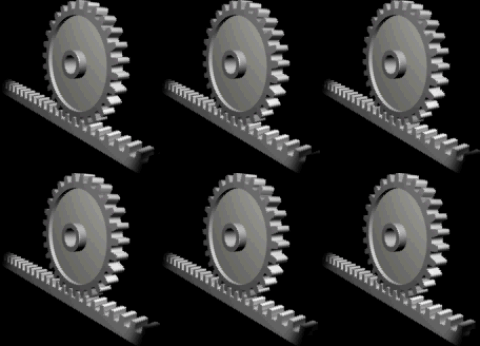
A rack and pinion is a type of linear actuator that comprises a pair of gears which convert rotational motion into linear motion. A circular gear called "the pinion" engages teeth on a linear "gear" bar called "the rack"; rotational motion applied to the pinion causes the rack to move, thereby...
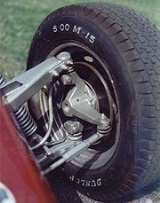
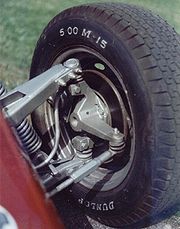
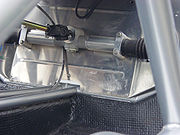
steering mechanisms, where the steering wheel turns the pinion gear; the pinion moves the rack, which is a linear gear that meshes with the pinion, converting circular motion into linear motion along the transverse axis of the car (side to side motion). This motion applies steering torque
Torque
Torque, moment or moment of force , is the tendency of a force to rotate an object about an axis, fulcrum, or pivot. Just as a force is a push or a pull, a torque can be thought of as a twist....
to the swivel pin ball joints that replaced previously used kingpin
Kingpin (mechanics)
The kingpin, also king-pin and king pin, is the main pivot in the steering mechanism of a car or other vehicle.Originally this was literally a steel pin on which the moveable, steerable wheel was mounted to the suspension. Free to rotate on a single axis, it limited the degrees of freedom of motion...
s of the stub axle of the steered wheels via tie rod
Tie rod
A tie rod is a slender structural unit used as a tie and capable of carrying tensile loads only.- Subtypes and examples of applications :* In airplane structures, tie rods are sometimes used in the fuselage or wings....
s and a short lever
Lever
In physics, a lever is a rigid object that is used with an appropriate fulcrum or pivot point to either multiply the mechanical force that can be applied to another object or resistance force , or multiply the distance and speed at which the opposite end of the rigid object travels.This leverage...
arm called the steering arm.
The rack and pinion design has the advantages of a large degree of feedback and direct steering "feel". A disadvantage is that it is not adjustable, so that when it does wear and develop lash
Backlash (engineering)
In mechanical engineering, backlash, sometimes called lash or play, is clearance between mating components, sometimes described as the amount of lost motion due to clearance or slackness when movement is reversed and contact is re-established...
, the only cure is replacement.
Older designs often use the recirculating ball
Recirculating ball
Recirculating ball, also known as recirculating ball and nut or worm and sector, is a steering mechanism commonly found in older automobiles, and some trucks...
mechanism, which is still found on trucks and utility vehicles. This is a variation on the older worm and sector design; the steering column turns a large screw (the "worm gear") which meshes with a sector of a gear, causing it to rotate about its axis as the worm gear is turned; an arm attached to the axis of the sector moves the Pitman arm
Pitman arm
The Pitman arm is a steering component in an automobile or truck.The Pitman arm is a linkage attached to the steering gear sector shaft, that converts the angular motion of the sector shaft into the linear motion needed to steer the wheels. The Pitman arm is supported by the sector shaft and...
, which is connected to the steering linkage and thus steers the wheels. The recirculating ball version of this apparatus reduces the considerable friction by placing large ball bearings between the teeth of the worm and those of the screw; at either end of the apparatus the balls exit from between the two pieces into a channel internal to the box which connects them with the other end of the apparatus, thus they are "recirculated".
The recirculating ball mechanism has the advantage of a much greater mechanical advantage
Mechanical advantage
Mechanical advantage is a measure of the force amplification achieved by using a tool, mechanical device or machine system. Ideally, the device preserves the input power and simply trades off forces against movement to obtain a desired amplification in the output force...
, so that it was found on larger, heavier vehicles while the rack and pinion was originally limited to smaller and lighter ones; due to the almost universal adoption of power steering
Power steering
Power steering helps drivers steer vehicles by augmenting steering effort of the steering wheel.Hydraulic or electric actuators add controlled energy to the steering mechanism, so the driver needs to provide only modest effort regardless of conditions. Power steering helps considerably when a...
, however, this is no longer an important advantage, leading to the increasing use of rack and pinion on newer cars. The recirculating ball design also has a perceptible lash, or "dead spot" on center, where a minute turn of the steering wheel in either direction does not move the steering apparatus; this is easily adjustable via a screw on the end of the steering box to account for wear, but it cannot be entirely eliminated because it will create excessive internal forces at other positions and the mechanism will wear very rapidly. This design is still in use in trucks and other large vehicles, where rapidity of steering and direct feel are less important than robustness, maintainability, and mechanical advantage. The much smaller degree of feedback with this design can also sometimes be an advantage; drivers of vehicles with rack and pinion steering can have their thumbs broken when a front wheel hits a bump, causing the steering wheel to kick to one side suddenly (leading to driving instructors telling students to keep their thumbs on the front of the steering wheel, rather than wrapping around the inside of the rim). This effect is even stronger with a heavy vehicle like a truck; recirculating ball steering prevents this degree of feedback, just as it prevents desirable feedback under normal circumstances.
The worm and sector was an older design, used for example in Willys and Chrysler vehicles, and the Ford Falcon (1960s).
Other systems for steering exist, but are uncommon on road vehicles. Children's toys and go-kart
Go-kart
thumb|A [[Kart racing|racing kart]] at the [[Commission Internationale de Karting|CIK-FIA]] European Championship 2008A go-kart is a small four-wheeled vehicle...
s often use a very direct linkage in the form of a bellcrank (also commonly known as a Pitman arm
Pitman arm
The Pitman arm is a steering component in an automobile or truck.The Pitman arm is a linkage attached to the steering gear sector shaft, that converts the angular motion of the sector shaft into the linear motion needed to steer the wheels. The Pitman arm is supported by the sector shaft and...
) attached directly between the steering column and the steering arms, and the use of cable-operated steering linkages (e.g. the Capstan and Bowstring
Capstan and Bowstring
The Capstan and Bowstring is a mechanism that converts rotary motion into linear motion and vice versa. It is very similar in function to a rack and pinion but operates on a different principle, being that of the Polelathe. It consists of a capstan which is a reel or pulley around which the...
mechanism) is also found on some home-built vehicles such as soapbox cars and recumbent tricycles.
Power steering
Power steering helps the driver of a vehicle to steer by directing some of the it's power to assist in swivelling the steered roadwheels about their steering axes. As vehicles have become heavier and switched to front wheel drive, particularly using negative offset geometry, along with increases in tire width and diameter, the effort needed to turn the wheels about their steering axis has increased, often to the point where major physical exertion would be needed were it not for power assistance. To alleviate this auto makers have developed power steeringPower steering
Power steering helps drivers steer vehicles by augmenting steering effort of the steering wheel.Hydraulic or electric actuators add controlled energy to the steering mechanism, so the driver needs to provide only modest effort regardless of conditions. Power steering helps considerably when a...
systems: or more correctly power-assisted steering—on road going vehicles there has to be a mechanical linkage as a fail safe. There are two types of power steering systems; hydraulic and electric/electronic. A hydraulic-electric hybrid system is also possible.
A hydraulic power steering (HPS) uses hydraulic pressure supplied by an engine-driven pump to assist the motion of turning the steering wheel. Electric power steering (EPS) is more efficient than the hydraulic power steering, since the electric power steering motor only needs to provide assistance when the steering wheel is turned, whereas the hydraulic pump must run constantly. In EPS, the amount of assistance is easily tunable to the vehicle type, road speed, and even driver preference. An added benefit is the elimination of environmental hazard posed by leakage and disposal of hydraulic power steering fluid. In addition, electrical assistance is not lost when the engine fails or stalls, whereas hydraulic assistance stops working if the engine stops, making the steering doubly heavy as the driver must now turn not only the very heavy steering—without any help—but also the power-assistance system itself.
Speed Sensitive Steering
An outgrowth of power steering is speed sensitive steering, where the steering is heavily assisted at low speed and lightly assisted at high speed. The auto makers perceive that motorists might need to make large steering inputs while manoeuvering for parking, but not while traveling at high speed. The first vehicle with this feature was the Citroën SMCitroën SM
The Citroën SM is a high-performance coupé produced by the French manufacturer Citroën from 1970 to 1975. The SM placed third in the 1971 European Car of the Year contest, trailing its stablemate Citroën GS, and won the 1972 Motor Trend Car of the Year award in the U.S. in 1972.-History:In 1961,...
with its Diravi
DIRAVI
DIRAVI is the name given by Citroën to its proprietary power steering system, first seen in 1970.DIRAVI is an acronym for "Direction à rappel asservi" literally meaning "steering with controlled return" more accurately described in English as "power steering with power assisted return". In the UK,...
layout, although rather than altering the amount of assistance as in modern power steering systems, it altered the pressure on a centring cam which made the steering wheel try to "spring" back to the straight-ahead position. Modern speed-sensitive power steering systems reduce the mechanical or electrical assistance as the vehicle speed increases, giving a more direct feel. This feature is gradually becoming more common.
Four-wheel steering
Four-wheel steering (or all-wheel steering) is a system employed by some vehicles to improve steering response, increase vehicle stability while maneuvering at high speed, or to decrease turning radiusTurning radius
The turning radius or turning circle of a vehicle is the size of the smallest circular turn that the vehicle is capable of making. The term turning radius is actually a misnomer, since the size of a circle is actually its diameter, not its radius. The less ambiguous term turning circle is preferred...
at low speed.
In most active four-wheel steering systems, the rear wheels are steered by a computer and actuators. The rear wheels generally cannot turn as far as the front wheels. Some systems, including Delphi's Quadrasteer
Quadrasteer
Quadrasteer is the name of a 4 wheel steering system developed by Delphi Corporation while under the ownership of General Motors for use in automobiles. It was available as an option on GM's full-size pickup trucks and 2500 suburbans for model years 2002 to 2005, inclusive...
and the system in Honda's Prelude line, allow the rear wheels to be steered in the opposite direction as the front wheels during low speeds. This allows the vehicle to turn in a significantly smaller radius—sometimes critical for large trucks
Pickup truck
A pickup truck is a light motor vehicle with an open-top rear cargo area .-Definition:...
or tractors and vehicles with trailers.
Many modern vehicles offer a form of passive rear steering to counteract normal vehicle tendencies. For example, Subaru used a passive steering system to correct for the rear wheel's tendency to toe-out. On many vehicles, when cornering, the rear wheels tend to steer slightly to the outside of a turn, which can reduce stability. The passive steering system uses the lateral forces generated in a turn (through suspension geometry) and the bushings
Bushing (isolator)
A bushing or rubber bushing is a type of vibration isolator. It provides an interface between two parts, damping the energy transmitted through the bushing. A common application is in vehicle suspension systems, where a bushing made of rubber separates the faces of two metal objects while allowing...
to correct this tendency and steer the wheels slightly to the inside of the corner. This improves the stability of the car, through the turn. This effect is called compliance understeer
Understeer
Understeer and oversteer are vehicle dynamics terms used to describe the sensitivity of a vehicle to steering. Simply put, oversteer is what occurs when a car turns by more than the amount commanded by the driver...
and it, or its opposite, is present on all suspensions. Typical methods of achieving compliance understeer are to use a Watt's Link
Watt's linkage
Watt's linkage is a type of mechanical linkage invented by James Watt in which the central moving point of the linkage is constrained to travel on an approximation to a straight line...
on a live rear axle, or the use of toe control bushings on a twist beam suspension
Twist-beam rear suspension
The twist-beam rear suspension, also known as torsion-beam axle is a type of automobile suspension based on a large H or C shaped member. The front of the H attaches to the body via rubber bushings, and the rear of the H carries each stub-axle assembly, on each side of the car...
. On an independent rear suspension it is normally achieved by changing the rates of the rubber bushings in the suspension. Some suspensions will always have compliance oversteer due to geometry, such as Hotchkiss live axles
Hotchkiss drive
The Hotchkiss drive is a system of power transmission. It was the dominant form of power transmission for front-engine, rear-wheel drive layout cars in the 20th century...
or a semi-trailing arm IRS.
Passive rear wheel steering is not a new concept, as it has been in use for many years, although not always recognised as such. For example, Jaguar independent rear suspension
Jaguar independent rear suspension
Jaguar's independent rear suspension unit has been a common component of a number of Jaguar production cars since 1961, passing through three major changes of configuration up to 2003 and still used in the full-sized Jaguar XJ...
incorporated a small amount of passive rear wheel steering since 1961.
Recent application
In an active four-wheel steering system, all four wheels turn at the same time when the driver steers. There can be controls to switch off the rear steer and options to steer only the rear wheel independent of the front wheels. At slow speeds (e.g. parking) the rear wheels turn opposite of the front wheels, reducing the turning radius by up to twenty-five percent, while at higher speeds both front and rear wheels turn alike (electronically controlled), so that the vehicle may change position with less yaw, enhancing straight-line stability. The "Snaking effect" experienced during motorway drives while towing a travel trailerTravel trailer
A travel trailer or caravan is towed behind a road vehicle to provide a place to sleep which is more comfortable and protected than a tent . It provides the means for people to have their own home on a journey or a vacation, without relying on a motel or hotel, and enables them to stay in places...
is thus largely nullified. Four-wheel steering found its most widespread use in monster trucks, where maneuverability in small arenas is critical, and it is also popular in large farm
Farm
A farm is an area of land, or, for aquaculture, lake, river or sea, including various structures, devoted primarily to the practice of producing and managing food , fibres and, increasingly, fuel. It is the basic production facility in food production. Farms may be owned and operated by a single...
vehicles and truck
Truck
A truck or lorry is a motor vehicle designed to transport cargo. Trucks vary greatly in size, power, and configuration, with the smallest being mechanically similar to an automobile...
s. Some of the modern European Intercity buses also utilize four-wheel steering to assist maneuverability in bus terminals, and also to improve road stability.
General Motors offers Delphi's Quadrasteer
Quadrasteer
Quadrasteer is the name of a 4 wheel steering system developed by Delphi Corporation while under the ownership of General Motors for use in automobiles. It was available as an option on GM's full-size pickup trucks and 2500 suburbans for model years 2002 to 2005, inclusive...
in their consumer Silverado
Chevrolet Silverado
The Chevrolet Silverado , is the latest line of full-size pickup trucks from General Motors.-History:...
/Sierra and Suburban
Chevrolet Suburban
Chevrolet offered a station wagon body, built on the 1/2 ton truck frame. This model was specifically built for National Guard units and Civilian Conservation Corps units. Much of the body was constructed from wood, and could seat up to eight occupants....
/Yukon
Chevrolet Tahoe
The Chevrolet Tahoe are full-size SUVs from General Motors. Chevrolet and GMC sold two different-sized SUVs under their Blazer/Jimmy model names through the early 1990s. This situation changed when GMC rebadged the full-size Jimmy as the Yukon in 1992...
. However, only 16,500 vehicles have been sold with this system since its introduction in 2002 through 2004. Due to this low demand, GM discontinued the technology at the end of the 2005 model year.
Previously, Honda
Honda
is a Japanese public multinational corporation primarily known as a manufacturer of automobiles and motorcycles.Honda has been the world's largest motorcycle manufacturer since 1959, as well as the world's largest manufacturer of internal combustion engines measured by volume, producing more than...
had four-wheel steering as an option in their 1987–2000 Prelude
Honda Prelude
The Honda Prelude was a sports coupe produced by Japanese automaker Honda from 1978 until 2001. It replaced the Honda S800, a front-engined, front wheel drive sports car...
and Honda Ascot Innova models (1992–1996). Mazda
Mazda
is a Japanese automotive manufacturer based in Fuchū, Aki District, Hiroshima Prefecture, Japan.In 2007, Mazda produced almost 1.3 million vehicles for global sales...
also offered four-wheel steering on the 626
Mazda 626
The Mazda 626 is an automobile that was produced by Mazda for the export market. It was based on the Japan-market Mazda Capella. The 626 replaced the 616/618 and RX-2 in 1979 and was sold through 2002, when the new Mazda6 took over as Mazda's large family car...
and MX6
Mazda MX-6
The first generation MX-6 appeared in 1988 and lasted until 1992 in the United States. In some markets the model years were from 1987 to 1991. It was based on a series of futuristic sports compact concept cars of the early 1980s...
in 1988.
A new "Active Drive" system is introduced on the 2008 version of the Renault Laguna
Renault Laguna
The Renault Laguna is a large family car produced by the French manufacturer Renault. The first Laguna was launched in 1993, the second generation was launched in 2000, and the third generation was made available for sale in October 2007....
line. It was designed as one of several measures to increase security and stability. The Active Drive should lower the effects of under steer and decrease the chances of spinning by diverting part of the G-forces generated in a turn from the front to the rear tires. At low speeds the turning circle can be tightened so parking and maneuvering is easier.
Production cars with active four wheel steering
- BMW 850CSi (optional)
- BMW 7-Series (2009 onwards, part of sport package)
- Chevrolet SilveradoChevrolet SilveradoThe Chevrolet Silverado , is the latest line of full-size pickup trucks from General Motors.-History:...
(2002–2005) (high and low speed) - Efini MS-9 (high and low speed)
- GMC Sierra (2002–2005) (high and low speed)
- GMC Sierra Denali (2002–2004) (high and low speed)
- Honda PreludeHonda PreludeThe Honda Prelude was a sports coupe produced by Japanese automaker Honda from 1978 until 2001. It replaced the Honda S800, a front-engined, front wheel drive sports car...
(high and low speed, mechanical from 1987 to 1991, computerized from 1992–2001) - Honda AccordHonda AccordThe Honda Accord is a series of compact, mid-size and full-size automobiles manufactured by Honda since 1976, and sold in a majority of automotive markets throughout the world....
(1991) (high and low speed, mechanical) - Honda Ascot Innova (1992) (high and low speed, computerized from 1992–1996)
- Infiniti FX50 AWD (option on Sports package) (2008–Present) (high and low speed, fully electronic)
- Infiniti G35 SedanInfiniti GThe Infiniti G is a compact executive/entry-level luxury car produced by Nissan's luxury brand Infiniti. The first two generations of the Infiniti G were sedans based on the Nissan Primera. Beginning with its third generation , the Infiniti G have been rebadged versions of the Nissan Skyline line...
(option on Sport models) (2007–Present) (high speed only?) - Infiniti G35 CoupeInfiniti GThe Infiniti G is a compact executive/entry-level luxury car produced by Nissan's luxury brand Infiniti. The first two generations of the Infiniti G were sedans based on the Nissan Primera. Beginning with its third generation , the Infiniti G have been rebadged versions of the Nissan Skyline line...
(option on Sport models) (2006–Present) (high speed only) - Infiniti G37
- Infiniti J30t (touring package) (1993–1994)
- Infiniti M35 (option on Sport models) (2006–Present) (high speed only?)
- Infiniti M45 (option on Sport models) (2006–Present) (high speed only?)
- Infiniti Q45Infiniti Q45The Infiniti Q45 was a full-size luxury car sold by Nissan's Infiniti marque from 1990 until 2006. It is a rear wheel drive, four-door sedan powered by a V8 engine. Early generations were based on the automaker's Japanese-market flagship sedan, the Nissan President, while models produced after 1997...
t (1989–1994) (high speed only?) - Mazda 929Mazda 929The Mazda 929 was originally a mid-size car from 1973–1987 and as a full-size car thereafter. Marketed over three decades, the 929 was originally the export name for the Mazda Luce. When equipped with a rotary engine, it was called the Mazda RX-4 in export markets...
(1992–1995)(computerised, high and low speed)(all models) - Mazda 626Mazda 626The Mazda 626 is an automobile that was produced by Mazda for the export market. It was based on the Japan-market Mazda Capella. The 626 replaced the 616/618 and RX-2 in 1979 and was sold through 2002, when the new Mazda6 took over as Mazda's large family car...
(1988) (high and low speed) - Mazda MX-6Mazda MX-6The first generation MX-6 appeared in 1988 and lasted until 1992 in the United States. In some markets the model years were from 1987 to 1991. It was based on a series of futuristic sports compact concept cars of the early 1980s...
(1989–1997) (high and low speed) - Mazda RX-7Mazda RX-7Series 1 is commonly referred to as the "SA22C" from the first alphanumerics of the vehicle identification number. This series of RX-7 had exposed steel bumpers and a high-mounted indentation-located license plate, called by Werner Buhrer of Road & Track magazine a "Baroque depression."In 1980...
(optional, computerized, high and low speed) - Mazda Eunos 800 (1996–2003) (Optional, computerized, high and low speed)
- Mitsubishi GalantMitsubishi GalantThe first generation of the car, initially known as the Colt Galant, was released in December 1969. The design was dubbed "Dynawedge" by Mitsubishi, referring to the influence of aerodynamics on the silhouette. Three models were available, powered by the new 'Saturn' engine in 1.3 or 1.5 L ...
/Sigma (high speed only) - Mitsubishi GTOMitsubishi GTOThe Mitsubishi GTO is a sports car built by Japanese automaker Mitsubishi Motors between 1990 and 2001. In most export markets it was rebadged as a Mitsubishi 3000GT. It was also sold by Chrysler in North America as a Dodge Stealth captive import from the 1991 to 1996 model years with only minor...
(also sold as the Mitsubishi 3000GT and the Dodge Stealth) (Mechanical) (high speed only) - Nissan CefiroNissan CefiroThe Nissan Cefiro is a intermediate-size automobile range sold in Japan and other countries. The 1989 model was introduced initially as a 4-door sedan, however a wagon was later produced. A large proportion were equipped with automatic transmissions....
(A31) (high speed only) - Nissan 240SXNissan 240SXThe 240SX is a two-door compact car that was introduced to the North American market by Nissan in 1988 for the following model year. It replaced the outgoing 200SX model. Most of the 240SX were equipped with the 2.4-liter inline 4 engine . The KA24E being single over-head cam and KA24DE being dual...
/Silvia (option on SE models) (high speed only) - Nissan 300ZXNissan 300ZXThe Z31 chassis designation was first introduced in 1983 as a 1984 Nissan/Datsun 300ZX in the US only. The 300ZX, as its predecessors, was known as a Nissan in other parts of the world. This continued in the US until 1985 model year when Nissan standardized their brand name worldwide and dropped...
(all Twin-Turbo Z32 models) (high speed only) - Nissan LaurelNissan LaurelIn April 1968 Nissan presented its new Laurel in four-door deLuxe and Super deLuxe versions, both equipped with a 1.8 L inline-four cylinder engine and independent rear suspension. In summer 1970 a hardtop coupé joined the line-up, one year later a 2000 cc engine became available...
(later versions) (high speed only) - Nissan FugaNissan FugaThe Fuga is a full-size sedan, rear wheel drive with optional all wheel drive, produced by Nissan of Japan since October 2004 and now in its second generation. It is built on a wider, stretched wheelbase version of the Nissan FM platform. After the Nissan Cima and Nissan President were...
/Infiniti MInfiniti MThe "M" nameplate has been used on various mid-luxury cars from the Infiniti luxury division of Nissan.The first iteration was the M30 Coupe/Convertible, which were rebadged JDM Nissan Leopard....
(high speed only) - Nissan SilviaNissan SilviaThe S12 was produced from 1984 to 1988, with revisions to the exterior trim in 1987 . It was sold in three configurations—a coupe , a hatchback, and a widebody chassis called grandprix .A number of different engines were equipped in the S12 chassis, depending on production year and more...
(option on all S13 models) (high speed only) - Nissan SkylineNissan SkylineThe first Skyline was introduced in April 1957, by the Prince Motor Company, and was marketed as a luxury car. It featured a 1.5 L GA-30 engine producing 44 kW @ 4400 rpm. It used a de Dion tube rear suspension and was capable of 140 km/h . The car weighed around 1300 kg...
GTS, GTS-R, GTS-X (1986) (high speed only) - Nissan Skyline GT-RNissan Skyline GT-RThe Nissan Skyline GT-R is a Japanese sports car based on the Nissan Skyline range.The first GT-Rs were produced from 1969–1973. After a 16 year hiatus since the KPGC110 in 1972, the GT-R name was revived in 1989 with the Skyline R32. This car was nicknamed "Godzilla" by the Australian motoring...
(high and low speed) - Renault LagunaRenault LagunaThe Renault Laguna is a large family car produced by the French manufacturer Renault. The first Laguna was launched in 1993, the second generation was launched in 2000, and the third generation was made available for sale in October 2007....
(only in GT version of 3rd generation which was launched October 2007, GT launched on April 2008) - Subaru Alcyone SVXSubaru Alcyone SVXThe Subaru Alcyone SVX, also known outside of its home market Japan as the Subaru SVX, is a two-door grand tourer coupé that was sold by Subaru, the automobile manufacturing division of Japanese transportation conglomerate Fuji Heavy Industries . Produced from 1991 to 1997, it was FHI's first...
JDM (1991–1996) (Japanese version: "L-CDX" only) (high speed only) - Toyota Aristo (1997) (high and low speed?)
- Toyota CamryToyota CamryThe Toyota Camry is a series of mid-size automobiles manufactured by Toyota since 1982, and sold in the majority of automotive markets throughout the world...
/ VistaToyota VistaThe Toyota Vista is a compact car launched in 1982 as a sister nameplate to the Camry by Toyota in Japan. The name was introduced to tie in with the Toyota Vista dealership network, and launched around the same time...
JDM 1988–1999 (Optional) - Toyota CelicaToyota CelicaThe Toyota Celica name has been applied to a series of coupes made by the Japanese company Toyota. The name is ultimately derived from the Latin word coelica meaning "heavenly" or "celestial"....
(option on 5th and 6th generation, 1990–1993 ST183 and 1994–1997 ST203) (Dual-mode, high and low speed) - Toyota SoarerToyota SoarerThe Soarer made its first appearance at the 1980 Osaka International Motor Show with the name "EX-8", and the Z10 series Toyota Soarer was produced from February 1981 to December 1985, with 2.0L, 2.8L or 3.0L DOHC I-6 variants. The first generation Soarer debuted with a rear-wheel drive...
(UZZ32)
Articulated steering

Hydraulic cylinder
A Hydraulic cylinder is a mechanical actuator that is used to give a unidirectional force through a unidirectional stroke. It has many applications, notably in engineering vehicles.- Operation :...
s that change the angle between the halves, including the front and rear axles and wheels, thus steering the vehicle. This system does not use steering arms, king pins, tie rods, etc. as does four-wheel steering. If the vertical hinge is placed equidistant between the two axles, it also eliminates the need for a central differential
Differential (mechanics)
A differential is a device, usually, but not necessarily, employing gears, capable of transmitting torque and rotation through three shafts, almost always used in one of two ways: in one way, it receives one input and provides two outputs—this is found in most automobiles—and in the other way, it...
, as both front and rear axles will follow the same path, and thus rotate at the same speed.
Rear wheel steering
A few types of vehicle use only rear wheel steering, notably fork lift trucks, early pay loadersLoader (equipment)
A loader is a heavy equipment machine often used in construction, primarily used to load material into or onto another type of machinery .-Heavy equipment front loaders:A loader A loader is a heavy equipment machine often used in construction, primarily used to load material (such as asphalt,...
, Buckminster Fuller
Buckminster Fuller
Richard Buckminster “Bucky” Fuller was an American systems theorist, author, designer, inventor, futurist and second president of Mensa International, the high IQ society....
's Dymaxion car
Dymaxion car
thumb|The Dymaxion car designed by inventor–architect [[Buckminster Fuller]].The Dymaxion car was a concept car designed by U.S. inventor and architect Buckminster Fuller in 1933. The word Dymaxion is a brand name that Fuller gave to several of his inventions, to emphasize that he considered them...
, and the ThrustSSC
ThrustSSC
ThrustSSC, also spelt Thrust SSC by secondary sources, is a British jet-propelled car developed by Richard Noble, Glynne Bowsher, Ron Ayers and Jeremy Bliss....
.
Rear wheel steering can tend to be unstable because in turns the steering geometry tends to decrease the turn radius (oversteer), rather than increase it (understeer). A rear wheel steered automobile exhibits non-minimum phase behavior. It turns in the direction opposite of how it is initially steered. A rapid steering input will cause two accelerations, first in the direction that the wheel is steered, and then in the opposite direction: a "reverse response." This makes it harder to steer a rear wheel steered vehicle at high speed than a front wheel steered vehicle.
Steer-by-wire
The aim of steer-by-wire technology is to completely do away with as many mechanical components (steering shaft, column, gear reduction mechanism, etc.) as possible. Completely replacing conventional steering system with steer-by-wire holds several advantages, such as:- The absence of steering column simplifies the car interior design.
- The absence of steering shaft, column and gear reduction mechanism allows much better space utilization in the engine compartment.
- The steering mechanism can be designed and installed as a modular unit.
- Without mechanical connection between the steering wheel and the road wheel, it is less likely that the impact of a frontal crash will force the steering wheel to intrude into the driver's survival space.
- Steering system characteristics can easily and infinitely be adjusted to optimize the steering response and feel.
As of 2007 there are no production cars available that rely solely on steer-by-wire technology due to safety, reliability and economic concerns, but this technology has been demonstrated in numerous concept cars and the similar fly-by-wire
Fly-by-wire
Fly-by-wire is a system that replaces the conventional manual flight controls of an aircraft with an electronic interface. The movements of flight controls are converted to electronic signals transmitted by wires , and flight control computers determine how to move the actuators at each control...
technology is in use in both military and civilian aviation applications. Removing the mechanical steering linkage in road going vehicles would require new legislation in most countries.
Safety
For safety reasons all modern cars feature a collapsible steering column (energy absorbing steering column) which will collapse in the event of a heavy frontal impact to avoid excessive injuries to the driver. Airbags are also generally fitted as standard. Non-collapsible steering columns fitted to older vehicles very often impaledImpalement
Impalement is the traumatic penetration of an organism by an elongated foreign object such as a stake, pole, or spear, and this usually implies complete perforation of the central mass of the impaled body...
drivers in frontal crashes, particularly when the steering box or rack was mounted in front of the front axle line, at the front of the crumple zone
Crumple zone
The crumple zone is a structural feature mainly of automobiles. Crumple zones have also been incorporated into railcars in recent years.They are designed to absorb the energy from the impact during an accident by controlled deformation. This energy is much higher than is commonly recognized...
. This was particularly a problem on vehicles that had a rigid separate chassis frame, with no crumple zone. Most modern vehicle steering boxes/racks are mounted behind the front axle on the front bulkhead, at the rear of the front crumple zone.
Audi
Audi
Audi AG is a German automobile manufacturer, from supermini to crossover SUVs in various body styles and price ranges that are marketed under the Audi brand , positioned as the premium brand within the Volkswagen Group....
used a retractable steering wheel and seat belt tensioning system called procon-ten
Procon-ten
procon-ten is a proprietary Safety Restraint System , used by German car manufacturer Audi, from 1986 until the mid-1990s....
, but it has since been discontinued in favor of airbags and pyrotechnic seat belt pre-tensioners.
Collapsible steering columns were invented by Bela Barenyi
Bela Barenyi
Béla Barényi was a Hungarian-Austrian engineer, regarded as the father of passive safety in automobiles. He was born in Hirtenberg near Vienna during the Austro-Hungarian Empire...
and were introduced in the 1959 Mercedes-Benz W111
Mercedes-Benz W111
The Mercedes-Benz W111 was a chassis code given to its top-range vehicles, including 4-door sedans, produced from 1959 to 1968, and 2-door coupes and cabriolets from 1961 to 1971. The W111, was initially attributed only to 6-cylinder cars with 2.2 litre engines. The luxury version with big-block 3...
Fintail, along with crumple zones.
This safety feature first appeared on cars built by General Motors after an extensive and very public lobbying
Lobbying
Lobbying is the act of attempting to influence decisions made by officials in the government, most often legislators or members of regulatory agencies. Lobbying is done by various people or groups, from private-sector individuals or corporations, fellow legislators or government officials, or...
campaign enacted by Ralph Nader
Ralph Nader
Ralph Nader is an American political activist, as well as an author, lecturer, and attorney. Areas of particular concern to Nader include consumer protection, humanitarianism, environmentalism, and democratic government....
.
Ford started to install collapsible steering columns in 1968.
Cycles
Steering is crucial to the stability of bicycles and motorcycles. For details, see articles on bicycle and motorcycle dynamicsBicycle and motorcycle dynamics
Bicycle and motorcycle dynamics is the science of the motion of bicycles and motorcycles and their components, due to the forces acting on them. Dynamics is a branch of classical mechanics, which in turn is a branch of physics. Bike motions of interest include balancing, steering, braking,...
and countersteering
Countersteering
Countersteering is the technique used by single-track vehicle operators, such as cyclists and motorcyclists, to initiate a turn toward a given direction by momentarily steering counter to the desired direction...
.
Ship and boat steering
Ships and boats are usually steered with a rudderRudder
A rudder is a device used to steer a ship, boat, submarine, hovercraft, aircraft or other conveyance that moves through a medium . On an aircraft the rudder is used primarily to counter adverse yaw and p-factor and is not the primary control used to turn the airplane...
. Depending on the size of the vessel, rudders can be manually actuated, or operated using a servomechanism
Servomechanism
thumb|right|200px|Industrial servomotorThe grey/green cylinder is the [[Brush |brush-type]] [[DC motor]]. The black section at the bottom contains the [[Epicyclic gearing|planetary]] [[Reduction drive|reduction gear]], and the black object on top of the motor is the optical [[rotary encoder]] for...
, or a trim tab/servo tab
Servo tab
A servo tab is a small hinged device installed on an aircraft control surface to assist the movement of the control surface.-Servo tabs:...
system.
See also
- Bump SteerBump SteerBump steer is the term for the tendency of a wheel to steer as it moves upwards into jounce. It is typically measured in degrees per metre or degrees per foot....
- Camber angleCamber anglethumb|100px|From the front of the car, a right wheel with a negative camber angleCamber angle is the angle made by the wheels of a vehicle; specifically, it is the angle between the vertical axis of the wheels used for steering and the vertical axis of the vehicle when viewed from the front or...
- Camber thrustCamber thrustCamber thrust and camber force are terms used to describe the force generated perpendicular to the direction of travel of a rolling tire due to its camber angle and finite contact patch...
- Caster angleCaster anglethumb|250px|θ is the caster angle, the red line is the pivot line, and the grey area is the tire.Caster angle or castor angle is the angular displacement from the vertical axis of the suspension of a steered wheel in a car, bicycle or other vehicle, measured in the longitudinal direction...
- DIRAVIDIRAVIDIRAVI is the name given by Citroën to its proprietary power steering system, first seen in 1970.DIRAVI is an acronym for "Direction à rappel asservi" literally meaning "steering with controlled return" more accurately described in English as "power steering with power assisted return". In the UK,...
- Dry steeringDry steeringDry steering is the act of turning the steering wheel or rotating the steer wheels of a vehicle on the Z axis by some other means, while the vehicle is stationary....
- Kingpin
- Power steeringPower steeringPower steering helps drivers steer vehicles by augmenting steering effort of the steering wheel.Hydraulic or electric actuators add controlled energy to the steering mechanism, so the driver needs to provide only modest effort regardless of conditions. Power steering helps considerably when a...
- Skid steer
- Steer-by-wire
- Steering kickbackSteering kickbackSteering kickback relates to the sharp and rapid movements of an automobile's steering wheel as the front wheels encounter a significant obstruction or imperfection in the road...
- Steering law
- Steering ratioSteering ratioSteering ratio refers to the ratio between the turn of the steering wheel or handlebars and the turn of the wheels .The steering ratio, is the amount of degrees you have to turn the steering wheel, for the wheels to turn an amount of degrees.In motorcycles and bicycles, the steering ratio is...
- Steering wheel (ship)
- Steering wheel cover
- TillerTillerA tiller or till is a lever attached to a rudder post or rudder stock of a boat that provides leverage for the helmsman to turn the rudder...
- Torque steeringTorque steeringTorque steering is the influence of engine torque on the steering for some front-wheel drive vehicles. For example, during heavy acceleration the steering may pull to one side, which may be disturbing to the driver. The effect is manifested either as a tugging sensation in the steering wheel, or a...
- Vehicle dynamicsVehicle dynamicsVehicle dynamics refers to the dynamics of vehicles, here assumed to be ground vehicles. Vehicle dynamics is a part of engineering primarily based on classical mechanics but it may also involve chemistry, solid state physics, electrical engineering, communications, psychology, control theory,...