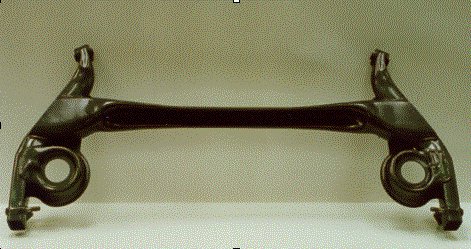
Twist-beam rear suspension

Encyclopedia
The twist-beam rear suspension, also known as torsion-beam axle is a type of automobile suspension
based on a large H or C shaped member. The front of the H attaches to the body via rubber bushings, and the rear of the H carries each stub-axle assembly, on each side of the car. The cross beam of the H holds the two trailing arms together, and provides the roll stiffness
of the suspension, by twisting as the two trailing arms move vertically, relative to each other.
The coil springs usually bear on a pad alongside the stub-axle. Often the shock is colinear with the spring, to form a coilover. This location gives them a very high motion ratio compared with most suspensions, which improves their performance, and reduces their weight.
The longitudinal location of the cross beam controls important parameters of the suspension's behaviour, such as the roll steer curve and toe
and camber
compliance. The closer the cross beam to the axle stubs the more the camber and toe changes under deflection. A key difference between the camber and toe changes of a twist beam vs independent suspension is the change in camber and toe is dependent on the position of the other wheel, not the car's chassis. In a traditional independent suspension the camber and toe are based on the position of the wheel relative to the body. If both wheels compress together their camber and toe will not change. Thus if both wheels started perpendicular to the road and car compressed together they will stay perpendicular to the road. The camber and toe changes are the result of one wheel being compressed relative to the other.
This suspension is commonly used on a wide variety of front wheel drive cars (mainly compacts and subcompacts), and was almost ubiquitous on European superminis
. It dates at least to the Saab 95
and 96
, which were produced from 1960 until 1978 and 1980, respectively.
This suspension is usually described as semi-independent, meaning that the two wheels can move relative to each other, but their motion is still somewhat inter-linked, to a greater extent than in a true independent rear suspension (IRS). This can mildly compromise the handling of the vehicle, and Volkswagen
dropped the torsion beam in favour of a true IRS for the Volkswagen Golf Mk5
, possibly in response to the Ford Focus' Control Blade rear suspension.
Suspension (vehicle)
Suspension is the term given to the system of springs, shock absorbers and linkages that connects a vehicle to its wheels. Suspension systems serve a dual purpose — contributing to the car's roadholding/handling and braking for good active safety and driving pleasure, and keeping vehicle occupants...
based on a large H or C shaped member. The front of the H attaches to the body via rubber bushings, and the rear of the H carries each stub-axle assembly, on each side of the car. The cross beam of the H holds the two trailing arms together, and provides the roll stiffness
Sway bar
A sway bar or anti-roll bar or stabilizer bar is a part of an automobile suspension that helps reduce the roll of a vehicle that is induced by cornering or road irregularities. It connects opposite wheels together through short lever arms linked by a torsion spring...
of the suspension, by twisting as the two trailing arms move vertically, relative to each other.
The coil springs usually bear on a pad alongside the stub-axle. Often the shock is colinear with the spring, to form a coilover. This location gives them a very high motion ratio compared with most suspensions, which improves their performance, and reduces their weight.
The longitudinal location of the cross beam controls important parameters of the suspension's behaviour, such as the roll steer curve and toe
Toe (automotive)
In automotive engineering, toe, also known as tracking, is the symmetric angle that each wheel makes with the longitudinal axis of the vehicle, as a function of static geometry, and kinematic and compliant effects. This can be contrasted with steer, which is the antisymmetric angle, i.e. both...
and camber
Camber angle
thumb|100px|From the front of the car, a right wheel with a negative camber angleCamber angle is the angle made by the wheels of a vehicle; specifically, it is the angle between the vertical axis of the wheels used for steering and the vertical axis of the vehicle when viewed from the front or...
compliance. The closer the cross beam to the axle stubs the more the camber and toe changes under deflection. A key difference between the camber and toe changes of a twist beam vs independent suspension is the change in camber and toe is dependent on the position of the other wheel, not the car's chassis. In a traditional independent suspension the camber and toe are based on the position of the wheel relative to the body. If both wheels compress together their camber and toe will not change. Thus if both wheels started perpendicular to the road and car compressed together they will stay perpendicular to the road. The camber and toe changes are the result of one wheel being compressed relative to the other.
This suspension is commonly used on a wide variety of front wheel drive cars (mainly compacts and subcompacts), and was almost ubiquitous on European superminis
Supermini car
A supermini is a British term that describes automobiles larger than a city car but smaller than a small family car. This car class is also known as the B-segment across Europe, and as subcompact in North America....
. It dates at least to the Saab 95
Saab 95
The Saab 95 was a 7-seater, 2-door station wagon made by Saab. Initially it was based on the Saab 93 sedan version, but the model's development throughout the years followed closely that of the 96 since the 93 was put off the market in 1960...
and 96
Saab 96
For the modern car, see Saab 9-6The Saab 96 is an automobile made by Saab. It was introduced in 1960 and was produced until January 1980, a run of 20 years. Like the 93 it replaced, the 96 was a development from the old Saab 92 chassis and, on account of its improvements and modernisation, it...
, which were produced from 1960 until 1978 and 1980, respectively.
This suspension is usually described as semi-independent, meaning that the two wheels can move relative to each other, but their motion is still somewhat inter-linked, to a greater extent than in a true independent rear suspension (IRS). This can mildly compromise the handling of the vehicle, and Volkswagen
Volkswagen
Volkswagen is a German automobile manufacturer and is the original and biggest-selling marque of the Volkswagen Group, which now also owns the Audi, Bentley, Bugatti, Lamborghini, SEAT, and Škoda marques and the truck manufacturer Scania.Volkswagen means "people's car" in German, where it is...
dropped the torsion beam in favour of a true IRS for the Volkswagen Golf Mk5
Volkswagen Golf Mk5
The fifth generation Volkswagen Golf Mk5 , built on the Volkswagen Group A5 platform was unveiled at the Frankfurt Motor Show in October 2003 and went on sale in Europe one month later. To commemorate this, Wolfsburg was renamed "Golfsburg" for a week. It reached North American markets in June...
, possibly in response to the Ford Focus' Control Blade rear suspension.
Advantages
- Can be durable
- Simple
- Neat package, reduces clutter under floor
- Fairly light weight
- Springs and shocks can be light and cheap
- No need for a separate sway barSway barA sway bar or anti-roll bar or stabilizer bar is a part of an automobile suspension that helps reduce the roll of a vehicle that is induced by cornering or road irregularities. It connects opposite wheels together through short lever arms linked by a torsion spring...
Disadvantages
- Basic toe vs lateral force characteristic is oversteer
- Since toe characteristics may be unsuitable, adding toe-control bushings may be expensive.
- Camber characteristics are very limited.
- Not very easy to adjust roll stiffness
- Welds see a lot of fatigue, may need a lot of development
- Not much recession compliance - can be poor for impact harshness, and will cause unwelcome toe changes (steer effects)
- Wheel moves forward as it rises, can also be poor for impact harshness (this can be negated by designing the beam with the mounts higher than the stub axles, which impacts on the floorpan height, and causes more roll oversteer)
- Need to package room for exhaust and so on past the cross beam
- Camber compliance may be high