


Nissan Skyline

Encyclopedia
The first Skyline was introduced in April 1957, by the Prince Motor Company
, and was marketed as a luxury car. It featured a 1.5 L (1482 cc) GA-30 engine producing 44 kW (60 hp
) @ 4400 rpm. It used a de Dion tube
rear suspension and was capable of 140 km/h (87 mph). The car weighed around 1300 kg. Prince Skylines were produced as four door sedans and five door station wagons.
The Skyline also spawned a pickup truck
and a delivery van called the Prince Skyway
.
This model was powered by a slightly altered 1.5 L engine known as the GA-4 OHV (1484 cc) producing about 70 hp @ 4800 rpm and was produced through 1961.
In 1962, this model was restyled as the S21D/S series.
and convertible
versions. These cars used the 1.9 L (1862 cc/113 in³) GB-30 engine, producing 96 hp (72 kW) and 113.5 ft·lbf (154 N m). While only a few hundred were built, Prince Motors had a very aggressive product placement group and they can be seen (along the company's mainstream models) in many Toho films of the early 1960s.
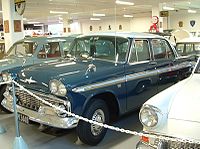

after the 1954 merger, and the S50 series was launched, which like its predecessor, came in sedan and wagon bodystyles. This was the second generation car, and became one of the more desirable cars in Japan. It was powered by the G-1 engine, a 70 hp (52 kW) version of the old GA-4. A 1862 cc engine was also available, delivering 91 hp. The S50 series were available with a 3-speed column shift transmission or a 4-speed floor shift transmission, as well as a 4-door sedan (S50) or a 5-door wagon (W50).
Three models of the S50 were built: S50E (1962–1965), S50E-2 (1965–1966), and S50E-3 (1967). All three used the same engines.
The S50 was further developed with new styling for 1963, and was sold in some markets with an A150 designation. The S50 was also sold as the A190D, which was equipped with a diesel engine.
In 1966, Nissan and Prince merged and the S50 also appeared with Nissan Prince Skyline badging. This model lasted in production through 1967. In 1967, the S50E-3 was introduced. It was sold as Prince Skyline, Prince A150, PMC A150, or Nissan A150.
 Prince
created a racing GT Skyline in May 1964. It was based on the S54 and used the larger 6-cylinder G-7 engine from the Gloria S41, though the car needed an 8" extension to the wheelbase (all forward of the cowl/firewall) to provide space in the engine bay for the lankier in-line six. When it entered the 2nd Japanese Grand prix they hoped to win the GT-II class. Competitive against the Porsche 904
, the Skyline managed 2nd through to 6th places.
Largely due to the success of the race vehicle, the Prince Skyline 2000GT (also called GT-A, GT-B, S54A and S54B) was released to the Japanese market. There were two versions produced:
The B model featured three Weber
40DCOE-18 carburetors, a limited slip differential
, 5-speed close ratio manual transmission
, and power brakes. Both the B and A used front disc brake
s with dual pistons and alloy finned drums in the rear.
 The C10 series of 1968, which began its development under Prince at the company's Ogikubo R&D centre in the suburbs of Tokyo, was marketed with a Nissan badge. By the time the C10 went on sale, the Prince nameplate had been completely phased out on cars and trucks. The dealer network selling the cars became the Prince channel of Nissan, and the marketing group stayed at the Prince headquarters in Mita instead of moving to Nissan's headquarters in Ginza. The C10 Skyline was launched with Prince's 1.5 L OHC G15 I4 like the S57. A 1.8 L G18 version was also available.
A station wagon variant, known previously as the Prince Skyway
, was offered with this generation. A hardtop coupé was introduced in October 1970.
I6. This new DOHC engine (which was designed by the former Prince engineers) produced 160 hp (118 kW, 180 N m), and was similar to the GR8 engine used in the Prince R380
racing car.
The GT-R began as a sedan, but a 2-door coupé version was debuted in October 1970 and introduced in March 1971. The cars were stripped of unnecessary equipment to be as light as possible for racing, and performed well at the track. The sedan racked up 33 victories in less than two years, and the coupé stretched this to 50 through 1972.
The C10 raced against many cars including the Toyota 1600 GT (RT55), Isuzu Bellett
GTR, Mazda Familia
(R100) & Capella
(RX-2
) – even Porsche
. In late 1971 the new Mazda RX-3
became the GT-R's main rival. The GT-R managed a few more victories before the RX-3 ended the GT-R's winning streak.
Models:

 The C110 generation was produced from 1972 through 1977.
For export in the 1970s, the C110 and GC110 Skyline was sold as the Datsun
K-series, with models such as the Datsun 160K, 180K and Datsun 240K.
The body styles were, once again, four-door sedan, two-door hardtop coupé, and five-door station wagon. The C110 was more fussy in its styling than its predecessor, particularly so in wagon form, where unusually for a wagon design, no windows were fitted between the C and D pillars. The C110 was the first version to feature the round rear lights, typical of later Skyline designs.
The C110 Skyline was better known as the "Ken & Mary" or "Kenmeri" (ケンメリ) Skyline, stemming from the advertisement campaign in Japan at the time which featured a young couple (Ken and Mary) who relaxed and enjoyed the countryside in Ken and Mary's Skyline (ケンとメリーのスカイライン). The ads were highly successful and perhaps as a result the C110 was sold in very large numbers in Japan. It sold just as well in Australia (in a 2.4L 6-cylinder form, badged as "Datsun 240K") , though few survive today. There, the 240K was about the same price as a Ford Falcon
GT or BMW 5 series
, around $5000.
Models:

A rare variant would be the wagon version, which had a unique styling treatment behind the rear doors, of a much smaller window than usual between the C and D pillars.
The GT-EX replaced the GT-R with a turbocharged engine, the L20ET
. This was the first turbo engine to power a Japanese production vehicle . One notable aspect of the turbo versions was that they were not intercooled and there was no form of blowoff valve
, only an emergency pressure release valve.
The "T" designation on the L16T and L18T does not signify a turbocharger was included; it denotes that those engines came with twin carburetors.
Models:
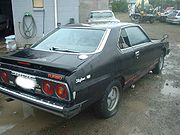
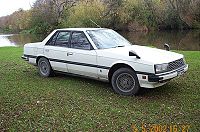 The names were brought into line with the home Japanese and worldwide markets with the launch of the R30 series in August 1981, which was built on a C31 Laurel
platform. Unlike preceding generations, four and six-cylinder versions now shared a front end of the same length. The R30 was available as a two door hardtop coupe
, a four door sedan, a five door hatchback
(available only in the R30 generation), or a four door station wagon
. In all, there were 26 variations of the R30 Skyline available.
All versions with the exception of the wagon were usually fitted with the four round tail lights that had become a regular feature to the Skyline's design. The wagon had different tail lights, headlights, and no turbo or 6-cylinder versions available. It more closely resembled a Nissan Sunny than a Skyline. The two-door coupe had a hardtop
, pillarless design, and featured roll-down quarter windows for the rear seat passengers (a styling feature of the previous C10, C110, and C211 coupes), while four door versions had a traditional sedan body style with framed windows.
Notably, configurations of the R30 sold in Australia and New Zealand were missing the traditional hotplate tail lights, instead opting for more conventional styling.
Various engine configurations were available, initially ranging from the top of the line 103 kW SOHC 6-cylinder turbo L20ET
to the 4-cylinder Z18S and 6-cylinder LD28 diesel versions at the other end of the scale. The all-new 16-valve DOHC FJ20
engine debuted in late 1981, and was the first 4-cylinder engine by any Japanese manufacturer to employ more than two valves per cylinder (see below). Some of the top spec models featured adjustable suspension dampers that could be adjusted while driving, this was another first for mass produced JDM vehicles. Nissan Glorias and Laurels also used the L series engines, as well as some diesel (Laurel only) variants.
The R30 range was facelifted in August 1983 with various changes across the board; for example four wheel disc brakes were now standard issue, instead of being optional for lower-spec models. Trim specifications were revised and the 4-cylinder Z18S engine was replaced with the newer CA18E. Features included upgraded interior trim, new front and rear bumpers, door-mounted wing mirrors (replacing the old 'hockey stick' fender mirrors), and smoked tail lights.
, who used to appear in promotional material, as well as race for the company during the late-1970s and early-1980s. The Newman Skyline was simply a top spec GT-ES turbo with signature embroidery and decals.
 Although making about the same power as the L20ET-powered GT-ES models, the version of the Skyline initially known as the 2000RS was released on October 2, 1981 as more of a stripped-down lightweight racer, without as many luxury extras included (quoted curb weight was only 1130 kg (2,491.2 lb)). These were equipped with the naturally aspirated 4-valve per cylinder DOHC FJ20E
engine generating 110 kW of power at 6000 rpm and 181 newton metre of torque at 4800 rpm. The official Nissan chassis designation for all FJ20-powered models was DR30.
In February 1983 the DR30 range received a significant boost in performance with the introduction of the turbocharged FJ20ET
engine in the 2000RS-Turbo. Front brakes were also significantly upgraded to cope with the power increase. Now with 140 kW of power at 6400 rpm and 225 newton metre of torque at 4800 rpm on tap, the FJ20ET enjoyed new-found prestige as the most powerful Japanese production engine of its era.
Nissan sought to elevate the status of the DR30 Skyline as their new flagship model in light of this success, and it received a generous amount of changes to distinguish it from lesser Skyline models in August 1983. Interior equipment was significantly upgraded to now include electric windows, air conditioning and power steering as standard in the new RS-X model (for Extra) with an increased curb weight of around 1235 kg (2,723 lb); gone were the days of the spartan, stripped-out race interior, although this could still be specified at time of purchase. But by far the most striking change to the RS was the new unique front end treatment, nicknamed Tekkamen (鉄仮面) or Iron Mask by fans for its distinctive look. The headlights were considerably slimmer, and instead of a conventional grille the bonnet now sloped down to two narrow slits above a facelifted front bumper and airdam.
Further changes were made in 1984, most notably the addition of an intercooler, revised compression ratios and turbocharger exhaust housing to the FJ20ET
powered model, now known as the RS-Turbo C and increasing output to 151 kW of power at 6400 rpm and 245 newton metre of torque at 4400 rpm. An automatic transmission option was also added at this time, and changes to the "PLASMA Spark" ignition system followed in early 1985 towards the end of R30 production.
To this day the FJ20-powered R30 Skyline remains a cult car both at home and overseas (there are still dedicated "one make" drag racing events for this model in Japan), and is credited with rejuvenating the Skyline brand in the early 1980s. It also paved the way for the eventual re-introduction of the legendary GT-R badge, markedly absent since the end of C110 Skyline production in 1973.
The RS achieved moderate success in Australian Touring car racing
in the mid-1980s with Nissan winning the 1986 Australian Manufacturers' Championship
and sharing victory in the 1987 Australian Manufacturers' Championship with BMW.
Models: (Japan)

_gxe_station_wagon_01.jpg) The R31 Skyline of 1986 was a natural evolution on the R30 shape, and also this one was loosely based on the Laurel platform (C32). The design was slightly larger and squarer than previous Skylines. It was available as a Sedan, Hardtop sedan, Coupe and station wagon. Affectionately known as the "Seventhsu" or simply "7th Sukairain" by owners, due to it being the 7th generation Skyline.
The R31 Skyline of 1986 was a natural evolution on the R30 shape, and also this one was loosely based on the Laurel platform (C32). The design was slightly larger and squarer than previous Skylines. It was available as a Sedan, Hardtop sedan, Coupe and station wagon. Affectionately known as the "Seventhsu" or simply "7th Sukairain" by owners, due to it being the 7th generation Skyline.
The R31 Skyline introduced many new technologies and features. The HR31 was the first Skyline to be equipped with the new RB-series
of engines. The R31 RB engines are often referred to as "Red Top" engines because of the red cam covers. There were three variants. The earliest series of DOHC RB engines used the NICS (Nissan Induction Control System) injection system with 12 very small intake runners, and a butterfly system to divide the intake ports in half for better low RPM performance. Later versions used ECCS (Electronically Concentrated Control System) engine management, discarded the twelve tiny runners for six much larger ones (though they retained twelve ports on the head, so there was a splitter plate), and received a slightly larger turbocharger. Nissan's RD28
, a 2.8 straight-6 engine, featured for a diesel option. Another technological first for the R31 was the introduction of Nissan's proprietary 4-wheel steering system, dubbed HICAS
(High Capacity Active Steering). The R31 series were also the only models in the Skyline family to feature a 4-door hardtop
variation. These models were generally badged as the Passage GT.
The R31 Skyline was also produced in Australia, with a 3.0 L motor (RB30E) available in sedan or wagon form, as well as a four-cylinder version called the Nissan Pintara
. The wagon had the same front style as the coupe and sedan—the only difference being that it lacked the four round brake lights that had been a consistent element of Skyline design (except for the R31 series one/two which had rectangular taillights with a solid bar through the centre which was also shared by the Pintara). These cars were manufactured in Australia due to the heavy import laws which made it expensive to bring cars into Australia.
29,305 R31 Skylines were also manufactured and sold in South Africa in 4-door sedan form between 1987 and 1992. These were the last Skylines seen in South Africa. Power came from either the RB30E 3.0 straight-6
motor, RB20E 2.0 straight-6
motor or the CA20S 4-cylinder powerplant.
for Group A
Touring Car racing. It had a reworked version of the normal RB20DET with a much larger turbocharger on a tubular steel exhaust manifold, as well as a much larger front mounted intercooler boosting power to a factory claimed 210 ps (154 kW), with racing versions making over 430 hp in Group A trim.
'Australia'
'South Africa'
straight-6
engines, which had improved heads (the twelve port inlet was gone) and used the ECCS (Electronically Concentrated Control System) injection system. Also available was an 1,800 cc 4 cylinder GXi model. Most models had HICAS
four-wheel steering, with the rear wheels being hydraulically linked to the front steering. The 2.5 litre GTS-25 became one of the first Japanese production cars to feature a 5-speed automatic
transmission. The GTS-t came in standard and Type M configurations, with the Type M having larger five-stud 16 inch wheels, four piston front callipers and twin piston rears plus other minor differences. ABS was optional (except for the GT-R and GTS-4), mechanical LSD was standard on the GTR and viscous LSD was standard on all turbo models and optional on all but the GXi. Nissan also produced 100 Australian models of the R32. There was also a 4WD version of the GTS-t Type M, called the GTS-4.
Models:
 The GT-R
returned with twin ceramic turbocharger
s, all-wheel steering, electronically controlled four wheel drive
, and 276 hp (206 kW) at 6800 rpm. The RB26DETT
engine actually produced ~320. hp, but it was unstated due to the Japanese car makers' "gentlemen's agreement
" not to exceed 280 PS (276 hp). The engine was designed for ~500 hp in racing trim, and then muzzled by the exhaust, boost restriction, and ECU. The electronic boost control had a small physical restriction in the control lines. It was marked in yellow so the new owner could remove it and enjoy a safe factory boost increase. After this increase the car would put out ~310 hp (~230 kW) and could do 0–100 km/h in 4.7seconds and quarter mile in 12.8 seconds.
The GT-R had a significantly larger intercooler, larger brakes, and aluminium front guards and bonnet. Other distinguishing features include flared front and rear wheel arches. More supportive seats were fitted, and the turbo boost gauge and digital clock were removed from inside the instrument cluster. The clock was replaced with a torque meter that indicated how much torque was being delivered to the front wheels (0%–50%). Oil temp, voltage, and turbo boost gauges were fitted just above the climate control.
The Porsche 959
was Nissan's target when designing the GT-R. The chief engineer, Naganori Itoh, intended to use the car for Group A racing, so the design specification was drawn up in conjunction with a copy of the Group A rules. The Nordschleife
production car record at the time of development was 8'45" – set by a Porsche 944
. Nissan test driver Hiroyoshi Katoh reset the record with a time of 8'20". Best Motoring managed 8'22"38.
The R32 GT-R dominated Japanese Touring Car Championship
(JTCC), winning 29 races from 29 starts, taking the series title every year from 1989 to 1993. It took 50 races from 50 starts from 1991 to 1997 (latterly R33) in the N1 Super Taikyu
.
The R32 GT-R was introduced in to the Australian Touring Car Championship in 1990 and promptly ended the reign of the previously all-conquering Ford Sierra
Cosworth, winning Bathurst 1000
classic in 1991 and 1992. This success led to the Australian motoring press nicknaming the car Godzilla
due to it being a "monster from Japan". As Australia was the first export market for the car the name quickly spread. Such was GT-R's dominance that it was a significant factor in the demise of Group A
Touring Car racing, the formula being scrapped soon after. JTCC was similarly blighted by the R32 GT-R, and splintered soon after, leading to the switch to the Supertouring
category and also indirectly to the GT500 category of today.
When originally designed, the homologation
rulebook mandated 16-inch wheels, so that's what the GT-R got. This limited the size of the brakes, and the Nissan four pots weren't really up to competition use. A later change in rules allowed 17-inch wheels, so in February 1993 the GT-R V-spec (for Victory) emerged wearing 17" BBS mesh wheels(225/50/17) covering larger Brembo
brakes. The clutch actuation changed from a push to a pull system, the car had the standard rear differential, the electronic rear differential did not show up until the R33 Vspec. A year later the V-Spec II appeared with a new sticker and wider tires(245/45/17).
, while the twin-cam of the R32 GTS was discontinued along with the 2.0 L turbo RB20DET
.
Some models came equipped with a new version of the HICAS 4-wheel steering system called Super HICAS
. This computer controlled system was first used on the R32 GT-R. Super HICAS used electric actuators to steer the rear, as opposed to the hydraulic HICAS. This generation was no longer considered a "compact" under Japanese legislation that determined the amount of tax liability based on exterior dimensions.
As an option, an active limited slip differential
was available instead of the standard viscous LSD. This new unit locked the rear differential if it detected that traction was lost by one of the wheels. A light on the dash also lit up if the LSD engaged. Active LSD came standard on all V-Spec R33 GT-R Skylines and was also available on some ECR33 GTS-25t models; these can be identified by the A-LSD and SLIP lights on the tachometer.
The RB25DE
and RB25DET
engines also became equipped with NVCS
(variable inlet cam phasing). NVCS equipped RB's have a bulge on the front of the cam cover. To celebrate their 40th anniversary, Nissan introduced a very rare 4 door GT-R. Two versions of the 4-door GT-R were available from Nissan's subsidiaries: the first was produced by Autech
, and the second was a joint Autech
/Nismo
project.
An R33 based wagon was released in September 1996, called the Stagea
. It had a different body style than the R33 and R34 and (with the exception of the RS FOUR & Autech
variants) was only available with an automatic transmission. A common modification on the Stagea
is to fit it with an R34 skyline front, in effect making a 4 door R34 wagon. The Stagea
is the only four wheel drive
manual transmission Nissan on the R33 platform with the RB25DET
engine. Presumably, a 5-speed 4WD Skyline equipped with an RB25DET would have been too close in performance to the much more expensive GT-R. There was also an Autech
Stagea, the 260RS released with full GT-R running gear, the RB26DETT engine, body kit, 17" BBS style alloys, GT-R instrumentation, and manual transmission.
Models:
 The R33 Skyline (Series 2) continued the concepts introduced in the R32. Driver and Passenger airbags became standard in 1996. As a result, pre-1996 models are barred from being imported into various countries for consumer road use as they do not meet the frontal impact standards. For the RB25DET
engine the ignition system was also changed, with the ignition module no longer located on the cam covers and was instead replaced by smart ignition coils (Ignitor built into coil) and ECU. The RB25DET
turbo was also given a nylon compressor wheel. Throughout the time the R33 was produced there were quite a number of different styled lights and bodykits fitted, the actual body/chassis underwent no changes. Among the cosmetic changes in the series 2 were, the headlights which tapered down more towards the grill and were fitted with improved reflectors, the grill (which was longer on the Series 1), the bonnet which had a re-shaped leading edge to fit the new lights and front bumper changing shape in the smallest amount to match the lower edge of the new headlights. Later models of the Series 2 also had the option of having an Active-LSD fitted.
The R33 ceased production in March 1998 with the 40th Anniversary R33 Series 2.
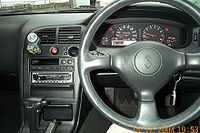 The BCNR33 GT-R version also had the same RB26DETT
engine that the BNR32 was equipped with, although torque had been improved, due to changes in the turbo compressor aerodynamics, turbo dump pipe, and intercooler. The turbo core changed from a sleeve bearing to a ball bearing, but the turbine itself remained ceramic, except on N1 turbos (steel turbine, sleeve bearing). From the R33 onward, all GT-Rs received Brembo
brakes. In 1995 the GT-R received an improved version of the RB26DETT
, the ATTESA-ETS four wheel drive
system, and Super HICAS
4-wheel steering.
A limited edition model was created in 1996, called the NISMO 400R, that produced 400 hp (298 kW) from a road-tuned version of Nissan's Le Mans engine. A stronger six-speed Getrag gearbox was used.
An R33 GT-R driven by Dirk Schoysman lapped the Nordschleife
in less than 8 minutes. Though it was often said to be the first production car to break 8 minutes, the limited run Jaguar XJ220
had already achieved a 7'46" lap.
Other manufacturers had caught up since the R32 was released, and the R33 never dominated motorsport to the extent of the R32.
Michael Begley with the Gaijin R33 GT-R http://www.the-gaijin.co.uk currently holds the European four wheel drive 1/4 mile record with a time of 8.06 @ 173 mph. This record was set at Santa Pod raceway in England. Gaijin ("the outsider") is tuned by TR Racing in Harlow Essex UK. This R33 GT-R is said to have had in the region of 1400 bhp. The owner Mick Begley lives in the UK and is reportedly chasing a 7 second pass.
The four wheel drive 1/4 mile world record was set by Reece McGregor from New Zealand
in the Heat Treatments R32 GT-R, setting a best time of 7:54 @ 197 mph, overtaking the haloed HKS R33 GT-R.
In August 2010, Elitetech Automotive (based near Silverstone, UK) launched a low volume production run of the R33 GT-R but in LHD (left hand drive) format.
First deliveries will be made in early 2011, with vehicles being sold to Europe and further afield.
All standard equipment remains on the specification list of the zero compromise LHD version.
Models:
 In May 1998, after sales of the Nissan Skyline plummeted from the release of the R33 chassis the EN34, HR34, ER34 and BNR34 addressed many of the concerns over the change from the R33, with more emphasis on sportiness, and marked the introduction of the more fuel-efficient and environmentally-friendly RB25DET NEO engine. Also the front end was re-arranged from the R33 unattractive front end and was aimed more towards the R32 style to draw people back into the "skyline world" . The RB20E engine was discontinued in the R34 base model (GT), and the RB20DE, after last being used in the R32 Skyline, was reintroduced in updated NEO guise. The R34 GT powered by the RB20DE NEO, coupled with a 5-speed gearbox, became the most fuel-efficient straight-6 Skyline to date (of any shape). Carlos Ghosn stated on the release date of the Nissan Skyline R34 that " We hope to win people back with the old school design based around the R32 shell, due to the initial complaints corresponded with the R33 chasis and body" The 5-speed automatic transmission
available on some models in the previous two shapes were discontinued. In its place, Nissan produced a 4-speed Tiptronic transmission for all of the automatic versions (Except the base 2.0L, which has a standard 5 speed gearbox). Only the GT-T coupe variant was sold in New Zealand from 2000 and it was the only country besides Japan that sold the R34 GT-T model Skylines new. The GT-T models were rebadged as Infiniti G
25t for export markets. The Nissan Skyline rivals are the Toyota Supra
and the Mazda RX-7
.
Models:
reappeared in 1999, with a revised chassis and other updates. The R34 turbos received a ball bearing core. The R34 N1 turbos had a metal exhaust wheel, and ball bearing center section. A 6-speed Getrag
gearbox was used. The turbo outlet pipes were changed from cast to formed metal outlets. The intercooler outlet side and rear turbo dump pipe had temperature probes fitted in the V-spec models.
Models: (all 4WD)

, shared with the Nissan 350Z
. The Nissan Skyline used a front-midship engine (VQ35DE
), rear-wheel drive layout (four wheel drive was available for the sedan) to achieve a 52%/48% weight distribution. The V35 was the first Skyline made for export to the United States. There it was sold under the company's luxury brand, Infiniti as the Infiniti G35.
The V35 broke with Skyline tradition. There was no straight-6
, no turbo, and no GT-R
, a decision which extended to all later Skylines. The intention had been for the model to use a different name, a decision reversed by Renault/Nissan CEO Carlos Ghosn
. who choose to gear the V35 towards the luxury-sport market. Billing the 350Z
as a pure sports car, Nissan put a slightly more powerful VQ35DE
in the 350Z
, and while the Skyline and the 350Z
shared the same platform, the 350Z
had additional bracing, under-body aero parts, and weighed 100 kg less.
Japanese tuners mostly ignored the V35 Skyline, the 2006 Tsukuba Super Lap Battle had not a single V35 entrant. Tuners such as Mines
, Amuse, Hosaka, Garage Defend, M Speed, Nagisa, MCR, HKS, & Top Secret continued developing R32-R34 GT-Rs as time attack cars. Top Secret did tune a V35, but replaced the VQ35DE
with a VK45DE
V8 Twin Turbo. Signal USA entered a V35 in Formula D, replacing the VQ35DE
with an SR20DET
.
Models:

It was first available only as a 4-door sedan in Japan and was also sold in the USA as the 2007 Infiniti G35. It is equipped with either a VQ25HR 2.5 L V6 producing 165 kW or a VQ35HR 3.5 L V6 with 232 kW. The 2.5 L is available with four wheel drive as well.
On May 13, 2008, Nissan announced that a convertible variant of the Infiniti G37 (U.S. Spec Skyline coupe) will be produced for the 2009 model year.
Four wheel drive is standard on 250GT FOUR models (NV36, where N stands for 4WD).
250GT Type S was introduced for 2008 model year.
17-inch wheels are standard for all model ranges, except for the 250GT Type S, which has 18-inch wheels.
4-wheel active steering is available in Type S and Type SP as option.
18-inch wheels are used on the base and 370GT Type P cars, while Type S and Type SP cars include 19-inch wheels.
18-inch wheels are standard for all model ranges, except for the 370GT Type P, which has 17-inch wheels.
37. The vehicle went on sale in April 2009.
Four wheel drive is standard on 370GT FOUR models. 18-inch wheels are standard for all model ranges.
Prince Motor Company
Prince Motor Company was a Japanese automobile manufacturer from 1952 until its merger with Nissan in 1966. Prince began as the Tachikawa Aircraft Company, a producer of the famous Japanese Zero fighter planes used in WWII...
, and was marketed as a luxury car. It featured a 1.5 L (1482 cc) GA-30 engine producing 44 kW (60 hp
Horsepower
Horsepower is the name of several units of measurement of power. The most common definitions equal between 735.5 and 750 watts.Horsepower was originally defined to compare the output of steam engines with the power of draft horses in continuous operation. The unit was widely adopted to measure the...
) @ 4400 rpm. It used a de Dion tube
De Dion tube
A de Dion tube is an automobile suspension technology. It is a sophisticated form of non-independent suspension and is a considerable improvement over the alternative swing axle and Hotchkiss drive types. A de Dion suspension uses universal joints at both the wheel hubs and differential, and uses a...
rear suspension and was capable of 140 km/h (87 mph). The car weighed around 1300 kg. Prince Skylines were produced as four door sedans and five door station wagons.
The Skyline also spawned a pickup truck
Pickup truck
A pickup truck is a light motor vehicle with an open-top rear cargo area .-Definition:...
and a delivery van called the Prince Skyway
Prince Skyway
The Prince Skyway was a commercial delivery van based on the 1957 Prince Skyline type ALSI and later the S50 Skyline, identified with the chassis code ALVG for the first generation, then V51A-I. The Skyway was produced from April 1957 - September 1968...
.
ALSID-2
The Skyline was updated with quad headlights for 1958.This model was powered by a slightly altered 1.5 L engine known as the GA-4 OHV (1484 cc) producing about 70 hp @ 4800 rpm and was produced through 1961.
In 1962, this model was restyled as the S21D/S series.
BLRA-3
The Skyline Sport featured hand-built Michelotti bodies in stylish coupeCoupé
A coupé or coupe is a closed car body style , the precise definition of which varies from manufacturer to manufacturer, and over time...
and convertible
Convertible
A convertible is a type of automobile in which the roof can retract and fold away having windows which wind-down inside the doors, converting it from an enclosed to an open-air vehicle...
versions. These cars used the 1.9 L (1862 cc/113 in³) GB-30 engine, producing 96 hp (72 kW) and 113.5 ft·lbf (154 N m). While only a few hundred were built, Prince Motors had a very aggressive product placement group and they can be seen (along the company's mainstream models) in many Toho films of the early 1960s.
S50
In 1961 Fuji Precision Industries changed its name to PrincePrince Motor Company
Prince Motor Company was a Japanese automobile manufacturer from 1952 until its merger with Nissan in 1966. Prince began as the Tachikawa Aircraft Company, a producer of the famous Japanese Zero fighter planes used in WWII...
after the 1954 merger, and the S50 series was launched, which like its predecessor, came in sedan and wagon bodystyles. This was the second generation car, and became one of the more desirable cars in Japan. It was powered by the G-1 engine, a 70 hp (52 kW) version of the old GA-4. A 1862 cc engine was also available, delivering 91 hp. The S50 series were available with a 3-speed column shift transmission or a 4-speed floor shift transmission, as well as a 4-door sedan (S50) or a 5-door wagon (W50).
Three models of the S50 were built: S50E (1962–1965), S50E-2 (1965–1966), and S50E-3 (1967). All three used the same engines.
The S50 was further developed with new styling for 1963, and was sold in some markets with an A150 designation. The S50 was also sold as the A190D, which was equipped with a diesel engine.
In 1966, Nissan and Prince merged and the S50 also appeared with Nissan Prince Skyline badging. This model lasted in production through 1967. In 1967, the S50E-3 was introduced. It was sold as Prince Skyline, Prince A150, PMC A150, or Nissan A150.
S54
Prince Motor Company
Prince Motor Company was a Japanese automobile manufacturer from 1952 until its merger with Nissan in 1966. Prince began as the Tachikawa Aircraft Company, a producer of the famous Japanese Zero fighter planes used in WWII...
created a racing GT Skyline in May 1964. It was based on the S54 and used the larger 6-cylinder G-7 engine from the Gloria S41, though the car needed an 8" extension to the wheelbase (all forward of the cowl/firewall) to provide space in the engine bay for the lankier in-line six. When it entered the 2nd Japanese Grand prix they hoped to win the GT-II class. Competitive against the Porsche 904
Porsche 904
The Porsche 904 is an automobile which was produced by Porsche in Germany in 1964 and 1965. It was officially called Porsche Carrera GTS due to the same naming rights problem that required renaming the Porsche 901 to Porsche 911.- History :...
, the Skyline managed 2nd through to 6th places.
Largely due to the success of the race vehicle, the Prince Skyline 2000GT (also called GT-A, GT-B, S54A and S54B) was released to the Japanese market. There were two versions produced:
- S54A – 1988 cc G-7 single-carb I6, 105 hp (78 kW)
- S54B – 1988 cc G-7 triple-carb I6, 125 hp (94 kW)
The B model featured three Weber
Weber carburetor
Weber is an Italian company producing carburetors, currently owned by Magneti Marelli Powertrain S.p.A., in turn part of the Fiat Group.The company was established as...
40DCOE-18 carburetors, a limited slip differential
Limited slip differential
A limited slip differential is a type of differential gear arrangement that allows for some difference in angular velocity of the output shafts, but imposes a mechanical bound on the disparity...
, 5-speed close ratio manual transmission
Manual transmission
A manual transmission, also known as a manual gearbox or standard transmission is a type of transmission used in motor vehicle applications...
, and power brakes. Both the B and A used front disc brake
Disc brake
The disc brake or disk brake is a device for slowing or stopping the rotation of a wheel while it is in motion.A brake disc is usually made of cast iron, but may in some cases be made of composites such as reinforced carbon–carbon or ceramic matrix composites. This is connected to the wheel and/or...
s with dual pistons and alloy finned drums in the rear.
S57
The S50 Skyline was updated to become the S57 in 1967. It used a Prince's new engine (designed before the merger with Nissan), the OHC 1.5 L (1487 cc) G15. At 88 hp (66 kW), it was the most-powerful engine in the Japanese 1500 cc class.C10
A station wagon variant, known previously as the Prince Skyway
Prince Skyway
The Prince Skyway was a commercial delivery van based on the 1957 Prince Skyline type ALSI and later the S50 Skyline, identified with the chassis code ALVG for the first generation, then V51A-I. The Skyway was produced from April 1957 - September 1968...
, was offered with this generation. A hardtop coupé was introduced in October 1970.
2000GT-X
In 1971, the KGC10 2000GT-X received a 2.0 L (1998 cc) L20 I6 engine instead of a Prince G-7 engine. The chassis was already designed to receive a straight six, to avoid the S54 extension problem. 120 hp (78 kW) was available from this new engine, in March 1972 Nissan introduced 4 Door Sedan GT-X.2000GT
The following year, the GC10 2000GT received a 2.0 L (1998 cc) L20 I6 engine like the Nissan Cedric instead of a Prince G-7 engine. The chassis was already designed to receive a straight six, to avoid the S54 extension problem. 105 hp (78 kW) was available from this new engine, in 1970 Nissan production Skyline 2000GT Automatic, in October 1970 Nissan introduced 2 Door Coupe.GT-R
The first GT-R Skyline appeared in February 1969. Called the PGC-10 (KPGC-10 for later coupé version) internally and Hakosuka (ハコスカ) by fans. Hako (ハコ) means Box in Japanese, and suka(スカ) is short for Skyline (スカイライン; Sukairain). It used the 2.0 L (1998 cc) S20Nissan S20 engine
The Nissan S20 engine was a straight-6, DOHC internal combustion engine produced by Nissan in the 1970s. It was essentially the same as the 1966 Prince GR8 engine of Prince/Nissan's R380 racecar. It produces @7000 rpm and...
I6. This new DOHC engine (which was designed by the former Prince engineers) produced 160 hp (118 kW, 180 N m), and was similar to the GR8 engine used in the Prince R380
Prince R380
The Prince R380 was a racing car built in 1965 by Prince Motor Company to compete in the Japanese Grand Prix. Following the merger of Prince Motor Company and Nissan Motors in 1966, the R380 was modified into the Nissan R380-II .-Development:In 1964, Prince had entered their new S54 Skyline GTs in...
racing car.
The GT-R began as a sedan, but a 2-door coupé version was debuted in October 1970 and introduced in March 1971. The cars were stripped of unnecessary equipment to be as light as possible for racing, and performed well at the track. The sedan racked up 33 victories in less than two years, and the coupé stretched this to 50 through 1972.
The C10 raced against many cars including the Toyota 1600 GT (RT55), Isuzu Bellett
Isuzu Bellett
-Video games:The 1969 Bellett GT-R is a playable car in the Polyphony Digital video game Gran Turismo 4 for the PlayStation 2. In simulation mode, it is available as a used car only and comes in three colors: white, gold and orange.It can also be played in the Polyphony Digital video game Gran...
GTR, Mazda Familia
Mazda Familia
Mazda's automotive plans for the early sixties consisted of growing alongside the Japanese economy. To achieve this goal, they began by building an extremely cheap Kei car, the R360 in 1960, planning on introducing gradually larger and pricier cars as the Japanese customers became able to afford them...
(R100) & Capella
Mazda Capella
The second generation rear-wheel drive Capella was available between 1978 and 1982, in both sedan and coupe forms. It was known on export markets as the Mazda 626, with the exception of the United Kingdom, where it was called the Mazda Montrose, the name was changed to honour the local Mazda...
(RX-2
Mazda RX-2
The Mazda RX-2 was a midsize car introduced in 1970 and sold through 1978. It used a rotary engine and shared a chassis with the piston-engined Mazda Capella/616/618....
) – even Porsche
Porsche
Porsche Automobil Holding SE, usually shortened to Porsche SE a Societas Europaea or European Public Company, is a German based holding company with investments in the automotive industry....
. In late 1971 the new Mazda RX-3
Mazda RX-3
The Mazda RX-3 is an automobile sold in the 1970s. It was intended to be smaller and sportier than its brother, the RX-2/Capella Rotary. In 1972 all rotary engines had their die-cast rotor housing coated with a new process: The new Transplant Coating Process featured sprayed-on steel which is...
became the GT-R's main rival. The GT-R managed a few more victories before the RX-3 ended the GT-R's winning streak.
Models:
- 1500 – 1.5 L G15 I4, 88 hpHorsepowerHorsepower is the name of several units of measurement of power. The most common definitions equal between 735.5 and 750 watts.Horsepower was originally defined to compare the output of steam engines with the power of draft horses in continuous operation. The unit was widely adopted to measure the...
(71 kW, 128 N m) - 1500 – 1.5 L G15 I4, 95 hpHorsepowerHorsepower is the name of several units of measurement of power. The most common definitions equal between 735.5 and 750 watts.Horsepower was originally defined to compare the output of steam engines with the power of draft horses in continuous operation. The unit was widely adopted to measure the...
(71 kW, 128 N m) - 1800 – 1.8 L G18 I4, 105 hp (78 kW, 150 N m)
- 2000GT – 2.0 L L20 I6, 120 hp (90 kW, 167 N m)
- 2000GT-R – 2.0 L S20Nissan S20 engineThe Nissan S20 engine was a straight-6, DOHC internal combustion engine produced by Nissan in the 1970s. It was essentially the same as the 1966 Prince GR8 engine of Prince/Nissan's R380 racecar. It produces @7000 rpm and...
I6, 160 hp (118 kW, 180 N m)
C110
For export in the 1970s, the C110 and GC110 Skyline was sold as the Datsun
Datsun
Datsun was an automobile marque. The name was created in 1931 by the DAT Motorcar Co. for a new car model, spelling it as "Datson" to indicate its smaller size when compared to the existing, larger DAT car. Later, in 1933 after Nissan Motor Co., Ltd...
K-series, with models such as the Datsun 160K, 180K and Datsun 240K.
The body styles were, once again, four-door sedan, two-door hardtop coupé, and five-door station wagon. The C110 was more fussy in its styling than its predecessor, particularly so in wagon form, where unusually for a wagon design, no windows were fitted between the C and D pillars. The C110 was the first version to feature the round rear lights, typical of later Skyline designs.
The C110 Skyline was better known as the "Ken & Mary" or "Kenmeri" (ケンメリ) Skyline, stemming from the advertisement campaign in Japan at the time which featured a young couple (Ken and Mary) who relaxed and enjoyed the countryside in Ken and Mary's Skyline (ケンとメリーのスカイライン). The ads were highly successful and perhaps as a result the C110 was sold in very large numbers in Japan. It sold just as well in Australia (in a 2.4L 6-cylinder form, badged as "Datsun 240K") , though few survive today. There, the 240K was about the same price as a Ford Falcon
Ford Falcon (Australia)
The Ford Falcon is a full-size car which has been manufactured by Ford Australia since 1960. Each model from the XA series of 1972 onward has been designed, developed and built in Australia and/or New Zealand, following the phasing out of the American Falcon of 1960–71 which had been re-engineered...
GT or BMW 5 series
BMW 5 Series
The BMW 5 Series is a mid-size / executive car manufactured by BMW since 1972. The car, now in its sixth generation, is sold in sedan and touring body styles....
, around $5000.
GT-R
The Nissan Skyline GT-R hardtop arrived in September 1972 but only lasted until March 1973, when Nissan ceased its production. The oil crisis saw many people preferring economy cars and high-performance sports cars were looked down upon. Nissan pulled out of Motor Racing, so there was no purpose to the GT-R. It was not officially exported anywhere, although Nissan contemplated exporting to Australia. Only 197 KPGC110 GT-Rs were ever sold in Japan, through specialist Nissan Performance shops (before it was called NISMO). This was the last GT-R for 16 years until the BNR32 in 1989.Models:
- 1600 – 1.6 L G16Prince G engineThe Prince G-series engine was the company's only straight-4 and straight-6 which began production in 1955. A number of variations were made, with both OHV and OHC heads. The G series was used in the Skyline, the Laurel and the Gloria from the 1950s to the early 1970s.Note that, prior to its...
I4 - 1800 – 1.8 L G18Prince G engineThe Prince G-series engine was the company's only straight-4 and straight-6 which began production in 1955. A number of variations were made, with both OHV and OHC heads. The G series was used in the Skyline, the Laurel and the Gloria from the 1950s to the early 1970s.Note that, prior to its...
I4 - 2000GT-X – 2.0 L L20ANissan L engineThe Nissan L series of automobile engines ranged from 1.3 L to 2.8 L in both straight-4 and straight-6 configurations and were produced from 1967 through 1986. This was the engine of the Datsun 240Z sports car as well as the Datsun 510 and the first Nissan Maxima. These engines are known for their...
I6, 130 hp (96 kW, 172 N m) - 2000GT-R – 2.0 L S20Nissan S20 engineThe Nissan S20 engine was a straight-6, DOHC internal combustion engine produced by Nissan in the 1970s. It was essentially the same as the 1966 Prince GR8 engine of Prince/Nissan's R380 racecar. It produces @7000 rpm and...
I6, 160 hp (118 kW, 180 N m)
C210
The succeeding C210/211 and GC210/211 of 1977 continued to split the Skyline range into basic and six-cylinder models, the latter with a longer front end. This line continued through 1981. The Datsun C211 240K/280K and 240C/280C variants continued for export.A rare variant would be the wagon version, which had a unique styling treatment behind the rear doors, of a much smaller window than usual between the C and D pillars.
The GT-EX replaced the GT-R with a turbocharged engine, the L20ET
Nissan L engine
The Nissan L series of automobile engines ranged from 1.3 L to 2.8 L in both straight-4 and straight-6 configurations and were produced from 1967 through 1986. This was the engine of the Datsun 240Z sports car as well as the Datsun 510 and the first Nissan Maxima. These engines are known for their...
. This was the first turbo engine to power a Japanese production vehicle . One notable aspect of the turbo versions was that they were not intercooled and there was no form of blowoff valve
Blowoff valve
A blowoff valve or dump valve is a pressure release system present in most turbocharged engines.Its purpose is to prevent compressor surge, and reduce wear on the turbocharger and engine...
, only an emergency pressure release valve.
The "T" designation on the L16T and L18T does not signify a turbocharger was included; it denotes that those engines came with twin carburetors.
Models:
- 1600TI – 1.6 L L16T I4, 95 hp (71 kW, 132 N m)
- 1800TI – 1.8 L L18T I4, 115 hp (86 kW, 152 N m)
- 2000GT-EL – 2.0 L L20E I6, 130 hp (97 kW, 167 N m)
- 2000GT-EX – 2.0 L L20ET turbo I6, 145 hp (108 kW, 206 N m)
R30
Nissan Laurel
In April 1968 Nissan presented its new Laurel in four-door deLuxe and Super deLuxe versions, both equipped with a 1.8 L inline-four cylinder engine and independent rear suspension. In summer 1970 a hardtop coupé joined the line-up, one year later a 2000 cc engine became available...
platform. Unlike preceding generations, four and six-cylinder versions now shared a front end of the same length. The R30 was available as a two door hardtop coupe
Coupé
A coupé or coupe is a closed car body style , the precise definition of which varies from manufacturer to manufacturer, and over time...
, a four door sedan, a five door hatchback
Hatchback
A Hatchback is a car body style incorporating a shared passenger and cargo volume, with rearmost accessibility via a rear third or fifth door, typically a top-hinged liftgate—and features such as fold-down rear seats to enable flexibility within the shared passenger/cargo volume. As a two-box...
(available only in the R30 generation), or a four door station wagon
Station wagon
A station wagon is a body style variant of a sedan/saloon with its roof extended rearward over a shared passenger/cargo volume with access at the back via a third or fifth door , instead of a trunk lid...
. In all, there were 26 variations of the R30 Skyline available.
All versions with the exception of the wagon were usually fitted with the four round tail lights that had become a regular feature to the Skyline's design. The wagon had different tail lights, headlights, and no turbo or 6-cylinder versions available. It more closely resembled a Nissan Sunny than a Skyline. The two-door coupe had a hardtop
Hardtop
A hardtop is a term for a rigid, rather than canvas, automobile roof. It has been used in several contexts: detachable hardtops, retractable hardtop roofs, and the so-called pillarless hardtop body style....
, pillarless design, and featured roll-down quarter windows for the rear seat passengers (a styling feature of the previous C10, C110, and C211 coupes), while four door versions had a traditional sedan body style with framed windows.
Notably, configurations of the R30 sold in Australia and New Zealand were missing the traditional hotplate tail lights, instead opting for more conventional styling.
Various engine configurations were available, initially ranging from the top of the line 103 kW SOHC 6-cylinder turbo L20ET
Nissan L engine
The Nissan L series of automobile engines ranged from 1.3 L to 2.8 L in both straight-4 and straight-6 configurations and were produced from 1967 through 1986. This was the engine of the Datsun 240Z sports car as well as the Datsun 510 and the first Nissan Maxima. These engines are known for their...
to the 4-cylinder Z18S and 6-cylinder LD28 diesel versions at the other end of the scale. The all-new 16-valve DOHC FJ20
Nissan FJ engine
The Nissan FJ series engine was a straight-4 DOHC 2- or 2.4 L internal combustion engine produced by Nissan in the 1980s, in 2.4 L guise as a rally motor for the 240RS, and 2.0 L for general production models. The FJ20 weighs 366 lb ; the FJ24 weighs 368 lb...
engine debuted in late 1981, and was the first 4-cylinder engine by any Japanese manufacturer to employ more than two valves per cylinder (see below). Some of the top spec models featured adjustable suspension dampers that could be adjusted while driving, this was another first for mass produced JDM vehicles. Nissan Glorias and Laurels also used the L series engines, as well as some diesel (Laurel only) variants.
The R30 range was facelifted in August 1983 with various changes across the board; for example four wheel disc brakes were now standard issue, instead of being optional for lower-spec models. Trim specifications were revised and the 4-cylinder Z18S engine was replaced with the newer CA18E. Features included upgraded interior trim, new front and rear bumpers, door-mounted wing mirrors (replacing the old 'hockey stick' fender mirrors), and smoked tail lights.
Paul Newman Version
During 1983 the Paul Newman Version R30 was released to commemorate the association between Nissan and the actor Paul NewmanPaul Newman
Paul Leonard Newman was an American actor, film director, entrepreneur, humanitarian, professional racing driver and auto racing enthusiast...
, who used to appear in promotional material, as well as race for the company during the late-1970s and early-1980s. The Newman Skyline was simply a top spec GT-ES turbo with signature embroidery and decals.
RS
Nissan FJ engine
The Nissan FJ series engine was a straight-4 DOHC 2- or 2.4 L internal combustion engine produced by Nissan in the 1980s, in 2.4 L guise as a rally motor for the 240RS, and 2.0 L for general production models. The FJ20 weighs 366 lb ; the FJ24 weighs 368 lb...
engine generating 110 kW of power at 6000 rpm and 181 newton metre of torque at 4800 rpm. The official Nissan chassis designation for all FJ20-powered models was DR30.
In February 1983 the DR30 range received a significant boost in performance with the introduction of the turbocharged FJ20ET
Nissan FJ engine
The Nissan FJ series engine was a straight-4 DOHC 2- or 2.4 L internal combustion engine produced by Nissan in the 1980s, in 2.4 L guise as a rally motor for the 240RS, and 2.0 L for general production models. The FJ20 weighs 366 lb ; the FJ24 weighs 368 lb...
engine in the 2000RS-Turbo. Front brakes were also significantly upgraded to cope with the power increase. Now with 140 kW of power at 6400 rpm and 225 newton metre of torque at 4800 rpm on tap, the FJ20ET enjoyed new-found prestige as the most powerful Japanese production engine of its era.
Nissan sought to elevate the status of the DR30 Skyline as their new flagship model in light of this success, and it received a generous amount of changes to distinguish it from lesser Skyline models in August 1983. Interior equipment was significantly upgraded to now include electric windows, air conditioning and power steering as standard in the new RS-X model (for Extra) with an increased curb weight of around 1235 kg (2,723 lb); gone were the days of the spartan, stripped-out race interior, although this could still be specified at time of purchase. But by far the most striking change to the RS was the new unique front end treatment, nicknamed Tekkamen (鉄仮面) or Iron Mask by fans for its distinctive look. The headlights were considerably slimmer, and instead of a conventional grille the bonnet now sloped down to two narrow slits above a facelifted front bumper and airdam.
Further changes were made in 1984, most notably the addition of an intercooler, revised compression ratios and turbocharger exhaust housing to the FJ20ET
Nissan FJ engine
The Nissan FJ series engine was a straight-4 DOHC 2- or 2.4 L internal combustion engine produced by Nissan in the 1980s, in 2.4 L guise as a rally motor for the 240RS, and 2.0 L for general production models. The FJ20 weighs 366 lb ; the FJ24 weighs 368 lb...
powered model, now known as the RS-Turbo C and increasing output to 151 kW of power at 6400 rpm and 245 newton metre of torque at 4400 rpm. An automatic transmission option was also added at this time, and changes to the "PLASMA Spark" ignition system followed in early 1985 towards the end of R30 production.
To this day the FJ20-powered R30 Skyline remains a cult car both at home and overseas (there are still dedicated "one make" drag racing events for this model in Japan), and is credited with rejuvenating the Skyline brand in the early 1980s. It also paved the way for the eventual re-introduction of the legendary GT-R badge, markedly absent since the end of C110 Skyline production in 1973.
The RS achieved moderate success in Australian Touring car racing
Touring car racing
Touring car racing is a general term for a number of distinct auto racing competitions in heavily-modified street cars. It is notably popular in Argentina, Australia, Brazil, Germany, Japan, Scandinavia and Britain.-Characteristics of a touring car:...
in the mid-1980s with Nissan winning the 1986 Australian Manufacturers' Championship
Australian Manufacturers' Championship
The Australian Manufacturers' Championship is a motor racing title awarded by the Confederation of Australian Motor Sport to the winning car manufacturer in a series of races held throughout Australia...
and sharing victory in the 1987 Australian Manufacturers' Championship with BMW.
Models: (Japan)
- 1800TI – 1.8 L Z18SNissan Z engineThe Nissan Z series of automobile engines ranged from 1.6 L to 2.4 L and were produced from 1979 through August 1989. The Z series engines retained a nearly identical block to the earlier L Series with the exception of the Z24 which utilized a taller deck height to increase engine...
SOHC I4, 105 hp (77 kW), later models 1.8 L CA18SNissan CA engineThe CA engine is a 1.6 L to 2.0 L Inline-4 piston engine from Nissan designed for a variety of smaller Nissan vehicles to replace Z and smaller 4-cylinder L series engines. It is an iron block, aluminum head design with a timing belt, thus was cheaper to make than the timing chain setup...
SOHC I4, 105 hp (77 kW) - 2000TI – 2.0 L CA20ENissan CA engineThe CA engine is a 1.6 L to 2.0 L Inline-4 piston engine from Nissan designed for a variety of smaller Nissan vehicles to replace Z and smaller 4-cylinder L series engines. It is an iron block, aluminum head design with a timing belt, thus was cheaper to make than the timing chain setup...
SOHC I4 - 2000TI – 2.0 L Z20ENissan Z engineThe Nissan Z series of automobile engines ranged from 1.6 L to 2.4 L and were produced from 1979 through August 1989. The Z series engines retained a nearly identical block to the earlier L Series with the exception of the Z24 which utilized a taller deck height to increase engine...
SOHC I4 - 280D GT – 2.8 L LD28 SOHC I6 DieselDiesel engineA diesel engine is an internal combustion engine that uses the heat of compression to initiate ignition to burn the fuel, which is injected into the combustion chamber...
- 2000GT and Passage – 2.0 L L20ENissan L engineThe Nissan L series of automobile engines ranged from 1.3 L to 2.8 L in both straight-4 and straight-6 configurations and were produced from 1967 through 1986. This was the engine of the Datsun 240Z sports car as well as the Datsun 510 and the first Nissan Maxima. These engines are known for their...
SOHC I6 - 2000GT Turbo, Passage and Paul Newman Version – 2.0 L L20ETNissan L engineThe Nissan L series of automobile engines ranged from 1.3 L to 2.8 L in both straight-4 and straight-6 configurations and were produced from 1967 through 1986. This was the engine of the Datsun 240Z sports car as well as the Datsun 510 and the first Nissan Maxima. These engines are known for their...
turbo I6, 140 hp (103 kW, 206 N m) - RS – 2.0 L FJ20ENissan FJ engineThe Nissan FJ series engine was a straight-4 DOHC 2- or 2.4 L internal combustion engine produced by Nissan in the 1980s, in 2.4 L guise as a rally motor for the 240RS, and 2.0 L for general production models. The FJ20 weighs 366 lb ; the FJ24 weighs 368 lb...
DOHC I4, 150 hp (112 kW, 181 N m) - RS-X and RS-X Turbo C – 2.0 L FJ20ETNissan FJ engineThe Nissan FJ series engine was a straight-4 DOHC 2- or 2.4 L internal combustion engine produced by Nissan in the 1980s, in 2.4 L guise as a rally motor for the 240RS, and 2.0 L for general production models. The FJ20 weighs 366 lb ; the FJ24 weighs 368 lb...
DOHC turbo I4, 190 to 205 hp (140 to 151 kW, 225 to 245 N m)
R31
The R31 Skyline introduced many new technologies and features. The HR31 was the first Skyline to be equipped with the new RB-series
Nissan RB engine
The RB engine is a 2.0–3.0 L straight-6 four-stroke petrol/gasoline engine from Nissan produced from 1980-2004. A special limited edition the LMRB26 was also built during this time by General Motors in Australia....
of engines. The R31 RB engines are often referred to as "Red Top" engines because of the red cam covers. There were three variants. The earliest series of DOHC RB engines used the NICS (Nissan Induction Control System) injection system with 12 very small intake runners, and a butterfly system to divide the intake ports in half for better low RPM performance. Later versions used ECCS (Electronically Concentrated Control System) engine management, discarded the twelve tiny runners for six much larger ones (though they retained twelve ports on the head, so there was a splitter plate), and received a slightly larger turbocharger. Nissan's RD28
Nissan RD engine
The Nissan RD engine series is substantially similar in design to the Nissan RB engine series, except that it is only a single overhead cam six cylinder diesel engine. It was the successor to the Nissan LD and SD 6 cylinder engines and was joined by the Nissan TD engine 6 cylinder.From 1997 onwards...
, a 2.8 straight-6 engine, featured for a diesel option. Another technological first for the R31 was the introduction of Nissan's proprietary 4-wheel steering system, dubbed HICAS
HICAS
HICAS is Nissan's rear wheel steering system found on cars ranging from the more recent Skyline and Fairlady Z iterations to smaller models like the Nissan Cefiro , 240SX/Silvia /180SX and Nissan Serena/Nissan Largo. It is also found on models from Nissan's Infiniti division, such as the Q45,...
(High Capacity Active Steering). The R31 series were also the only models in the Skyline family to feature a 4-door hardtop
Hardtop
A hardtop is a term for a rigid, rather than canvas, automobile roof. It has been used in several contexts: detachable hardtops, retractable hardtop roofs, and the so-called pillarless hardtop body style....
variation. These models were generally badged as the Passage GT.
The R31 Skyline was also produced in Australia, with a 3.0 L motor (RB30E) available in sedan or wagon form, as well as a four-cylinder version called the Nissan Pintara
Nissan Pintara
The Nissan Pintara is a mid-sized automobile that was manufactured by Nissan Australia from 1986 until 1992.- First generation :...
. The wagon had the same front style as the coupe and sedan—the only difference being that it lacked the four round brake lights that had been a consistent element of Skyline design (except for the R31 series one/two which had rectangular taillights with a solid bar through the centre which was also shared by the Pintara). These cars were manufactured in Australia due to the heavy import laws which made it expensive to bring cars into Australia.
29,305 R31 Skylines were also manufactured and sold in South Africa in 4-door sedan form between 1987 and 1992. These were the last Skylines seen in South Africa. Power came from either the RB30E 3.0 straight-6
Straight-6
The straight-six engine or inline-six engine is a six-cylinder internal combustion engine with all six cylinders mounted in a straight line along the crankcase...
motor, RB20E 2.0 straight-6
Straight-6
The straight-six engine or inline-six engine is a six-cylinder internal combustion engine with all six cylinders mounted in a straight line along the crankcase...
motor or the CA20S 4-cylinder powerplant.
GTS-R
The ultimate version of the R31 was the RB20DET-R powered HR31 GTS-R Coupe of which 800 units were built to allow homologationHomologation
Homologation is a technical term, derived from the Greek homologeo for "to agree", which is generally used in English to signify the granting of approval by an official authority...
for Group A
Group A
In relation to motorsport governed by the FIA, Group A referred to a set of regulations providing production-derived vehicles for outright competition. In contrast to the short-lived Group B and Group C, the Group A referred to production-derived vehicles limited in terms of power, weight, allowed...
Touring Car racing. It had a reworked version of the normal RB20DET with a much larger turbocharger on a tubular steel exhaust manifold, as well as a much larger front mounted intercooler boosting power to a factory claimed 210 ps (154 kW), with racing versions making over 430 hp in Group A trim.
Models
'Japan'- 1800 C, 1800 Excel and 1800 Passage – 1.8 L CA18SNissan CA engineThe CA engine is a 1.6 L to 2.0 L Inline-4 piston engine from Nissan designed for a variety of smaller Nissan vehicles to replace Z and smaller 4-cylinder L series engines. It is an iron block, aluminum head design with a timing belt, thus was cheaper to make than the timing chain setup...
SOHC I4, 90 hp (66 kW) - GT Excel D, GT Passage D – 2.8 L Diesel RD28Nissan RD engineThe Nissan RD engine series is substantially similar in design to the Nissan RB engine series, except that it is only a single overhead cam six cylinder diesel engine. It was the successor to the Nissan LD and SD 6 cylinder engines and was joined by the Nissan TD engine 6 cylinder.From 1997 onwards...
SOHC I6, 92 hp (68 kW, 173 N m) - GT Excel, GT Passage – 2.0 L RB20ENissan RB engineThe RB engine is a 2.0–3.0 L straight-6 four-stroke petrol/gasoline engine from Nissan produced from 1980-2004. A special limited edition the LMRB26 was also built during this time by General Motors in Australia....
SOHC I6, 128 hp (96 kW) - GT Excel Twin Cam 24V, GT Passage Twin Cam 24V – 2.0 L RB20DENissan RB engineThe RB engine is a 2.0–3.0 L straight-6 four-stroke petrol/gasoline engine from Nissan produced from 1980-2004. A special limited edition the LMRB26 was also built during this time by General Motors in Australia....
DOHC I6, 155 hp (114 kW) - GT Passage Turbo – 2.0 L RB20ETNissan RB engineThe RB engine is a 2.0–3.0 L straight-6 four-stroke petrol/gasoline engine from Nissan produced from 1980-2004. A special limited edition the LMRB26 was also built during this time by General Motors in Australia....
SOHC turbo I6, 167 hp (125 kW, 206 N m) - GT Passage Twin Cam 24V Turbo – 2.0 L RB20DETNissan RB engineThe RB engine is a 2.0–3.0 L straight-6 four-stroke petrol/gasoline engine from Nissan produced from 1980-2004. A special limited edition the LMRB26 was also built during this time by General Motors in Australia....
DOHC turbo I6, 180 hp (133 kW, 225 N m) - GTS – 2.0 L RB20DENissan RB engineThe RB engine is a 2.0–3.0 L straight-6 four-stroke petrol/gasoline engine from Nissan produced from 1980-2004. A special limited edition the LMRB26 was also built during this time by General Motors in Australia....
DOHC I6, 155 hp (114 kW) - GTS Turbo – 2.0 L RB20DETNissan RB engineThe RB engine is a 2.0–3.0 L straight-6 four-stroke petrol/gasoline engine from Nissan produced from 1980-2004. A special limited edition the LMRB26 was also built during this time by General Motors in Australia....
DOHC I6, 180 hp (133 kW, 225 N m) - GTS-X – 2.0 L RB20DETNissan RB engineThe RB engine is a 2.0–3.0 L straight-6 four-stroke petrol/gasoline engine from Nissan produced from 1980-2004. A special limited edition the LMRB26 was also built during this time by General Motors in Australia....
DOHC turbo I6, 190 hp (141 kW, 240 N m) - GTS-R – 2.0 L RB20DET-RNissan RB engineThe RB engine is a 2.0–3.0 L straight-6 four-stroke petrol/gasoline engine from Nissan produced from 1980-2004. A special limited edition the LMRB26 was also built during this time by General Motors in Australia....
DOHC turbo I6, 210 hp (154 kW, 245 N m) - GTS Autech – 2.0 L RB20DET-RNissan RB engineThe RB engine is a 2.0–3.0 L straight-6 four-stroke petrol/gasoline engine from Nissan produced from 1980-2004. A special limited edition the LMRB26 was also built during this time by General Motors in Australia....
DOHC turbo I6, 210 hp (154 kW, 245 N m)
'Australia'
- Pintara – 2.0 L CA20ENissan CA engineThe CA engine is a 1.6 L to 2.0 L Inline-4 piston engine from Nissan designed for a variety of smaller Nissan vehicles to replace Z and smaller 4-cylinder L series engines. It is an iron block, aluminum head design with a timing belt, thus was cheaper to make than the timing chain setup...
I4, 102 hp (78 kW, 160 N m) - GX, Executive, GXE, Silhouette, Ti – 3.0 L RB30ENissan RB engineThe RB engine is a 2.0–3.0 L straight-6 four-stroke petrol/gasoline engine from Nissan produced from 1980-2004. A special limited edition the LMRB26 was also built during this time by General Motors in Australia....
SOHC I6, 155 hp (114 kW, 247 N m) - Silhouette GTS1 – 3.0 L RB30ENissan RB engineThe RB engine is a 2.0–3.0 L straight-6 four-stroke petrol/gasoline engine from Nissan produced from 1980-2004. A special limited edition the LMRB26 was also built during this time by General Motors in Australia....
SOHC I6, 176 hp (130 kW, 255 N m) - Silhouette GTS2 – 3.0 L RB30ENissan RB engineThe RB engine is a 2.0–3.0 L straight-6 four-stroke petrol/gasoline engine from Nissan produced from 1980-2004. A special limited edition the LMRB26 was also built during this time by General Motors in Australia....
SOHC I6, 190 hp (140 kW, 270 N m)
'South Africa'
- 2.0GL, 2.0GLE – 2.0 L CA20SNissan CA engineThe CA engine is a 1.6 L to 2.0 L Inline-4 piston engine from Nissan designed for a variety of smaller Nissan vehicles to replace Z and smaller 4-cylinder L series engines. It is an iron block, aluminum head design with a timing belt, thus was cheaper to make than the timing chain setup...
I4, 106 hp (78 kW, 163 N m) - 2.0SGLi – 2.0 L RB20ENissan RB engineThe RB engine is a 2.0–3.0 L straight-6 four-stroke petrol/gasoline engine from Nissan produced from 1980-2004. A special limited edition the LMRB26 was also built during this time by General Motors in Australia....
SOHC I6, 115 hp (85 kW, 174 N m) - 3.0SGLi – 3.0 L RB30ENissan RB engineThe RB engine is a 2.0–3.0 L straight-6 four-stroke petrol/gasoline engine from Nissan produced from 1980-2004. A special limited edition the LMRB26 was also built during this time by General Motors in Australia....
SOHC I6, 171 hp (126 kW, 260 N m)
R32
The R32 Skyline debuted in May 1989. It was available as either a 2-door coupe or 4-door hardtop sedan, all other bodystyles were dropped. The R32 featured several versions of the RB-seriesNissan RB engine
The RB engine is a 2.0–3.0 L straight-6 four-stroke petrol/gasoline engine from Nissan produced from 1980-2004. A special limited edition the LMRB26 was also built during this time by General Motors in Australia....
straight-6
Straight-6
The straight-six engine or inline-six engine is a six-cylinder internal combustion engine with all six cylinders mounted in a straight line along the crankcase...
engines, which had improved heads (the twelve port inlet was gone) and used the ECCS (Electronically Concentrated Control System) injection system. Also available was an 1,800 cc 4 cylinder GXi model. Most models had HICAS
HICAS
HICAS is Nissan's rear wheel steering system found on cars ranging from the more recent Skyline and Fairlady Z iterations to smaller models like the Nissan Cefiro , 240SX/Silvia /180SX and Nissan Serena/Nissan Largo. It is also found on models from Nissan's Infiniti division, such as the Q45,...
four-wheel steering, with the rear wheels being hydraulically linked to the front steering. The 2.5 litre GTS-25 became one of the first Japanese production cars to feature a 5-speed automatic
Automatic transmission
An automatic transmission is one type of motor vehicle transmission that can automatically change gear ratios as the vehicle moves, freeing the driver from having to shift gears manually...
transmission. The GTS-t came in standard and Type M configurations, with the Type M having larger five-stud 16 inch wheels, four piston front callipers and twin piston rears plus other minor differences. ABS was optional (except for the GT-R and GTS-4), mechanical LSD was standard on the GTR and viscous LSD was standard on all turbo models and optional on all but the GXi. Nissan also produced 100 Australian models of the R32. There was also a 4WD version of the GTS-t Type M, called the GTS-4.
Models:
- GXi Type-X – 1.8 L CA18iNissan CA engineThe CA engine is a 1.6 L to 2.0 L Inline-4 piston engine from Nissan designed for a variety of smaller Nissan vehicles to replace Z and smaller 4-cylinder L series engines. It is an iron block, aluminum head design with a timing belt, thus was cheaper to make than the timing chain setup...
I4, 91 hp (67 kW) - GTE Type-X – 2.0 L RB20ENissan RB engineThe RB engine is a 2.0–3.0 L straight-6 four-stroke petrol/gasoline engine from Nissan produced from 1980-2004. A special limited edition the LMRB26 was also built during this time by General Motors in Australia....
I6, 125 hp (93 kW, 152 N m) - GTS Type-X, S, J – 2.0 L RB20DENissan RB engineThe RB engine is a 2.0–3.0 L straight-6 four-stroke petrol/gasoline engine from Nissan produced from 1980-2004. A special limited edition the LMRB26 was also built during this time by General Motors in Australia....
I6 155 hp (115 kW, 154 N m) - GTS-25 Type-X, S, XG – 2.5 L RB25DENissan RB engineThe RB engine is a 2.0–3.0 L straight-6 four-stroke petrol/gasoline engine from Nissan produced from 1980-2004. A special limited edition the LMRB26 was also built during this time by General Motors in Australia....
I6, 180 hp (134 kW, 231 N m) - GTS-t, Type-M – 2.0 L RB20DETNissan RB engineThe RB engine is a 2.0–3.0 L straight-6 four-stroke petrol/gasoline engine from Nissan produced from 1980-2004. A special limited edition the LMRB26 was also built during this time by General Motors in Australia....
turbo I6, 212 hp (158 kW, 265 N m) - GTS-4 – 2.0 L RB20DETNissan RB engineThe RB engine is a 2.0–3.0 L straight-6 four-stroke petrol/gasoline engine from Nissan produced from 1980-2004. A special limited edition the LMRB26 was also built during this time by General Motors in Australia....
turbo I6, 212 hp (158 kW, 265 N m) 4WD - Autech GTS-4 – 2.6 L RB26DENissan RB engineThe RB engine is a 2.0–3.0 L straight-6 four-stroke petrol/gasoline engine from Nissan produced from 1980-2004. A special limited edition the LMRB26 was also built during this time by General Motors in Australia....
I6, 217 hp (162 kW, AutechAutech, is a pro tuner of Nissan cars.Autech was founded in 1986 as a subsidiary of Nissan Motor Co. Ltd.. Nissan named Shinichiro Sakurai, the former general manager of Nissan's Advanced Vehicle Design Department, as president designate of the new subsidiary...
Version – auto only) 4WD - GT-R – 2.6 L RB26DETTNissan RB engineThe RB engine is a 2.0–3.0 L straight-6 four-stroke petrol/gasoline engine from Nissan produced from 1980-2004. A special limited edition the LMRB26 was also built during this time by General Motors in Australia....
twin-turboTwin-turboTwin-turbo refers to a turbocharged engine, in which two turbochargers compress the intake charge. There are two commonly used twin turbo configurations: parallel twin-turbo and sequential twin-turbo...
I6, 276 hp (280ps) (206 kW, 368 N m) 4WD also NISMO,N1, V-Spec, and V-Spec II variants. - NISMO S-Tune
GT-R
Nissan Skyline GT-R
The Nissan Skyline GT-R is a Japanese sports car based on the Nissan Skyline range.The first GT-Rs were produced from 1969–1973. After a 16 year hiatus since the KPGC110 in 1972, the GT-R name was revived in 1989 with the Skyline R32. This car was nicknamed "Godzilla" by the Australian motoring...
returned with twin ceramic turbocharger
Turbocharger
A turbocharger, or turbo , from the Greek "τύρβη" is a centrifugal compressor powered by a turbine that is driven by an engine's exhaust gases. Its benefit lies with the compressor increasing the mass of air entering the engine , thereby resulting in greater performance...
s, all-wheel steering, electronically controlled four wheel drive
Four Wheel Drive
The Four Wheel Drive Auto Company, more often known as Four Wheel Drive or just FWD, was founded in 1909 in Clintonville, Wisconsin, as the Badger Four-Wheel Drive Auto Company by Otto Zachow and William Besserdich.-History:...
, and 276 hp (206 kW) at 6800 rpm. The RB26DETT
Nissan RB engine
The RB engine is a 2.0–3.0 L straight-6 four-stroke petrol/gasoline engine from Nissan produced from 1980-2004. A special limited edition the LMRB26 was also built during this time by General Motors in Australia....
engine actually produced ~320. hp, but it was unstated due to the Japanese car makers' "gentlemen's agreement
Gentlemen's agreement
A gentlemen's agreement is an informal agreement between two or more parties. It may be written, oral, or simply understood as part of an unspoken agreement by convention or through mutually beneficial etiquette. The essence of a gentlemen's agreement is that it relies upon the honor of the parties...
" not to exceed 280 PS (276 hp). The engine was designed for ~500 hp in racing trim, and then muzzled by the exhaust, boost restriction, and ECU. The electronic boost control had a small physical restriction in the control lines. It was marked in yellow so the new owner could remove it and enjoy a safe factory boost increase. After this increase the car would put out ~310 hp (~230 kW) and could do 0–100 km/h in 4.7seconds and quarter mile in 12.8 seconds.
The GT-R had a significantly larger intercooler, larger brakes, and aluminium front guards and bonnet. Other distinguishing features include flared front and rear wheel arches. More supportive seats were fitted, and the turbo boost gauge and digital clock were removed from inside the instrument cluster. The clock was replaced with a torque meter that indicated how much torque was being delivered to the front wheels (0%–50%). Oil temp, voltage, and turbo boost gauges were fitted just above the climate control.
The Porsche 959
Porsche 959
The Porsche 959 is a sports car manufactured by Porsche from 1986 to 1989, first as a Group B rally car and later as a legal production car designed to satisfy FIA homologation regulations requiring that a minimum number of 200 street legal units be built....
was Nissan's target when designing the GT-R. The chief engineer, Naganori Itoh, intended to use the car for Group A racing, so the design specification was drawn up in conjunction with a copy of the Group A rules. The Nordschleife
Nürburgring
The Nürburgring is a motorsport complex around the village of Nürburg, Germany. It features a modern Grand Prix race track built in 1984, and a much longer old North loop track which was built in the 1920s around the village and medieval castle of Nürburg in the Eifel mountains. It is located about...
production car record at the time of development was 8'45" – set by a Porsche 944
Porsche 944
The Porsche 944 is a sports car built by Porsche from 1982 to 1991. It was built on the same platform as the 924, although 924 production continued through 1988. The 944 was intended to last into the 1990s, but major revisions planned for a 944 S3 model were eventually rolled into the 968 instead,...
. Nissan test driver Hiroyoshi Katoh reset the record with a time of 8'20". Best Motoring managed 8'22"38.
The R32 GT-R dominated Japanese Touring Car Championship
Japanese Touring Car Championship
The Japanese Touring Car Championship , is a former touring car racing series held in Japan...
(JTCC), winning 29 races from 29 starts, taking the series title every year from 1989 to 1993. It took 50 races from 50 starts from 1991 to 1997 (latterly R33) in the N1 Super Taikyu
Group N
In relation to motorsport governed by the FIA, Group N refers to a set of regulations providing 'standard' production vehicles for competition, often referred to as the "Showroom Class"....
.
The R32 GT-R was introduced in to the Australian Touring Car Championship in 1990 and promptly ended the reign of the previously all-conquering Ford Sierra
Ford Sierra
The Ford Sierra is a large family car that was built by Ford Europe from 1982 until 1993. It was designed by Uwe Bahnsen, Robert Lutz and Patrick le Quément. The code used during development was "Project Toni"....
Cosworth, winning Bathurst 1000
Bathurst 1000
The Bathurst 1000 is a touring car race held annually at Mount Panorama Circuit in Bathurst, New South Wales, Australia...
classic in 1991 and 1992. This success led to the Australian motoring press nicknaming the car Godzilla
Godzilla
is a daikaijū, a Japanese movie monster, first appearing in Ishirō Honda's 1954 film Godzilla. Since then, Godzilla has gone on to become a worldwide pop culture icon starring in 28 films produced by Toho Co., Ltd. The monster has appeared in numerous other media incarnations including video games,...
due to it being a "monster from Japan". As Australia was the first export market for the car the name quickly spread. Such was GT-R's dominance that it was a significant factor in the demise of Group A
Group A
In relation to motorsport governed by the FIA, Group A referred to a set of regulations providing production-derived vehicles for outright competition. In contrast to the short-lived Group B and Group C, the Group A referred to production-derived vehicles limited in terms of power, weight, allowed...
Touring Car racing, the formula being scrapped soon after. JTCC was similarly blighted by the R32 GT-R, and splintered soon after, leading to the switch to the Supertouring
Supertouring
Super Touring, Class 2 or Class II was a motor racing Touring Cars category defined by the Fédération Internationale de l'Automobile for national touring car racing in 1993. It was based on the "2 litre Touring Car Formula" created for the British Touring Car Championship in 1990...
category and also indirectly to the GT500 category of today.
When originally designed, the homologation
Homologation
Homologation is a technical term, derived from the Greek homologeo for "to agree", which is generally used in English to signify the granting of approval by an official authority...
rulebook mandated 16-inch wheels, so that's what the GT-R got. This limited the size of the brakes, and the Nissan four pots weren't really up to competition use. A later change in rules allowed 17-inch wheels, so in February 1993 the GT-R V-spec (for Victory) emerged wearing 17" BBS mesh wheels(225/50/17) covering larger Brembo
Brembo
Brembo S.p.A. is a manufacturer of automotive brake systems, especially for high-performance cars and motorcycles. It was established in Bergamo, Italy in 1961. Soon after the company was formed, it specialised in disc brakes, which were exclusively imported from the United Kingdom at the time...
brakes. The clutch actuation changed from a push to a pull system, the car had the standard rear differential, the electronic rear differential did not show up until the R33 Vspec. A year later the V-Spec II appeared with a new sticker and wider tires(245/45/17).
R33
The R33 Skyline was introduced in August 1993. Slightly heavier than the R32, it is available in coupe and sedan bodystyles. All models now used a 6-cylinder engine. Nissan took the unusual step of down-grading the GTS model to have only the RB20ENissan RB engine
The RB engine is a 2.0–3.0 L straight-6 four-stroke petrol/gasoline engine from Nissan produced from 1980-2004. A special limited edition the LMRB26 was also built during this time by General Motors in Australia....
, while the twin-cam of the R32 GTS was discontinued along with the 2.0 L turbo RB20DET
Nissan RB engine
The RB engine is a 2.0–3.0 L straight-6 four-stroke petrol/gasoline engine from Nissan produced from 1980-2004. A special limited edition the LMRB26 was also built during this time by General Motors in Australia....
.
Some models came equipped with a new version of the HICAS 4-wheel steering system called Super HICAS
HICAS
HICAS is Nissan's rear wheel steering system found on cars ranging from the more recent Skyline and Fairlady Z iterations to smaller models like the Nissan Cefiro , 240SX/Silvia /180SX and Nissan Serena/Nissan Largo. It is also found on models from Nissan's Infiniti division, such as the Q45,...
. This computer controlled system was first used on the R32 GT-R. Super HICAS used electric actuators to steer the rear, as opposed to the hydraulic HICAS. This generation was no longer considered a "compact" under Japanese legislation that determined the amount of tax liability based on exterior dimensions.
As an option, an active limited slip differential
Limited slip differential
A limited slip differential is a type of differential gear arrangement that allows for some difference in angular velocity of the output shafts, but imposes a mechanical bound on the disparity...
was available instead of the standard viscous LSD. This new unit locked the rear differential if it detected that traction was lost by one of the wheels. A light on the dash also lit up if the LSD engaged. Active LSD came standard on all V-Spec R33 GT-R Skylines and was also available on some ECR33 GTS-25t models; these can be identified by the A-LSD and SLIP lights on the tachometer.
The RB25DE
Nissan RB engine
The RB engine is a 2.0–3.0 L straight-6 four-stroke petrol/gasoline engine from Nissan produced from 1980-2004. A special limited edition the LMRB26 was also built during this time by General Motors in Australia....
and RB25DET
Nissan RB engine
The RB engine is a 2.0–3.0 L straight-6 four-stroke petrol/gasoline engine from Nissan produced from 1980-2004. A special limited edition the LMRB26 was also built during this time by General Motors in Australia....
engines also became equipped with NVCS
N-VCT
Nissan Variable Cam Timing is an automobile variable valve timing technology developed by Nissan. N-VCT was first introduced in 1987 on the VG30DE and VG20DET engine. N-VCT varies the timing of the valves by rotating the cam shaft; valve lift and duration are NOT altered...
(variable inlet cam phasing). NVCS equipped RB's have a bulge on the front of the cam cover. To celebrate their 40th anniversary, Nissan introduced a very rare 4 door GT-R. Two versions of the 4-door GT-R were available from Nissan's subsidiaries: the first was produced by Autech
Autech
, is a pro tuner of Nissan cars.Autech was founded in 1986 as a subsidiary of Nissan Motor Co. Ltd.. Nissan named Shinichiro Sakurai, the former general manager of Nissan's Advanced Vehicle Design Department, as president designate of the new subsidiary...
, and the second was a joint Autech
Autech
, is a pro tuner of Nissan cars.Autech was founded in 1986 as a subsidiary of Nissan Motor Co. Ltd.. Nissan named Shinichiro Sakurai, the former general manager of Nissan's Advanced Vehicle Design Department, as president designate of the new subsidiary...
/Nismo
Nismo
Nismo is the motorsports and performance division of Nissan Motor Company. Formed in 1984 as a result of a merger of two motorsport departments, Nismo cars have participated in JSPC, Formula Nippon, JTCC, 24 Hours of Le Mans and 24 Hours of Daytona...
project.
An R33 based wagon was released in September 1996, called the Stagea
Nissan Stagea
The Nissan Stagea commonly referred to as the Skyline wagon when the 2.5 turbo is fitted, is a station wagon originally produced by Nissan in 1996 as direct competition for the Subaru Legacy Touring wagon in the Japanese Domestic Market.There are 3 different versions of the Stagea, WC34 Series 1 ,...
. It had a different body style than the R33 and R34 and (with the exception of the RS FOUR & Autech
Autech
, is a pro tuner of Nissan cars.Autech was founded in 1986 as a subsidiary of Nissan Motor Co. Ltd.. Nissan named Shinichiro Sakurai, the former general manager of Nissan's Advanced Vehicle Design Department, as president designate of the new subsidiary...
variants) was only available with an automatic transmission. A common modification on the Stagea
Nissan Stagea
The Nissan Stagea commonly referred to as the Skyline wagon when the 2.5 turbo is fitted, is a station wagon originally produced by Nissan in 1996 as direct competition for the Subaru Legacy Touring wagon in the Japanese Domestic Market.There are 3 different versions of the Stagea, WC34 Series 1 ,...
is to fit it with an R34 skyline front, in effect making a 4 door R34 wagon. The Stagea
Nissan Stagea
The Nissan Stagea commonly referred to as the Skyline wagon when the 2.5 turbo is fitted, is a station wagon originally produced by Nissan in 1996 as direct competition for the Subaru Legacy Touring wagon in the Japanese Domestic Market.There are 3 different versions of the Stagea, WC34 Series 1 ,...
is the only four wheel drive
Four Wheel Drive
The Four Wheel Drive Auto Company, more often known as Four Wheel Drive or just FWD, was founded in 1909 in Clintonville, Wisconsin, as the Badger Four-Wheel Drive Auto Company by Otto Zachow and William Besserdich.-History:...
manual transmission Nissan on the R33 platform with the RB25DET
Nissan RB engine
The RB engine is a 2.0–3.0 L straight-6 four-stroke petrol/gasoline engine from Nissan produced from 1980-2004. A special limited edition the LMRB26 was also built during this time by General Motors in Australia....
engine. Presumably, a 5-speed 4WD Skyline equipped with an RB25DET would have been too close in performance to the much more expensive GT-R. There was also an Autech
Autech
, is a pro tuner of Nissan cars.Autech was founded in 1986 as a subsidiary of Nissan Motor Co. Ltd.. Nissan named Shinichiro Sakurai, the former general manager of Nissan's Advanced Vehicle Design Department, as president designate of the new subsidiary...
Stagea, the 260RS released with full GT-R running gear, the RB26DETT engine, body kit, 17" BBS style alloys, GT-R instrumentation, and manual transmission.
Models:
- HR33 GTS – 2.0 L RB20ENissan RB engineThe RB engine is a 2.0–3.0 L straight-6 four-stroke petrol/gasoline engine from Nissan produced from 1980-2004. A special limited edition the LMRB26 was also built during this time by General Motors in Australia....
SOHC I6, 130 PS (96 kW, 172 N m) - ER33 GTS-25 – 2.5 L RB25DENissan RB engineThe RB engine is a 2.0–3.0 L straight-6 four-stroke petrol/gasoline engine from Nissan produced from 1980-2004. A special limited edition the LMRB26 was also built during this time by General Motors in Australia....
DOHC I6, 190 PS (140 kW, 231 N m) - ENR33 GTS-4 – 2.5 L RB25DENissan RB engineThe RB engine is a 2.0–3.0 L straight-6 four-stroke petrol/gasoline engine from Nissan produced from 1980-2004. A special limited edition the LMRB26 was also built during this time by General Motors in Australia....
DOHC I6, 190 PS (140 kW, 231 N m) 4WD - ECR33 GTS-25t – 2.5 L RB25DETNissan RB engineThe RB engine is a 2.0–3.0 L straight-6 four-stroke petrol/gasoline engine from Nissan produced from 1980-2004. A special limited edition the LMRB26 was also built during this time by General Motors in Australia....
DOHC turbo I6, 250 PS (184 kW, 294 N m)
1996
Nissan RB engine
The RB engine is a 2.0–3.0 L straight-6 four-stroke petrol/gasoline engine from Nissan produced from 1980-2004. A special limited edition the LMRB26 was also built during this time by General Motors in Australia....
engine the ignition system was also changed, with the ignition module no longer located on the cam covers and was instead replaced by smart ignition coils (Ignitor built into coil) and ECU. The RB25DET
Nissan RB engine
The RB engine is a 2.0–3.0 L straight-6 four-stroke petrol/gasoline engine from Nissan produced from 1980-2004. A special limited edition the LMRB26 was also built during this time by General Motors in Australia....
turbo was also given a nylon compressor wheel. Throughout the time the R33 was produced there were quite a number of different styled lights and bodykits fitted, the actual body/chassis underwent no changes. Among the cosmetic changes in the series 2 were, the headlights which tapered down more towards the grill and were fitted with improved reflectors, the grill (which was longer on the Series 1), the bonnet which had a re-shaped leading edge to fit the new lights and front bumper changing shape in the smallest amount to match the lower edge of the new headlights. Later models of the Series 2 also had the option of having an Active-LSD fitted.
The R33 ceased production in March 1998 with the 40th Anniversary R33 Series 2.
GT-R
Nissan RB engine
The RB engine is a 2.0–3.0 L straight-6 four-stroke petrol/gasoline engine from Nissan produced from 1980-2004. A special limited edition the LMRB26 was also built during this time by General Motors in Australia....
engine that the BNR32 was equipped with, although torque had been improved, due to changes in the turbo compressor aerodynamics, turbo dump pipe, and intercooler. The turbo core changed from a sleeve bearing to a ball bearing, but the turbine itself remained ceramic, except on N1 turbos (steel turbine, sleeve bearing). From the R33 onward, all GT-Rs received Brembo
Brembo
Brembo S.p.A. is a manufacturer of automotive brake systems, especially for high-performance cars and motorcycles. It was established in Bergamo, Italy in 1961. Soon after the company was formed, it specialised in disc brakes, which were exclusively imported from the United Kingdom at the time...
brakes. In 1995 the GT-R received an improved version of the RB26DETT
Nissan RB engine
The RB engine is a 2.0–3.0 L straight-6 four-stroke petrol/gasoline engine from Nissan produced from 1980-2004. A special limited edition the LMRB26 was also built during this time by General Motors in Australia....
, the ATTESA-ETS four wheel drive
Four Wheel Drive
The Four Wheel Drive Auto Company, more often known as Four Wheel Drive or just FWD, was founded in 1909 in Clintonville, Wisconsin, as the Badger Four-Wheel Drive Auto Company by Otto Zachow and William Besserdich.-History:...
system, and Super HICAS
HICAS
HICAS is Nissan's rear wheel steering system found on cars ranging from the more recent Skyline and Fairlady Z iterations to smaller models like the Nissan Cefiro , 240SX/Silvia /180SX and Nissan Serena/Nissan Largo. It is also found on models from Nissan's Infiniti division, such as the Q45,...
4-wheel steering.
A limited edition model was created in 1996, called the NISMO 400R, that produced 400 hp (298 kW) from a road-tuned version of Nissan's Le Mans engine. A stronger six-speed Getrag gearbox was used.
An R33 GT-R driven by Dirk Schoysman lapped the Nordschleife
Nürburgring
The Nürburgring is a motorsport complex around the village of Nürburg, Germany. It features a modern Grand Prix race track built in 1984, and a much longer old North loop track which was built in the 1920s around the village and medieval castle of Nürburg in the Eifel mountains. It is located about...
in less than 8 minutes. Though it was often said to be the first production car to break 8 minutes, the limited run Jaguar XJ220
Jaguar XJ220
The Jaguar XJ220 is a mid-engined supercar produced by Jaguar in collaboration with Tom Walkinshaw Racing as Jaguar Sport between 1992 and 1994. It held the record for the highest top speed of a production car , until the arrival of the McLaren F1 in 1994...
had already achieved a 7'46" lap.
Other manufacturers had caught up since the R32 was released, and the R33 never dominated motorsport to the extent of the R32.
Michael Begley with the Gaijin R33 GT-R http://www.the-gaijin.co.uk currently holds the European four wheel drive 1/4 mile record with a time of 8.06 @ 173 mph. This record was set at Santa Pod raceway in England. Gaijin ("the outsider") is tuned by TR Racing in Harlow Essex UK. This R33 GT-R is said to have had in the region of 1400 bhp. The owner Mick Begley lives in the UK and is reportedly chasing a 7 second pass.
The four wheel drive 1/4 mile world record was set by Reece McGregor from New Zealand
New Zealand
New Zealand is an island country in the south-western Pacific Ocean comprising two main landmasses and numerous smaller islands. The country is situated some east of Australia across the Tasman Sea, and roughly south of the Pacific island nations of New Caledonia, Fiji, and Tonga...
in the Heat Treatments R32 GT-R, setting a best time of 7:54 @ 197 mph, overtaking the haloed HKS R33 GT-R.
In August 2010, Elitetech Automotive (based near Silverstone, UK) launched a low volume production run of the R33 GT-R but in LHD (left hand drive) format.
First deliveries will be made in early 2011, with vehicles being sold to Europe and further afield.
All standard equipment remains on the specification list of the zero compromise LHD version.
Models:
- GT-R – 2.6 L RB26DETTNissan RB engineThe RB engine is a 2.0–3.0 L straight-6 four-stroke petrol/gasoline engine from Nissan produced from 1980-2004. A special limited edition the LMRB26 was also built during this time by General Motors in Australia....
DOHC twin-turbo I6, 305 PS (224 kW, 375 N m) (advertised as 280 PS) 4WD - GT-R LM – 2.6 L RB26DETTNissan RB engineThe RB engine is a 2.0–3.0 L straight-6 four-stroke petrol/gasoline engine from Nissan produced from 1980-2004. A special limited edition the LMRB26 was also built during this time by General Motors in Australia....
DOHC twin-turbo I6, 305 PS (224 kW) FRFRFR may stand for:* FR Fireball, a fighter aircraft of the US Navy* Farbrausch, a German demogroup* Federal Register, the official journal of the Federal Government of the United States* First responder... - NISMO 400R – 2.8 L RBX-GT2Nissan RB engineThe RB engine is a 2.0–3.0 L straight-6 four-stroke petrol/gasoline engine from Nissan produced from 1980-2004. A special limited edition the LMRB26 was also built during this time by General Motors in Australia....
DOHC twin-turbo I6, 400 PS (294 kW, 478 N m) 4WD - 4Dr.GT-R Autech Version – 2.6 L RB26DETTNissan RB engineThe RB engine is a 2.0–3.0 L straight-6 four-stroke petrol/gasoline engine from Nissan produced from 1980-2004. A special limited edition the LMRB26 was also built during this time by General Motors in Australia....
DOHC twin-turbo I6, 305 PS (224 kW, 375 N m) (advertised as 280 PS) 4WD
R34
Automatic transmission
An automatic transmission is one type of motor vehicle transmission that can automatically change gear ratios as the vehicle moves, freeing the driver from having to shift gears manually...
available on some models in the previous two shapes were discontinued. In its place, Nissan produced a 4-speed Tiptronic transmission for all of the automatic versions (Except the base 2.0L, which has a standard 5 speed gearbox). Only the GT-T coupe variant was sold in New Zealand from 2000 and it was the only country besides Japan that sold the R34 GT-T model Skylines new. The GT-T models were rebadged as Infiniti G
Infiniti G
The Infiniti G is a compact executive/entry-level luxury car produced by Nissan's luxury brand Infiniti. The first two generations of the Infiniti G were sedans based on the Nissan Primera. Beginning with its third generation , the Infiniti G have been rebadged versions of the Nissan Skyline line...
25t for export markets. The Nissan Skyline rivals are the Toyota Supra
Toyota Supra
The Toyota Supra is a sports car/grand tourer that was produced by Toyota Motor Company from 1979 to 2002. The styling of the Toyota Supra was derived from the Toyota Celica, but it was both longer and wider. Starting in mid-1986, the Supra became its own model and was no longer based on the Celica...
and the Mazda RX-7
Mazda RX-7
Series 1 is commonly referred to as the "SA22C" from the first alphanumerics of the vehicle identification number. This series of RX-7 had exposed steel bumpers and a high-mounted indentation-located license plate, called by Werner Buhrer of Road & Track magazine a "Baroque depression."In 1980...
.
Models:
- GT – 2.0/2.5 L RB20DE NEONissan RB engineThe RB engine is a 2.0–3.0 L straight-6 four-stroke petrol/gasoline engine from Nissan produced from 1980-2004. A special limited edition the LMRB26 was also built during this time by General Motors in Australia....
I6, 155 ps (114 kW) - 25 GT, GT-X, 2.5 L RB25DE NEONissan RB engineThe RB engine is a 2.0–3.0 L straight-6 four-stroke petrol/gasoline engine from Nissan produced from 1980-2004. A special limited edition the LMRB26 was also built during this time by General Motors in Australia....
I6, 200 ps (147 kW) - GT-V 2.5 L RB25DE NEONissan RB engineThe RB engine is a 2.0–3.0 L straight-6 four-stroke petrol/gasoline engine from Nissan produced from 1980-2004. A special limited edition the LMRB26 was also built during this time by General Motors in Australia....
I6, 177 kW - GT-FOUR – 2.5 L RB25DE NEONissan RB engineThe RB engine is a 2.0–3.0 L straight-6 four-stroke petrol/gasoline engine from Nissan produced from 1980-2004. A special limited edition the LMRB26 was also built during this time by General Motors in Australia....
I6, 200 ps (147 kW) 4WD - GT-T – 2.5 L RB25DET NEONissan RB engineThe RB engine is a 2.0–3.0 L straight-6 four-stroke petrol/gasoline engine from Nissan produced from 1980-2004. A special limited edition the LMRB26 was also built during this time by General Motors in Australia....
turbo I6, 280 hp (206 kW, 343 N m)
GT-R
The GT-RNissan Skyline GT-R
The Nissan Skyline GT-R is a Japanese sports car based on the Nissan Skyline range.The first GT-Rs were produced from 1969–1973. After a 16 year hiatus since the KPGC110 in 1972, the GT-R name was revived in 1989 with the Skyline R32. This car was nicknamed "Godzilla" by the Australian motoring...
reappeared in 1999, with a revised chassis and other updates. The R34 turbos received a ball bearing core. The R34 N1 turbos had a metal exhaust wheel, and ball bearing center section. A 6-speed Getrag
Getrag
Getrag is a leading manufacturer of automobile manual transmissions. The company was founded on 1 May 1935, in Ludwigsburg, Germany, by Hermann Hagenmeyer; as the Getriebe und Zahnradfabrik Hermann Hagenmeyer GmbH & Cie KG...
gearbox was used. The turbo outlet pipes were changed from cast to formed metal outlets. The intercooler outlet side and rear turbo dump pipe had temperature probes fitted in the V-spec models.
Models: (all 4WD)
- GT-R – 2.6 L RB26DETTNissan RB engineThe RB engine is a 2.0–3.0 L straight-6 four-stroke petrol/gasoline engine from Nissan produced from 1980-2004. A special limited edition the LMRB26 was also built during this time by General Motors in Australia....
twin-turboTwin-turboTwin-turbo refers to a turbocharged engine, in which two turbochargers compress the intake charge. There are two commonly used twin turbo configurations: parallel twin-turbo and sequential twin-turbo...
I6, 332 PS (244 kW, 392 Nm) (advertised as 276) - GT-R V-Spec – Additional aero parts, brake ventilation ducts, diffuserDiffuser (automotive)A diffuser, in an automotive context, is a shaped section of the car underbody which improves the car's aerodynamic properties by enhancing the transition between the high-velocity airflow underneath the car and the much slower freestream airflow of the ambient atmosphere...
, LSDLimited slip differentialA limited slip differential is a type of differential gear arrangement that allows for some difference in angular velocity of the output shafts, but imposes a mechanical bound on the disparity...
. - GT-R V-Spec II – As above + carbon fibreCarbon fiberCarbon fiber, alternatively graphite fiber, carbon graphite or CF, is a material consisting of fibers about 5–10 μm in diameter and composed mostly of carbon atoms. The carbon atoms are bonded together in crystals that are more or less aligned parallel to the long axis of the fiber...
hood with NACA ductNACA ductA NACA duct also sometimes called a NACA scoop or NACA Inlet, is a common form of low-drag air inlet design, originally developed by the U.S. National Advisory Committee for Aeronautics , the precursor to NASA, in 1945....
. - GT-R N1 – Blueprinted N1 motor, no A/C, no stereo, no rear wiper, basic interior trim. (only 45 made)
- GT-R M-Spec – Leather interior, softer suspension with "Ripple Control" dampersShock absorberA shock absorber is a mechanical device designed to smooth out or damp shock impulse, and dissipate kinetic energy. It is a type of dashpot.-Nomenclature:...
, heated seats. - GT-R V-Spec II Nür – As above V-Spec II + N1 motor, 300 km/h speedo. (only 750 made)
- GT-R M-Spec Nür – As above M-Spec + N1 motor, 300 km/h speedo. (only 253 made)
- GT-R NISMO S-tune
- GT-R NISMO R-tune
- GT-R NISMO Z-tune – 2.8 L (bored and stroked) RB26DETT Z2Nissan RB engineThe RB engine is a 2.0–3.0 L straight-6 four-stroke petrol/gasoline engine from Nissan produced from 1980-2004. A special limited edition the LMRB26 was also built during this time by General Motors in Australia....
twin-turboTwin-turboTwin-turbo refers to a turbocharged engine, in which two turbochargers compress the intake charge. There are two commonly used twin turbo configurations: parallel twin-turbo and sequential twin-turbo...
I6, 500 PS (368 kW, 540 Nm) Z1 and Z2 (Only 20 made)
V35
The 11th generation (V35) Nissan Skyline, introduced in June 2001, was based on Nissan's FM platformNissan FM platform
The Nissan FM platform is a modern FR automobile layout. The name is derived from the "front midships" location of the engine, referring to the engine's center of mass being located behind the front axle centerline, shifting weight to the middle of the car, leaving the front suspension less...
, shared with the Nissan 350Z
Nissan 350Z
The Nissan 350Z is a two seat sports car that was manufactured by Nissan from 2002 to 2009 and marks the fifth generation of Nissan's Z-car line. The 350Z entered production in late 2002 and was sold and marketed as a 2003 model. The first year there was only a coupe, as the roadster did not debut...
. The Nissan Skyline used a front-midship engine (VQ35DE
Nissan VQ engine
The VQ is a V6 piston engine produced by Nissan with displacements varying from 2.0 L to 4.0 L. It is an aluminum block DOHC 4-valve design with aluminum heads. It is fitted with Nissan's EGI/ECCS sequential multi-point fuel injection system...
), rear-wheel drive layout (four wheel drive was available for the sedan) to achieve a 52%/48% weight distribution. The V35 was the first Skyline made for export to the United States. There it was sold under the company's luxury brand, Infiniti as the Infiniti G35.
The V35 broke with Skyline tradition. There was no straight-6
Straight-6
The straight-six engine or inline-six engine is a six-cylinder internal combustion engine with all six cylinders mounted in a straight line along the crankcase...
, no turbo, and no GT-R
Nissan Skyline GT-R
The Nissan Skyline GT-R is a Japanese sports car based on the Nissan Skyline range.The first GT-Rs were produced from 1969–1973. After a 16 year hiatus since the KPGC110 in 1972, the GT-R name was revived in 1989 with the Skyline R32. This car was nicknamed "Godzilla" by the Australian motoring...
, a decision which extended to all later Skylines. The intention had been for the model to use a different name, a decision reversed by Renault/Nissan CEO Carlos Ghosn
Carlos Ghosn
Carlos Ghosn, KBE , born 9 March 1954, is a Brazilian-Lebanese-French businessman who is currently the Chairman and CEO of Yokohama, Japan-based Nissan and holds the same positions at Paris-based Renault, which together produce more than one in 10 cars worldwide...
. who choose to gear the V35 towards the luxury-sport market. Billing the 350Z
Nissan 350Z
The Nissan 350Z is a two seat sports car that was manufactured by Nissan from 2002 to 2009 and marks the fifth generation of Nissan's Z-car line. The 350Z entered production in late 2002 and was sold and marketed as a 2003 model. The first year there was only a coupe, as the roadster did not debut...
as a pure sports car, Nissan put a slightly more powerful VQ35DE
Nissan VQ engine
The VQ is a V6 piston engine produced by Nissan with displacements varying from 2.0 L to 4.0 L. It is an aluminum block DOHC 4-valve design with aluminum heads. It is fitted with Nissan's EGI/ECCS sequential multi-point fuel injection system...
in the 350Z
Nissan 350Z
The Nissan 350Z is a two seat sports car that was manufactured by Nissan from 2002 to 2009 and marks the fifth generation of Nissan's Z-car line. The 350Z entered production in late 2002 and was sold and marketed as a 2003 model. The first year there was only a coupe, as the roadster did not debut...
, and while the Skyline and the 350Z
Nissan 350Z
The Nissan 350Z is a two seat sports car that was manufactured by Nissan from 2002 to 2009 and marks the fifth generation of Nissan's Z-car line. The 350Z entered production in late 2002 and was sold and marketed as a 2003 model. The first year there was only a coupe, as the roadster did not debut...
shared the same platform, the 350Z
Nissan 350Z
The Nissan 350Z is a two seat sports car that was manufactured by Nissan from 2002 to 2009 and marks the fifth generation of Nissan's Z-car line. The 350Z entered production in late 2002 and was sold and marketed as a 2003 model. The first year there was only a coupe, as the roadster did not debut...
had additional bracing, under-body aero parts, and weighed 100 kg less.
Japanese tuners mostly ignored the V35 Skyline, the 2006 Tsukuba Super Lap Battle had not a single V35 entrant. Tuners such as Mines
MINE'S
Mine's is a tuning firm based in Yokosuka, Kanagawa Prefecture, Japan. Mine's was started by Tsuzo Niikura in 1985. It attracted attention in 1988 by being among the first Japanese companies to sell re-programmed ECU systems for popular Japanese sports cars...
, Amuse, Hosaka, Garage Defend, M Speed, Nagisa, MCR, HKS, & Top Secret continued developing R32-R34 GT-Rs as time attack cars. Top Secret did tune a V35, but replaced the VQ35DE
Nissan VQ engine
The VQ is a V6 piston engine produced by Nissan with displacements varying from 2.0 L to 4.0 L. It is an aluminum block DOHC 4-valve design with aluminum heads. It is fitted with Nissan's EGI/ECCS sequential multi-point fuel injection system...
with a VK45DE
Nissan VK engine
The VK engine is a V8 piston engine from Nissan. It is an aluminum DOHC 4-valve design.The VK56 engine was originally based on Nissan's VQ V6 rather than the VH V8 used in previous Q45/Cima models. Changes include: a variable polymer intake manifold, newly designed heads, and a larger drive by...
V8 Twin Turbo. Signal USA entered a V35 in Formula D, replacing the VQ35DE
Nissan VQ engine
The VQ is a V6 piston engine produced by Nissan with displacements varying from 2.0 L to 4.0 L. It is an aluminum block DOHC 4-valve design with aluminum heads. It is fitted with Nissan's EGI/ECCS sequential multi-point fuel injection system...
with an SR20DET
Nissan SR engine
The Nissan SR engine is a 1.6 L, 1.8 L, or 2.0 L straight-4 4-stroke internal combustion gasoline engine manufactured by Nissan Motors. It features an aluminum head and aluminum block with steel sleeves in selected models and features a DOHC 4-valve design, with variable valve timing...
.
Models:
- 250GT – 2.5 L VQ25DD V6V6 engineA V6 engine is a V engine with six cylinders mounted on the crankcase in two banks of three cylinders, usually set at either a right angle or an acute angle to each other, with all six pistons driving a common crankshaft...
, 215 PS (158 kW, 270 N m) - 250GT Four – 2.5 L VQ25DD V6V6 engineA V6 engine is a V engine with six cylinders mounted on the crankcase in two banks of three cylinders, usually set at either a right angle or an acute angle to each other, with all six pistons driving a common crankshaft...
, 215 PS (158 kW, 270 Nm) 4WD - 300GT – 3.0 L VQ30DD V6V6 engineA V6 engine is a V engine with six cylinders mounted on the crankcase in two banks of three cylinders, usually set at either a right angle or an acute angle to each other, with all six pistons driving a common crankshaft...
, 260 PS (191 kW, 324 N m) - 350GT-8 – 3.5 L VQ35DE V6V6 engineA V6 engine is a V engine with six cylinders mounted on the crankcase in two banks of three cylinders, usually set at either a right angle or an acute angle to each other, with all six pistons driving a common crankshaft...
, 272 PS (200 kW, 353 N m) - 350GT Coupe – 3.5 L VQ35DE V6V6 engineA V6 engine is a V engine with six cylinders mounted on the crankcase in two banks of three cylinders, usually set at either a right angle or an acute angle to each other, with all six pistons driving a common crankshaft...
, 280 PS (206 kW, 363 N m)
V36/J50
The 12th generation Skyline appeared on November 20, 2006.It was first available only as a 4-door sedan in Japan and was also sold in the USA as the 2007 Infiniti G35. It is equipped with either a VQ25HR 2.5 L V6 producing 165 kW or a VQ35HR 3.5 L V6 with 232 kW. The 2.5 L is available with four wheel drive as well.
On May 13, 2008, Nissan announced that a convertible variant of the Infiniti G37 (U.S. Spec Skyline coupe) will be produced for the 2009 model year.
250GT sedan (DBA-V36, DBA-NV36)
It is a Japanese version of the Infiniti G25 sedan.Four wheel drive is standard on 250GT FOUR models (NV36, where N stands for 4WD).
250GT Type S was introduced for 2008 model year.
17-inch wheels are standard for all model ranges, except for the 250GT Type S, which has 18-inch wheels.
350GT sedan
It is a Japanese version of the Infiniti G35 sedan.4-wheel active steering is available in Type S and Type SP as option.
370GT coupe (DBA-CKV36)
Introduced in 2007 for the 2008 model year, it is a Japanese version of the Infiniti G37 coupe.18-inch wheels are used on the base and 370GT Type P cars, while Type S and Type SP cars include 19-inch wheels.
370GT sedan (DBA-KV36)
Introduced in 2008 for the 2009 model year, it is a Japanese version of the Infiniti G37 sedan. It replaced the 350GT sedan.18-inch wheels are standard for all model ranges, except for the 370GT Type P, which has 17-inch wheels.
50th Limited (2008–)
It is an option for 250GT Type P, 350GT Type P, 350GT Type SP, 250GT FOUR Type P, commemorating 50th anniversary of Nissan Skyline. The interior is marked with anniversary red leather seats, and serial numbered front glass. This package went on sale on 2008-03-31.370GT crossover (DBA-J50, DBA-NJ50)
Introduced in 2009, it is based on the Infiniti EXInfiniti EX
The Infiniti EX is a premium-type compact crossover SUV priced below the Infiniti FX. It is based on the same FM platform as the Infiniti G, M, and FX models.- Infiniti EX Concept :...
37. The vehicle went on sale in April 2009.
Four wheel drive is standard on 370GT FOUR models. 18-inch wheels are standard for all model ranges.
Body styles
| Chassis code | V36 | J50 |
|---|---|---|
| Body style | coupe, sedan | crossover |
Models
| Model | Years | Engine Type/code | Power, torque@rpm | Drive |
|---|---|---|---|---|
| 250GT sedan (DBA-V36) | 2006– | 2495 cc V6 V6 engine A V6 engine is a V engine with six cylinders mounted on the crankcase in two banks of three cylinders, usually set at either a right angle or an acute angle to each other, with all six pistons driving a common crankshaft... (VQ25HR) |
225 PS@6800, 263 newton metres (194 ft·lbf)@4800 | RWD |
| 250GT FOUR sedan (DBA-NV36) | 2006– | 2495 cc V6 V6 engine A V6 engine is a V engine with six cylinders mounted on the crankcase in two banks of three cylinders, usually set at either a right angle or an acute angle to each other, with all six pistons driving a common crankshaft... (VQ25HR) |
225 PS@6800, 263 newton metres (194 ft·lbf)@4800 | AWD |
| 350GT sedan | 2006–2008 | 3498 cc V6 V6 engine A V6 engine is a V engine with six cylinders mounted on the crankcase in two banks of three cylinders, usually set at either a right angle or an acute angle to each other, with all six pistons driving a common crankshaft... (VQ35HR) |
315 PS@6800, 358 newton metres (264 ft·lbf)@4800 | RWD |
| 370GT coupe (DBA-CKV36) | 2007– | 3696 cc V6 V6 engine A V6 engine is a V engine with six cylinders mounted on the crankcase in two banks of three cylinders, usually set at either a right angle or an acute angle to each other, with all six pistons driving a common crankshaft... (VQ37VHR) |
333 PS@7000, 363 newton metres (267.7 ft·lbf)@5200 | RWD |
| 370GT sedan (DBA-KV36) | 2008– | 3696 cc V6 V6 engine A V6 engine is a V engine with six cylinders mounted on the crankcase in two banks of three cylinders, usually set at either a right angle or an acute angle to each other, with all six pistons driving a common crankshaft... (VQ37VHR) |
330 PS@7000, 361 newton metres (266.3 ft·lbf)@5200 | RWD |
| 370GT crossover (DBA-J50) | 2009– | 3696 cc V6 V6 engine A V6 engine is a V engine with six cylinders mounted on the crankcase in two banks of three cylinders, usually set at either a right angle or an acute angle to each other, with all six pistons driving a common crankshaft... (VQ37VHR) |
330 PS@7000, 361 newton metres (266.3 ft·lbf)@5200 | RWD |
| 370GT FOUR crossover (DBA-NJ50) | 2009– | 3696 cc V6 V6 engine A V6 engine is a V engine with six cylinders mounted on the crankcase in two banks of three cylinders, usually set at either a right angle or an acute angle to each other, with all six pistons driving a common crankshaft... (VQ37VHR) |
330 PS@7000, 361 newton metres (266.3 ft·lbf)@5200 | AWD |
Transmissions
| Model | Years | Standard | Optional |
|---|---|---|---|
| 250GT sedan | 2006– | 5-speed automatic | |
| 350GT sedan | 2006–2008 | 5-speed automatic | |
| 370GT coupe | 2007–2008 | 5-speed automatic | 6-speed manual (Type S, Type SP) |
| 370GT coupe | 2008– | 7-speed automatic | 6-speed manual (Type S, Type SP) |
| 370GT sedan | 2008– | 7-speed automatic | |
| 370GT crossover | 2009– | 7-speed automatic | |
Marketing
As part of Nissan Skyline's 50th anniversary, Warner Music Japan published a CD titled SKYLINE 50th ANNIVERSARY CD, featuring music from Nissan Skyline commercials. Skyline model cars had also been produced. Nissan also staged an exhibition in midtown Tokyo called Grand Touring – The Legend and the Future in which examples of all twelve generations of Skyline were shown.External links
- Nissan GT-R press information
- Nissan Skyline page: Sedan, Coupe, Crossover
- Official Skyline history page