


Hydraulic cylinder

Encyclopedia

Actuator
An actuator is a type of motor for moving or controlling a mechanism or system. It is operated by a source of energy, usually in the form of an electric current, hydraulic fluid pressure or pneumatic pressure, and converts that energy into some kind of motion. An actuator is the mechanism by which...
that is used to give a unidirectional force
Force
In physics, a force is any influence that causes an object to undergo a change in speed, a change in direction, or a change in shape. In other words, a force is that which can cause an object with mass to change its velocity , i.e., to accelerate, or which can cause a flexible object to deform...
through a unidirectional stroke. It has many applications, notably in engineering vehicle
Engineering vehicle
Heavy equipment refers to heavy-duty vehicles, specially designed for executing construction tasks, most frequently ones involving earthwork operations. They are also known as, construction equipment, construction plant, earth movers, engineering vehicles, or simply equipment...
s.
Operation
Hydraulic cylinders get their power from pressurized hydraulic fluidHydraulic fluid
Hydraulic fluids, also called hydraulic liquids, are the medium by which power is transferred in hydraulic machinery. Common hydraulic fluids are based on mineral oil or water...
, which is typically oil
Oil
An oil is any substance that is liquid at ambient temperatures and does not mix with water but may mix with other oils and organic solvents. This general definition includes vegetable oils, volatile essential oils, petrochemical oils, and synthetic oils....
. The hydraulic cylinder consists of a cylinder barrel
Barrel
A barrel or cask is a hollow cylindrical container, traditionally made of vertical wooden staves and bound by wooden or metal hoops. Traditionally, the barrel was a standard size of measure referring to a set capacity or weight of a given commodity. A small barrel is called a keg.For example, a...
, in which a piston
Piston
A piston is a component of reciprocating engines, reciprocating pumps, gas compressors and pneumatic cylinders, among other similar mechanisms. It is the moving component that is contained by a cylinder and is made gas-tight by piston rings. In an engine, its purpose is to transfer force from...
connected to a piston rod
Piston rod
In a piston engine, a piston rod joins a piston to a connecting rod.Many internal combustion engines, and in particular all current automobile engines, do not have true piston rods, and the term piston rod is often used as a synonym for connecting rod in the context of these engines.All engines...
moves back and forth. The barrel is closed on each end by the cylinder bottom (also called the cap end) and by the cylinder head where the piston rod comes out of the cylinder. The piston has sliding rings and seals. The piston divides the inside of the cylinder in two chambers, the bottom chamber (cap end) and the piston rod side chamber (rod end). The hydraulic pressure acts on the piston to do linear work
Mechanical work
In physics, work is a scalar quantity that can be described as the product of a force times the distance through which it acts, and it is called the work of the force. Only the component of a force in the direction of the movement of its point of application does work...
and motion.
Flange
Flange
A flange is an external or internal ridge, or rim , for strength, as the flange of an iron beam such as an I-beam or a T-beam; or for attachment to another object, as the flange on the end of a pipe, steam cylinder, etc., or on the lens mount of a camera; or for a flange of a rail car or tram wheel...
s, trunnion
Trunnion
A trunnion is a cylindrical protrusion used as a mounting and/or pivoting point. In a cannon, the trunnions are two projections cast just forward of the centre of mass of the cannon and fixed to a two-wheeled movable gun carriage...
s, and/or clevisses are mounted to the cylinder body. The piston rod also has mounting attachments to connect the cylinder to the object or machine component that it is pushing.
An hydraulic cylinder is the actuator or "motor" side of this system. The "generator" side of the hydraulic system is the hydraulic pump
Hydraulic pump
Hydraulic pumps are used in hydraulic drive systems and can be hydrostatic or hydrodynamic.Hydrostatic pumps are positive displacement pumps while hydrodynamic pumps can be fixed displacement pumps, in which the displacement cannot be adjusted, or variable displacement pumps, which have a more...
which brings in a fixed or regulated flow of oil to the bottom side of the hydraulic cylinder, to move the piston rod upwards. The piston pushes the oil in the other chamber back to the reservoir. If we assume that the oil pressure in the piston rod chamber is approximately zero, the force F on the piston rod equals the pressure P in the cylinder times the piston area A:

The piston moves instead downwards if oil is pumped into the piston rod side chamber and the oil from the piston area flows back to the reservoir without pressure. The fluid pressure in the piston rod area chamber is (Pull Force) / (piston area - piston rod area):

where P is the fluid pressure, Fp is the pulling force, Ap is the piston face area and Ar is the rod cross-section area.
Cylinder barrel
The cylinder barrel is mostly a seamless thick walled forged pipe that must be machined internally. The cylinder barrel is ground and/or honed internally.Cylinder base or cap
In most hydraulic cylinders, the barrel and the bottom portion are welded together. This can damage the inside of the barrel if done poorly. Therefore, some cylinder designs have a screwed or flanged connection from the cylinder end cap to the barrel. (See "Tie rod cylinder", below) In this type the barrel can be disassembled and repaired.Cylinder head
The cylinder head is sometimes connected to the barrel with a sort of a simple lock (for simple cylinders). In general, however, the connection is screwed or flanged. Flange connections are the best, but also the most expensive. A flange has to be welded to the pipe before machining. The advantage is that the connection is bolted and always simple to remove. For larger cylinder sizes, the disconnection of a screw with a diameter of 300 to 600 mm is a huge problem as well as the alignment during mounting.Piston
The piston is a short, cylinder-shaped metal component that separates the two sides of the cylinder barrel internally. The piston is usually machined with grooves to fit elastomerElastomer
An elastomer is a polymer with the property of viscoelasticity , generally having notably low Young's modulus and high yield strain compared with other materials. The term, which is derived from elastic polymer, is often used interchangeably with the term rubber, although the latter is preferred...
ic or metal seals. These seals are often O-ring
O-ring
An O-ring, also known as a packing, or a toric joint, is a mechanical gasket in the shape of a torus; it is a loop of elastomer with a disc-shaped cross-section, designed to be seated in a groove and compressed during assembly between two or more parts, creating a seal at the interface.The O-ring...
s, U-cups or cast iron
Cast iron
Cast iron is derived from pig iron, and while it usually refers to gray iron, it also identifies a large group of ferrous alloys which solidify with a eutectic. The color of a fractured surface can be used to identify an alloy. White cast iron is named after its white surface when fractured, due...
rings. They prevent the pressurized hydraulic oil from passing by the piston to the chamber on the opposite side. This difference in pressure between the two sides of the piston causes the cylinder to extend and retract. Piston seals vary in design and material according to the pressure and temperature requirements that the cylinder will see in service. Generally speaking, elastomeric seals made from nitrile rubber
Nitrile rubber
Nitrile rubber, also known as Buna-N, Perbunan, or NBR, is a synthetic rubber copolymer of acrylonitrile and butadiene. Trade names include Nipol, Krynac and Europrene....
or other materials are best in lower temperature environments, while seals made of Viton
Viton
Viton is a brand of synthetic rubber and fluoropolymer elastomer commonly used in O-rings and other molded or extruded goods. The name is a registered trademark of DuPont Performance Elastomers L.L.C.....
are better for higher temperatures. The best seals for high temperature are cast iron piston rings.
Piston rod
The piston rod is typically a hard chrome-plated piece of cold-rolled steel which attaches to the piston and extends from the cylinder through the rod-end head. In double rod-end cylinders, the actuator has a rod extending from both sides of the piston and out both ends of the barrel. The piston rod connects the hydraulic actuator to the machine component doing the work. This connection can be in the form of a machine thread or a mounting attachment, such as a rod-clevis or rod-eye. These mounting attachments can be threaded or welded to the piston rod or, in some cases, they are a machined part of the rod-end.Rod gland
The cylinder head is fitted with seals to prevent the pressurized oil from leaking past the interface between the rod and the head. This area is called the rod gland. It often has another seal called a rod wiper which prevents contaminants from entering the cylinder when the extended rod retracts back into the cylinder. The rod gland also has a rod wear ring. This wear ring acts as a linear bearing to support the weight of the piston rod and guides it as it passes back and forth through the rod gland. In some cases, especially in small hydraulic cylinders, the rod gland and the rod wear ring are made from a single integral machined part.Single acting vs. double acting
- Single acting cylinders are economical and the simplest design. Hydraulic fluid enters through a port at one end of the cylinder, which then moves the piston to extend the rod. An external force returns the piston to its normal position and forces the hydraulic fluid back through the supply tubing to the fluid reservoir.
- Double acting cylinders have a port at each end, supplied with hydraulic fluid for both the retraction and extension of the piston. They are used where an external force is not available to retract the piston or where high force is required in both directions of travel.
An hydraulic cylinder should be used for pushing and pulling only. No bending moments or side loads should be transmitted to the piston rod or the cylinder to prevent rapid failure of the rod seals. For this reason, the ideal connection of an hydraulic cylinder is a single clevis with a spherical ball bearing. This allows the hydraulic actuator to move and allow for any misalignment between the actuator and the load it is pushing.
Hydraulic cylinder designs
There are primarily two styles of hydraulic cylinder construction used in industry: Tie rod style cylinders and welded body style cylinders.Tie rod cylinder
Tie rod style hydraulic cylinders use high strength threaded steel rods to hold the two end caps to the cylinder barrel. This method of construction is most often seen in industrial factory applications. Small bore cylinders usually have 4 tie rods, while large bore cylinders may require as many as 16 or 20 tie rods in order to retain the end caps under the tremendous forces produced. Tie rod style cylinders can be completely disassembled for service and repair.The National Fluid Power Association
National Fluid Power Association
The National Fluid Power Association is a 5016 trade association founded in 1955. Members include more than 315 manufacturers of fluid power systems and components, fluid power distributors, suppliers to the fluid power industry, educators and researchers...
(NFPA) has standardized the dimensions of hydraulic tie rod cylinders. This enables cylinders from different manufacturers to interchange within the same mountings.
Welded body cylinder
Welded body cylinders have no tie rods. The barrel is welded directly to the end caps. The ports are welded to the barrel. The front rod gland is usually threaded into or bolted to the cylinder barrel. This allows the piston rod assembly and the rod seals to be removed for service.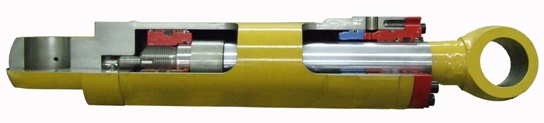
The smooth outer body of welded cylinders also enables the design of multi-stage telescopic cylinders.
Welded body hydraulic cylinders dominate the mobile hydraulic equipment market such as construction equipment (excavator
Excavator
Excavators are heavy construction equipment consisting of a boom, stick, bucket and cab on a rotating platform . The house sits atop an undercarriage with tracks or wheels. A cable-operated excavator uses winches and steel ropes to accomplish the movements. They are a natural progression from the...
s, bulldozers, and road graders) and material handling equipment (forklift trucks, telehandlers, and lift-gates). They are also used in heavy industry such as cranes, oil rigs, and large off-road vehicles in above-ground mining.
Piston rod construction
The piston rod of an hydraulic cylinder operates both inside and outside the barrel, and consequently both in and out of the hydraulic fluid and surrounding atmosphere.Metallic coatings
Smooth and hard surfaces are desirable on the outer diameter of the piston rod and slide rings for proper sealing. Corrosion resistance is also advantageous. A chromiumChromium
Chromium is a chemical element which has the symbol Cr and atomic number 24. It is the first element in Group 6. It is a steely-gray, lustrous, hard metal that takes a high polish and has a high melting point. It is also odorless, tasteless, and malleable...
layer may often be applied on the outer surfaces of these parts. However, chromium layers may be porous, thereby attracting moisture and eventually causing oxidation. In harsh marine environments, the steel
Steel
Steel is an alloy that consists mostly of iron and has a carbon content between 0.2% and 2.1% by weight, depending on the grade. Carbon is the most common alloying material for iron, but various other alloying elements are used, such as manganese, chromium, vanadium, and tungsten...
is often treated with both a nickel
Nickel
Nickel is a chemical element with the chemical symbol Ni and atomic number 28. It is a silvery-white lustrous metal with a slight golden tinge. Nickel belongs to the transition metals and is hard and ductile...
layer and a chromium layer. Often 40 to 150 micrometer thick layers are applied. Sometimes solid stainless steel
Stainless steel
In metallurgy, stainless steel, also known as inox steel or inox from French "inoxydable", is defined as a steel alloy with a minimum of 10.5 or 11% chromium content by mass....
rods are used. High quality stainless steel such as AISI 316 may be used for low stress applications. Other stainless steels such as AISI 431 may also be used where there are higher stresses, but lower corrosion concerns.
Ceramic coatings
Due to shortcomings of metallic materials, ceramicCeramic
A ceramic is an inorganic, nonmetallic solid prepared by the action of heat and subsequent cooling. Ceramic materials may have a crystalline or partly crystalline structure, or may be amorphous...
coatings were developed. Initially ceramic protection schemes seemed ideal, but porosity was higher than projected. Recently the corrosion resistant semi ceramic Lunac 2+
Lunac (alloy and trans-ceramic coatings)
Lunac refers to two kinds of coating developed by the WMV laboratories. Lunac 1 is a metallic glass coating with particularly good non-stick properties, used mainly for coating the insides of dies used in plastic molding; Lunac 2 + is a very hard trans-ceramic coating, resistant to abrasive...
coatings were introduced. These hard coatings are non porous and do not suffer from high brittleness.
Length
Piston rods are generally available in lengths which are cut to suit the application. As the common rods have a soft or mild steel core, their ends can be welded or machined for a screw threadScrew thread
A screw thread, often shortened to thread, is a helical structure used to convert between rotational and linear movement or force. A screw thread is a ridge wrapped around a cylinder or cone in the form of a helix, with the former being called a straight thread and the latter called a tapered thread...
.
Telescopic cylinder
.svg.png)
Telescopic cylinder
Telescopic cylinders are a special design of hydraulic cylinder that provide an exceptionally long output travel from a very compact retracted length. Typically the collapsed length of a telescopic cylinder is 20 to 40%...
s. If we call a normal rod cylinder single stage, telescopic cylinders are multi-stage units of two, three, four, five or more stages. In general telescopic cylinders are much more expensive than normal cylinders. Most telescopic cylinders are single acting (push). Double acting telescopic cylinder
Telescopic cylinder
Telescopic cylinders are a special design of hydraulic cylinder that provide an exceptionally long output travel from a very compact retracted length. Typically the collapsed length of a telescopic cylinder is 20 to 40%...
s must be specially designed and manufactured.
Plunger cylinder
An hydraulic cylinder without a piston or with a piston without seals is called a plungerPlunger
A plunger is a common device that is used to release stoppages in plumbing. The tool consists of a rubber cup with an attached stick "shaft", usually made of wood or bronze. Before use, any objects such as hair in the plug grate should be removed and, if possible the overflow hole should be...
cylinder. A plunger cylinder can only be used as a pushing cylinder; the maximum force is piston rod area multiplied by pressure. This means that a plunger cylinder in general has a relatively thick piston rod.
Differential cylinder
.svg.png)
Rephasing cylinder
Rephasing cylinders are two or more cylinders plumbed in series or parallel, with the bores and rods sized such that all rods extend and/or retract equally when flow is directed to the first, or last, cylinder within the system.In "parallel" applications, the bore and rod sizes are always the same, and the cylinders are always used in pairs. In "series" applications, the bore and rod sizes are always different, and two or more cylinders may be used. In these applications, the bores and rods are sized such that all rods extend or retract equally when flow is applied to the first or last cylinder within the system.
This hydraulic synchronization of rod positions eliminates the need for a flow divider in the hydraulic system, or any type of mechanical connection between the cylinder rods to achieve synchronization.
Position sensing "smart" hydraulic cylinder
Position sensing hydraulic cylindersPosition-sensing hydraulic cylinder
The position-sensing feature in the position-sensing cylinder provides instantaneous analog or digital electronic position feedback information from the cylinder that indicates the amount of rod extension throughout the range of stroke.-Internal LDT:...
eliminate the need for a hollow cylinder rod. Instead, an external sensing “bar” using Hall-Effect technology senses the position of the cylinder’s piston. This is accomplished by the placement of a permanent magnet within the piston. The magnet propagates a magnetic field through the steel wall of the cylinder, providing a locating signal to the sensor.