

South End, Boston, Massachusetts

Encyclopedia
The South End is a neighborhood of Boston
, Massachusetts
.
 The South End lies south of the Back Bay, northwest of South Boston, northeast of Roxbury
, north of Dorchester
, and southwest of Bay Village. Despite the name, it is not directly south of the center of downtown Boston.
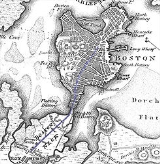
The neighborhood is built upon a former tidal marsh, a part of a larger project of the filling of Boston's Back Bay (north and west of Washington Street) and South Bay
(south and east of Washington Street), from the 1830s to the 1870s. Fill was brought in by trains from large trenches of gravel excavated in Needham, Massachusetts
. The South End was filled and developed first, before the Back Bay which was mostly built after the American Civil War
. Nineteenth century technology did not allow for driving steel piles
into bedrock
and instead a system of submerged timbers provided an understructure for most South End buildings. Recent decreases in underground water levels has caused damage to some wood pilings by exposing them to air. A series of monitoring wells have been drilled and the water level is now checked, and can be adjusted by the introduction of water.
The South End was once bordered to the north and west by the Boston and Providence Railroad, which terminated at the B&P RR Station bordering the Public Garden. The railroad line is now covered by the Southwest Corridor Park and terminates at Back Bay Station. Most of the cross streets in the neighborhood are named after cities and towns served by it or by the Boston and Albany Railroad
: Greenwich
, Newton
, Canton
, Dedham
, Brookline
, Rutland, Concord
, Worcester
, Springfield
, Camden, Maine
, Northampton
, Sharon
, Randolph
, Plympton
, Stoughton
, Waltham
, Dover
, Chatham
, and Wareham
.
The primary business thoroughfares of the South End are Tremont
and Washington Streets, from West Newton Street to Berkeley Street. Washington Street, the original causeway that connected Roxbury to Boston, experienced considerable reinvestment in the 1990s. The street was once defined by the Washington Street Elevated
, an elevated train that was moved to below Southwest Corridor Park in the 1980s. Today Washington is the route of the Silver Line
, Boston's first bus rapid transit
line. Columbus Avenue, the third main street of the South End, also has numerous restaurants and provides a remarkable straight-line view to the steeple of Park Street Church
. Today the modern MBTA Orange Line
rapid transit train runs along the partially covered Southwest Corridor
, with neighborhood stops at Back Bay
(also an MBTA Commuter Rail
stop due to its proximity to the Copley Square
employment center) and Massachusetts Avenue
.
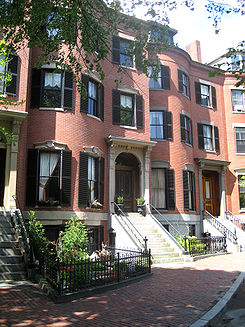
 The South End is built mostly of mid-nineteenth century bowfronts — aesthetically uniform rows of five-story, predominantly red-brick structures, of mixed residential and commercial uses. The most common styles are Renaissance Revival, Italianate and French Second Empire, though there are Greek Revival, Egyptian Revival, Gothic Revival, and Queen Anne style houses, among several other styles. Row houses built in the last quarter of the nineteenth century, especially along the present Southwest Corridor Park show the influence of Charles Eastlake
in the incised decoration on stone trim. Despite the style, a common palette of red brick, slate, limestone or granite trim, and cast iron railings provide great visual unity. Today, the South End is listed on the National Register of Historic Places
and is a Boston Landmark District. It is North America's largest extant Victorian residential district. A citizens' group, The South End Historical Society
, works with the Boston Landmarks Commission, on matters of historic preservation.
A series of eleven residential parks are located across the South End, most are elliptical in shape with passive-use green space located in the middle. These residential squares vary in size, and take inspiration from English-inspired residential squares first laid out by Charles Bulfinch downtown. Many of the parks have a central fountain and are bordered with cast iron fencing. Complimenting the nineteenth century residential parks are several newer parks, and a series of sixteen community gardens and pocket parks operated by the South End Lower Roxbury Open Space Land Trust
.
laid out some of the first filled land. He designed a large residential park called Columbia Square located at the present Franklin and Blackstone Squares
. Bulfinch's plan was to route traffic around the square, not through it. Eventually his plan was abandoned and Washington street was allowed to once more divide the square creating today's separate squares.
Many rooming houses on the Back Bay side of the South End had no bathing facilities; roomers went to public showers to bathe. Filled land in the South End was originally eight feet above sea level; it's now four feet, as fill settles. The original shore line of Boston Neck crosses in front of 40 St. George Street, (formerly James Street), and tapers to the narrowest point on the Neck at Dover Street. Blackstone and Franklin Parks are solid land on the original neck, but clam and snail shells are just beneath its surface, as high seas would occasionally overrun the Neck. Massive granite blocks of original sea wall can be seen on the Harrison Avenue side of the Joshua Bates School.
A burgeoning middle class moved to the South End including business owners, two mayors, bankers, and industrialists. Though the neighborhood's status as a wealthy neighborhood was relatively short-lived, myths of a dramatic white flight
in the 1880s are not entirely true. A series of national financial panics (see e.g., Panic of 1884
, Economic history of the United States
), combined with the emergence of new residential housing in Back Bay and Roxbury
fed a steady decline of whites of English Protestant ancestry. Still whites remained in the neighborhood, but increasingly they were Irish
Catholic
and recent immigrants.
By the close of the nineteenth century the South End was becoming a tenement
district, first attracting new immigrants and, in the 1940s, single gay
men. The South End also became a center of black
middle class Boston life and culture. The largest concentration of Pullman Porters in the country lived in the South End, mostly between Columbus Avenue and the railroad bed. As the decades progressed, more buildings became tenement
s and by the 1960s absentee landlordism was rampant and the neighborhood was one of the poorest of the city.
The first settlement houses in Boston were in the South End: the South End House, Haley House, Lincoln House, the Harriet Miller House, and the Children's Art Centre. In 1960 these settlement houses merged to form United South End Settlements.
The racial makeup of the South End in 2000 was 45% non-Hispanic white, 23% black or African-American, 17% Hispanic or Latino, 12% Asian-American, and 2% multi-racial.
mecca
, with clubs such as the Royal Palms, Eddie Levine's, the Pioneer Club, Handy's Grille, Tic-Toc, Connolly's, Estelle's, the Hi-Hat, The Savoy, The Cave, Basin Street, Louie's Lounge, and Wally's Paradise. Wally's is the only venue to have survived to the present day.
From 1915 to 1970 the American Federation of Musicians
Local 535 was the top black musicians' union in the country, with local and national musicians such as Duke Ellington
, Cab Calloway
, Chick Webb
, Earl Hines
, and Jimmie Lunceford
. Its offices were originally above Charlie's Sandwich Shoppe
(whose walls are lined with photographs of the jazz stars who ate there), but moved to 409 Massachusetts Avenue around 1930. In 1970 it and the white union (Local 9) were ordered to merge by the courts (Boston Musicians Association Local 9-535) and most of the black musicians left.
(BC) first opened in the South End in 1863. A few of the original college buildings on Harrison Avenue still stand, though BC moved from the South End to then-rural Chestnut Hill
as a result of rapid growth and urbanization in the late nineteenth century.
Today, the South End is home to the Boston Ballet
, the Boston Center for the Arts
(BCA), Boston Medical Center
, and many art galleries and artists studios.
The South End is host to numerous community organizations including South End Community Health Center, South End Baseball, Youth Enrichment Services, the South End Lower Roxbury Open Space Land Trust
, Mytown
(an organization training youth to lead walking tours on neighborhood and Boston history), the South End Historical Society
, Inquilinos Boricuas en Accion, and United South End Settlements.
The Animal Rescue League of Boston, founded in 1899 by Anna Harris Smith is located in the South End at 10 Chandler Street. The Animal Rescue League of Boston features an animal shelter, an animal cruelty investigation and prosecution law enforcement department, a rescue department, an animal behavior department and an outpatient veterinary facility, Boston Veterinary Care.
, Lebanese
, Jewish, African-American, and Greek
populations began to settle in the neighborhood. In the 1930s a substantial immigration from Canada
's maritime provinces found economic opportunity in Boston, and homes in the South End neighborhood.
Beginning in the 1940s, particularly after the end of WWII the South End's rooming houses became home to growing numbers of gays and lesbians. The environment of single sex rooming houses provided home, and social cover for unmarried GLBT people. In the late 1940s a growing population of Hispanic people began settlement. At first much of this settlement was centered around the Cathedral of the Holy Cross
.
Today the neighborhood remains diverse, integrating people of nearly every race, religion, and sexual orientation.
Income levels are anecdotally reported as stratified: a concentration of the wealthy and the poor. However, neither the U.S. Census or City of Boston reports on income of this specific neighborhood. Though gentrification
is sometimes cited as a reason for flight of poorer and non-white residents, the neighborhood has maintained racial and income diversity due to a large number of subsidized, publicly owned, or otherwise low-income housing units and a homeless shelter. Subsidized below market rate housing developments such as Methunion Manor, Cathedral Housing (public housing
project), Villa Victoria, Tent City, Lenox St Apartments, Camden, Camfield Gardens, 1850 Washington St, and Mandela Homes vary considerably and represent evolving attitudes in public housing design and governance.
Although all neighborhoods in Boston suffer from crime, the city has a comparatively low incidence of street crime
. The South End is large enough that some parts can be known for street crime while others are family friendly. Those parts include the Villa Victoria Housing Projects, the Cathedral Housing Projects, and basically anywhere past Mass. Ave. The South End has more public playgrounds per square foot than other Boston neighborhoods. The South End is known as an increasingly upper middle class
neighborhood, although is still home to many lower income residents. Some long-time residents are being pushed out by rising rents and property taxes. Because of a strong low-income agenda from the city, its recent (until the 1970s) history of impoverishment, and the presence of several low income housing projects, the South End will likely remain economically and racially diverse.
The South End used to be known as a gay
, artistic, and cultural neighborhood, although rising costs in the neighborhood threaten this character. Unlike cities such as New York, there are no city policies to help artists keep their long-term studios. Art galleries, however, are flourishing even though there arent many. GardenMoms, now one of Boston's most popular online parent groups with over 2500 members city-wide, was started by several South End moms in 2002, and helped confirm the role of families as a growing and important facet of this community. (It is named after the South End cafe it started in, The Garden of Eden)
Though housing in the South End is very expensive by U.S. and Greater Boston
standards — it is rare to find a one bedroom condo for less than $400,000 — the South End remains less expensive than the wealthiest central Boston neighborhoods (Beacon Hill and the Back Bay).
, French
, Ethiopian, Brazilian, Indian
, Italian
, Venezuelan, African, Peruvian
, Latin American
, Thai, and Japanese
among others.
The South End has a growing retail presence, much of it aimed primarily at upper-middle class shoppers. New retail shops offer a range of handmade gifts by local artists, home furnishings, men's and women's clothing, stationery, specialty foods, spa services, and a rapidly growing number of manicure and pedicure shops. Several new stores cater to wealthy dog owners.
As recently as 1985 there were no bank offices in the neighborhood. As of autumn 2006 there are seven full service branch offices, an additional four partial-service branches offering home loans and ATMs but without full cashier service, more than forty local bank-linked ATM locations, and additional ATMs operated by retailers with service fees nearly double those in banks.
Boston
Boston is the capital of and largest city in Massachusetts, and is one of the oldest cities in the United States. The largest city in New England, Boston is regarded as the unofficial "Capital of New England" for its economic and cultural impact on the entire New England region. The city proper had...
, Massachusetts
Massachusetts
The Commonwealth of Massachusetts is a state in the New England region of the northeastern United States of America. It is bordered by Rhode Island and Connecticut to the south, New York to the west, and Vermont and New Hampshire to the north; at its east lies the Atlantic Ocean. As of the 2010...
.
Geography
Roxbury, Massachusetts
Roxbury is a dissolved municipality and current neighborhood of Boston, Massachusetts, United States. It was one of the first towns founded in the Massachusetts Bay Colony in 1630, and became a city in 1846 until annexed to Boston on January 5, 1868...
, north of Dorchester
Dorchester, Massachusetts
Dorchester is a dissolved municipality and current neighborhood of Boston, Massachusetts, United States. It is named after the town of Dorchester in the English county of Dorset, from which Puritans emigrated and is today endearingly nicknamed "Dot" by its residents. Dorchester, including a large...
, and southwest of Bay Village. Despite the name, it is not directly south of the center of downtown Boston.
The neighborhood is built upon a former tidal marsh, a part of a larger project of the filling of Boston's Back Bay (north and west of Washington Street) and South Bay
South Bay, Boston, Massachusetts
South Bay is a 10-acre site in Boston, Massachusetts sandwiched between Chinatown and the Leather District. It is roughly bounded by Kneeland Street, Hudson Street, the Massachusetts Turnpike mainline, and the Interstate 93 mainline. Currently owned by the Massachusetts Turnpike Authority , the...
(south and east of Washington Street), from the 1830s to the 1870s. Fill was brought in by trains from large trenches of gravel excavated in Needham, Massachusetts
Needham, Massachusetts
Needham is a town in Norfolk County, Massachusetts, United States. A suburb of Boston, its population was 28,886 at the 2010 census.- History :...
. The South End was filled and developed first, before the Back Bay which was mostly built after the American Civil War
American Civil War
The American Civil War was a civil war fought in the United States of America. In response to the election of Abraham Lincoln as President of the United States, 11 southern slave states declared their secession from the United States and formed the Confederate States of America ; the other 25...
. Nineteenth century technology did not allow for driving steel piles
Deep foundation
A deep foundation is a type of foundation distinguished from shallow foundations by the depth they are embedded into the ground. There are many reasons a geotechnical engineer would recommend a deep foundation over a shallow foundation, but some of the common reasons are very large design loads, a...
into bedrock
Bedrock
In stratigraphy, bedrock is the native consolidated rock underlying the surface of a terrestrial planet, usually the Earth. Above the bedrock is usually an area of broken and weathered unconsolidated rock in the basal subsoil...
and instead a system of submerged timbers provided an understructure for most South End buildings. Recent decreases in underground water levels has caused damage to some wood pilings by exposing them to air. A series of monitoring wells have been drilled and the water level is now checked, and can be adjusted by the introduction of water.
The South End was once bordered to the north and west by the Boston and Providence Railroad, which terminated at the B&P RR Station bordering the Public Garden. The railroad line is now covered by the Southwest Corridor Park and terminates at Back Bay Station. Most of the cross streets in the neighborhood are named after cities and towns served by it or by the Boston and Albany Railroad
Boston and Albany Railroad
The Boston and Albany Railroad was a railroad connecting Boston, Massachusetts to Albany, New York, later becoming part of the New York Central Railroad system, Conrail and CSX. The line is used by CSX for freight...
: Greenwich
Greenwich, Connecticut
Greenwich is a town in Fairfield County, Connecticut, United States. As of the 2010 census, the town had a total population of 61,171. It is home to many hedge funds and other financial service companies. Greenwich is the southernmost and westernmost municipality in Connecticut and is 38+ minutes ...
, Newton
Newton, Massachusetts
Newton is a city in Middlesex County, Massachusetts, United States bordered to the east by Boston. According to the 2010 U.S. Census, the population of Newton was 85,146, making it the eleventh largest city in the state.-Villages:...
, Canton
Canton, Massachusetts
Canton is a town in Norfolk County, Massachusetts, United States. The population was 21,561 at the 2010 census. Canton is part of Greater Boston, about 15 miles southwest of downtown Boston.- History :...
, Dedham
Dedham, Massachusetts
Dedham is a town in and the county seat of Norfolk County, Massachusetts, United States. The population was 24,729 at the 2010 census. It is located on Boston's southwest border. On the northwest it is bordered by Needham, on the southwest by Westwood and on the southeast by...
, Brookline
Brookline, Massachusetts
Brookline is a town in Norfolk County, Massachusetts, United States, which borders on the cities of Boston and Newton. As of the 2010 census, the population of the town was 58,732.-Etymology:...
, Rutland, Concord
Concord, Massachusetts
Concord is a town in Middlesex County, Massachusetts, in the United States. As of the 2010 census, the town population was 17,668. Although a small town, Concord is noted for its leading roles in American history and literature.-History:...
, Worcester
Worcester, Massachusetts
Worcester is a city and the county seat of Worcester County, Massachusetts, United States. Named after Worcester, England, as of the 2010 Census the city's population is 181,045, making it the second largest city in New England after Boston....
, Springfield
Springfield, Massachusetts
Springfield is the most populous city in Western New England, and the seat of Hampden County, Massachusetts, United States. Springfield sits on the eastern bank of the Connecticut River near its confluence with three rivers; the western Westfield River, the eastern Chicopee River, and the eastern...
, Camden, Maine
Camden, Maine
Camden is a town in Knox County, Maine, United States. The population was 5,254 at the 2000 census. The population of the town more than triples during the summer months, due to tourists and summer residents. Camden is a famous summer colony in the Mid-Coast region of Maine...
, Northampton
Northampton, Massachusetts
The city of Northampton is the county seat of Hampshire County, Massachusetts, United States. As of the 2010 census, the population of Northampton's central neighborhoods, was 28,549...
, Sharon
Sharon, Massachusetts
Sharon is a town in Norfolk County, Massachusetts, United States. The population was 17,612 at the 2010 census. Sharon is part of Greater Boston, about 17 miles southwest of downtown Boston....
, Randolph
Randolph, Massachusetts
The Town of Randolph is a city in Norfolk County, Massachusetts, United States. As of the 2010 census, the town population was 32,112. Randolph adopted a new charter effective January 2010 providing for a council-manager form of government instead of the traditional town meeting...
, Plympton
Plympton, Massachusetts
Plympton is a town in Plymouth County, Massachusetts, United States. The population was 2,820 at the 2010 census. The United States senator William Bradford was born here.- History :Plympton was first settled in 1662 as the western parish of Plymouth...
, Stoughton
Stoughton, Massachusetts
Stoughton is a town in Norfolk County, Massachusetts, United States. The population was 26,962 at the 2010 census. The town is located approximately from Boston, from Providence, and from Cape Cod.-History:...
, Waltham
Waltham, Massachusetts
Waltham is a city in Middlesex County, Massachusetts, United States, was an early center for the labor movement, and major contributor to the American Industrial Revolution. The original home of the Boston Manufacturing Company, the city was a prototype for 19th century industrial city planning,...
, Dover
Dover, Massachusetts
Dover is a town in Norfolk County, Massachusetts, United States. The population was 5,589 at the 2010 census.Located about southwest of downtown Boston, Dover is a residential town nestled on the south banks of the Charles River. Almost all of the residential zoning requires or larger...
, Chatham
Chatham, Massachusetts
Chatham is a town in Barnstable County, Massachusetts, United States, Barnstable County being coextensive with Cape Cod. The population was 6,625 at the 2000 census...
, and Wareham
Wareham, Massachusetts
Wareham is a town located in Plymouth County, Massachusetts. As of the 2000 census, the town had a total population of 20,335, with an estimated 2008 population of 21,221....
.
The primary business thoroughfares of the South End are Tremont
Tremont Street
Tremont Street is a major thoroughfare in Boston, Massachusetts.-Etymology:The name is a variation of one of the original appellations of the city, "Trimountaine," a reference to a hill that formerly had three peaks. Beacon Hill, with its single peak, is all that remains of the Trimountain...
and Washington Streets, from West Newton Street to Berkeley Street. Washington Street, the original causeway that connected Roxbury to Boston, experienced considerable reinvestment in the 1990s. The street was once defined by the Washington Street Elevated
Washington Street Elevated
The Washington Street Elevated was an elevated segment of Boston's Massachusetts Bay Transportation Authority subway system, comprising the southern stretch of the Orange Line . It ran from Chinatown through the South End and Roxbury, ending in Forest Hills in Jamaica Plain...
, an elevated train that was moved to below Southwest Corridor Park in the 1980s. Today Washington is the route of the Silver Line
Silver Line (MBTA)
The Silver Line is the only bus rapid transit line currently operated by the Massachusetts Bay Transportation Authority . It operates in two sections; the first runs from Dudley Square in Roxbury to downtown Boston, Massachusetts and South Station, mostly via Washington Street, with buses...
, Boston's first bus rapid transit
Bus rapid transit
Bus rapid transit is a term applied to a variety of public transportation systems using buses to provide faster, more efficient service than an ordinary bus line. Often this is achieved by making improvements to existing infrastructure, vehicles and scheduling...
line. Columbus Avenue, the third main street of the South End, also has numerous restaurants and provides a remarkable straight-line view to the steeple of Park Street Church
Park Street Church
The Park Street Church in Boston, Massachusetts is an active Conservative Congregational Church at the corner of Tremont Street and Park Street. The church is currently pastored by Gordon P. Hugenberger.-History:...
. Today the modern MBTA Orange Line
Orange Line (MBTA)
The Orange Line is one of the four subway lines of the Massachusetts Bay Transportation Authority. It extends from Forest Hills in Jamaica Plain, Boston in the south to Oak Grove in Malden, Massachusetts in the north. It meets the Red Line at Downtown Crossing, the Blue Line at State, and the Green...
rapid transit train runs along the partially covered Southwest Corridor
Southwest Corridor
The Southwest Corridor or Southwest Expressway was a project designed to bring an eight-lane highway into the City of Boston from a direction southwesterly of downtown. It was supposed to connect with Interstate 95 at Route 128...
, with neighborhood stops at Back Bay
Back Bay (MBTA station)
Back Bay station, located at 145 Dartmouth Street, between Stuart Street and Columbus Avenue, is a train station in the Back Bay neighborhood of Boston...
(also an MBTA Commuter Rail
MBTA Commuter Rail
The MBTA Commuter Rail serves as the regional rail arm of the Massachusetts Bay Transportation Authority, in the United States. It is operated under contract by the Massachusetts Bay Commuter Railroad Company a joint partnership of Veolia Transportation, Bombardier Transportation and Alternate...
stop due to its proximity to the Copley Square
Copley Square
Copley Square is a public square located in the Back Bay neighborhood of Boston, Massachusetts, named for the donor of the land on which it was developed. The square is named for John Singleton Copley, a famous portrait painter of the late 18th century and native of Boston. A bronze statue of...
employment center) and Massachusetts Avenue
Massachusetts Avenue (MBTA station)
Massachusetts Avenue is a MBTA subway station on the Orange Line, located at 380 Massachusetts Avenue in Boston, Massachusetts. The station opened in 1987 as part of the renovation and relocation of the southern Orange Line. The Orange line runs parallel to the Northeast Corridor, which carries...
.
Architecture and environment
Charles Eastlake
Charles Locke Eastlake was a British architect and furniture designer. Trained by the architect Philip Hardwick , he popularised William Morris's notions of decorative arts in the Arts and Crafts style, becoming one of the principal exponents of the revived Early English or Modern Gothic style...
in the incised decoration on stone trim. Despite the style, a common palette of red brick, slate, limestone or granite trim, and cast iron railings provide great visual unity. Today, the South End is listed on the National Register of Historic Places
National Register of Historic Places
The National Register of Historic Places is the United States government's official list of districts, sites, buildings, structures, and objects deemed worthy of preservation...
and is a Boston Landmark District. It is North America's largest extant Victorian residential district. A citizens' group, The South End Historical Society
South End Historical Society
The South End Historical Society or SEHS, is a non-profit community organization founded in 1966, and dedicated to the preservation of the built environment and revitalization of the South End neighborhood in Boston, Massachusetts, USA...
, works with the Boston Landmarks Commission, on matters of historic preservation.
A series of eleven residential parks are located across the South End, most are elliptical in shape with passive-use green space located in the middle. These residential squares vary in size, and take inspiration from English-inspired residential squares first laid out by Charles Bulfinch downtown. Many of the parks have a central fountain and are bordered with cast iron fencing. Complimenting the nineteenth century residential parks are several newer parks, and a series of sixteen community gardens and pocket parks operated by the South End Lower Roxbury Open Space Land Trust
South End Lower Roxbury Open Space Land Trust
The South End Lower Roxbury Open Space Land Trust is a membership-supported, non-profit organization that owns, protects, and manages 16 community gardens and pocket parks in the South End and Lower Roxbury neighborhoods of Boston, in the U.S. state of Massachusetts...
.
History and changing demographics
As the South End geographically grew from filling in land north and west of "the Neck" (today's Washington Street) the city of Boston envisioned a large inner city residential neighborhood to relieve the crowded downtown and Beacon Hill neighborhoods. The city also hoped for a large and stable tax base. Architect Charles BulfinchCharles Bulfinch
Charles Bulfinch was an early American architect, and has been regarded by many as the first native-born American to practice architecture as a profession....
laid out some of the first filled land. He designed a large residential park called Columbia Square located at the present Franklin and Blackstone Squares
Franklin and Blackstone Squares
Blackstone and Franklin Squares are located in the South End of Boston, Massachusetts. Charles Bullfinch, who created the plan for the South End, originally intended the two squares to be one, calling it Columbia Square. Franklin Square opened in 1849 and Blackstone Square subsequently opened in...
. Bulfinch's plan was to route traffic around the square, not through it. Eventually his plan was abandoned and Washington street was allowed to once more divide the square creating today's separate squares.
Many rooming houses on the Back Bay side of the South End had no bathing facilities; roomers went to public showers to bathe. Filled land in the South End was originally eight feet above sea level; it's now four feet, as fill settles. The original shore line of Boston Neck crosses in front of 40 St. George Street, (formerly James Street), and tapers to the narrowest point on the Neck at Dover Street. Blackstone and Franklin Parks are solid land on the original neck, but clam and snail shells are just beneath its surface, as high seas would occasionally overrun the Neck. Massive granite blocks of original sea wall can be seen on the Harrison Avenue side of the Joshua Bates School.
A burgeoning middle class moved to the South End including business owners, two mayors, bankers, and industrialists. Though the neighborhood's status as a wealthy neighborhood was relatively short-lived, myths of a dramatic white flight
White flight
White flight has been a term that originated in the United States, starting in the mid-20th century, and applied to the large-scale migration of whites of various European ancestries from racially mixed urban regions to more racially homogeneous suburban or exurban regions. It was first seen as...
in the 1880s are not entirely true. A series of national financial panics (see e.g., Panic of 1884
Panic of 1884
The Panic of 1884 was a panic during the Recession of 1882-85. Gold reserves of Europe were depleted and the New York City national banks, with tacit approval of the United States Treasury Department, halted investments in the rest of the United States and called in outstanding loans. A larger...
, Economic history of the United States
Economic history of the United States
The economic history of the United States has its roots in European colonization in the 16th, 17th, and 18th centuries. Marginal colonial economies grew into 13 small, independent farming economies, which joined together in 1776 to form the United States of America...
), combined with the emergence of new residential housing in Back Bay and Roxbury
Roxbury, Massachusetts
Roxbury is a dissolved municipality and current neighborhood of Boston, Massachusetts, United States. It was one of the first towns founded in the Massachusetts Bay Colony in 1630, and became a city in 1846 until annexed to Boston on January 5, 1868...
fed a steady decline of whites of English Protestant ancestry. Still whites remained in the neighborhood, but increasingly they were Irish
Irish people
The Irish people are an ethnic group who originate in Ireland, an island in northwestern Europe. Ireland has been populated for around 9,000 years , with the Irish people's earliest ancestors recorded having legends of being descended from groups such as the Nemedians, Fomorians, Fir Bolg, Tuatha...
Catholic
Catholic
The word catholic comes from the Greek phrase , meaning "on the whole," "according to the whole" or "in general", and is a combination of the Greek words meaning "about" and meaning "whole"...
and recent immigrants.
By the close of the nineteenth century the South End was becoming a tenement
Tenement
A tenement is, in most English-speaking areas, a substandard multi-family dwelling, usually old, occupied by the poor.-History:Originally the term tenement referred to tenancy and therefore to any rented accommodation...
district, first attracting new immigrants and, in the 1940s, single gay
Gay
Gay is a word that refers to a homosexual person, especially a homosexual male. For homosexual women the specific term is "lesbian"....
men. The South End also became a center of black
Black people
The term black people is used in systems of racial classification for humans of a dark skinned phenotype, relative to other racial groups.Different societies apply different criteria regarding who is classified as "black", and often social variables such as class, socio-economic status also plays a...
middle class Boston life and culture. The largest concentration of Pullman Porters in the country lived in the South End, mostly between Columbus Avenue and the railroad bed. As the decades progressed, more buildings became tenement
Tenement
A tenement is, in most English-speaking areas, a substandard multi-family dwelling, usually old, occupied by the poor.-History:Originally the term tenement referred to tenancy and therefore to any rented accommodation...
s and by the 1960s absentee landlordism was rampant and the neighborhood was one of the poorest of the city.
The first settlement houses in Boston were in the South End: the South End House, Haley House, Lincoln House, the Harriet Miller House, and the Children's Art Centre. In 1960 these settlement houses merged to form United South End Settlements.
The racial makeup of the South End in 2000 was 45% non-Hispanic white, 23% black or African-American, 17% Hispanic or Latino, 12% Asian-American, and 2% multi-racial.
Jazz mecca
Until the 1950s the South End and bordering Roxbury was a jazzJazz
Jazz is a musical style that originated at the beginning of the 20th century in African American communities in the Southern United States. It was born out of a mix of African and European music traditions. From its early development until the present, jazz has incorporated music from 19th and 20th...
mecca
Mecca
Mecca is a city in the Hijaz and the capital of Makkah province in Saudi Arabia. The city is located inland from Jeddah in a narrow valley at a height of above sea level...
, with clubs such as the Royal Palms, Eddie Levine's, the Pioneer Club, Handy's Grille, Tic-Toc, Connolly's, Estelle's, the Hi-Hat, The Savoy, The Cave, Basin Street, Louie's Lounge, and Wally's Paradise. Wally's is the only venue to have survived to the present day.
From 1915 to 1970 the American Federation of Musicians
American Federation of Musicians
The American Federation of Musicians of the United States and Canada is a labor union of professional musicians in the United States and Canada...
Local 535 was the top black musicians' union in the country, with local and national musicians such as Duke Ellington
Duke Ellington
Edward Kennedy "Duke" Ellington was an American composer, pianist, and big band leader. Ellington wrote over 1,000 compositions...
, Cab Calloway
Cab Calloway
Cabell "Cab" Calloway III was an American jazz singer and bandleader. He was strongly associated with the Cotton Club in Harlem, New York City where he was a regular performer....
, Chick Webb
Chick Webb
William Henry Webb, usually known as Chick Webb was an American jazz and swing music drummer as well as a band leader.-Biography:...
, Earl Hines
Earl Hines
Earl Kenneth Hines, universally known as Earl "Fatha" Hines, was an American jazz pianist. Hines was one of the most influential figures in the development of modern jazz piano and, according to one source, is "one of a small number of pianists whose playing shaped the history of jazz".-Early...
, and Jimmie Lunceford
Jimmie Lunceford
James Melvin "Jimmie" Lunceford was an American jazz alto saxophonist and bandleader in the swing era.-Biography:...
. Its offices were originally above Charlie's Sandwich Shoppe
Charlie's Sandwich Shoppe
Charlie's Sandwich Shoppe is a restaurant located in Boston's South End that is known for serving African-American jazz musicians during the era of segregated hotels, The walls of the diner are adorned with pictures of customers ranging from Sammy Davis, Jr. to Vice President Al Gore...
(whose walls are lined with photographs of the jazz stars who ate there), but moved to 409 Massachusetts Avenue around 1930. In 1970 it and the white union (Local 9) were ordered to merge by the courts (Boston Musicians Association Local 9-535) and most of the black musicians left.
Institutions and community organizations
Boston CollegeBoston College
Boston College is a private Jesuit research university located in the village of Chestnut Hill, Massachusetts, USA. The main campus is bisected by the border between the cities of Boston and Newton. It has 9,200 full-time undergraduates and 4,000 graduate students. Its name reflects its early...
(BC) first opened in the South End in 1863. A few of the original college buildings on Harrison Avenue still stand, though BC moved from the South End to then-rural Chestnut Hill
Chestnut Hill, Massachusetts
Chestnut Hill is a wealthy New England village located six miles west of downtown Boston, Massachusetts, United States. Like all Massachusetts villages, Chestnut Hill is not an incorporated municipal entity, but unlike most of them, it encompasses parts of three separate municipalities, each of...
as a result of rapid growth and urbanization in the late nineteenth century.
Today, the South End is home to the Boston Ballet
Boston Ballet
Boston Ballet, founded in 1963 by E. Virginia Williams, was the first professional repertory ballet company in New England. Boston Ballet’s national and international reputation developed under the leadership of Artistic Directors Violette Verdy , Bruce Marks , and Anna-Marie Holmes...
, the Boston Center for the Arts
Boston Center for the Arts
The Boston Center for the Arts is a 501 nonprofit visual and performing arts complex in the South End neighborhood of Boston, Massachusetts. The BCA houses several performance and rehearsal spaces, restaurants, a gallery, the headquarters of the Boston Ballet, the Community Music Center of Boston...
(BCA), Boston Medical Center
Boston Medical Center
Boston Medical Center is a non-profit 639 licensed-bed medical center in Boston, Massachusetts. It was created by the formal merger of Boston City Hospital which was the first municipal hospital in the United States and Boston University Medical Center Hospital in July 1996 which was sponsored...
, and many art galleries and artists studios.
The South End is host to numerous community organizations including South End Community Health Center, South End Baseball, Youth Enrichment Services, the South End Lower Roxbury Open Space Land Trust
South End Lower Roxbury Open Space Land Trust
The South End Lower Roxbury Open Space Land Trust is a membership-supported, non-profit organization that owns, protects, and manages 16 community gardens and pocket parks in the South End and Lower Roxbury neighborhoods of Boston, in the U.S. state of Massachusetts...
, Mytown
Mytown
Mytown, an acronym for Multicultural Youth Tour of What's Now, is a youth organization based in Boston, Massachusetts, USA, engaging young people in learning about and teaching others about the local history of their urban neighborhood....
(an organization training youth to lead walking tours on neighborhood and Boston history), the South End Historical Society
South End Historical Society
The South End Historical Society or SEHS, is a non-profit community organization founded in 1966, and dedicated to the preservation of the built environment and revitalization of the South End neighborhood in Boston, Massachusetts, USA...
, Inquilinos Boricuas en Accion, and United South End Settlements.
The Animal Rescue League of Boston, founded in 1899 by Anna Harris Smith is located in the South End at 10 Chandler Street. The Animal Rescue League of Boston features an animal shelter, an animal cruelty investigation and prosecution law enforcement department, a rescue department, an animal behavior department and an outpatient veterinary facility, Boston Veterinary Care.
Diversity
The South End's population has been diverse since the 1880s when IrishIrish people
The Irish people are an ethnic group who originate in Ireland, an island in northwestern Europe. Ireland has been populated for around 9,000 years , with the Irish people's earliest ancestors recorded having legends of being descended from groups such as the Nemedians, Fomorians, Fir Bolg, Tuatha...
, Lebanese
Demographics of Lebanon
This article is about the demographic features of the population of Lebanon, including population density, ethnicity, education level, health of the populace, economic status, religious affiliations and other aspects of the population....
, Jewish, African-American, and Greek
Greeks
The Greeks, also known as the Hellenes , are a nation and ethnic group native to Greece, Cyprus and neighboring regions. They also form a significant diaspora, with Greek communities established around the world....
populations began to settle in the neighborhood. In the 1930s a substantial immigration from Canada
Canada
Canada is a North American country consisting of ten provinces and three territories. Located in the northern part of the continent, it extends from the Atlantic Ocean in the east to the Pacific Ocean in the west, and northward into the Arctic Ocean...
's maritime provinces found economic opportunity in Boston, and homes in the South End neighborhood.
Beginning in the 1940s, particularly after the end of WWII the South End's rooming houses became home to growing numbers of gays and lesbians. The environment of single sex rooming houses provided home, and social cover for unmarried GLBT people. In the late 1940s a growing population of Hispanic people began settlement. At first much of this settlement was centered around the Cathedral of the Holy Cross
Cathedral of the Holy Cross
The Cathedral of the Holy Cross is the mother church of the Roman Catholic Archdiocese of Boston and the largest Roman Catholic church in New England....
.
Today the neighborhood remains diverse, integrating people of nearly every race, religion, and sexual orientation.
Income levels are anecdotally reported as stratified: a concentration of the wealthy and the poor. However, neither the U.S. Census or City of Boston reports on income of this specific neighborhood. Though gentrification
Gentrification
Gentrification and urban gentrification refer to the changes that result when wealthier people acquire or rent property in low income and working class communities. Urban gentrification is associated with movement. Consequent to gentrification, the average income increases and average family size...
is sometimes cited as a reason for flight of poorer and non-white residents, the neighborhood has maintained racial and income diversity due to a large number of subsidized, publicly owned, or otherwise low-income housing units and a homeless shelter. Subsidized below market rate housing developments such as Methunion Manor, Cathedral Housing (public housing
Public housing
Public housing is a form of housing tenure in which the property is owned by a government authority, which may be central or local. Social housing is an umbrella term referring to rental housing which may be owned and managed by the state, by non-profit organizations, or by a combination of the...
project), Villa Victoria, Tent City, Lenox St Apartments, Camden, Camfield Gardens, 1850 Washington St, and Mandela Homes vary considerably and represent evolving attitudes in public housing design and governance.
Although all neighborhoods in Boston suffer from crime, the city has a comparatively low incidence of street crime
Street crime
Street crime is a loose term for criminal offences taking place in public places. It has moved to occupy the place once held by mugging. According to London's Metropolitan Police Force, street crime is:...
. The South End is large enough that some parts can be known for street crime while others are family friendly. Those parts include the Villa Victoria Housing Projects, the Cathedral Housing Projects, and basically anywhere past Mass. Ave. The South End has more public playgrounds per square foot than other Boston neighborhoods. The South End is known as an increasingly upper middle class
Upper middle class
The upper middle class is a sociological concept referring to the social group constituted by higher-status members of the middle class. This is in contrast to the term "lower middle class", which is used for the group at the opposite end of the middle class stratum, and to the broader term "middle...
neighborhood, although is still home to many lower income residents. Some long-time residents are being pushed out by rising rents and property taxes. Because of a strong low-income agenda from the city, its recent (until the 1970s) history of impoverishment, and the presence of several low income housing projects, the South End will likely remain economically and racially diverse.
The South End used to be known as a gay
Gay
Gay is a word that refers to a homosexual person, especially a homosexual male. For homosexual women the specific term is "lesbian"....
, artistic, and cultural neighborhood, although rising costs in the neighborhood threaten this character. Unlike cities such as New York, there are no city policies to help artists keep their long-term studios. Art galleries, however, are flourishing even though there arent many. GardenMoms, now one of Boston's most popular online parent groups with over 2500 members city-wide, was started by several South End moms in 2002, and helped confirm the role of families as a growing and important facet of this community. (It is named after the South End cafe it started in, The Garden of Eden)
Though housing in the South End is very expensive by U.S. and Greater Boston
Greater Boston
Greater Boston is the area of the Commonwealth of Massachusetts surrounding the city of Boston. Due to ambiguity in usage, the size of the area referred to can be anywhere between that of the metropolitan statistical area of Boston and that of the city's combined statistical area which includes...
standards — it is rare to find a one bedroom condo for less than $400,000 — the South End remains less expensive than the wealthiest central Boston neighborhoods (Beacon Hill and the Back Bay).
Restaurants and retail
The South End is one of Boston's main restaurant districts offering a diverse mix of cuisines, many at a relatively high price point. Tremont Street is often called "Restaurant Row." The South End's range of restaurants include American southern "Low Country"Cuisine of the Southern United States
The cuisine of the Southern United States is defined as the historical regional culinary form of states generally south of the Mason Dixon Line dividing Pennsylvania from Maryland and Delaware as well as along the Ohio River, and extending west to Southern Missouri, Oklahoma and Texas.The most...
, French
French cuisine
French cuisine is a style of food preparation originating from France that has developed from centuries of social change. In the Middle Ages, Guillaume Tirel , a court chef, authored Le Viandier, one of the earliest recipe collections of Medieval France...
, Ethiopian, Brazilian, Indian
Indian cuisine
Indian cuisine consists of thousands of regional cuisines which date back thousands of years. The dishes of India are characterised by the extensive use of various Indian spices, herbs, vegetables and fruit. Indian cuisine is also known for the widespread practice of vegetarianism in Indian society...
, Italian
Italian cuisine
Italian cuisine has developed through centuries of social and political changes, with roots as far back as the 4th century BCE. Italian cuisine in itself takes heavy influences, including Etruscan, ancient Greek, ancient Roman, Byzantine, Jewish and Arab cuisines...
, Venezuelan, African, Peruvian
Peruvian cuisine
Peruvian cuisine reflects local cooking practices and ingredients—and, through immigration, influences from Spain, China, Italy, West Africa, and Japan. Due to a lack of ingredients from their home countries, immigrants to Peru modified their traditional cuisines by using ingredients...
, Latin American
Latin American cuisine
Latin American Cuisine refers to typical foods, beverages, and cooking styles common to many of the countries and cultures in Latin America...
, Thai, and Japanese
Japanese cuisine
Japanese cuisine has developed over the centuries as a result of many political and social changes throughout Japan. The cuisine eventually changed with the advent of the Medieval age which ushered in a shedding of elitism with the age of shogun rule...
among others.
The South End has a growing retail presence, much of it aimed primarily at upper-middle class shoppers. New retail shops offer a range of handmade gifts by local artists, home furnishings, men's and women's clothing, stationery, specialty foods, spa services, and a rapidly growing number of manicure and pedicure shops. Several new stores cater to wealthy dog owners.
As recently as 1985 there were no bank offices in the neighborhood. As of autumn 2006 there are seven full service branch offices, an additional four partial-service branches offering home loans and ATMs but without full cashier service, more than forty local bank-linked ATM locations, and additional ATMs operated by retailers with service fees nearly double those in banks.
Further reading
- Leading business men of Back Bay, South End, Boston Highlands, Jamaica Plain and Dorchester: illustrated. Boston. Mercantile Pub. Co., 1888.
- Krieger, Alex, and David Cobb. Mapping Boston. The MIT Press: 1999. ISBN 0-262-11244-2.
- Griffin, Arthur, and Esther Forbes. The Boston Book. Houghton Mifflin Company: 1947.
- Goodman, Phoebe. The Garden Squares of Boston. University Press of New England: 2003. ISBN 1-58465-298-5.
- Sammarco, Anthony Mitchell, Boston's South End, Charleston, SC : Arcadia Publishing, February 1, 1998. ISBN 073853949X
External links
- South End Boston
- Eight Streets Neighborhood Association, South End
- St. John the Baptist, Hellenic/Greek Orthodox Church of the South End
- The Animal Rescue League of Boston
- Ellis Memorial & Eldredge House
- A Short History of Boston's South End
- The Inquilinos Boricuas en Acción records, 1967-2004 (bulk 1974-1999) are located in the Northeastern University Libraries, Archives and Special Collections Department, Boston, MA.
- The Escuelita Agueybana Day Care Centers records, 1978-1996 are located in the Northeastern University Libraries, Archives and Special Collections Department, Boston, MA.
- The United South End Settlements records, 1892-2006 (bulk 1980-1999) are located in the Northeastern University Libraries, Archives and Special Collections Department, Boston, MA.
- Boston Pictorial Archive. Boston Public Library. Images of the South End, Boston.