

Earl Hines

Encyclopedia
Earl Kenneth Hines, universally known as Earl "Fatha" Hines, (December 28, 1903 – April 22, 1983) was an American jazz pianist
. Hines was one of the most influential figures in the development of modern jazz piano
and, according to one source, is "one of a small number of pianists whose playing shaped the history of jazz
".
12 miles from Pittsburgh
city center. His father played cornet
and was leader of Pittsburgh's Eureka Brass Band, his stepmother a church organist
. Hines intended to follow his father on cornet but "blowing" hurt him behind the ears - while the piano didn't. The young Hines took classical piano lessons - at eleven he was playing organ in his local Baptist church - but he also had a "good ear and a good memory" and could re-play songs and numbers he heard in theaters and park 'concerts': "I'd be playing songs from these shows months before the song copies came out. That astonished a lot of people and they'd ask where I heard these numbers and I'd tell them at the theatre where my parents had taken me." Later Hines was to say that he was playing piano around Pittsburgh "before the word 'jazz' was even invented".
in 1923. Only two of these were issued, and only one, a Hines composition, "Congaine", "a keen snappy foxtrot", featured any solo work by Hines. Hines entered the studio again with Deppe a month later to record spirituals and popular songs.
In 1925, after much family debate, Hines moved to Chicago, Illinois, then the world's "jazz" capital, home (at the time) to Jelly Roll Morton
and King Oliver. He started in The Elite no 2 Club but soon joined Carroll Dickerson
's band with whom he also toured on the Pantages Theatre Circuit to Los Angeles and back.
Then, in the poolroom at Chicago's Musicians' Union on State & 39th, Earl Hines met Louis Armstrong
. Hines was 21, Armstrong 24. They played together at the Union piano. Armstrong was astounded by Hines's avant-garde "trumpet-style" piano-playing, often using dazzlingly fast octaves so that on none-too-perfect upright pianos (and with no amplification) "they could hear me out front" - as indeed they could. Richard Cook
's Jazz Encyclopedia says:
Armstrong and Hines became good friends, shared a car, and Armstrong joined Hines in Carroll Dickerson
's band at the Sunset Cafe
. In 1927, this became Louis Armstrong's band under the musical direction of Hines. Later that year, Armstrong revamped his Okeh Records
recording-only band, Louis Armstrong's Hot Five, and replaced his wife Lil Hardin Armstrong
on piano with Hines. Armstrong and Hines then recorded what are often regarded as some of the most important jazz records ever made, most famously their 1928 trumpet and piano duet "Weatherbird".
The Sunset Cafe
closed in 1927. Hines, Armstrong and their drummer, Zutty Singleton, agreed they would be, “'The Unholy Three', stick together and not play for anyone unless the three of us were hired” but, trying to establish their own Warwick Hall Club as 'Louis Armstrong and his Stompers' [with Hines as musical director and the premises rented in Hines' name] they ran into difficulties. Hines went briefly to New York to return to find that in his absence Armstrong and Singleton had re-joined their now-rival Carroll Dickerson’s band at the new The Savoy Ballroom – a fact which left Hines “warm”.
Hines joined clarinetist Jimmy Noone at The Apex, an after-hours speakeasy
, playing from midnight – 6am 7 nights a week. Hines recorded with Noone, again with Armstrong and late in 1928 recorded his first piano solos, 8 for QRS Records
in New York then 7 for Okeh Records
in Chicago, all except two his own compositions. He moved in with Kathryn Perry with whom he had recorded 'Sadie Green The Vamp of New Orleans' but Hines had also begun rehearsing his own big-band. At 24 his big break was about to come.
and Prohibition
Earl Hines was "The Orchestra" in The Grand Terrace. The Hines Orchestra [or 'Organization' as Hines preferred it - it had up to 28 musicians] did three shows a night in The Grand Terrace, four shows every Saturday and sometimes did Sundays. "Earl Hines and The Grand Terrace were to Chicago what Duke Ellington and The Cotton Club were to New York - but fierier." The Grand Terrace was controlled by Al Capone
- so Hines became Capone's "Mr Piano Man" with the Grand Terrace upright piano soon replaced by a white $3,000 Bechstein grand.
From The Grand Terrace, Hines and his band broadcast on "open mikes" over many years, sometimes seven nights a week, coast-to-coast across America — Chicago being well placed to deal with the U.S. live-broadcasting time-zone problem. Earl Hines' became the most broadcast band in America. Among his listeners were a young Nat 'King' Cole and Jay McShann
in Kansas City who said his "...real education came from Earl Hines. When 'Fatha' went off the air, I went to bed”. But Hines' most notable 'student' was Art Tatum
from Toledo, Ohio, 6 years younger than Hines and now often regarded as the greatest pianist jazz has so far produced.
Hines always liked to promote and, often surprisingly quietly, to accompany singers most notably, in the Grand Terrace days, Billy Eckstine
:
Each summer, Hines toured his whole band for three months, including through the South. "When we traveled by train through the South, they would send a porter back to our car to let us know when the dining room was cleared, and then we would all go in together. We couldn't eat when we wanted to. We had to eat when they were ready for us."
Occasionally, Hines allowed other pianists to play as 'relief' piano player which better allowed Hines to conduct his whole 'Organization'. Jess Stacy
was one, Nat "King" Cole and Teddy Wilson
were others (though Cliff Smalls was his favorite). It was with Hines in The Grand Terrace that Charlie Parker
got his first professional job until he was fired for his "time-keeping" — by which Hines meant Parker's inability to show up on time despite Parker resorting to sleeping under The Grand Terrace stage in his attempts to do so.
The Grand Terrace closed suddenly in December 1940 with the manager, Ed Fox, 'not to be found'. Hines, always famously good to work for, took his band on the road. Some of his band members were drafted to fight in World War ll but Hines toured his band coast to coast across America taking time out to front the Duke Ellington
Orchestra in 1944 while Duke was ill. (Thirty years later, Hines's 20 solo "transformative versions" of his Earl Hines Plays Duke Ellington recorded in the 1970s were described by Ben Ratliff in the New York Times as "as good an example of the jazz process as anything out there".)
It was during this time (and especially during the 1942–1945 recording ban) that members of the Hines' band's late-night jam-sessions laid the seeds for the upcoming 'revolution' in jazz, Bebop
. Duke Ellington
was later to say that "the seeds of bop were in Earl Hines's piano style". Composer Gunther Schuller
said, "In 1943 I heard the great Earl Hines band which had Bird in it and all those other great musicians. They were playing all the flatted fifth chords and all the modern harmonies and substitutions and Dizzy Gillespie runs in the trumpet section work. Two years later I read that that was 'bop' and the beginning of modern jazz ... but the band never made recordings".
In 1946 Hines received serious head injuries in a car crash near Houston which affected his eyesight but he continued to lead his big-band for 2 more years. In 1947 he bought the El Grotto nightclub in Chicago - the showgirls were called The Grottoettes - but it soon foundered, Hines losing $30,000. In reality the big-band era was over - Hines had had his for 20 years.
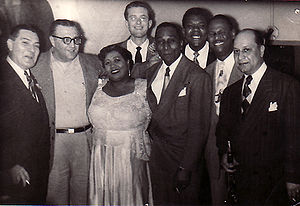 In early 1948, Hines joined up again with Armstrong in the "Louis Armstrong
and his All-Stars" 'small-band' (rather, Hines now came to feel, as a sideman) and stayed, not entirely happily, thru' 1951. Next, back as leader again, Hines took his own small combos around the States and Europe but, at the start of the jazz-lean 1960s and old enough now to retire and take up bowling, Hines settled "home" in Oakland, California
with his wife and two young daughters, Janear and Tosca, opened a tobacconist's and came close to giving up the profession.
Then, in 1964, thanks to Stanley Dance
, Earl Hines' determined friend and unofficial manager, Hines was "suddenly rediscovered" following a series of 'recitals' at The Little Theatre in New York that Dance had cajoled him into. They were the first piano 'recitals' Hines - always thinking of himself as "just a band pianist" - had ever given. These 'recitals' caused a sensation. "What is there left to hear after you've heard Earl Hines?", asked the New York Times. Hines then won the 1966 "International Critics Poll" for Down Beat
Magazine's "Hall of Fame". Down Beat also elected him the world's "No 1 Jazz Pianist" in 1966 (and were to do so again five further times). Jazz Journal awarded his LP's of the year first and second in their overall poll and first, second and third in their piano category. Jazz voted him "Jazzman of the Year", voted him their no. 1 and no. 2 in their piano recordings category and he was on Johnny Carson
's and Mike Douglas' TV shows.
From then until he died twenty years later Hines recorded endlessly both solo and with jazz notables like Cat Anderson, Harold Ashby
, Barney Bigard
, Lawrence Brown, Dave Brubeck
(they recorded duets in 1975), Jaki Byard
(duets in 1972), Benny Carter
, Buck Clayton
, Cozy Cole
, Wallace Davenport
, Eddie "Lockjaw" Davis
, Vic Dickenson
, Roy Eldridge
, Duke Ellington
(duets in 1966), Ella Fitzgerald
, Panama Francis, Bud Freeman
, Stan Getz
, Dizzie Gillespie, Paul Gonsalves
, Stephane Grappelli
, Sonny Greer
, Lionel Hampton
, Coleman Hawkins
, Johnny Hodges
, Peanuts Hucko
, Helen Humes
, Budd Johnson
, Jonah Jones
, Max Kaminsky
, Gene Krupa
, Ellis Larkins
, Marian McPartland
(duets in 1970), Gerry Mulligan
, Ray Nance
, Oscar Peterson
(duets in 1968), Russell Procope
, Pee Wee Russell
, Jimmy Rushing
, Stuff Smith
, Rex Stewart
, Maxine Sullivan
, Buddy Tate, Jack Teagarden
, Clark Terry
, Sarah Vaughan
, Joe Venuti, Earle Warren
, Ben Webster
, Teddy Wilson
(duets in 1965 & 1970), Jimmy Witherspoon
, Jimmy Woode
and Lester Young
. Possibly more surprising were Alvin Batiste
, Art Blakey
, Teresa Brewer
, Richard Davis, Elvin Jones
, Etta Jones
, The Inkspots, Peggy Lee
, Helen Merrill
, Charles Mingus
, Vi Redd
, Betty Roché
, Caterina Valente
, Dinah Washington
—and "Ditty Wah Ditty" with Ry Cooder
.
But his most acclaimed recordings of this period were his solo performances, "a whole orchestra by himself". Whitney Balliett
wrote of his solo recordings and performances of this time:
Solo tributes to Louis Armstrong
, Hoagy Carmichael
, Duke Ellington
, George Gershwin
and Cole Porter
were all put on record in the 1970s, sometimes on the 1904 12-legged Steinway (unique and famously ornate) given to him in 1969 by Scott Newhall, managing editor of the San Francisco Chronicle
. In 1974, so now in his seventies, Hines recorded sixteen LPs. "A spate of solo recording meant that, in his old age, Hines was being comprehensively documented at last, and he rose to the challenge with consistent inspirational force". Between his 1964 "come-back" and up to when he died, Hines recorded over 100 LPs all over the world. Within the industry, he became legendary for going into a studio and coming out an hour-and-a-half later with a famously-unplanned 'solo' LP behind him including discussion and coffee time - and ideally a brandy or two. Retakes were almost unheard of except when Hines wanted to try a tune again in some, often completely, "other way".
Pianist Lennie Tristano
said of these recordings, "Earl Hines is the ONLY one of us capable of creating real jazz and real swing when playing all alone." To Horace Silver
, "He has a completely unique style. No one can get that sound, no other pianist". Erroll Garner
said, "When you talk about greatness, you talk about Art Tatum and Earl Hines". To Count Basie
, Hines was "The greatest piano player in the world".
From 1964 on Hines often toured Europe (especially France), toured South America in 1968 and added Asia
, Australia
, Japan
and, in 1966, the Soviet Union
to his list of State Department-funded destinations. (During his 6-week Soviet Union tour, the 10,000-seat Kiev Sports Palace was sold out. As a result, the Kremlin
canceled his Moscow and Leningrad concerts ("Reds Change Hines Tour") as being "too culturally dangerous".)
) in these performances. Now, he sometimes sang as he played, especially his own "They Didn't Believe I Could Do It—Neither Did I". In 1975, Hines made an hour-long "solo" film for British TV out-of-hours in Blues Alley
, a Washington nightclub: the "New York Herald Tribune" described it as "The greatest jazz film ever made". In that film Hines said, '"The way I like to play is that ... I'm an explorer, if I might use that expression, I'm looking for something all the time ... almost like I'm trying to talk".
He played solo in The White House (twice) and played solo for The Pope - and played (and sang) his last show in San Francisco a few days before he died in Oakland, quite likely somewhat older than he had always maintained. As he had wished, his Steinway had a very much "All Star" Christie's auction for the benefit of gifted low-income music students, still bearing its silver plaque: "presented by jazz lovers from all over the world. this piano is the only one of its kind in the world and expresses the great genius of a man who has never played a melancholy note in his lifetime on a planet that has often succumbed to despair".
On his tombstone is the inscription: "piano man".
[It would seem that Hines' first-ever recording was on 3 Oct 1923 @ Richmond, Indiana when he was 19: 'Falling' with "Deppe's Serenaders": Tom Lord: 'The Jazz Discography']
[Big bands were particularly affected by the 1942-1944 American Federation of Musicians
recording ban which also curtailed the recording of early bebop
]
After 1948 - and therefore after Big Band era:
[It would seem that Hines' last-ever recording was on 29 December 1981 @ São Paulo, Brazil, when he was 78: 'One o'clock Jump' with Eric Schneider and the 150 Band on 'Fatha's Birthday': Tom Lord: 'The Jazz Discography']
On anthologies:
Pianist
A pianist is a musician who plays the piano. A professional pianist can perform solo pieces, play with an ensemble or orchestra, or accompany one or more singers, solo instrumentalists, or other performers.-Choice of genres:...
. Hines was one of the most influential figures in the development of modern jazz piano
Jazz piano
Jazz piano is a collective term for the techniques pianists use when playing jazz. The piano has been an integral part of the jazz idiom since its inception, in both solo and ensemble settings. Its role is multifaceted due largely to the instrument's combined melodic and harmonic capabilities...
and, according to one source, is "one of a small number of pianists whose playing shaped the history of jazz
Jazz
Jazz is a musical style that originated at the beginning of the 20th century in African American communities in the Southern United States. It was born out of a mix of African and European music traditions. From its early development until the present, jazz has incorporated music from 19th and 20th...
".
Early life
Earl Hines was born in Duquesne, PennsylvaniaDuquesne, Pennsylvania
Duquesne is a city along the Monongahela River in Allegheny County, Pennsylvania, United States, and is part of the Pittsburgh Metropolitan Area. The population was 5,565 at the 2010 census.-History:...
12 miles from Pittsburgh
Pittsburgh, Pennsylvania
Pittsburgh is the second-largest city in the US Commonwealth of Pennsylvania and the county seat of Allegheny County. Regionally, it anchors the largest urban area of Appalachia and the Ohio River Valley, and nationally, it is the 22nd-largest urban area in the United States...
city center. His father played cornet
Cornet
The cornet is a brass instrument very similar to the trumpet, distinguished by its conical bore, compact shape, and mellower tone quality. The most common cornet is a transposing instrument in B. It is not related to the renaissance and early baroque cornett or cornetto.-History:The cornet was...
and was leader of Pittsburgh's Eureka Brass Band, his stepmother a church organist
Organist
An organist is a musician who plays any type of organ. An organist may play solo organ works, play with an ensemble or orchestra, or accompany one or more singers or instrumental soloists...
. Hines intended to follow his father on cornet but "blowing" hurt him behind the ears - while the piano didn't. The young Hines took classical piano lessons - at eleven he was playing organ in his local Baptist church - but he also had a "good ear and a good memory" and could re-play songs and numbers he heard in theaters and park 'concerts': "I'd be playing songs from these shows months before the song copies came out. That astonished a lot of people and they'd ask where I heard these numbers and I'd tell them at the theatre where my parents had taken me." Later Hines was to say that he was playing piano around Pittsburgh "before the word 'jazz' was even invented".
Early career
At the age of 17, and with his father's approval, Hines moved away from home to take a job playing piano with Lois Deppe & his 'Symphonian Serenaders' in the "Liederhaus", a Pittsburgh nightclub. He got 2 meals a day and $15 a week. Deppe was a well-known baritone who sang both classical and popular numbers. Deppe used the young Hines as his accompanist for both and took Hines on his concert-trips to New York. Hines' first recordings were accompanying Deppe — four sides recorded with Gennett RecordsGennett Records
Gennett was a United States based record label which flourished in the 1920s.-Label history:Gennett records was founded in Richmond, Indiana by the Starr Piano Company, and released its first records in October 1917. The company took its name from its top managers: Harry, Fred and Clarence Gennett....
in 1923. Only two of these were issued, and only one, a Hines composition, "Congaine", "a keen snappy foxtrot", featured any solo work by Hines. Hines entered the studio again with Deppe a month later to record spirituals and popular songs.
In 1925, after much family debate, Hines moved to Chicago, Illinois, then the world's "jazz" capital, home (at the time) to Jelly Roll Morton
Jelly Roll Morton
Ferdinand Joseph LaMothe , known professionally as Jelly Roll Morton, was an American ragtime and early jazz pianist, bandleader and composer....
and King Oliver. He started in The Elite no 2 Club but soon joined Carroll Dickerson
Carroll Dickerson
Carroll Dickerson was a Chicago and New York-based dixieland jazz violinist and bandleader, probably better known for his extensive work with Louis Armstrong and Earl Hines or his more brief work touring with King Oliver....
's band with whom he also toured on the Pantages Theatre Circuit to Los Angeles and back.
Then, in the poolroom at Chicago's Musicians' Union on State & 39th, Earl Hines met Louis Armstrong
Louis Armstrong
Louis Armstrong , nicknamed Satchmo or Pops, was an American jazz trumpeter and singer from New Orleans, Louisiana....
. Hines was 21, Armstrong 24. They played together at the Union piano. Armstrong was astounded by Hines's avant-garde "trumpet-style" piano-playing, often using dazzlingly fast octaves so that on none-too-perfect upright pianos (and with no amplification) "they could hear me out front" - as indeed they could. Richard Cook
Richard Cook
Richard David Cook was a British jazz writer, magazine editor and former record company executive.Sometimes credited as R. D. Cook, Cook was born in Kew, Surrey and lived in west London as an adult. He was co-author, with Brian Morton, of The Penguin Guide to Jazz Recordings , now in its ninth...
's Jazz Encyclopedia says:
... [Hines'] most dramatic departure from what other pianists were then playing was his approach to the underlying pulse: he would charge against the metre of the piece being played, accent off-beats, introduce sudden stops and brief silences. In other hands this might sound clumsy or all over the place but Hines could keep his bearings with uncanny resilience.
Armstrong and Hines became good friends, shared a car, and Armstrong joined Hines in Carroll Dickerson
Carroll Dickerson
Carroll Dickerson was a Chicago and New York-based dixieland jazz violinist and bandleader, probably better known for his extensive work with Louis Armstrong and Earl Hines or his more brief work touring with King Oliver....
's band at the Sunset Cafe
Sunset Cafe
The Sunset Cafe was a jazz club in Chicago, Illinois operating during the 1920s and 1930s. It was one of the most important American jazz clubs, especially around the period between 1917 and 1928 when Chicago became a creative capital of Jazz innovation...
. In 1927, this became Louis Armstrong's band under the musical direction of Hines. Later that year, Armstrong revamped his Okeh Records
Okeh Records
Okeh Records began as an independent record label based in the United States of America in 1918. From 1926 on, it was a subsidiary of Columbia Records.-History:...
recording-only band, Louis Armstrong's Hot Five, and replaced his wife Lil Hardin Armstrong
Lil Hardin Armstrong
Lil Hardin Armstrong was a jazz pianist, composer, arranger, singer, and bandleader, and the second wife of Louis Armstrong with whom she collaborated on many recordings in the 1920s....
on piano with Hines. Armstrong and Hines then recorded what are often regarded as some of the most important jazz records ever made, most famously their 1928 trumpet and piano duet "Weatherbird".
... with Earl Hines arriving on piano, Armstrong was already approaching the stature of a concerto soloist, a role he would play more or less throughout the next decade, which makes these final small-group sessions something like a reluctant farewell to jazz's first golden age. Since Hines is also magnificent on these discs (and their insouciant exuberance is a marvel on the duet showstopper "Weather Bird") the results seem like eavesdropping on great men speaking almost quietly among themselves. There is nothing in jazz finer or more moving than the playing on "West End BluesWest End Blues"West End Blues" is a multi-strain 12 bar blues composition by Joe "King" Oliver. It is most commonly performed as an instrumental, although it has lyrics added by Clarence Williams....
", "Tight Like This", "Beau Koo Jack" & "MugglesMuggles (recording)"Muggles" is the title of a recording by Louis Armstrong and His Orchestra, recorded in Chicago on December 7, 1928. The title refers to the use of the word "muggles" as a slang term for marijuana amongst jazz musicians of the 1920s and 1930s...
".
The Sunset Cafe
Sunset Cafe
The Sunset Cafe was a jazz club in Chicago, Illinois operating during the 1920s and 1930s. It was one of the most important American jazz clubs, especially around the period between 1917 and 1928 when Chicago became a creative capital of Jazz innovation...
closed in 1927. Hines, Armstrong and their drummer, Zutty Singleton, agreed they would be, “'The Unholy Three', stick together and not play for anyone unless the three of us were hired” but, trying to establish their own Warwick Hall Club as 'Louis Armstrong and his Stompers' [with Hines as musical director and the premises rented in Hines' name] they ran into difficulties. Hines went briefly to New York to return to find that in his absence Armstrong and Singleton had re-joined their now-rival Carroll Dickerson’s band at the new The Savoy Ballroom – a fact which left Hines “warm”.
Hines joined clarinetist Jimmy Noone at The Apex, an after-hours speakeasy
Speakeasy
A speakeasy, also called a blind pig or blind tiger, is an establishment that illegally sells alcoholic beverages. Such establishments came into prominence in the United States during the period known as Prohibition...
, playing from midnight – 6am 7 nights a week. Hines recorded with Noone, again with Armstrong and late in 1928 recorded his first piano solos, 8 for QRS Records
QRS Records
QRS Records was a United States record label, which produced three different groups of records 1928-1930, including some notable jazz and blues recordings....
in New York then 7 for Okeh Records
Okeh Records
Okeh Records began as an independent record label based in the United States of America in 1918. From 1926 on, it was a subsidiary of Columbia Records.-History:...
in Chicago, all except two his own compositions. He moved in with Kathryn Perry with whom he had recorded 'Sadie Green The Vamp of New Orleans' but Hines had also begun rehearsing his own big-band. At 24 his big break was about to come.
Chicago years
On 28 December 1928 (so on his 25th birthday and 6 weeks before The Saint Valentine's Day massacre) the flashily-dressed and always-immaculate Hines opened at Chicago's Grand Terrace Cafe leading his own big-band, the pinnacle of jazz ambition at the time. "All America was dancing", Hines said - and for the next 12 years and through the worst of the Great DepressionGreat Depression
The Great Depression was a severe worldwide economic depression in the decade preceding World War II. The timing of the Great Depression varied across nations, but in most countries it started in about 1929 and lasted until the late 1930s or early 1940s...
and Prohibition
Prohibition
Prohibition of alcohol, often referred to simply as prohibition, is the practice of prohibiting the manufacture, transportation, import, export, sale, and consumption of alcohol and alcoholic beverages. The term can also apply to the periods in the histories of the countries during which the...
Earl Hines was "The Orchestra" in The Grand Terrace. The Hines Orchestra [or 'Organization' as Hines preferred it - it had up to 28 musicians] did three shows a night in The Grand Terrace, four shows every Saturday and sometimes did Sundays. "Earl Hines and The Grand Terrace were to Chicago what Duke Ellington and The Cotton Club were to New York - but fierier." The Grand Terrace was controlled by Al Capone
Al Capone
Alphonse Gabriel "Al" Capone was an American gangster who led a Prohibition-era crime syndicate. The Chicago Outfit, which subsequently became known as the "Capones", was dedicated to smuggling and bootlegging liquor, and other illegal activities such as prostitution, in Chicago from the early...
- so Hines became Capone's "Mr Piano Man" with the Grand Terrace upright piano soon replaced by a white $3,000 Bechstein grand.
From The Grand Terrace, Hines and his band broadcast on "open mikes" over many years, sometimes seven nights a week, coast-to-coast across America — Chicago being well placed to deal with the U.S. live-broadcasting time-zone problem. Earl Hines' became the most broadcast band in America. Among his listeners were a young Nat 'King' Cole and Jay McShann
Jay McShann
Jay McShann was an American Grammy Award-nominated jump blues, mainstream jazz, and swing bandleader, pianist and singer....
in Kansas City who said his "...real education came from Earl Hines. When 'Fatha' went off the air, I went to bed”. But Hines' most notable 'student' was Art Tatum
Art Tatum
Arthur "Art" Tatum, Jr. was an American jazz pianist and virtuoso who played with phenomenal facility despite being nearly blind.Tatum is widely acknowledged as one of the greatest jazz pianists of all time...
from Toledo, Ohio, 6 years younger than Hines and now often regarded as the greatest pianist jazz has so far produced.
Hines always liked to promote and, often surprisingly quietly, to accompany singers most notably, in the Grand Terrace days, Billy Eckstine
Billy Eckstine
William Clarence Eckstine was an American singer of ballads and a bandleader of the swing era. Eckstine's smooth baritone and distinctive vibrato broke down barriers throughout the 1940s, first as leader of the original bop big-band, then as the first romantic black male in popular...
:
"... on tour, Hines and his star singer Billy EckstineBilly EckstineWilliam Clarence Eckstine was an American singer of ballads and a bandleader of the swing era. Eckstine's smooth baritone and distinctive vibrato broke down barriers throughout the 1940s, first as leader of the original bop big-band, then as the first romantic black male in popular...
were treated like the rock stars of later years, being mobbed by the huge crowds that turned out to hear them."
Each summer, Hines toured his whole band for three months, including through the South. "When we traveled by train through the South, they would send a porter back to our car to let us know when the dining room was cleared, and then we would all go in together. We couldn't eat when we wanted to. We had to eat when they were ready for us."
Occasionally, Hines allowed other pianists to play as 'relief' piano player which better allowed Hines to conduct his whole 'Organization'. Jess Stacy
Jess Stacy
Jess Stacy was an American jazz pianist who gained prominence during the Swing era.-Early life:Stacy was born Jesse Alexandria Stacy in Bird's Point, Missouri, a small town across the Mississippi River from Cairo, Illinois. In 1918 Stacy moved to Cape Girardeau, Missouri...
was one, Nat "King" Cole and Teddy Wilson
Teddy Wilson
Theodore Shaw "Teddy" Wilson was an American jazz pianist whose sophisticated and elegant style was featured on the records of many of the biggest names in jazz, including Louis Armstrong, Lena Horne, Benny Goodman, Billie Holiday and Ella Fitzgerald.-Biography:Wilson was born in Austin, Texas in...
were others (though Cliff Smalls was his favorite). It was with Hines in The Grand Terrace that Charlie Parker
Charlie Parker
Charles Parker, Jr. , famously called Bird or Yardbird, was an American jazz saxophonist and composer....
got his first professional job until he was fired for his "time-keeping" — by which Hines meant Parker's inability to show up on time despite Parker resorting to sleeping under The Grand Terrace stage in his attempts to do so.
The Grand Terrace closed suddenly in December 1940 with the manager, Ed Fox, 'not to be found'. Hines, always famously good to work for, took his band on the road. Some of his band members were drafted to fight in World War ll but Hines toured his band coast to coast across America taking time out to front the Duke Ellington
Duke Ellington
Edward Kennedy "Duke" Ellington was an American composer, pianist, and big band leader. Ellington wrote over 1,000 compositions...
Orchestra in 1944 while Duke was ill. (Thirty years later, Hines's 20 solo "transformative versions" of his Earl Hines Plays Duke Ellington recorded in the 1970s were described by Ben Ratliff in the New York Times as "as good an example of the jazz process as anything out there".)
It was during this time (and especially during the 1942–1945 recording ban) that members of the Hines' band's late-night jam-sessions laid the seeds for the upcoming 'revolution' in jazz, Bebop
Bebop
Bebop differed drastically from the straightforward compositions of the swing era, and was instead characterized by fast tempos, asymmetrical phrasing, intricate melodies, and rhythm sections that expanded on their role as tempo-keepers...
. Duke Ellington
Duke Ellington
Edward Kennedy "Duke" Ellington was an American composer, pianist, and big band leader. Ellington wrote over 1,000 compositions...
was later to say that "the seeds of bop were in Earl Hines's piano style". Composer Gunther Schuller
Gunther Schuller
Gunther Schuller is an American composer, conductor, horn player, author, historian, and jazz musician.- Biography and works :...
said, "In 1943 I heard the great Earl Hines band which had Bird in it and all those other great musicians. They were playing all the flatted fifth chords and all the modern harmonies and substitutions and Dizzy Gillespie runs in the trumpet section work. Two years later I read that that was 'bop' and the beginning of modern jazz ... but the band never made recordings".
In 1946 Hines received serious head injuries in a car crash near Houston which affected his eyesight but he continued to lead his big-band for 2 more years. In 1947 he bought the El Grotto nightclub in Chicago - the showgirls were called The Grottoettes - but it soon foundered, Hines losing $30,000. In reality the big-band era was over - Hines had had his for 20 years.
Rediscovery
Louis Armstrong
Louis Armstrong , nicknamed Satchmo or Pops, was an American jazz trumpeter and singer from New Orleans, Louisiana....
and his All-Stars" 'small-band' (rather, Hines now came to feel, as a sideman) and stayed, not entirely happily, thru' 1951. Next, back as leader again, Hines took his own small combos around the States and Europe but, at the start of the jazz-lean 1960s and old enough now to retire and take up bowling, Hines settled "home" in Oakland, California
Oakland, California
Oakland is a major West Coast port city on San Francisco Bay in the U.S. state of California. It is the eighth-largest city in the state with a 2010 population of 390,724...
with his wife and two young daughters, Janear and Tosca, opened a tobacconist's and came close to giving up the profession.
Then, in 1964, thanks to Stanley Dance
Stanley Dance
Stanley Dance was a jazz writer and oral historian of the swing era.He began writing about the jazz scene for the French magazine Jazz Hot in 1935...
, Earl Hines' determined friend and unofficial manager, Hines was "suddenly rediscovered" following a series of 'recitals' at The Little Theatre in New York that Dance had cajoled him into. They were the first piano 'recitals' Hines - always thinking of himself as "just a band pianist" - had ever given. These 'recitals' caused a sensation. "What is there left to hear after you've heard Earl Hines?", asked the New York Times. Hines then won the 1966 "International Critics Poll" for Down Beat
Down Beat
Down Beat is an American magazine devoted to "jazz, blues and beyond" to indicate its expansion beyond the jazz realm which it covered exclusively in previous years. The publication was established in 1934 in Chicago, Illinois...
Magazine's "Hall of Fame". Down Beat also elected him the world's "No 1 Jazz Pianist" in 1966 (and were to do so again five further times). Jazz Journal awarded his LP's of the year first and second in their overall poll and first, second and third in their piano category. Jazz voted him "Jazzman of the Year", voted him their no. 1 and no. 2 in their piano recordings category and he was on Johnny Carson
Johnny Carson
John William "Johnny" Carson was an American television host and comedian, known as host of The Tonight Show Starring Johnny Carson for 30 years . Carson received six Emmy Awards including the Governor Award and a 1985 Peabody Award; he was inducted into the Television Academy Hall of Fame in 1987...
's and Mike Douglas' TV shows.
From then until he died twenty years later Hines recorded endlessly both solo and with jazz notables like Cat Anderson, Harold Ashby
Harold Ashby
Harold Ashby was a jazz tenor saxophonist. He is perhaps known for his work with Duke Ellington's band and stylistic similarities with Ben Webster.He worked as a freelance musician after leaving the Duke Ellington Orchestra in 1975, and took part in various reunions of...
, Barney Bigard
Barney Bigard
Albany Leon Bigard, aka Barney Bigard, was an American jazz clarinetist and tenor saxophonist, though primarily known for the clarinet....
, Lawrence Brown, Dave Brubeck
Dave Brubeck
David Warren "Dave" Brubeck is an American jazz pianist. He has written a number of jazz standards, including "In Your Own Sweet Way" and "The Duke". Brubeck's style ranges from refined to bombastic, reflecting his mother's attempts at classical training and his improvisational skills...
(they recorded duets in 1975), Jaki Byard
Jaki Byard
Jaki Byard was an American jazz pianist and composer who also played trumpet and saxophone, among several other instruments. He was noteworthy for his eclectic style, incorporating everything from ragtime and stride to free jazz...
(duets in 1972), Benny Carter
Benny Carter
Bennett Lester Carter was an American jazz alto saxophonist, clarinetist, trumpeter, composer, arranger, and bandleader. He was a major figure in jazz from the 1930s to the 1990s, and was recognized as such by other jazz musicians who called him King...
, Buck Clayton
Buck Clayton
Buck Clayton was an American jazz trumpet player who was a leading member of Count Basie’s "Old Testament" orchestra and a leader of mainstream-oriented jam session recordings in the 1950s. His principal influence was Louis Armstrong...
, Cozy Cole
Cozy Cole
Cozy Cole was an American jazz drummer who scored a #1 Cashbox magazine hit with the record "Topsy Part 2". "Topsy" peaked at number three on Billboard Hot 100, and at number one on the R&B chart. It sold over one million copies, and was awarded a gold disc. The track peaked at #29 in the UK...
, Wallace Davenport
Wallace Davenport
Wallace Foster Davenport was a United States jazz trumpeter. Davenport has been one of the few traditional jazz musicians of the 1930s who later branched out into swing and bop styles, as well as backing gospel and R&B vocalists during an extensive career in eight different decades.Davenport was...
, Eddie "Lockjaw" Davis
Eddie Davis (saxophonist)
Edward Davis , who performed and recorded as Eddie "Lockjaw" Davis, was an American jazz tenor saxophonist.-Biography:...
, Vic Dickenson
Vic Dickenson
Vic Dickenson was an African-American jazz trombonist. Dickenson's career started out in the 1920s and led him through musical partnerships with such legends as Count Basie , Sidney Bechet and Earl Hines...
, Roy Eldridge
Roy Eldridge
Roy David Eldridge , nicknamed "Little Jazz" was an American jazz trumpet player. His sophisticated use of harmony, including the use of tritone substitutions, his virtuosic solos and his strong influence on Dizzy Gillespie mark him as one of the most exciting musicians of the swing era and a...
, Duke Ellington
Duke Ellington
Edward Kennedy "Duke" Ellington was an American composer, pianist, and big band leader. Ellington wrote over 1,000 compositions...
(duets in 1966), Ella Fitzgerald
Ella Fitzgerald
Ella Jane Fitzgerald , also known as the "First Lady of Song" and "Lady Ella," was an American jazz and song vocalist...
, Panama Francis, Bud Freeman
Bud Freeman
Lawrence "Bud" Freeman was a U.S. jazz musician, bandleader, and composer, known mainly for playing the tenor saxophone, but also able at the clarinet. He had a smooth and full tenor sax style with a heavy robust swing. He was one of the most influential and important jazz tenor saxophonists of...
, Stan Getz
Stan Getz
Stanley Getz was an American jazz saxophone player. Getz was known as "The Sound" because of his warm, lyrical tone, his prime influence being the wispy, mellow timbre of his idol, Lester Young. Coming to prominence in the late 1940s with Woody Herman's big band, Getz is described by critic Scott...
, Dizzie Gillespie, Paul Gonsalves
Paul Gonsalves
Paul Gonsalves, was an American jazz tenor saxophonist best known for his association with Duke Ellington. At the 1956 Newport Jazz Festival, Gonsalves played a 27-chorus solo in the middle of Ellington's "Diminuendo and Crescendo in Blue"...
, Stephane Grappelli
Stéphane Grappelli
Stéphane Grappelli was a French jazz violinist who founded the Quintette du Hot Club de France with guitarist Django Reinhardt in 1934. It was one of the first all-string jazz bands....
, Sonny Greer
Sonny Greer
Sonny Greer was an American jazz drummer, best known for his work with Duke Ellington.Greer was born in Long Branch, New Jersey, and played with Elmer Snowden's band and the Howard Theatre's orchestra in Washington, D.C. before joining Duke Ellington, who he met in 1919...
, Lionel Hampton
Lionel Hampton
Lionel Leo Hampton was an American jazz vibraphonist, pianist, percussionist, bandleader and actor. Like Red Norvo, he was one of the first jazz vibraphone players. Hampton ranks among the great names in jazz history, having worked with a who's who of jazz musicians, from Benny Goodman and Buddy...
, Coleman Hawkins
Coleman Hawkins
Coleman Randolph Hawkins was an American jazz tenor saxophonist. Hawkins was one of the first prominent jazz musicians on his instrument. As Joachim E. Berendt explained, "there were some tenor players before him, but the instrument was not an acknowledged jazz horn"...
, Johnny Hodges
Johnny Hodges
John Cornelius "Johnny" Hodges was an American alto saxophonist, best known for his solo work with Duke Ellington's big band. He played lead alto in the saxophone section for many years, except the period between 1932–1946 when Otto Hardwick generally played first chair...
, Peanuts Hucko
Peanuts Hucko
Michael Andrew "Peanuts" Hucko was an American big band musician. His primary instrument was the clarinet.-Early life and education:...
, Helen Humes
Helen Humes
Helen Humes was an American jazz and blues singer.Humes was successively a teenaged blues singer, band vocalist with Count Basie, saucy R&B diva and a mature interpreter of the classy popular song.-Career:...
, Budd Johnson
Budd Johnson
Not to be confused with Buddy Johnson.Budd Johnson was an American jazz saxophonist and clarinetist who worked extensively with Ben Webster, Benny Goodman, Big Joe Turner, Coleman Hawkins, Dizzy Gillespie, Duke Ellington, Billie Holiday and Earl Hines, among others.-Biography:He initially played...
, Jonah Jones
Jonah Jones
Jonah Jones was a jazz trumpeter who is perhaps best known for creating concise versions of jazz and swing standards that appealed to a mass audience. In jazz, he might be best appreciated for his work with Stuff Smith. He was sometimes referred to as "King Louis II," a reference to Louis Armstrong...
, Max Kaminsky
Max Kaminsky
Max Kaminsky was a professional ice hockey center who played 3 seasons in the National Hockey League for the St. Louis Eagles, Boston Bruins and Montreal Maroons. Following his retirement he was the long time coach for the Pittsburgh Hornets until the team disbanded from 1957-1961 at which point...
, Gene Krupa
Gene Krupa
Gene Krupa was an American jazz and big band drummer and composer, known for his highly energetic and flamboyant style.-Biography:...
, Ellis Larkins
Ellis Larkins
Ellis Larkins was an African-American jazz pianist born in Baltimore, Maryland, perhaps best known for his two recordings with Ella Fitzgerald, the albums Ella Sings Gershwin and Songs in a Mellow Mood .Larkins was the first African American to attend the Peabody Conservatory of Music, a...
, Marian McPartland
Marian McPartland
Margaret Marian McPartland, OBE is an English-born jazz pianist, composer, writer, and the host of Marian McPartland's Piano Jazz on National Public Radio, NPR.-Early life:...
(duets in 1970), Gerry Mulligan
Gerry Mulligan
Gerald Joseph "Gerry" Mulligan was an American jazz saxophonist, clarinetist, composer and arranger. Though Mulligan is primarily known as one of the leading baritone saxophonists in jazz history – playing the instrument with a light and airy tone in the era of cool jazz – he was also...
, Ray Nance
Ray Nance
Ray Willis Nance was a jazz trumpeter, violinist and singer.Nance is best known for his long association with Duke Ellington through most of the 1940s and 1950s, after he was hired to replace Cootie Williams in 1940...
, Oscar Peterson
Oscar Peterson
Oscar Emmanuel Peterson was a Canadian jazz pianist and composer. He was called the "Maharaja of the keyboard" by Duke Ellington, "O.P." by his friends. He released over 200 recordings, won seven Grammy Awards, and received other numerous awards and honours over the course of his career...
(duets in 1968), Russell Procope
Russell Procope
Russell Procope , an American clarinettist and alto saxophonist, was known best for his long tenure in the reed section of Duke Ellington's orchestra, where he was one of its two signature clarinet soloists....
, Pee Wee Russell
Pee Wee Russell
Charles Ellsworth Russell, much better known by his nickname Pee Wee Russell, was a jazz musician. Early in his career he played clarinet and saxophones, but eventually focused solely on clarinet....
, Jimmy Rushing
Jimmy Rushing
James Andrew Rushing , known as Jimmy Rushing, was an American blues shouter and swing jazz singer from Oklahoma City, Oklahoma, United States, best known as the featured vocalist of Count Basie's Orchestra from 1935 to 1948.Rushing was known as "Mr...
, Stuff Smith
Stuff Smith
Hezekiah Leroy Gordon Smith , better known as Stuff Smith, was a jazz violinist. He is known well for the song "If You're a Viper".-Biography:...
, Rex Stewart
Rex Stewart
Rex Stewart was an American jazz cornetist best known for his work with the Duke Ellington orchestra....
, Maxine Sullivan
Maxine Sullivan
Maxine Sullivan , born Marietta Williams, was an American blues and jazz singer.She was born in Homestead, Pennsylvania, and married jazz musician John Kirby in 1938 , and stride pianist Cliff Jackson in 1956...
, Buddy Tate, Jack Teagarden
Jack Teagarden
Weldon Leo "Jack" Teagarden , known as "Big T" and "The Swingin' Gate", was an influential jazz trombonist, bandleader, composer, and vocalist, regarded as the "Father of Jazz Trombone".-Early life:...
, Clark Terry
Clark Terry
Clark Terry is an American swing and bop trumpeter, a pioneer of the fluegelhorn in jazz, educator, NEA Jazz Masters inductee, and recipient of the 2010 Grammy Lifetime Achievement Award...
, Sarah Vaughan
Sarah Vaughan
Sarah Lois Vaughan was an American jazz singer, described by Scott Yanow as having "one of the most wondrous voices of the 20th century."...
, Joe Venuti, Earle Warren
Earle Warren
Earle Warren was an alto saxophonist and occasional singer with Count Basie.He was born in Springfield, Ohio....
, Ben Webster
Ben Webster
Benjamin Francis Webster , a.k.a. "The Brute" or "Frog," was an influential American jazz tenor saxophonist. Webster, born in Kansas City, Missouri, was considered one of the three most important "swing tenors" along with Coleman Hawkins and Lester Young...
, Teddy Wilson
Teddy Wilson
Theodore Shaw "Teddy" Wilson was an American jazz pianist whose sophisticated and elegant style was featured on the records of many of the biggest names in jazz, including Louis Armstrong, Lena Horne, Benny Goodman, Billie Holiday and Ella Fitzgerald.-Biography:Wilson was born in Austin, Texas in...
(duets in 1965 & 1970), Jimmy Witherspoon
Jimmy Witherspoon
Jimmy Witherspoon was an American jump blues singer.-Early life and career:James Witherspoon was born in Gurdon, Arkansas. He first attracted attention singing with Teddy Weatherford's band in Calcutta, India, which made regular radio broadcasts over the U. S. Armed Forces Radio Service during...
, Jimmy Woode
Jimmy Woode
Jimmy Woode was a jazz bassist. His father, also named Jimmy Woode, was a music teacher and pianist who played with Hot Lips Page...
and Lester Young
Lester Young
Lester Willis Young , nicknamed "Prez", was an American jazz tenor saxophonist and clarinetist. He also played trumpet, violin, and drums....
. Possibly more surprising were Alvin Batiste
Alvin Batiste
Alvin Batiste was an avant garde jazz clarinetist born in New Orleans, Louisiana. He taught at his own jazz institute at Southern University in Baton Rouge...
, Art Blakey
Art Blakey
Arthur "Art" Blakey , known later as Abdullah Ibn Buhaina, was an American Grammy Award-winning jazz drummer and bandleader. He was a member of the Ahmadiyya Muslim Community....
, Teresa Brewer
Teresa Brewer
Teresa Brewer was an American pop singer whose style incorporated elements of country, jazz, R&B, musicals and novelty songs. She was one of the most prolific and popular female singers of the 1950s, recording nearly 600 songs. Born Theresa Breuer in Toledo, Ohio, Brewer died of a neuromuscular...
, Richard Davis, Elvin Jones
Elvin Jones
Elvin Ray Jones was a jazz drummer of the post-bop era. He showed interest in drums at a young age, watching the circus bands march by his family's home in Pontiac, Michigan....
, Etta Jones
Etta Jones
Etta Jones was an American jazz singer. She is not to be confused with the more popular singer Etta James nor her namesake, a member of the Dandridge Sisters, who recorded with Jimmy Lunceford and was Gerald Wilson's first wife. Her best known recordings were "Don't Go To Strangers" and "Save...
, The Inkspots, Peggy Lee
Peggy Lee
Peggy Lee was an American jazz and popular music singer, songwriter, composer, and actress in a career spanning six decades. From her beginning as a vocalist on local radio to singing with Benny Goodman's big band, she forged a sophisticated persona, evolving into a multi-faceted artist and...
, Helen Merrill
Helen Merrill
Helen Merrill is an internationally known jazz vocalist.Merrill's recording career has spanned six decades and she is popular with fans of jazz in Japan and Italy as well as in her native United States...
, Charles Mingus
Charles Mingus
Charles Mingus Jr. was an American jazz musician, composer, bandleader, and civil rights activist.Mingus's compositions retained the hot and soulful feel of hard bop and drew heavily from black gospel music while sometimes drawing on elements of Third stream, free jazz, and classical music...
, Vi Redd
Vi Redd
Vi Redd is an American jazz alto saxophone player, vocalist and educator. She has been active since the early 1950s and is known primarily for playing in the bebop, hard bop and post bop styles...
, Betty Roché
Betty Roché
Mary Elizabeth "Betty" Roché was an American blues singer, who became most famous with her cover of the song "Take the "A" Train". She recorded with the Savoy Sultans, Hot Lips Page, Duke Ellington, Charles Brown and Clark Terry.Roché was born in Wilmington, Delaware, United States...
, Caterina Valente
Caterina Valente
Caterina Valente is a singer, dancer, and actress. She was born into an Italian artist family; her father Giuseppe was a well-known accordion player, her mother, Maria Valente, a musical clown...
, Dinah Washington
Dinah Washington
Dinah Washington, born Ruth Lee Jones , was an American blues, R&B and jazz singer. She has been cited as "the most popular black female recording artist of the '50s", and called "The Queen of the Blues"...
—and "Ditty Wah Ditty" with Ry Cooder
Ry Cooder
Ryland Peter "Ry" Cooder is an American guitarist, singer and composer. He is known for his slide guitar work, his interest in roots music from the United States, and, more recently, his collaborations with traditional musicians from many countries.His solo work has been eclectic, encompassing...
.
But his most acclaimed recordings of this period were his solo performances, "a whole orchestra by himself". Whitney Balliett
Whitney Balliett
Whitney Lyon Balliett was a jazz critic and book reviewer for the New Yorker and was with the journal from 1954 until 2001....
wrote of his solo recordings and performances of this time:
... Hines will be sixty-seven this year and his style has become involuted, rococo, and subtle to the point of elusiveness. It unfolds in orchestral layers and it demands intense listening. Despite the sheer mass of notes he now uses, his playing is never fatty. Hines may go along like this in a medium tempo blues. He will play the first two choruses softly and out of tempo, unreeling placid chords that safely hold the kernel of the melody. By the third chorus, he will have slid into a steady but implied beat and raised his volume. Then, using steady tenths in his left hand, he will stamp out a whole chorus of right-hand chords in between beats. He will vault into the upper register in the next chorus and wind through irregularly placed notes, while his left hand plays descending, on-the-beat, chords that pass through a forest of harmonic changes. (There are so many push-me, pull-you contrasts going on in such a chorus that it is impossible to grasp it one time through.) In the next chorus—bang!—up goes the volume again and Hines breaks into a crazy-legged double-time-and-a-half run that may make several sweeps up and down the keyboard and that are punctuated by offbeat single notes in the left hand. Then he will throw in several fast descending two-fingered glissandoGlissandoIn music, a glissando is a glide from one pitch to another. It is an Italianized musical term derived from the French glisser, to glide. In some contexts it is distinguished from the continuous portamento...
s, go abruptly into an arrhythmic swirl of chords and short, broken, runs and, as abruptly as he began it all, ease into an interlude of relaxed chords and poling single notes. But these choruses, which may be followed by eight or ten more before Hines has finished what he has to say, are irresistible in other ways. Each is a complete creation in itself, and yet each is lashed tightly to the next. Hines' sudden changes in dynamics, tempo, and texture are dramatic but not melodramatic; the ham lurking in the middle distance never gets any closer. And Hines is a perfervid pianist; he gives the impression that he has shut himself up completely within his instrument, that he is issuing chords and runs and glisses not merely through its keyboard and hammers and strings but directly from its soul.
Solo tributes to Louis Armstrong
Louis Armstrong
Louis Armstrong , nicknamed Satchmo or Pops, was an American jazz trumpeter and singer from New Orleans, Louisiana....
, Hoagy Carmichael
Hoagy Carmichael
Howard Hoagland "Hoagy" Carmichael was an American composer, pianist, singer, actor, and bandleader. He is best known for writing "Stardust", "Georgia On My Mind", "The Nearness of You", and "Heart and Soul", four of the most-recorded American songs of all time.Alec Wilder, in his study of the...
, Duke Ellington
Duke Ellington
Edward Kennedy "Duke" Ellington was an American composer, pianist, and big band leader. Ellington wrote over 1,000 compositions...
, George Gershwin
George Gershwin
George Gershwin was an American composer and pianist. Gershwin's compositions spanned both popular and classical genres, and his most popular melodies are widely known...
and Cole Porter
Cole Porter
Cole Albert Porter was an American composer and songwriter. Born to a wealthy family in Indiana, he defied the wishes of his domineering grandfather and took up music as a profession. Classically trained, he was drawn towards musical theatre...
were all put on record in the 1970s, sometimes on the 1904 12-legged Steinway (unique and famously ornate) given to him in 1969 by Scott Newhall, managing editor of the San Francisco Chronicle
San Francisco Chronicle
thumb|right|upright|The Chronicle Building following the [[1906 San Francisco earthquake|1906 earthquake]] and fireThe San Francisco Chronicle is a newspaper serving primarily the San Francisco Bay Area of the U.S. state of California, but distributed throughout Northern and Central California,...
. In 1974, so now in his seventies, Hines recorded sixteen LPs. "A spate of solo recording meant that, in his old age, Hines was being comprehensively documented at last, and he rose to the challenge with consistent inspirational force". Between his 1964 "come-back" and up to when he died, Hines recorded over 100 LPs all over the world. Within the industry, he became legendary for going into a studio and coming out an hour-and-a-half later with a famously-unplanned 'solo' LP behind him including discussion and coffee time - and ideally a brandy or two. Retakes were almost unheard of except when Hines wanted to try a tune again in some, often completely, "other way".
Pianist Lennie Tristano
Lennie Tristano
Leonard Joseph Tristano was a jazz pianist, composer and teacher of jazz improvisation. He performed in the cool jazz, bebop, post bop and avant-garde jazz genres. He remains a somewhat overlooked figure in jazz history, but his enormous originality and dazzling work as an improviser have long...
said of these recordings, "Earl Hines is the ONLY one of us capable of creating real jazz and real swing when playing all alone." To Horace Silver
Horace Silver
Horace Silver , born Horace Ward Martin Tavares Silva in Norwalk, Connecticut, is an American jazz pianist and composer....
, "He has a completely unique style. No one can get that sound, no other pianist". Erroll Garner
Erroll Garner
Erroll Louis Garner was an American jazz pianist and composer known for his swing playing and ballads. His best-known composition, the ballad "Misty", has become a jazz standard...
said, "When you talk about greatness, you talk about Art Tatum and Earl Hines". To Count Basie
Count Basie
William "Count" Basie was an American jazz pianist, organist, bandleader, and composer. Basie led his jazz orchestra almost continuously for nearly 50 years...
, Hines was "The greatest piano player in the world".
From 1964 on Hines often toured Europe (especially France), toured South America in 1968 and added Asia
Asia
Asia is the world's largest and most populous continent, located primarily in the eastern and northern hemispheres. It covers 8.7% of the Earth's total surface area and with approximately 3.879 billion people, it hosts 60% of the world's current human population...
, Australia
Australia
Australia , officially the Commonwealth of Australia, is a country in the Southern Hemisphere comprising the mainland of the Australian continent, the island of Tasmania, and numerous smaller islands in the Indian and Pacific Oceans. It is the world's sixth-largest country by total area...
, Japan
Japan
Japan is an island nation in East Asia. Located in the Pacific Ocean, it lies to the east of the Sea of Japan, China, North Korea, South Korea and Russia, stretching from the Sea of Okhotsk in the north to the East China Sea and Taiwan in the south...
and, in 1966, the Soviet Union
Soviet Union
The Soviet Union , officially the Union of Soviet Socialist Republics , was a constitutionally socialist state that existed in Eurasia between 1922 and 1991....
to his list of State Department-funded destinations. (During his 6-week Soviet Union tour, the 10,000-seat Kiev Sports Palace was sold out. As a result, the Kremlin
Kremlin
A kremlin , same root as in kremen is a major fortified central complex found in historic Russian cities. This word is often used to refer to the best-known one, the Moscow Kremlin, or metonymically to the government that is based there...
canceled his Moscow and Leningrad concerts ("Reds Change Hines Tour") as being "too culturally dangerous".)
Final years
Arguably still playing as well as he ever had, Hines displayed individualistic quirks (including grunts a la' Glenn GouldGlenn Gould
Glenn Herbert Gould was a Canadian pianist who became one of the best-known and most celebrated classical pianists of the 20th century. He was particularly renowned as an interpreter of the keyboard music of Johann Sebastian Bach...
) in these performances. Now, he sometimes sang as he played, especially his own "They Didn't Believe I Could Do It—Neither Did I". In 1975, Hines made an hour-long "solo" film for British TV out-of-hours in Blues Alley
Blues Alley
Blues Alley, founded in 1965, is a jazz dinner-and-nightclub in an alley off Wisconsin Avenue in Washington, D.C.'s Georgetown neighborhood.As of 2008, exclusively jazz musicians are booked into Blues Alley for approximately 360 nights out of the year....
, a Washington nightclub: the "New York Herald Tribune" described it as "The greatest jazz film ever made". In that film Hines said, '"The way I like to play is that ... I'm an explorer, if I might use that expression, I'm looking for something all the time ... almost like I'm trying to talk".
He played solo in The White House (twice) and played solo for The Pope - and played (and sang) his last show in San Francisco a few days before he died in Oakland, quite likely somewhat older than he had always maintained. As he had wished, his Steinway had a very much "All Star" Christie's auction for the benefit of gifted low-income music students, still bearing its silver plaque: "presented by jazz lovers from all over the world. this piano is the only one of its kind in the world and expresses the great genius of a man who has never played a melancholy note in his lifetime on a planet that has often succumbed to despair".
On his tombstone is the inscription: "piano man".
Selected discography
Up until 1948 - and therefore including Big Band era:[It would seem that Hines' first-ever recording was on 3 Oct 1923 @ Richmond, Indiana when he was 19: 'Falling' with "Deppe's Serenaders": Tom Lord: 'The Jazz Discography']
- Louis Armstrong & Earl Hines: inc.'Weatherbird','Muggles','Tight Like This','West End Blues : Columbia 1928: reissued many times inc. as The Smithsonian Collection MLP 2012
- Jimmie Noone & Earl Hines: "At the Apex Club": DeccaDecca RecordsDecca Records began as a British record label established in 1929 by Edward Lewis. Its U.S. label was established in late 1934; however, owing to World War II, the link with the British company was broken for several decades....
1928: reissued - Earl Hines Solo: 14 of his own compositions: QRS & OKeh: 1928/9: reissued many times[see below]
- Earl Hines Collection: Piano Solos 1928-40: OKeh/BrunswickBrunswick RecordsBrunswick Records is a United States based record label. The label is currently distributed by E1 Entertainment.-From 1916:Records under the "Brunswick" label were first produced by the Brunswick-Balke-Collender Company...
/BluebirdBluebird RecordsBluebird Records is a sub-label of RCA Victor Records originally created in 1932 to counter the American Record Company in the "3 records for a dollar" market. Along with ARC's Perfect Records, Melotone Records and Romeo Records, and the independent US Decca label, Bluebird became one of the best...
: Collectors Classics - That's a Plenty, Quadromania series 1928-1947 Membran 4 CDs 2006
- Deep Forest, HEP ca. 1932-1933,
- Earl Hines - South Side Swing 1934-1935: Decca
- The Indispensable Earl Hines: Vols 1, 2, 3 & 4 [also 5 & 6 @ later dates] Jazz Tribune/BMG 1939-1945
- Earl Hines & The Duke's Men: [with Ellington side-men] 1944: reissued Delmark 1994
- Earl Hines & His Grand Terrace Orchestra: 'Piano Man' etc. 1939-1945: RCA Bluebird: reissued many times
- Earl Fatha Hines and His Orchestra: 1945-1951, LimelightLimelight RecordsLimelight Records was a subsidiary label of Mercury Records. Originally headed by Quincy Jones, its activities were directed by the producer Jack Tracy...
15 766
[Big bands were particularly affected by the 1942-1944 American Federation of Musicians
American Federation of Musicians
The American Federation of Musicians of the United States and Canada is a labor union of professional musicians in the United States and Canada...
recording ban which also curtailed the recording of early bebop
Bebop
Bebop differed drastically from the straightforward compositions of the swing era, and was instead characterized by fast tempos, asymmetrical phrasing, intricate melodies, and rhythm sections that expanded on their role as tempo-keepers...
]
After 1948 - and therefore after Big Band era:
- Louis Armstrong All Stars: Live in Zurich 18 October 1949: Montreux Jazz Label
- Louis Armstrong & The All Stars: Decca 1950 & 1951: reissued
- Earl Hines: Paris One Night Stand: VerveVerve RecordsVerve Records is an American jazz record label now owned by Universal Music Group. It was founded by Norman Granz in 1956, absorbing the catalogues of his earlier labels, Clef Records and Norgran Records , and material which had been licensed to Mercury previously.-Jazz and folk origins:The Verve...
/Emarcy France 1957 - The Real Earl Hines: [1st 'Rediscovery' concert @ Little Theatre NY 1964] Focus & Collectibles Jazz Classics: reissued
- Earl Hines: The Legendary Little Theatre Concert [2nd 'Rediscovery' concert]: MuseMuse RecordsMuse Records was an American record label which released jazz and blues music.Muse was founded in the early 1970s by Joe Fields, who had previously worked as an executive for Prestige Records in the 1960s...
1964 - Earl Hines: Blues in Thirds: solo: Black LionBlack Lion RecordsBlack Lion Records was a jazz record label based in London, England.Black Lion was founded by Alan Bates in 1968. The label had two series of releases, one for British jazz musicians and one for international musicians...
1965 - Earl Hines: '65 Solo - The Definitive Black & Blue Sessions: Black & Blue 1965
- Earl Hines: Fatha's Hands - Americans Swinging in Paris EMIEMIThe EMI Group, also known as EMI Music or simply EMI, is a multinational music company headquartered in London, United Kingdom. It is the fourth-largest business group and family of record labels in the recording industry and one of the "big four" record companies. EMI Group also has a major...
1965 - Earl Hines: Hine's Tune: [live in France with Ben Webster, Don Byas, Roy Eldridge, Stuff Smith, Jimmy Woode & Kenny Clarke]: Wotre Music/Esoldun 1965: reissued
- Once Upon a TimeOnce Upon a Time (Earl Hines album)Once Upon a Time is a 1966 studio album by Earl Hines, accompanied by members of the Duke Ellington orchestra.-Track listing:# "Once Upon a Time" – 7:57# "Black and Tan Fantasy" – 5:13...
[with Ellington side-men]: Verve 1966 - Jazz from a Swinging Era [with All-Star group in Paris]: FontanaFontana RecordsFontana Records is a record label which was started in the 1950s as a subsidiary of the Dutch Philips Records; when Philips restructured its music operations it dropped Fontana in favor of Vertigo Records. In the seventies PolyGram acquired the dormant label....
1967 - Earl Hines: At Home: solo: [on his own Steinway]: Delmark 1969
- Earl Hines: My Tribute to Louis: solo: Audiophile 1971 [recorded 2 weeks after Armstrong's death]
- Earl Hines plays Duke Ellington: vols 1 & 2: solo: New World 1971-1975
- Earl Hines: Hines plays Hines: The Australian Sessions: solo: Swaggie 1972
- Earl Hines: Tour de Force & Tour de Force Encore: solo: Black Lion 1972
- Earl Hines: Live at the New School: solo: Chiarascuro 1973
- Earl Hines: A Monday Date: reissues of Hines' 15 1928/1929 QRS & OKEH solo recordings: Milestone 1973
- Earl Hines: The Quintessential Recording Session: solo: Chiaroscuro 1973 [remakes of his 8 1928 solo QRS piano recordings]
- Earl Hines: The Quintessential Continued: solo: Chiaroscuro 1973 [remakes of his 7 1928/9 solo OKEH piano recordings]
- Earl Hines/Stephane Grappelli duets, The Giants: Black Lion Records 1974
- Earl Hines/Joe Venuti duets: Hot Sonatas: Chiaroscuro 1975
- Earl 'Fatha' Hines: The Father of Modern Jazz Piano: solo [on Schiedmeyer grand] and with Budd Johnson, Bill Pemberton, Oliver Jackson: MF Productions 1977
- Earl Hines: In New Orleans: solo: Chiarascuro 1977
- An Evening With Earl Hines: with Tiny GrimesTiny GrimesLloyd "Tiny" Grimes was an American jazz and R&B guitarist. He was a member of the Art Tatum Trio from 1943 to 1944, was a backing musician on recording sessions, and later led his own bands, including a recording session with Charlie Parker...
, Hank Young, Bert Dahlander and Marva Josie: Vogue VDJ-534, 1977 - Earl 'Fatha' Hines plays Hits he Missed: [inc Monk, Zawinul, Silver]: Direct to Disc M & K RealTime 1978
[It would seem that Hines' last-ever recording was on 29 December 1981 @ São Paulo, Brazil, when he was 78: 'One o'clock Jump' with Eric Schneider and the 150 Band on 'Fatha's Birthday': Tom Lord: 'The Jazz Discography']
On anthologies:
- The Complete Master Jazz Piano Series: 13 Hines solo numbers: MD4 140 [with Jay McShannJay McShannJay McShann was an American Grammy Award-nominated jump blues, mainstream jazz, and swing bandleader, pianist and singer....
, Teddy WilsonTeddy WilsonTheodore Shaw "Teddy" Wilson was an American jazz pianist whose sophisticated and elegant style was featured on the records of many of the biggest names in jazz, including Louis Armstrong, Lena Horne, Benny Goodman, Billie Holiday and Ella Fitzgerald.-Biography:Wilson was born in Austin, Texas in...
, Cliff Smalls etc.] 1969-1972