

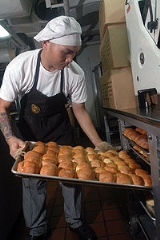
Baker

Overview
- This article refers to the cooking profession. For other uses, see Baker (disambiguation)Baker (disambiguation)A baker is someone who primarily bakes and sells bread.Baker may also refer to:-Places:United States*Baker, California, in San Bernardino County*Baker, Kern County, California...
A baker is someone who bakes
Baking
Baking is the technique of prolonged cooking of food by dry heat acting by convection, and not by radiation, normally in an oven, but also in hot ashes, or on hot stones. It is primarily used for the preparation of bread, cakes, pastries and pies, tarts, quiches, cookies and crackers. Such items...
and sells
Sales
A sale is the act of selling a product or service in return for money or other compensation. It is an act of completion of a commercial activity....
bread
Bread
Bread is a staple food prepared by cooking a dough of flour and water and often additional ingredients. Doughs are usually baked, but in some cuisines breads are steamed , fried , or baked on an unoiled frying pan . It may be leavened or unleavened...
, Cake
Cake
Cake is a form of bread or bread-like food. In its modern forms, it is typically a sweet and enriched baked dessert. In its oldest forms, cakes were normally fried breads or cheesecakes, and normally had a disk shape...
s and similar foods may also be produced, as the traditional boundaries between what is produced by a baker as opposed to a pastry chef
Pastry chef
A pastry chef or pâtissier is a station chef in a professional kitchen, skilled in the making of pastries, desserts, breads and other baked goods...
have blurred in recent decades. The place where a baker work
Employment
Employment is a contract between two parties, one being the employer and the other being the employee. An employee may be defined as:- Employee :...
s is called a bakery
Bakery
A bakery is an establishment which produces and sells flour-based food baked in an oven such as bread, cakes, pastries and pies. Some retail bakeries are also cafés, serving coffee and tea to customers who wish to consume the baked goods on the premises.-See also:*Baker*Cake...
.
The first group of people to bake bread were ancient Egyptians, around 8000 BC
8th millennium BC
In the 8th millennium BC, agriculture became widely practised in the Fertile Crescent and Anatolia.Pottery became widespread and animal husbandry spread to Africa and Eurasia. World population was approximately 5 million.-Events:*c. 8000 BC—The last glacial period ends.*c...
.
During the very very old ages it was common for each landlord
Landlord
A landlord is the owner of a house, apartment, condominium, or real estate which is rented or leased to an individual or business, who is called a tenant . When a juristic person is in this position, the term landlord is used. Other terms include lessor and owner...
to have a bakery, which was actually a public oven
Oven
An oven is a thermally insulated chamber used for the heating, baking or drying of a substance. It is most commonly used for cooking. Kilns, and furnaces are special-purpose ovens...
; Housewives would bring dough that they had prepared to the baker, who would tend the oven and bake them into bread.
Unanswered Questions
