

San Francisco 49ers

Encyclopedia
The San Francisco 49ers are a professional American football
team based in San Francisco, California
, playing in the West Division
of the National Football Conference
(NFC) in the National Football League
(NFL). The team was founded in 1946 as a charter member of the All-America Football Conference
(AAFC) and joined the NFL in 1950 after the two leagues merged. The 49ers are well known for having one of the greatest dynasties in NFL and sports history during the the 1980s and early 1990s winning five Super Bowl
championships, including four in the 1980s. Those championship teams were led by notable hall of famers such as Joe Montana
, Jerry Rice
, Ronnie Lott
, Steve Young
,and coach Bill Walsh
. They are currently second only to the Pittsburgh Steelers
in total Super Bowl
wins (6), tied with the Dallas Cowboys
at 5. The 49ers won 10 or more games for 16 straight seasons. Particularly notable seasons are the 1984
and 1989
teams. The 49ers remain the only team in NFL history to appear in more than one Super Bowl
without ever losing.
The name "49ers" comes from the name given to the gold
prospectors who arrived in Northern California around 1849 during the California Gold Rush
. The name was suggested to reflect the voyagers who had rushed the West for gold. It is the only name the team has ever been affiliated with and San Francisco is the only city in which it has resided.
The team is the oldest major professional sports team in California. Major League Baseball would not come for a few more years when the New York Giants
and Brooklyn Dodgers would move to San Francisco and Los Angeles, respectively. The Philadelphia Warriors and Minneapolis Lakers would move to California in the sixties, and the Oakland Seals and Los Angeles Kings
would become the first NHL teams in the state in 1967. The Cleveland Rams
arrived in Los Angeles in 1946. The 49ers and Los Angeles Rams were cross-state rivals until 1994, when the present St. Louis Rams
left Southern California .
. The Cleveland Rams moved to Los Angeles the same year, 1946. The franchise's first touchdown was scored by Len Eshmont. The first score in 49ers history came on an exquisitely executed passing play. Albert, a scrambling left-hander, tossed a 6-yard pass to halfback John Strzykalski, who tossed a lateral to Len Eshmont, who raced down the sideline toward the end zone for a play that covered 66 yards under the foggy afternoon skies of Kezar Stadium on Sept. 8, 1946. In 1957
, the 49ers would enjoy their first sustained success as members of the NFL. After losing the opening game of the season, the 49ers won their next three against the Rams
, Bears
, and Packers
before returning home to Kezar Stadium for a game against the Chicago Bears on October 27, 1957. The 49ers fell behind the Bears 17–7. Tragically, 49ers owner Tony Morabito
(1910–1957) collapsed of a heart attack and died during the game. The 49ers players learned of his death at halftime when coach Frankie Albert
was handed a note with two words: "Tony's gone." With tears running down their faces, and motivated to win for their departed owner, the 49ers scored 14 unanswered points to win the game, 21–17. Dicky Moegle's late-game interception in the endzone sealed the victory. Victor Morabito (1919–1964) and Tony's widow, Josephine V. Morabito (1910–1995) hired Louis G. Spadia as general manager.
On Nov. 3, 1957, the 49ers hosted the Detroit Lions
, a game which has gone down in local lore as featuring arguably the greatest pass play (along with Dwight Clark's "The Catch" in 1981). With 10 seconds remaining, 49ers ball on the Lions 41, Detroit leading 31–28, Y. A. Tittle
threw a desperation pass into the end zone, right into the arms of high-leaping R. C. Owens. The play became famously known as the "Alley Oop". Ironically, the two men covering Owens would later become 49ers coaches: Jack Christiansen
(Head Coach), and Jim David. The 49ers would end that season with three straight victories and an 8–4 record, tying the Detroit Lions for the NFL Western Division title, and setting up a one-game divisional playoff in San Francisco. The 49ers got off to a fast start, and in the third quarter led 27–7. The Lions, led by quarterback Tobin Rote
, who earlier in the season had replaced an injured Bobby Layne
, would mount one of the biggest comebacks in NFL history and defeat the 49ers, 31—27. Had they won the game, the 49ers would have hosted the NFL Championship game the following weekend against the Cleveland Browns. As it happened, the Lions wound up beating the Browns 59–14.
Also in the 1950s the 49ers famous “Million Dollar Backfield” was formed. The team’s backfield consisted of four future Hall of Fame members—quarterback Y. A. Tittle
and running backs John Henry Johnson
, Hugh McElhenny
, and Joe Perry
.
For most of the next thirteen years the 49ers would hover around .500, except for 1963 and 1964 when they went 2–12 and 4–10 respectively. Key players for these 49ers included running back Ken Willard
, quarterback John Brodie
, and offensive lineman Bruce Bosley
. During this time the 49ers became the first NFL team to use the shotgun formation
. It was named by the man who actually devised the formation, San Francisco 49ers' coach Red Hickey
, in 1960. The formation, where the quarterback lines up seven yards behind the center, was designed to allow the quarterback extra time to throw. The formation was used for the first time in 1960 and enabled the 49ers to beat the Baltimore Colts
, who were not familiar with the formation.
In 1961
, primarily using the shotgun the 49ers
got off to a fast 4–1 start, including two shutouts in back-to-back weeks. In their sixth game they faced the Chicago Bears, who, by moving players closer to the line of scrimmage and rushing the quarterback were able to defeat the shotgun and in fact shut out the 49ers, 31–0. Though the 49ers would go only 3—5—1 the rest of the way, the shotgun would eventually become a component of most team's offenses and is a formation used by football teams at all levels. In 1962
, the 49ers
had a frustrating season as they won only 6 games that year. They won only one game at Kezar Stadium while on the road they won five of seven games. After posting a losing record in 1963
. Victor Morabito died May 10, 1964, at age 45. The 1964 season
was another lost campaign. According to the 1965, 49ers Year Book the co-owners of the team were: Mrs. Josephine V. Morabito Fox, Mrs. Jane Morabito, Mrs. O.H. Heintzelman, Lawrence J. Purcell, Mrs. William O'Grady, Albert J. Ruffo
, Franklin Mieuli
, Frankie Albert
, Louis G. Spadia and James Ginella. The 1965
, 49ers
rebounded nicely to finish with a 7–6–1 record. They were led that year by John Brodie, who after being plagued by injuries came back to become one of the NFL's best passers by throwing for 3,112 yards and 30 touchdowns. In 1966
, the Morabito widows named Lou Spadia, team president. For the 1968 season
, the 49ers hired Dick Nolan as their head coach, who had been Tom Landry
's defensive coordinator with the Dallas Cowboys
. Nolan's first two seasons with the 49ers had gone much the same as the previous decade, with the 49ers going 7–6–1 and 4–8–2.
 The 49ers started out the 1970 season
7–1–1, their only loss a one-point defeat to Atlanta
. After losses to Detroit
and Los Angeles
, the 49ers won their next two games before the season finale against the Oakland Raiders
. Going into the game the 49ers had a half-game lead on the Rams and needed either a win or the Giants
to defeat the Rams in their finale to give the 49ers their first ever divisional title.
In the early game the Giants were crushed by the Rams 31–3, thus forcing the 49ers to win their game to clinch the division. In wet, rainy conditions in Oakland, the 49ers dominated the Raiders, 38–7, giving the 49ers their first divisional championship, becoming champions of the NFC West.
The 49ers won their divisional playoff game 17–14 against the defending conference champion Minnesota Vikings
, thus setting up a matchup against the Dallas Cowboys
for the NFC Championship. In what would be the final home game for the 49ers at Kezar Stadium
the 49ers kept up with the Cowboys before losing, 17–10, thus giving the Cowboys their first conference championship.
The 49ers sent five players to the Pro Bowl
that season, including MVP veteran quarterback John Brodie
, wide receiver Gene Washington, and linebacker Dave Wilcox
. Nolan was also named NFL Coach of the Year for 1970.
Following the 1970 season the 49ers moved from Kezar Stadium
to Candlestick Park. Despite being located on the outskirts of the city, Candlestick Park gave the 49ers a much more modern facility with more amenities that was easier for fans to access by highway.
The 49ers won their second straight divisional title in 1971 with a 9-5 record. The 49ers again won their divisional playoff game against the Washington Redskins
by a 24-20 final score. This set up a rematch against the Dallas Cowboys
in the NFC Championship Game, this time to be played in Dallas. Though the defense again held the Cowboys in check, the 49ers offense was ineffective and the eventual Super Bowl champion Cowboys beat the 49ers again, 14-3.
In 1971, eight 49ers made the Pro Bowl
, including defensive back Jimmy Johnson and Gene Washington, both for the second year in a row, as well as defensive end Cedric Hardman, running back Vic Washington
, and offensive lineman Forest Blue
.
The 49ers won their third consecutive NFC West championship in 1972
with five wins in their last six games, making them the only franchise to win their first three divisional titles after the 1970 AFL-NFL merger
. Their opponents in the divisional playoffs would once again be the Dallas Cowboys
, making it the third consecutive year the teams faced each other in the playoffs. Vic Washington took the opening kickoff 97 yards for a score, and the 49ers took a 21-6 lead in the second quarter. After the 49ers took a 28-13 lead in the 4th quarter, Tom Landry sent quarterback Roger Staubach
, who was backing up Craig Morton
, into the game. Staubach quickly led the Cowboys on a drive to a field goal, bringing the score to within 28-16, and as the game wound down it appeared that that would be all the Cowboys would get. However, the Cowboys would complete the comeback all in the last two minutes. Just after the two minute warning Staubach found Billy Parks
for a touchdown to bring the score to 28-23. Needing an onside kick to have a realistic chance at a game-winning touchdown, Cowboys kicker Toni Fritsch executed a successful onside kick, with the ball going back to the Cowboys. With the 49ers on the ropes, Staubach completed the comeback with a touchdown pass to Ron Sellers
giving the Cowboys a dramatic 30-28 victory and sending the 49ers to yet another crushing playoff defeat.
The 49ers run at the top of the NFC West ended in 1973
with the 49ers falling to a 5-9 record, their worst since 1969. The team lost six of its last eight games, including games to the also-ran New Orleans Saints
and Detroit Lions
. In the final season of his career, longtime 49ers quarterback John Brodie
split playing time with two other quarterbacks, most notably longtime backup Steve Spurrier
. The team also suffered from not having a dominant running back, with Vic Washington
leading the team with only 534 yards rushing.
In 1974
, the 49ers drafted Wilbur Jackson
from the University of Alabama
to be the team's primary back. Jackson enjoyed a fine rookie year, leading the 49ers with 705 yards rushing. He and fellow running back Larry Schreiber
combined for over 1300 yards rushing. With Steve Spurrier
injured and missing nearly the entire year, the 49ers did not have a regular quarterback but did put together a respectable 6-8 record. Following the season, longtime tight end Ted Kwalick
left the 49ers to join the World Football League
(he would join the Oakland Raiders upon the WFL's dissolution.)
The 49ers dropped back down to 5-9 in what would be Dick Nolan's final season as coach in 1975
, the 49ers losing their final four games of the season. Wilbur Jackson was hurt much of the year and Delvin Williams
led the 49ers in rushing with 631 yards rushing.
Following the 1975 season the 49ers traded for New England Patriots
quarterback Jim Plunkett
, former Heisman Trophy winner from nearby Stanford University
(which was also the alma mater of John Brodie). Though Plunkett had shown promise with the Patriots, he had not won there and it was thought that he needed a change of scenery. Monte Clark
was also brought on as 49ers head coach.
The 49ers were led by one of the best running games in the NFL in 1976
. Delvin Williams emerged as an elite back, gaining over 1200 yards rushing and would make the Pro Bowl. Wilbur Jackson also enjoyed a resurgence, rushing for 792 yards. Once again Gene Washington was the teams leading receiver with 457 yards receiving and six scores.
The 49ers started the season 6-1 for their best start since 1970. Most of the wins were against second-tier teams, although the 49ers did shut out the Rams 16-0, in Los Angeles
on Monday Night Football
. In that game the 49ers recorded 10 sacks, including 6 by Tommy Hart
. However, the 49ers lost four games in a row, including two against divisional rivals Los Angeles and Atlanta that proved fatal to their playoff hopes. Despite finishing the season with a winning record of 8-6, Clark was fired after just one season by general manager Joe Thomas, who would oversee the worst stretch of football in the team's history.
Under coach Ken Meyer
the 49ers would lose their first five games of the 1977 season
, including being shut out twice. Though they would win five of their next six they would lose their last three games to finish the season 5-9. Playing in San Francisco proved not to revive Plunkett's career as he had another disappointing season, throwing only 9 touchdown passes. Bright spots for the 49ers included defensive linemen Tommy Hart
and Cleveland Elam
, who made the Pro Bowl, and running backs Wilbur Jackson
and Delvin Williams
, who combined for over 1600 yards rushing. Gene Washington again led the team in receiving in 1977, which would be his final year with the 49ers.
The 1977 offseason was marked by a number of questionable moves by Joe Thomas that backfired badly. Thomas's big offseason acquisition was running back O. J. Simpson
from the Buffalo Bills
. As with Plunkett two years previously, it was thought that rescuing Simpson from a bad situation and bringing him to the area of the country he had been raised would rejuvenate his career. To create playing time for Simpson, Thomas traded Delvin Williams to the Miami Dolphins
for wide receiver Freddie Solomon
. Thomas also released Jim Plunkett, giving up on him after two seasons. Finally, Thomas fired Meyer after only one season, and replaced him with Pete McCulley
, his third coach in three seasons.
The 1978 season
was a disaster for the 49ers, as they finished 2–14, their only wins coming against the Cincinnati Bengals
and Tampa Bay Buccaneers
. Simpson indeed led the team in rushing, but with less than 600 yards. It had become apparent that Simpson's knees and body were shot, and he was clearly near the end of his career. Wilbur Jackson also missed the entire season due to injury. Even worse for the franchise was that the first pick of the 1979 draft
that they would have had was traded to the Bills as part of the O. J. Simpson deal. Thomas was fired following the season.
However some of the key players that would be part of the 49ers stunning rise to emergence would begin their 49ers career in 1978. Rookie quarterback Steve DeBerg
, who would be Joe Montana
's first mentor, was the 49ers starting quarterback. Running back Paul Hofer
and center/guard Randy Cross
also started with the 49ers in 1978.
was known for stockpiling draft picks, making excellent draft selections, and patching roster holes by acquiring key free agents.
Bill Walsh was hired to be the 49ers head coach in the 1978 off-season. Walsh was a disciple of Paul Brown
, and served as Brown's offensive coordinator with the Cincinnati Bengals
from 1968 to 1975. However, Brown did not appoint him as his successor upon his retirement, ironically choosing another assistant, former 49ers center Bill "Tiger" Johnson. Desiring head coach experience, Walsh looked to Stanford University
in 1977. He had had some success there before the 49ers tapped him to be their replacement.
Walsh is given credit for popularizing the 'West Coast offense
'. The Bill Walsh offense was actually created and refined while he was an assistant coach with the Bengals. The offense utilizes a short, precise, timed passing game as a replacement/augmentation of the running game. The offense is extremely difficult to defend against as it is content to consistently make 6-8 yard gains all the way down the field. (The other West Coast offense—more focused on the vertical, or downfield, passing game—was actually created by 1960s L.A. / San Diego coach Sid Gillman
, and San Diego State coach Don Coryell
, who also employed a version of it as head coach of the San Diego Chargers
during a period where it garnered the nickname "Air Coryell
".)
In Walsh's first draft, the 49ers had targeted Notre Dame
quarterback Joe Montana
as an early round pick. Montana had enjoyed a storied college career, leading the Fighting Irish
to the 1977 national title and a number of dramatic comeback victories, the most stunning of all being his final game, at the 1979 Cotton Bowl Classic. Playing the University of Houston
in an ice storm, and with Montana suffering from a bad flu, Notre Dame was down 34–13 in the third quarter. However, Montana led a magnificent rally that culminated with him throwing a touchdown pass on the game's final play to give Notre Dame the 35-34 win.
Despite this, most scouts did not peg Montana as a top prospect. In addition to being relatively small for a quarterback (just over six feet) and slow, Montana's arm strength was considered suspect. Though he did get credit for his moxie
and intangibles, most thought of him as a system player surrounded by a great team.
In the 1979 draft, the Dallas Cowboys were placed just ahead of the 49ers. The Cowboys' draft strategy through that time was to take the highest-ranked player on their draft board at the time of their selection, regardless of position. When the Cowboys' turn came up in the third round, the highest rated player on their board was Montana. However, feeling that the quarterback position was in excellent long-term shape with Roger Staubach
and Danny White
, and desperately needing a tight end, the Cowboys went off their strategy and drafted Doug Cosbie
. The 49ers took Montana. The 49ers other notable draft choice of the 1979 draft was wide receiver Dwight Clark
in the 10th round. Walsh discovered the unheralded Clark while scouting quarterback Steve Fuller of Clemson University
as Clark ran routes for Fuller during Walsh's evaluation of the quarterback. Walsh's serendipitous discovery of Clark would prove to be an early glimpse into the coach's keen eye for talent.
As Walsh implemented his strategies and game plan, the 49ers had another year of losing, going 2-14. There were, however, a number of bright spots. Despite throwing more interceptions (21) than touchdowns (17), Steve DeBerg
blossomed under Walsh, throwing for over 3600 yards and completing 60% of his passes. Freddie Solomon also had a good year, with over 800 yards receiving. The running game was patchwork, with Paul Hofer leading the team with 615 yards and O.J. Simpson, in what would be his final season, rushing for only 460 yards and being sidelined with injuries.
The 49ers got off to a strong start in 1980, winning their first three games of the season. However, the team, still not quite ready for the big time, would lose their next eight games in a row, although many of those games were close, and the 49ers acquitted themselves well. During the season Walsh alternated DeBerg and Montana at quarterback. Though DeBerg had played well for the 49ers, Walsh felt the team's best chance to win in the long run was with Montana. He alternated the two QBs, giving Montana some experience while keeping opponents off guard. This strategy of alternating quarterbacks from game to game and during games is rare in football, although it had been employed by other successful teams in the past, specifically the Dallas Cowboys
of the early 1970s who alternated Roger Staubach
and Craig Morton
, and the Los Angeles Rams of the early 1950s alternating Norm Van Brocklin
and Bob Waterfield
.
In all DeBerg started nine games, going 4-5 with 1,998 yards, 12 touchdowns and 17 interceptions. Montana started seven games, going 2-5 with 1,795 yards, 15 touchdowns, and nine picks; Montana also had a better completion percentage at 64.6 to DeBerg's 57.9.
The highlight of the 1980 season, and a sign of good things to come, came in Week 14. The 49ers trailed the New Orleans Saints
, who at the time were winless at 0-13, 35-7 at halftime. However, led by Joe Montana
, the 49ers made (what was then) the greatest comeback in NFL history, coming back to tie the score in regulation and winning the game in overtime
with a field goal by Ray Wersching
to give the 49ers an incredible 38-35 victory. It was this game, which marked Montana's first big NFL comeback win, that won Montana the quarterback job full time.
A number of key players emerged for the 49ers in 1980. Among them were Dwight Clark
, who led the 49ers with 82 receptions and just under 1000 yards receiving, and running back Earl Cooper, who ran for over 700 yards.
, Eric Wright and Carlton Williamson
and giving Dwight Hicks
a prominent role. He also acquired veteran linebacker Jack "Hacksaw" Reynolds and veteran defensive lineman and sack specialist Fred Dean
.
These new additions, when added to existing defensive mainstays like Keena Turner
, turned the 49ers into a offensively and defensively balanced, dominant team. After a 1-2 start, the 49ers won all but one of their remaining games to finish with a 13-3 record, up to this point in time it was the team's best regular season win-loss record in its history. Dean made the Pro Bowl
, as did Lott (in his rookie season), and Hicks.
Led by Montana, the unusual offense was centered around the short passing game
, which Walsh used as ball control. Both Dwight Clark and Freddie Solomon
had excellent years receiving; Clark as the possession receiver, and Solomon as more of a deep threat. The 49ers running game, however, was among the weakest for any champion in NFL history. Ricky Patton
led the 49ers with only 543 yards rushing. The 49ers' most valuable running back, however, might have been Earl Cooper, whose strength was as a pass-catching back (he had 51 catches during the season).
The 49ers faced the New York Giants
in the divisional playoffs and won, 38-24. This set up an NFC Championship Game match-up with the Dallas Cowboys
, whom the 49ers historically could not beat during their earlier success and playoff run in the early 1970s.
As they had earlier in the season (beating the Cowboys 45-14), the 49ers played the Cowboys tough, but the Cowboys forced six turnovers and held the lead late. Unlike the playoff games of the '70s, this would end differently. In a scenario not unlike the 1972 divisional playoff, the 49ers were down 27-21 and on their own 11 yard line with 4:54 remaining. As Montana had done for Notre Dame and the 49ers so many times before, he led the 49ers on a sustained drive to the Cowboys' 6-yard line. On a 3rd-and-3 play, with his primary receiver covered, Montana rolled right and threw the ball off balance to Dwight Clark in the end zone, who leaped up and caught the ball to tie the game at 27, with the extra point giving the 49ers the lead. Other contributors on the final 89-yard drive included Solomon
, Lenvil Elliott
(RB), Earl Cooper (FB), Mike Wilson
(WR), Charle Young
(TE), Dan Audick
(LT), John Ayers
(LG), Fred Quillan
(C), Randy Cross
(RG), and Keith Fahnhorst
(RT).
"The Catch", as the play has since been named by sportscasters, reminded older 49er fans of the "Alley-oop" passes that Y.A. Tittle threw to lanky receiver R.C. Owens back in the 1950s. A picture of Clark's leap in the air taken by Walter Iooss, Jr. appeared on the cover of that week's Sports Illustrated
and was also featured in an Autumn 2005 commercial for Gatorade
.
Despite this, the Cowboys had one last chance to win. And indeed, on the first play of the next possession, Cowboys receiver Drew Pearson
caught a pass from Danny White and got to midfield before he was pulled down by the jersey at the 49ers 44 yard line by Cornerback Eric Wright. Had Pearson not have been jersey-tackled, there was a good chance he would have scored a touchdown, as there were no 49ers downfield. On the next play, White was sacked by Lawrence Pillers
and fumbled the ball, which was recovered by Jim Stuckey
, giving the 49ers the win and a trip to their first ever Super Bowl against the Cincinnati Bengals
, who were also in their first Super Bowl.
The 49ers would take a 20-0 halftime lead and hold on to win Super Bowl XVI
26-21 behind kicker Ray Wersching
's four field goals and a key defensive stand. Throughout the '81 season, the defense had been a significant reason for the team's success, despite residing in the shadow of the then-innovative offense. Montana won MVP honors mostly on the strength of leading the 49ers on a 92 yard, 12 play drive culminating in a touchdown pass to Earl Cooper. Thus did the 49ers complete one of the most dramatic and complete turnarounds in NFL history, going from back-to-back 2-14 seasons to a Super Bowl championship in just two years.
During their first Super Bowl run, the team was known for its short-range passing game and the play-making ability of quarterback Joe Montana
. Later, they became proficient in all aspects of the game, featuring a dominant defense (always in the offense's shadow) and a fast-scoring passing attack (with wide-receivers Jerry Rice
and John Taylor
).
The 1982 season was a bad one for the 49ers, as they lost all five games at Candlestick Park en route to a 3–6 record in a strike-shortened season. This would be the 49ers last losing season for the next 17 years. Joe Montana was the one highlight, passing for 2,613 yards in just nine games, highlighted by five straight games in which he broke the 300-yard barrier.
In 1983, the 49ers won their final three games of the season, finishing with a 10-6 record and winning their 2nd NFC Western Divisional Title in three years. Leading the rebound was Joe Montana with another stellar season, passing for 3,910 yards and connecting on 26 touchdowns. In the NFC Divisional Playoffs, they hosted the Detroit Lions. The 49ers jumped out in front early and led 17-9 entering the 4th quarter, but the Lions roared back, scoring two touchdowns to take a 23—17 lead. However, Montana would lead a comeback, hitting wide receiver Freddie Solomon
on a game-winning 14-yard touchdown pass with 2:00 left on the clock to put the 49ers ahead 24—23. The game ended when a potential game-winning FG attempt by Lions kicker Eddie Murray
missed. The next week, the 49ers came back from a 21—0 deficit against the Washington Redskins
in the NFC Championship Game to tie the game, only to lose, after a questionable pass interference call, 24—21 on a Mark Moseley field goal that sent the Redskins to Super Bowl XVIII
.
, the 1998 Minnesota Vikings
, and the 2004 Pittsburgh Steelers
, and finally broken by the 2007 New England Patriots
(with 16 regular season victories). Their 18 wins overall is also still a record, tied by the 1985 Bears and the 2007 New England Patriots. The 49ers' only defeat in the 1984 season was a 20-17 loss to the Steelers; a late field goal attempt in that game by San Francisco kicker Ray Wersching
went off the uprights and was no good. In the playoffs, they beat the New York Giants
21-10, shut out the Chicago Bears
23–0 in the NFC Championship, and in Super Bowl XIX
the 49ers shut down a record-setting year by NFL MVP Dan Marino
(and his speedy receivers Mark Clayton and Mark Duper), beating the Miami Dolphins
38-16. Their entire defensive backfield (Ronnie Lott, Eric Wright, Dwight Hicks, and Carlton Williamson) was elected to the Pro Bowl—an NFL first.
During the 1984 season, fourteen 49ers players came together to record a 45 pop single entitled "We're the 49ers." The song, released as a 45 rpm single on Megatone Records
, was produced and co-written by Narada Michael Walden
. It mixed elements of R&B, funk
, and pop
. Prominent 49ers who provided vocals include Roger Craig, Dwight Clark
and Ronnie Lott
(Joe Montana
is noticeably absent, although he would join Lott, Clark and Riki Ellison
to provide background vocals for the San Francisco band Huey Lewis and the News
on two tracks from their 1986 album Fore!
). While achieving some local airplay in San Francisco on radio stations like KMEL
, it did not catch on nationally the way the Bears' Super Bowl Shuffle
would a year later.
In the 1985 season, Roger Craig became the first NFL player to gain 1,000 yards rushing and 1,000 yards receiving in the same season. The 49ers were not as dominant as in 1984, however, and they settled for a 10-6 record, a wild card berth and a quick elimination from the playoffs when the New York Giants
beat them 17-3. In addition, 1985 marked the appearance of newly acquired rookie Jerry Rice
who would continue with the 49ers throughout the 1990s.
When the 1986 season began, the 49ers were off and running with a 31–7 win over the Tampa Bay Buccaneers
on opening day. But the win was costly; Joe Montana injured his back and was out for two months. Jeff Kemp
became the starting quarterback, and the 49ers went 4–3–1 in September and October. Upon Montana's return, the 49ers caught fire, winning 6 of the last 8 games, including a 24–14 win over the Los Angeles Rams, to clinch the NFC West title. However, the New York Giants
defeated them again in the playoffs, 49–3. Montana was injured in the first half by a hit from the Giants' Jim Burt
.
During the strike-shortened 1987 season, the 49ers led the league with a 13–2 record but fell in their first playoff game to the Minnesota Vikings, 36–24—the third year in a row they lost in the first round. The loss to the Vikings was a stunning upset considering the 49ers that year were ranked #1 on both offense and defense, making them the odds-on favorite to win the Super Bowl. Note that 1987 marked the first of six seasons when the 49ers had two Hall of Fame
quarterbacks on the roster: from 1987 through 1992, Montana's backup (and frequent replacement) was Steve Young.
, the 49ers at first struggled. At one point, they were 6–5 and in danger of missing the playoffs but rose to defeat the Washington Redskins
on a Monday night game, eventually finishing the season at 10-6. They gained a measure of revenge by thrashing the Minnesota Vikings
34–9 in the first round. The 49ers then traveled to Chicago's Soldier Field
, where the chill factor at game time was 26 degrees below zero. The Las Vegas line at game time was "pick", but it was the Bears famed 46 defense who got methodically picked apart by Joe Montana and Jerry Rice as the 49ers dominated the Chicago Bears
28-3 in the NFC Championship game.
The win over the Bears gave the 49ers their third trip to the Super Bowl: Super Bowl XXIII
, located in Miami. Despite numerous trips deep into Cincinnati territory by the 49ers, the game was tied 3–3 at halftime. A late Cincinnati field goal put the Bengals ahead 16-13 with just over three minutes left on the clock. Following the kickoff, and a holding penalty, the 49ers took over on their 8 yard line with 3:08 left on the clock. Joe Montana began the final drive by stepping into the huddle and remarking to his teammates, during a television timeout, "hey, isn't that John Candy
," as he pointed to the stands on the other side of the field. Harris Barton (offensive tackle) was asked by Joe Montana and said if he wanted to go meet him. His calm demeanor reassured the 49ers, and he then engineered what some consider the greatest drive in Super Bowl history, as he drove the team 92 yards for the winning touchdown on a pass to John Taylor with only 34 seconds left. Final score: 20–16 49ers.
The following year, coach Bill Walsh retired, and his defensive coordinator and handpicked successor, George Seifert
, took over head coaching duties. The 49ers then steamrolled through the league to finish 14–2 and gain homefield advantage throughout the playoffs. Their two losses were by a combined five points. In the first round, they crushed the Vikings, 41—13. In the NFC Championship game, they blew out the Los Angeles Rams
30-3 before crushing the Denver Broncos
55–10 in Super Bowl XXIV
- setting a record for points scored and widest margin of victory in a Super Bowl. Montana himself set many Super Bowl records (some since tied or surpassed) en route to his third Super Bowl MVP. In winning the Super Bowl, the 49ers became the only team to win back-to-back Super Bowls under different head coaches. This 1989 championship squad is often regarded as one of the most dominant teams ever, winning all three playoff games by a combined 100 points.
, the 49ers won their first ten games, and they eventually finished 14-2. They ripped through the season, and the coveted third consecutive Super Bowl victory seemed within reach. In the playoffs, the 49ers dispatched the Washington Redskins
28–10, setting up a conference championship game with the New York Giants
. Despite not scoring a touchdown in the game, the Giants took advantage of a fourth-quarter injury to Montana and converted a faked punt attempt to thwart the 49ers attempt at a "three-peat." The Giants kicked a last-second field goal after recovering a Roger Craig fumble in the final minutes of the game, winning 15-13 and going on to win Super Bowl XXV
.
During their quest for a "three-peat" between 1988 and 1990, the 49ers set a league record with 18 consecutive road victories.
Joe Montana missed almost all of the following two seasons with a recurring elbow injury. Following the 1990 season, the 49ers left team stalwarts Roger Craig and Ronnie Lott unprotected and let them go to the Los Angeles Raiders
via Plan B free agency.
In 1991
, Steve Young injured the thumb on his throwing hand and later was sidelined with an injured knee. After 10 games, the 49ers had a record of 4-6. Backup quarterback Steve Bono
helped the team win five of its next six games with Young sidelined. In the final game of the season, Monday night versus the NFC's number two seed, Young returned and the 49ers embarrassed the Chicago Bears
52-14, finishing 10-6. However, the team missed qualifying for the playoffs by virtue of losing the head-to-head tiebreaker to the Atlanta Falcons
, which had beaten the 49ers on a last-second Hail Mary pass earlier in the season. The 1992 and 1993 seasons saw a resurgent 49er team under the leadership of Steve Young, but a subpar and aging defense could only take them to the NFC Championship game before falling to the Dallas Cowboys
each time.
In 1992
, Joe Montana came back after missing almost two full seasons due to an elbow injury in his throwing arm, and started the second half of a Monday night game versus Detroit
on December 28, 1992. With the 49ers clinging to a 7–6 lead, Montana entered the game and looked as though he had not missed a single snap, completing 15-21 for 126 yards and 2 TDs, as the 49ers defeated the Lions 24-6. The 49ers finished the 1992 season with a 14-2 record and home field advantage in the playoffs. San Francisco defeated the Washington Redskins
20-13 in the divisional playoff game, but lost to the Dallas Cowboys
30-20 in the NFC Championship at Candlestick Park.
At the end of the 1992 season, partly fueled by media hype, the biggest quarterback controversy in football history was in full swing. After discussions with the owner and the coach, Montana asked for, and was granted, a trade to the Kansas City Chiefs
prior to the 1993 season. Despite Eddie DeBartolo wanting Montana to stay and start, Montana realized that he and Young could not stay with the 49ers without a controversy. Montana was later quoted as saying, "If I had stayed and started, there would have been problems. If I had stayed and Steve Young had started, there would have been problems."
The 49ers finished the 1993 season
, the team's first without Joe Montana on the roster, with a 10-6 record and no. 2 seed in the playoffs. San Francisco defeated the New York Giants
44-3 in the divisional playoff game, but lost to the Dallas Cowboys
38-21 in the NFC Championship at Texas Stadium.
, the team spent large amounts of money on the addition of several star free agents from other teams, including Ken Norton, Jr., Gary Plummer
, Rickey Jackson
, Bart Oates
, Richard Dent
, Charles Mann and Deion Sanders
. Additionally, several rookie players made key contributions to the team, some becoming season-long starters such as defensive tackle Bryant Young
, fullback William Floyd, and linebacker Lee Woodall
. Due to injuries to the offensive line, the 49ers had some tough times early in the season, including a 40–8 home loss to the Philadelphia Eagles
, and a 24–17 loss to the Kansas City Chiefs
, led by former 49ers quarterback Joe Montana. Following the Eagles game, a poll conducted on local sports radio station KNBR
showed that an overwhelming majority of 49er fans wanted head coach George Seifert fired.
The game against the Eagles was a turning point for the 49ers despite the lopsided score. Young was benched in the 3rd quarter and was later seen livid on the sidelines, shouting profanities at Seifert. The following week in Detroit, the 49ers trailed the Lions
14-0. After throwing a pass, Young was hit, picked up, and driven into the ground by three Lions defenders. After the hit, Young was screaming with his face dark red in color. He crawled most of the way off of the field before refusing help from the trainers as he limped the remaining way off the field. He miraculously returned to the field one play later (NFL rules state that after trainers attend to an injured player, that player must leave the field for at least one play) to lead the 49ers to a 27-21 victory. The team rallied around Young to win 10 straight games, including a 21-14 victory over the two-time defending Super Bowl champion Dallas Cowboys
. During that span the 49ers' average margin of victory was nearly 20 points per game, a sustained dominance not seen since the 1985 Chicago Bears
. Despite scoring only 8 points in one game and 14 in another the 49ers set a new record for total regular season and post season combined points scored. That record was later broken by the Minnesota Vikings
in 1998 and the New England Patriots
in 2007.
Even after those initial rough spots early in the season, the 49ers finished the season 13-3 and with homefield advantage throughout the playoffs. In their first game, they easily defeated the Chicago Bears
, 44-15, setting up the third straight 49ers-Cowboys NFC Championship Game. The 49ers took advantage of three early Cowboys
turnovers, taking a 21-0 lead in the first quarter. Taking a 31-14 lead into halftime after a perfect 29 yard pass from Young to Rice in the closing seconds, the game appeared to be far out of reach for the Cowboys. A 49er fumble on the opening kick of the 3rd quarter led to a Cowboy score, cutting the lead to 31-21. Later, the 49ers responded with a Steve Young touchdown run, making it 38-21, before the Cowboys scored another touchdown in the final minutes for a final score of 38-28. The convincing win qualified the 49ers for their fifth Super Bowl
appearance, and the first to be played by two teams from California. The 49ers steamrolled the San Diego Chargers
49-26,and at the time becoming the first team to win a record five Super Bowls. They are the only multiple Super Bowl winner that has never lost and are 5-0. With a record 6 touchdown passes, Steve Young was named the game's MVP. Their run of five Super Bowl wins in 14 seasons (1981–1994) solidified them as one of the all time greatest NFL teams.
both times. On January 17, 1997, George Seifert
retired as 49ers head coach; on the same day, the 49ers hired Cal
head coach Steve Mariucci
as his replacement. At the time, Mariucci only had one year of head coaching experience at any level.
The first game of the 1997 season
against the Tampa Bay Buccaneers
was a disaster, as both quarterback Steve Young and receiver Jerry Rice went down with injuries. Rice appeared to be out for the season with a serious knee injury, while Steve Young left the game with one of the many concussions he suffered throughout his career. However, Steve Young returned just two weeks later and, along with the league's number one defense, lead the 49ers to a strong finish with a final record of 13-3. Even Jerry Rice returned for one and a half quarters late in the season against the Denver Broncos, before getting another injury to his knee (unrelated to the first one). In the NFC Championship game, the 49ers would again meet the Green Bay Packers
at Candlestick Park and would lose 23-10.
In 1998
, Jerry Rice finally returned from his knee injury and helped the 49ers to a 12-4 record and their 16th straight winning season (all with 10 wins or more). Once again, the 49ers faced the Green Bay Packers
in the playoffs. Things looked bleak when the 49ers trailed 27-23 in the waning seconds. However, in one last moment of glory, Young hit Terrell Owens
on a dramatic, game-winning 25-yard touchdown pass, dubbed by many as "The Catch II". The catch followed a fumble by Jerry Rice recovered by the Packers, but he was erroneously called down by the officials allowing the drive to continue. That put the Niners ahead 30-27 with just three seconds left on the game clock, sealing the win. After beating the Packers, San Francisco would go on to lose 20-18 to the eventual NFC champion Atlanta Falcons
a week later, in a game that was marked by Pro Bowl running back Garrison Hearst
suffering a gruesome broken ankle on the first play from scrimmage.
investigation regarding Louisiana
Governor Edwin Edwards
and one of his Mississippi
riverboat
casino
s. DeBartolo later pled guilty to a failure to report a felony charge in 1998. He was suspended from active control of the 49ers for one year. His sister, Denise DeBartolo York
, and her husband, Dr. John York
, took over operations of the team.
Eddie DeBartolo returned from his suspension in 1999, but a series of lawsuits over control of the family's vast holdings led him to surrender controlling interest to the Yorks as part of a 2000 settlement. Denise York is now chairwoman of the board, while John York is CEO.
On the field, the 1999 version of the 49ers got off to a 3-1 start, then in a nationally televised Monday Night Football
game against the Arizona Cardinals
, Steve Young suffered a blindside hit from cornerback Aeneas Williams that would eventually convince him to retire. At the time it was believed the severe hit ended his career but Young later said in interviews he could have come back to play another season or two. After meeting with then GM Bill Walsh and being told about how the salary cap troubles would make the team non-competitive, Young chose to retire rather than risk his long-term health further for a likely losing club. Without their future Hall of Famer, the 49ers lost 11 of their last 12 games, and suffered their first losing season since 1982. Bobb McKittrick
, 49ers offensive line coach since 1979, also died of cancer following the 1999 season.
In 2002, they produced the second-greatest comeback in playoff history when Jeff Garcia
led the team back from a 24-point deficit to win 39-38 against the New York Giants. They lost their subsequent game to the eventual Super Bowl Champion Tampa Bay Buccaneers
. This would be, to date, the last postseason appearance for the 49ers. Following the season, head coach Steve Mariucci
-- whose published statements about his degree of power in the organization had frayed already-strained relations with management—was fired by John York, despite a winning record. York has since said he made the correct decision to fire Mariucci, but could have handled it better; for instance, he admitted he should have made the announcement himself rather than hand that responsibility to general manager Terry Donahue
. The replacement, former Seattle Seahawks
and Oregon State University
head coach Dennis Erickson
was signed to a five-year contract. The hiring of Erickson was highly criticized by the fans and the media. During the coaching search, three defensive coordinator
s emerged as candidates for the job, but the offensive-minded Erickson was chosen despite the fact that Erickson's offensive philosophy was very different from the West Coast Offense.
Although they finished the 2003 season with a losing record of 7–9, Erickson was retained as coach for the 2004 season. The 2003 season also marked the end for volatile wide receiver Terrell Owens with the San Francisco 49ers. Owens scored 85 touchdowns in 8 seasons for the 49ers, including 4 in the playoffs. But his on and off-field antics lead to the 49ers trading him to the Philadelphia Eagles during the offseason.
 The 49ers finished the 2004 season with a league worst record 2–14, and finished last in the NFC West division for the first time since 1979, ending what had been the NFL's longest active streak for not finishing last in a division. It was also the worst record that season among the 32 NFL teams, securing them the right to the first pick in the NFL Draft. Erickson and the man who hired him, General Manager Terry Donahue, were fired. After an extensive coaching search, the 49ers announced the hiring of Mike Nolan
—defensive coordinator of the Baltimore Ravens
—as their head coach for the 2005 season
. MIke Nolan was the son of Dick Nolan, who had led the team to three consecutive playoff appearances from 1970 to 1972. The 49ers did not hire a general manager, indicating that Nolan would likely possess substantial control in all of these areas. In his inaugural draft as head coach, Mike Nolan
selected with the first pick of the draft, quarterback Alex Smith of the University of Utah
. It was a pick predicted by most, though many predicted the 49ers might select local product Aaron Rodgers
of the University of California
.
Tragedy struck the Niners on August 20, 2005, when OL Thomas Herrion
died immediately following a preseason loss to the Denver Broncos
at Invesco Field. Coach Mike Nolan had just finished addressing the players in the locker room when Herrion collapsed. He was taken to a local Denver hospital, where he died several hours later. An autopsy revealed that Herrion died of a heart disease, which had not been previously diagnosed. In 2005
, the 49ers finished 4th in the NFC West for the second consecutive year, but were able to double their win total from 2004, ending the season with a 4–12 record. They ended the season on a high note with two consecutive wins; their first two game winning streak since 2003. Also, they swept their division arch-rival, the St. Louis Rams
for the first time since 1998.
The 49ers finished the 2006 regular season
with a 7–9 record and 3rd in the NFC West, their fourth consecutive losing season. The team displayed vast improvement, however. The most impressive victory of the season came in the last week vs. the Denver Broncos
. The 49ers managed to come back from a 13–0 deficit and knock Denver out of the playoffs in an OT win (26–23). They also swept division rival, and defending NFC Champion, Seattle Seahawks
. At the beginning of the 2006 season, the team made perhaps their most important decision, awarding the top running back spot to second year player Frank Gore
from Miami. Gore ran for a franchise record of 1,695 rushing yards, which led the NFC, along with 8 TDs. He was awarded his first Pro Bowl appearance as a starter.Before the beginning of the 2007 season, former coach and Hall of Fame coach Bill Walsh died of complications from leukemia
. In the off-season, cornerback Nate Clements
was signed as a free agent from the Buffalo Bills
. Clement's contract was worth $80 million for eight years, the largest contract given to a defensive player in NFL history at the time. In the NFL Draft
that year, the 49ers made another key addition to their defense, selecting middle linebacker Patrick Willis
with the 11th overall pick. Willis was named the 2007 AP NFL Defensive Rookie of the Year.The 49ers started that season 2–0, winning their first two games against the Arizona Cardinals
and the St. Louis Rams
. This marked the first time the 49ers started 2–0 since 1998
. In the fourth game of the season, against the Seattle Seahawks
, QB Alex Smith suffered a separated shoulder on the third play of the game, an injury that would severely hamper his play and ultimately lead to an early end to his 2008 campaign after having shoulder surgery. Chiefly due to QB Trent Dilfer's struggles and Alex Smith's injury, the 49ers lost eight straight consecutive games from week three through week 12, ending the year with a disappointing 5–11 record.
Questions were raised about the future of Alex Smith, whose first three seasons had been plagued by inconsistent play, injuries, and not having had an offensive coordinator remain on the team for consecutive years. Head coach Mike Nolan and new offensive coordinator Mike Martz
stated that a competition between Smith, Shaun Hill
, and NFL journeyman J. T. O'Sullivan would run through the first two preseason games of 2008. O'Sullivan was named the 49ers starter because of his familiarity with the Martz offense and after performing better than Smith or Hill in the first three preseason games. On the night of October 20, 2008, after a 2-5 start, Mike Nolan was fired. Assistant head coach Mike Singletary
, a Hall of Fame
linebacker with the Chicago Bears
, was named as the interim head coach. Singletary proved to be a fan favorite when after his first game as head coach he delivered a memorable post game interview. Singletary said of their loss: "... right now, we've got to figure out the formula. Our formula. Our formula is this: We go out, we hit people in the mouth.". The team had won five of its final seven games and went 5–4 overall under Singletary, ending the season with a 7-9 record. After the last game of the season, Singletary was named the head coach by Jed York, who had been appointed as team president just days before. Jed York
is the oldest son of John York and Denise DeBartolo York.
On April 25, 2009, the 49ers selected Texas Tech WR Michael Crabtree
with the 10th pick in the first round of the 2009 NFL Draft
. A player many people thought would go in the top five. The 2009 training camp was the first time since 2005 that the 49ers failed to have all drafted rookies signed and in training camp on time. Crabtree, reached a contract agreement with the team on October 7, 2009, after having missed the first four games of the regular season. After an up and down season, featuring many close games, the 49ers posted an 8-8 record, the team's first non-losing season since 2002. Despite missing the playoffs for the seventh straight season, several key players showed signs of improvement. Alex Smith regained his role as the 49ers' starting quarterback (after Shaun Hill had won the starting job in training camp), passing for more than 2,000 yards with 18 touchdowns, while Frank Gore collected his fourth consecutive season with 1,000 or more rushing yards, a 49ers record. Safety Dashon Goldson
showed signs of potential in his first year as full-time starter, as he tallied 94 tackles, four interceptions, three forced fumbles, and two sacks. Vernon Davis
in particular, had a breakthrough year at tight end, earning Pro Bowl honors with 965 yards and 13 touchdowns (tying the NFL record for his position). 2010 saw five Pro-Bowl players for the 49ers. Patrick Willis, Vernon Davis, Frank Gore, Justin Smith, and Andy Lee. Before the 2010 season
, the 49ers became heavy favorites to win the NFC West after Cardinals QB Kurt Warner
retired early in the offseason, with their promising young talent around and a solid draft
drafting Rutgers OT Anthony Davis, 11th overall, and Idaho OG Mike Iupati, 17th overall, in the first round. However, the 49ers' 2010 season was a surprising disaster. They started the season with an 0-5 record, their worst start since 1979. By week 3, the 49ers fired offensive coordinator Jimmy Raye
, who was hand picked by Singletary in the 2009 offseason, and starting safety Michael Lewis had demanded to be released after he was demoted in favor of rookie safety Taylor Mays
. By mid-season, Singletary would constantly switch QBs between Alex Smith
and Troy Smith
, who was picked up in free agency after the preseason. On December 27, 2010, the San Francisco 49ers fired Mike Singletary as head coach, and defensive lines coach Jim Tomsula stepped in to be interim Head Coach for the last game of the season, where they blew out the Cardinals
38-7 and finished a disappointing 6-10.
to be the General Manager, Baalke took over the General Manager role after former GM Scot McCloughan
was relieved of his duties the year before. Two days later on January 7, 2011, former head coach of Stanford University
Jim Harbaugh
was named the 49ers new head coach. In the 2011 NFL Draft
, the 49ers selected defensive end/linebacker Aldon Smith
from the University of Missouri
with the seventh pick of the first round.
In the first game of the 2011 regular season, the 49ers defeated the Seattle Seahawks
33-17 at Candlestick. Ted Ginn Jr. was the star of the game as he returned two kicks, a kickoff and a punt, for touchdowns late in the 4th quarter. The win marked Harbaugh's first career win as a head coach in the NFL. In week two, the Dallas Cowboys
came to town. The 49ers built a 14-0 lead in the first half but ended up losing the game 27-24 in overtime. The 49ers traveled to Cincinnati the next week to play the Bengals
. The 49ers won that game 13-8. In week four, the 49ers visited Philadelphia to take on the Eagles
. At halftime, Philadelphia was winning 20-3. In the third quarter the Eagles added a field goal to extend their lead to 23-3. With a 20-point deficit, the 49ers retaliated with touchdowns scored by Joshua Morgan
and Vernon Davis
bringing the Niners within 6 points. Late in the 4th quarter, Frank Gore
ran for a 12-yard touchdown with three minutes remaining, giving the Niners their first lead of the game. On the Eagles next possession, they drove into 49ers territory and field goal range. However, Eagles receiver Jeremy Maclin
took a bubble screen pass from quarterback Michael Vick
up the field and was stripped recovered by the 49ers' Justin Smith
and Dashon Goldson
respectively, sealing their victory. The 49ers' 20-point comeback was their biggest since 1996. The next game was at home against the Tampa Bay Buccaneers
. They defeated them 48-3, one of the biggest leads they've had. They then traveled to Detroit to take the then-undefeated Detroit Lions
. They gave Detroit their first loss, 25-19. After defeating the Giants, the 49ers achieved a 8-1 record for the first time since 1997. The following week the 49ers defeated the Arizona Cardinals
23-7, and at 9-1 secured their first true winning season in eight years. Unfortunately, their eight-game win streak ended on a game against the Baltimore Ravens on Thursday Night Football on Thanksgiving, a game many called the "Harbowl" because the Ravens coach was Jim's brother, John. They allowed 9 sacks and lost the game 6-16.
, 30 miles south of San Francisco; Santa Clara already hosts the team's administrative headquarters and training facility. The Yorks and then-San Francisco mayor Gavin Newsom
had been talking over the last few months about building a privately financed stadium at Candlestick Point that was going to be part of the city's bid for the 2016 Summer Olympics
. The 49ers' decision ended the Olympic bid. San Francisco, Los Angeles, and Chicago were the three cities competing to be the U.S. Olympic Committee's choice to bid on the 2016 games, with Chicago emerging as the eventual victor. The team's current lease at Candlestick Park could extend through 2013.
The 49ers sponsored Measure J, which appeared on the June 8, 2010 Santa Clara, California
ballot, to build a new stadium as home for 49ers in that city. The measure passed with 58.2% of the total vote. This is seen as the first step for the 49ers relocation to a new venue to be built in Santa Clara.
On the 49ers website, the team's owner, businessman John York had a letter stating that after a move to Santa Clara, the team would retain its name "San Francisco". York will use the S.F Brand in order to help keep the team marketable. In the history of the NFL, Teams who have relocated have embraced the city/community support for its stadium and name change United States Senator (D-CA) Dianne Feinstein
and other leaders will attempt to keep the name "San Francisco".
York later confirmed in a press conference on November 9, 2011 that the team would move to Santa Clara with plans to build a state of the art stadium without a shopping mall in time for the 2015 season.
, dressed in plaid pants and a red shirt, jumping in midair with his hat falling off, and fired pistols in each hand: one nearly shooting his foot, and the other pistol forming the word "Forty-Niners" from its smoke, the alternate logo was a shield-shaped crest formed from the number "49", with a football in the upper right quadrant and "SF" in the lower left quadrant. From 1962 The iconic 49ers' logo has been a "SF" within the center of a red oval, through out the years the logo has had minor modifications such as a black outlining on the intertwined "SF" that was added in 1989 and a gold trimming inside the oval was added in 1996
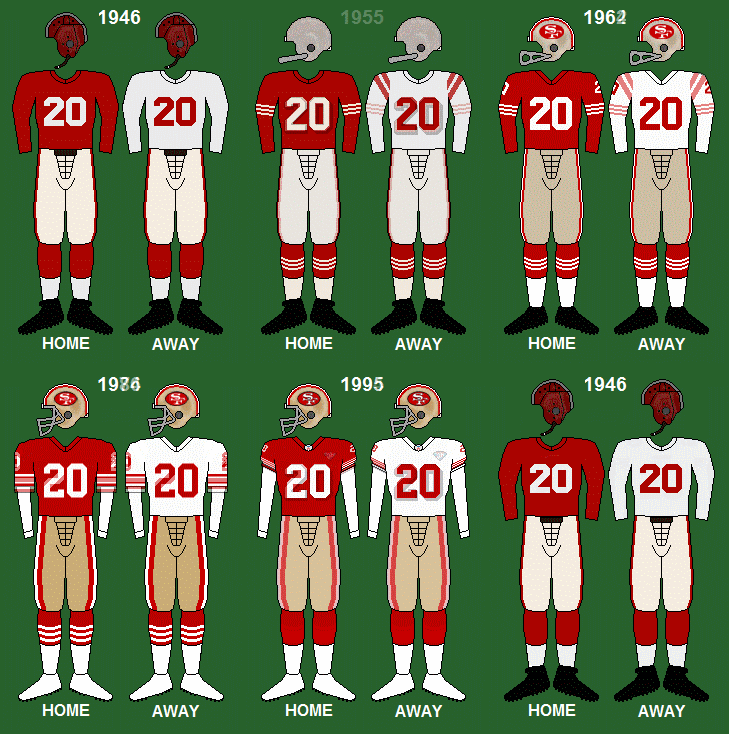
In 1996, the 49ers celebrated their 50th anniversary by designing a commemorative jersey patch based on the earlier shield-crest logo. The team also debuted a substantially new uniform design, most notably changing the shade of red used in their jerseys from bright scarlet to a deeper, cardinal red a black dropshadow effect (along with gold trim) was added to the jersey numerals (which remained in the blocked serif style). As in 1994, the Niners donned white pants full-time for the 1996 season (also wearing them for the 1997 season and 1998 preseason,) though this time the pant stripes were marginally thicker and the colors were reversed to black-cardinal red-black (matching the striping on the helmets). the 1998 regular season opener, the team switched back to gold pants,with a more metallic gold rather than the previous beige-matte gold of the past. The striping along the side of the pants remained black-cardinal red-black, though a thin gold trimming was added, along with further oval "SF" logos placed on both sides of the hip. The 1996 helmet and jersey design with the 1998 gold pants would be worn as the team's regular uniforms until the end of the 2008 season. The 49ers once again changed uniforms in 2009, which are very similar to the classic design, albeit with several significant changes. The sleeve stripes are now set at an angle to accommodate the even shorter sleeves of modern jerseys, (though the stripes appear straight and parallel to the ground when worn by the players themselves). These are their current uniforms
, Arizona Cardinals
, Seattle Seahawks
).They also have rivalries with other teams that arose from post-season games in the past, most notably the Dallas Cowboys
, New York Giants
, and Green Bay Packers
. They also have an intense Crosstown rivalry
with the Oakland Raiders
, but because both teams play in different conferences they only play each other once every four years.
Bold - inducted as a 49er.
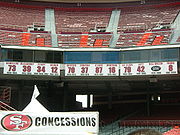
* During his tenure with the 49ers from 2006–2007, quarterback Trent Dilfer wore #12, unofficially unretiring QB John Brodie's number. Brodie's Son In Law Dilfer wore the #12 as a tribute to the former 49ers great.
As of late 2010, the inductees are:
“Forty-Niner Ten Year Club. Dedicated to those Forty-Niners, who have served ten or more years proudly wearing the scarlet and gold.”
1950’s:
1960’s:
1970’s:
1980’s:
1990’s:
2000’s:
680 AM, and KTCT
1050 AM. KSAN airs all 49ers games on FM. On AM, they are simulcast on KTCT in August, September, and October and on KNBR from October to the end of the season. All three stations are owned by Cumulus Media
. Joe Starkey
, best known as the voice of the University of California and The Play
, was previously the color commentator on the broadcasts next to legendary announcer Lon Simmons
in 1987 and 1988 and took over as lead commentator in 1989. Lon Simmons
and Gordy Soltau
did the broadcasts on KSFO in the 1950s and 1960s. For a brief period in the late 1970s and early 1980s Don Kline, the Voice of Stanford did the 49ers' games. Starkey first teamed with former Detroit Lions
' and KPIX Sports Director, Wayne Walker
and then former 49ers' linebacker Gary Plummer
formed the broadcast team from 1998 to 2008, with Starkey retiring after the 2008 season. Ted Robinson
replaced Starkey and teamed up with Plummer for the 2009 and 2010 seasons. Plummer was relieved of his color commentating duties for the 2011 season and replaced by former teammate Eric Davis.
Most preseason games are telecast on KPIX, channel 5, with announcers Dennis O'Donnell
and Tim Ryan
.
The 49ers are a beneficiary of league scheduling policies. Both the 49ers and the Oakland Raiders
share the San Francisco Bay Area market, and said market is on the West Coast of the United States. This means that the 49ers cannot play home games or most division games in the early 10:00 a.m. Pacific time
slot, nor can they play interconference home games at the same time or network as the Raiders. As a result, both teams generally have more limited scheduling options, and also benefit by receiving more prime time games than usual (click here for further information). Thus, regardless of the previous season's record, the 49ers receive a disproportionate number of Sunday Night
, Monday Night
and/or Thursday Night games, compared to the rest of the league.
American football
American football is a sport played between two teams of eleven with the objective of scoring points by advancing the ball into the opposing team's end zone. Known in the United States simply as football, it may also be referred to informally as gridiron football. The ball can be advanced by...
team based in San Francisco, California
San Francisco, California
San Francisco , officially the City and County of San Francisco, is the financial, cultural, and transportation center of the San Francisco Bay Area, a region of 7.15 million people which includes San Jose and Oakland...
, playing in the West Division
NFC West
The NFC West is a division of the National Football League's National Football Conference. It currently has four members: Arizona Cardinals, St...
of the National Football Conference
National Football Conference
The National Football Conference is one of the two conferences of the National Football League . This conference and its counterpart, the American Football Conference , currently contain 16 teams each, making up the 32 teams of the NFL.-Current teams:Since 2002, the NFC has comprised 16 teams,...
(NFC) in the National Football League
National Football League
The National Football League is the highest level of professional American football in the United States, and is considered the top professional American football league in the world. It was formed by eleven teams in 1920 as the American Professional Football Association, with the league changing...
(NFL). The team was founded in 1946 as a charter member of the All-America Football Conference
All-America Football Conference
The All-America Football Conference was a professional American football league that challenged the established National Football League from 1946 to 1949. One of the NFL's most formidable challengers, the AAFC attracted many of the nation's best players, and introduced many lasting innovations...
(AAFC) and joined the NFL in 1950 after the two leagues merged. The 49ers are well known for having one of the greatest dynasties in NFL and sports history during the the 1980s and early 1990s winning five Super Bowl
Super Bowl
The Super Bowl is the championship game of the National Football League , the highest level of professional American football in the United States, culminating a season that begins in the late summer of the previous calendar year. The Super Bowl uses Roman numerals to identify each game, rather...
championships, including four in the 1980s. Those championship teams were led by notable hall of famers such as Joe Montana
Joe Montana
Joseph Clifford "Joe" Montana, Jr. , nicknamed Joe Cool, Golden Joe, The Golden Great and Comeback Joe, is a retired American football player. Montana started his NFL career in 1979 with the San Francisco 49ers, where he played quarterback for the next 14 seasons...
, Jerry Rice
Jerry Rice
Jerry Lee Rice is a retired American football wide receiver. He is generally regarded as the greatest wide receiver of all time and one of the greatest players in National Football League history...
, Ronnie Lott
Ronnie Lott
Ronald Mandel "Ronnie" Lott is a former American football player who starred as a cornerback, free safety, and strong safety in college football and the NFL. He is most well known for his crushing hits on opposing players...
, Steve Young
Steve Young
Steve Young is an American football quarterback.Steve Young may also refer to:*Steve Young , country music singer, songwriter and guitarist*Steve Young , industrial rock music songwriter and guitarist...
,and coach Bill Walsh
Bill Walsh
Bill Walsh may refer to the following:*Bill Walsh , coached San Francisco 49ers*Bill Walsh , center from Notre Dame*Bill Walsh...
. They are currently second only to the Pittsburgh Steelers
Pittsburgh Steelers
The Pittsburgh Steelers are a professional football team based in Pittsburgh, Pennsylvania. The team currently belongs to the North Division of the American Football Conference in the National Football League . Founded in , the Steelers are the oldest franchise in the AFC...
in total Super Bowl
Super Bowl
The Super Bowl is the championship game of the National Football League , the highest level of professional American football in the United States, culminating a season that begins in the late summer of the previous calendar year. The Super Bowl uses Roman numerals to identify each game, rather...
wins (6), tied with the Dallas Cowboys
Dallas Cowboys
The Dallas Cowboys are a professional American football franchise which plays in the Eastern Division of the National Football Conference of the National Football League . They are headquartered in Valley Ranch in Irving, Texas, a suburb of Dallas...
at 5. The 49ers won 10 or more games for 16 straight seasons. Particularly notable seasons are the 1984
1984 San Francisco 49ers season
The 1984 San Francisco 49ers season was their 39th season in the National Football League. The season was highlighted by their second Super Bowl victory. The franchise had their best season ever with a record of 15 wins and only 1 loss...
and 1989
1989 San Francisco 49ers season
The San Francisco 49ers 1989 season was their 44th season in the National Football League. Joe Montana and the 49ers franchise cemented their reputation as the best team of the decade...
teams. The 49ers remain the only team in NFL history to appear in more than one Super Bowl
Super Bowl
The Super Bowl is the championship game of the National Football League , the highest level of professional American football in the United States, culminating a season that begins in the late summer of the previous calendar year. The Super Bowl uses Roman numerals to identify each game, rather...
without ever losing.
The name "49ers" comes from the name given to the gold
Gold
Gold is a chemical element with the symbol Au and an atomic number of 79. Gold is a dense, soft, shiny, malleable and ductile metal. Pure gold has a bright yellow color and luster traditionally considered attractive, which it maintains without oxidizing in air or water. Chemically, gold is a...
prospectors who arrived in Northern California around 1849 during the California Gold Rush
California Gold Rush
The California Gold Rush began on January 24, 1848, when gold was found by James W. Marshall at Sutter's Mill in Coloma, California. The first to hear confirmed information of the gold rush were the people in Oregon, the Sandwich Islands , and Latin America, who were the first to start flocking to...
. The name was suggested to reflect the voyagers who had rushed the West for gold. It is the only name the team has ever been affiliated with and San Francisco is the only city in which it has resided.
The team is the oldest major professional sports team in California. Major League Baseball would not come for a few more years when the New York Giants
History of the New York Giants (NL)
The history of the New York Giants, before the franchise moved to San Francisco, lasted from 1883 to 1957. It featured five of the franchise's six World Series wins and 17 of its 21 National League pennants...
and Brooklyn Dodgers would move to San Francisco and Los Angeles, respectively. The Philadelphia Warriors and Minneapolis Lakers would move to California in the sixties, and the Oakland Seals and Los Angeles Kings
Los Angeles Kings
The Los Angeles Kings are a professional ice hockey team based in Los Angeles, California. They are members of the Pacific Division of the Western Conference of the National Hockey League...
would become the first NHL teams in the state in 1967. The Cleveland Rams
Cleveland Rams
The Cleveland Rams were a professional American football team based in Cleveland, Ohio.The Rams began playing in 1936 in Cleveland, Ohio. The NFL considers the franchise as a second incarnation of the previous Cleveland Rams team that was a charter member of the second American Football League...
arrived in Los Angeles in 1946. The 49ers and Los Angeles Rams were cross-state rivals until 1994, when the present St. Louis Rams
St. Louis Rams
The St. Louis Rams are a professional American football team based in St. Louis, Missouri. They are currently members of the West Division of the National Football Conference in the National Football League . The Rams have won three NFL Championships .The Rams began playing in 1936 in Cleveland,...
left Southern California .
Franchise history
1946-1978: Pre-Walsh
The San Francisco 49ers were the first major league professional sports franchise based in San Francisco, and one of the first professional sports teams based on the West Coast of the United StatesWest Coast of the United States
West Coast or Pacific Coast are terms for the westernmost coastal states of the United States. The term most often refers to the states of California, Oregon, and Washington. Although not part of the contiguous United States, Alaska and Hawaii do border the Pacific Ocean but can't be included in...
. The Cleveland Rams moved to Los Angeles the same year, 1946. The franchise's first touchdown was scored by Len Eshmont. The first score in 49ers history came on an exquisitely executed passing play. Albert, a scrambling left-hander, tossed a 6-yard pass to halfback John Strzykalski, who tossed a lateral to Len Eshmont, who raced down the sideline toward the end zone for a play that covered 66 yards under the foggy afternoon skies of Kezar Stadium on Sept. 8, 1946. In 1957
1957 NFL season
The 1957 NFL season was the 38th regular season of the National Football League. The season ended when the Detroit Lions crushed the Cleveland Browns in the NFL Championship Game, 59–14.-Major rule changes:...
, the 49ers would enjoy their first sustained success as members of the NFL. After losing the opening game of the season, the 49ers won their next three against the Rams
1957 Los Angeles Rams season
The 1957 Los Angeles Rams season was the team's 20th year with the National Football League and the 12th season in Los Angeles.-Schedule:-Standings:...
, Bears
1957 Chicago Bears season
The 1957 Chicago Bears season was their 38th regular season completed in the National Football League. The club subpar 5-7 record under head coach Paddy Driscoll one year after making the championship game. The 47-7 loss in the 1956 title game coupled with a 5-7 season forced Halas to fire Driscoll...
, and Packers
1957 Green Bay Packers season
The 1957 Green Bay Packers season was their 37th season in the National Football League. The club posted a 3-9 record under coach Lisle Blackbourn, earning a last-place finish in the Western Conference. This season was the Packers last under Lisle Blackbourn...
before returning home to Kezar Stadium for a game against the Chicago Bears on October 27, 1957. The 49ers fell behind the Bears 17–7. Tragically, 49ers owner Tony Morabito
Tony Morabito
Anthony J. "Tony" Morabito, a University of Santa Clara alumnus who had been moderately successful during the late 1930s and early 1940s in the lumber hauling business in San Francisco, California realized that air travel would make feasible a coast-to-coast rivalry in football.In 1944, after...
(1910–1957) collapsed of a heart attack and died during the game. The 49ers players learned of his death at halftime when coach Frankie Albert
Frankie Albert
Frank Cullen "Frankie" Albert was an American football player. He played as a quarterback with the San Francisco 49ers in the National Football League...
was handed a note with two words: "Tony's gone." With tears running down their faces, and motivated to win for their departed owner, the 49ers scored 14 unanswered points to win the game, 21–17. Dicky Moegle's late-game interception in the endzone sealed the victory. Victor Morabito (1919–1964) and Tony's widow, Josephine V. Morabito (1910–1995) hired Louis G. Spadia as general manager.
On Nov. 3, 1957, the 49ers hosted the Detroit Lions
1957 Detroit Lions season
Scoring*DET - FG Martin 31*DET - Rote 1 yard run *DET - Gedman 1 yard run *CLE - Brown 29 yard run *DET - Junker 26 yard pass from Rote *DET - Barr 19 yard interception...
, a game which has gone down in local lore as featuring arguably the greatest pass play (along with Dwight Clark's "The Catch" in 1981). With 10 seconds remaining, 49ers ball on the Lions 41, Detroit leading 31–28, Y. A. Tittle
Y. A. Tittle
Yelberton Abraham Tittle , better known as Y. A. Tittle, is a former football quarterback in the National Football League and All-America Football Conference who played for the Baltimore Colts, San Francisco 49ers, and the New York Giants...
threw a desperation pass into the end zone, right into the arms of high-leaping R. C. Owens. The play became famously known as the "Alley Oop". Ironically, the two men covering Owens would later become 49ers coaches: Jack Christiansen
Jack Christiansen
-External links:*Pro Football Hall of Fame: *...
(Head Coach), and Jim David. The 49ers would end that season with three straight victories and an 8–4 record, tying the Detroit Lions for the NFL Western Division title, and setting up a one-game divisional playoff in San Francisco. The 49ers got off to a fast start, and in the third quarter led 27–7. The Lions, led by quarterback Tobin Rote
Tobin Rote
Tobin Cornelius Rote was an American college and professional football player who played quarterback for the NFL's Green Bay Packers and Detroit Lions, the Canadian Football League's Toronto Argonauts, and the American Football League's San Diego Chargers and Denver Broncos.-Early life:Rote...
, who earlier in the season had replaced an injured Bobby Layne
Bobby Layne
Robert Lawrence "Bobby" Layne was an American football quarterback who played for 15 seasons in the National Football League. He played for the Chicago Bears in 1948, the New York Bulldogs in 1949, the Detroit Lions from 1950–1958, and the Pittsburgh Steelers from 1958–1962...
, would mount one of the biggest comebacks in NFL history and defeat the 49ers, 31—27. Had they won the game, the 49ers would have hosted the NFL Championship game the following weekend against the Cleveland Browns. As it happened, the Lions wound up beating the Browns 59–14.
Also in the 1950s the 49ers famous “Million Dollar Backfield” was formed. The team’s backfield consisted of four future Hall of Fame members—quarterback Y. A. Tittle
Y. A. Tittle
Yelberton Abraham Tittle , better known as Y. A. Tittle, is a former football quarterback in the National Football League and All-America Football Conference who played for the Baltimore Colts, San Francisco 49ers, and the New York Giants...
and running backs John Henry Johnson
John Henry Johnson
John Henry Johnson was an American football fullback. He played from 1954 to 1965 for the San Francisco 49ers, the Detroit Lions, and the Pittsburgh Steelers of the National Football League...
, Hugh McElhenny
Hugh McElhenny
Hugh Edward McElhenny is a former American football running back in the National Football League who played from 1952–1964, for the San Francisco 49ers, Minnesota Vikings, New York Giants, and Detroit Lions. He was noted for his explosive, elusive running style and was frequently called "The...
, and Joe Perry
Joe Perry (American football)
Fletcher Joseph "Joe" Perry was a professional American football fullback for the San Francisco 49ers from 1948 to 1950 , then 1950 to 1960 when the 49ers were absorbed into the NFL, the Baltimore Colts from 1961–1962, and finally back to the 49ers for his final year in football,...
.
For most of the next thirteen years the 49ers would hover around .500, except for 1963 and 1964 when they went 2–12 and 4–10 respectively. Key players for these 49ers included running back Ken Willard
Ken Willard
Kenneth Henderson Willard is a former American football running back/fullback in the National Football League. Willard was drafted with the second pick of the 1965 NFL Draft, by the San Francisco 49ers ahead of future NFL Hall of Famers Dick Butkus and Gale Sayers. He played nine seasons with the...
, quarterback John Brodie
John Brodie
John Riley Brodie is a former professional American football quarterback for the San Francisco 49ers, and had a second career as a Senior PGA Tour professional golfer.-Early years and education:...
, and offensive lineman Bruce Bosley
Bruce Bosley
Bruce Lee Bosley is a former American football offensive tackle who played for the San Francisco 49ers and the Atlanta Falcons in a fourteen year career in which he was selected to appear in 4 Pro Bowls , and was named All-Pro 4 times .-Collegiate Career:Bosley was a third team Class B all-state...
. During this time the 49ers became the first NFL team to use the shotgun formation
Shotgun formation
The shotgun formation is a formation used by the offensive team in American and Canadian football. This formation is used mainly for passing plays, although some teams use it as their base formation. In the shotgun, instead of the quarterback receiving the snap from center at the line of scrimmage,...
. It was named by the man who actually devised the formation, San Francisco 49ers' coach Red Hickey
Red Hickey
Howard Wayne "Red" Hickey was an American football player and coach who played for two teams and served as head coach for the San Francisco 49ers, where he was most famous for creating the shotgun formation in 1960....
, in 1960. The formation, where the quarterback lines up seven yards behind the center, was designed to allow the quarterback extra time to throw. The formation was used for the first time in 1960 and enabled the 49ers to beat the Baltimore Colts
1960 Baltimore Colts season
The 1960 Baltimore Colts season was the 8th season for the team in the National Football League. The Colts finished the National Football League's 1960 season with a record of 6 wins and 6 losses and finished fourth in the Western Conference, while their two-year reign as NFL Champions came to an...
, who were not familiar with the formation.
In 1961
1961 NFL season
The 1961 NFL season was the 42nd regular season of the National Football League. The league expanded to 14 teams with the addition of the Minnesota Vikings, after the team's owners declined to be charter members of the new American Football League. The schedule was also expanded from 12 games per...
, primarily using the shotgun the 49ers
1961 San Francisco 49ers season
The 1961 San Francisco 49ers season was the team's 12th year with the National Football League. The 49ers won seven games and lost six, with one game ending in a tie. As a result, the team finished in fifth-place in the NFL Western Conference. The 49ers had three first round picks in the NFL...
got off to a fast 4–1 start, including two shutouts in back-to-back weeks. In their sixth game they faced the Chicago Bears, who, by moving players closer to the line of scrimmage and rushing the quarterback were able to defeat the shotgun and in fact shut out the 49ers, 31–0. Though the 49ers would go only 3—5—1 the rest of the way, the shotgun would eventually become a component of most team's offenses and is a formation used by football teams at all levels. In 1962
1962 NFL season
The 1962 NFL season was the 43rd regular season of the National Football League. Before the season, CBS signed a contract with the league to televise all regular-season games for a $4.65 million annual fee....
, the 49ers
1962 San Francisco 49ers season
The 1962 San Francisco 49ers season was the team's 13th year with the National Football League. The 49ers went 6-8 that season, finishing in fifth place in the NFL Western Conference...
had a frustrating season as they won only 6 games that year. They won only one game at Kezar Stadium while on the road they won five of seven games. After posting a losing record in 1963
1963 NFL season
The 1963 NFL season was the 44th regular season of the National Football League. On April 17, NFL commissioner Pete Rozelle indefinitely suspended Green Bay Packers running back Paul Hornung and Detroit Lions defensive tackle Alex Karras for gambling on their own teams, as well as other NFL games;...
. Victor Morabito died May 10, 1964, at age 45. The 1964 season
1964 NFL season
The 1964 NFL season was the 45th regular season of the National Football League. Before the season started, NFL commissioner Pete Rozelle reinstated Green Bay Packers running back Paul Hornung and Detroit Lions defensive tackle Alex Karras, who had been suspended for the 1963 season due to...
was another lost campaign. According to the 1965, 49ers Year Book the co-owners of the team were: Mrs. Josephine V. Morabito Fox, Mrs. Jane Morabito, Mrs. O.H. Heintzelman, Lawrence J. Purcell, Mrs. William O'Grady, Albert J. Ruffo
Albert J. Ruffo
Albert J. Ruffo was a politician, philanthropist, educator, lawyer, and football coach.Ruffo grew up in Tacoma, Washington. In 1927 he moved to San Jose, California to attend nearby Santa Clara University, where he played football, and graduated with degrees in political science, electrical...
, Franklin Mieuli
Franklin Mieuli
Franklin Mieuli was a San Francisco Bay Area radio and television producer who was best known as the principal owner of the Golden State Warriors from 1962 to 1986. The pinnacle of his twenty-four years with the franchise was its National Basketball Association Championship in 1975...
, Frankie Albert
Frankie Albert
Frank Cullen "Frankie" Albert was an American football player. He played as a quarterback with the San Francisco 49ers in the National Football League...
, Louis G. Spadia and James Ginella. The 1965
1965 NFL season
The 1965 NFL season was the 46th regular season of the National Football League.Because the Green Bay Packers and Baltimore Colts ended up tied in the Western Conference standings after the regular season ended, a conference playoff game was held in Green Bay. Although the Packers had defeated the...
, 49ers
1965 San Francisco 49ers season
-NFL Draft:-Schedule:-Standings:-External links:* *...
rebounded nicely to finish with a 7–6–1 record. They were led that year by John Brodie, who after being plagued by injuries came back to become one of the NFL's best passers by throwing for 3,112 yards and 30 touchdowns. In 1966
1966 NFL season
The 1966 NFL season was the 47th regular season of the National Football League, and the season after which was played Super Bowl I, though it was called the AFL-NFL World Championship Game. The league expanded to 15 teams with the addition of the Atlanta Falcons, thus an odd number of teams...
, the Morabito widows named Lou Spadia, team president. For the 1968 season
1968 NFL season
The 1968 NFL season was the 49th regular season of the National Football League. As per the agreement made during the 1967 realignment, the New Orleans Saints and the New York Giants switched divisions; the Saints joined the Century Division while the Giants became part of the Capitol Division.The...
, the 49ers hired Dick Nolan as their head coach, who had been Tom Landry
Tom Landry
Thomas Wade "Tom" Landry was an American football player and coach. He is ranked as one of the greatest and most innovative coaches in National Football League history, creating many new formations and methods...
's defensive coordinator with the Dallas Cowboys
Dallas Cowboys
The Dallas Cowboys are a professional American football franchise which plays in the Eastern Division of the National Football Conference of the National Football League . They are headquartered in Valley Ranch in Irving, Texas, a suburb of Dallas...
. Nolan's first two seasons with the 49ers had gone much the same as the previous decade, with the 49ers going 7–6–1 and 4–8–2.
1970 NFL season
The 1970 NFL season was the 51st regular season of the National Football League, and the first one after the AFL-NFL Merger.The merger forced a realignment between the combined league's clubs. Because there were 16 NFL teams and 10 AFL teams, three teams needed to transfer to balance the two new...
7–1–1, their only loss a one-point defeat to Atlanta
1970 Atlanta Falcons season
The 1970 Atlanta Falcons season was their 5th in the league. The team failed to improve on their previous season's output of 6-8, winning only four games. They failed to reach the playoffs for the fifth straight season.-NFL Draft:...
. After losses to Detroit
1970 Detroit Lions season
-References:***...
and Los Angeles
1970 Los Angeles Rams season
The 1970 Los Angeles Rams season was the team's 33rd year with the National Football League and the 25th season in Los Angeles.-NFL Draft:-Schedule:-Standings:-Roster:...
, the 49ers won their next two games before the season finale against the Oakland Raiders
1970 Oakland Raiders season
-Awards and honors:*George Blanda, Associated Press Athlete of the Year*George Blanda, Bert Bell Award-References:**...
. Going into the game the 49ers had a half-game lead on the Rams and needed either a win or the Giants
1970 New York Giants season
The 1970 New York Giants was the 46th season for the professional American football franchise. This was the first season for the Giants after the AFL-NFL merger, in which ten American Football League teams joined the National Football League. The team was led by second-year head coach Alex Webster...
to defeat the Rams in their finale to give the 49ers their first ever divisional title.
In the early game the Giants were crushed by the Rams 31–3, thus forcing the 49ers to win their game to clinch the division. In wet, rainy conditions in Oakland, the 49ers dominated the Raiders, 38–7, giving the 49ers their first divisional championship, becoming champions of the NFC West.
The 49ers won their divisional playoff game 17–14 against the defending conference champion Minnesota Vikings
1970 Minnesota Vikings season
1970 was the tenth year of season play for the Minnesota Vikings and the 51st regular season of the National Football League. It was also the first season of play following the AFL-NFL merger, as the Vikings played in the National Football Conference...
, thus setting up a matchup against the Dallas Cowboys
1970 Dallas Cowboys season
The 1970 Dallas Cowboys season was their 11th in the NFL. The club scored 299 points and allowed 221 points. For the fifth consecutive season, the Cowboys finished first in their division. In 1970, the club made its debut on Monday Night Football. The Cowboys lost to the St. Louis Cardinals 38–0...
for the NFC Championship. In what would be the final home game for the 49ers at Kezar Stadium
Kezar Stadium
Kezar Stadium is a stadium located adjacent to Kezar Pavilion in the southeastern corner of Golden Gate Park in San Francisco, California. It is the former home of the Oakland Raiders and the San Francisco 49ers of the NFL, and of the San Francisco Dragons of MLL. It also served as the home of the...
the 49ers kept up with the Cowboys before losing, 17–10, thus giving the Cowboys their first conference championship.
The 49ers sent five players to the Pro Bowl
1970 Pro Bowl
The 1970 East–West Pro Bowl was played on January 24, 1970 at Los Angeles Memorial Coliseum in Los Angeles, California. The final score was West 16, East 13. Gayle Sayers of the Chicago Bears was the game's offensive MVP, rushing for 75 yards on 9 carries and George Andrie of the Dallas Cowboys was...
that season, including MVP veteran quarterback John Brodie
John Brodie
John Riley Brodie is a former professional American football quarterback for the San Francisco 49ers, and had a second career as a Senior PGA Tour professional golfer.-Early years and education:...
, wide receiver Gene Washington, and linebacker Dave Wilcox
Dave Wilcox
David Wilcox is a former American football linebacker for the National Football League's San Francisco 49ers between 1964 and 1974. Wilcox was selected to play for seven Pro Bowls and was named All-NFL five times during his career...
. Nolan was also named NFL Coach of the Year for 1970.
Following the 1970 season the 49ers moved from Kezar Stadium
Kezar Stadium
Kezar Stadium is a stadium located adjacent to Kezar Pavilion in the southeastern corner of Golden Gate Park in San Francisco, California. It is the former home of the Oakland Raiders and the San Francisco 49ers of the NFL, and of the San Francisco Dragons of MLL. It also served as the home of the...
to Candlestick Park. Despite being located on the outskirts of the city, Candlestick Park gave the 49ers a much more modern facility with more amenities that was easier for fans to access by highway.
The 49ers won their second straight divisional title in 1971 with a 9-5 record. The 49ers again won their divisional playoff game against the Washington Redskins
1971 Washington Redskins season
The 1971 Washington Redskins began with the team trying to improve on their 6-8 record from 1970.-NFL Draft:-Schedule:-Playoffs:-Standings:-References:...
by a 24-20 final score. This set up a rematch against the Dallas Cowboys
1971 Dallas Cowboys season
The 1971 Dallas Cowboys season was their 12th in the NFL. The club led the NFL with 406 points scored. Their defense allowed 222 points. For the sixth consecutive seasons, the Cowboys had a first place finish. The Cowboys made it to their second consecutive Super Bowl and beat the Miami Dolphins to...
in the NFC Championship Game, this time to be played in Dallas. Though the defense again held the Cowboys in check, the 49ers offense was ineffective and the eventual Super Bowl champion Cowboys beat the 49ers again, 14-3.
In 1971, eight 49ers made the Pro Bowl
1972 Pro Bowl
The 1972 AFC-NFC Pro Bowl was played on January 23, 1972 at Los Angeles Memorial Coliseum in Los Angeles, California. The final Score was AFC 26, NFC 13. Jan Stenerud of the Kansas City Chiefs was the game's offensive MVP and Willie Lanier of the Kansas City Chiefs was the game's defensive MVP....
, including defensive back Jimmy Johnson and Gene Washington, both for the second year in a row, as well as defensive end Cedric Hardman, running back Vic Washington
Vic Washington
Victor Arnold Washington is a former American football running back/safety...
, and offensive lineman Forest Blue
Forest Blue
Forrest Murrell Blue, Jr. was an offensive lineman who played eleven seasons in the NFL with the San Francisco 49ers and the Baltimore Colts....
.
The 49ers won their third consecutive NFC West championship in 1972
1972 NFL season
The 1972 NFL season was the 53rd regular season of the National Football League. The Miami Dolphins became the first NFL team to finish a championship season undefeated and untied when they beat the Washington Redskins in Super Bowl VII.-Major rule changes:...
with five wins in their last six games, making them the only franchise to win their first three divisional titles after the 1970 AFL-NFL merger
AFL-NFL Merger
The AFL–NFL merger of 1970 was the merger of the two major professional American football leagues in the United States at the time: the National Football League and the American Football League...
. Their opponents in the divisional playoffs would once again be the Dallas Cowboys
1972 Dallas Cowboys season
The 1972 Dallas Cowboys season was their 13th in the league. The team failed to improve their previous output of 11–3, winning only ten games. They qualified for the playoffs for the seventh consecutive season but settled for the wildcard spot...
, making it the third consecutive year the teams faced each other in the playoffs. Vic Washington took the opening kickoff 97 yards for a score, and the 49ers took a 21-6 lead in the second quarter. After the 49ers took a 28-13 lead in the 4th quarter, Tom Landry sent quarterback Roger Staubach
Roger Staubach
Roger Thomas Staubach is a businessman, Heisman Trophy winner and legendary Hall of Fame former quarterback for the Dallas Cowboys from 1969 until 1979. Staubach was instrumental in developing the Cowboys into becoming one of the best teams of the 1970s and led the team to nine of the Cowboys'...
, who was backing up Craig Morton
Craig Morton
Larry Craig Morton is a former professional football player. He played quarterback in the National Football League for 18 seasons, 1965-82...
, into the game. Staubach quickly led the Cowboys on a drive to a field goal, bringing the score to within 28-16, and as the game wound down it appeared that that would be all the Cowboys would get. However, the Cowboys would complete the comeback all in the last two minutes. Just after the two minute warning Staubach found Billy Parks
Billy Parks
William James "Billy" Parks was a former professional American football wide receiver in the National Football League...
for a touchdown to bring the score to 28-23. Needing an onside kick to have a realistic chance at a game-winning touchdown, Cowboys kicker Toni Fritsch executed a successful onside kick, with the ball going back to the Cowboys. With the 49ers on the ropes, Staubach completed the comeback with a touchdown pass to Ron Sellers
Ron Sellers
Ron "Jingle Joints" Sellers was an American college and professional football player. He played college football for Florida State University, where he was a two-time All-American...
giving the Cowboys a dramatic 30-28 victory and sending the 49ers to yet another crushing playoff defeat.
The 49ers run at the top of the NFC West ended in 1973
1973 NFL season
The 1973 NFL season was the 54th regular season of the National Football League. The season featured O.J. Simpson becoming the first man to rush for 2,000 yards in one season...
with the 49ers falling to a 5-9 record, their worst since 1969. The team lost six of its last eight games, including games to the also-ran New Orleans Saints
1973 New Orleans Saints season
The 1973 New Orleans Saints season was the team's seventh as a member of the National Football League. They improved on their previous season's output of 2-11-1, winning five games. The team failed to qualify for the playoffs for the seventh consecutive season....
and Detroit Lions
1973 Detroit Lions season
The 1973 Detroit Lions season was their 44th in the league. The team failed to improve on their previous season's output of 8-5-1 The team missed the playoffs for the third straight season.-Schedule:-Standings:-References:...
. In the final season of his career, longtime 49ers quarterback John Brodie
John Brodie
John Riley Brodie is a former professional American football quarterback for the San Francisco 49ers, and had a second career as a Senior PGA Tour professional golfer.-Early years and education:...
split playing time with two other quarterbacks, most notably longtime backup Steve Spurrier
Steve Spurrier
Stephen Orr Spurrier is an American college football coach and player. Spurrier is the current head coach of the University of South Carolina's Gamecocks football team. He is also a former professional player and coach...
. The team also suffered from not having a dominant running back, with Vic Washington
Vic Washington
Victor Arnold Washington is a former American football running back/safety...
leading the team with only 534 yards rushing.
In 1974
1974 NFL season
The 1974 NFL season was the 55th regular season of the National Football League. The season ended with Super Bowl IX when the Pittsburgh Steelers defeated the Minnesota Vikings...
, the 49ers drafted Wilbur Jackson
Wilbur Jackson
Wilbur Jackson is a former American football running back for the San Francisco 49ers of the National Football League. He was drafted in the first round of the 1974 NFL Draft out of University of Alabama by the 49ers. He played five seasons for San Francisco, and then three years with the...
from the University of Alabama
Alabama Crimson Tide football
|TeamName = Alabama football |Image = Alabama Crimson Tide Logo.svg |ImageSize = 110 |Helmet = Alabama Football.png |ImageSize2 = 150 |CurrentSeason = 2011 Alabama Crimson Tide football team...
to be the team's primary back. Jackson enjoyed a fine rookie year, leading the 49ers with 705 yards rushing. He and fellow running back Larry Schreiber
Larry Schreiber
Lawrence Anthony "Larry" Schreiber is a former professional American football player who played running back for six seasons for the San Francisco 49ers and the Chicago Bears....
combined for over 1300 yards rushing. With Steve Spurrier
Steve Spurrier
Stephen Orr Spurrier is an American college football coach and player. Spurrier is the current head coach of the University of South Carolina's Gamecocks football team. He is also a former professional player and coach...
injured and missing nearly the entire year, the 49ers did not have a regular quarterback but did put together a respectable 6-8 record. Following the season, longtime tight end Ted Kwalick
Ted Kwalick
Thaddeus John Kwalick is a former American football tight end in the National Football League and World Football League. He played for the San Francisco 49ers from 1969-1974 and the Oakland Raiders from 1975-1977. In 1975 he also played with the Philadelphia Bell of the World Football League...
left the 49ers to join the World Football League
World Football League
The World Football League was a short-lived gridiron football league that played in 1974 and part of 1975. Although the league's proclaimed ambition was to bring American football onto a worldwide stage, the farthest the WFL reached was placing a team – the Hawaiians – in Honolulu, Hawaii. The...
(he would join the Oakland Raiders upon the WFL's dissolution.)
The 49ers dropped back down to 5-9 in what would be Dick Nolan's final season as coach in 1975
1975 NFL season
The 1975 NFL season was the 56th regular season of the National Football League. It was also the first time that featured an entire season with no games ending in a tie. The league made two significant changes to increase the appeal of the game:...
, the 49ers losing their final four games of the season. Wilbur Jackson was hurt much of the year and Delvin Williams
Delvin Williams
Delvin Williams , is a former professional American football player who was selected by the San Francisco 49ers in the 2nd round of the 1974 NFL Draft. A 6'0", 197-lb. running back from the University of Kansas, Williams played for the 49ers, Miami Dolphins, and Green Bay Packers in eight NFL...
led the 49ers in rushing with 631 yards rushing.
Following the 1975 season the 49ers traded for New England Patriots
New England Patriots
The New England Patriots, commonly called the "Pats", are a professional football team based in the Greater Boston area, playing their home games in the town of Foxborough, Massachusetts at Gillette Stadium. The team is part of the East Division of the American Football Conference in the National...
quarterback Jim Plunkett
Jim Plunkett
James William "Jim" Plunkett is a former American football quarterback who played college football for Stanford University, where he won the Heisman Trophy, and professionally for three National Football League teams: the New England Patriots, San Francisco 49ers and Oakland/Los Angeles Raiders. ...
, former Heisman Trophy winner from nearby Stanford University
Stanford Cardinal football
The Stanford Cardinal football program represents Stanford University in college football at the NCAA Division I FBS level and is a member of the Pac-12 Conference's North Division. Stanford, the top-ranked academic institution with an FBS program, has a highly successful football tradition. The...
(which was also the alma mater of John Brodie). Though Plunkett had shown promise with the Patriots, he had not won there and it was thought that he needed a change of scenery. Monte Clark
Monte Clark
Monte Dale Clark was an American football player who served as head coach for two National Football League teams: the San Francisco 49ers and the Detroit Lions.-College career:...
was also brought on as 49ers head coach.
The 49ers were led by one of the best running games in the NFL in 1976
1976 NFL season
The 1976 NFL season was the 57th regular season of the National Football League. The league expanded to 28 teams with the addition of the Seattle Seahawks and the Tampa Bay Buccaneers...
. Delvin Williams emerged as an elite back, gaining over 1200 yards rushing and would make the Pro Bowl. Wilbur Jackson also enjoyed a resurgence, rushing for 792 yards. Once again Gene Washington was the teams leading receiver with 457 yards receiving and six scores.
The 49ers started the season 6-1 for their best start since 1970. Most of the wins were against second-tier teams, although the 49ers did shut out the Rams 16-0, in Los Angeles
1976 Los Angeles Rams season
The 1976 Los Angeles Rams season was the team's 39th year with the National Football League and the 31st season in Los Angeles.-NFL Draft:-Schedule:-Playoffs:-Standings:-References:...
on Monday Night Football
Monday Night Football
Monday Night Football is a live broadcast of the National Football League on ESPN. From to it aired on ABC. Monday Night Football was, along with Hallmark Hall of Fame, and the Walt Disney anthology television series, one of the longest running prime time commercial network television series...
. In that game the 49ers recorded 10 sacks, including 6 by Tommy Hart
Tommy Hart
Tommy Lee Hart is a former American football defensive end who played for the San Francisco 49ers, the Chicago Bears and the New Orleans Saints in a thirteen year career that lasted from 1968 to 1980 in the National Football League.Hart played college football at Morris Brown College and was...
. However, the 49ers lost four games in a row, including two against divisional rivals Los Angeles and Atlanta that proved fatal to their playoff hopes. Despite finishing the season with a winning record of 8-6, Clark was fired after just one season by general manager Joe Thomas, who would oversee the worst stretch of football in the team's history.
Under coach Ken Meyer
Ken Meyer
Ken Meyer is a former football coach at the high school, collegiate and professional levels. He may be best remembered as the head coach of the National Football League's San Francisco 49ers in 1977....
the 49ers would lose their first five games of the 1977 season
1977 NFL season
The 1977 NFL season was the 58th regular season of the National Football League. The Seattle Seahawks were placed in the AFC West while the Tampa Bay Buccaneers were slotted in the NFC Central....
, including being shut out twice. Though they would win five of their next six they would lose their last three games to finish the season 5-9. Playing in San Francisco proved not to revive Plunkett's career as he had another disappointing season, throwing only 9 touchdown passes. Bright spots for the 49ers included defensive linemen Tommy Hart
Tommy Hart
Tommy Lee Hart is a former American football defensive end who played for the San Francisco 49ers, the Chicago Bears and the New Orleans Saints in a thirteen year career that lasted from 1968 to 1980 in the National Football League.Hart played college football at Morris Brown College and was...
and Cleveland Elam
Cleveland Elam
Cleveland Elam is a former American football defensive tackle who played for the San Francisco 49ers and the Detroit Lions in an injury-shortened five year career that lasted from 1975 to 1979 in the National Football League.Had 14.5 sacks in 1976 and 17.5 in 1977, leading the team in 1977.Elam...
, who made the Pro Bowl, and running backs Wilbur Jackson
Wilbur Jackson
Wilbur Jackson is a former American football running back for the San Francisco 49ers of the National Football League. He was drafted in the first round of the 1974 NFL Draft out of University of Alabama by the 49ers. He played five seasons for San Francisco, and then three years with the...
and Delvin Williams
Delvin Williams
Delvin Williams , is a former professional American football player who was selected by the San Francisco 49ers in the 2nd round of the 1974 NFL Draft. A 6'0", 197-lb. running back from the University of Kansas, Williams played for the 49ers, Miami Dolphins, and Green Bay Packers in eight NFL...
, who combined for over 1600 yards rushing. Gene Washington again led the team in receiving in 1977, which would be his final year with the 49ers.
The 1977 offseason was marked by a number of questionable moves by Joe Thomas that backfired badly. Thomas's big offseason acquisition was running back O. J. Simpson
O. J. Simpson
Orenthal James "O. J." Simpson , nicknamed "The Juice", is a retired American collegiate and professional football player, football broadcaster, and actor...
from the Buffalo Bills
Buffalo Bills
The Buffalo Bills are a professional football team based in Buffalo, New York. They are currently members of the East Division of the American Football Conference in the National Football League...
. As with Plunkett two years previously, it was thought that rescuing Simpson from a bad situation and bringing him to the area of the country he had been raised would rejuvenate his career. To create playing time for Simpson, Thomas traded Delvin Williams to the Miami Dolphins
Miami Dolphins
The Miami Dolphins are a Professional football team based in the Miami metropolitan area in Florida. The team is part of the Eastern Division of the American Football Conference in the National Football League...
for wide receiver Freddie Solomon
Freddie Solomon
.Freddie Solomon , is a former professional American football player who was selected by the Miami Dolphins in the 2nd round of the 1975 NFL Draft. A 5'11", 184-lb. wide receiver from the University of Tampa, Solomon played in 11 NFL seasons for the Dolphins and San Francisco 49ers from 1975 to 1985...
. Thomas also released Jim Plunkett, giving up on him after two seasons. Finally, Thomas fired Meyer after only one season, and replaced him with Pete McCulley
Pete McCulley
Pete McCulley was the head coach of the San Francisco 49ers for the first nine games of the 1978 season. Winning only one game during that span, he was eventually fired and replaced with Fred O'Connor...
, his third coach in three seasons.
The 1978 season
1978 NFL season
The 1978 NFL season was the 59th regular season of the National Football League. The league expanded the regular season from a 14-game schedule to 16. Furthermore, the playoff format was expanded from 8 teams to 10 teams by adding another wild card from each conference...
was a disaster for the 49ers, as they finished 2–14, their only wins coming against the Cincinnati Bengals
1978 Cincinnati Bengals season
QB Ken Anderson missed the first four games with a broken bone in his right hand, and Homer Rice replaced Bill Johnson as head coach after the Bengals started 0–5. The team dipped to marks of 0–8 and 1–12 before rebounding under Rice to win the last three games...
and Tampa Bay Buccaneers
1978 Tampa Bay Buccaneers season
The 1978 Tampa Bay Buccaneers season began with the team trying to improve on a 2-12 season. Since their two 1977 victories came in the last two games of the season, they entered the 1978 season with the longest active winning streak in the NFC Central. The Buccaneers entered the season with new...
. Simpson indeed led the team in rushing, but with less than 600 yards. It had become apparent that Simpson's knees and body were shot, and he was clearly near the end of his career. Wilbur Jackson also missed the entire season due to injury. Even worse for the franchise was that the first pick of the 1979 draft
1979 NFL season
The 1979 NFL season was the 60th regular season of the National Football League. The season ended with Super Bowl XIV when the Pittsburgh Steelers defeated the Los Angeles Rams...
that they would have had was traded to the Bills as part of the O. J. Simpson deal. Thomas was fired following the season.
However some of the key players that would be part of the 49ers stunning rise to emergence would begin their 49ers career in 1978. Rookie quarterback Steve DeBerg
Steve DeBerg
Steven Leroy DeBerg had a long career as an American Football quarterback. His career spanned 21 years over 3 decades. Despite the fact that large portions of his career were spent as a backup, DeBerg ultimately accumulated some impressive NFL statistics, particularly during the early 1990s, when...
, who would be Joe Montana
Joe Montana
Joseph Clifford "Joe" Montana, Jr. , nicknamed Joe Cool, Golden Joe, The Golden Great and Comeback Joe, is a retired American football player. Montana started his NFL career in 1979 with the San Francisco 49ers, where he played quarterback for the next 14 seasons...
's first mentor, was the 49ers starting quarterback. Running back Paul Hofer
Paul Hofer
Paul Hofer is a former professional American football player who played running back for six seasons in the NFL. He was a part of the San Francisco 49ers Super Bowl XVI winning team. Known for his hard and relentless running style, Hofer was a fan favorite despite being on poor 49ers teams in the...
and center/guard Randy Cross
Randy Cross
Randall "Randy" Laureat Cross , is a football analyst and former NFL offensive lineman. He was inducted into the College Football Hall of Fame in July 2011.-High school years:...
also started with the 49ers in 1978.
1979–80: Arrival of Edward DeBartolo, Bill Walsh & Joe Montana
The team was led in its turnaround from late 1970s doormat by new owner Edward J. DeBartolo Jr. and head coach Bill Walsh. The former head coach of Stanford UniversityStanford University
The Leland Stanford Junior University, commonly referred to as Stanford University or Stanford, is a private research university on an campus located near Palo Alto, California. It is situated in the northwestern Santa Clara Valley on the San Francisco Peninsula, approximately northwest of San...
was known for stockpiling draft picks, making excellent draft selections, and patching roster holes by acquiring key free agents.
Bill Walsh was hired to be the 49ers head coach in the 1978 off-season. Walsh was a disciple of Paul Brown
Paul Brown
Paul Eugene Brown was a coach in American football and a major figure in the development of the National Football League...
, and served as Brown's offensive coordinator with the Cincinnati Bengals
Cincinnati Bengals
The Cincinnati Bengals are a professional football team based in Cincinnati, Ohio. They are members of the AFC's North Division in the National Football League . The Bengals began play in 1968 as an expansion team in the American Football League , and joined the NFL in 1970 in the AFL-NFL...
from 1968 to 1975. However, Brown did not appoint him as his successor upon his retirement, ironically choosing another assistant, former 49ers center Bill "Tiger" Johnson. Desiring head coach experience, Walsh looked to Stanford University
Stanford University
The Leland Stanford Junior University, commonly referred to as Stanford University or Stanford, is a private research university on an campus located near Palo Alto, California. It is situated in the northwestern Santa Clara Valley on the San Francisco Peninsula, approximately northwest of San...
in 1977. He had had some success there before the 49ers tapped him to be their replacement.
Walsh is given credit for popularizing the 'West Coast offense
West Coast offense
In American football, "West Coast Offense" refers to two similar but distinct offensive-strategic-systems of play: the "Air Coryell" system; or more commonly the pass play system popularized by Bill Walsh...
'. The Bill Walsh offense was actually created and refined while he was an assistant coach with the Bengals. The offense utilizes a short, precise, timed passing game as a replacement/augmentation of the running game. The offense is extremely difficult to defend against as it is content to consistently make 6-8 yard gains all the way down the field. (The other West Coast offense—more focused on the vertical, or downfield, passing game—was actually created by 1960s L.A. / San Diego coach Sid Gillman
Sid Gillman
Sidney "Sid" Gillman was an American football player, coach, executive, and innovator. Gillman's insistence on stretching the football field by throwing deep downfield passes, instead of short passes to running backs or wide receivers at the sides of the line of scrimmage, was instrumental in...
, and San Diego State coach Don Coryell
Don Coryell
Donald David Coryell was an American football coach, who coached in the NFL first with the St. Louis Cardinals from 1973–1977 and then the San Diego Chargers from 1978-1986. He was well known for his innovations to football's passing offense. Coryell's offense was commonly known as "Air Coryell"...
, who also employed a version of it as head coach of the San Diego Chargers
San Diego Chargers
The San Diego Chargers are a professional American football team based in San Diego, California. they were members of the Western Division of the American Football Conference in the National Football League...
during a period where it garnered the nickname "Air Coryell
Coryell Offense
Coryell offense is the name given to the scheme and philosophy developed by former San Diego Chargers Coach, Don Coryell. Air Coryell was initially a nickname given to the offense of the San Diego Chargers under Coryell from 1978–1986, but now has come be used interchangeably with the term...
".)
In Walsh's first draft, the 49ers had targeted Notre Dame
Notre Dame Fighting Irish football
Notre Dame Fighting Irish football team is the football team of the University of Notre Dame. The team is currently coached by Brian Kelly.Notre Dame competes as an Independent at the NCAA Football Bowl Subdivision level, and is a founding member of the Bowl Championship Series coalition. It is an...
quarterback Joe Montana
Joe Montana
Joseph Clifford "Joe" Montana, Jr. , nicknamed Joe Cool, Golden Joe, The Golden Great and Comeback Joe, is a retired American football player. Montana started his NFL career in 1979 with the San Francisco 49ers, where he played quarterback for the next 14 seasons...
as an early round pick. Montana had enjoyed a storied college career, leading the Fighting Irish
1977 Notre Dame Fighting Irish football team
The 1977 Notre Dame Fighting Irish football team represented the University of Notre Dame during the 1977 college football season. The Irish, coached by Dan Devine, ended the season with 11 wins and one loss, winning the national championship...
to the 1977 national title and a number of dramatic comeback victories, the most stunning of all being his final game, at the 1979 Cotton Bowl Classic. Playing the University of Houston
Houston Cougars football
The Houston Cougars football program is an NCAA Division I FBS football team that represents the University of Houston. The team is commonly referred to as "Houston" or "UH" . The UH football program is currently a member of the Conference USA intercollegiate athletic conference, and is coached by...
in an ice storm, and with Montana suffering from a bad flu, Notre Dame was down 34–13 in the third quarter. However, Montana led a magnificent rally that culminated with him throwing a touchdown pass on the game's final play to give Notre Dame the 35-34 win.
Despite this, most scouts did not peg Montana as a top prospect. In addition to being relatively small for a quarterback (just over six feet) and slow, Montana's arm strength was considered suspect. Though he did get credit for his moxie
Moxie
Moxie is a carbonated beverage that was one of the first mass-produced soft drinks in the United States. It continues to be regionally popular today....
and intangibles, most thought of him as a system player surrounded by a great team.
In the 1979 draft, the Dallas Cowboys were placed just ahead of the 49ers. The Cowboys' draft strategy through that time was to take the highest-ranked player on their draft board at the time of their selection, regardless of position. When the Cowboys' turn came up in the third round, the highest rated player on their board was Montana. However, feeling that the quarterback position was in excellent long-term shape with Roger Staubach
Roger Staubach
Roger Thomas Staubach is a businessman, Heisman Trophy winner and legendary Hall of Fame former quarterback for the Dallas Cowboys from 1969 until 1979. Staubach was instrumental in developing the Cowboys into becoming one of the best teams of the 1970s and led the team to nine of the Cowboys'...
and Danny White
Danny White
Wilford Daniel "Danny" White is a former quarterback and punter for the Dallas Cowboys, an American football coach in the Arena Football League and also occasionally appears as an analyst on broadcasts of college football games. He was named the head coach of the Arena Football League expansion...
, and desperately needing a tight end, the Cowboys went off their strategy and drafted Doug Cosbie
Doug Cosbie
Douglas Durant Cosbie is a former professional American football player in the National Football League who was drafted by the Dallas Cowboys in the third round of the 1979 NFL Draft. A 6'6", 236-lb. tight end from Santa Clara University, Cosbie played his entire NFL career for the Cowboys from...
. The 49ers took Montana. The 49ers other notable draft choice of the 1979 draft was wide receiver Dwight Clark
Dwight Clark
Dwight Edward Clark is a former American Pro Bowl wide receiver for the San Francisco 49ers from 1979 to 1987...
in the 10th round. Walsh discovered the unheralded Clark while scouting quarterback Steve Fuller of Clemson University
Clemson University
Clemson University is an American public, coeducational, land-grant, sea-grant, research university located in Clemson, South Carolina, United States....
as Clark ran routes for Fuller during Walsh's evaluation of the quarterback. Walsh's serendipitous discovery of Clark would prove to be an early glimpse into the coach's keen eye for talent.
As Walsh implemented his strategies and game plan, the 49ers had another year of losing, going 2-14. There were, however, a number of bright spots. Despite throwing more interceptions (21) than touchdowns (17), Steve DeBerg
Steve DeBerg
Steven Leroy DeBerg had a long career as an American Football quarterback. His career spanned 21 years over 3 decades. Despite the fact that large portions of his career were spent as a backup, DeBerg ultimately accumulated some impressive NFL statistics, particularly during the early 1990s, when...
blossomed under Walsh, throwing for over 3600 yards and completing 60% of his passes. Freddie Solomon also had a good year, with over 800 yards receiving. The running game was patchwork, with Paul Hofer leading the team with 615 yards and O.J. Simpson, in what would be his final season, rushing for only 460 yards and being sidelined with injuries.
The 49ers got off to a strong start in 1980, winning their first three games of the season. However, the team, still not quite ready for the big time, would lose their next eight games in a row, although many of those games were close, and the 49ers acquitted themselves well. During the season Walsh alternated DeBerg and Montana at quarterback. Though DeBerg had played well for the 49ers, Walsh felt the team's best chance to win in the long run was with Montana. He alternated the two QBs, giving Montana some experience while keeping opponents off guard. This strategy of alternating quarterbacks from game to game and during games is rare in football, although it had been employed by other successful teams in the past, specifically the Dallas Cowboys
Dallas Cowboys
The Dallas Cowboys are a professional American football franchise which plays in the Eastern Division of the National Football Conference of the National Football League . They are headquartered in Valley Ranch in Irving, Texas, a suburb of Dallas...
of the early 1970s who alternated Roger Staubach
Roger Staubach
Roger Thomas Staubach is a businessman, Heisman Trophy winner and legendary Hall of Fame former quarterback for the Dallas Cowboys from 1969 until 1979. Staubach was instrumental in developing the Cowboys into becoming one of the best teams of the 1970s and led the team to nine of the Cowboys'...
and Craig Morton
Craig Morton
Larry Craig Morton is a former professional football player. He played quarterback in the National Football League for 18 seasons, 1965-82...
, and the Los Angeles Rams of the early 1950s alternating Norm Van Brocklin
Norm Van Brocklin
Norman Mack "Norm" Van Brocklin , nicknamed "The Dutchman", was an American football player and coach. He was also a first rate punter in college and in the NFL...
and Bob Waterfield
Bob Waterfield
Robert "Bob" Stanton Waterfield was an American football player.Waterfield attended Van Nuys High School, in Van Nuys, California and went on to play college football for UCLA. In 1943 he led the Bruins to the Pacific Coast Conference football championship...
.
In all DeBerg started nine games, going 4-5 with 1,998 yards, 12 touchdowns and 17 interceptions. Montana started seven games, going 2-5 with 1,795 yards, 15 touchdowns, and nine picks; Montana also had a better completion percentage at 64.6 to DeBerg's 57.9.
The highlight of the 1980 season, and a sign of good things to come, came in Week 14. The 49ers trailed the New Orleans Saints
New Orleans Saints
The New Orleans Saints are a professional American football team based in New Orleans, Louisiana. They are members of the South Division of the National Football Conference of the National Football League ....
, who at the time were winless at 0-13, 35-7 at halftime. However, led by Joe Montana
Joe Montana
Joseph Clifford "Joe" Montana, Jr. , nicknamed Joe Cool, Golden Joe, The Golden Great and Comeback Joe, is a retired American football player. Montana started his NFL career in 1979 with the San Francisco 49ers, where he played quarterback for the next 14 seasons...
, the 49ers made (what was then) the greatest comeback in NFL history, coming back to tie the score in regulation and winning the game in overtime
Overtime (sports)
Overtime or extra time is an additional period of play specified under the rules of a sport to bring a game to a decision and avoid declaring the match a tie or draw. In most sports, this extra period is only played if the game is required to have a clear winner, as in single-elimination...
with a field goal by Ray Wersching
Ray Wersching
Raimund "Ray" Wersching is an Austrian former placekicker in the National Football League . He played in the NFL for a span of 15 years, stretching from 1973 through 1987.-NFL career:...
to give the 49ers an incredible 38-35 victory. It was this game, which marked Montana's first big NFL comeback win, that won Montana the quarterback job full time.
A number of key players emerged for the 49ers in 1980. Among them were Dwight Clark
Dwight Clark
Dwight Edward Clark is a former American Pro Bowl wide receiver for the San Francisco 49ers from 1979 to 1987...
, who led the 49ers with 82 receptions and just under 1000 yards receiving, and running back Earl Cooper, who ran for over 700 yards.
1981: 'The Catch' and first Super Bowl championship
With the offense playing well consistently, Walsh and the 49ers focused on overhauling the defense in 1981. Walsh took the highly unusual step of overhauling his entire secondary with rookies and untested players, bringing on board Ronnie LottRonnie Lott
Ronald Mandel "Ronnie" Lott is a former American football player who starred as a cornerback, free safety, and strong safety in college football and the NFL. He is most well known for his crushing hits on opposing players...
, Eric Wright and Carlton Williamson
Carlton Williamson
Carlton Williamson , is a former professional American football player who was selected by the San Francisco 49ers in the 3rd round of the 1981 NFL Draft. A 6'0", 200 lbs. safety from the University of Pittsburgh, Williamson was a 2-time Pro Bowl selection in 1984 and 1985 and a 2-time Super...
and giving Dwight Hicks
Dwight Hicks
Dwight Hicks is a former professional American football player who played defensive back for the Toronto Argonauts in 1978, the San Francisco 49ers from 1979 to 1985, and for the Indianapolis Colts in 1986.-High school and college:...
a prominent role. He also acquired veteran linebacker Jack "Hacksaw" Reynolds and veteran defensive lineman and sack specialist Fred Dean
Fred Dean
Frederick Rudolph "Fred" Dean is a former American football player in the National Football League, and a member of the NFL Hall of Fame. His career started with the San Diego Chargers in 1975 and ended with the San Francisco 49ers after the 1985 season. Dean was born in Arcadia, the seat of...
.
These new additions, when added to existing defensive mainstays like Keena Turner
Keena Turner
Keena Turner , is a former American professional football player who was selected by the Miami Dolphins in the 2nd round of the 1980 NFL Draft and traded on draft day to the San Francisco 49ers. A 6'2" 237 pound linebacker from Purdue University, Turner played in 11 NFL seasons and spent his entire...
, turned the 49ers into a offensively and defensively balanced, dominant team. After a 1-2 start, the 49ers won all but one of their remaining games to finish with a 13-3 record, up to this point in time it was the team's best regular season win-loss record in its history. Dean made the Pro Bowl
Pro Bowl
In professional American football, the Pro Bowl is the all-star game of the National Football League . Since the merger with the rival American Football League in 1970, it has been officially called the AFC–NFC Pro Bowl, matching the top players in the American Football Conference against those...
, as did Lott (in his rookie season), and Hicks.
Led by Montana, the unusual offense was centered around the short passing game
West Coast offense
In American football, "West Coast Offense" refers to two similar but distinct offensive-strategic-systems of play: the "Air Coryell" system; or more commonly the pass play system popularized by Bill Walsh...
, which Walsh used as ball control. Both Dwight Clark and Freddie Solomon
Freddie Solomon
.Freddie Solomon , is a former professional American football player who was selected by the Miami Dolphins in the 2nd round of the 1975 NFL Draft. A 5'11", 184-lb. wide receiver from the University of Tampa, Solomon played in 11 NFL seasons for the Dolphins and San Francisco 49ers from 1975 to 1985...
had excellent years receiving; Clark as the possession receiver, and Solomon as more of a deep threat. The 49ers running game, however, was among the weakest for any champion in NFL history. Ricky Patton
Ricky Patton
Ricky Patton , is a former professional American football player who played running back for five seasons for the Atlanta Falcons, Green Bay Packers, and San Francisco 49ers. He started in Super Bowl XVI for the 49ers....
led the 49ers with only 543 yards rushing. The 49ers' most valuable running back, however, might have been Earl Cooper, whose strength was as a pass-catching back (he had 51 catches during the season).
The 49ers faced the New York Giants
New York Giants
The New York Giants are a professional American football team based in East Rutherford, New Jersey, representing the New York City metropolitan area. The Giants are currently members of the Eastern Division of the National Football Conference in the National Football League...
in the divisional playoffs and won, 38-24. This set up an NFC Championship Game match-up with the Dallas Cowboys
Dallas Cowboys
The Dallas Cowboys are a professional American football franchise which plays in the Eastern Division of the National Football Conference of the National Football League . They are headquartered in Valley Ranch in Irving, Texas, a suburb of Dallas...
, whom the 49ers historically could not beat during their earlier success and playoff run in the early 1970s.
As they had earlier in the season (beating the Cowboys 45-14), the 49ers played the Cowboys tough, but the Cowboys forced six turnovers and held the lead late. Unlike the playoff games of the '70s, this would end differently. In a scenario not unlike the 1972 divisional playoff, the 49ers were down 27-21 and on their own 11 yard line with 4:54 remaining. As Montana had done for Notre Dame and the 49ers so many times before, he led the 49ers on a sustained drive to the Cowboys' 6-yard line. On a 3rd-and-3 play, with his primary receiver covered, Montana rolled right and threw the ball off balance to Dwight Clark in the end zone, who leaped up and caught the ball to tie the game at 27, with the extra point giving the 49ers the lead. Other contributors on the final 89-yard drive included Solomon
Freddie Solomon
.Freddie Solomon , is a former professional American football player who was selected by the Miami Dolphins in the 2nd round of the 1975 NFL Draft. A 5'11", 184-lb. wide receiver from the University of Tampa, Solomon played in 11 NFL seasons for the Dolphins and San Francisco 49ers from 1975 to 1985...
, Lenvil Elliott
Lenvil Elliott
Lenvil Elliott was a former professional American football player who played running back for nine seasons in the National Football League. He was a part of the San Francisco 49ers Super Bowl XVI winning team.-Early life:...
(RB), Earl Cooper (FB), Mike Wilson
Mike Wilson (wide receiver)
Michael Ruben Wilson is a former professional American football wide receiver for the San Francisco 49ers from 1981 to 1990. He played football collegiately at Washington State University and was selected by the Dallas Cowboys in the 9th round of the 1981 NFL Draft...
(WR), Charle Young
Charle Young
Charle Edward Young is a former American football tight end who played for 13 seasons in the National Football League for the Philadelphia Eagles from 1973–1976, the Los Angeles Rams from 1977–1979, the San Francisco 49ers from 1980–1982, and the Seattle Seahawks from...
(TE), Dan Audick
Dan Audick
Daniel James Audick, Ed.D., is a former American football offensive lineman in the National Football League from 1977 through 1984. Dan was born into a large military family as the son of Col. Albert E. Audick, Sr. and Stella Audick...
(LT), John Ayers
John Ayers
John Ayers was a National Football League offensive lineman from 1977 through 1987. During that span, he appeared in two Super Bowls: Super Bowl XVI and Super Bowl XIX for the San Francisco 49ers...
(LG), Fred Quillan
Fred Quillan
Frederick David Quillan is a former professional American football offensive lineman from 1978 through 1987. During that span he appeared in two Super Bowls: Super Bowl XVI and Super Bowl XIX for the San Francisco 49ers. He played college football at the University of Oregon...
(C), Randy Cross
Randy Cross
Randall "Randy" Laureat Cross , is a football analyst and former NFL offensive lineman. He was inducted into the College Football Hall of Fame in July 2011.-High school years:...
(RG), and Keith Fahnhorst
Keith Fahnhorst
Keith Fahnhorst is a former National Football League offensive lineman from 1974 through 1987. During that span he appeared in two Super Bowls: Super Bowl XVI and Super Bowl XIX for the San Francisco 49ers...
(RT).
"The Catch", as the play has since been named by sportscasters, reminded older 49er fans of the "Alley-oop" passes that Y.A. Tittle threw to lanky receiver R.C. Owens back in the 1950s. A picture of Clark's leap in the air taken by Walter Iooss, Jr. appeared on the cover of that week's Sports Illustrated
Sports Illustrated
Sports Illustrated is an American sports media company owned by media conglomerate Time Warner. Its self titled magazine has over 3.5 million subscribers and is read by 23 million adults each week, including over 18 million men. It was the first magazine with circulation over one million to win the...
and was also featured in an Autumn 2005 commercial for Gatorade
Gatorade
Gatorade is a brand of sports-themed food and beverage products, built around its signature product: a line of sports drinks. Gatorade is currently manufactured by PepsiCo, distributed in over 80 countries...
.
Despite this, the Cowboys had one last chance to win. And indeed, on the first play of the next possession, Cowboys receiver Drew Pearson
Drew Pearson (American football)
Drew Pearson is a sportscaster and former American football wide receiver for the Dallas Cowboys of the National Football League.-Early years:...
caught a pass from Danny White and got to midfield before he was pulled down by the jersey at the 49ers 44 yard line by Cornerback Eric Wright. Had Pearson not have been jersey-tackled, there was a good chance he would have scored a touchdown, as there were no 49ers downfield. On the next play, White was sacked by Lawrence Pillers
Lawrence Pillers
Lawrence Pillers is a former American football defensive end who played for the New York Jets, the San Francisco 49ers and the Atlanta Falcons in a ten year career that lasted from 1976 to 1985 in the National Football League.Pillers played college football at Alcorn State University and was...
and fumbled the ball, which was recovered by Jim Stuckey
Jim Stuckey
James Stuckey is a former American Football defensive tackle who played for the San Francisco 49ers and the New York Jets in a seven year career that lasted from 1980 to 1986 in the National Football League....
, giving the 49ers the win and a trip to their first ever Super Bowl against the Cincinnati Bengals
Cincinnati Bengals
The Cincinnati Bengals are a professional football team based in Cincinnati, Ohio. They are members of the AFC's North Division in the National Football League . The Bengals began play in 1968 as an expansion team in the American Football League , and joined the NFL in 1970 in the AFL-NFL...
, who were also in their first Super Bowl.
The 49ers would take a 20-0 halftime lead and hold on to win Super Bowl XVI
Super Bowl XVI
Super Bowl XVI was an American football game played on January 24, 1982, at the Pontiac Silverdome in Pontiac, Michigan to decide the National Football League champion following the 1981 regular season. It marked the first time that a Super Bowl was held at a cold-weather city...
26-21 behind kicker Ray Wersching
Ray Wersching
Raimund "Ray" Wersching is an Austrian former placekicker in the National Football League . He played in the NFL for a span of 15 years, stretching from 1973 through 1987.-NFL career:...
's four field goals and a key defensive stand. Throughout the '81 season, the defense had been a significant reason for the team's success, despite residing in the shadow of the then-innovative offense. Montana won MVP honors mostly on the strength of leading the 49ers on a 92 yard, 12 play drive culminating in a touchdown pass to Earl Cooper. Thus did the 49ers complete one of the most dramatic and complete turnarounds in NFL history, going from back-to-back 2-14 seasons to a Super Bowl championship in just two years.
1982–83: Strike-shortened season and rebounding
Montana's success in the playoffs, and his success in leading the 49ers on big comebacks, made him one of the biggest stars in the NFL, and arguably the best quarterback ever to play the game. Not only was he the face of the 49ers, but his easygoing and modest manner enabled his celebrity to transcend football. Additionally, it caused other teams to consider players who, although not physically gifted, nonetheless had certain intangibles and tendencies that made them great players who could come up big in the toughest of situations.During their first Super Bowl run, the team was known for its short-range passing game and the play-making ability of quarterback Joe Montana
Joe Montana
Joseph Clifford "Joe" Montana, Jr. , nicknamed Joe Cool, Golden Joe, The Golden Great and Comeback Joe, is a retired American football player. Montana started his NFL career in 1979 with the San Francisco 49ers, where he played quarterback for the next 14 seasons...
. Later, they became proficient in all aspects of the game, featuring a dominant defense (always in the offense's shadow) and a fast-scoring passing attack (with wide-receivers Jerry Rice
Jerry Rice
Jerry Lee Rice is a retired American football wide receiver. He is generally regarded as the greatest wide receiver of all time and one of the greatest players in National Football League history...
and John Taylor
John Taylor (American football player)
John Gregory Taylor is a former American football wide receiver with the San Francisco 49ers. Taylor attended Pennsauken High School and was one of six NFL players to come from PHS during the 1980s. Taylor attended Delaware State College and was a member of their football team, the Hornets...
).
The 1982 season was a bad one for the 49ers, as they lost all five games at Candlestick Park en route to a 3–6 record in a strike-shortened season. This would be the 49ers last losing season for the next 17 years. Joe Montana was the one highlight, passing for 2,613 yards in just nine games, highlighted by five straight games in which he broke the 300-yard barrier.
In 1983, the 49ers won their final three games of the season, finishing with a 10-6 record and winning their 2nd NFC Western Divisional Title in three years. Leading the rebound was Joe Montana with another stellar season, passing for 3,910 yards and connecting on 26 touchdowns. In the NFC Divisional Playoffs, they hosted the Detroit Lions. The 49ers jumped out in front early and led 17-9 entering the 4th quarter, but the Lions roared back, scoring two touchdowns to take a 23—17 lead. However, Montana would lead a comeback, hitting wide receiver Freddie Solomon
Freddie Solomon
.Freddie Solomon , is a former professional American football player who was selected by the Miami Dolphins in the 2nd round of the 1975 NFL Draft. A 5'11", 184-lb. wide receiver from the University of Tampa, Solomon played in 11 NFL seasons for the Dolphins and San Francisco 49ers from 1975 to 1985...
on a game-winning 14-yard touchdown pass with 2:00 left on the clock to put the 49ers ahead 24—23. The game ended when a potential game-winning FG attempt by Lions kicker Eddie Murray
Eddie Murray (football)
Edward Peter Murray is a former National Football League kicker.Murray played college football at Tulane University and was drafted in the seventh round of the 1980 NFL Draft by the Detroit Lions...
missed. The next week, the 49ers came back from a 21—0 deficit against the Washington Redskins
Washington Redskins
The Washington Redskins are a professional American football team and members of the East Division of the National Football Conference in the National Football League . The team plays at FedExField in Landover, Maryland, while its headquarters and training facility are at Redskin Park in Ashburn,...
in the NFC Championship Game to tie the game, only to lose, after a questionable pass interference call, 24—21 on a Mark Moseley field goal that sent the Redskins to Super Bowl XVIII
Super Bowl XVIII
Super Bowl XVIII was an American football game played on January 22, 1984, at Tampa Stadium in Tampa, Florida, deciding the National Football League champion following the 1983 regular season. The American Football Conference champion Los Angeles Raiders defeated the National Football Conference...
.
1984–87:Second Superbowl/Arrival of Jerry Rice
In 1984, the 49ers had one of the greatest seasons in team history by finishing the regular season 15-1-0, setting the record for most regular season wins that was later equaled by the 1985 Chicago BearsChicago Bears
The Chicago Bears are a professional American football team based in Chicago, Illinois. They are members of the North Division of the National Football Conference in the National Football League...
, the 1998 Minnesota Vikings
Minnesota Vikings
The Minnesota Vikings are a professional American football team based in Minneapolis, Minnesota. The Vikings joined the National Football League as an expansion team in 1960...
, and the 2004 Pittsburgh Steelers
Pittsburgh Steelers
The Pittsburgh Steelers are a professional football team based in Pittsburgh, Pennsylvania. The team currently belongs to the North Division of the American Football Conference in the National Football League . Founded in , the Steelers are the oldest franchise in the AFC...
, and finally broken by the 2007 New England Patriots
New England Patriots
The New England Patriots, commonly called the "Pats", are a professional football team based in the Greater Boston area, playing their home games in the town of Foxborough, Massachusetts at Gillette Stadium. The team is part of the East Division of the American Football Conference in the National...
(with 16 regular season victories). Their 18 wins overall is also still a record, tied by the 1985 Bears and the 2007 New England Patriots. The 49ers' only defeat in the 1984 season was a 20-17 loss to the Steelers; a late field goal attempt in that game by San Francisco kicker Ray Wersching
Ray Wersching
Raimund "Ray" Wersching is an Austrian former placekicker in the National Football League . He played in the NFL for a span of 15 years, stretching from 1973 through 1987.-NFL career:...
went off the uprights and was no good. In the playoffs, they beat the New York Giants
New York Giants
The New York Giants are a professional American football team based in East Rutherford, New Jersey, representing the New York City metropolitan area. The Giants are currently members of the Eastern Division of the National Football Conference in the National Football League...
21-10, shut out the Chicago Bears
Chicago Bears
The Chicago Bears are a professional American football team based in Chicago, Illinois. They are members of the North Division of the National Football Conference in the National Football League...
23–0 in the NFC Championship, and in Super Bowl XIX
Super Bowl XIX
Super Bowl XIX was an American football game played on January 20, 1985 at Stanford Stadium, on the campus of Stanford University in Stanford, California, to decide the National Football League champion following the 1984 regular season...
the 49ers shut down a record-setting year by NFL MVP Dan Marino
Dan Marino
Daniel Constantine "Dan" Marino, Jr. is a retired American football quarterback who played for the Miami Dolphins in the National Football League...
(and his speedy receivers Mark Clayton and Mark Duper), beating the Miami Dolphins
Miami Dolphins
The Miami Dolphins are a Professional football team based in the Miami metropolitan area in Florida. The team is part of the Eastern Division of the American Football Conference in the National Football League...
38-16. Their entire defensive backfield (Ronnie Lott, Eric Wright, Dwight Hicks, and Carlton Williamson) was elected to the Pro Bowl—an NFL first.
During the 1984 season, fourteen 49ers players came together to record a 45 pop single entitled "We're the 49ers." The song, released as a 45 rpm single on Megatone Records
Megatone Records
Megatone Records was an independent music label created in San Francisco in 1981 by Patrick Cowley and Marty Blecman. The name was derived from Cowley's "Megatron Man". The top artists involved include The Patrick Cowley Singers, Jeanie Tracy, Sylvester, and Paul Parker.Megatone owned 2 sublabels....
, was produced and co-written by Narada Michael Walden
Narada Michael Walden
Narada Michael Walden is an American producer, drummer, singer, and songwriter. He was given the name Narada by guru Sri Chinmoy in the early 1970s and his musical career spans three decades, in which he was awarded several gold, platinum and multi-platinum awards...
. It mixed elements of R&B, funk
Funk
Funk is a music genre that originated in the mid-late 1960s when African American musicians blended soul music, jazz and R&B into a rhythmic, danceable new form of music. Funk de-emphasizes melody and harmony and brings a strong rhythmic groove of electric bass and drums to the foreground...
, and pop
Pop music
Pop music is usually understood to be commercially recorded music, often oriented toward a youth market, usually consisting of relatively short, simple songs utilizing technological innovations to produce new variations on existing themes.- Definitions :David Hatch and Stephen Millward define pop...
. Prominent 49ers who provided vocals include Roger Craig, Dwight Clark
Dwight Clark
Dwight Edward Clark is a former American Pro Bowl wide receiver for the San Francisco 49ers from 1979 to 1987...
and Ronnie Lott
Ronnie Lott
Ronald Mandel "Ronnie" Lott is a former American football player who starred as a cornerback, free safety, and strong safety in college football and the NFL. He is most well known for his crushing hits on opposing players...
(Joe Montana
Joe Montana
Joseph Clifford "Joe" Montana, Jr. , nicknamed Joe Cool, Golden Joe, The Golden Great and Comeback Joe, is a retired American football player. Montana started his NFL career in 1979 with the San Francisco 49ers, where he played quarterback for the next 14 seasons...
is noticeably absent, although he would join Lott, Clark and Riki Ellison
Riki Ellison
Riki Morgan Ellison is a former linebacker, who went by Riki Gray while in college at USC as an All Pac 10 player in 1982.-College career:...
to provide background vocals for the San Francisco band Huey Lewis and the News
Huey Lewis and the News
Huey Lewis and the News is an American rock band based in San Francisco, California. They had a run of hit singles during the 1980s and early 1990s, eventually scoring a total of 19 top-ten singles across the Billboard Hot 100, Adult Contemporary and Mainstream Rock charts...
on two tracks from their 1986 album Fore!
Fore!
Fore! is the fourth album by American rock band Huey Lewis and the News, released in 1986 . The album hit number one on the Billboard 200 album chart and contained five top-ten Billboard Hot 100 singles, including the number-one hits: "Stuck with You" and "Jacob's Ladder."- Album cover :The wall...
). While achieving some local airplay in San Francisco on radio stations like KMEL
KMEL
KMEL is an Urban Contemporary-formatted radio station located in San Francisco, California, and owned by Clear Channel Communications....
, it did not catch on nationally the way the Bears' Super Bowl Shuffle
Super Bowl Shuffle
"The Super Bowl Shuffle" is a rap song performed by players of the Chicago Bears football team during 1985, slightly prior to their win in Super Bowl XX.-Song and video:...
would a year later.
In the 1985 season, Roger Craig became the first NFL player to gain 1,000 yards rushing and 1,000 yards receiving in the same season. The 49ers were not as dominant as in 1984, however, and they settled for a 10-6 record, a wild card berth and a quick elimination from the playoffs when the New York Giants
New York Giants
The New York Giants are a professional American football team based in East Rutherford, New Jersey, representing the New York City metropolitan area. The Giants are currently members of the Eastern Division of the National Football Conference in the National Football League...
beat them 17-3. In addition, 1985 marked the appearance of newly acquired rookie Jerry Rice
Jerry Rice
Jerry Lee Rice is a retired American football wide receiver. He is generally regarded as the greatest wide receiver of all time and one of the greatest players in National Football League history...
who would continue with the 49ers throughout the 1990s.
When the 1986 season began, the 49ers were off and running with a 31–7 win over the Tampa Bay Buccaneers
Tampa Bay Buccaneers
The Tampa Bay Buccaneers are a professional American football franchise based in Tampa, Florida, U.S. They are currently members of the Southern Division of the National Football Conference in the National Football League – they are the only team in the division not to come from the old NFC West...
on opening day. But the win was costly; Joe Montana injured his back and was out for two months. Jeff Kemp
Jeff Kemp
Jeffrey Allan Kemp is a former professional American football quarterback in the National Football League for the Los Angeles Rams, San Francisco 49ers, Seattle Seahawks, and the Philadelphia Eagles. He played college football at Dartmouth College. In 1984, Kemp led the Rams with 13 touchdowns...
became the starting quarterback, and the 49ers went 4–3–1 in September and October. Upon Montana's return, the 49ers caught fire, winning 6 of the last 8 games, including a 24–14 win over the Los Angeles Rams, to clinch the NFC West title. However, the New York Giants
New York Giants
The New York Giants are a professional American football team based in East Rutherford, New Jersey, representing the New York City metropolitan area. The Giants are currently members of the Eastern Division of the National Football Conference in the National Football League...
defeated them again in the playoffs, 49–3. Montana was injured in the first half by a hit from the Giants' Jim Burt
Jim Burt (football player)
James P. Burt is a former American football player who played for the New York Giants and San Francisco 49ers in the National Football League...
.
During the strike-shortened 1987 season, the 49ers led the league with a 13–2 record but fell in their first playoff game to the Minnesota Vikings, 36–24—the third year in a row they lost in the first round. The loss to the Vikings was a stunning upset considering the 49ers that year were ranked #1 on both offense and defense, making them the odds-on favorite to win the Super Bowl. Note that 1987 marked the first of six seasons when the 49ers had two Hall of Fame
Pro Football Hall of Fame
The Pro Football Hall of Fame is the hall of fame of professional football in the United States with an emphasis on the National Football League . It opened in Canton, Ohio, on September 7, 1963, with 17 charter inductees...
quarterbacks on the roster: from 1987 through 1992, Montana's backup (and frequent replacement) was Steve Young.
1988–89: Back-to-back Super Bowls
In 19881988 NFL season
The 1988 NFL season was the 69th regular season of the National Football League. The Cardinals relocated from St. Louis, Missouri to the Phoenix, Arizona area becoming the Phoenix Cardinals but remained in the NFC East division....
, the 49ers at first struggled. At one point, they were 6–5 and in danger of missing the playoffs but rose to defeat the Washington Redskins
1988 Washington Redskins season
The 1988 Washington Redskins began with the team trying to improve on their 11-4 record from 1987, when they won Super Bowl XXII. The Redskins failed to qualify for the playoffs. They were the seventh team in NFL history to enter a season as the defending Super Bowl champion and miss the...
on a Monday night game, eventually finishing the season at 10-6. They gained a measure of revenge by thrashing the Minnesota Vikings
1988 Minnesota Vikings season
-Schedule:-Postseason:*12/26 LA Rams W 28-17 *1/1 at San Francisco L 9-34 -Standings:-NFC Divisional Playoff:-References:* *...
34–9 in the first round. The 49ers then traveled to Chicago's Soldier Field
Soldier Field
Soldier Field is located on Lake Shore Drive in Chicago, Illinois, United States, in the Near South Side. It is home to the NFL's Chicago Bears...
, where the chill factor at game time was 26 degrees below zero. The Las Vegas line at game time was "pick", but it was the Bears famed 46 defense who got methodically picked apart by Joe Montana and Jerry Rice as the 49ers dominated the Chicago Bears
1988 Chicago Bears season
The 1988 Chicago Bears season was their 69th regular season and 19th postseason completed in the National Football League. The club posted a 12-4 record, winning the NFC Central for the fifth straight season, but lost in the NFC Championship Game. Coach Mike Ditka suffered a heart attack during the...
28-3 in the NFC Championship game.
The win over the Bears gave the 49ers their third trip to the Super Bowl: Super Bowl XXIII
Super Bowl XXIII
Super Bowl XXIII was an American football game played on January 22, 1989 at Joe Robbie Stadium in Miami, Florida to decide the National Football League champion following the 1988 regular season. This was the first Super Bowl hosted in the Miami area in 10 years, and the first in Miami not held...
, located in Miami. Despite numerous trips deep into Cincinnati territory by the 49ers, the game was tied 3–3 at halftime. A late Cincinnati field goal put the Bengals ahead 16-13 with just over three minutes left on the clock. Following the kickoff, and a holding penalty, the 49ers took over on their 8 yard line with 3:08 left on the clock. Joe Montana began the final drive by stepping into the huddle and remarking to his teammates, during a television timeout, "hey, isn't that John Candy
John Candy
John Franklin Candy was a Canadian actor and comedian. He rose to fame as a member of the Toronto branch of The Second City and its related Second City Television series, and through his appearances in comedy films such as Stripes, Splash, Cool Runnings, The Great Outdoors, Spaceballs, and Uncle...
," as he pointed to the stands on the other side of the field. Harris Barton (offensive tackle) was asked by Joe Montana and said if he wanted to go meet him. His calm demeanor reassured the 49ers, and he then engineered what some consider the greatest drive in Super Bowl history, as he drove the team 92 yards for the winning touchdown on a pass to John Taylor with only 34 seconds left. Final score: 20–16 49ers.
The following year, coach Bill Walsh retired, and his defensive coordinator and handpicked successor, George Seifert
George Seifert
George Seifert is a former NFL head coach of the San Francisco 49ers and the Carolina Panthers. Seifert joined the 49ers' coaching staff under Bill Walsh in 1980 as defensive backs coach and served as the team's defensive coordinator from 1983–1988.As a 49er assistant, his defenses finished...
, took over head coaching duties. The 49ers then steamrolled through the league to finish 14–2 and gain homefield advantage throughout the playoffs. Their two losses were by a combined five points. In the first round, they crushed the Vikings, 41—13. In the NFC Championship game, they blew out the Los Angeles Rams
1989 Los Angeles Rams season
The 1989 Los Angeles Rams season was the team's 52nd year with the National Football League and the 44th season in Los Angeles.-NFL Draft:-Regular season:In week 16, Jerry Gray returned an interception 27 yards for a touchdown...
30-3 before crushing the Denver Broncos
1989 Denver Broncos season
-Regular season:One of Denver's new major additions was rookie running back Bobby Humphrey, who rushed for 1,151 yards, caught 22 passes for 156 yards, and scored 8 touchdowns. Humphrey gave the Broncos a powerful running attack that they lacked in their previous Super Bowl seasons. The defense had...
55–10 in Super Bowl XXIV
Super Bowl XXIV
Super Bowl XXIV was an American football game played on January 28, 1990 at the Louisiana Superdome in New Orleans, Louisiana to decide the National Football League champion following the 1989 regular season...
- setting a record for points scored and widest margin of victory in a Super Bowl. Montana himself set many Super Bowl records (some since tied or surpassed) en route to his third Super Bowl MVP. In winning the Super Bowl, the 49ers became the only team to win back-to-back Super Bowls under different head coaches. This 1989 championship squad is often regarded as one of the most dominant teams ever, winning all three playoff games by a combined 100 points.
1990–93: Failed to three-peat,Steve Young steps in
In 19901990 NFL season
The 1990 NFL season was the 71st regular season of the National Football League. To increase revenue, the league changed the regular season so that all NFL teams would play their 16-game schedule over a 17-week period...
, the 49ers won their first ten games, and they eventually finished 14-2. They ripped through the season, and the coveted third consecutive Super Bowl victory seemed within reach. In the playoffs, the 49ers dispatched the Washington Redskins
1990 Washington Redskins season
The 1990 Washington Redskins began with the team trying to improve on their 10-6 record from 1989.-Schedule:-Playoffs:-References:...
28–10, setting up a conference championship game with the New York Giants
1990 New York Giants season
The 1990 New York Giants season was one of the most successful seasons in the professional American football franchise's history. The Giants, who play in the National Football Conference of the National Football League , won their sixth championship—and second Super Bowl—in franchise history...
. Despite not scoring a touchdown in the game, the Giants took advantage of a fourth-quarter injury to Montana and converted a faked punt attempt to thwart the 49ers attempt at a "three-peat." The Giants kicked a last-second field goal after recovering a Roger Craig fumble in the final minutes of the game, winning 15-13 and going on to win Super Bowl XXV
Super Bowl XXV
Super Bowl XXV was an American football game played on January 27, 1991 at Tampa Stadium in Tampa, Florida to decide the National Football League champion following the 1990 regular season. The National Football Conference Champion New York Giants defeated the American Football Conference ...
.
During their quest for a "three-peat" between 1988 and 1990, the 49ers set a league record with 18 consecutive road victories.
Joe Montana missed almost all of the following two seasons with a recurring elbow injury. Following the 1990 season, the 49ers left team stalwarts Roger Craig and Ronnie Lott unprotected and let them go to the Los Angeles Raiders
Oakland Raiders
The Oakland Raiders are a professional American football team based in Oakland, California. They currently play in the Western Division of the American Football Conference in the National Football League...
via Plan B free agency.
In 1991
1991 NFL season
The 1991 NFL season was the 72nd regular season of the National Football League. The season ended with Super Bowl XXVI when the Washington Redskins defeated the Buffalo Bills....
, Steve Young injured the thumb on his throwing hand and later was sidelined with an injured knee. After 10 games, the 49ers had a record of 4-6. Backup quarterback Steve Bono
Steve Bono
Steven Christopher Bono is a former American football quarterback in the National Football League.-Collegiate career:Bono attended the University of California at Los Angeles, where he received a degree in sociology. As a Bruins quarterback, Bono posted collegiate career numbers of 177...
helped the team win five of its next six games with Young sidelined. In the final game of the season, Monday night versus the NFC's number two seed, Young returned and the 49ers embarrassed the Chicago Bears
1991 Chicago Bears season
The 1991 Chicago Bears season was their 72nd regular season and 21st postseason completed in the National Football League. The club posted a 11–5 record, and lost in the NFC Wild Card playoffs to the Dallas Cowboys.-NFL Draft:-Staff:-Roster:...
52-14, finishing 10-6. However, the team missed qualifying for the playoffs by virtue of losing the head-to-head tiebreaker to the Atlanta Falcons
1991 Atlanta Falcons season
-Roster:-Schedule:-NFC Wild Card Game:Falcons quarterback Chris Miller completed the game-winning 61-yard touchdown pass to wide receiver Michael Haynes with 2:41 left in the contest...
, which had beaten the 49ers on a last-second Hail Mary pass earlier in the season. The 1992 and 1993 seasons saw a resurgent 49er team under the leadership of Steve Young, but a subpar and aging defense could only take them to the NFC Championship game before falling to the Dallas Cowboys
1991 Dallas Cowboys season
This year would mark the Cowboys' return to the playoffs after a number of seasons, including a 1–15 campaign just two years prior. This also marked Norv Turner's first year as offensive coordinator under head coach Jimmy Johnson. The young offensive nucleus of Troy Aikman, Michael Irvin and Emmitt...
each time.
In 1992
1992 NFL season
The 1992 NFL season was the 73rd regular season of the National Football League.Due to the damage caused by Hurricane Andrew, the New England Patriots–Miami Dolphins game that was scheduled for September 6 at Joe Robbie Stadium was rescheduled to October 18. Both teams originally had that...
, Joe Montana came back after missing almost two full seasons due to an elbow injury in his throwing arm, and started the second half of a Monday night game versus Detroit
1992 Detroit Lions season
The 1992 Detroit Lions season was the 63rd season in franchise history.-Schedule:-Roster:-References:***...
on December 28, 1992. With the 49ers clinging to a 7–6 lead, Montana entered the game and looked as though he had not missed a single snap, completing 15-21 for 126 yards and 2 TDs, as the 49ers defeated the Lions 24-6. The 49ers finished the 1992 season with a 14-2 record and home field advantage in the playoffs. San Francisco defeated the Washington Redskins
1992 Washington Redskins season
The 1992 Washington Redskins began with the team trying to win their second Super Bowl in a row, following Super Bowl XXVI.-Draft Selections:-Schedule:-Standings:...
20-13 in the divisional playoff game, but lost to the Dallas Cowboys
1992 Dallas Cowboys season
-Week 3: vs Phoenix Cardinals:-Week 5: at Philadelphia Eagles:-Week 6: vs Seattle Seahawks:-Week 7: vs Kansas City Chiefs:-NFC Divisional Round: Dallas Cowboys 34, Philadelphia Eagles 10:...
30-20 in the NFC Championship at Candlestick Park.
At the end of the 1992 season, partly fueled by media hype, the biggest quarterback controversy in football history was in full swing. After discussions with the owner and the coach, Montana asked for, and was granted, a trade to the Kansas City Chiefs
Kansas City Chiefs
The Kansas City Chiefs are a professional American football team based in Kansas City, Missouri. They are a member of the Western Division of the American Football Conference in the National Football League . Originally named the Dallas Texans, the club was founded by Lamar Hunt in 1960 as a...
prior to the 1993 season. Despite Eddie DeBartolo wanting Montana to stay and start, Montana realized that he and Young could not stay with the 49ers without a controversy. Montana was later quoted as saying, "If I had stayed and started, there would have been problems. If I had stayed and Steve Young had started, there would have been problems."
The 49ers finished the 1993 season
1993 NFL season
The 1993 NFL season was the 74th regular season of the National Football League. For the first time in league history, all NFL teams played their 16-game schedule over a span of 18 weeks. After the success of expanding the regular season to a period of 17 weeks in 1990, the league hoped this new...
, the team's first without Joe Montana on the roster, with a 10-6 record and no. 2 seed in the playoffs. San Francisco defeated the New York Giants
1993 New York Giants season
The 1993 New York Giants season was the 69th season for the club in the National Football League. Following the 1992 season, Ray Handley was replaced by former Broncos coach Dan Reeves, who immediately released Jeff Hostetler and named Phil Simms the team's starting quarterback.-NFL...
44-3 in the divisional playoff game, but lost to the Dallas Cowboys
1993 Dallas Cowboys season
The 1993 Dallas Cowboys season marked their 34th in the NFL and a quest for back-to-back Super Bowl titles. The season saw the franchise become the first team to start 0–2 and still reach the Super Bowl.-Regular season:...
38-21 in the NFC Championship at Texas Stadium.
1994: The fifth Super Bowl victory
In 19941994 NFL season
The 1994 NFL season was the 75th regular season of the National Football League. To honor the NFL's 75th season, a special anniversary logo was designed and each player wore a patch on their jerseys with this logo throughout the season...
, the team spent large amounts of money on the addition of several star free agents from other teams, including Ken Norton, Jr., Gary Plummer
Gary Plummer (American football)
Gary Plummer is a former American football linebacker in the National Football League and the United States Football League. He was signed by the San Diego Chargers as a free agent in 1986 after playing three years in the USFL...
, Rickey Jackson
Rickey Jackson
Rickey Anderson Jackson is a former American football linebacker in the NFL for the New Orleans Saints and the San Francisco 49ers . In 1997, Jackson was inducted into the New Orleans Saints Hall of Fame. Jackson won a Super Bowl ring with the 49ers in Super Bowl XXIX one year before retiring...
, Bart Oates
Bart Oates
Bart Steven Oates is a former American football player in the National Football League for the New York Giants and San Francisco 49ers. He played center for the Giants from 1985-93 and with the 49ers from 1994-95...
, Richard Dent
Richard Dent
Richard Lamar Dent is a former American football defensive end, who played primarily for the Chicago Bears of the National Football League. He was the MVP of Super Bowl XX...
, Charles Mann and Deion Sanders
Deion Sanders
Deion Luwynn Sanders , nicknamed "Prime Time" and "Neon Deion", is a former National Football League cornerback and Major League Baseball outfielder who currently works as an NFL Network analyst...
. Additionally, several rookie players made key contributions to the team, some becoming season-long starters such as defensive tackle Bryant Young
Bryant Young
Bryant Colby Young is an American football coach serving as defensive line coach for the University of Florida and former NFL player for the San Francisco 49ers...
, fullback William Floyd, and linebacker Lee Woodall
Lee Woodall
Lee Artis Woodall is a former professional American football player who was selected by the San Francisco 49ers in the sixth round of the 1994 NFL Draft. A 6'1", 230-lb. linebacker from West Chester University, Woodall played in 8 NFL seasons from 1994 to 2001...
. Due to injuries to the offensive line, the 49ers had some tough times early in the season, including a 40–8 home loss to the Philadelphia Eagles
1994 Philadelphia Eagles season
The 1994 Philadelphia Eagles season was their 62nd in the league. On May 6, 1994, the NFL approved the transfer of majority interest in the club from Norman Braman to Jeffrey Lurie. The team failed to improve upon their previous output of 8–8, winning only seven games and failing to qualify for the...
, and a 24–17 loss to the Kansas City Chiefs
1994 Kansas City Chiefs season
The 1994 Kansas City Chiefs season ended with a 9–7 record and Wild Card spot in the 1995 playoffs. The Chiefs lost to the Miami Dolphins 27–17 in the Wild Card round. Alongside celebrating the NFL's 75th anniversary season, the Chiefs also honored their 35th season as a franchise...
, led by former 49ers quarterback Joe Montana. Following the Eagles game, a poll conducted on local sports radio station KNBR
KNBR
KNBR, The Sports Leader, is the on-air branding used by two AM radio stations in the San Francisco, California, area broadcasting a sports radio format, owned by Cumulus Media....
showed that an overwhelming majority of 49er fans wanted head coach George Seifert fired.
The game against the Eagles was a turning point for the 49ers despite the lopsided score. Young was benched in the 3rd quarter and was later seen livid on the sidelines, shouting profanities at Seifert. The following week in Detroit, the 49ers trailed the Lions
1994 Detroit Lions season
The 1994 season marked the Lions second consecutive playoff appearance. For the second consecutive year, the Lions lost in the playoffs to the Green Bay Packers.-NFL Draft:-Schedule:-NFC Wild Card Game:...
14-0. After throwing a pass, Young was hit, picked up, and driven into the ground by three Lions defenders. After the hit, Young was screaming with his face dark red in color. He crawled most of the way off of the field before refusing help from the trainers as he limped the remaining way off the field. He miraculously returned to the field one play later (NFL rules state that after trainers attend to an injured player, that player must leave the field for at least one play) to lead the 49ers to a 27-21 victory. The team rallied around Young to win 10 straight games, including a 21-14 victory over the two-time defending Super Bowl champion Dallas Cowboys
1994 Dallas Cowboys season
The 1994 Dallas Cowboys season would mark their 35th in the NFL. Following their second Super Bowl title, the Cowboys would see a multitude of changes. In March, months of frustration finally reached its climax as team owner Jerry Jones and head coach Jimmy Johnson held a press conference and...
. During that span the 49ers' average margin of victory was nearly 20 points per game, a sustained dominance not seen since the 1985 Chicago Bears
1985 Chicago Bears season
The 1985 Chicago Bears season was their 66th regular season and 16th post-season completed in the National Football League. The club posted a 15-1 record, earning them the top seed in the NFC for the playoffs. The Bears defeated their three post season opponents by a combined score of 91-10 en...
. Despite scoring only 8 points in one game and 14 in another the 49ers set a new record for total regular season and post season combined points scored. That record was later broken by the Minnesota Vikings
1998 Minnesota Vikings season
1998 was the 38th year of season play for the Minnesota Vikings and the 79th regular season of the National Football League.The 1998 Minnesota Vikings became only the third team in NFL history to win 15 games during the regular season. That year, the Vikings high powered offense scored 556 points...
in 1998 and the New England Patriots
2007 New England Patriots season
The 2007 New England Patriots season was the 38th season for the team in the National Football League and 48th season overall. They finished with a perfect 16–0 regular season record but lost to the New York Giants in Super Bowl XLII....
in 2007.
Even after those initial rough spots early in the season, the 49ers finished the season 13-3 and with homefield advantage throughout the playoffs. In their first game, they easily defeated the Chicago Bears
1994 Chicago Bears season
The 1994 Chicago Bears season was their 75th regular season completed in the National Football League. The club posted a 9–7 record under head coach Dave Wannstedt. The club was one of four teams from the NFC Central to make the playoffs. This was also the NFL's 75th Anniversary so it saw the Bears...
, 44-15, setting up the third straight 49ers-Cowboys NFC Championship Game. The 49ers took advantage of three early Cowboys
1994 Dallas Cowboys season
The 1994 Dallas Cowboys season would mark their 35th in the NFL. Following their second Super Bowl title, the Cowboys would see a multitude of changes. In March, months of frustration finally reached its climax as team owner Jerry Jones and head coach Jimmy Johnson held a press conference and...
turnovers, taking a 21-0 lead in the first quarter. Taking a 31-14 lead into halftime after a perfect 29 yard pass from Young to Rice in the closing seconds, the game appeared to be far out of reach for the Cowboys. A 49er fumble on the opening kick of the 3rd quarter led to a Cowboy score, cutting the lead to 31-21. Later, the 49ers responded with a Steve Young touchdown run, making it 38-21, before the Cowboys scored another touchdown in the final minutes for a final score of 38-28. The convincing win qualified the 49ers for their fifth Super Bowl
Super Bowl XXIX
Super Bowl XXIX was an American football game played on January 29, 1995 at Joe Robbie Stadium in Miami, Florida to decide the National Football League champion following the 1994 regular season...
appearance, and the first to be played by two teams from California. The 49ers steamrolled the San Diego Chargers
1994 San Diego Chargers season
-Schedule:-Playoffs:-References:...
49-26,and at the time becoming the first team to win a record five Super Bowls. They are the only multiple Super Bowl winner that has never lost and are 5-0. With a record 6 touchdown passes, Steve Young was named the game's MVP. Their run of five Super Bowl wins in 14 seasons (1981–1994) solidified them as one of the all time greatest NFL teams.
1995–98: Seifert steps down, Mariucci steps in
The 49ers made the playoffs in 1995 and again in 1996, being eliminated by the Green Bay PackersGreen Bay Packers
The Green Bay Packers are an American football team based in Green Bay, Wisconsin. They are members of the North Division of the National Football Conference in the National Football League . The Packers are the current NFL champions...
both times. On January 17, 1997, George Seifert
George Seifert
George Seifert is a former NFL head coach of the San Francisco 49ers and the Carolina Panthers. Seifert joined the 49ers' coaching staff under Bill Walsh in 1980 as defensive backs coach and served as the team's defensive coordinator from 1983–1988.As a 49er assistant, his defenses finished...
retired as 49ers head coach; on the same day, the 49ers hired Cal
California Golden Bears football
The California Golden Bears football team is the college football team of the University of California. The team plays its home games at California Memorial Stadium, however the team played at San Francisco's AT&T Park in 2011 while Memorial Stadium was being renovated, the team will return to...
head coach Steve Mariucci
Steve Mariucci
Stephen Ray "Steve" Mariucci is a former National Football League coach. He coached for the San Francisco 49ers and most recently for the Detroit Lions.-Early career:...
as his replacement. At the time, Mariucci only had one year of head coaching experience at any level.
The first game of the 1997 season
1997 NFL season
The 1997 NFL season was the 78th regular season of the National Football League. The Oilers relocated from Houston, Texas to Nashville, Tennessee...
against the Tampa Bay Buccaneers
1997 Tampa Bay Buccaneers season
The 1997 Tampa Bay Buccaneers season began with the team trying to improve on a 6-10 season from 1996. The 1997 season was notable for several reasons...
was a disaster, as both quarterback Steve Young and receiver Jerry Rice went down with injuries. Rice appeared to be out for the season with a serious knee injury, while Steve Young left the game with one of the many concussions he suffered throughout his career. However, Steve Young returned just two weeks later and, along with the league's number one defense, lead the 49ers to a strong finish with a final record of 13-3. Even Jerry Rice returned for one and a half quarters late in the season against the Denver Broncos, before getting another injury to his knee (unrelated to the first one). In the NFC Championship game, the 49ers would again meet the Green Bay Packers
1997 Green Bay Packers season
The 1997 Green Bay Packers season concluded with the team winning its second consecutive NFC championship, but losing in a 31-24 upset to John Elway's Denver Broncos in Super Bowl XXXII...
at Candlestick Park and would lose 23-10.
In 1998
1998 NFL season
The 1998 NFL season was the 79th regular season of the National Football League.The Tennessee Oilers moved their home games from Liberty Bowl Memorial Stadium in Memphis to Vanderbilt Stadium in Nashville, still awaiting construction on a new stadium in Nashville.This was the first season that CBS...
, Jerry Rice finally returned from his knee injury and helped the 49ers to a 12-4 record and their 16th straight winning season (all with 10 wins or more). Once again, the 49ers faced the Green Bay Packers
1998 Green Bay Packers season
The 1998 Green Bay Packers season ended with a 27-30 loss in the NFC Wild Card playoff game to the San Francisco 49ers, with Steve Young throwing a 25-yard touchdown pass to Terrell Owens with three seconds left...
in the playoffs. Things looked bleak when the 49ers trailed 27-23 in the waning seconds. However, in one last moment of glory, Young hit Terrell Owens
Terrell Owens
Terrell Owens is an American football wide receiver who is currently a free agent. A six-time Pro Bowl selection, Owens has been one of the dominant receivers of his era...
on a dramatic, game-winning 25-yard touchdown pass, dubbed by many as "The Catch II". The catch followed a fumble by Jerry Rice recovered by the Packers, but he was erroneously called down by the officials allowing the drive to continue. That put the Niners ahead 30-27 with just three seconds left on the game clock, sealing the win. After beating the Packers, San Francisco would go on to lose 20-18 to the eventual NFC champion Atlanta Falcons
1998 Atlanta Falcons season
The 1998 Atlanta Falcons season saw the Falcons qualify for the Super Bowl for the first time under the guidance of second-year head coach Dan Reeves. The team won its final nine games of the season to earn the #2 seed in the NFC for the playoffs and the first-week bye...
a week later, in a game that was marked by Pro Bowl running back Garrison Hearst
Garrison Hearst
Gerard Garrison Hearst is a former National Football League running back who last played for the NFL's Denver Broncos in 2004. He had previously played for the Arizona Cardinals, Cincinnati Bengals, and San Francisco 49ers...
suffering a gruesome broken ankle on the first play from scrimmage.
1999–2003:The end of a dynasty
In 1997 Eddie DeBartolo, Jr. was involved in a corruptionPolitical corruption
Political corruption is the use of legislated powers by government officials for illegitimate private gain. Misuse of government power for other purposes, such as repression of political opponents and general police brutality, is not considered political corruption. Neither are illegal acts by...
investigation regarding Louisiana
Louisiana
Louisiana is a state located in the southern region of the United States of America. Its capital is Baton Rouge and largest city is New Orleans. Louisiana is the only state in the U.S. with political subdivisions termed parishes, which are local governments equivalent to counties...
Governor Edwin Edwards
Edwin Edwards
Edwin Washington Edwards served as the Governor of Louisiana for four terms , twice as many terms as any other Louisiana chief executive has served. Edwards was also Louisiana's first Roman Catholic governor in the 20th century...
and one of his Mississippi
Mississippi River
The Mississippi River is the largest river system in North America. Flowing entirely in the United States, this river rises in western Minnesota and meanders slowly southwards for to the Mississippi River Delta at the Gulf of Mexico. With its many tributaries, the Mississippi's watershed drains...
riverboat
Riverboat
A riverboat is a ship built boat designed for inland navigation on lakes, rivers, and artificial waterways. They are generally equipped and outfitted as work boats in one of the carrying trades, for freight or people transport, including luxury units constructed for entertainment enterprises, such...
casino
Casino
In modern English, a casino is a facility which houses and accommodates certain types of gambling activities. Casinos are most commonly built near or combined with hotels, restaurants, retail shopping, cruise ships or other tourist attractions...
s. DeBartolo later pled guilty to a failure to report a felony charge in 1998. He was suspended from active control of the 49ers for one year. His sister, Denise DeBartolo York
Denise DeBartolo York
Marie Denise DeBartolo York is the former owner and current co-chair of the San Francisco 49ers. She is the daughter of late construction magnate Edward J. DeBartolo Sr. and the late Marie Patricia Montani DeBartolo....
, and her husband, Dr. John York
John York
John C. York is a retired American cancer research pathologist, married to Marie Denise DeBartolo York, and former co-owner and current co-chairman of the San Francisco 49ers. The Yorks have four children: sons Jed and Tony, and daughters Jenna and Mara.York was born in Muskogee, Oklahoma...
, took over operations of the team.
Eddie DeBartolo returned from his suspension in 1999, but a series of lawsuits over control of the family's vast holdings led him to surrender controlling interest to the Yorks as part of a 2000 settlement. Denise York is now chairwoman of the board, while John York is CEO.
On the field, the 1999 version of the 49ers got off to a 3-1 start, then in a nationally televised Monday Night Football
Monday Night Football
Monday Night Football is a live broadcast of the National Football League on ESPN. From to it aired on ABC. Monday Night Football was, along with Hallmark Hall of Fame, and the Walt Disney anthology television series, one of the longest running prime time commercial network television series...
game against the Arizona Cardinals
Arizona Cardinals
The Arizona Cardinals are a professional American football team based in Glendale, Arizona, a suburb of Phoenix. They are currently members of the Western Division of the National Football Conference in the National Football League...
, Steve Young suffered a blindside hit from cornerback Aeneas Williams that would eventually convince him to retire. At the time it was believed the severe hit ended his career but Young later said in interviews he could have come back to play another season or two. After meeting with then GM Bill Walsh and being told about how the salary cap troubles would make the team non-competitive, Young chose to retire rather than risk his long-term health further for a likely losing club. Without their future Hall of Famer, the 49ers lost 11 of their last 12 games, and suffered their first losing season since 1982. Bobb McKittrick
Bobb McKittrick
Bobb McKittrick was an American football offensive line coach in the National Football League who coached in five Super Bowls.-Playing career:...
, 49ers offensive line coach since 1979, also died of cancer following the 1999 season.
In 2002, they produced the second-greatest comeback in playoff history when Jeff Garcia
Jeff Garcia
Jeffrey Jason "Jeff" Garcia is an American football quarterback who is currently a free agent. He played college football at San Jose State University....
led the team back from a 24-point deficit to win 39-38 against the New York Giants. They lost their subsequent game to the eventual Super Bowl Champion Tampa Bay Buccaneers
Tampa Bay Buccaneers
The Tampa Bay Buccaneers are a professional American football franchise based in Tampa, Florida, U.S. They are currently members of the Southern Division of the National Football Conference in the National Football League – they are the only team in the division not to come from the old NFC West...
. This would be, to date, the last postseason appearance for the 49ers. Following the season, head coach Steve Mariucci
Steve Mariucci
Stephen Ray "Steve" Mariucci is a former National Football League coach. He coached for the San Francisco 49ers and most recently for the Detroit Lions.-Early career:...
-- whose published statements about his degree of power in the organization had frayed already-strained relations with management—was fired by John York, despite a winning record. York has since said he made the correct decision to fire Mariucci, but could have handled it better; for instance, he admitted he should have made the announcement himself rather than hand that responsibility to general manager Terry Donahue
Terry Donahue
Terry Donahue is a former American football, player, coach, and executive and, currently, a football analyst. He served as the head football coach at the University of California, Los Angeles from 1976 to 1995, compiling a record of 151–74–8. From 2001 to 2005, Donahue served as...
. The replacement, former Seattle Seahawks
Seattle Seahawks
The Seattle Seahawks are a professional American football team based in Seattle, Washington. They are currently members of the Western Division of the National Football Conference in the National Football League . The team joined the NFL in 1976 as an expansion team...
and Oregon State University
Oregon State University
Oregon State University is a coeducational, public research university located in Corvallis, Oregon, United States. The university offers undergraduate, graduate and doctoral degrees and a multitude of research opportunities. There are more than 200 academic degree programs offered through the...
head coach Dennis Erickson
Dennis Erickson
Dennis Erickson is an American football coach and former player. He was the head football coach at Arizona State University until November 28, 2011, a position he had held since the 2007 season. In 2008 the Arizona Board of Regents had approved a contract extension to keep Erickson at Arizona...
was signed to a five-year contract. The hiring of Erickson was highly criticized by the fans and the media. During the coaching search, three defensive coordinator
Defensive coordinator
A defensive coordinator typically refers to a coach on a gridiron football team who is in charge of the defense. Generally, along with his offensive counterpart, he represents the second level of command structure after the head coach...
s emerged as candidates for the job, but the offensive-minded Erickson was chosen despite the fact that Erickson's offensive philosophy was very different from the West Coast Offense.
Although they finished the 2003 season with a losing record of 7–9, Erickson was retained as coach for the 2004 season. The 2003 season also marked the end for volatile wide receiver Terrell Owens with the San Francisco 49ers. Owens scored 85 touchdowns in 8 seasons for the 49ers, including 4 in the playoffs. But his on and off-field antics lead to the 49ers trading him to the Philadelphia Eagles during the offseason.
2004–2010: Difficult years
Mike Nolan
Mike Nolan is an American football coach and the current defensive coordinator of the Miami Dolphins...
—defensive coordinator of the Baltimore Ravens
Baltimore Ravens
The Baltimore Ravens are a professional football franchise based in Baltimore, Maryland.The Baltimore Ravens are officially a quasi-expansion franchise, having originated in 1995 with the Cleveland Browns relocation controversy after Art Modell, then owner of the Cleveland Browns, announced his...
—as their head coach for the 2005 season
2005 NFL season
The 2005 NFL season was the 86th regular season of the National Football League.With the New England Patriots as the defending league champions, regular season play was held from September 8, 2005 to January 1, 2006...
. MIke Nolan was the son of Dick Nolan, who had led the team to three consecutive playoff appearances from 1970 to 1972. The 49ers did not hire a general manager, indicating that Nolan would likely possess substantial control in all of these areas. In his inaugural draft as head coach, Mike Nolan
Mike Nolan
Mike Nolan is an American football coach and the current defensive coordinator of the Miami Dolphins...
selected with the first pick of the draft, quarterback Alex Smith of the University of Utah
Utah Utes football
The Utah Utes football program is a college football team that currently competes in the Pacific-12 Conference of the Football Bowl Subdivision of NCAA Division I and represents the University of Utah. The Utah college football program began in 1892 and has played home games at Rice–Eccles...
. It was a pick predicted by most, though many predicted the 49ers might select local product Aaron Rodgers
Aaron Rodgers
Aaron Charles Rodgers is an American football quarterback for the Green Bay Packers of the National Football League . Rodgers was selected in the first round of the 2005 NFL Draft by the Packers...
of the University of California
California Golden Bears football
The California Golden Bears football team is the college football team of the University of California. The team plays its home games at California Memorial Stadium, however the team played at San Francisco's AT&T Park in 2011 while Memorial Stadium was being renovated, the team will return to...
.
Tragedy struck the Niners on August 20, 2005, when OL Thomas Herrion
Thomas Herrion
Thomas Herrion was an American football player for the San Francisco 49ers. Born in Fort Worth, Texas, Herrion, a 6-foot-3 , 310-pound guard, played college football first at Kilgore College at the junior college level before transferring to the University of Utah where he blocked for current...
died immediately following a preseason loss to the Denver Broncos
2005 Denver Broncos season
In 2005 the Denver Broncos ended the 2005 regular season with a 13–3 record, the franchise's second-best number of wins of all time and their third best win percentage ever. They won their first playoff game since winning Super Bowl XXXIII in the 1998 season...
at Invesco Field. Coach Mike Nolan had just finished addressing the players in the locker room when Herrion collapsed. He was taken to a local Denver hospital, where he died several hours later. An autopsy revealed that Herrion died of a heart disease, which had not been previously diagnosed. In 2005
2005 NFL season
The 2005 NFL season was the 86th regular season of the National Football League.With the New England Patriots as the defending league champions, regular season play was held from September 8, 2005 to January 1, 2006...
, the 49ers finished 4th in the NFC West for the second consecutive year, but were able to double their win total from 2004, ending the season with a 4–12 record. They ended the season on a high note with two consecutive wins; their first two game winning streak since 2003. Also, they swept their division arch-rival, the St. Louis Rams
2005 St. Louis Rams season
The 2005 St. Louis Rams season was the team's 68th year with the National Football League and the 11th season in St. Louis.-Schedule:-Standings:...
for the first time since 1998.
The 49ers finished the 2006 regular season
2006 NFL season
The 2006 NFL season was the 87th regular season of the National Football League.Regular season play was held from September 7 to December 31, 2006...
with a 7–9 record and 3rd in the NFC West, their fourth consecutive losing season. The team displayed vast improvement, however. The most impressive victory of the season came in the last week vs. the Denver Broncos
2006 Denver Broncos season
The 2006 Denver Broncos season began with the team trying to improve on their 13–3 record and make a return to the AFC Championship Game as they did in 2005.-Offseason:...
. The 49ers managed to come back from a 13–0 deficit and knock Denver out of the playoffs in an OT win (26–23). They also swept division rival, and defending NFC Champion, Seattle Seahawks
2006 Seattle Seahawks season
The 2006 Seattle Seahawks season was the team's 31st season in the National Football League. The season began with the team attempting to improve on their 13-3 record from 2005, repeat as National Football Conference champions, and return to the Super Bowl...
. At the beginning of the 2006 season, the team made perhaps their most important decision, awarding the top running back spot to second year player Frank Gore
Frank Gore
Franklin Gore is an American football running back who plays for the San Francisco 49ers of the National Football League. He played college football at the University of Miami. NFL Network analysts have nicknamed Gore "The Inconvenient Truth".-High school career:Gore attended Coral Gables High...
from Miami. Gore ran for a franchise record of 1,695 rushing yards, which led the NFC, along with 8 TDs. He was awarded his first Pro Bowl appearance as a starter.Before the beginning of the 2007 season, former coach and Hall of Fame coach Bill Walsh died of complications from leukemia
Leukemia
Leukemia or leukaemia is a type of cancer of the blood or bone marrow characterized by an abnormal increase of immature white blood cells called "blasts". Leukemia is a broad term covering a spectrum of diseases...
. In the off-season, cornerback Nate Clements
Nate Clements
Nathan D. Clements is an American football cornerback for the Cincinnati Bengals of the National Football League. He was drafted by the Buffalo Bills 21st overall in the 2001 NFL Draft...
was signed as a free agent from the Buffalo Bills
Buffalo Bills
The Buffalo Bills are a professional football team based in Buffalo, New York. They are currently members of the East Division of the American Football Conference in the National Football League...
. Clement's contract was worth $80 million for eight years, the largest contract given to a defensive player in NFL history at the time. In the NFL Draft
2007 NFL Draft
The 2007 National Football League Draft took place at Radio City Music Hall in New York City on April 28 and April 29, 2007. The draft was televised for the 28th consecutive year on ESPN and ESPN2. The NFL Network also broadcast coverage of the event, its second year doing so...
that year, the 49ers made another key addition to their defense, selecting middle linebacker Patrick Willis
Patrick Willis
Patrick L. Willis is an American football player who plays inside linebacker for the San Francisco 49ers of the National Football League. He was selected by the San Francisco 49ers 11th overall in the 2007 NFL Draft...
with the 11th overall pick. Willis was named the 2007 AP NFL Defensive Rookie of the Year.The 49ers started that season 2–0, winning their first two games against the Arizona Cardinals
2007 Arizona Cardinals season
The 2007 Arizona Cardinals season was the 88th season for the team in the National Football League, and their 20th season in Arizona. They improved upon their 5–11 record in 2006 after finishing last place in the NFC West, by finishing 8–8, but the failure of the Cardinals to qualify for the Super...
and the St. Louis Rams
2007 St. Louis Rams season
The 2007 St. Louis Rams season was the 70th season for the team in the National Football League and their 13th in St. Louis, Missouri. This was the worst season for the Rams during their time in St. Louis up to this year, and their worst overall since 1991, when the Rams were in Los Angeles,...
. This marked the first time the 49ers started 2–0 since 1998
1998 NFL season
The 1998 NFL season was the 79th regular season of the National Football League.The Tennessee Oilers moved their home games from Liberty Bowl Memorial Stadium in Memphis to Vanderbilt Stadium in Nashville, still awaiting construction on a new stadium in Nashville.This was the first season that CBS...
. In the fourth game of the season, against the Seattle Seahawks
2007 Seattle Seahawks season
The 2007 Seattle Seahawks season was the 32nd season for the team in the National Football League. The team has improved upon its 9-7 record in 2006 and secured its fourth consecutive NFC West division title and its fifth consecutive playoff appearance...
, QB Alex Smith suffered a separated shoulder on the third play of the game, an injury that would severely hamper his play and ultimately lead to an early end to his 2008 campaign after having shoulder surgery. Chiefly due to QB Trent Dilfer's struggles and Alex Smith's injury, the 49ers lost eight straight consecutive games from week three through week 12, ending the year with a disappointing 5–11 record.
Questions were raised about the future of Alex Smith, whose first three seasons had been plagued by inconsistent play, injuries, and not having had an offensive coordinator remain on the team for consecutive years. Head coach Mike Nolan and new offensive coordinator Mike Martz
Mike Martz
Michael Martz is a former NFL head coach and currently the offensive coordinator for the National Football League's Chicago Bears....
stated that a competition between Smith, Shaun Hill
Shaun Hill
Shaun Hill is an American football quarterback for the Detroit Lions of the National Football League. He was signed by the Minnesota Vikings as an undrafted free agent in 2002...
, and NFL journeyman J. T. O'Sullivan would run through the first two preseason games of 2008. O'Sullivan was named the 49ers starter because of his familiarity with the Martz offense and after performing better than Smith or Hill in the first three preseason games. On the night of October 20, 2008, after a 2-5 start, Mike Nolan was fired. Assistant head coach Mike Singletary
Mike Singletary
Michael "Mike" Singletary is an American football coach and former professional football player. He is currently the linebacker coach and assistant head coach for the Minnesota Vikings of the NFL....
, a Hall of Fame
Pro Football Hall of Fame
The Pro Football Hall of Fame is the hall of fame of professional football in the United States with an emphasis on the National Football League . It opened in Canton, Ohio, on September 7, 1963, with 17 charter inductees...
linebacker with the Chicago Bears
Chicago Bears
The Chicago Bears are a professional American football team based in Chicago, Illinois. They are members of the North Division of the National Football Conference in the National Football League...
, was named as the interim head coach. Singletary proved to be a fan favorite when after his first game as head coach he delivered a memorable post game interview. Singletary said of their loss: "... right now, we've got to figure out the formula. Our formula. Our formula is this: We go out, we hit people in the mouth.". The team had won five of its final seven games and went 5–4 overall under Singletary, ending the season with a 7-9 record. After the last game of the season, Singletary was named the head coach by Jed York, who had been appointed as team president just days before. Jed York
Jed York
John Edward 'Jed' York is an American sports executive, the son of Marie Denise DeBartolo York and John York, and the Team President / Owner of the San Francisco 49ers. He is also the nephew of former San Francisco 49ers owner Edward J. DeBartolo Jr.....
is the oldest son of John York and Denise DeBartolo York.
On April 25, 2009, the 49ers selected Texas Tech WR Michael Crabtree
Michael Crabtree
Michael Alex Crabtree is an American football wide receiver for the San Francisco 49ers of the National Football League. He was drafted by the 49ers with the 10th overall pick in the 2009 NFL Draft. He played college football for Texas Tech, where he received recognition as one of the nation's...
with the 10th pick in the first round of the 2009 NFL Draft
2009 NFL Draft
The 2009 NFL Draft was the seventy-fourth annual meeting of National Football League franchises to select newly eligible football players. The draft took place at Radio City Music Hall in New York City on April 25 and 26, 2009. The draft consisted of two rounds on the first day starting at 4:00...
. A player many people thought would go in the top five. The 2009 training camp was the first time since 2005 that the 49ers failed to have all drafted rookies signed and in training camp on time. Crabtree, reached a contract agreement with the team on October 7, 2009, after having missed the first four games of the regular season. After an up and down season, featuring many close games, the 49ers posted an 8-8 record, the team's first non-losing season since 2002. Despite missing the playoffs for the seventh straight season, several key players showed signs of improvement. Alex Smith regained his role as the 49ers' starting quarterback (after Shaun Hill had won the starting job in training camp), passing for more than 2,000 yards with 18 touchdowns, while Frank Gore collected his fourth consecutive season with 1,000 or more rushing yards, a 49ers record. Safety Dashon Goldson
Dashon Goldson
Dashon Goldson is an American football safety for the San Francisco 49ers of the National Football League. Dashon started playing football with the Tri-City Falcons which is a Pop Warner team in Harbor City, California...
showed signs of potential in his first year as full-time starter, as he tallied 94 tackles, four interceptions, three forced fumbles, and two sacks. Vernon Davis
Vernon Davis
-2006 rookie season:Vernon's first reception in the NFL was a 31-yard touchdown catch, against the Arizona Cardinals on September 10, 2006. He added a career-long 52-yard touchdown against the Green Bay Packers on December 10 with a short catch followed by a long run. Davis played in ten games in...
in particular, had a breakthrough year at tight end, earning Pro Bowl honors with 965 yards and 13 touchdowns (tying the NFL record for his position). 2010 saw five Pro-Bowl players for the 49ers. Patrick Willis, Vernon Davis, Frank Gore, Justin Smith, and Andy Lee. Before the 2010 season
2010 NFL season
The 2010 NFL season was the 91st regular season of the National Football League.The regular season began with the NFL Kickoff game on NBC on Thursday, September 9, at the Louisiana Superdome as the New Orleans Saints, Super Bowl XLIV champions, defeated the Minnesota Vikings 14–9.Tom Brady,...
, the 49ers became heavy favorites to win the NFC West after Cardinals QB Kurt Warner
Kurt Warner
Kurtis Eugene "Kurt" Warner is a retired American football player. He played quarterback for three National Football League teams: the St. Louis Rams, the New York Giants, and the Arizona Cardinals. He was originally signed by the Green Bay Packers as an undrafted free agent in 1994 after playing...
retired early in the offseason, with their promising young talent around and a solid draft
2010 NFL Draft
The 2010 NFL Draft was the 75th annual meeting of National Football League franchises to select newly eligible football players. Unlike previous years, the 2010 draft took place over three days, at Radio City Music Hall in New York City, with the first round on Thursday, April 22, 2010, at 7:30 pm...
drafting Rutgers OT Anthony Davis, 11th overall, and Idaho OG Mike Iupati, 17th overall, in the first round. However, the 49ers' 2010 season was a surprising disaster. They started the season with an 0-5 record, their worst start since 1979. By week 3, the 49ers fired offensive coordinator Jimmy Raye
Jimmy Raye
Jimmy Arthur Raye is a former National Football League player and the current director of player personnel for the San Diego Chargers.-Early years:...
, who was hand picked by Singletary in the 2009 offseason, and starting safety Michael Lewis had demanded to be released after he was demoted in favor of rookie safety Taylor Mays
Taylor Mays
Taylor Mays is an American football safety for the Cincinnati Bengals of the National Football League.He played college football at USC...
. By mid-season, Singletary would constantly switch QBs between Alex Smith
Alex Smith
Alexander Douglas Smith is a professional American football player and starting quarterback for the San Francisco 49ers of the National Football League. Smith was drafted with the 1st-overall pick in the 1st round of the 2005 NFL Draft by San Francisco from the University of Utah...
and Troy Smith
Troy Smith
Troy James Smith is an American football quarterback for the Omaha Nighthawks of the United Football League. He was drafted by the Baltimore Ravens of the NFL in the fifth round of the 2007 NFL Draft. He played college football at Ohio State.Smith has also played for the San Francisco 49ers. He...
, who was picked up in free agency after the preseason. On December 27, 2010, the San Francisco 49ers fired Mike Singletary as head coach, and defensive lines coach Jim Tomsula stepped in to be interim Head Coach for the last game of the season, where they blew out the Cardinals
2010 Arizona Cardinals season
The 2010 Arizona Cardinals season is the 91st season for the team in the National Football League, and their 23rd season in Arizona. The Cardinals failed to improve on their 10–6 record from 2009, and were eliminated from postseason contention in Week 15....
38-7 and finished a disappointing 6-10.
2011-present: The Jim Harbaugh era
On January 4, 2011, Jed York promoted interim General Manager Trent BaalkeTrent Baalke
Trent John Baalke is the General Manager of the San Francisco 49ers, having been promoted to this position from Vice President of Player Personnel in January 2011. Prior to his brief tenure in that position, he had been the team's Director of Player Personnel, a position largely responsible for...
to be the General Manager, Baalke took over the General Manager role after former GM Scot McCloughan
Scot McCloughan
Scot McCloughan is the former General Manager of the San Francisco 49ers. On March 18, 2010, he was relieved of his duties.-Notes and references:...
was relieved of his duties the year before. Two days later on January 7, 2011, former head coach of Stanford University
Stanford Cardinal football
The Stanford Cardinal football program represents Stanford University in college football at the NCAA Division I FBS level and is a member of the Pac-12 Conference's North Division. Stanford, the top-ranked academic institution with an FBS program, has a highly successful football tradition. The...
Jim Harbaugh
Jim Harbaugh
James Joseph "Jim" Harbaugh is an American football coach and former player. He is currently the head coach for the San Francisco 49ers of the National Football League. Harbaugh agreed to a five-year deal with the San Francisco 49ers on January 7, 2011. Previously, he was the head coach at...
was named the 49ers new head coach. In the 2011 NFL Draft
2011 NFL Draft
The 2011 NFL Draft was the 76th installment of the annual NFL Draft, where the franchises of the National Football League select newly eligible football players...
, the 49ers selected defensive end/linebacker Aldon Smith
Aldon Smith
Aldon Smith is an American football outside linebacker who currently plays for the San Francisco 49ers. He was drafted by the 49ers with the seventh overall pick in the 2011 NFL Draft...
from the University of Missouri
Missouri Tigers football
The Missouri Tigers football team represents the University of Missouri in NCAA Division I FBS college football. The team has competed in the North Division of the Big 12 Conference since the conference's inception in 1996...
with the seventh pick of the first round.
In the first game of the 2011 regular season, the 49ers defeated the Seattle Seahawks
2011 Seattle Seahawks season
The 2011 Seattle Seahawks season is the franchise's 36th season in the National Football League, the 10th playing their home games at CenturyLink Field and the second under head coach Pete Carroll...
33-17 at Candlestick. Ted Ginn Jr. was the star of the game as he returned two kicks, a kickoff and a punt, for touchdowns late in the 4th quarter. The win marked Harbaugh's first career win as a head coach in the NFL. In week two, the Dallas Cowboys
2011 Dallas Cowboys season
The 2011 Dallas Cowboys season will be the Cowboys' 52nd season in the NFL, the third season playing their home games at Cowboys Stadium and the first full season under head coach Jason Garrett, who served as the interim head coach for the team's final eight games in 2010...
came to town. The 49ers built a 14-0 lead in the first half but ended up losing the game 27-24 in overtime. The 49ers traveled to Cincinnati the next week to play the Bengals
2011 Cincinnati Bengals season
The 2011 Cincinnati Bengals season will be the team's 44th season as a professional sports franchise and its 42nd season as a member of the National Football League . The team has improved on its 2010 season, where it finished with a record of 4–12 and placed fourth in the AFC North. This marks...
. The 49ers won that game 13-8. In week four, the 49ers visited Philadelphia to take on the Eagles
2011 Philadelphia Eagles season
The 2011 Philadelphia Eagles season will be the 79th season for the team in the National Football League . The Eagles will play all of their home games at Lincoln Financial Field in Philadelphia, Pennsylvania.-Personnel changes:...
. At halftime, Philadelphia was winning 20-3. In the third quarter the Eagles added a field goal to extend their lead to 23-3. With a 20-point deficit, the 49ers retaliated with touchdowns scored by Joshua Morgan
Josh Morgan
Joshua Lewis Morgan is an American football wide receiver for the San Francisco 49ers of the National Football League. He was drafted by the 49ers in the sixth round of the 2008 NFL Draft. He played college football at Virginia Tech.-High school career:Morgan played quarterback, wide receiver...
and Vernon Davis
Vernon Davis
-2006 rookie season:Vernon's first reception in the NFL was a 31-yard touchdown catch, against the Arizona Cardinals on September 10, 2006. He added a career-long 52-yard touchdown against the Green Bay Packers on December 10 with a short catch followed by a long run. Davis played in ten games in...
bringing the Niners within 6 points. Late in the 4th quarter, Frank Gore
Frank Gore
Franklin Gore is an American football running back who plays for the San Francisco 49ers of the National Football League. He played college football at the University of Miami. NFL Network analysts have nicknamed Gore "The Inconvenient Truth".-High school career:Gore attended Coral Gables High...
ran for a 12-yard touchdown with three minutes remaining, giving the Niners their first lead of the game. On the Eagles next possession, they drove into 49ers territory and field goal range. However, Eagles receiver Jeremy Maclin
Jeremy Maclin
-2009 NFL Draft:Maclin was considered a top National Football League prospect following his second season, and roommate Sean Weatherspoon hoped to convince Maclin to return for his junior year instead of leaving Missouri for the 2009 NFL Draft. Weatherspoon’s efforts were unsuccessful, and on...
took a bubble screen pass from quarterback Michael Vick
Michael Vick
Michael Dwayne Vick is an American football quarterback for the Philadelphia Eagles of the National Football League...
up the field and was stripped recovered by the 49ers' Justin Smith
Justin Smith (American football)
Justin Smith is an American football defensive tackle for the San Francisco 49ers of the National Football League. He was originally drafted by the Cincinnati Bengals fourth overall in the 2001 NFL Draft. He played college football at Missouri.-College Years:While majoring in General Studies at...
and Dashon Goldson
Dashon Goldson
Dashon Goldson is an American football safety for the San Francisco 49ers of the National Football League. Dashon started playing football with the Tri-City Falcons which is a Pop Warner team in Harbor City, California...
respectively, sealing their victory. The 49ers' 20-point comeback was their biggest since 1996. The next game was at home against the Tampa Bay Buccaneers
2011 Tampa Bay Buccaneers season
The 2011 Tampa Bay Buccaneers season will be the club's 36th season as a franchise in the NFL. The team will compete in the NFC South. Both of their preseason home games, and seven of their regular season home games will be played at Raymond James Stadium in Tampa, Florida...
. They defeated them 48-3, one of the biggest leads they've had. They then traveled to Detroit to take the then-undefeated Detroit Lions
2011 Detroit Lions season
The 2011 Detroit Lions season is the franchise's 82nd season in the National Football League, the 10th playing its home games at Ford Field and the third year under head coach Jim Schwartz. Currently 7–4, the team has improved on its 6–10 record from 2010, which is its third consecutive improved...
. They gave Detroit their first loss, 25-19. After defeating the Giants, the 49ers achieved a 8-1 record for the first time since 1997. The following week the 49ers defeated the Arizona Cardinals
2011 Arizona Cardinals season
The 2011 Arizona Cardinals season will be the franchise's 92nd season in the National Football League and the 24th season in Arizona. For Ken Whisenhunt, this will be his fifth season as the head coach of the Cardinals; he has compiled an overall record of 32–32 in the regular season and 4–2 in...
23-7, and at 9-1 secured their first true winning season in eight years. Unfortunately, their eight-game win streak ended on a game against the Baltimore Ravens on Thursday Night Football on Thanksgiving, a game many called the "Harbowl" because the Ravens coach was Jim's brother, John. They allowed 9 sacks and lost the game 6-16.
New stadium in 2015
On November 8, 2006, reports surfaced that the 49ers ended negotiations with the city of San Francisco about building a new stadium and plan to move to Santa ClaraSanta Clara, California
Santa Clara , founded in 1777 and incorporated in 1852, is a city in Santa Clara County, in the U.S. state of California. The city is the site of the eighth of 21 California missions, Mission Santa Clara de Asís, and was named after the mission. The Mission and Mission Gardens are located on the...
, 30 miles south of San Francisco; Santa Clara already hosts the team's administrative headquarters and training facility. The Yorks and then-San Francisco mayor Gavin Newsom
Gavin Newsom
Gavin Christopher Newsom is an American politician who is the 49th and current Lieutenant Governor of California. Previously, he was the 42nd Mayor of San Francisco, and was elected in 2003 to succeed Willie Brown, becoming San Francisco's youngest mayor in 100 years. Newsom was re-elected in 2007...
had been talking over the last few months about building a privately financed stadium at Candlestick Point that was going to be part of the city's bid for the 2016 Summer Olympics
2016 Summer Olympics
The 2016 Summer Olympics, officially known as the Games of the XXXI Olympiad, are a major international multi-sport event to be celebrated in the tradition of the Olympic Games, as governed by the International Olympic Committee...
. The 49ers' decision ended the Olympic bid. San Francisco, Los Angeles, and Chicago were the three cities competing to be the U.S. Olympic Committee's choice to bid on the 2016 games, with Chicago emerging as the eventual victor. The team's current lease at Candlestick Park could extend through 2013.
The 49ers sponsored Measure J, which appeared on the June 8, 2010 Santa Clara, California
Santa Clara, California
Santa Clara , founded in 1777 and incorporated in 1852, is a city in Santa Clara County, in the U.S. state of California. The city is the site of the eighth of 21 California missions, Mission Santa Clara de Asís, and was named after the mission. The Mission and Mission Gardens are located on the...
ballot, to build a new stadium as home for 49ers in that city. The measure passed with 58.2% of the total vote. This is seen as the first step for the 49ers relocation to a new venue to be built in Santa Clara.
On the 49ers website, the team's owner, businessman John York had a letter stating that after a move to Santa Clara, the team would retain its name "San Francisco". York will use the S.F Brand in order to help keep the team marketable. In the history of the NFL, Teams who have relocated have embraced the city/community support for its stadium and name change United States Senator (D-CA) Dianne Feinstein
Dianne Feinstein
Dianne Goldman Berman Feinstein is the senior U.S. Senator from California. A member of the Democratic Party, she has served in the Senate since 1992. She also served as 38th Mayor of San Francisco from 1978 to 1988....
and other leaders will attempt to keep the name "San Francisco".
York later confirmed in a press conference on November 9, 2011 that the team would move to Santa Clara with plans to build a state of the art stadium without a shopping mall in time for the 2015 season.
Logo
The original 49ers logo was a mustached forty-niner gold miner from the 1849 California Gold RushCalifornia Gold Rush
The California Gold Rush began on January 24, 1848, when gold was found by James W. Marshall at Sutter's Mill in Coloma, California. The first to hear confirmed information of the gold rush were the people in Oregon, the Sandwich Islands , and Latin America, who were the first to start flocking to...
, dressed in plaid pants and a red shirt, jumping in midair with his hat falling off, and fired pistols in each hand: one nearly shooting his foot, and the other pistol forming the word "Forty-Niners" from its smoke, the alternate logo was a shield-shaped crest formed from the number "49", with a football in the upper right quadrant and "SF" in the lower left quadrant. From 1962 The iconic 49ers' logo has been a "SF" within the center of a red oval, through out the years the logo has had minor modifications such as a black outlining on the intertwined "SF" that was added in 1989 and a gold trimming inside the oval was added in 1996
Uniforms
The San Francisco 49ers currently have two different uniforms: red and gold home uniforms,and a white and gold road uniforms. However the 49ers have changed uniform designs and color combinations quite often through out their history. From the team's inception in 1946 through the early 1960s, the San Francisco 49ers usually wore red, white or silver helmets, white or light-gray pants, and cardinal red and white jerseys. In 1964 the team's colors then changed in 1964. All silver elements were changed to what was called "Forty-Niner Gold;" helmets were gold. New beige-gold pants with a red-white-red tri-stripe in the same style as the helmet were introduced. uniform's basic design would be worn for practically the next thirty seasons with only some minor changes and adjustments, such as a gradual change over from sans-serif to serifed block numerals from 1970–74 and a switch from thin stripes to a very thick pant striping in 1976 (during which white jerseys were also worn at home for most of that season). The uniform ensemble of red and white jerseys, and beige-gold pants with thick striping would be worn until 1995 with a few minor changes. During the 1994 season, many NFL teams wore "throwback uniforms" on occasional games to celebrate the NFL's 75th anniversary (a corresponding diamond-shaped 75th Anniversary patch was also worn by all teams) . The 49ers chose to wear a version of their 1955 uniforms as their throwbacks, with simpler sans-serif block numerals that were outlined and shadowed in black with White pants with thinner red-black-red striping were also worn, along with the old striped red socks. The regular 1989-95 design gold helmet was worn with this uniform, as there was no logo on the 1955 helmet.In 1996, the 49ers celebrated their 50th anniversary by designing a commemorative jersey patch based on the earlier shield-crest logo. The team also debuted a substantially new uniform design, most notably changing the shade of red used in their jerseys from bright scarlet to a deeper, cardinal red a black dropshadow effect (along with gold trim) was added to the jersey numerals (which remained in the blocked serif style). As in 1994, the Niners donned white pants full-time for the 1996 season (also wearing them for the 1997 season and 1998 preseason,) though this time the pant stripes were marginally thicker and the colors were reversed to black-cardinal red-black (matching the striping on the helmets). the 1998 regular season opener, the team switched back to gold pants,with a more metallic gold rather than the previous beige-matte gold of the past. The striping along the side of the pants remained black-cardinal red-black, though a thin gold trimming was added, along with further oval "SF" logos placed on both sides of the hip. The 1996 helmet and jersey design with the 1998 gold pants would be worn as the team's regular uniforms until the end of the 2008 season. The 49ers once again changed uniforms in 2009, which are very similar to the classic design, albeit with several significant changes. The sleeve stripes are now set at an angle to accommodate the even shorter sleeves of modern jerseys, (though the stripes appear straight and parallel to the ground when worn by the players themselves). These are their current uniforms
Rivalries
The San Francisco 49ers have three rivals,within their division:(St. Louis RamsSt. Louis Rams
The St. Louis Rams are a professional American football team based in St. Louis, Missouri. They are currently members of the West Division of the National Football Conference in the National Football League . The Rams have won three NFL Championships .The Rams began playing in 1936 in Cleveland,...
, Arizona Cardinals
Arizona Cardinals
The Arizona Cardinals are a professional American football team based in Glendale, Arizona, a suburb of Phoenix. They are currently members of the Western Division of the National Football Conference in the National Football League...
, Seattle Seahawks
Seattle Seahawks
The Seattle Seahawks are a professional American football team based in Seattle, Washington. They are currently members of the Western Division of the National Football Conference in the National Football League . The team joined the NFL in 1976 as an expansion team...
).They also have rivalries with other teams that arose from post-season games in the past, most notably the Dallas Cowboys
Dallas Cowboys
The Dallas Cowboys are a professional American football franchise which plays in the Eastern Division of the National Football Conference of the National Football League . They are headquartered in Valley Ranch in Irving, Texas, a suburb of Dallas...
, New York Giants
New York Giants
The New York Giants are a professional American football team based in East Rutherford, New Jersey, representing the New York City metropolitan area. The Giants are currently members of the Eastern Division of the National Football Conference in the National Football League...
, and Green Bay Packers
Green Bay Packers
The Green Bay Packers are an American football team based in Green Bay, Wisconsin. They are members of the North Division of the National Football Conference in the National Football League . The Packers are the current NFL champions...
. They also have an intense Crosstown rivalry
Crosstown rivalry
In sports, a crosstown rivalry is a rivalry between two teams in the same metropolitan area. It is a term primarily used in the United States and Canada. They are called "crosstown rivalries" because in most cases, they are held in large cities or metropolitan areas where each team represents a...
with the Oakland Raiders
Oakland Raiders
The Oakland Raiders are a professional American football team based in Oakland, California. They currently play in the Western Division of the American Football Conference in the National Football League...
, but because both teams play in different conferences they only play each other once every four years.
Divisional rivals
- The rivalry between the St. Louis RamsSt. Louis RamsThe St. Louis Rams are a professional American football team based in St. Louis, Missouri. They are currently members of the West Division of the National Football Conference in the National Football League . The Rams have won three NFL Championships .The Rams began playing in 1936 in Cleveland,...
and the San Francisco 49ers is considered by many to be one of the greatest NFL rivalries ever, placing #8 on Sports Illustrated's "Top 10 NFL Rivalries Of All Time" list, compiled in 2008. Some feel that the rivalry was more intense before the Rams moved from Los Angeles to St. Louis, as it seemed like the rivalry was coming to an end when the Rams relocated. Yet, some players did not believe so. Roger Craig stated in Tales from the San Francisco 49ers Sideline that "the Rams will always be the 49ers' biggest rival. It doesn't matter if they no longer play in Los Angeles. If the Rams played their home games on MarsMarsMars is the fourth planet from the Sun in the Solar System. The planet is named after the Roman god of war, Mars. It is often described as the "Red Planet", as the iron oxide prevalent on its surface gives it a reddish appearance...
, it would still be a rivalry." In fact, the Rams are the only team to have played the 49ers twice every season for the last 58 seasons to combine for more than 100 regular season games. Though they have only met once in a playoff game when the 49ers beat the Rams 30-3 in 1989, the 49ers lead the overall series through 123 games (including the postseason) with a record of 61-60-2.
- The Arizona CardinalsArizona CardinalsThe Arizona Cardinals are a professional American football team based in Glendale, Arizona, a suburb of Phoenix. They are currently members of the Western Division of the National Football Conference in the National Football League...
are a recent growing rival of the 49ers. Unlike most rivalries of this team, the Arizona Cardinals are in the same division as the 49ers (since 2002, when the Cardinals transferred from the NFC EastNFC EastThe NFC East is a division of the National Football League's National Football Conference. It currently has four members: the Philadelphia Eagles, the New York Giants, the Dallas Cowboys, and Washington Redskins....
). Recently, there has been much bad blood between these two team's players, an example of this is a TwitterTwitterTwitter is an online social networking and microblogging service that enables its users to send and read text-based posts of up to 140 characters, informally known as "tweets".Twitter was created in March 2006 by Jack Dorsey and launched that July...
battle between Darnell DockettDarnell DockettDarnell Maurice Dockett is an American football defensive end who currently plays for the Arizona Cardinals of the NFL. Arizona picked him in the 3rd round of the 2004 NFL Draft...
of the Arizona Cardinals and Vernon DavisVernon Davis-2006 rookie season:Vernon's first reception in the NFL was a 31-yard touchdown catch, against the Arizona Cardinals on September 10, 2006. He added a career-long 52-yard touchdown against the Green Bay Packers on December 10 with a short catch followed by a long run. Davis played in ten games in...
of the San Francisco 49ers.. Another clash is when Early Doucet of the Cardinals and Dashon Goldson of the Niners threw puches at each other. The clash of words between players of both teams added with the decline of the other major rivalries of the 49ers, either from the rarity of meeting the rival teams (49ers rarely meet the Cowboys) or the move to different cities (Los Angeles Rams moving to St. Louis) has led to the rivalry between the 49ers and the Cardinals becoming heated and intense. The 49ers currently hold the edge over the Cardinals all-time 24 wins to 16 losses.
- The Seattle SeahawksSeattle SeahawksThe Seattle Seahawks are a professional American football team based in Seattle, Washington. They are currently members of the Western Division of the National Football Conference in the National Football League . The team joined the NFL in 1976 as an expansion team...
have also become a new rival of the 49ers, following the NFL's realignment in 2002 that put both teams in the same division. Until then, the teams played each other almost every season during the pre-season, but only every 3 years during the regular season when the AFC West and NFC West teams faced each other. So far, their rivalry has not been as intense as other division foes because for the most part both teams have not been good at the same time. In the early to mid part of the decade, the Seahawks ruled the division and their favorable record against the 49ers reflected this. In recent years, as the Seahawks have faded the 49ers have enjoyed more success than in earlier years, however the 49ers still continue to struggle when playing at CenturyLink Field. The rivalry is expected to intensify after the 49ers hired Jim HarbaughJim HarbaughJames Joseph "Jim" Harbaugh is an American football coach and former player. He is currently the head coach for the San Francisco 49ers of the National Football League. Harbaugh agreed to a five-year deal with the San Francisco 49ers on January 7, 2011. Previously, he was the head coach at...
out of StanfordStanford UniversityThe Leland Stanford Junior University, commonly referred to as Stanford University or Stanford, is a private research university on an campus located near Palo Alto, California. It is situated in the northwestern Santa Clara Valley on the San Francisco Peninsula, approximately northwest of San...
in 2011, as he and Seahawks and former USCUniversity of Southern CaliforniaThe University of Southern California is a private, not-for-profit, nonsectarian, research university located in Los Angeles, California, United States. USC was founded in 1880, making it California's oldest private research university...
head coach Pete CarrollPete CarrollPeter Clay Carroll is the head coach and executive Vice-President of the Seattle Seahawks of the National Football League. He is a former head coach of the New York Jets, New England Patriots and the University of Southern California Trojans football team.-Early life:Carroll attended Redwood High...
had an intense rivalry in college. The 49ers trail the all-time series 13-12.
Historic rivals
- The rivalry between the Dallas CowboysDallas CowboysThe Dallas Cowboys are a professional American football franchise which plays in the Eastern Division of the National Football Conference of the National Football League . They are headquartered in Valley Ranch in Irving, Texas, a suburb of Dallas...
and San Francisco 49ers has been going on since the 1970s. San Francisco has played Dallas in seven postseason games. The Cowboys defeated the 49ers in the 1970 and 1971 NFC Championship games, and again in the 1972 Divisional Playoff Game. The 1981 NFC Championship Game in San Francisco, which saw the 49ers' Joe MontanaJoe MontanaJoseph Clifford "Joe" Montana, Jr. , nicknamed Joe Cool, Golden Joe, The Golden Great and Comeback Joe, is a retired American football player. Montana started his NFL career in 1979 with the San Francisco 49ers, where he played quarterback for the next 14 seasons...
complete a game-winning pass to Dwight ClarkDwight ClarkDwight Edward Clark is a former American Pro Bowl wide receiver for the San Francisco 49ers from 1979 to 1987...
in the final minute (now known as The Catch) is one of the most famous games in NFL history. The rivalry became even more intense during the 1992-1994 seasons. San Francisco and Dallas faced each other in the NFC Championship Game three separate times. Dallas won the first two match-ups, and San Francisco won the third. In each of these pivotal match-ups, the game's victor went on to win the Super Bowl. Both the Cowboys and the 49ers are second all time in Super BowlSuper BowlThe Super Bowl is the championship game of the National Football League , the highest level of professional American football in the United States, culminating a season that begins in the late summer of the previous calendar year. The Super Bowl uses Roman numerals to identify each game, rather...
victories to the Pittsburgh SteelersPittsburgh SteelersThe Pittsburgh Steelers are a professional football team based in Pittsburgh, Pennsylvania. The team currently belongs to the North Division of the American Football Conference in the National Football League . Founded in , the Steelers are the oldest franchise in the AFC...
with five each. The 49ers-Cowboys rivalry is also part of the larger cultural rivalry between California and Texas, or more specifically, the San Francisco Bay AreaSan Francisco Bay AreaThe San Francisco Bay Area, commonly known as the Bay Area, is a populated region that surrounds the San Francisco and San Pablo estuaries in Northern California. The region encompasses metropolitan areas of San Francisco, Oakland, and San Jose, along with smaller urban and rural areas...
and the Dallas–Fort Worth metroplexDallas–Fort Worth metroplexThe Dallas–Fort Worth–Arlington Metropolitan Statistical Area, a title designated by the U.S. Census as of 2003, encompasses 12 counties within the U.S. state of Texas. The area is divided into two metropolitan divisions: Dallas–Plano–Irving and Fort Worth–Arlington. Residents of the area...
. In recent years, this once bitter rivalry has greatly softened, with the recent struggles of both the Cowboys and 49ers.However, in its prime especially in the 1990s this rivalry was a very bitter one as both teams were the class of the NFL during this time.
- The New York GiantsNew York GiantsThe New York Giants are a professional American football team based in East Rutherford, New Jersey, representing the New York City metropolitan area. The Giants are currently members of the Eastern Division of the National Football Conference in the National Football League...
rivalry is rooted in the 1980s when both teams were on the rise. The Giants and 49ers have met in the playoffs 7 times over last 25 years, the 49ers leading the playoff series 4–3. four of the seven victors of these match-ups would go on to win the super bowl that year. Some notable games in the rivalry include the 1990 NFC Championship game where the Giants upset the 49ers 15–13, ruining their hopes of a Super Bowl three-peat, the other game was the 2002 NFC Wildcard game at Candlestick Park. The Giants had a 38-14 lead deep into the third quarter,however their defense which had been highly ranked all year, began to collapse, and by the final minute in the 4th quarter the 49ers had taken a 39-38 lead. Giants QB Kerry CollinsKerry CollinsKerry Michael Collins is an American football quarterback for the Indianapolis Colts of the National Football League. He was drafted by the Carolina Panthers with the fifth overall pick of the 1995 NFL Draft, the first choice in the franchise's history...
led a drive to put the Giants at the 49ers 23-yard line with six seconds left for a shot at a game-winning field goal. After a bad snap, holder Matt AllenMatt AllenMatt Allen is a former American football punter in the NFL who played for the New York Giants. He played college football at Troy State.- NFL career :...
attempted a desperate pass down the field, which fell incomplete. It was the second biggest comeback victory in NFL playoff history.
- The Green Bay PackersGreen Bay PackersThe Green Bay Packers are an American football team based in Green Bay, Wisconsin. They are members of the North Division of the National Football Conference in the National Football League . The Packers are the current NFL champions...
rivalry emerged in the mid 1990's when the Packers upset the 49ers in the 1995 NFC Divisional game at Candlestick Park,ending any chance of a Super Bowl repeat. From that point the Packers would beat the 49ers 4 more times including 2 post-season games. San Francisco was finally able to exact revenge in the 1998 NFC Wild Card Round, a game that is remembered by a dramatic 25-yard game winning touchdown reception by Terrell OwensTerrell OwensTerrell Owens is an American football wide receiver who is currently a free agent. A six-time Pro Bowl selection, Owens has been one of the dominant receivers of his era...
off a Steve YoungSteve YoungSteve Young is an American football quarterback.Steve Young may also refer to:*Steve Young , country music singer, songwriter and guitarist*Steve Young , industrial rock music songwriter and guitarist...
pass (referred to by many as The Catch II) lifting the 49ers over the Packers 30-27. Since that game the Packers have beaten the 49ers eight straight times including once in the 2001 post-season
Pro Football Hall of Famers
- Bill Walsh (1993)
- 8 Steve Young (2005)
- 14 Y. A. TittleY. A. TittleYelberton Abraham Tittle , better known as Y. A. Tittle, is a former football quarterback in the National Football League and All-America Football Conference who played for the Baltimore Colts, San Francisco 49ers, and the New York Giants...
(1971) - 16 Joe MontanaJoe MontanaJoseph Clifford "Joe" Montana, Jr. , nicknamed Joe Cool, Golden Joe, The Golden Great and Comeback Joe, is a retired American football player. Montana started his NFL career in 1979 with the San Francisco 49ers, where he played quarterback for the next 14 seasons...
(2000) - 21 Deion SandersDeion SandersDeion Luwynn Sanders , nicknamed "Prime Time" and "Neon Deion", is a former National Football League cornerback and Major League Baseball outfielder who currently works as an NFL Network analyst...
(2011) - 22 Bob HayesBob HayesRobert Lee "Bullet Bob" Hayes was an Olympic sprinter turned American football wide receiver in the National Football League for the Dallas Cowboys. An American track and field athlete, he was a two-sport stand-out in college in both track and football at Florida A&M University...
(2009) - 26 Rod WoodsonRod WoodsonRoderick Kevin "Rod" Woodson is the current cornerbacks coach for the Oakland Raiders of the National Football League. He is also a former defensive back best known for his 10-year stint with the Pittsburgh Steelers as well as being a key member of the Baltimore Ravens Super Bowl XXXV championship...
(2009) - 32 O. J. SimpsonO. J. SimpsonOrenthal James "O. J." Simpson , nicknamed "The Juice", is a retired American collegiate and professional football player, football broadcaster, and actor...
(1985) - 34 Joe PerryJoe Perry (American football)Fletcher Joseph "Joe" Perry was a professional American football fullback for the San Francisco 49ers from 1948 to 1950 , then 1950 to 1960 when the 49ers were absorbed into the NFL, the Baltimore Colts from 1961–1962, and finally back to the 49ers for his final year in football,...
(1969) - 35 John Henry JohnsonJohn Henry JohnsonJohn Henry Johnson was an American football fullback. He played from 1954 to 1965 for the San Francisco 49ers, the Detroit Lions, and the Pittsburgh Steelers of the National Football League...
(1987) - 37 Jimmy Johnson (1994)
- 39 Hugh McElhennyHugh McElhennyHugh Edward McElhenny is a former American football running back in the National Football League who played from 1952–1964, for the San Francisco 49ers, Minnesota Vikings, New York Giants, and Detroit Lions. He was noted for his explosive, elusive running style and was frequently called "The...
(1970) - 42 Ronnie LottRonnie LottRonald Mandel "Ronnie" Lott is a former American football player who starred as a cornerback, free safety, and strong safety in college football and the NFL. He is most well known for his crushing hits on opposing players...
(2000) - 57 Rickey JacksonRickey JacksonRickey Anderson Jackson is a former American football linebacker in the NFL for the New Orleans Saints and the San Francisco 49ers . In 1997, Jackson was inducted into the New Orleans Saints Hall of Fame. Jackson won a Super Bowl ring with the 49ers in Super Bowl XXIX one year before retiring...
(2010) - 64 Dave WilcoxDave WilcoxDavid Wilcox is a former American football linebacker for the National Football League's San Francisco 49ers between 1964 and 1974. Wilcox was selected to play for seven Pro Bowls and was named All-NFL five times during his career...
(2000) - 73 Leo NomelliniLeo NomelliniLeo Joseph Nomellini was a Hall of Fame American football player with the San Francisco 49ers. He was born at Lucca in Italy. He was a two-time All-American at the University of Minnesota and the 49ers' first-ever NFL draft choice in 1950.Nomellini played every 49ers game for 14 seasons, 174...
(1969) - 74 Fred DeanFred DeanFrederick Rudolph "Fred" Dean is a former American football player in the National Football League, and a member of the NFL Hall of Fame. His career started with the San Diego Chargers in 1975 and ended with the San Francisco 49ers after the 1985 season. Dean was born in Arcadia, the seat of...
(2008) - 79 Bob St. ClairBob St. ClairRobert Bruce St. Clair, nicknamed "The Geek" is a former San Francisco American football player known for fine play and eating raw beef. Because of his eccentricities, his teammates nicknamed him "The Geek".St...
(1990) - 80 Jerry RiceJerry RiceJerry Lee Rice is a retired American football wide receiver. He is generally regarded as the greatest wide receiver of all time and one of the greatest players in National Football League history...
(2010) - 95 Richard DentRichard DentRichard Lamar Dent is a former American football defensive end, who played primarily for the Chicago Bears of the National Football League. He was the MVP of Super Bowl XX...
(2011)
Bold - inducted as a 49er.
Retired numbers
- 8 - Steve Young
- 12 - John BrodieJohn BrodieJohn Riley Brodie is a former professional American football quarterback for the San Francisco 49ers, and had a second career as a Senior PGA Tour professional golfer.-Early years and education:...
* - 16 - Joe MontanaJoe MontanaJoseph Clifford "Joe" Montana, Jr. , nicknamed Joe Cool, Golden Joe, The Golden Great and Comeback Joe, is a retired American football player. Montana started his NFL career in 1979 with the San Francisco 49ers, where he played quarterback for the next 14 seasons...
- 34 - Joe PerryJoe Perry (American football)Fletcher Joseph "Joe" Perry was a professional American football fullback for the San Francisco 49ers from 1948 to 1950 , then 1950 to 1960 when the 49ers were absorbed into the NFL, the Baltimore Colts from 1961–1962, and finally back to the 49ers for his final year in football,...
- 37 - Jimmy Johnson
- 39 - Hugh McElhennyHugh McElhennyHugh Edward McElhenny is a former American football running back in the National Football League who played from 1952–1964, for the San Francisco 49ers, Minnesota Vikings, New York Giants, and Detroit Lions. He was noted for his explosive, elusive running style and was frequently called "The...
- 42 - Ronnie LottRonnie LottRonald Mandel "Ronnie" Lott is a former American football player who starred as a cornerback, free safety, and strong safety in college football and the NFL. He is most well known for his crushing hits on opposing players...
- 70 - Charlie KruegerCharlie KruegerCharlie Krueger is a former American football defensive lineman. He played his whole fifteen-season career in the NFL for the San Francisco 49ers. Previously he was an All-American at Texas A&M University and was inducted into the College Football Hall of Fame in 1982. With the 49ers, Krueger wore...
- 73 - Leo NomelliniLeo NomelliniLeo Joseph Nomellini was a Hall of Fame American football player with the San Francisco 49ers. He was born at Lucca in Italy. He was a two-time All-American at the University of Minnesota and the 49ers' first-ever NFL draft choice in 1950.Nomellini played every 49ers game for 14 seasons, 174...
- 79 - Bob St. ClairBob St. ClairRobert Bruce St. Clair, nicknamed "The Geek" is a former San Francisco American football player known for fine play and eating raw beef. Because of his eccentricities, his teammates nicknamed him "The Geek".St...
- 80 - Jerry RiceJerry RiceJerry Lee Rice is a retired American football wide receiver. He is generally regarded as the greatest wide receiver of all time and one of the greatest players in National Football League history...
- 87 - Dwight ClarkDwight ClarkDwight Edward Clark is a former American Pro Bowl wide receiver for the San Francisco 49ers from 1979 to 1987...
* During his tenure with the 49ers from 2006–2007, quarterback Trent Dilfer wore #12, unofficially unretiring QB John Brodie's number. Brodie's Son In Law Dilfer wore the #12 as a tribute to the former 49ers great.
49ers in the Bay Area Sports Hall of Fame
- Bill Walsh, Head Coach, 1979–88
- Buck ShawBuck ShawLawrence T. "Buck" Shaw was an American football player and coach. He served as the head coach for Santa Clara University, the University of California, Berkeley, the San Francisco 49ers, the United States Air Force Academy, and the Philadelphia Eagles...
, Head Coach, 1946–54 - Eddie DeBartolo, Jr., Owner, 1979–2000
- 12 John BrodieJohn BrodieJohn Riley Brodie is a former professional American football quarterback for the San Francisco 49ers, and had a second career as a Senior PGA Tour professional golfer.-Early years and education:...
, QB, 1957–73 - 14 Y. A. TittleY. A. TittleYelberton Abraham Tittle , better known as Y. A. Tittle, is a former football quarterback in the National Football League and All-America Football Conference who played for the Baltimore Colts, San Francisco 49ers, and the New York Giants...
, QB, 1952–60 - 16 Joe MontanaJoe MontanaJoseph Clifford "Joe" Montana, Jr. , nicknamed Joe Cool, Golden Joe, The Golden Great and Comeback Joe, is a retired American football player. Montana started his NFL career in 1979 with the San Francisco 49ers, where he played quarterback for the next 14 seasons...
, QB, 1979–92 - 16 Frankie AlbertFrankie AlbertFrank Cullen "Frankie" Albert was an American football player. He played as a quarterback with the San Francisco 49ers in the National Football League...
, QB, 1946–52; Head Coach, 1956–58 - 16 Jim PlunkettJim PlunkettJames William "Jim" Plunkett is a former American football quarterback who played college football for Stanford University, where he won the Heisman Trophy, and professionally for three National Football League teams: the New England Patriots, San Francisco 49ers and Oakland/Los Angeles Raiders. ...
, QB, 1976–77 (elected mainly on performance with Oakland RaidersOakland RaidersThe Oakland Raiders are a professional American football team based in Oakland, California. They currently play in the Western Division of the American Football Conference in the National Football League...
; grew up in San Jose) - 32 O. J. SimpsonO. J. SimpsonOrenthal James "O. J." Simpson , nicknamed "The Juice", is a retired American collegiate and professional football player, football broadcaster, and actor...
, RB, 1978–79 (elected mainly on performance with Buffalo BillsBuffalo BillsThe Buffalo Bills are a professional football team based in Buffalo, New York. They are currently members of the East Division of the American Football Conference in the National Football League...
; born and raised in San Francisco) - 33 Roger Craig, RB, 1983–90
- 34 Joe PerryJoe Perry (American football)Fletcher Joseph "Joe" Perry was a professional American football fullback for the San Francisco 49ers from 1948 to 1950 , then 1950 to 1960 when the 49ers were absorbed into the NFL, the Baltimore Colts from 1961–1962, and finally back to the 49ers for his final year in football,...
, RB, 1950–60, 1963 - 35 John Henry JohnsonJohn Henry JohnsonJohn Henry Johnson was an American football fullback. He played from 1954 to 1965 for the San Francisco 49ers, the Detroit Lions, and the Pittsburgh Steelers of the National Football League...
, RB, 1954–56 (Tittle, McElhenny, Perry and Johnson were called "The Million Dollar Backfield") - 37 Jimmy Johnson, CB, 1961–76 (not to be confused with the former Dallas CowboysDallas CowboysThe Dallas Cowboys are a professional American football franchise which plays in the Eastern Division of the National Football Conference of the National Football League . They are headquartered in Valley Ranch in Irving, Texas, a suburb of Dallas...
coachJimmy Johnson (American football coach)James William "Jimmy" Johnson is an American former NCAA and National Football League head coach. As of 2010, he is currently an analyst for Fox NFL Sunday, the Fox network's NFL pregame show. He was the first football coach whose teams won both an NCAA Division 1A National Championship and a...
) - 39 Hugh McElhennyHugh McElhennyHugh Edward McElhenny is a former American football running back in the National Football League who played from 1952–1964, for the San Francisco 49ers, Minnesota Vikings, New York Giants, and Detroit Lions. He was noted for his explosive, elusive running style and was frequently called "The...
, RB, 1952–60 - 42 Ronnie LottRonnie LottRonald Mandel "Ronnie" Lott is a former American football player who starred as a cornerback, free safety, and strong safety in college football and the NFL. He is most well known for his crushing hits on opposing players...
, CB-S, 1981–90 - 64 Dave WilcoxDave WilcoxDavid Wilcox is a former American football linebacker for the National Football League's San Francisco 49ers between 1964 and 1974. Wilcox was selected to play for seven Pro Bowls and was named All-NFL five times during his career...
, LB, 1964–74 - 73 Leo NomelliniLeo NomelliniLeo Joseph Nomellini was a Hall of Fame American football player with the San Francisco 49ers. He was born at Lucca in Italy. He was a two-time All-American at the University of Minnesota and the 49ers' first-ever NFL draft choice in 1950.Nomellini played every 49ers game for 14 seasons, 174...
, DE, 1950–63 - 79 Bob St. ClairBob St. ClairRobert Bruce St. Clair, nicknamed "The Geek" is a former San Francisco American football player known for fine play and eating raw beef. Because of his eccentricities, his teammates nicknamed him "The Geek".St...
, T, 1953–63 (grew up in San Francisco, attended University of San FranciscoUniversity of San FranciscoThe University of San Francisco , is a private, Jesuit/Catholic university located in San Francisco, California. Founded in 1855, USF was established as the first university in San Francisco. It is the second oldest institution for higher learning in California and the tenth-oldest university of...
) - 82 Gordy SoltauGordy SoltauGordon Leroy Soltau was a wide receiver who played nine seasons in the National Football League for the San Francisco 49ers. His all around athletic versatility was developed as a youth growing up in Duluth, Minnesota, where he excelled in many sports: football, baseball, track, even hockey and...
, WR, 1950–58
49ers Hall of Fame
The Edward J. DeBartolo, Sr. 49ers Hall of Fame is the team's official hall of honor for the franchise's greatest players.As of late 2010, the inductees are:
- John BrodieJohn BrodieJohn Riley Brodie is a former professional American football quarterback for the San Francisco 49ers, and had a second career as a Senior PGA Tour professional golfer.-Early years and education:...
- Dwight ClarkDwight ClarkDwight Edward Clark is a former American Pro Bowl wide receiver for the San Francisco 49ers from 1979 to 1987...
- Fred DeanFred DeanFrederick Rudolph "Fred" Dean is a former American football player in the National Football League, and a member of the NFL Hall of Fame. His career started with the San Diego Chargers in 1975 and ended with the San Francisco 49ers after the 1985 season. Dean was born in Arcadia, the seat of...
- Eddie DeBartolo, Jr.
- Jimmy JohnsonJimmy JohnsonJimmy Johnson or Jim Johnson or Jimmie Johnson may refer to:In sports:* Jim Johnson , NFL assistant coach most notably with the Philadelphia Eagles...
- John Henry JohnsonJohn Henry JohnsonJohn Henry Johnson was an American football fullback. He played from 1954 to 1965 for the San Francisco 49ers, the Detroit Lions, and the Pittsburgh Steelers of the National Football League...
- Charlie KruegerCharlie KruegerCharlie Krueger is a former American football defensive lineman. He played his whole fifteen-season career in the NFL for the San Francisco 49ers. Previously he was an All-American at Texas A&M University and was inducted into the College Football Hall of Fame in 1982. With the 49ers, Krueger wore...
- Ronnie LottRonnie LottRonald Mandel "Ronnie" Lott is a former American football player who starred as a cornerback, free safety, and strong safety in college football and the NFL. He is most well known for his crushing hits on opposing players...
- Hugh McElhennyHugh McElhennyHugh Edward McElhenny is a former American football running back in the National Football League who played from 1952–1964, for the San Francisco 49ers, Minnesota Vikings, New York Giants, and Detroit Lions. He was noted for his explosive, elusive running style and was frequently called "The...
- Joe MontanaJoe MontanaJoseph Clifford "Joe" Montana, Jr. , nicknamed Joe Cool, Golden Joe, The Golden Great and Comeback Joe, is a retired American football player. Montana started his NFL career in 1979 with the San Francisco 49ers, where he played quarterback for the next 14 seasons...
- Leo NomelliniLeo NomelliniLeo Joseph Nomellini was a Hall of Fame American football player with the San Francisco 49ers. He was born at Lucca in Italy. He was a two-time All-American at the University of Minnesota and the 49ers' first-ever NFL draft choice in 1950.Nomellini played every 49ers game for 14 seasons, 174...
- Joe PerryJoe PerryJoe Perry may refer to:*Joe Perry *Joe Perry **Joe Perry *Joe Perry...
- Jerry RiceJerry RiceJerry Lee Rice is a retired American football wide receiver. He is generally regarded as the greatest wide receiver of all time and one of the greatest players in National Football League history...
- Bob St. ClairBob St. ClairRobert Bruce St. Clair, nicknamed "The Geek" is a former San Francisco American football player known for fine play and eating raw beef. Because of his eccentricities, his teammates nicknamed him "The Geek".St...
- Y.A. Tittle
- Bill WalshBill WalshBill Walsh may refer to the following:*Bill Walsh , coached San Francisco 49ers*Bill Walsh , center from Notre Dame*Bill Walsh...
- Dave WilcoxDave WilcoxDavid Wilcox is a former American football linebacker for the National Football League's San Francisco 49ers between 1964 and 1974. Wilcox was selected to play for seven Pro Bowls and was named All-NFL five times during his career...
- Steve YoungSteve YoungSteve Young is an American football quarterback.Steve Young may also refer to:*Steve Young , country music singer, songwriter and guitarist*Steve Young , industrial rock music songwriter and guitarist...
Forty-Niner Ten Year Club
The 10-Year Club is a shrine that honors members of the San Francisco 49ers who played 10 or more seasons with the organization, and is suspected to have been started by Bill Walsh to recognize players that have shown longevity, success and consistency. Each member is shown in a black-and-white photo on a scarlet and gold plaque with their name under the photo and the years in which they played. A plaque placed in the center of the photos of club members reads:“Forty-Niner Ten Year Club. Dedicated to those Forty-Niners, who have served ten or more years proudly wearing the scarlet and gold.”
1950’s:
- Joe Perry, 1948–60, 1963
- Leo Nomellini, 1950–63
- Y.A. Tittle, 1951–60
- Billy Wilson, 1951–60
- Bob St. Clair, 1953–64
- Matt Hazeltine, 1955–68
- Bruce Bosley, 1956–68
- John Brodie, 1957–73
- John Thomas, 1958–67
1960’s:
- Tommy Davis, 1959–69
- Charlie Krueger, 1959–73
- Len Rohde, 1960–74
- Roland Lakes, 1959–73
- Jimmy Johnson, 1961–76
- Dave Wilcox, 1964–74
- Mel Phillips, 1966–76
- Frank Nunley, 1967–76
1970’s:
- Woody Peoples, 1968–77
- Randy Cross, 1976–88
- John Ayers, 1976–86
- Ray Wersching, 1977–87
- Cas Banaszek, 1968–77
- Tommy Hart, 1968–77
- Skip Vanderbundt, 1968–77
- Cedrick Hardman, 1970–79
- Willie Harper, 1973–83
- Keith Fahnhorst, 1974–87
1980’s:
- Mike Walter, 1984–93
- Jesse Sapolu, 1983–97
- Guy McIntyre, 1984–93
- Jerry Rice, 1985-00
- John Taylor, 1986–95
- Steve Wallace, 1986–96
- Fred Quillan, 1978–87
- Dwaine Board, 1979–88
- Eric Wright, 1981–90
- Ronnie Lott, 1981–90
- Keena Turner, 1980–90
- Mike Wilson, 1981–90
- Joe Montana, 1979–92
1990’s:
- Steve Young, 1987–99
- Harris Barton, 1987–98
- Brent Jones, 1987–97
2000’s:
- Bryant Young, 1994–2007
- Jeff Ulbrich, 2000–2009
- Derrick Deese, 1992–2003
- Brian Jennings 2000-2010
Radio and television
The 49ers' flagship radio stations are KSAN 107.7 FM ("The Bone"), KNBRKNBR
KNBR, The Sports Leader, is the on-air branding used by two AM radio stations in the San Francisco, California, area broadcasting a sports radio format, owned by Cumulus Media....
680 AM, and KTCT
KNBR
KNBR, The Sports Leader, is the on-air branding used by two AM radio stations in the San Francisco, California, area broadcasting a sports radio format, owned by Cumulus Media....
1050 AM. KSAN airs all 49ers games on FM. On AM, they are simulcast on KTCT in August, September, and October and on KNBR from October to the end of the season. All three stations are owned by Cumulus Media
Cumulus Media
Cumulus Media, Inc. is the second largest Owner and Operator of AM and FM radio stations in the United States, behind Clear Channel Communications, operating 570 stations in 150 markets as of September 16, 2011. The company also owns Cumulus Media Networks...
. Joe Starkey
Joe Starkey
Joe Starkey is an American sportscaster who has served as the radio play-by-play announcer of California Golden Bears football since 1975...
, best known as the voice of the University of California and The Play
The Play
The Play refers to a last-second kickoff return during a college football game between the and the Stanford University Cardinal on Saturday, November 20, 1982...
, was previously the color commentator on the broadcasts next to legendary announcer Lon Simmons
Lon Simmons
Lon Simmons born on July 19, 1923, in Elko, Nevada, is an American baseball and football broadcaster, and is currently broadcasting part-time for the San Francisco Giants.-Career:...
in 1987 and 1988 and took over as lead commentator in 1989. Lon Simmons
Lon Simmons
Lon Simmons born on July 19, 1923, in Elko, Nevada, is an American baseball and football broadcaster, and is currently broadcasting part-time for the San Francisco Giants.-Career:...
and Gordy Soltau
Gordy Soltau
Gordon Leroy Soltau was a wide receiver who played nine seasons in the National Football League for the San Francisco 49ers. His all around athletic versatility was developed as a youth growing up in Duluth, Minnesota, where he excelled in many sports: football, baseball, track, even hockey and...
did the broadcasts on KSFO in the 1950s and 1960s. For a brief period in the late 1970s and early 1980s Don Kline, the Voice of Stanford did the 49ers' games. Starkey first teamed with former Detroit Lions
Detroit Lions
The Detroit Lions are a professional American football team based in Detroit, Michigan. They are members of the North Division of the National Football Conference in the National Football League , and play their home games at Ford Field in Downtown Detroit.Originally based in Portsmouth, Ohio and...
' and KPIX Sports Director, Wayne Walker
Wayne Walker
Wayne Harrison Walker is a former professional football player and sports broadcaster. He played in the NFL for fifteen seasons, from 1958-72 for the Detroit Lions. A starter throughout his career, #55 played in 200 regular season games as a 6'2", 225 lb...
and then former 49ers' linebacker Gary Plummer
Gary Plummer (American football)
Gary Plummer is a former American football linebacker in the National Football League and the United States Football League. He was signed by the San Diego Chargers as a free agent in 1986 after playing three years in the USFL...
formed the broadcast team from 1998 to 2008, with Starkey retiring after the 2008 season. Ted Robinson
Ted Robinson (sportscaster)
Theodore "Ted" Robinson is an American sportscaster. He is currently the radio play-by-play announcer for the San Francisco 49ers, having taken over for longtime 49ers announcer, Joe Starkey, following Starkey's retirement in 2009.-Early life:Ted Robinson grew up in Rockville Centre, New York and...
replaced Starkey and teamed up with Plummer for the 2009 and 2010 seasons. Plummer was relieved of his color commentating duties for the 2011 season and replaced by former teammate Eric Davis.
Most preseason games are telecast on KPIX, channel 5, with announcers Dennis O'Donnell
Dennis O'Donnell
Dennis O'Donnell was an English professional footballer who scored 41 goals from 167 appearances in the Football League playing as a forward for Lincoln City, Sunderland, Notts County and Bradford Park Avenue. He also played in the Southern League for Queens Park Rangers.-Football career:O'Donnell...
and Tim Ryan
Tim Ryan (American football)
Timothy Edward Ryan is a former National Football League defensive tackle. He is currently an NFL analyst on the NFL on Fox and the host of "Movin' the Chains" on Sirius XM NFL Radio.-College career:...
.
The 49ers are a beneficiary of league scheduling policies. Both the 49ers and the Oakland Raiders
Oakland Raiders
The Oakland Raiders are a professional American football team based in Oakland, California. They currently play in the Western Division of the American Football Conference in the National Football League...
share the San Francisco Bay Area market, and said market is on the West Coast of the United States. This means that the 49ers cannot play home games or most division games in the early 10:00 a.m. Pacific time
Pacific Time Zone
The Pacific Time Zone observes standard time by subtracting eight hours from Coordinated Universal Time . The clock time in this zone is based on the mean solar time of the 120th meridian west of the Greenwich Observatory. During daylight saving time, its time offset is UTC-7.In the United States...
slot, nor can they play interconference home games at the same time or network as the Raiders. As a result, both teams generally have more limited scheduling options, and also benefit by receiving more prime time games than usual (click here for further information). Thus, regardless of the previous season's record, the 49ers receive a disproportionate number of Sunday Night
NBC Sunday Night Football
NBC Sunday Night Football is a weekly television broadcast of Sunday evening National Football League games on NBC that began airing on Sunday, August 6, 2006 with the pre-season opening Hall of Fame Game. Al Michaels serves as the play-by-play announcer, with Cris Collinsworth as the color...
, Monday Night
Monday Night Football
Monday Night Football is a live broadcast of the National Football League on ESPN. From to it aired on ABC. Monday Night Football was, along with Hallmark Hall of Fame, and the Walt Disney anthology television series, one of the longest running prime time commercial network television series...
and/or Thursday Night games, compared to the rest of the league.
Radio affiliates
| City | Call Sign | Frenquency |
|---|---|---|
| San Francisco, California San Francisco, California San Francisco , officially the City and County of San Francisco, is the financial, cultural, and transportation center of the San Francisco Bay Area, a region of 7.15 million people which includes San Jose and Oakland... |
KNBR KNBR KNBR, The Sports Leader, is the on-air branding used by two AM radio stations in the San Francisco, California, area broadcasting a sports radio format, owned by Cumulus Media.... -AM |
680 AM |
| San Francisco, California San Francisco, California San Francisco , officially the City and County of San Francisco, is the financial, cultural, and transportation center of the San Francisco Bay Area, a region of 7.15 million people which includes San Jose and Oakland... |
KSAN-FM | 107.7 FM |
| San Mateo, California San Mateo, California San Mateo is a city in San Mateo County, California, United States, in the San Francisco Bay Area. With a population of approximately 100,000 , it is one of the larger suburbs on the San Francisco Peninsula, located between Burlingame to the north, Foster City to the east, Belmont to the south,... |
KTCT-AM | 1050 AM |
| Chico, California Chico, California Chico is the most populous city in Butte County, California, United States. The population was 86,187 at the 2010 census, up from 59,954 at the time of the 2000 census... |
KTHU KTHU KTHU is a commercial radio station located in Corning, California, broadcasting to the entire Sacramento Valley and surrounding areas on 100.7 FM. KTHU airs a classic rock music format branded as "Thunder 100.7".-External links:*... -FM |
100.7 FM |
| Eureka, California Eureka, California Eureka is the principal city and the county seat of Humboldt County, California, United States. Its population was 27,191 at the 2010 census, up from 26,128 at the 2000 census.... |
KATA KATA (AM) KATA is a radio station broadcasting a Sports radio format. Licensed to Arcata, California, USA. The station is currently owned by Bicoastal Media Licenses Ii, LLC and features programing from ESPN Radio, Premiere Radio Networks and Westwood One.... -AM |
1340 AM |
| Grass Valley, California Grass Valley, California -2010:The 2010 United States Census reported that Grass Valley had a population of 12,860. The population density was 2,711.3 people per square mile . The racial makeup of Grass Valley was 11,493 White, 46 African American, 208 Native American, 188 Asian, 9 Pacific Islander, 419 from other... |
KNCO-AM | 830 AM |
| Medford, Oregon Medford, Oregon Medford is a city in Jackson County, Oregon, United States. As of the 2010 US Census, the city had a total population of 74,907 and a metropolitan area population of 207,010, making the Medford MSA the 4th largest metro area in Oregon... |
KEZX KEZX KEZX is a radio station broadcasting a sports radio format. Licensed to Medford, Oregon, USA, the station serves the Medford-Ashland area. The station is currently owned by Opus Broadcasting Systems.... -AM |
730 AM |
| Fort Bragg, California Fort Bragg, California Fort Bragg is a city located in coastal Mendocino County, California along State Route 1, the major north-south highway along the Pacific Coast. Fort Bragg is located west of Willits, at an elevation of 85 feet... |
KMFB KMFB KUNK is an American radio station broadcasting an oldies format. Licensed to Mendocino, California, USA, the station serves the Fort Bragg-Ukiah area. In August 2011 the station was sold to Hooten Broadcasting, LLC.... -FM |
92.7 FM |
| Modesto, California Modesto, California Modesto is a city in, and is the county seat of, Stanislaus County, California. With a population of approximately 201,165 at the 2010 census, Modesto ranks as the 18th largest city in the state of California.... |
KESP KESP KESP is an all-sports radio station in Modesto, California, USA. The station serves Modesto, Stockton, Lodi, and surrounding communities of the northern San Joaquin Valley. It is currently owned by Cumulus Media.... -AM |
970 AM |
| Paso Robles, California Paso Robles, California Paso Robles is a city in San Luis Obispo County, California, United States. Paso Robles is the fastest growing city in San Luis Obispo County: Its population at the 2000 census was 24,297; in 2010 it recorded some 29,793 residentsLocated on the Salinas River north of San Luis Obispo, California,... |
KPRL KPRL KPRL is a radio station broadcasting a News/Talk format. Licensed to Paso Robles, California, USA. The station is currently owned by North County Communications, LLC.-External links:*... -AM |
1230 AM |
| Reno, Nevada Reno, Nevada Reno is the county seat of Washoe County, Nevada, United States. The city has a population of about 220,500 and is the most populous Nevada city outside of the Las Vegas metropolitan area... |
KJFK-AM | 1230 AM |
| Sacramento, California Sacramento, California Sacramento is the capital city of the U.S. state of California and the county seat of Sacramento County. It is located at the confluence of the Sacramento River and the American River in the northern portion of California's expansive Central Valley. With a population of 466,488 at the 2010 census,... |
KCTC KCTC KCTC AM 1320 is a radio station in Sacramento, California, that has been affiliated with ESPN Radio since February 2007.KCTC's history dates back to 1947, although in its glory years when it was an FM stereo radio station at 96.1 MHz, it broadcast a variant of the beautiful music format which they... -AM |
1320 AM |
| San Luis Obispo, California San Luis Obispo, California San Luis Obispo is a city in California, located roughly midway between San Francisco and Los Angeles on the Central Coast. Founded in 1772 by Spanish Fr. Junipero Serra, San Luis Obispo is one of California’s oldest communities... |
KKJL KKJL KKJL is a radio station broadcasting an Adult Standards/MOR format. It also is the radio home for San Francisco Giants broadcasts. Licensed to San Luis Obispo, California, USA, it serves the San Luis Obispo area. The station is currently owned by San Luis Obispo Broadcasting, Inc.... -AM |
1400 AM |
| Salinas, California Salinas, California Salinas is the county seat and the largest municipality of Monterey County, California. Salinas is located east-southeast of the mouth of the Salinas River, at an elevation of about 52 feet above sea level. The population was 150,441 at the 2010 census... |
KION KION (AM) KION is a radio station broadcasting a News Talk Information format. Licensed to Salinas, California, USA, the station serves the Monterey-Salinas-Santa Cruz area... -AM |
1460 AM |
| Hillsboro, Oregon Hillsboro, Oregon Hillsboro is the fifth-largest city in the U.S. state of Oregon and is the county seat of Washington County. Lying in the Tualatin Valley on the west side of the Portland metropolitan area, the city is home to many high-technology companies, such as Intel, that compose what has become known as the... |
KUIK KUIK KUIK is a radio station broadcasting in a news talk information format, and licensed to Hillsboro, Oregon. It is currently owned by Dolphin Communications, Inc.... -AM |
1360 AM |
| Susanville, California Susanville, California Susanville is the county seat of Lassen County, California, United States. Susanville is located on the Susan River in the south-central part of the county, at an elevation of 4186 feet . The population was 17,974 at the 2010 census, up from 13,541 at the 2000 census... |
KJDX KJDX KHLX is a radio station that is airing a classic hits format. Licensed to Pollock Pines, California, USA, it serves the Sacramento area. It first began broadcasting in 1981 under the call sign KSUE-FM. The station is currently owned by Clear Channel Communications... -FM |
93.3 FM |
| Hilo, Hawaii | KPUA KPUA KPUA is a radio station broadcasting a News Talk Information format.Licensed to Hilo, Hawaii, USA, the station serves the Hilo area. The station is currently owned by New West Broadcasting Corp. and features programing from Premiere Radio Networks, Sporting News Radio and CBS Radio.... -AM |
670 AM |
| King City, California King City, California King City is a city in Monterey County, California, United States. King City is located on the Salinas River southeast of Salinas, at an elevation of 335 feet . It lies along U.S. Route 101 in the Salinas Valley of the Central Coast of California. King City is a member of the Association of... |
KRKC KRKC (AM) KRKC is a radio station broadcasting a Country format. Licensed to King City, California, USA, it serves the South Monterey County area. The station is currently owned by Radio Del Rey Incorporated, and features programing provided from CBS Radio and AP Radio and local news and sports provided... -AM |
1490 AM |
| Red Bluff, California Red Bluff, California Red Bluff is a city in and the county seat of Tehama County, California, United States. The population was 14,076 at the 2010 census, up from 13,147 at the 2000 census.... |
KBLF KBLF KBLF is an American radio station based in Red Bluff, California. It is owned by Huth Broadcasting of Marysville, California and Cal Hunter serves as the station's managing partner, general manager, main on-air talent, and morning personality... -AM |
1490 AM |
| Redding, California Redding, California Redding is a city in far-Northern California. It is the county seat of Shasta County, California, USA. With a population of 89,861, according to the 2010 Census... |
KKXS KKXS KKXS is a commercial radio station in Shingletown, California, broadcasting to the Redding, California, area. KKXS airs a sports format and is an affiliate of ESPN Radio... -FM |
96.1 FM |
External links
- Official San Francisco 49ers fan community
- Sports E-Cyclopedia.com
- 49erswebzone
- 49ers Paradise
- 49ers News
- German-speaking 49ers fan community
- San Francisco Team Building 49ers Mentoring
- Blog Covering the 1980s and 1990s 49ers
- Matt Maiocco's Blog up to date news on 49ers
- 49ers Training Camp Pics
- NinersCentral for up to the minute news results and opinions
- 49ers Pro-Football Reference