
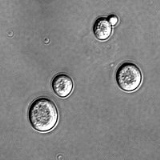
Saccharomyces is a
genusIn biology, a genus is a low-level taxonomic rank used in the biological classification of living and fossil organisms, which is an example of definition by genus and differentia...
in the kingdom of
fungiA fungus is a member of a large group of eukaryotic organisms that includes microorganisms such as yeasts and molds , as well as the more familiar mushrooms. These organisms are classified as a kingdom, Fungi, which is separate from plants, animals, and bacteria...
that includes many species of
yeastYeasts are eukaryotic micro-organisms classified in the kingdom Fungi, with 1,500 species currently described estimated to be only 1% of all fungal species. Most reproduce asexually by mitosis, and many do so by an asymmetric division process called budding...
.
Saccharomyces is from
GreekGreek is an independent branch of the Indo-European family of languages. Native to the southern Balkans, it has the longest documented history of any Indo-European language, spanning 34 centuries of written records. Its writing system has been the Greek alphabet for the majority of its history;...
σάκχαρ (sugar) and μύκης (mushroom) and means
sugar fungus. Many members of this genus are considered very important in food production. One example is
Saccharomyces cerevisiaeSaccharomyces cerevisiae is a species of yeast. It is perhaps the most useful yeast, having been instrumental to baking and brewing since ancient times. It is believed that it was originally isolated from the skin of grapes...
, which is used in making
wineWine is an alcoholic beverage, made of fermented fruit juice, usually from grapes. The natural chemical balance of grapes lets them ferment without the addition of sugars, acids, enzymes, or other nutrients. Grape wine is produced by fermenting crushed grapes using various types of yeast. Yeast...
,
breadBread is a staple food prepared by cooking a dough of flour and water and often additional ingredients. Doughs are usually baked, but in some cuisines breads are steamed , fried , or baked on an unoiled frying pan . It may be leavened or unleavened...
, and
beerBeer is the world's most widely consumed andprobably oldest alcoholic beverage; it is the third most popular drink overall, after water and tea. It is produced by the brewing and fermentation of sugars, mainly derived from malted cereal grains, most commonly malted barley and malted wheat...
. Other members of this genus include
Saccharomyces bayanusSaccharomyces bayanus is a yeast of the genus Saccharomyces, and is used in winemaking and cider fermentation. It is closely related to Saccharomyces cerevisiae. Both Saccharomyces bayanus and Saccharomyces pastorianus contain diverse strains, with different genetic and metabolic characteristics,...
, used in making wine, and
Saccharomyces boulardiiSaccharomyces boulardii is a tropical strain of yeast first isolated from lychee and mangosteen fruit in 1923 by French scientist Henri Boulard. It is related to, but distinct from, Saccharomyces cerevisiae in several taxonomic, metabolic, and genetic properties. S...
, used in medicine.
Morphology
ColoniesIn biology, a colony reference to several individual organisms of the same species living closely together, usually for mutual benefit, such as stronger defense or the ability to attack bigger prey. Some insects live only in colonies...
of
Saccharomyces grow rapidly and mature in three days. They are flat, smooth, moist, glistening or dull, and cream to tannish cream in color. The inability to use nitrate and ability to ferment various
carbohydrateA carbohydrate is an organic compound with the empirical formula ; that is, consists only of carbon, hydrogen, and oxygen, with a hydrogen:oxygen atom ratio of 2:1 . However, there are exceptions to this. One common example would be deoxyribose, a component of DNA, which has the empirical...
s are typical characteristics of
Saccharomyces.
Cellular morphology
Blastoconidia (cell buds) are observed. They are unicellular, globose, and ellipsoid to elongate in shape. Multilateral (multipolar) budding is typical. Pseudohyphae, if present, are rudimentary. Hyphae are absent.
Saccharomyces produces ascospores, especially when grown on V-8 medium, acetate ascospor
agarAgar or agar-agar is a gelatinous substance derived from a polysaccharide that accumulates in the cell walls of agarophyte red algae. Throughout history into modern times, agar has been chiefly used as an ingredient in desserts throughout Asia and also as a solid substrate to contain culture medium...
, or Gorodkowa medium. These ascospores are globose and located in asci. Each ascus contains 1-4 ascospores. Asci do not rupture at maturity. Ascospores are stained with Kinyoun stain and ascospore stain. When stained with Gram stain, ascospores appear
Gram-negativeGram-negative bacteria are bacteria that do not retain crystal violet dye in the Gram staining protocol. In a Gram stain test, a counterstain is added after the crystal violet, coloring all Gram-negative bacteria with a red or pink color...
, while vegetative cells appear
Gram-positiveGram-positive bacteria are those that are stained dark blue or violet by Gram staining. This is in contrast to Gram-negative bacteria, which cannot retain the crystal violet stain, instead taking up the counterstain and appearing red or pink...
.
History
The presence of yeast in beer was first suggested in 1680, although the genus was not named
Saccharomyces until 1837. It was not until 1876 that
Louis PasteurLouis Pasteur was a French chemist and microbiologist born in Dole. He is remembered for his remarkable breakthroughs in the causes and preventions of diseases. His discoveries reduced mortality from puerperal fever, and he created the first vaccine for rabies and anthrax. His experiments...
demonstrated the involvement of living organisms in fermentation and in 1888, Hansen isolated brewing yeast and propagated leading to the importance of yeast in brewing. The use of microscopes for the study of yeast morphology and purity was crucial to understanding their functionality.
Use in brewing
Brewing yeasts are
polyploidPolyploid is a term used to describe cells and organisms containing more than two paired sets of chromosomes. Most eukaryotic species are diploid, meaning they have two sets of chromosomes — one set inherited from each parent. However polyploidy is found in some organisms and is especially common...
and belong to the
Saccharomyces genera. The brewing strains can be classified into two groups; the ale strains (
Saccharomyces cerevisiaeSaccharomyces cerevisiae is a species of yeast. It is perhaps the most useful yeast, having been instrumental to baking and brewing since ancient times. It is believed that it was originally isolated from the skin of grapes...
) and the lager strains (
Saccharomyces pastorianusSaccharomyces pastorianus is a yeast, used industrially for the production of lager beer. It is a synonym of the yeast species Saccharomyces carlsbergensis, which was originally described in 1883 by Emil Christian Hansen, who was working for the Danish brewery Carlsberg.-Genomics:As S...
or
Saccharomyces carlsbergensis in the old taxonomy). Lager strains are a hybrid strain of
S. cerevisiae and
S. eubayanusSaccharomyces eubayanus, a type of yeast, is a likely parent of the lager brewing yeast, Saccharomyces pastorianus.Lager is a type of beer created from malted barley and brewed at low temperatures, originally in Bavaria. S...
and are often referred to as bottom fermenting. In contrast, ale strains are referred to as top fermenting strains, reflecting their separation characteristics in open square fermenters. Although the two species differ in a number of ways, including their response to temperature, sugar transport and use, the
S. pastorianus and
S. cerevisiae species are closely related within the
Saccharomyces genus.
Saccharomyces yeasts can form symbiotic matrices with bacteria, and are used to produce
kombuchaKombucha is an effervescent tea-based beverage that is often drunk for its anecdotal health benefits or medicinal purposes. Kombucha is available commercially and can be made at home by fermenting tea using a visible, solid mass of yeast and bacteria which forms the kombucha culture, often referred...
,
kefirKefir is a fermented milk drink that originated with shepherds of the North Caucasus region, who discovered that fresh milk carried in leather pouches would occasionally ferment into an effervescent beverage...
and
ginger beerGinger beer is a carbonated drink that is flavored primarily with ginger and sweetened with sugar or artificial sweeteners.-History:Brewed ginger beer originated in England in the mid-18th century and became popular in Britain, the United States, and Canada, reaching a peak of popularity in the...
.
Pathology
Saccharomyces cause food spoilage of sugar-rich foods, such as maple sap, syrup, concentrated juices and condiments. Extended exposure to
S. cerevisiae can result in
hypersensitivityHypersensitivity refers to undesirable reactions produced by the normal immune system, including allergies and autoimmunity. These reactions may be damaging, uncomfortable, or occasionally fatal. Hypersensitivity reactions require a pre-sensitized state of the host. The four-group classification...
.
See also
- Mating of yeast
The yeast Saccharomyces cerevisiae is a simple single celled eukaryote with both a diploid and haploid mode of existence. The mating of yeast only occurs between haploids, which can be either the a or α mating type and thus display simple sexual differentiation...
- Yeast
Yeasts are eukaryotic micro-organisms classified in the kingdom Fungi, with 1,500 species currently described estimated to be only 1% of all fungal species. Most reproduce asexually by mitosis, and many do so by an asymmetric division process called budding...
- Saccharomyces cerevisiae virus L-A
Saccharomyces cerevisiae virus L-A is a double-stranded RNA virus of the yeast Saccharomyces cerevisiae. This virus has a single 4.6 kb genomic segment that encodes its major coat protein, Gag and a Gag-Pol fusion protein formed by a -1 ribosomal frameshift...
External links