

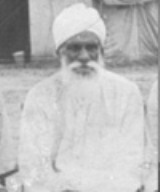
Sohan Singh Bhakna

Encyclopedia
Baba Sohan Singh Bhakna (1870–1968) was as Indian revolutionary
, the founding president of the Ghadar Party
, and a leading member of the party involved in the Ghadar Conspiracy
of 1915. Tried at the Lahore Conspiracy trial, Sohan Singh served sixteen years of a life sentence for his part in the conspiracy before he was released in 1930. He later worked closely with the Indian labour movement, devoting considerable time to the Kisan Sabha and the Communist Party of India
.
. Young Sohan Singh spent his childhood at Bhakhna, where he received his childhood education in the village Gurudwara. He learnt to read and write in the Punjabi language
at an early age, and was also instructed on the rudiments of Sikh faith. Sohan Singh was married at the age of ten to Bishan Kaur, daughter of a landlord near Lahore
by the name of Khushal Singh. Sohan Singh finished school at the age of sixteen, by which time he was also proficient in Urdu
and Persian
. His marriage to Bishan Kaur, however, remained childless.
Sohan Singh became involved in the nationalist movement and the agrarian unrest that emerged in Punjab in the 1900s. He participated in the protests against the anti-Colonization Bill in 1906-07. Two years later, in February 1909, he left home to sail for the United States. After a two month journey, Singh reached Seattle on 4 April 1909.
saw large scale Indian immigration. A large proportion of the immigrants were especially from Punjab British India which was facing an economic depression and agrarian unrest. The Canadian government met this influx with a series of legislations aimed at limiting the entry of South Asians into Canada, and restricting the political rights of those already in the country. The Punjabi community had hitherto been an important loyal force for the British Empire
and the Commonwealth
, and the community had expected, to honour its commitment, equal welcome and rights from the British and commonwealth governments as extended to British and white immigrants. These legislations fed growing discontent, protests and anti-colonial sentiments within the community. Faced with increasingly difficult situations, the community began organising itself into political groups. A large number of Punjabis also moved to the United States, but they encountered similar political and social problems. Early works among these groups date back to the time around 1908 when Indian students and Punjabi immigrants of the likes of P S Khankhoje, Pandit Kanshi Ram
, Taraknath Das and Bhai Bhagwan Singh
were working towards and for a political movement. Khankhoje himself founded the Indian Independence League in Portland, Oregon
. Sohan Singh at this time came to be strongly associated with this political movement taking shape among Indian immigrants. His works also brought him close to other Indian nationalists in United States at the time.
Meanwhile, India House
and nationalist activism of Indian students had begun declining in the East Coast towards 1910, but gradually shifted west to San Francisco. The arrival at this time of Har Dayal
from Europe bridged the gap between the intellectual agitators in New York and the predominantly Punjabi labour workers and migrants in the west coast, and laid the foundations of the Ghadar movement
. In the summer of 1913, representatives of Indians living in Canada and the United States met at Stockton
, where the decision was taken to establish an organization, Hindustani Workers of the Pacific Coast. The Pacific Coast Hindustan Association, was formed in 1913 in the United States under the leadership of Har Dayal
, P.S. Khankhoje and Sohan Singh Bhakna. Bhakna was its president. It drew members from Indian immigrants, largely from Punjab
. Many of its members were also from the University of California at Berkeley
including Dayal, Tarak Nath Das
, Kartar Singh Sarabha and V.G. Pingle
. The party quickly gained support from Indian expatriates, especially in the United States, Canada
and Asia. Ghadar meetings were held in Los Angeles
, Oxford
, Vienna
, Washington, D.C.
, and Shanghai
.
-led mainstream movement
for dominion status modest and the latter's constitutional methods as soft. Ghadar's foremost strategy was to entice Indian soldiers
to revolt. To that end, in November 1913 Ghadar established the Yugantar Ashram press in San Francisco. The press produced the Hindustan Ghadar
newspaper and other nationalist literature.
The Ghadar leadership,under Sohan Singh Bhakna, began at this time their first plans for mutiny. The inflammatory passions surrounding the Komagata Maru
incident helped the Ghadarite cause, and Ghadar leaders including Sohan Singh, Barkatullah
and Taraknath Das used it as a rallying point and successfully brought many disaffected Indians in North America into the party's fold. Sohan Singh himself had contacted the returning Komagata Maru at Yokohama
and delivered to Baba Gurdit Singh
a consignment of arms when he learnt of hostilities breaking out in July 1914.
The war in Europe hastened Ghadar's plans. It was already in touch with Indian revolutionaries in Germany
and with the German consulate in San Fracisco. Ghadar also had party members in South-East Asia and had made contact with the Indian revolutionary underground. Elaborate plans were made to ship funds and arms from the United States and from South-East Asia, to India in what came to be called the Hindu German Conspiracy. These were to be used for a planned mutiny in India sometime in late 1914 or early 1915. The plans for the latter came to be known as the Ghadar Conspiracy
. Sohan Singh, as one of the top of the Ghadar leadership, sailed to India in the SS Namsang at the outbreak of the war, in the wake of the Komagata Maru
incidence to organise and direct the rebellion from India. However, British intelligence was already picking up traces of the revolutionary conspiracy. Returning to India, Singh was arrested in Calcutta on 13 October 1914 and sent to Ludhiana for interrogation. He was subsequently sent to the Central Jail in Multan
and later tried in the Lahore Conspiracy Case
and sentenced to death, with forfeiture of property. The death sentence was later commuted to life imprisonment in the Andamans, where he reached on 10 December 1915 and where he undertook several hunger strikes successively to secure the detenues better treatment.
jail and then to Yervada. Here however, Singh famously embarked on a hunger strike in protest against Sikh prisoners not being allowed to wear turban
s and their Kaccha
, amongst their religious obligations. In 1927, he was shifted to the Central Jail at Lahore
, where he again went on hunger strike in June 1928 to protest against the segregation of the so-called low-caste Mazhabi
Sikhs from other 'high-caste' Sikhs during meals. In 1929, while still interned, Sohan Singh famously went on a hunger strike
in support of Bhagat Singh. Sohan Singh ultimately served sixteen years before he was released early in July 1930.
After his release, Sohan Singh Bhakna continued working in the nationalist movement and labour politics. His works were identified closely with the works of the Communist party of India
, devoting most of his time to organizing the Kisan Sabhas. He also made the release of interened Ghadarites a key part of his political work.
He was interned a second time during World War II, when he was jailed at the Deoli Camp in what is today Rajasthan
. He remained incarcerated for nearly three years. After Independence he veered decisively towards the Communist Party of India
. He was arrested on 31 March 1948, but released on 8 May 1948. However, he was seized again, but jail-going ended for him finally at the intervention of Independent India's first Prime Minister, Jawaharlal Nehru
. Bent with age and ravaged by pneumonia, Baba Sohan Singh Bhakna died, at Amritsar, on 21 December 1968.
Indian independence movement
The term Indian independence movement encompasses a wide area of political organisations, philosophies, and movements which had the common aim of ending first British East India Company rule, and then British imperial authority, in parts of South Asia...
, the founding president of the Ghadar Party
Ghadar Party
The Ghadar Party was an organization founded by Punjabi Indians, in the United States and Canada with the aim to liberate India from British rule...
, and a leading member of the party involved in the Ghadar Conspiracy
Ghadar Conspiracy
The Ghadar Conspiracy was a conspiracy for a pan-Indian mutiny in the British Indian Army in February 1915 formulated by the Ghadar Party...
of 1915. Tried at the Lahore Conspiracy trial, Sohan Singh served sixteen years of a life sentence for his part in the conspiracy before he was released in 1930. He later worked closely with the Indian labour movement, devoting considerable time to the Kisan Sabha and the Communist Party of India
Communist Party of India
The Communist Party of India is a national political party in India. In the Indian communist movement, there are different views on exactly when the Indian communist party was founded. The date maintained as the foundation day by CPI is 26 December 1925...
.
Early life
Sohan Singh was born in January 1870 at the village of Khutrai Khurd, north of Amritsar, which was the ancestral home of his mother Ram Kaur. His father was Bhai Karam Singh, who lived with his family in the village of Bhakna, 16 km southwest of AmritsarAmritsar
Amritsar is a city in the northern part of India and is the administrative headquarters of Amritsar district in the state of Punjab, India. The 2001 Indian census reported the population of the city to be over 1,500,000, with that of the entire district numbering 3,695,077...
. Young Sohan Singh spent his childhood at Bhakhna, where he received his childhood education in the village Gurudwara. He learnt to read and write in the Punjabi language
Punjabi language
Punjabi is an Indo-Aryan language spoken by inhabitants of the historical Punjab region . For Sikhs, the Punjabi language stands as the official language in which all ceremonies take place. In Pakistan, Punjabi is the most widely spoken language...
at an early age, and was also instructed on the rudiments of Sikh faith. Sohan Singh was married at the age of ten to Bishan Kaur, daughter of a landlord near Lahore
Lahore
Lahore is the capital of the Pakistani province of Punjab and the second largest city in the country. With a rich and fabulous history dating back to over a thousand years ago, Lahore is no doubt Pakistan's cultural capital. One of the most densely populated cities in the world, Lahore remains a...
by the name of Khushal Singh. Sohan Singh finished school at the age of sixteen, by which time he was also proficient in Urdu
Urdu
Urdu is a register of the Hindustani language that is identified with Muslims in South Asia. It belongs to the Indo-European family. Urdu is the national language and lingua franca of Pakistan. It is also widely spoken in some regions of India, where it is one of the 22 scheduled languages and an...
and Persian
Persian language
Persian is an Iranian language within the Indo-Iranian branch of the Indo-European languages. It is primarily spoken in Iran, Afghanistan, Tajikistan and countries which historically came under Persian influence...
. His marriage to Bishan Kaur, however, remained childless.
Sohan Singh became involved in the nationalist movement and the agrarian unrest that emerged in Punjab in the 1900s. He participated in the protests against the anti-Colonization Bill in 1906-07. Two years later, in February 1909, he left home to sail for the United States. After a two month journey, Singh reached Seattle on 4 April 1909.
United States
Sohan Singh soon found work as a labourer in a timber mill being constructed near the city. In this first decade of the 1900s, the Pacific coast of North AmericaNorth America
North America is a continent wholly within the Northern Hemisphere and almost wholly within the Western Hemisphere. It is also considered a northern subcontinent of the Americas...
saw large scale Indian immigration. A large proportion of the immigrants were especially from Punjab British India which was facing an economic depression and agrarian unrest. The Canadian government met this influx with a series of legislations aimed at limiting the entry of South Asians into Canada, and restricting the political rights of those already in the country. The Punjabi community had hitherto been an important loyal force for the British Empire
British Empire
The British Empire comprised the dominions, colonies, protectorates, mandates and other territories ruled or administered by the United Kingdom. It originated with the overseas colonies and trading posts established by England in the late 16th and early 17th centuries. At its height, it was the...
and the Commonwealth
Commonwealth of Nations
The Commonwealth of Nations, normally referred to as the Commonwealth and formerly known as the British Commonwealth, is an intergovernmental organisation of fifty-four independent member states...
, and the community had expected, to honour its commitment, equal welcome and rights from the British and commonwealth governments as extended to British and white immigrants. These legislations fed growing discontent, protests and anti-colonial sentiments within the community. Faced with increasingly difficult situations, the community began organising itself into political groups. A large number of Punjabis also moved to the United States, but they encountered similar political and social problems. Early works among these groups date back to the time around 1908 when Indian students and Punjabi immigrants of the likes of P S Khankhoje, Pandit Kanshi Ram
Pandit Kanshi Ram
Pandit Kanshi Ram was an Indian revolutionary who, along with Har Dayal and Sohan Singh Bhakna was one of the three key members in founding the Ghadar Party. He served as the treasurer of the party from its foundation in 1913 to 1914...
, Taraknath Das and Bhai Bhagwan Singh
Bhai Bhagwan Singh
Bhai Bhagwan Singh Gyanee was an Indian Nationalist and a leading luminary of the Ghadar Party. Elected the party president in 1914, he was extensively involved in the Ghadar Conspiracy of 1915 during World War I and in the aftermath of its failure fled to Japan...
were working towards and for a political movement. Khankhoje himself founded the Indian Independence League in Portland, Oregon
Portland, Oregon
Portland is a city located in the Pacific Northwest, near the confluence of the Willamette and Columbia rivers in the U.S. state of Oregon. As of the 2010 Census, it had a population of 583,776, making it the 29th most populous city in the United States...
. Sohan Singh at this time came to be strongly associated with this political movement taking shape among Indian immigrants. His works also brought him close to other Indian nationalists in United States at the time.
Meanwhile, India House
India House
India House was an informal Indian nationalist organisation based in London between 1905 and 1910. With the patronage of Shyamji Krishna Varma, its home in a student residence in Highgate, North London was launched to promote nationalist views among Indian students in Britain...
and nationalist activism of Indian students had begun declining in the East Coast towards 1910, but gradually shifted west to San Francisco. The arrival at this time of Har Dayal
Har Dayal
Lala Har Dayal was a Indian nationalist revolutionary who founded the Ghadar Party in America. He was a polymath who turned down a career in the Indian Civil Service...
from Europe bridged the gap between the intellectual agitators in New York and the predominantly Punjabi labour workers and migrants in the west coast, and laid the foundations of the Ghadar movement
Ghadar Party
The Ghadar Party was an organization founded by Punjabi Indians, in the United States and Canada with the aim to liberate India from British rule...
. In the summer of 1913, representatives of Indians living in Canada and the United States met at Stockton
Stockton, California
Stockton, California, the seat of San Joaquin County, is the fourth-largest city in the Central Valley of the U.S. state of California. With a population of 291,707 at the 2010 census, Stockton ranks as this state's 13th largest city...
, where the decision was taken to establish an organization, Hindustani Workers of the Pacific Coast. The Pacific Coast Hindustan Association, was formed in 1913 in the United States under the leadership of Har Dayal
Har Dayal
Lala Har Dayal was a Indian nationalist revolutionary who founded the Ghadar Party in America. He was a polymath who turned down a career in the Indian Civil Service...
, P.S. Khankhoje and Sohan Singh Bhakna. Bhakna was its president. It drew members from Indian immigrants, largely from Punjab
Punjab (British India)
Punjab was a province of British India, it was one of the last areas of the Indian subcontinent to fall under British rule. With the end of British rule in 1947 the province was split between West Punjab, which went to Pakistan, and East Punjab, which went to India...
. Many of its members were also from the University of California at Berkeley
University of California, Berkeley
The University of California, Berkeley , is a teaching and research university established in 1868 and located in Berkeley, California, USA...
including Dayal, Tarak Nath Das
Tarak Nath Das
Taraknath Das was an anti-British Bengali Indian revolutionary and internationalist scholar. He was a pioneering immigrant in the west coast of North America and discussed his plans with Tolstoy, while organizing the Asian Indian immigrants in favor of the Indian freedom movement...
, Kartar Singh Sarabha and V.G. Pingle
Vishnu Ganesh Pingle
Vishnu Ganesh Pingle was an Indian revolutionary and a member of the Ghadar Party who was one of those executed in 1915 following the Lahore conspiracy trial for his role in the Ghadar conspiracy.-Early life:...
. The party quickly gained support from Indian expatriates, especially in the United States, Canada
Canada
Canada is a North American country consisting of ten provinces and three territories. Located in the northern part of the continent, it extends from the Atlantic Ocean in the east to the Pacific Ocean in the west, and northward into the Arctic Ocean...
and Asia. Ghadar meetings were held in Los Angeles
Los Ángeles
Los Ángeles is the capital of the province of Biobío, in the commune of the same name, in Region VIII , in the center-south of Chile. It is located between the Laja and Biobío rivers. The population is 123,445 inhabitants...
, Oxford
Oxford
The city of Oxford is the county town of Oxfordshire, England. The city, made prominent by its medieval university, has a population of just under 165,000, with 153,900 living within the district boundary. It lies about 50 miles north-west of London. The rivers Cherwell and Thames run through...
, Vienna
Vienna
Vienna is the capital and largest city of the Republic of Austria and one of the nine states of Austria. Vienna is Austria's primary city, with a population of about 1.723 million , and is by far the largest city in Austria, as well as its cultural, economic, and political centre...
, Washington, D.C.
Washington, D.C.
Washington, D.C., formally the District of Columbia and commonly referred to as Washington, "the District", or simply D.C., is the capital of the United States. On July 16, 1790, the United States Congress approved the creation of a permanent national capital as permitted by the U.S. Constitution....
, and Shanghai
Shanghai
Shanghai is the largest city by population in China and the largest city proper in the world. It is one of the four province-level municipalities in the People's Republic of China, with a total population of over 23 million as of 2010...
.
Ghadar Conspiracy
The Ghadar Party evolved from the Pacific coast association. The Ghadar's ultimate goal was to overthrow British colonial authority in India by means of an armed revolution. It viewed the CongressIndian National Congress
The Indian National Congress is one of the two major political parties in India, the other being the Bharatiya Janata Party. It is the largest and one of the oldest democratic political parties in the world. The party's modern liberal platform is largely considered center-left in the Indian...
-led mainstream movement
Indian independence movement
The term Indian independence movement encompasses a wide area of political organisations, philosophies, and movements which had the common aim of ending first British East India Company rule, and then British imperial authority, in parts of South Asia...
for dominion status modest and the latter's constitutional methods as soft. Ghadar's foremost strategy was to entice Indian soldiers
British Indian Army
The British Indian Army, officially simply the Indian Army, was the principal army of the British Raj in India before the partition of India in 1947...
to revolt. To that end, in November 1913 Ghadar established the Yugantar Ashram press in San Francisco. The press produced the Hindustan Ghadar
Hindustan Ghadar
thumb|right|Ghadar Newspaper Vol. 1, No. 22, March 24, 1914The Hindustan Ghadar was a weekly publication that was the party organ of the Ghadar Party. It was published under the auspices of the Yugantar Ashram in San Francisco...
newspaper and other nationalist literature.
The Ghadar leadership,under Sohan Singh Bhakna, began at this time their first plans for mutiny. The inflammatory passions surrounding the Komagata Maru
Komagata Maru
The Komagata Maru incident involved a Japanese steamship, the Komagata Maru, that sailed from Hong Kong to Shanghai, China; Yokohama, Japan; and then to Vancouver, British Columbia, Canada, in 1914, carrying 376 passengers from Punjab, India. The 356 of passengers were not allowed to land in...
incident helped the Ghadarite cause, and Ghadar leaders including Sohan Singh, Barkatullah
Maulavi Barkatullah
Maulavi Abdul Hafiz Mohamed Barakatullah or Maulana Barkatullah was a staunch anti-British Indian revolutionary with sympathy for the Pan-Islamic movement. Barkatullah was born on 7 July 1854 at Itwra Mohalla Bhopal in Madhya Pradesh, India...
and Taraknath Das used it as a rallying point and successfully brought many disaffected Indians in North America into the party's fold. Sohan Singh himself had contacted the returning Komagata Maru at Yokohama
Yokohama
is the capital city of Kanagawa Prefecture and the second largest city in Japan by population after Tokyo and most populous municipality of Japan. It lies on Tokyo Bay, south of Tokyo, in the Kantō region of the main island of Honshu...
and delivered to Baba Gurdit Singh
Baba Gurdit Singh
Baba Gurdit Singh was born in 1860 at Sarhali, in Amritsar District Of British Punjab province . He chartered a Japanese ship, the Komagata Maru, in 1914 to go to Canada, reaching Vancouver on May 23, 1914. The government did not allow the ship to anchor. The ship was attacked by the police at night...
a consignment of arms when he learnt of hostilities breaking out in July 1914.
The war in Europe hastened Ghadar's plans. It was already in touch with Indian revolutionaries in Germany
Berlin Committee
The Berlin Committee, later known as the Indian Independence Committee after 1915, was an organisation formed in Germany in 1914 during World War I by Indian students and political activists residing in the country. The purpose of the Committee was to promote the cause of Indian Independence...
and with the German consulate in San Fracisco. Ghadar also had party members in South-East Asia and had made contact with the Indian revolutionary underground. Elaborate plans were made to ship funds and arms from the United States and from South-East Asia, to India in what came to be called the Hindu German Conspiracy. These were to be used for a planned mutiny in India sometime in late 1914 or early 1915. The plans for the latter came to be known as the Ghadar Conspiracy
Ghadar Conspiracy
The Ghadar Conspiracy was a conspiracy for a pan-Indian mutiny in the British Indian Army in February 1915 formulated by the Ghadar Party...
. Sohan Singh, as one of the top of the Ghadar leadership, sailed to India in the SS Namsang at the outbreak of the war, in the wake of the Komagata Maru
Komagata Maru
The Komagata Maru incident involved a Japanese steamship, the Komagata Maru, that sailed from Hong Kong to Shanghai, China; Yokohama, Japan; and then to Vancouver, British Columbia, Canada, in 1914, carrying 376 passengers from Punjab, India. The 356 of passengers were not allowed to land in...
incidence to organise and direct the rebellion from India. However, British intelligence was already picking up traces of the revolutionary conspiracy. Returning to India, Singh was arrested in Calcutta on 13 October 1914 and sent to Ludhiana for interrogation. He was subsequently sent to the Central Jail in Multan
Multan
Multan , is a city in the Punjab Province of Pakistan and capital of Multan District. It is located in the southern part of the province on the east bank of the Chenab River, more or less in the geographic centre of the country and about from Islamabad, from Lahore and from Karachi...
and later tried in the Lahore Conspiracy Case
Lahore Conspiracy Case
This can refer to :* The First Lahore Conspiracy, also known as the Lahore Conspiracy Case trial in the aftermath of the Ghadar conspiracy in 1915* The Second Lahore Conspiracy Case, the trial of Bhagat Singh, Rajguru, and Sukhdev in 1931...
and sentenced to death, with forfeiture of property. The death sentence was later commuted to life imprisonment in the Andamans, where he reached on 10 December 1915 and where he undertook several hunger strikes successively to secure the detenues better treatment.
Later life
In 1921, Sohan Singh was transferred to CoimbatoreCoimbatore
Coimbatore , also known as Kovai , is the second largest city in the Indian state of Tamil Nadu. It is a major commercial centre in Tamil Nadu and is known as the "Manchester of South India"....
jail and then to Yervada. Here however, Singh famously embarked on a hunger strike in protest against Sikh prisoners not being allowed to wear turban
Turban
In English, Turban refers to several types of headwear popularly worn in the Middle East, North Africa, Punjab, Jamaica and Southwest Asia. A commonly used synonym is Pagri, the Indian word for turban.-Styles:...
s and their Kaccha
Kaccha
Kacchera or Kaccha are specially designed short, shalwar-like) loose undergarments with a tie-knot worn by baptized Sikhs. It is one of the five Sikh articles of faith called the Five Ks , and was given as a "gift of love" by Gobind Singh at the Baisakhi Amrit Sanskar in 1699...
, amongst their religious obligations. In 1927, he was shifted to the Central Jail at Lahore
Lahore
Lahore is the capital of the Pakistani province of Punjab and the second largest city in the country. With a rich and fabulous history dating back to over a thousand years ago, Lahore is no doubt Pakistan's cultural capital. One of the most densely populated cities in the world, Lahore remains a...
, where he again went on hunger strike in June 1928 to protest against the segregation of the so-called low-caste Mazhabi
Mazhabi
A Mazhabi Sikh is a member of the Rangretta clans Churas who have embraced the sikh faith who are mainly found in the Punjab region, Kashmir and Rajastan...
Sikhs from other 'high-caste' Sikhs during meals. In 1929, while still interned, Sohan Singh famously went on a hunger strike
Hunger strike
A hunger strike is a method of non-violent resistance or pressure in which participants fast as an act of political protest, or to provoke feelings of guilt in others, usually with the objective to achieve a specific goal, such as a policy change. Most hunger strikers will take liquids but not...
in support of Bhagat Singh. Sohan Singh ultimately served sixteen years before he was released early in July 1930.
After his release, Sohan Singh Bhakna continued working in the nationalist movement and labour politics. His works were identified closely with the works of the Communist party of India
Communist Party of India
The Communist Party of India is a national political party in India. In the Indian communist movement, there are different views on exactly when the Indian communist party was founded. The date maintained as the foundation day by CPI is 26 December 1925...
, devoting most of his time to organizing the Kisan Sabhas. He also made the release of interened Ghadarites a key part of his political work.
He was interned a second time during World War II, when he was jailed at the Deoli Camp in what is today Rajasthan
Rajasthan
Rājasthān the land of Rajasthanis, , is the largest state of the Republic of India by area. It is located in the northwest of India. It encompasses most of the area of the large, inhospitable Great Indian Desert , which has an edge paralleling the Sutlej-Indus river valley along its border with...
. He remained incarcerated for nearly three years. After Independence he veered decisively towards the Communist Party of India
Communist Party of India
The Communist Party of India is a national political party in India. In the Indian communist movement, there are different views on exactly when the Indian communist party was founded. The date maintained as the foundation day by CPI is 26 December 1925...
. He was arrested on 31 March 1948, but released on 8 May 1948. However, he was seized again, but jail-going ended for him finally at the intervention of Independent India's first Prime Minister, Jawaharlal Nehru
Jawaharlal Nehru
Jawaharlal Nehru , often referred to with the epithet of Panditji, was an Indian statesman who became the first Prime Minister of independent India and became noted for his “neutralist” policies in foreign affairs. He was also one of the principal leaders of India’s independence movement in the...
. Bent with age and ravaged by pneumonia, Baba Sohan Singh Bhakna died, at Amritsar, on 21 December 1968.