
Home      Discussion      Topics      Dictionary      Almanac
Signup       Login
Communist Party of India

Communist Party of India

Overview
The Communist Party of India (CPI) is a national political party
Political party
A political party is a political organization that typically seeks to influence government policy, usually by nominating their own candidates and trying to seat them in political office. Parties participate in electoral campaigns, educational outreach or protest actions...

 in India. In the Indian communist movement, there are different views on exactly when the Indian communist party was founded. The date maintained as the foundation day by CPI is 26 December 1925. But the Communist Party of India (Marxist)
Communist Party of India (Marxist)
The Communist Party of India is a political party in India. It has a strong presence in the states of Kerala, West Bengal and Tripura. As of 2011, CPI is leading the state government in Tripura. It leads the Left Front coalition of leftist parties in various states and the national parliament of...

, which separated from the CPI, claims that the party was founded in 1920.
Discussion
Ask a question about 'Communist Party of India'
Start a new discussion about 'Communist Party of India'
Answer questions from other users
Full Discussion Forum
 
Unanswered Questions
Encyclopedia
The Communist Party of India (CPI) is a national political party
Political party
A political party is a political organization that typically seeks to influence government policy, usually by nominating their own candidates and trying to seat them in political office. Parties participate in electoral campaigns, educational outreach or protest actions...

 in India. In the Indian communist movement, there are different views on exactly when the Indian communist party was founded. The date maintained as the foundation day by CPI is 26 December 1925. But the Communist Party of India (Marxist)
Communist Party of India (Marxist)
The Communist Party of India is a political party in India. It has a strong presence in the states of Kerala, West Bengal and Tripura. As of 2011, CPI is leading the state government in Tripura. It leads the Left Front coalition of leftist parties in various states and the national parliament of...

, which separated from the CPI, claims that the party was founded in 1920.

Communism during the colonial period


The Communist Party of India was founded in Tashkent
Tashkent
Tashkent is the capital of Uzbekistan and of the Tashkent Province. The officially registered population of the city in 2008 was about 2.2 million. Unofficial sources estimate the actual population may be as much as 4.45 million.-Early Islamic History:...

, Turkestan Autonomous Soviet Socialist Republic on October 17, 1920, soon after the Second Congress of the Communist International. The founding members of the party were M.N. Roy, Evelyn Trent Roy (Roy's wife), Abani Mukherji
Abani Mukherji
Abaninath Mukherji was an Indian revolutionary and co-founder of the Communist Party of India. His name was often spelt Abani Mukherjee.-Early life:...

, Rosa Fitingof (Abani's wife), Mohammad Ali (Ahmed Hasan), Mohammad Shafiq Siddiqui and M.P.B.T. Acharya.

The CPI began efforts to build a party organisation inside India. Roy made contacts with Anushilan and Jugantar
Jugantar
Jugantar or Yugantar was one of the two main secret revolutionary trends operating in Bengal for Indian independence.This association, like Anushilan Samiti started in the guise of suburban fitness club. Several Jugantar members were arrested, hanged, or deported for life to the Cellular Jail in...

 groups in Bengal
Bengal
Bengal is a historical and geographical region in the northeast region of the Indian Subcontinent at the apex of the Bay of Bengal. Today, it is mainly divided between the sovereign land of People's Republic of Bangladesh and the Indian state of West Bengal, although some regions of the previous...

. Small communist groups were formed in Bengal (led by Muzaffar Ahmed
Muzaffar Ahmed (politician)
Muzaffar Ahmed was a noted Bengali politician, journalist and communist activist, popularly known as "Kakababu".-Background:...

), Bombay (led by S.A. Dange), Madras (led by Singaravelu Chettiar
Singaravelu Chettiar
-Ma.Singaravelar :He was one of the early leftist thinkers of India in 20th century. He was an advocate by profession and spent his earlier days for the propagation of Buddhism. Being contemporary of freedom fighters, VOC and Balagangadhar Thilak. He was actively participated in railway workers...

), United Provinces
United Provinces of British India
The United Provinces of British India, more commonly known as the United Provinces, was a province of British India, which came into existence on 3 January 1921 as a result of the renaming of the United Provinces of Agra and Oudh. It corresponded approximately to the combined regions of the...

 (led by Shaukat Usmani
Shaukat Usmani
Shaukat Usmani was an early Indian communist, who was born to artstic USTA family of Bikaner and a member of the émigré Communist Party of India, established in Tashkent in 1920, and a founding member of the Communist Party of India when it was formed in Kanpur in 1925...

) and Punjab
Punjab (British India)
Punjab was a province of British India, it was one of the last areas of the Indian subcontinent to fall under British rule. With the end of British rule in 1947 the province was split between West Punjab, which went to Pakistan, and East Punjab, which went to India...

 (led by Ghulam Hussain
Ghulam Hussain
Ghulam Hussain was the founder of the Atba-i-Malak Badra branch of Mustaali Ismaili Shi'a Islam....

). However, only Usmani became a CPI party member.

During the 1920s and beginning of 1930s the party was badly organized, and in practice there were several communist groups working with limited national coordination. The British colonial authorities had banned all communist activity, which made the task of building a united party very difficult. Between 1921 and 1924 there were four conspiracy trials against the communist movement; First Peshawar Conspiracy Case, Second Peshawar Conspiracy Case, Moscow Conspiracy Case and the Cawnpore Bolshevik Conspiracy Case. In the first three cases, Russian-trained muhajir communists were put on trial. However, the Cawnpore trial had more political impact. On March 17, 1924, M.N. Roy, S.A. Dange, Muzaffar Ahmed, Nalini Gupta, Shaukat Usmani, Singaravelu Chettiar, Ghulam Hussain and R.C. Sharma were charged, in Cawnpore (now spelt Kanpur) Bolshevik Conspiracy case. The specific charge was that they as communists were seeking "to deprive the King Emperor of his sovereignty of British India, by complete separation of India from imperialistic Britain by a violent revolution." Pages of newspapers daily splashed sensational communist plans and people for the first time learned , on such a large scale, about communism and its doctrines and the aims of the Communist International in India.

Singaravelu Chettiar was released on account of illness. M.N. Roy was in Germany and R.C. Sharma in French Pondicherry, and therefore could not be arrested. Ghulam Hussain confessed that he had received money from the Russians in Kabul
Kabul
Kabul , spelt Caubul in some classic literatures, is the capital and largest city of Afghanistan. It is also the capital of the Kabul Province, located in the eastern section of Afghanistan...

 and was pardoned. Muzaffar Ahmed, Nalini Gupta, Shaukat Usmani and Dange were sentenced for various terms of imprisonment. This case was responsible for actively introducing communism to a larger Indian audience. Dange was released from prison in 1927.

On December 25, 1925 a communist conference was organized in Kanpur. Colonial authorities estimated that 500 persons took part in the conference. The conference was convened by a man called Satyabhakta. At the conference Satyabhakta argued for a 'national communism' and against subordination under Comintern. Being outvoted by the other delegates, Satyabhakta left both the conference venue in protest. The conference adopted the name 'Communist Party of India'. Groups such as Labour Kisan Party of Hindustan
Labour Kisan Party of Hindustan
Labour Kisan Party of Hindustan was a political party in India. The party was founded by Singaravelu Chettiar on May 1, 1923 in Madras. This was the first May Day celebration in India. This was also the first time the red flag was used in India....

 (LKPH) dissolved into the unified CPI. The émigré CPI, which probably had little organic character anyway, was effectively substituted by the organization now operating inside India.

Soon after the 1926 conference of the Workers and Peasants Party
Workers and Peasants Party
The Workers and Peasants Party was a political party in India, which worked inside the Indian National Congress 1925-1929. It became an important front organisation for the Communist Party of India and an influential force in the Bombay labour movement...

 of Bengal
Bengal
Bengal is a historical and geographical region in the northeast region of the Indian Subcontinent at the apex of the Bay of Bengal. Today, it is mainly divided between the sovereign land of People's Republic of Bangladesh and the Indian state of West Bengal, although some regions of the previous...

, the underground CPI directed its members to join the provincial Workers and Peasants Parties. All open communist activities were carried out through Workers and Peasants Parties.

The sixth congress of the Communist International met in 1928. In 1927 the Kuomintang
Kuomintang
The Kuomintang of China , sometimes romanized as Guomindang via the Pinyin transcription system or GMD for short, and translated as the Chinese Nationalist Party is a founding and ruling political party of the Republic of China . Its guiding ideology is the Three Principles of the People, espoused...

 had turned on the Chinese communists, which led to a review of the policy on forming alliances with the national bourgeoisie in the colonial countries. The Colonial theses of the 6th Comintern congress called upon the Indian communists to combat the 'national-reformist leaders' and to 'unmask the national reformism of the Indian National Congress
Indian National Congress
The Indian National Congress is one of the two major political parties in India, the other being the Bharatiya Janata Party. It is the largest and one of the oldest democratic political parties in the world. The party's modern liberal platform is largely considered center-left in the Indian...

 and oppose all phrases of the Swarajists, Gandhists, etc. about passive resistance'. The congress did however some differentiation between the character of the Chinese Kuomintang and the Indian Swarajist Party, considering the latter as neither a reliable ally nor a direct enemy. The congress called on the Indian communists to utilize the contradictions between the national bourgeoisie and the British imperialists. The congress also denounced the WPP. The Tenth Plenum of the Executive Committee of the Communist International, July 3, 1929 July 19, 1929, directed the Indian communists to break with WPP. When the communists deserted it, the WPP fell apart.


On March 20, 1929, arrests against WPP, CPI and other labour leaders were made in several parts of India, in what became known as the Meerut Conspiracy Case
Meerut Conspiracy Case
Meerut Conspiracy Case was a controversial court case, in which several trade unionists, including three Englishmen were arrested for organizing Indian-rail strike, this immediately caught attention back home in England, inspired the 1932 play titled Meerut, by Manchester street theatre group, the...

. The communist leadership was now put behind bars. The trial proceedings were to last for four years.

As of 1934, the main centres of activity of CPI were Bombay, Calcutta and Punjab. The party had also begun extending its activities to Madras. A group of Andhra and Tamil students, amongst them P. Sundarayya, were recruited to the CPI by Amir Hyder Khan.

The party was reorganised in 1933, after the communist leaders from the Meerut trials were released. A central committee of the party was set up. In 1934 the party was accepted as the Indian section of the Communist International.

When Indian leftwing elements formed the Congress Socialist Party
Congress Socialist Party
The Congress Socialist Party was founded in 1934 as a socialist caucus within the Indian National Congress. Its members rejected what they saw as the anti-rational mysticism of Mohandas Gandhi as well as the sectarian attitude of the Communist Party of India towards the Congress Party...

 in 1934, the CPI branded it as Social Fascist
Social fascism
Social fascism was a theory supported by the Communist International during the early 1930s, which believed that social democracy was a variant of fascism because, in addition to a shared corporatist economic model, it stood in the way of a complete and final transition to communism...

.

In connection with the change of policy of the Comintern
Comintern
The Communist International, abbreviated as Comintern, also known as the Third International, was an international communist organization initiated in Moscow during March 1919...

 toward Popular Front
Popular front
A popular front is a broad coalition of different political groupings, often made up of leftists and centrists. Being very broad, they can sometimes include centrist and liberal forces as well as socialist and communist groups...

 politics, the Indian communists changed their relation to the Indian National Congress
Indian National Congress
The Indian National Congress is one of the two major political parties in India, the other being the Bharatiya Janata Party. It is the largest and one of the oldest democratic political parties in the world. The party's modern liberal platform is largely considered center-left in the Indian...

. The communists joined the Congress Socialist Party, which worked as the left wing of Congress. Through joining CSP the CPI accepted the CSP demand for Constituent Assembly, which it had denounced two years before. The CPI however analysed that the demand for Constituent Assembly would not be a substitute for soviets
Soviet (council)
Soviet was a name used for several Russian political organizations. Examples include the Czar's Council of Ministers, which was called the “Soviet of Ministers”; a workers' local council in late Imperial Russia; and the Supreme Soviet of the Soviet Union....

.

In July 1937, the first Kerala
Kerala
or Keralam is an Indian state located on the Malabar coast of south-west India. It was created on 1 November 1956 by the States Reorganisation Act by combining various Malayalam speaking regions....

 unit of CPI was founded at a clandestine meeting in Calicut. Five persons were present at the meeting, E.M.S. Namboodiripad, Krishna Pillai, N.C. Sekhar, K. Damodaran
K. Damodaran
K. Damodaran -Was one of the founder leaders of the Communist Party in Kerala, India, Marxist theoritician and writer....

 and S.V. Ghate. The first four were members of the CSP in Kerala. The latter, Ghate, was a CPI Central Committee member, who had arrived from Madras. Contacts between the CSP in Kerala and the CPI had begun in 1935, when P. Sundarayya (CC member of CPI, based in Madras at the time) met with EMS and Krishna Pillai. Sundarayya and Ghate visited Kerala at several times and met with the CSP leaders there. The contacts were facilitated through the national meetings of the Congress, CSP and All India Kisan Sabha
All India Kisan Sabha
All India Kisan Sabha , was the name of the peasants front of the undivided Communist Party of India , an important peasant movement formed by Swami Sahajanand Saraswati in 1936, and which later split into two organizations, by the same name.-History:...

.

In 1936-1937, the cooperation between socialists and communists reached its peak. At the 2nd congress of the CSP, held in Meerut in January 1936, a thesis was adopted which declared that there was a need to build 'a united Indian Socialist Party based on Marxism-Leninism
Marxism-Leninism
Marxism–Leninism is a communist ideology, officially based upon the theories of Marxism and Vladimir Lenin, that promotes the development and creation of a international communist society through the leadership of a vanguard party over a revolutionary socialist state that represents a dictatorship...

'. At the 3rd CSP congress, held in Faizpur
Faizpur
Faizpur is a city and a municipal council in Jalgaon district in the state of Maharashtra, India.- Geography :Faizpur is located at . It has an average elevation of 226 metres .-History:...

, several communists were included into the CSP National Executive Committee.

In Kerala communists won control over CSP, and for a brief period controlled Congress there.

Two communists, E.M.S. Namboodiripad and Z.A. Ahmed, became All India joint secretaries of CSP. The CPI also had two other members inside the CSP executive.

On the occasion of the 1940 Ramgarh Congress Conference CPI released a declaration called Proletarian Path, which sought to utilize the weakened state of the British Empire in the time of war and gave a call for general strike
General strike
A general strike is a strike action by a critical mass of the labour force in a city, region, or country. While a general strike can be for political goals, economic goals, or both, it tends to gain its momentum from the ideological or class sympathies of the participants...

, no-tax, no-rent policies and mobilising for an armed revolution uprising. The National Executive of the CSP assembled at Ramgarh
Ramgarh
Ramgarh Raj was a major Zamindari in the era of the British Raj.The areas that would later comprise the Ramgarh Raj had initially belonged to the Raja of Chhota Nagpur. Around the year AD 1368, the area witnessed unrest for reasons not now known. The Raja deputed two brothers by name Baghdeo and...

 took a decision that all communists were expelled from CSP.

In July 1942, the CPI was legalised. Communists strengthened their control over the All India Trade Union Congress. At the same time, communists were politically cornered for their opposition to the Quit India Movement
Quit India Movement
The Quit India Movement , or the August Movement was a civil disobedience movement launched in India in August 1942 in response to Mohandas Gandhi's call for immediate independence. Gandhi hoped to bring the British government to the negotiating table...

.

CPI contested the Provincial Legislative Assembly elections of 1946 of its own. It had candidates in 108 out of 1585 seats. It won in eight seats. In total the CPI vote counted 666 723, which should be seen with the backdrop that 86% of the adult population of India lacked voting rights. The party had contested three seats in Bengal
Bengal
Bengal is a historical and geographical region in the northeast region of the Indian Subcontinent at the apex of the Bay of Bengal. Today, it is mainly divided between the sovereign land of People's Republic of Bangladesh and the Indian state of West Bengal, although some regions of the previous...

, and won all of them. One CPI candidate, Somanth Lahiri, was elected to the Constituent Assembly.
In 1946 the party launched the Tebhaga movement
Tebhaga movement
The Tebhaga movement was a militant campaign initiated in Bengal by the Kisan Sabha in 1946. At that time share-cropping peasants had to give half of their harvest to the owners of the land...

 in Bengal
Bengal
Bengal is a historical and geographical region in the northeast region of the Indian Subcontinent at the apex of the Bay of Bengal. Today, it is mainly divided between the sovereign land of People's Republic of Bangladesh and the Indian state of West Bengal, although some regions of the previous...

, a militant campaign against feudalism.

Communists after independence


During the period around and directly following Independence in 1947, the internal situation in the party was chaotic. The party shifted rapidly between left-wing and right-wing positions. In February, 1948, at the 2nd Party Congress in Calcutta, B.T. Ranadive (BTR) was elected General Secretary of the party. The conference adopted the 'Programme of Democratic Revolution'. This programme included the first mention of struggle against caste
Caste
Caste is an elaborate and complex social system that combines elements of endogamy, occupation, culture, social class, tribal affiliation and political power. It should not be confused with race or social class, e.g. members of different castes in one society may belong to the same race, as in India...

 injustice in a CPI document.

In several areas the party led armed struggles against a series of local monarchs that were reluctant to give up their power. Such insurgencies took place in Tripura
Tripura
Tripura is a state in North-East India, with an area of . It is the third smallest state of India, according to area. Tripura is surrounded by Bangladesh on the north, south, and west. The Indian states of Assam and Mizoram lie to the east. The capital is Agartala and the main languages spoken are...

, Telangana
Telangana
Telangana is a region in the present state of Andhra Pradesh, India and formerly was part of Hyderabad state which was ruled by Nizam. It is bordered with the states of Maharashtra on the north and north-west, Karnataka on the west, Chattisgarh on the north-east and Orissa to the east...

 and Kerala
Kerala
or Keralam is an Indian state located on the Malabar coast of south-west India. It was created on 1 November 1956 by the States Reorganisation Act by combining various Malayalam speaking regions....

. The most important rebellion took place in Telangana
Telangana
Telangana is a region in the present state of Andhra Pradesh, India and formerly was part of Hyderabad state which was ruled by Nizam. It is bordered with the states of Maharashtra on the north and north-west, Karnataka on the west, Chattisgarh on the north-east and Orissa to the east...

, against the Nizam
Nizam
Nizam-ul-Mulk of Hyderabad popularly known as Nizams of Hyderabad was a former monarchy of the Hyderabad State, now in the states of Andhra Pradesh , Karnataka , and Maharashtra in India...

 of Hyderabad
Hyderabad State
-After Indian independence :When India gained independence in 1947 and Pakistan came into existence in 1947, the British left the local rulers of the princely states the choice of whether to join one of the new dominions or to remain independent...

. The Communists built up a people's army and militia and controlled an area with a population of three million. The rebellion was brutally crushed and the party abandoned the policy of armed struggle. BTR was deposed and denounced as a 'left adventurist'.

In Manipur
Manipur
Manipur is a state in northeastern India, with the city of Imphal as its capital. Manipur is bounded by the Indian states of Nagaland to the north, Mizoram to the south and Assam to the west; it also borders Burma to the east. It covers an area of...

, the party became a force to reckon with through the agrarian struggles led by Jananeta Irawat Singh. Singh had joined CPI in 1946. At the 1951 congress of the party, 'People's Democracy' was substituted by 'National Democracy' as the main slogan of the party.

In early 1950s young communist leadership was uniting textile workers, bank employees and unorganized sector workers to ensure mass support in north India. National leaders like S A Dange, Chandra Rajeswara Rao
Chandra Rajeswara Rao
Chandra Rajeshwara Rao is an Indian freedom fighter . He was one of the top leaders of the Telengana Rebellion . He also worked as Communist Party of India general secretary for 28 years until he gave up the job in 1992 for health reasons..-Family:His son and grandson, Chandra Chandrasekhar and...

 and P K Vasudevan Nair were encouraging them and supporting the idea despite their differences on the execution of these plans. Firebrand Communist leaders like Homi F Dazi, Guru Radha Kishan
Guru Radha Kishan
Guru Radha Kishan was born in the year 1925 on Krishna Janmashtami in Bid village of district Harda of Madhya Pradesh in a Brahmin family of farmers. He has to experience the hardships of the life very early as his father was expired while he was a kid...

, H L Parwana, Sarjoo Pandey
Sarjoo Pandey
Sarjoo Pandey was an Indian politician, Indian independence activist and a leader of the Communist Party of India.-Life:...

, Darshan Singh Canadian and Avtaar Singh Malhotra were emerging between the masses and the working class in particular. This was the first leadership of communists that was very close to the masses and people consider them champions of the cause of the workers and the poor. In Delhi, May Day ( majdoor diwas or mai diwas) was organized at Chandni Chowk Ghantaghar in such a manner that demonstrates the unity between all the factions of working classes and ignite the passion for communist movement in the northern part of India.

Communist movement or CPI in particular emerged as a front runner after Guru Radha Kishan
Guru Radha Kishan
Guru Radha Kishan was born in the year 1925 on Krishna Janmashtami in Bid village of district Harda of Madhya Pradesh in a Brahmin family of farmers. He has to experience the hardships of the life very early as his father was expired while he was a kid...

 undertook a fast unto death for 24 days to promote the cause of textile workers in Delhi. Till than it was a public misconception that communists are the revolutionaries with arms in their hands and workers and their families were afraid to get associated with the communists but this act mobilize general public in the favor communist movement as a whole. During this period people with their families use to visit this 'dharna sthal' to encourage CPI cadre.

This model of selflessness for the society benefits worked for CPI far more than expected. This trend was followed by almost all other state units of party in hindi heartland. Communist Party related trade union AITUC became a prominent force to unite the workers in textile, municipal and unorganised sectors, the first labour union in unorganised sector was also emerged in the leadership of Comrade Guru Radha Kishan
Guru Radha Kishan
Guru Radha Kishan was born in the year 1925 on Krishna Janmashtami in Bid village of district Harda of Madhya Pradesh in a Brahmin family of farmers. He has to experience the hardships of the life very early as his father was expired while he was a kid...

 during this period in Delhi's Sadar Bazaar area. This movement of mass polarisation of workers in the favour of CPI worked effectively in Delhi and paved the way for great success of CPI in the elections in working class dominated areas in Delhi. Comrade Gangadhar Adhikari and E.M.S. Namboodiripad applauded this brigade of dynamic comrades for their selfless approach and organisational capabilities. This brigade of firebrand communists gained more prominence when Telangana Hero Chandra Rajeswara Rao
Chandra Rajeswara Rao
Chandra Rajeshwara Rao is an Indian freedom fighter . He was one of the top leaders of the Telengana Rebellion . He also worked as Communist Party of India general secretary for 28 years until he gave up the job in 1992 for health reasons..-Family:His son and grandson, Chandra Chandrasekhar and...

 raised as General Secretary of Communist Party of India.

In the general elections in 1957, the CPI emerged as the largest opposition party. In 1957, the CPI won the state elections in Kerala. This was the first time that an opposition party won control over an Indian state. E. M. S. Namboodiripad
E. M. S. Namboodiripad
Elamkulam Manakkal Sankaran Namboodiripad, , popularly known as EMS, was an Indian Communist leader and the first Chief Minister of Kerala. As the first non-Congress chief minister in independent India, he became the leader of the first democratically elected communist government in the world...

 became Chief Minister. At the 1957 international meeting of Communist parties in Moscow, the Communist Party of China
Communist Party of China
The Communist Party of China , also known as the Chinese Communist Party , is the founding and ruling political party of the People's Republic of China...

 directed criticism at the CPI for having formed a ministry in Kerala.

A serious rift within the party surfaced in 1962. One reason was the Sino-Indian War
Sino-Indian War
The Sino-Indian War , also known as the Sino-Indian Border Conflict , was a war between China and India that occurred in 1962. A disputed Himalayan border was the main pretext for war, but other issues played a role. There had been a series of violent border incidents after the 1959 Tibetan...

, where a faction of the Indian Communists backed the position of the Indian government, while other sections of the party claimed that it was a conflict between a socialist and a capitalist state, and thus took a pro-Chinese position. There were three factions in the party - "internationalists", "centrists", and "nationalists". "Internationalists", including B. T. Ranadive
B. T. Ranadive
Bhalchandra Trimbak Ranadive , popularly known as BTR was an Indian communist politician and trade union leader....

, P. Sundarayya, P. C. Joshi
P. C. Joshi
Puran Chand Joshi , one of the early leaders of the communist movement in India. He was the first general secretary of the Communist Party of India from 1935–47.-Early years:...

, Makineni Basavapunnaiah
Makineni Basavapunnaiah
Makineni Basavapunnaiah BA was an Indian Communist leader who was a member of Politbureau of the Communist Party of India . He was also the editor of the central organ of CPI , People's Democracy magazine...

, Jyoti Basu
Jyoti Basu
Jyoti Basu was an Indian politician belonging to the Communist Party of India from West Bengal, India. He served as the Chief Minister of West Bengal from 1977 to 2000, making him the longest-serving Chief Minister of any Indian state. Basu was a member of the CPI Politburo from the time of the...

, and Harkishan Singh Surjeet
Harkishan Singh Surjeet
Harkishan Singh Surjeet was a communist politician from Punjab, India. He was the General Secretary of the Communist Party of India from 1992 to 2005 and was a member of the party's Political Bureau from 1964 to 2008.-Pre-1947 career:Born to a Basi Jat family in Bundala, Jalandhar district,...

, supported the Chinese stand. The "nationalists", including prominent leaders such as S.A. Dange, A. K. Gopalan
A. K. Gopalan
Ayillyath Kuttiari Gopalan , 1 October 1904 to March 22, 1977, popularly known as A. K. Gopalan or AKG, was an Indian communist leader and first leader of opposition of India.- Early life and education :...

backed India. "Centrists" took a neutral view; Ajoy Ghosh
Ajoy Ghosh
Ajoy Kumar Ghosh was a prominent leader of the Communist Party of India. In 1934, he was elected to the Central Committee of the CPI and in 1936 he was elected to its Polit Bureau. In 1938, he became the member of the editorial board of the Party's mouthpiece, the National Front...

 was the prominent person in the centrist faction. In general, most of Bengal Communist leaders supported China and most others supported India . Hundreds of CPI leaders, accused of being pro-Chinese, were imprisoned. Some of the nationalists were also imprisoned, as they used to express their opinion only in party forums, and CPI's official stand was pro-China.

Ideological differences lead to the split in the party in 1964 when two different party conferences were held, one of CPI and one of the Communist Party of India (Marxist)
Communist Party of India (Marxist)
The Communist Party of India is a political party in India. It has a strong presence in the states of Kerala, West Bengal and Tripura. As of 2011, CPI is leading the state government in Tripura. It leads the Left Front coalition of leftist parties in various states and the national parliament of...

. There is a common misconception that the rift during Sino-Indian war lead to the 1962 split. In fact, the split was leftists vs rightists, rather than internationalists vs nationalists. The presence of nationalists, and internationalists P. Sundarayya, Jyoti Basu
Jyoti Basu
Jyoti Basu was an Indian politician belonging to the Communist Party of India from West Bengal, India. He served as the Chief Minister of West Bengal from 1977 to 2000, making him the longest-serving Chief Minister of any Indian state. Basu was a member of the CPI Politburo from the time of the...

, and Harkishan Singh Surjeet
Harkishan Singh Surjeet
Harkishan Singh Surjeet was a communist politician from Punjab, India. He was the General Secretary of the Communist Party of India from 1992 to 2005 and was a member of the party's Political Bureau from 1964 to 2008.-Pre-1947 career:Born to a Basi Jat family in Bundala, Jalandhar district,...

 in the Communist Party of India (Marxist)
Communist Party of India (Marxist)
The Communist Party of India is a political party in India. It has a strong presence in the states of Kerala, West Bengal and Tripura. As of 2011, CPI is leading the state government in Tripura. It leads the Left Front coalition of leftist parties in various states and the national parliament of...

 proves this fact.

During the period 1970-77, CPI was allied with the Congress party. In Kerala
Kerala
or Keralam is an Indian state located on the Malabar coast of south-west India. It was created on 1 November 1956 by the States Reorganisation Act by combining various Malayalam speaking regions....

, they formed a government together with Congress, with the CPI-leader C. Achutha Menon
C. Achutha Menon
Chelat Achutha Menon was a senior leader of the Communist Party of India . He was the Chief Minister of Kerala state for two terms. The first term was from 1 November 1969 to 1 August 1970 and the second 4 October 1970 to 25 March 1977. Achutha Menon is widely considered as the best Chief Minister...

 as Chief Minister. After the fall of the regime of Indira Gandhi
Indira Gandhi
Indira Priyadarshini Gandhara was an Indian politician who served as the third Prime Minister of India for three consecutive terms and a fourth term . She was assassinated by Sikh extremists...

, CPI reoriented itself towards cooperation with CPI(M).

In 1986, the CPI's leader in the Punjab and MLA in the Punjabi legislature Darshan Singh Canadian
Darshan Singh Canadian
Darshan Singh Canadian was a Sikh trade union activist and Communist organizer in Canada and India.- Canada :...

 was assassinated by Sikh extremists.Then on 19May 1987 Com Deepak Dhawan General secretary of Punjab CPM was murdered. Altogether about 200 communist leaders out of which most were Sikhs were murdered by Sikh terrorists in Punjab.

Present situation


CPI is recognized by the Election Commission of India
Election Commission of India
The Election Commission of India is an autonomous, quasi-judiciary constitutional body of India. Its mission is to conduct free and fair elections in India...

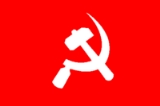
 as a 'National Party'. To date, CPI happens to be the only national political party from India to have contested all the general elections using the same electoral symbol.

On the national level they supported the Indian National Congress
Indian National Congress
The Indian National Congress is one of the two major political parties in India, the other being the Bharatiya Janata Party. It is the largest and one of the oldest democratic political parties in the world. The party's modern liberal platform is largely considered center-left in the Indian...

-led United Progressive Alliance
United Progressive Alliance
The United Progressive Alliance is a ruling coalition of center-left political parties heading the government of India. The coalition is led by the Indian National Congress , which is currently the single largest political party in the Lok Sabha...

 government, but without taking part in it. The party is part of a coalition of leftist and communist parties known in the national media as the Left Front
Left Front
The Left Front is an alliance of Indian leftist parties. After a 34-year reign in West Bengal, the Left Front was swept from power in the 2011 election...

. Upon attaining power in May 2004, the United Progressive Alliance formulated a programme of action known as the Common Minimum Programme
Common minimum programme
The Common Minimum Programme is a document outlining the minimum objectives of a coalition government in India. The document has acquired prominence since coalition governments have become the norm in India.-References:...

. The Left bases its support to the UPA on strict adherence to it. Provisions of the CMP mentions to discontinue disinvestment
Disinvestment
Disinvestment, sometimes referred to as divestment, refers to the use of a concerted economic boycott, with specific emphasis on liquidating stock, to pressure a government, industry, or company towards a change in policy, or in the case of governments, even regime change...

, massive social sector outlays and an independent foreign policy.

On July 8, 2008, Prakash Karat
Prakash Karat
Prakash Karat , born on February 7, 1948 in Letpadan, Burma is a communist politician in India and the current General Secretary of the Communist Party of India since 2005.-Education and early career:...

 announced that left front is withdrawing its support over the decision by the government to go ahead on the United States-India Peaceful Atomic Energy Cooperation Act. The left front had been a staunch advocate of not proceeding with this deal citing national interests. http://www.hindu.com/thehindu/holnus/000200807081550.htm

In West Bengal
West Bengal
West Bengal is a state in the eastern region of India and is the nation's fourth-most populous. It is also the seventh-most populous sub-national entity in the world, with over 91 million inhabitants. A major agricultural producer, West Bengal is the sixth-largest contributor to India's GDP...

 it participates in the Left Front
Left Front
The Left Front is an alliance of Indian leftist parties. After a 34-year reign in West Bengal, the Left Front was swept from power in the 2011 election...

. It also participates in the state government in Manipur
Manipur
Manipur is a state in northeastern India, with the city of Imphal as its capital. Manipur is bounded by the Indian states of Nagaland to the north, Mizoram to the south and Assam to the west; it also borders Burma to the east. It covers an area of...

. In Kerala the party is part of Left Democratic Front. In Tripura
Tripura
Tripura is a state in North-East India, with an area of . It is the third smallest state of India, according to area. Tripura is surrounded by Bangladesh on the north, south, and west. The Indian states of Assam and Mizoram lie to the east. The capital is Agartala and the main languages spoken are...

 the party is a partner of the governing Left Front, having a minister. In Tamil Nadu
Tamil Nadu
Tamil Nadu is one of the 28 states of India. Its capital and largest city is Chennai. Tamil Nadu lies in the southernmost part of the Indian Peninsula and is bordered by the union territory of Pondicherry, and the states of Kerala, Karnataka, and Andhra Pradesh...

 it is part of the Progressive Democratic Alliance
Progressive Democratic Alliance
The Progressive Democratic Alliance was a centrist political party in British Columbia, Canada founded by Gordon Wilson, Member of the Legislative Assembly for Powell River—Sunshine Coast....

. It is involved in the Left Democratic Front in Maharashtra

The current general secretary of CPI is Ardhendu Bhushan Bardhan
Ardhendu Bhushan Bardhan
Ardhendu Bhushan Bardhan or A. B. Bardhan is the general secretary of the Communist Party of India , one of the oldest political parties in India. He is from Nagpur and contested many elections from there winning only one - the 1957 for the Maharashtra State Assembly as an Independent candidate. He...

.

The principal mass organizations of the CPI are:
  • All India Trade Union Congress
    All India Trade Union Congress
    -External links:**...

  • All India Youth Federation
    All India Youth Federation
    All India Youth Federation is the youth wing of Communist Party of India. AIYF is a member of World Federation of Democratic Youth. AIYF was started by Balraj Sahni and P.K. Vasudevan Nair, among others, in 1959.The All India Youth Federation came into being in 1959...

  • All India Students Federation
    All India Students Federation
    The All India Students Federation was the first student union in India level.It was founded by students] on 12 August 1936 with the banner Freedom Peace Progress, with the guidance of Nehru. At that time, it worked for the independence of India. The organisation now works for the betterment of...

  • National Federation of Indian Women
    National Federation of Indian Women
    National Federation of Indian Women is the women's wing of Communist Party of India. It was established in 1954 by several leaders including Aruna Asaf Ali....

  • All India Kisan Sabha
    All India Kisan Sabha (Ajoy Bhavan)
    All India Kisan Sabha is the peasant or farmers' wing of the Communist Party of India. The Kisan Sabha movement started in Bihar under the leadership of Swami Sahajanand Saraswati, who had formed in 1929 the Bihar Provincial Kisan Sabha to mobilise peasant grievances against the zamindari attacks...

     (peasants organization)
  • Bharatiya Khet Mazdoor Union
    Bharatiya Khet Mazdoor Union
    Bharatiya Khet Mazdoor Union is a trade union of agricultural labourers in India. BKMU is politically tied to the Communist Party of India...

     (agricultural workers)
  • All India State Government Employees Federation (State government employees)

Lok Sabha election tally


State No. of candidates 2004 No. of elected 2004 No. of candidates 1999 No. of elected 1999 Total no. of seats in the state
Andhra Pradesh
Andhra Pradesh
Andhra Pradesh , is one of the 28 states of India, situated on the southeastern coast of India. It is India's fourth largest state by area and fifth largest by population. Its capital and largest city by population is Hyderabad.The total GDP of Andhra Pradesh is $100 billion and is ranked third...

 
1 1 6 0 42
Arunachal Pradesh
Arunachal Pradesh
Arunachal Pradesh is a state of India, located in the far northeast. It borders the states of Assam and Nagaland to the south, and shares international borders with Burma in the east, Bhutan in the west, and the People's Republic of China in the north. The majority of the territory is claimed by...

 
0 0 0 0 2
Assam
Assam
Assam , also, rarely, Assam Valley and formerly the Assam Province , is a northeastern state of India and is one of the most culturally and geographically distinct regions of the country...

 
1 0 1 0 14
Bihar  6 0 9 0 40 (2004)/54(1999)
Chhattisgarh
Chhattisgarh
Chhattisgarh is a state in Central India, formed when the 16 Chhattisgarhi-speaking South-Eastern districts of Madhya Pradesh gained separate statehood on 1 November 2000....

 
1 0 - - 11 (2004)
Goa
Goa
Goa , a former Portuguese colony, is India's smallest state by area and the fourth smallest by population. Located in South West India in the region known as the Konkan, it is bounded by the state of Maharashtra to the north, and by Karnataka to the east and south, while the Arabian Sea forms its...

 
2 0 2 0 2
Gujarat  0 0 1 0 26
Haryana
Haryana
Haryana is a state in India. Historically, it has been a part of the Kuru region in North India. The name Haryana is found mentioned in the 12th century AD by the apabhramsha writer Vibudh Shridhar . It is bordered by Punjab and Himachal Pradesh to the north, and by Rajasthan to the west and south...

 
0 0 0 0 10
Himachal Pradesh
Himachal Pradesh
Himachal Pradesh is a state in Northern India. It is spread over , and is bordered by the Indian states of Jammu and Kashmir on the north, Punjab on the west and south-west, Haryana and Uttar Pradesh on the south, Uttarakhand on the south-east and by the Tibet Autonomous Region on the east...

 
0 0 1 0 4
Jammu and Kashmir
Jammu and Kashmir
Jammu and Kashmir is the northernmost state of India. It is situated mostly in the Himalayan mountains. Jammu and Kashmir shares a border with the states of Himachal Pradesh and Punjab to the south and internationally with the People's Republic of China to the north and east and the...

 
0 0 0 0 6
Jharkhand
Jharkhand
Jharkhand is a state in eastern India. It was carved out of the southern part of Bihar on 15 November 2000. Jharkhand shares its border with the states of Bihar to the north, Uttar Pradesh and Chhattisgarh to the west, Orissa to the south, and West Bengal to the east...

 
1 1 - - 14 (2004)
Karnataka
Karnataka
Karnataka , the land of the Kannadigas, is a state in South West India. It was created on 1 November 1956, with the passing of the States Reorganisation Act and this day is annually celebrated as Karnataka Rajyotsava...

 
0 0 0 0 28
Kerala
Kerala
or Keralam is an Indian state located on the Malabar coast of south-west India. It was created on 1 November 1956 by the States Reorganisation Act by combining various Malayalam speaking regions....

 
4 3 4 0 20
Madhya Pradesh
Madhya Pradesh
Madhya Pradesh , often called the Heart of India, is a state in central India. Its capital is Bhopal and Indore is the largest city....

 
2 0 1 0 29 (2004)/40(1999)
Maharashtra
Maharashtra
Maharashtra is a state located in India. It is the second most populous after Uttar Pradesh and third largest state by area in India...

 
1 0 2 0 48
Manipur
Manipur
Manipur is a state in northeastern India, with the city of Imphal as its capital. Manipur is bounded by the Indian states of Nagaland to the north, Mizoram to the south and Assam to the west; it also borders Burma to the east. It covers an area of...

 
1 0 1 0 2
Meghalaya
Meghalaya
Meghalaya is a state in north-eastern India. The word "Meghalaya" literally means the Abode of Clouds in Sanskrit and other Indic languages. Meghalaya is a hilly strip in the eastern part of the country about 300 km long and 100 km wide, with a total area of about 8,700 sq mi . The...

 
0 0 2 0 2
Mizoram
Mizoram
Mizoram is one of the Seven Sister States in North Eastern India, sharing borders with the states of Tripura, Assam, Manipur and with the neighbouring countries of Bangladesh and Burma. Mizoram became the 23rd state of India on 20 February 1987. Its capital is Aizawl. Mizoram is located in the...

 
0 0 0 0 1
Nagaland
Nagaland
Nagaland is a state in the far north-eastern part of India. It borders the state of Assam to the west, Arunachal Pradesh and part of Assam to the north, Burma to the east and Manipur to the south. The state capital is Kohima, and the largest city is Dimapur...

 
0 0 0 0 1
Orissa
Orissa
Orissa , officially Odisha since Nov 2011, is a state of India, located on the east coast of India, by the Bay of Bengal. It is the modern name of the ancient nation of Kalinga, which was invaded by the Maurya Emperor Ashoka in 261 BC. The modern state of Orissa was established on 1 April...

 
0 0 3 0 21
Punjab  1 0 1 1 13
Rajasthan
Rajasthan
Rājasthān the land of Rajasthanis, , is the largest state of the Republic of India by area. It is located in the northwest of India. It encompasses most of the area of the large, inhospitable Great Indian Desert , which has an edge paralleling the Sutlej-Indus river valley along its border with...

 
2 0 4 0 25
Sikkim
Sikkim
Sikkim is a landlocked Indian state nestled in the Himalayan mountains...

 
0 0 0 0 1
Tamil Nadu
Tamil Nadu
Tamil Nadu is one of the 28 states of India. Its capital and largest city is Chennai. Tamil Nadu lies in the southernmost part of the Indian Peninsula and is bordered by the union territory of Pondicherry, and the states of Kerala, Karnataka, and Andhra Pradesh...

 
2 2 2 0 39
Tripura
Tripura
Tripura is a state in North-East India, with an area of . It is the third smallest state of India, according to area. Tripura is surrounded by Bangladesh on the north, south, and west. The Indian states of Assam and Mizoram lie to the east. The capital is Agartala and the main languages spoken are...

 
0 0 0 0 2
Uttar Pradesh
Uttar Pradesh
Uttar Pradesh abbreviation U.P. , is a state located in the northern part of India. With a population of over 200 million people, it is India's most populous state, as well as the world's most populous sub-national entity...

 
6 0 11 0 80 (2004)/85 (1999)
Uttaranchal  0 0 - - 5 (2004)
West Bengal
West Bengal
West Bengal is a state in the eastern region of India and is the nation's fourth-most populous. It is also the seventh-most populous sub-national entity in the world, with over 91 million inhabitants. A major agricultural producer, West Bengal is the sixth-largest contributor to India's GDP...

 
3 3 3 3 42
Union Territories
Andaman & Nicobar  0 0 0 0 1
Chandigarh
Chandigarh
Chandigarh is a union territory of India that serves as the capital of two states, Haryana and Punjab. The name Chandigarh translates as "The Fort of Chandi". The name is from an ancient temple called Chandi Mandir, devoted to the Hindu goddess Chandi, in the city...

 
0 0 0 0 1
Dadra and Nagar Haveli  0 0 0 0 1
Daman and Diu  0 0 0 0 1
Delhi
Delhi
Delhi , officially National Capital Territory of Delhi , is the largest metropolis by area and the second-largest by population in India, next to Mumbai. It is the eighth largest metropolis in the world by population with 16,753,265 inhabitants in the Territory at the 2011 Census...

 
0 0 0 0 7
Lakshadweep
Lakshadweep
Lakshadweep , formerly known as the Laccadive, Minicoy, and Amindivi Islands, is a group of islands in the Laccadive Sea, 200 to 440 km off the coast of the South West Indian state of Kerala...

 
0 0 0 0 1
Pondicherry  0 0 0 0 1
Total: 34 10 54 4 543

State election results


State No. of candidates No. of electedTotal no. of seats in AssemblyYear of Election
Andhra Pradesh
Andhra Pradesh
Andhra Pradesh , is one of the 28 states of India, situated on the southeastern coast of India. It is India's fourth largest state by area and fifth largest by population. Its capital and largest city by population is Hyderabad.The total GDP of Andhra Pradesh is $100 billion and is ranked third...

1262942004
Assam
Assam
Assam , also, rarely, Assam Valley and formerly the Assam Province , is a northeastern state of India and is one of the most culturally and geographically distinct regions of the country...

1911262001
Bihar15353242000
Chhattisgarh
Chhattisgarh
Chhattisgarh is a state in Central India, formed when the 16 Chhattisgarhi-speaking South-Eastern districts of Madhya Pradesh gained separate statehood on 1 November 2000....

180902003
Delhi
Delhi
Delhi , officially National Capital Territory of Delhi , is the largest metropolis by area and the second-largest by population in India, next to Mumbai. It is the eighth largest metropolis in the world by population with 16,753,265 inhabitants in the Territory at the 2011 Census...

20702003
Goa
Goa
Goa , a former Portuguese colony, is India's smallest state by area and the fourth smallest by population. Located in South West India in the region known as the Konkan, it is bounded by the state of Maharashtra to the north, and by Karnataka to the east and south, while the Arabian Sea forms its...

30402002
Gujarat101812002
Haryana
Haryana
Haryana is a state in India. Historically, it has been a part of the Kuru region in North India. The name Haryana is found mentioned in the 12th century AD by the apabhramsha writer Vibudh Shridhar . It is bordered by Punjab and Himachal Pradesh to the north, and by Rajasthan to the west and south...

100902000
Himachal Pradesh
Himachal Pradesh
Himachal Pradesh is a state in Northern India. It is spread over , and is bordered by the Indian states of Jammu and Kashmir on the north, Punjab on the west and south-west, Haryana and Uttar Pradesh on the south, Uttarakhand on the south-east and by the Tibet Autonomous Region on the east...

70682003
Jammu and Kashmir
Jammu and Kashmir
Jammu and Kashmir is the northernmost state of India. It is situated mostly in the Himalayan mountains. Jammu and Kashmir shares a border with the states of Himachal Pradesh and Punjab to the south and internationally with the People's Republic of China to the north and east and the...

50872002
Karnataka
Karnataka
Karnataka , the land of the Kannadigas, is a state in South West India. It was created on 1 November 1956, with the passing of the States Reorganisation Act and this day is annually celebrated as Karnataka Rajyotsava...

502242004
Kerala
Kerala
or Keralam is an Indian state located on the Malabar coast of south-west India. It was created on 1 November 1956 by the States Reorganisation Act by combining various Malayalam speaking regions....

22171402006
Madhya Pradesh
Madhya Pradesh
Madhya Pradesh , often called the Heart of India, is a state in central India. Its capital is Bhopal and Indore is the largest city....

1702302003
Maharashtra
Maharashtra
Maharashtra is a state located in India. It is the second most populous after Uttar Pradesh and third largest state by area in India...

1902881999
Manipur
Manipur
Manipur is a state in northeastern India, with the city of Imphal as its capital. Manipur is bounded by the Indian states of Nagaland to the north, Mizoram to the south and Assam to the west; it also borders Burma to the east. It covers an area of...

164602006
Meghalaya
Meghalaya
Meghalaya is a state in north-eastern India. The word "Meghalaya" literally means the Abode of Clouds in Sanskrit and other Indic languages. Meghalaya is a hilly strip in the eastern part of the country about 300 km long and 100 km wide, with a total area of about 8,700 sq mi . The...

30602003
Mizoram
Mizoram
Mizoram is one of the Seven Sister States in North Eastern India, sharing borders with the states of Tripura, Assam, Manipur and with the neighbouring countries of Bangladesh and Burma. Mizoram became the 23rd state of India on 20 February 1987. Its capital is Aizawl. Mizoram is located in the...

40402003
Orissa
Orissa
Orissa , officially Odisha since Nov 2011, is a state of India, located on the east coast of India, by the Bay of Bengal. It is the modern name of the ancient nation of Kalinga, which was invaded by the Maurya Emperor Ashoka in 261 BC. The modern state of Orissa was established on 1 April...

611472004
Pondicherry20302001
Punjab1101172006
Rajasthan
Rajasthan
Rājasthān the land of Rajasthanis, , is the largest state of the Republic of India by area. It is located in the northwest of India. It encompasses most of the area of the large, inhospitable Great Indian Desert , which has an edge paralleling the Sutlej-Indus river valley along its border with...

1502002003
Tamil Nadu
Tamil Nadu
Tamil Nadu is one of the 28 states of India. Its capital and largest city is Chennai. Tamil Nadu lies in the southernmost part of the Indian Peninsula and is bordered by the union territory of Pondicherry, and the states of Kerala, Karnataka, and Andhra Pradesh...

862342006
Tripura
Tripura
Tripura is a state in North-East India, with an area of . It is the third smallest state of India, according to area. Tripura is surrounded by Bangladesh on the north, south, and west. The Indian states of Assam and Mizoram lie to the east. The capital is Agartala and the main languages spoken are...

21602003
Uttar Pradesh
Uttar Pradesh
Uttar Pradesh abbreviation U.P. , is a state located in the northern part of India. With a population of over 200 million people, it is India's most populous state, as well as the world's most populous sub-national entity...

504022002
Uttaranchal140702002
West Bengal
West Bengal
West Bengal is a state in the eastern region of India and is the nation's fourth-most populous. It is also the seventh-most populous sub-national entity in the world, with over 91 million inhabitants. A major agricultural producer, West Bengal is the sixth-largest contributor to India's GDP...

1382942006


Results from the Election Commission of India website. Results do not deal with partitions of states (Bihar was bifurcated after the 2000 election, creating Jharkhand
Jharkhand
Jharkhand is a state in eastern India. It was carved out of the southern part of Bihar on 15 November 2000. Jharkhand shares its border with the states of Bihar to the north, Uttar Pradesh and Chhattisgarh to the west, Orissa to the south, and West Bengal to the east...

), defections and by-elections during the mandate period.

See also


See also: List of political parties in India, Politics of India
Politics of India
The politics of India takes place within the framework of a federal constitutional republic, in which the President of India is head of state and the Prime Minister of India is the head of government. Executive power is exercised by the President and is independent of the legislature...

, List of Communist Parties
  • Communist Ghadar Party of India
    Communist Ghadar Party of India
    The Communist Ghadar Party of India was founded on December 25, 1980, as a continuation of the Hindustani Ghadar Party - Organisation of Indian Marxist-Leninists Abroad founded in Canada in 1970. The group had established a presence in Punjab during the 1970s. Initially the group identified itself...

  • Communist Party of Bangladesh
    Communist Party of Bangladesh
    The Communist Party of Bangladesh is a Marxist-Leninist political party in Bangladesh, founded in 1968 as the Communist Party of East Pakistan.- History :...

  • Pandit Karyanand Sharma
    Pandit Karyanand Sharma
    Pandit Karyanand Sharma was an eminent nationalist and peasant leader who led movements against zamindars and British.-Biography:Pandit Karyanand Sharma was born in Sahoor village in Monghyr district into a poor tenant Bhumihar Brahmin family. Although he started studying in 1906, he had soon to...

  • Indradeep Sinha
    Indradeep Sinha
    Indradeep Sinha was a freedom fighter and veteran communist leader. He was born in a Bhumihar Brahmin family at Shakara village in Siwan District of Bihar, India, in July 1914. He had an academic career and secured a gold medal in post-graduation in Economics from Patna University in 1938. He...

  • Indrajit Gupta
    Indrajit Gupta
    Indrajit Gupta was a Communist leader who became Indias Union Minister for Home Affairs in the United Front government from 1996 to 1998...

  • Guru Radha Kishan
    Guru Radha Kishan
    Guru Radha Kishan was born in the year 1925 on Krishna Janmashtami in Bid village of district Harda of Madhya Pradesh in a Brahmin family of farmers. He has to experience the hardships of the life very early as his father was expired while he was a kid...

  • Azhikodan Raghavan
    Azhikodan Raghavan
    Azhikodan Raghavan was a leader of Communist Party of India /CPI.He was born on July 1, 1919 at South Bazar, Kannur. He had his primary education from the 'Model Primary School' attached to Kannur Govt. Training school.After passing Vth std he was forced to discontinue his formal education...

  • Darshan Singh Canadian
    Darshan Singh Canadian
    Darshan Singh Canadian was a Sikh trade union activist and Communist organizer in Canada and India.- Canada :...

  • Chandrashekhar Singh
    Chandrashekhar Singh
    Chandrashekhar Singh was a member of the Indian National Congress and served as the Chief Minister of Bihar from August 1983 to March 1985. He also held a number of Cabinet Minister positions in the Cabinet of Indira Gandhi and Rajiv Gandhi....

  • Singaravelu Chettiar
    Singaravelu Chettiar
    -Ma.Singaravelar :He was one of the early leftist thinkers of India in 20th century. He was an advocate by profession and spent his earlier days for the propagation of Buddhism. Being contemporary of freedom fighters, VOC and Balagangadhar Thilak. He was actively participated in railway workers...

  • S A Dange

External links