


Sogyal Rinpoche

Encyclopedia
Sogyal Rinpoche (born 1947) is a Tibet
an Dzogchen
Lama
of the Nyingma
tradition. He has been teaching for over 30 years and continues to travel widely in Europe
, America
, Australia
and Asia
. He is also the founder and spiritual director of Rigpa
—an international network of over 100 Buddhist centres and groups in 23 countries around the world—and the author of the best-selling book The Tibetan Book of Living and Dying
, which has been printed in 30 languages and 56 countries. In addition, Rinpoche is a frequent speaker at major conferences in all areas of society, including medicine and healing, universities and educational institutions, interfaith dialogue, movements for peace
and non-violence, the world of business and leadership, and the field of serving the dying and hospice
care.
by Mayum Tsering Wangmo, in Eastern Tibet, Sogyal Rinpoche was recognized as the incarnation of Lerab Lingpa Tertön Sogyal
, a teacher to the Thirteenth Dalai Lama, by Jamyang Khyentse Chökyi Lodrö of the Rime movement
. Jamyang Khyentse supervised his training and raised him as a son. When conditions deteriorated in Kham, Khyentse Rinpoche and his young disciple left for Central Tibet and Lhasa
, where in 1955, for the first time, they met Tenzin Gyatso, the 14th Dalai Lama. They then continued to India
on pilgrimage, and finally settled in Gangtok
at the invitation of the Chögyal
, the king of Sikkim
. Rinpoche attended Catholic School in Kalimpong, and then university in Delhi
before coming to the west.
at Trinity College, Cambridge
as a visiting scholar. He continued to study with many masters, of all schools of Tibetan Buddhism, especially Dudjom Rinpoche
, Dilgo Khyentse Rinpoche, and Nyoshul Khenpo Rinpoche
. Trulshik Rinpoche
is one of his teachers, too.
In 1973, he assisted in organizing the Dalai Lama’s first ever visit to the West, in Rome—including a visit with Pope John Paul II
, Switzerland
and the United Kingdom
. The following year he began to teach in London
, creating his first Dharma centre
, called Orgyen Chöling, in north-west London in 1974.
Rinpoche soon began teaching in Paris
and often translated for Dudjom Rinpoche, whom he also accompanied to the United States
in 1976. In the summer of 1977, Rinpoche's London centre, known as Dzogchen Orgyen Chöling, found a home at Princess Road in Kilburn. Many great masters taught there: Dudjom Rinpoche, when he taught for a whole month in London in 1979, Sakya Trizin
, Gyalwang Karmapa, Tulku Urgyen Rinpoche
and others.
In 1979, Sogyal Rinpoche chose the name Rigpa
—the innermost, essential nature of mind—for his work.
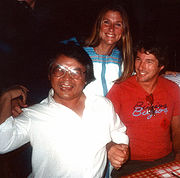 By 1980, Rinpoche was teaching in the United States, Holland and Ireland
, as well as in France
and the UK. Gradually, he opened centres in a number of major cities around the world. In many places, study and practice groups evolved and in each country Rigpa was established as a non-profit organization.
At Sogyal Rinpoche's and Rigpa’s request, the Dalai Lama granted the empowerment of Padmasambhava
and his Eight Manifestations from the pure visions of the ‘Great Fifth’ Dalai Lama at the Pagode de Vincennes in Paris in 1982.
In 1983, Rinpoche participated in the ‘New Dimensions in Death and Dying’ conference in California
. This brought Rinpoche in touch with the work of Dr. Elisabeth Kübler-Ross
and Professor Kenneth Ring
in the fields of hospice care and near-death research. This inspired Rinpoche to explore further the role that the Tibetan teachings on death and helping the dying could play in transforming modern attitudes towards to death.
In 1987, Rinpoche was invited to become spiritual director of the centre in Co. Cork in the west of Ireland that was to become Dzogchen Beara, Rigpa’s long-term retreat facility. The first closed one-year retreats, following a traditional Tibetan schedule of practice and study, began there in 1994.
In 1989, Sogyal Rinpoche was asked to help organize the Dalai Lama's visit to San Jose, California
. Five and a half thousand people, from all traditions and from all over the United States and other countries, attended in what at that time was the largest gathering of practitioners and masters of Buddhadharma in America, and possibly in the West. To mark this occasion, Rinpoche wrote Dzogchen and Padmasambhava.
and Nepal
in order to receive teachings from his masters and seek their advice and clarification. In time he began to teach the Tibetan community in exile in India and Sikkim
, especially the young people. Rigpa was established in Delhi in 1990 and Rigpa House opened in 1995.
In August 1990, Sogyal Rinpoche and Rigpa hosted Dilgo Khyentse Rinpoche on his final visit to the West, together with a large gathering of Tibetan Buddhist teachers at Prapoutel, a ski resort in the French Alps. The retreat was attended by 1500 people. Over ten days, he gave the most important empowerments and teachings for the complete practice of the Nyingma path and Dzogchen.
In 1991, Sogyal Rinpoche founded the retreat centre of Lerab Ling
near Montpellier
in southern France
. The first three-month retreat was held there in 1992.
In 1992,The Tibetan Book of Living and Dying
was published.
In 1993, Christine Longaker established the Spiritual Care Program which is based on the teachings of Sogyal Rinpoche and demonstrates practical ways in which the compassion and wisdom of the Buddhist teachings can be of benefit to those facing illness or death and also to their families and medical caregivers.
Sogyal Rinpoche appeared in the 1993 film Little Buddha
by Bernardo Bertolucci
in the role of Kenpo Tenzin.
In 1994, a $10 million civil lawsuit was filed against Sogyal Rinpoche. It was alleged that over a period of many years, Rinpoche had used his position as a spiritual leader to induce one of his female students to have sexual relations with him. The complaint included accusations of infliction of emotional distress, breach of fiduciary duty, as well as assault and battery. The lawsuit was settled privately, but related allegations flared up again later.
In 1999, at Sogyal Rinpoche's request, Kyabjé Trulshik Rinpoche
, the heart son of Dudjom Rinpoche and Dilgo Khyentse Rinpoche, gave a series of empowerments at Lerab Ling, and taught in San Francisco, New York
and London. He also founded the basis for a monastic sangha
within Rigpa by ordaining the first nuns. At the same time, Rigpa Australia acquired land for a new retreat centre at Blueys Beach, on the east coast near Sydney. With some three thousand people already following courses worldwide, 1999 also marked the beginning of a complete, long-term review of the programme for study and practice within Rigpa. Rinpoche has said that his vision is to set in place an authentic, accessible Buddhist study foundation for modern people, based on classical Buddhist teachings and the advice of teachers of all schools, both the senior masters as well as some of the brilliant younger teachers so attuned to modern times.
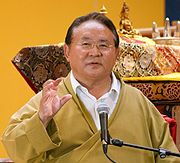 In 2000, Sogyal Rinpoche hosted the Dalai Lama at Lerab Ling, Rigpa's main retreat centre in France. taught on "The Path to Enlightenment" and the event was attended by up to 10,000 students of Tibetan Buddhism from around the world. The teachings given by the Dalai Lama have been published in a book entitled Mind in Comfort and Ease: The Vision of Enlightenment in the Great Perfection.
In 2001, Sogyal Rinpoche began the Rigpa Shedra, or study college. During October 2001, together with Father Laurence Freeman
OSB of the World Community for Christian Meditation
, Rinpoche also led an interfaith conference at Dublin Castle
in Ireland entitled "Finding Compassion in our Changing World". Three hundred people from Christian, Buddhist and other faiths attended the event.
In 2002, Rinpoche started the on-going Practical Wisdom leaders retreats and programme for top Australian CEO's and other leaders in the fields of the Arts and Education to enable them to explore the Buddhist teachings and integrate the principles of wisdom and compassion into their workplaces.
In 2003, 'The First Conference of Tibetan Buddhist Dharma Centers in the Americas' was held in upstate New York
. Rinpoche led the first plenary session on "The Experience and Challenge of Teaching and Studying Buddhism in the Americas".
In 2004, Rinpoche served as a keynote speaker at 'The Parliament of the World's Religions', where over 8,000 religious leaders and lay people gathered in Barcelona
in Spain
to discuss the issues of religious violence, access to safe water, the fate of refugee
s worldwide, and the elimination
of developing countries' debts.
In May 2005, Sogyal Rinpoche founded Rigpé Yeshé, at the first international family retreat and conference, 'Educating Children in the Dharma', to support families who wish to bring up their children in light of the teachings of the Buddha. "Rigpe Yeshe, sometimes mis-spelled Rigpa Yeshé, is an association of parents who are members of the Rigpa sangha, following the teachings of Buddha under the direction of Sogyal Rinpoche." One of the aims cited on the website reads like following: Bring the authentic and appropriate dharma to children, teenagers and families of the Rigpa Sangha, accomplishing Sogyal Rinpoche’s vision of bringing up children in the wisdom of rigpa;
In 2006, a traditional three-storey temple at Lerab Ling was completed, including a seven-metre high statue of Buddha Shakyamuni, and Rinpoche started Rigpa's first three-year retreat with over 400 hundred people taking part, and over 3000 students following a 'home retreat' programme in their own countries.
In 2007, ground was broken for the Spiritual Care Centre at Dzogchen Beara, designed as a place where people facing illness or death can come for periods of rest in a welcoming and healing atmosphere. Sogyal Rinpoche is the Spiritual Director. Dr. Balfour Mount
is a patron.
On 12 September 2007, the President of Ireland
, Mary McAleese
, visited Dzogchen Beara, along with Sogyal Rinpoche, to give an address in support of the Spiritual Care Centre that is in process there. Although by 2009, President McAleese was seen to distance herself from the Rigpa organisation, after learning of the 1994 $10 million civil lawsuit.
On 21 August 2008, the Dalai Lama visited Lerab Ling, Lodève for the temple consecration ceremony, together with many Tibetan spiritual masters and guests from other fields, including Carla Bruni, wife of French president N. Sarkozy.
On 23 May 2011, an episode of the documentary series, Sex Scandals In Religion aired on Canadian television VisionTV. It was an investigative look at a series of allegations and court cases involving women around the world who alleged that they had first hand experiences of sexual inappropriateness from Soygal Rinpoche. The Rigpa Organization flatly denied the accusations.
Tibet
Tibet is a plateau region in Asia, north-east of the Himalayas. It is the traditional homeland of the Tibetan people as well as some other ethnic groups such as Monpas, Qiang, and Lhobas, and is now also inhabited by considerable numbers of Han and Hui people...
an Dzogchen
Dzogchen
According to Tibetan Buddhism and Bön, Dzogchen is the natural, primordial state or natural condition of the mind, and a body of teachings and meditation practices aimed at realizing that condition. Dzogchen, or "Great Perfection", is a central teaching of the Nyingma school also practiced by...
Lama
Lama
Lama is a title for a Tibetan teacher of the Dharma. The name is similar to the Sanskrit term guru .Historically, the term was used for venerated spiritual masters or heads of monasteries...
of the Nyingma
Nyingma
The Nyingma tradition is the oldest of the four major schools of Tibetan Buddhism . "Nyingma" literally means "ancient," and is often referred to as Nga'gyur or the "old school" because it is founded on the first translations of Buddhist scriptures from Sanskrit into Tibetan, in the eighth century...
tradition. He has been teaching for over 30 years and continues to travel widely in Europe
Europe
Europe is, by convention, one of the world's seven continents. Comprising the westernmost peninsula of Eurasia, Europe is generally 'divided' from Asia to its east by the watershed divides of the Ural and Caucasus Mountains, the Ural River, the Caspian and Black Seas, and the waterways connecting...
, America
United States
The United States of America is a federal constitutional republic comprising fifty states and a federal district...
, Australia
Australia
Australia , officially the Commonwealth of Australia, is a country in the Southern Hemisphere comprising the mainland of the Australian continent, the island of Tasmania, and numerous smaller islands in the Indian and Pacific Oceans. It is the world's sixth-largest country by total area...
and Asia
Asia
Asia is the world's largest and most populous continent, located primarily in the eastern and northern hemispheres. It covers 8.7% of the Earth's total surface area and with approximately 3.879 billion people, it hosts 60% of the world's current human population...
. He is also the founder and spiritual director of Rigpa
Rigpa
Rigpa is the knowledge that ensues from recognizing one's nature i.e. one knows that there is a primordial freedom from grasping his or her mind . The opposite of rigpa is marigpa ....
—an international network of over 100 Buddhist centres and groups in 23 countries around the world—and the author of the best-selling book The Tibetan Book of Living and Dying
The Tibetan Book of Living and Dying
The Tibetan Book of Living and Dying, written by Sogyal Rinpoche, gives a comprehensive presentation of the teachings of Tibetan Buddhism, exploring: the message of impermanence; evolution, karma and rebirth; the nature of mind and how to train the mind through meditation; how to follow a spiritual...
, which has been printed in 30 languages and 56 countries. In addition, Rinpoche is a frequent speaker at major conferences in all areas of society, including medicine and healing, universities and educational institutions, interfaith dialogue, movements for peace
Peace
Peace is a state of harmony characterized by the lack of violent conflict. Commonly understood as the absence of hostility, peace also suggests the existence of healthy or newly healed interpersonal or international relationships, prosperity in matters of social or economic welfare, the...
and non-violence, the world of business and leadership, and the field of serving the dying and hospice
Hospice
Hospice is a type of care and a philosophy of care which focuses on the palliation of a terminally ill patient's symptoms.In the United States and Canada:*Gentiva Health Services, national provider of hospice and home health services...
care.
Early life
Born 1947 in the region of KhamKham
Kham , is a historical region covering a land area largely divided between present-day Tibetan Autonomous Region and Sichuan province, with smaller portions located within Qinghai, Gansu and Yunnan provinces of China. During the Republic of China's rule over mainland China , most of the region was...
by Mayum Tsering Wangmo, in Eastern Tibet, Sogyal Rinpoche was recognized as the incarnation of Lerab Lingpa Tertön Sogyal
Tertön Sogyal
Tertön Sogyal Lerab Lingpa was a Tibetan Buddhist tertön and a teacher of the Thirteenth Dalai Lama.-Biography:As a child, Tertön Sogyal was taught by Nyala Pema Duddul, Patrul Rinpoche, and Khenpo Pema Vajra at Dzogchen Monastery....
, a teacher to the Thirteenth Dalai Lama, by Jamyang Khyentse Chökyi Lodrö of the Rime movement
Rime movement
Rimé is a Tibetan word which means "no sides", "non-partisan" or "non-sectarian". In a religious context, the word ri-mé is usually used to refer to the "Eclectic Movement" between the Buddhist Nyingma, Sakya, and Kagyu traditions, along with the non-Buddhist Bön religion, wherein practitioners...
. Jamyang Khyentse supervised his training and raised him as a son. When conditions deteriorated in Kham, Khyentse Rinpoche and his young disciple left for Central Tibet and Lhasa
Lhasa
Lhasa is the administrative capital of the Tibet Autonomous Region in the People's Republic of China and the second most populous city on the Tibetan Plateau, after Xining. At an altitude of , Lhasa is one of the highest cities in the world...
, where in 1955, for the first time, they met Tenzin Gyatso, the 14th Dalai Lama. They then continued to India
India
India , officially the Republic of India , is a country in South Asia. It is the seventh-largest country by geographical area, the second-most populous country with over 1.2 billion people, and the most populous democracy in the world...
on pilgrimage, and finally settled in Gangtok
Gangtok
Gangtok is the capital and largest town of the Indian state of Sikkim. Gangtok is located in the Shivalik Hills of the eastern Himalayan range, at an altitude of . The town, with a population of thirty thousand belonging to different ethnicities such as Nepalis, Lepchas and Bhutia, is administered...
at the invitation of the Chögyal
Chogyal
The Chogyal were the monarchs of the former kingdoms of Sikkim and Ladakh, which were ruled by separate branches of the Namgyal family. The Chogyal, or divine ruler, was the absolute potentate of Sikkim from 1642 to 1975, when its monarchy was abrogated and its people voted to make Sikkim India's...
, the king of Sikkim
Sikkim
Sikkim is a landlocked Indian state nestled in the Himalayan mountains...
. Rinpoche attended Catholic School in Kalimpong, and then university in Delhi
Delhi
Delhi , officially National Capital Territory of Delhi , is the largest metropolis by area and the second-largest by population in India, next to Mumbai. It is the eighth largest metropolis in the world by population with 16,753,265 inhabitants in the Territory at the 2011 Census...
before coming to the west.
1970s
In 1971, he was granted a place to study comparative religionComparative religion
Comparative religion is a field of religious studies that analyzes the similarities and differences of themes, myths, rituals and concepts among the world's religions...
at Trinity College, Cambridge
Trinity College, Cambridge
Trinity College is a constituent college of the University of Cambridge. Trinity has more members than any other college in Cambridge or Oxford, with around 700 undergraduates, 430 graduates, and over 170 Fellows...
as a visiting scholar. He continued to study with many masters, of all schools of Tibetan Buddhism, especially Dudjom Rinpoche
Dudjom Rinpoche
Dudjom Rinpoche is the title of a prominent line of tulkus of the Nyingmapa order of Tibetan Buddhism. Dudjom Rinpoche was born in 1904 on the tenth day of the sixth month in the year of the wood dragon in Southern Tibet in a region called the "hidden land" of Pema Ko. He died on January 17, 1987...
, Dilgo Khyentse Rinpoche, and Nyoshul Khenpo Rinpoche
Nyoshul Khenpo Rinpoche
Nyoshul Khenpo Rinpoche was a Tibetan lama born in the Derge region of Kham.At age five, Rinpoche joined a Sakya monastery where he began his Buddhist studies. At age seventeen, he studied Longchen Nyingthig teachings and Dzogchen at the Nyoshul monastery...
. Trulshik Rinpoche
Trulshik Rinpoche
Trulshik Rinpoche Ngawang Chökyi Lodrö born in Yardrok Taklung, Central Tibet was one of the main teachers of HH the 14th Dalai Lama and of many of the younger generation of Nyingma lamas today including Sogyal Rinpoche...
is one of his teachers, too.
In 1973, he assisted in organizing the Dalai Lama’s first ever visit to the West, in Rome—including a visit with Pope John Paul II
Pope John Paul II
Blessed Pope John Paul II , born Karol Józef Wojtyła , reigned as Pope of the Catholic Church and Sovereign of Vatican City from 16 October 1978 until his death on 2 April 2005, at of age. His was the second-longest documented pontificate, which lasted ; only Pope Pius IX ...
, Switzerland
Switzerland
Switzerland name of one of the Swiss cantons. ; ; ; or ), in its full name the Swiss Confederation , is a federal republic consisting of 26 cantons, with Bern as the seat of the federal authorities. The country is situated in Western Europe,Or Central Europe depending on the definition....
and the United Kingdom
United Kingdom
The United Kingdom of Great Britain and Northern IrelandIn the United Kingdom and Dependencies, other languages have been officially recognised as legitimate autochthonous languages under the European Charter for Regional or Minority Languages...
. The following year he began to teach in London
London
London is the capital city of :England and the :United Kingdom, the largest metropolitan area in the United Kingdom, and the largest urban zone in the European Union by most measures. Located on the River Thames, London has been a major settlement for two millennia, its history going back to its...
, creating his first Dharma centre
Dharma centre
A Dharma centre is a non-monastic Buddhist centre in a community.According to the Foundation for the Preservation of the Mahayana Tradition, they preserve and spread the teachings of Buddhism and may have lay residents....
, called Orgyen Chöling, in north-west London in 1974.
Rinpoche soon began teaching in Paris
Paris
Paris is the capital and largest city in France, situated on the river Seine, in northern France, at the heart of the Île-de-France region...
and often translated for Dudjom Rinpoche, whom he also accompanied to the United States
United States
The United States of America is a federal constitutional republic comprising fifty states and a federal district...
in 1976. In the summer of 1977, Rinpoche's London centre, known as Dzogchen Orgyen Chöling, found a home at Princess Road in Kilburn. Many great masters taught there: Dudjom Rinpoche, when he taught for a whole month in London in 1979, Sakya Trizin
Sakya Trizin
Sakya Trizin or Sa'gya Gongma Rinboqê is the traditional title of the head of the Sakya Order of Tibetan Buddhism.The Sakya Order of Tibetan Buddhism was founded in 1073, when Khon Konchog Gyalpo , a member of Tibet’s noble Khön family, established a monastery in the region of Sakya, Tibet,...
, Gyalwang Karmapa, Tulku Urgyen Rinpoche
Tulku Urgyen Rinpoche
Tulku Urgyen Rinpoche . A contemporary Buddhist master of the Kagyü and Nyingma lineages, who lived at Nagi Gompa hermitage in Nepal, Urgyen Rinpoche was considered one of the greatest Dzogchen masters of our time.-Life:...
and others.
In 1979, Sogyal Rinpoche chose the name Rigpa
Rigpa
Rigpa is the knowledge that ensues from recognizing one's nature i.e. one knows that there is a primordial freedom from grasping his or her mind . The opposite of rigpa is marigpa ....
—the innermost, essential nature of mind—for his work.
1980s
Ireland
Ireland is an island to the northwest of continental Europe. It is the third-largest island in Europe and the twentieth-largest island on Earth...
, as well as in France
France
The French Republic , The French Republic , The French Republic , (commonly known as France , is a unitary semi-presidential republic in Western Europe with several overseas territories and islands located on other continents and in the Indian, Pacific, and Atlantic oceans. Metropolitan France...
and the UK. Gradually, he opened centres in a number of major cities around the world. In many places, study and practice groups evolved and in each country Rigpa was established as a non-profit organization.
At Sogyal Rinpoche's and Rigpa’s request, the Dalai Lama granted the empowerment of Padmasambhava
Padmasambhava
Padmasambhava ; Mongolian ловон Бадмажунай, lovon Badmajunai, , Means The Lotus-Born, was a sage guru from Oddiyāna who is said to have transmitted Vajrayana Buddhism to Bhutan and Tibet and neighbouring countries in the 8th century...
and his Eight Manifestations from the pure visions of the ‘Great Fifth’ Dalai Lama at the Pagode de Vincennes in Paris in 1982.
In 1983, Rinpoche participated in the ‘New Dimensions in Death and Dying’ conference in California
California
California is a state located on the West Coast of the United States. It is by far the most populous U.S. state, and the third-largest by land area...
. This brought Rinpoche in touch with the work of Dr. Elisabeth Kübler-Ross
Elisabeth Kübler-Ross
Elisabeth Kübler-Ross, M.D. was a Swiss American psychiatrist, a pioneer in Near-death studies and the author of the groundbreaking book On Death and Dying , where she first discussed what is now known as the Kübler-Ross model.She is a 2007 inductee into the American National Women's Hall of Fame...
and Professor Kenneth Ring
Kenneth Ring
Kenneth Ring is Professor Emeritus of psychology at the University of Connecticut, and a researcher within the field of near-death studies...
in the fields of hospice care and near-death research. This inspired Rinpoche to explore further the role that the Tibetan teachings on death and helping the dying could play in transforming modern attitudes towards to death.
In 1987, Rinpoche was invited to become spiritual director of the centre in Co. Cork in the west of Ireland that was to become Dzogchen Beara, Rigpa’s long-term retreat facility. The first closed one-year retreats, following a traditional Tibetan schedule of practice and study, began there in 1994.
In 1989, Sogyal Rinpoche was asked to help organize the Dalai Lama's visit to San Jose, California
San Jose, California
San Jose is the third-largest city in California, the tenth-largest in the U.S., and the county seat of Santa Clara County which is located at the southern end of San Francisco Bay...
. Five and a half thousand people, from all traditions and from all over the United States and other countries, attended in what at that time was the largest gathering of practitioners and masters of Buddhadharma in America, and possibly in the West. To mark this occasion, Rinpoche wrote Dzogchen and Padmasambhava.
1990s and controversies
Every year, Rinpoche would return to IndiaIndia
India , officially the Republic of India , is a country in South Asia. It is the seventh-largest country by geographical area, the second-most populous country with over 1.2 billion people, and the most populous democracy in the world...
and Nepal
Nepal
Nepal , officially the Federal Democratic Republic of Nepal, is a landlocked sovereign state located in South Asia. It is located in the Himalayas and bordered to the north by the People's Republic of China, and to the south, east, and west by the Republic of India...
in order to receive teachings from his masters and seek their advice and clarification. In time he began to teach the Tibetan community in exile in India and Sikkim
Sikkim
Sikkim is a landlocked Indian state nestled in the Himalayan mountains...
, especially the young people. Rigpa was established in Delhi in 1990 and Rigpa House opened in 1995.
In August 1990, Sogyal Rinpoche and Rigpa hosted Dilgo Khyentse Rinpoche on his final visit to the West, together with a large gathering of Tibetan Buddhist teachers at Prapoutel, a ski resort in the French Alps. The retreat was attended by 1500 people. Over ten days, he gave the most important empowerments and teachings for the complete practice of the Nyingma path and Dzogchen.
In 1991, Sogyal Rinpoche founded the retreat centre of Lerab Ling
Lerab Ling
Lerab Ling is a Tibetan Buddhist centre founded in 1992 by Sogyal Rinpoche in Roqueredonde, near Lodève in Languedoc-Roussillon, France. It contains perhaps the largest Tibetan Buddhist temple in Europe, which was officially inaugurated by the Dalai Lama in 2008 at a ceremony attended by Carla...
near Montpellier
Montpellier
-Neighbourhoods:Since 2001, Montpellier has been divided into seven official neighbourhoods, themselves divided into sub-neighbourhoods. Each of them possesses a neighbourhood council....
in southern France
France
The French Republic , The French Republic , The French Republic , (commonly known as France , is a unitary semi-presidential republic in Western Europe with several overseas territories and islands located on other continents and in the Indian, Pacific, and Atlantic oceans. Metropolitan France...
. The first three-month retreat was held there in 1992.
In 1992,The Tibetan Book of Living and Dying
The Tibetan Book of Living and Dying
The Tibetan Book of Living and Dying, written by Sogyal Rinpoche, gives a comprehensive presentation of the teachings of Tibetan Buddhism, exploring: the message of impermanence; evolution, karma and rebirth; the nature of mind and how to train the mind through meditation; how to follow a spiritual...
was published.
In 1993, Christine Longaker established the Spiritual Care Program which is based on the teachings of Sogyal Rinpoche and demonstrates practical ways in which the compassion and wisdom of the Buddhist teachings can be of benefit to those facing illness or death and also to their families and medical caregivers.
Sogyal Rinpoche appeared in the 1993 film Little Buddha
Little Buddha
Little Buddha is a 1994 feature film by Italian director Bernardo Bertolucci, starring Bridget Fonda and Keanu Reeves. Made by Bertolucci's regular partner, British producer Jeremy Thomas, it marked the team's return to the East after The Last Emperor....
by Bernardo Bertolucci
Bernardo Bertolucci
Bernardo Bertolucci is an Italian film director and screenwriter, whose films include The Conformist, Last Tango in Paris, 1900, The Last Emperor and The Dreamers...
in the role of Kenpo Tenzin.
In 1994, a $10 million civil lawsuit was filed against Sogyal Rinpoche. It was alleged that over a period of many years, Rinpoche had used his position as a spiritual leader to induce one of his female students to have sexual relations with him. The complaint included accusations of infliction of emotional distress, breach of fiduciary duty, as well as assault and battery. The lawsuit was settled privately, but related allegations flared up again later.
In 1999, at Sogyal Rinpoche's request, Kyabjé Trulshik Rinpoche
Trulshik Rinpoche
Trulshik Rinpoche Ngawang Chökyi Lodrö born in Yardrok Taklung, Central Tibet was one of the main teachers of HH the 14th Dalai Lama and of many of the younger generation of Nyingma lamas today including Sogyal Rinpoche...
, the heart son of Dudjom Rinpoche and Dilgo Khyentse Rinpoche, gave a series of empowerments at Lerab Ling, and taught in San Francisco, New York
New York
New York is a state in the Northeastern region of the United States. It is the nation's third most populous state. New York is bordered by New Jersey and Pennsylvania to the south, and by Connecticut, Massachusetts and Vermont to the east...
and London. He also founded the basis for a monastic sangha
Sangha
Sangha is a word in Pali or Sanskrit that can be translated roughly as "association" or "assembly," "company" or "community" with common goal, vision or purpose...
within Rigpa by ordaining the first nuns. At the same time, Rigpa Australia acquired land for a new retreat centre at Blueys Beach, on the east coast near Sydney. With some three thousand people already following courses worldwide, 1999 also marked the beginning of a complete, long-term review of the programme for study and practice within Rigpa. Rinpoche has said that his vision is to set in place an authentic, accessible Buddhist study foundation for modern people, based on classical Buddhist teachings and the advice of teachers of all schools, both the senior masters as well as some of the brilliant younger teachers so attuned to modern times.
After 2000
In 2001, Sogyal Rinpoche began the Rigpa Shedra, or study college. During October 2001, together with Father Laurence Freeman
Laurence Freeman
Laurence Freeman OSB is a Benedictine monk and Catholic priest of the Benedictine Congregation of Monte Oliveto. He is the Director of the World Community for Christian Meditation, a global network of Christian meditation groups that practice the way of Christian meditation, and of its Benedictine...
OSB of the World Community for Christian Meditation
World Community for Christian Meditation
The World Community for Christian Meditation was founded in 1991 to foster the teachings of Benedictine monk and priest, Fr. John Main, O.S.B. Fr. Main taught a way of Christian meditation which he based on parallels he saw between the spiritual practice taught by Desert Father John Cassian and...
, Rinpoche also led an interfaith conference at Dublin Castle
Dublin Castle
Dublin Castle off Dame Street, Dublin, Ireland, was until 1922 the fortified seat of British rule in Ireland, and is now a major Irish government complex. Most of it dates from the 18th century, though a castle has stood on the site since the days of King John, the first Lord of Ireland...
in Ireland entitled "Finding Compassion in our Changing World". Three hundred people from Christian, Buddhist and other faiths attended the event.
In 2002, Rinpoche started the on-going Practical Wisdom leaders retreats and programme for top Australian CEO's and other leaders in the fields of the Arts and Education to enable them to explore the Buddhist teachings and integrate the principles of wisdom and compassion into their workplaces.
In 2003, 'The First Conference of Tibetan Buddhist Dharma Centers in the Americas' was held in upstate New York
Upstate New York
Upstate New York is the region of the U.S. state of New York that is located north of the core of the New York metropolitan area.-Definition:There is no clear or official boundary between Upstate New York and Downstate New York...
. Rinpoche led the first plenary session on "The Experience and Challenge of Teaching and Studying Buddhism in the Americas".
In 2004, Rinpoche served as a keynote speaker at 'The Parliament of the World's Religions', where over 8,000 religious leaders and lay people gathered in Barcelona
Barcelona
Barcelona is the second largest city in Spain after Madrid, and the capital of Catalonia, with a population of 1,621,537 within its administrative limits on a land area of...
in Spain
Spain
Spain , officially the Kingdom of Spain languages]] under the European Charter for Regional or Minority Languages. In each of these, Spain's official name is as follows:;;;;;;), is a country and member state of the European Union located in southwestern Europe on the Iberian Peninsula...
to discuss the issues of religious violence, access to safe water, the fate of refugee
Refugee
A refugee is a person who outside her country of origin or habitual residence because she has suffered persecution on account of race, religion, nationality, political opinion, or because she is a member of a persecuted 'social group'. Such a person may be referred to as an 'asylum seeker' until...
s worldwide, and the elimination
Debt relief
Debt relief is the partial or total forgiveness of debt, or the slowing or stopping of debt growth, owed by individuals, corporations, or nations. From antiquity through the 19th century, it refers to domestic debts, in particular agricultural debts and freeing of debt slaves...
of developing countries' debts.
In May 2005, Sogyal Rinpoche founded Rigpé Yeshé, at the first international family retreat and conference, 'Educating Children in the Dharma', to support families who wish to bring up their children in light of the teachings of the Buddha. "Rigpe Yeshe, sometimes mis-spelled Rigpa Yeshé, is an association of parents who are members of the Rigpa sangha, following the teachings of Buddha under the direction of Sogyal Rinpoche." One of the aims cited on the website reads like following: Bring the authentic and appropriate dharma to children, teenagers and families of the Rigpa Sangha, accomplishing Sogyal Rinpoche’s vision of bringing up children in the wisdom of rigpa;
In 2006, a traditional three-storey temple at Lerab Ling was completed, including a seven-metre high statue of Buddha Shakyamuni, and Rinpoche started Rigpa's first three-year retreat with over 400 hundred people taking part, and over 3000 students following a 'home retreat' programme in their own countries.
In 2007, ground was broken for the Spiritual Care Centre at Dzogchen Beara, designed as a place where people facing illness or death can come for periods of rest in a welcoming and healing atmosphere. Sogyal Rinpoche is the Spiritual Director. Dr. Balfour Mount
Balfour Mount
Balfour M. Mount, is a Canadian physician, surgeon, and academic. He is considered the father of palliative care in North America....
is a patron.
On 12 September 2007, the President of Ireland
President of Ireland
The President of Ireland is the head of state of Ireland. The President is usually directly elected by the people for seven years, and can be elected for a maximum of two terms. The presidency is largely a ceremonial office, but the President does exercise certain limited powers with absolute...
, Mary McAleese
Mary McAleese
Mary Patricia McAleese served as the eighth President of Ireland from 1997 to 2011. She was the second female president and was first elected in 1997 succeeding Mary Robinson, making McAleese the world's first woman to succeed another as president. She was re-elected unopposed for a second term in...
, visited Dzogchen Beara, along with Sogyal Rinpoche, to give an address in support of the Spiritual Care Centre that is in process there. Although by 2009, President McAleese was seen to distance herself from the Rigpa organisation, after learning of the 1994 $10 million civil lawsuit.
On 21 August 2008, the Dalai Lama visited Lerab Ling, Lodève for the temple consecration ceremony, together with many Tibetan spiritual masters and guests from other fields, including Carla Bruni, wife of French president N. Sarkozy.
On 23 May 2011, an episode of the documentary series, Sex Scandals In Religion aired on Canadian television VisionTV. It was an investigative look at a series of allegations and court cases involving women around the world who alleged that they had first hand experiences of sexual inappropriateness from Soygal Rinpoche. The Rigpa Organization flatly denied the accusations.
Books
- Sogyal Rinpoche, The Tibetan Book of Living and Dying, ISBN 0-06-250834-2
- Sogyal Rinpoche, Dzogchen and Padmasambhava, Rigpa Publications, 1990, ISBN 0-96-248840-2
- Sogyal Rinpoche, Glimpse After Glimpse, ISBN 0712662375, ISBN 978-0712662376
- Sogyal Rinpoche, The Future of Buddhism, Rider & Co, 2002, ISBN 0-71-261564-4
Articles and contributions
- Himalaya: Personal Stories of Grandeur, Challenge and Hope, National Geographic Books, 2006
- Jonathon Cott, On the Sea of Memory: A Journey from Forgetting to Remembering, Random House, 2005, ISBN 1-40-006058-3
- Reginald A. Ray (ed.), The Pocket Tibetan Buddhist Reader, Shambhala Publications, Boston, Mass. 2004, ISBN 1-57-062851-3
- Kathryn Meeske (Author), Sandra Scales (Photographer), Sacred Voices of the Nyingma Masters, Padma Publishing, California, 2004, ISBN 1-88-184735-7
- Charles A. Tart, Living a Mindful Life, A Handbook for Living in the Present Moment, Shambhala Publications, Boston, Mass. 1994, ISBN 978-1570620034
Forewords and introductions
- Dilgo Khyentse; Ani Jinpa Palmo (trans), 2008. Brilliant Moon: The Autobiography of Dilgo Khyentse. Shambhala. ISBN 9781590302842.
- the Dalai Lama, Mind in Comfort and Ease, Wisdom Publications, 2007, ISBN 0-86-171493-8
- Tulku Urgyen Rinpoche, Blazing Splendor: The Memoirs of Tulku Urgyen Rinpoche, North Atlantic Books, 2005, ISBN 9-62-734156-8
- Don Farber, Portraits of Tibetan Buddhist Masters, University of California Press 2005, ISBN 0-52-023973-3
- Nyoshul Khenpo Jamyang Dorje (translated by Richard BarronRichard BarronRichard Barron is a Canadian-born translator who specializes in the writings of Longchenpa. He has served as an interpreter for many lamas from all from all four schools of Tibetan Buddhism, including his first teacher, Kalu Rinpoche...
), A Marvelous Garland of Rare Gems: Biographies of Masters of Awareness in the Dzogchen Lineage (A Spiritual History of the Teachings on Natural Great Perfection), Padma Publications, 2005, ISBN 1-88-184741-1 - Tsoknyi Rinpoche, Fearless Simplicity: The Dzogchen Way of Living Freely in a Complex World, Rangjung Yeshe Publications, Nepal, 2003, ISBN 9-62-734148-7
- the Dalai Lama, Dzogchen: The Heart Essence of the Great Perfection, Snow Lion Publications, 2000, ISBN 1-55-939219-3
- Khenpo Namdrol The Practice of Vajrakilaya, Snow Lion Publications, 1999, ISBN 1-55-939103-0
- Christine Longaker, Facing Death and Finding Hope: A Guide to the Emotional and Spiritual Care of the Dying, Arrow Books, 1998, ISBN 0-09-917692-0
- Mordicai Gerstein, The Mountains of Tibet, Harper Trophy, 1989, ISBN 0-06-443211-4