


Silvertip shark

Encyclopedia
The silvertip shark is a large species of requiem shark
, family
Carcharhinidae, with a fragmented distribution throughout the tropical
Indian
and Pacific Ocean
s. This species is often encountered around offshore islands and coral reef
s, and has been known to dive to a depth of 800 m (2,600 ft). The silvertip shark resembles a larger, bulkier grey reef shark (C. amblyrhynchos), and can be easily identified by the prominent white margins on its fins. It attains a maximum length of 3 m (10 ft).
An aggressive, powerful apex predator
, the silvertip shark feeds on a wide variety of bony fishes, as well as eagle ray
s, smaller sharks, and cephalopod
s. This species dominates other requiem sharks of equal size when competing for food, and larger individuals are often heavily scarred from conflicts with others of its species. As with other members of its family, the silvertip shark is viviparous, with females giving birth to 1–11 pups in the summer. Silvertip sharks are regarded as potentially dangerous to humans, as they often approach divers quite closely. This slow-reproducing species is taken by commercial fisheries
for its meat, fins, skin, cartilage
, and jaws and teeth, which has apparently led to local population declines or extirpation
s. As a result, the International Union for Conservation of Nature (IUCN) has assessed it as Near Threatened
.
, in the 1837 Fische des Rothen Meeres (Fishes of the Red Sea). The name was later changed to the currently valid Carcharhinus albimarginatus. The specific epithet is derived from the Latin
albi meaning "white", and marginatus meaning "to enclose with a border". In 1960, a 103 cm (3.4 ft) long immature male caught off Ras Muhammad
in the Red Sea
was designated as the type specimen. Based on similarities in morphology
, tooth shape, and vertebral characters, Garrick (1982) proposed the grey reef shark as the closest relative of the silvertip shark. This interpretation was corroborated by Lavery (1992), based on allozyme
data.
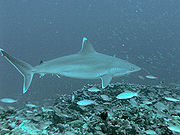 The silvertip shark is widely but non-continuously distributed in the tropical Indian and Pacific Oceans. In the western Indian Ocean, this species occurs from the Red Sea to South Africa
, including Madagascar
, the Seychelles
, the Aldabra Group
, Mauritius
, and the Chagos Archipelago
. In the western Pacific, it is known from off southern Japan
to northern Australia
, including Taiwan
, the Philippines
, Indonesia
, New Caledonia
, Guam
, Palau
, the Solomon Islands
, the Marshall Islands
, the Phoenix Islands
, and Tahiti
. In the eastern Pacific, it occurs from southern Baja California
to Colombia
, including the Cocos, Galapagos, and Revillagigedo Islands
. Its presence in the Gulf of Mexico
and the Caribbean Sea
is unconfirmed.
Silvertip sharks are found over continental and insular shelves at a depth of 30–800 m (100–2,600 ft), occupying all levels of the water column. They are most common around isolated islands, coral banks, and reef drop-offs. Juveniles frequent coastal shallows or lagoons while adults occur in deeper water, with little overlap between the two age groups.
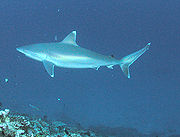 The silvertip shark is a robust and streamlined species with a moderately long, broad snout and large round eyes. The five pairs of gill slit
s are short. There are 12–14 tooth rows on each side of both jaws, with 1–2 small teeth at the symphysis (middle of the jaws). The upper teeth are broad with oblique triangular cusps and coarse serrations near the base; the lower teeth have erect cusps with fine serrations. The first dorsal fin
is large and triangular, originating above or slightly forward of the free pectoral fin tips. There is a ridge between the first and second dorsal fins. The pectoral fins are proportionately longer than in most requiem sharks and falcate (sickle-like) in shape, with pointed tips.
The coloration is blue-gray above with a bronze sheen, and white below. There is a subtle white band along the sides and distinctive white tips and borders on all fins. Silvertip sharks can grow up to 3 m (9.8 ft) long, but typically measure 2.0–2.5 m (6.6–8.2 ft) in length. The maximum reported weight is 162.2 kg (358 lbs). Females are larger than males.
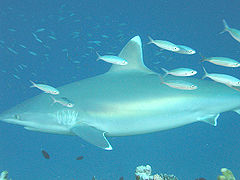 Though silvertip sharks are quite mobile, they exhibit fidelity to certain areas and there are reports of territorial behavior. They are usually encountered alone or in pairs. Small groups of adult females have been seen in deep water. Individual silvertip sharks behave very aggressively towards one another, and many are heavily scarred. They are also reported to dominate Galapagos shark
s (C. galapagensis) and blacktip shark
s (C. limbatus) of equal size when competing for food. This shark sometimes forms mixed-species aggregations with grey reef sharks. Rainbow runner
s (Elagatis bipinnulata) have been observed rubbing against silvertip sharks, using the sharks' rough skin to scrape off parasites. They sometimes follow marine mammal
s such as bottlenose dolphin
s (Tursiops sp.) in open water, and are themselves followed by pilot fish
(Naucrates ductor).
Like the grey reef shark, silvertip sharks sometimes perform a stereotyped threat display
if pursued by divers, warning that it is prepared to attack. The display begins with the shark accelerating away to a distance of 15 m (50 ft), before turning and charging towards the perceived threat. At a distance of two body lengths, the shark brakes, turns broadside, drops its pectoral fins, gapes its jaws, lowers the posterior two-thirds of its body, and "shivers". The last two elements of this display are unique to this species; the "shivering" may serve to emphasize its white fin markings. If the diver persists, the shark may rapidly close in and slash with its upper teeth.
, mackerel
, tuna
, escolars, lanternfish
, flyingfish
, wrasse
s, and soles
. Eagle rays, smaller sharks, and octopus
are occasionally taken. Larger sharks tend to be more sluggish and take more benthic prey. The differently shaped dentition in their upper and lower jaws allows them to tackle large prey, gripping and sawing off chunks of flesh with violent twists and turns. Silvertip sharks have been observed swimming around the periphery of groups of feeding sharks of other species, occasionally dashing in to steal food. This species often approaches ships, as they are attracted to certain artificial, low-frequency sounds.
s exhaust their supply of yolk, the depleted yolk sac
develops into a placenta
l connection through which the mother delivers nourishment. In the southern hemisphere, mating and parturition both occur in summer. Courtship involves the male biting the female to hold her for copulation; one female observed had the tip of her first dorsal fin bitten off from such activity. Females bear litters of 1–11 (usually 5–6) young after a gestation period
of about one year, on a biennial cycle. The newborns have been reported to measure 63–68 cm (24.8–26.8 in) and 73–81 cm (28.7–31.9 in) long by different authors, and are found in shallower water than adults. The growth rate is highly variable in the wild: Kato and Hernandez (1967) reported that juvenile silvertip sharks grow an average of 3.8 cm (1.5 in), or 5.3% of their body length, per year, with some individuals growing as much as 20.8 cm (8.2 in, 30.1% of their body length) per year and others showing negative "growth". Males have been reported to be sexually mature at 1.6–1.8 m (5.2–5.9 ft) or 1.9–2 m (6.2–6.6 ft) long, and females at 1.6–2 m (5.2–6.6 ft) long.
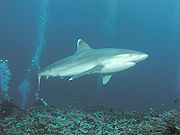 Inquisitive and bold, especially in the presence of food, the silvertip shark is regarded as potentially dangerous to humans. Often several silvertip sharks will rush up from deep water to inspect divers when they first enter the water, which can be an intimidating experience as the sharks may approach quite close. This species has also been known to circle or pursue divers. In one experiment involving bait, a large silvertip shark tore the leg off of a dummy dressed in SCUBA
gear, demonstrating that this species is capable of inflicting lethal injuries. As of 2008, the International Shark Attack File
lists four provoked attacks attributable to this species, none of them fatal.
The silvertip shark is caught by commercial and artisan fisheries
across its range using longlines, gillnet
s, and trawls, both intentionally and as bycatch
. The fins are highly valued for shark fin soup
and are sold on the export market, along with the skin and cartilage. The meat is marketed locally, fresh or dried and salted, as are the jaws and teeth. Silvertip sharks are known to be taken by fisheries in Indonesia
, Myanmar
, and the Philippines
, as well as by various Indian Ocean
nations with coral reef fisheries; it is also an increasingly important catch of pelagic fisheries, where it is often finned
at sea. This species is susceptible to overfishing
, due to its slow reproductive rate and tendency to stay in a certain area. It is believed to have been extirpated by Indonesian artisan fishers at Scott Reef off northern Australia
, and is likely becoming rare in many other parts of its range. As a result, the International Union for Conservation of Nature (IUCN) has assessed the silvertip shark as Near Threatened
, and noted that it may be approaching the criteria for Vulnerable
.
Requiem shark
Requiem sharks are a family, Carcharhinidae, of sharks in the order Carcharhiniformes, containing migratory, live-bearing sharks of warm seas such as the tiger shark, the blue shark, the bull shark, and the milk shark.The name may be related to the French word for shark, "requin", itself of...
, family
Family (biology)
In biological classification, family is* a taxonomic rank. Other well-known ranks are life, domain, kingdom, phylum, class, order, genus, and species, with family fitting between order and genus. As for the other well-known ranks, there is the option of an immediately lower rank, indicated by the...
Carcharhinidae, with a fragmented distribution throughout the tropical
Tropics
The tropics is a region of the Earth surrounding the Equator. It is limited in latitude by the Tropic of Cancer in the northern hemisphere at approximately N and the Tropic of Capricorn in the southern hemisphere at S; these latitudes correspond to the axial tilt of the Earth...
Indian
Indian Ocean
The Indian Ocean is the third largest of the world's oceanic divisions, covering approximately 20% of the water on the Earth's surface. It is bounded on the north by the Indian Subcontinent and Arabian Peninsula ; on the west by eastern Africa; on the east by Indochina, the Sunda Islands, and...
and Pacific Ocean
Pacific Ocean
The Pacific Ocean is the largest of the Earth's oceanic divisions. It extends from the Arctic in the north to the Southern Ocean in the south, bounded by Asia and Australia in the west, and the Americas in the east.At 165.2 million square kilometres in area, this largest division of the World...
s. This species is often encountered around offshore islands and coral reef
Coral reef
Coral reefs are underwater structures made from calcium carbonate secreted by corals. Coral reefs are colonies of tiny living animals found in marine waters that contain few nutrients. Most coral reefs are built from stony corals, which in turn consist of polyps that cluster in groups. The polyps...
s, and has been known to dive to a depth of 800 m (2,600 ft). The silvertip shark resembles a larger, bulkier grey reef shark (C. amblyrhynchos), and can be easily identified by the prominent white margins on its fins. It attains a maximum length of 3 m (10 ft).
An aggressive, powerful apex predator
Apex predator
Apex predators are predators that have no predators of their own, residing at the top of their food chain. Zoologists define predation as the killing and consumption of another organism...
, the silvertip shark feeds on a wide variety of bony fishes, as well as eagle ray
Eagle ray
The eagle rays are a group of cartilaginous fishes in the family Myliobatidae, consisting mostly of large species living in the open ocean rather than on the sea bottom....
s, smaller sharks, and cephalopod
Cephalopod
A cephalopod is any member of the molluscan class Cephalopoda . These exclusively marine animals are characterized by bilateral body symmetry, a prominent head, and a set of arms or tentacles modified from the primitive molluscan foot...
s. This species dominates other requiem sharks of equal size when competing for food, and larger individuals are often heavily scarred from conflicts with others of its species. As with other members of its family, the silvertip shark is viviparous, with females giving birth to 1–11 pups in the summer. Silvertip sharks are regarded as potentially dangerous to humans, as they often approach divers quite closely. This slow-reproducing species is taken by commercial fisheries
Commercial fishing
Commercial fishing is the activity of catching fish and other seafood for commercial profit, mostly from wild fisheries. It provides a large quantity of food to many countries around the world, but those who practice it as an industry must often pursue fish far into the ocean under adverse conditions...
for its meat, fins, skin, cartilage
Cartilage
Cartilage is a flexible connective tissue found in many areas in the bodies of humans and other animals, including the joints between bones, the rib cage, the ear, the nose, the elbow, the knee, the ankle, the bronchial tubes and the intervertebral discs...
, and jaws and teeth, which has apparently led to local population declines or extirpation
Local extinction
Local extinction, also known as extirpation, is the condition of a species which ceases to exist in the chosen geographic area of study, though it still exists elsewhere...
s. As a result, the International Union for Conservation of Nature (IUCN) has assessed it as Near Threatened
Near Threatened
Near Threatened is a conservation status assigned to species or lower taxa that may be considered threatened with extinction in the near future, although it does not currently qualify for the threatened status...
.
Taxonomy and phylogeny
The silvertip shark was originally described as Carcharias albimarginatus by German naturalist Eduard RüppellEduard Rüppell
Wilhelm Peter Eduard Simon Rüppell was a German naturalist and explorer. Rüppell is occasionally transliterated to "Rueppell" for the English alphabet....
, in the 1837 Fische des Rothen Meeres (Fishes of the Red Sea). The name was later changed to the currently valid Carcharhinus albimarginatus. The specific epithet is derived from the Latin
Latin
Latin is an Italic language originally spoken in Latium and Ancient Rome. It, along with most European languages, is a descendant of the ancient Proto-Indo-European language. Although it is considered a dead language, a number of scholars and members of the Christian clergy speak it fluently, and...
albi meaning "white", and marginatus meaning "to enclose with a border". In 1960, a 103 cm (3.4 ft) long immature male caught off Ras Muhammad
Ras Muhammad
Ras Mohammad is a national park in Egypt at the southern extreme of the Sinai Peninsula, overlooking the Gulf of Suez on the west and the Gulf of Aqaba to the east.-History:...
in the Red Sea
Red Sea
The Red Sea is a seawater inlet of the Indian Ocean, lying between Africa and Asia. The connection to the ocean is in the south through the Bab el Mandeb strait and the Gulf of Aden. In the north, there is the Sinai Peninsula, the Gulf of Aqaba, and the Gulf of Suez...
was designated as the type specimen. Based on similarities in morphology
Morphology (biology)
In biology, morphology is a branch of bioscience dealing with the study of the form and structure of organisms and their specific structural features....
, tooth shape, and vertebral characters, Garrick (1982) proposed the grey reef shark as the closest relative of the silvertip shark. This interpretation was corroborated by Lavery (1992), based on allozyme
Allozyme
Variant forms of an enzyme that are coded by different alleles at the same locus are called allozymes. These are opposed to isozymes, which are enzymes that perform the same function, but which are coded by genes located at different loci....
data.
Distribution and habitat
South Africa
The Republic of South Africa is a country in southern Africa. Located at the southern tip of Africa, it is divided into nine provinces, with of coastline on the Atlantic and Indian oceans...
, including Madagascar
Madagascar
The Republic of Madagascar is an island country located in the Indian Ocean off the southeastern coast of Africa...
, the Seychelles
Seychelles
Seychelles , officially the Republic of Seychelles , is an island country spanning an archipelago of 115 islands in the Indian Ocean, some east of mainland Africa, northeast of the island of Madagascar....
, the Aldabra Group
Aldabra Group
The Aldabra Group are part of the Outer Islands of the Seychelles, lying in the southwest of the island nation, 1000 kilometres from the capital, Victoria, on Mahé Island.The total land area of the Aldabra Group is 175.91 km²....
, Mauritius
Mauritius
Mauritius , officially the Republic of Mauritius is an island nation off the southeast coast of the African continent in the southwest Indian Ocean, about east of Madagascar...
, and the Chagos Archipelago
Chagos Archipelago
The Chagos Archipelago , is a group of seven atolls comprising more than 60 individual tropical islands in the Indian Ocean; situated some due south of the Maldives archipelago. This chain of islands are the southernmost archipelago of the Chagos-Laccadive Ridge a long submarine mountain range...
. In the western Pacific, it is known from off southern Japan
Japan
Japan is an island nation in East Asia. Located in the Pacific Ocean, it lies to the east of the Sea of Japan, China, North Korea, South Korea and Russia, stretching from the Sea of Okhotsk in the north to the East China Sea and Taiwan in the south...
to northern Australia
Australia
Australia , officially the Commonwealth of Australia, is a country in the Southern Hemisphere comprising the mainland of the Australian continent, the island of Tasmania, and numerous smaller islands in the Indian and Pacific Oceans. It is the world's sixth-largest country by total area...
, including Taiwan
Taiwan
Taiwan , also known, especially in the past, as Formosa , is the largest island of the same-named island group of East Asia in the western Pacific Ocean and located off the southeastern coast of mainland China. The island forms over 99% of the current territory of the Republic of China following...
, the Philippines
Philippines
The Philippines , officially known as the Republic of the Philippines , is a country in Southeast Asia in the western Pacific Ocean. To its north across the Luzon Strait lies Taiwan. West across the South China Sea sits Vietnam...
, Indonesia
Indonesia
Indonesia , officially the Republic of Indonesia , is a country in Southeast Asia and Oceania. Indonesia is an archipelago comprising approximately 13,000 islands. It has 33 provinces with over 238 million people, and is the world's fourth most populous country. Indonesia is a republic, with an...
, New Caledonia
New Caledonia
New Caledonia is a special collectivity of France located in the southwest Pacific Ocean, east of Australia and about from Metropolitan France. The archipelago, part of the Melanesia subregion, includes the main island of Grande Terre, the Loyalty Islands, the Belep archipelago, the Isle of...
, Guam
Guam
Guam is an organized, unincorporated territory of the United States located in the western Pacific Ocean. It is one of five U.S. territories with an established civilian government. Guam is listed as one of 16 Non-Self-Governing Territories by the Special Committee on Decolonization of the United...
, Palau
Palau
Palau , officially the Republic of Palau , is an island nation in the Pacific Ocean, east of the Philippines and south of Tokyo. In 1978, after three decades as being part of the United Nations trusteeship, Palau chose independence instead of becoming part of the Federated States of Micronesia, a...
, the Solomon Islands
Solomon Islands
Solomon Islands is a sovereign state in Oceania, east of Papua New Guinea, consisting of nearly one thousand islands. It covers a land mass of . The capital, Honiara, is located on the island of Guadalcanal...
, the Marshall Islands
Marshall Islands
The Republic of the Marshall Islands , , is a Micronesian nation of atolls and islands in the middle of the Pacific Ocean, just west of the International Date Line and just north of the Equator. As of July 2011 the population was 67,182...
, the Phoenix Islands
Phoenix Islands
The Phoenix Islands are a group of eight atolls and two submerged coral reefs, lying in the central Pacific Ocean east of the Gilbert Islands and west of the Line Islands. They are a part of the Republic of Kiribati. During the late 1930s they became the site of the last attempted colonial...
, and Tahiti
Tahiti
Tahiti is the largest island in the Windward group of French Polynesia, located in the archipelago of the Society Islands in the southern Pacific Ocean. It is the economic, cultural and political centre of French Polynesia. The island was formed from volcanic activity and is high and mountainous...
. In the eastern Pacific, it occurs from southern Baja California
Baja California
Baja California officially Estado Libre y Soberano de Baja California is one of the 31 states which, with the Federal District, comprise the 32 Federal Entities of Mexico. It is both the northernmost and westernmost state of Mexico. Before becoming a state in 1953, the area was known as the North...
to Colombia
Colombia
Colombia, officially the Republic of Colombia , is a unitary constitutional republic comprising thirty-two departments. The country is located in northwestern South America, bordered to the east by Venezuela and Brazil; to the south by Ecuador and Peru; to the north by the Caribbean Sea; to the...
, including the Cocos, Galapagos, and Revillagigedo Islands
Revillagigedo Islands
The Revillagigedo Islands or Revillagigedo Archipelago are a group of four volcanic islands in the Pacific Ocean, known for their unique ecosystem...
. Its presence in the Gulf of Mexico
Gulf of Mexico
The Gulf of Mexico is a partially landlocked ocean basin largely surrounded by the North American continent and the island of Cuba. It is bounded on the northeast, north and northwest by the Gulf Coast of the United States, on the southwest and south by Mexico, and on the southeast by Cuba. In...
and the Caribbean Sea
Caribbean Sea
The Caribbean Sea is a sea of the Atlantic Ocean located in the tropics of the Western hemisphere. It is bounded by Mexico and Central America to the west and southwest, to the north by the Greater Antilles, and to the east by the Lesser Antilles....
is unconfirmed.
Silvertip sharks are found over continental and insular shelves at a depth of 30–800 m (100–2,600 ft), occupying all levels of the water column. They are most common around isolated islands, coral banks, and reef drop-offs. Juveniles frequent coastal shallows or lagoons while adults occur in deeper water, with little overlap between the two age groups.
Description
Gill slit
Gill slits are individual openings to gills, i.e., multiple gill arches, which lack a single outer cover. Such gills are characteristic of Cartilaginous fish such as sharks, rays, sawfish, and guitarfish. Most of these have five pairs, but a few species have 6 or 7 pairs...
s are short. There are 12–14 tooth rows on each side of both jaws, with 1–2 small teeth at the symphysis (middle of the jaws). The upper teeth are broad with oblique triangular cusps and coarse serrations near the base; the lower teeth have erect cusps with fine serrations. The first dorsal fin
Dorsal fin
A dorsal fin is a fin located on the backs of various unrelated marine and freshwater vertebrates, including most fishes, marine mammals , and the ichthyosaurs...
is large and triangular, originating above or slightly forward of the free pectoral fin tips. There is a ridge between the first and second dorsal fins. The pectoral fins are proportionately longer than in most requiem sharks and falcate (sickle-like) in shape, with pointed tips.
The coloration is blue-gray above with a bronze sheen, and white below. There is a subtle white band along the sides and distinctive white tips and borders on all fins. Silvertip sharks can grow up to 3 m (9.8 ft) long, but typically measure 2.0–2.5 m (6.6–8.2 ft) in length. The maximum reported weight is 162.2 kg (358 lbs). Females are larger than males.
Biology and ecology
Galapagos shark
The Galapagos shark is a species of requiem shark, family Carcharhinidae, found worldwide. This species favors clear reef environments around oceanic islands, where it is often the most abundant shark species...
s (C. galapagensis) and blacktip shark
Blacktip shark
The blacktip shark is a species of requiem shark, family Carcharhinidae. It is common to coastal tropical and subtropical waters around the world, including brackish habitats. Genetic analyses have revealed substantial variation within this species, with populations from the western Atlantic Ocean...
s (C. limbatus) of equal size when competing for food. This shark sometimes forms mixed-species aggregations with grey reef sharks. Rainbow runner
Rainbow runner
The rainbow runner , also known as the rainbow yellowtail, Spanish jack and Hawaiian salmon, is a common species of pelagic marine fish of the jack family, Carangidae. The species is widespread throughout the tropical and subtropical waters of the world, inhabiting both coastal as well as far...
s (Elagatis bipinnulata) have been observed rubbing against silvertip sharks, using the sharks' rough skin to scrape off parasites. They sometimes follow marine mammal
Marine mammal
Marine mammals, which include seals, whales, dolphins, and walruses, form a diverse group of 128 species that rely on the ocean for their existence. They do not represent a distinct biological grouping, but rather are unified by their reliance on the marine environment for feeding. The level of...
s such as bottlenose dolphin
Bottlenose Dolphin
Bottlenose dolphins, the genus Tursiops, are the most common and well-known members of the family Delphinidae, the family of oceanic dolphins. Recent molecular studies show the genus contains two species, the common bottlenose dolphin and the Indo-Pacific bottlenose dolphin , instead of one...
s (Tursiops sp.) in open water, and are themselves followed by pilot fish
Pilot fish
The pilot fish is a carnivorous commensal fish in the family Carangidae. It is widely distributed and lives in warm or tropical open seas.- Description :...
(Naucrates ductor).
Like the grey reef shark, silvertip sharks sometimes perform a stereotyped threat display
Shark threat display
Shark threat display, a type of agonistic display, is a behaviour observed in some sharks when they feel threatened or protective. It consists of a contorting of the body into a series of "ritualized" postures coupled with an exaggerated swimming style...
if pursued by divers, warning that it is prepared to attack. The display begins with the shark accelerating away to a distance of 15 m (50 ft), before turning and charging towards the perceived threat. At a distance of two body lengths, the shark brakes, turns broadside, drops its pectoral fins, gapes its jaws, lowers the posterior two-thirds of its body, and "shivers". The last two elements of this display are unique to this species; the "shivering" may serve to emphasize its white fin markings. If the diver persists, the shark may rapidly close in and slash with its upper teeth.
Feeding
The diet of the silvertip shark consists primarily of bony fishes such as grouperGrouper
Groupers are fish of any of a number of genera in the subfamily Epinephelinae of the family Serranidae, in the order Perciformes.Not all serranids are called groupers; the family also includes the sea basses. The common name grouper is usually given to fish in one of two large genera: Epinephelus...
, mackerel
Mackerel
Mackerel is a common name applied to a number of different species of fish, mostly, but not exclusively, from the family Scombridae. They may be found in all tropical and temperate seas. Most live offshore in the oceanic environment but a few, like the Spanish mackerel , enter bays and can be...
, tuna
Tuna
Tuna is a salt water fish from the family Scombridae, mostly in the genus Thunnus. Tuna are fast swimmers, and some species are capable of speeds of . Unlike most fish, which have white flesh, the muscle tissue of tuna ranges from pink to dark red. The red coloration derives from myoglobin, an...
, escolars, lanternfish
Lanternfish
Cooper Lanternfishes are small mesopelagic fish of the large family Myctophidae. One of two families in the order Myctophiformes, the Myctophidae are represented by 246 species in 33 genera, and are found in oceans worldwide. They are aptly named after their conspicuous use of bioluminescence...
, flyingfish
Flyingfish
Exocoetidae, is a family of marine fish in the order Beloniformes of class Actinopterygii. Fish of this family are known as flying fish. There are about 64 species grouped in seven to nine genera.- Etymology :...
, wrasse
Wrasse
The wrasses are a family, Labridae, of marine fish, many of which are brightly colored. The family is large and diverse, with over 600 species in 82 genera, which are divided into nine subgroups or tribes....
s, and soles
Soleidae
The true soles are a family, Soleidae, of flatfishes, and include species that live in salt water and fresh water. They are bottom-dwelling fishes feeding on small crustaceans and other invertebrates. Other flatfishes are also known as soles....
. Eagle rays, smaller sharks, and octopus
Octopus
The octopus is a cephalopod mollusc of the order Octopoda. Octopuses have two eyes and four pairs of arms, and like other cephalopods they are bilaterally symmetric. An octopus has a hard beak, with its mouth at the center point of the arms...
are occasionally taken. Larger sharks tend to be more sluggish and take more benthic prey. The differently shaped dentition in their upper and lower jaws allows them to tackle large prey, gripping and sawing off chunks of flesh with violent twists and turns. Silvertip sharks have been observed swimming around the periphery of groups of feeding sharks of other species, occasionally dashing in to steal food. This species often approaches ships, as they are attracted to certain artificial, low-frequency sounds.
Life history
Like other requiem sharks, the silvertip shark is viviparous; once the embryoEmbryo
An embryo is a multicellular diploid eukaryote in its earliest stage of development, from the time of first cell division until birth, hatching, or germination...
s exhaust their supply of yolk, the depleted yolk sac
Yolk sac
The yolk sac is a membranous sac attached to an embryo, providing early nourishment in the form of yolk in bony fishes, sharks, reptiles, birds, and primitive mammals...
develops into a placenta
Placenta
The placenta is an organ that connects the developing fetus to the uterine wall to allow nutrient uptake, waste elimination, and gas exchange via the mother's blood supply. "True" placentas are a defining characteristic of eutherian or "placental" mammals, but are also found in some snakes and...
l connection through which the mother delivers nourishment. In the southern hemisphere, mating and parturition both occur in summer. Courtship involves the male biting the female to hold her for copulation; one female observed had the tip of her first dorsal fin bitten off from such activity. Females bear litters of 1–11 (usually 5–6) young after a gestation period
Gestation period
For mammals the gestation period is the time in which a fetus develops, beginning with fertilization and ending at birth. The duration of this period varies between species.-Duration:...
of about one year, on a biennial cycle. The newborns have been reported to measure 63–68 cm (24.8–26.8 in) and 73–81 cm (28.7–31.9 in) long by different authors, and are found in shallower water than adults. The growth rate is highly variable in the wild: Kato and Hernandez (1967) reported that juvenile silvertip sharks grow an average of 3.8 cm (1.5 in), or 5.3% of their body length, per year, with some individuals growing as much as 20.8 cm (8.2 in, 30.1% of their body length) per year and others showing negative "growth". Males have been reported to be sexually mature at 1.6–1.8 m (5.2–5.9 ft) or 1.9–2 m (6.2–6.6 ft) long, and females at 1.6–2 m (5.2–6.6 ft) long.
Human interactions
Scuba set
A scuba set is an independent breathing set that provides a scuba diver with the breathing gas necessary to breathe underwater during scuba diving. It is much used for sport diving and some sorts of work diving....
gear, demonstrating that this species is capable of inflicting lethal injuries. As of 2008, the International Shark Attack File
International Shark Attack File
The International Shark Attack File is a global database of shark attacks. It began as an attempt to catalogue shark attacks on servicemen during World War II. The Office of Naval Research funded it from 1958 until 1968. During that time a panel of shark experts developed a standard system for...
lists four provoked attacks attributable to this species, none of them fatal.
The silvertip shark is caught by commercial and artisan fisheries
Artisan fishing
Artisan fishing is a term used to describe small scale low-technology commercial or subsistence fishing practices. The term particularly applies to coastal or island ethnic groups using traditional techniques such as rod and tackle, arrows and harpoons, throw nets and drag nets, and traditional...
across its range using longlines, gillnet
Gillnet
Gillnetting is a common fishing method used by commercial and artisanal fishermen of all the oceans and in some freshwater and estuary areas. The gillnet also is used by fisheries scientists to monitor fish populations. Because gillnets can be so effective their use is closely monitored and...
s, and trawls, both intentionally and as bycatch
Bycatch
The term “bycatch” is usually used for fish caught unintentionally in a fishery while intending to catch other fish. It may however also indicate untargeted catch in other forms of animal harvesting or collecting...
. The fins are highly valued for shark fin soup
Shark fin soup
Shark fin soup is a popular soup item of Chinese cuisine usually served at special occasions such as weddings and banquets, or as a luxury item in Chinese culture. The shark fins provide texture while the taste comes from the other soup ingredients.There is controversy over the practice of shark...
and are sold on the export market, along with the skin and cartilage. The meat is marketed locally, fresh or dried and salted, as are the jaws and teeth. Silvertip sharks are known to be taken by fisheries in Indonesia
Indonesia
Indonesia , officially the Republic of Indonesia , is a country in Southeast Asia and Oceania. Indonesia is an archipelago comprising approximately 13,000 islands. It has 33 provinces with over 238 million people, and is the world's fourth most populous country. Indonesia is a republic, with an...
, Myanmar
Myanmar
Burma , officially the Republic of the Union of Myanmar , is a country in Southeast Asia. Burma is bordered by China on the northeast, Laos on the east, Thailand on the southeast, Bangladesh on the west, India on the northwest, the Bay of Bengal to the southwest, and the Andaman Sea on the south....
, and the Philippines
Philippines
The Philippines , officially known as the Republic of the Philippines , is a country in Southeast Asia in the western Pacific Ocean. To its north across the Luzon Strait lies Taiwan. West across the South China Sea sits Vietnam...
, as well as by various Indian Ocean
Indian Ocean
The Indian Ocean is the third largest of the world's oceanic divisions, covering approximately 20% of the water on the Earth's surface. It is bounded on the north by the Indian Subcontinent and Arabian Peninsula ; on the west by eastern Africa; on the east by Indochina, the Sunda Islands, and...
nations with coral reef fisheries; it is also an increasingly important catch of pelagic fisheries, where it is often finned
Shark finning
Shark finning refers to the removal and retention of shark fins and the discarding of the rest of the fish. Shark finning takes place at sea so the fishers only have to transport the fins.Shark finning is widespread, and largely unmanaged and unmonitored...
at sea. This species is susceptible to overfishing
Overfishing
Overfishing occurs when fishing activities reduce fish stocks below an acceptable level. This can occur in any body of water from a pond to the oceans....
, due to its slow reproductive rate and tendency to stay in a certain area. It is believed to have been extirpated by Indonesian artisan fishers at Scott Reef off northern Australia
Australia
Australia , officially the Commonwealth of Australia, is a country in the Southern Hemisphere comprising the mainland of the Australian continent, the island of Tasmania, and numerous smaller islands in the Indian and Pacific Oceans. It is the world's sixth-largest country by total area...
, and is likely becoming rare in many other parts of its range. As a result, the International Union for Conservation of Nature (IUCN) has assessed the silvertip shark as Near Threatened
Near Threatened
Near Threatened is a conservation status assigned to species or lower taxa that may be considered threatened with extinction in the near future, although it does not currently qualify for the threatened status...
, and noted that it may be approaching the criteria for Vulnerable
Vulnerable species
On 30 January 2010, the IUCN Red List of Threatened Species identified 9694 Vulnerable species, subspecies and varieties, stocks and sub-populations.-References:...
.