

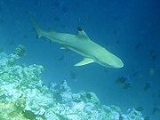
Requiem shark

Encyclopedia
Requiem sharks are a family
, Carcharhinidae, of shark
s in the order
Carcharhiniformes
, containing migratory, live-bearing sharks of warm seas (sometimes of brackish or fresh water) such as the tiger shark
, the blue shark
, the bull shark
, and the milk shark
.
The name may be related to the French word for shark, "requin", itself of disputed etymology ("chien de mer" or latin "requiem" ("Rest"), which would thereby create a cyclic etymology Requiem-Requin-Requiem http://www.cnrtl.fr/lexicographie/requin http://fr.wikipedia.org/wiki/Requiem).
Family members have the usual carcharhiniform characteristics. The eyes are round, and the pectoral fins are completely behind the five gill
slits. Most species are viviparous, the young being born fully developed. They vary widely in size, from as little as 69 centimetres (2.3 ft) adult length in the Australian sharpnose shark
, up to 7.5 metres (24.6 ft) adult length in the tiger shark
.
Requiem sharks are responsible for a large proportion of attacks on humans
; however, due to the difficulty in identifying individual species, there is a degree of inaccuracy in attack records.
Family Carcharhinidae
Family (biology)
In biological classification, family is* a taxonomic rank. Other well-known ranks are life, domain, kingdom, phylum, class, order, genus, and species, with family fitting between order and genus. As for the other well-known ranks, there is the option of an immediately lower rank, indicated by the...
, Carcharhinidae, of shark
Shark
Sharks are a type of fish with a full cartilaginous skeleton and a highly streamlined body. The earliest known sharks date from more than 420 million years ago....
s in the order
Order (biology)
In scientific classification used in biology, the order is# a taxonomic rank used in the classification of organisms. Other well-known ranks are life, domain, kingdom, phylum, class, family, genus, and species, with order fitting in between class and family...
Carcharhiniformes
Carcharhiniformes
The ground sharks, order Carcharhiniformes, are the largest order of sharks. With over 270 species, carcharhiniforms include a number of common types, such as the blue shark, catsharks, swellsharks, and sandbar shark....
, containing migratory, live-bearing sharks of warm seas (sometimes of brackish or fresh water) such as the tiger shark
Tiger shark
The tiger sharks, Galeocerdo cuvier, is a species of requiem shark and the only member of the genus Galeocerdo. Commonly known as sea tigers, tiger sharks are relatively large macropredators, capable of attaining a length of over . It is found in many tropical and temperate waters, and is...
, the blue shark
Blue shark
The blue shark is a species of requiem shark, family Carcharhinidae, that inhabits deep waters in the world's temperate and tropical oceans. Preferring cooler waters, blue sharks migrate long distances, for example from New England to South America. Although generally lethargic, they can move very...
, the bull shark
Bull shark
The bull shark, Carcharhinus leucas, also known as Zambezi shark or unofficially known as Zambi in Africa and Nicaragua shark in Nicaragua, is a shark common worldwide in warm, shallow waters along coasts and in rivers...
, and the milk shark
Milk shark
The milk shark is a species of requiem shark, family Carcharhinidae, whose common name comes from an Indian belief that consumption of its meat promotes lactation...
.
The name may be related to the French word for shark, "requin", itself of disputed etymology ("chien de mer" or latin "requiem" ("Rest"), which would thereby create a cyclic etymology Requiem-Requin-Requiem http://www.cnrtl.fr/lexicographie/requin http://fr.wikipedia.org/wiki/Requiem).
Family members have the usual carcharhiniform characteristics. The eyes are round, and the pectoral fins are completely behind the five gill
Gill
A gill is a respiratory organ found in many aquatic organisms that extracts dissolved oxygen from water, afterward excreting carbon dioxide. The gills of some species such as hermit crabs have adapted to allow respiration on land provided they are kept moist...
slits. Most species are viviparous, the young being born fully developed. They vary widely in size, from as little as 69 centimetres (2.3 ft) adult length in the Australian sharpnose shark
Australian sharpnose shark
The Australian sharpnose shark, Rhizoprionodon taylori, is a requiem shark of the family Carcharhinidae, found in the tropical waters of the western Pacific Ocean off Papua New Guinea and northern Australia between latitudes 8° N and 28° S, from the surface to 110 m. Its length is up to...
, up to 7.5 metres (24.6 ft) adult length in the tiger shark
Tiger shark
The tiger sharks, Galeocerdo cuvier, is a species of requiem shark and the only member of the genus Galeocerdo. Commonly known as sea tigers, tiger sharks are relatively large macropredators, capable of attaining a length of over . It is found in many tropical and temperate waters, and is...
.
Requiem sharks are responsible for a large proportion of attacks on humans
Shark attack
A shark attack is an attack on a human by a shark. Every year around 60 shark attacks are reported worldwide, although death is quite unusual. Despite the relative rarity of shark attacks, the fear of sharks is a common phenomenon, having been fueled by the occasional instances of serial attacks,...
; however, due to the difficulty in identifying individual species, there is a degree of inaccuracy in attack records.
Classification
There are 52 species of requiem shark, grouped into 12 genera:Family Carcharhinidae
- Subfamily Galeocerdinae
- Genus Galeocerdo J. P. MüllerJohannes Peter MüllerJohannes Peter Müller , was a German physiologist, comparative anatomist, and ichthyologist not only known for his discoveries but also for his ability to synthesize knowledge.-Early years and education:...
& HenleFriedrich Gustav Jakob HenleFriedrich Gustav Jakob Henle was a German physician, pathologist and anatomist. He is credited with the discovery of the loop of Henle in the kidney. His essay "On Miasma and Contagia" was an early argument for the germ theory of disease...
, 1837- Galeocerdo cuvier (PéronFrançois PéronFrançois Auguste Péron was a French naturalist and explorer. He is credited with the first use of the term anthropology.-Explorations:...
& LesueurCharles Alexandre LesueurCharles Alexandre Lesueur was a French naturalist, artist and explorer.Pictured here is the oil portrait by Charles Willson Peale of Charles-Alexandre Lesueur...
, 1822) (Tiger shark)
- Galeocerdo cuvier (Péron
- Genus Galeocerdo J. P. Müller
- Subfamily Scoliodontinae
- Genus Scoliodon J. P. MüllerJohannes Peter MüllerJohannes Peter Müller , was a German physiologist, comparative anatomist, and ichthyologist not only known for his discoveries but also for his ability to synthesize knowledge.-Early years and education:...
& HenleFriedrich Gustav Jakob HenleFriedrich Gustav Jakob Henle was a German physician, pathologist and anatomist. He is credited with the discovery of the loop of Henle in the kidney. His essay "On Miasma and Contagia" was an early argument for the germ theory of disease...
, 1838- Scoliodon laticaudus J. P. MüllerJohannes Peter MüllerJohannes Peter Müller , was a German physiologist, comparative anatomist, and ichthyologist not only known for his discoveries but also for his ability to synthesize knowledge.-Early years and education:...
& HenleFriedrich Gustav Jakob HenleFriedrich Gustav Jakob Henle was a German physician, pathologist and anatomist. He is credited with the discovery of the loop of Henle in the kidney. His essay "On Miasma and Contagia" was an early argument for the germ theory of disease...
, 1838 (Spadenose shark)
- Scoliodon laticaudus J. P. Müller
- Genus Scoliodon J. P. Müller
- Subfamily Carcharhininae
- Tribe Carcharhinini
- Genus CarcharhinusCarcharhinusCarcharhinus is the type genus of the requiem shark family, Carcharhinidae.- Species :* Carcharhinus acarenatus * Carcharhinus acronotus...
BlainvilleHenri Marie Ducrotay de BlainvilleHenri Marie Ducrotay de Blainville was a French zoologist and anatomist.Blainville was born at Arques, near Dieppe. In about 1796 he went to Paris to study painting, but he ultimately devoted himself to natural history, and attracted the attention of Georges Cuvier, for whom he occasionally...
, 1816- Carcharhinus acronotus (Poey, 1860) (Blacknose shark)
- Carcharhinus albimarginatus (RüppellEduard RüppellWilhelm Peter Eduard Simon Rüppell was a German naturalist and explorer. Rüppell is occasionally transliterated to "Rueppell" for the English alphabet....
, 1837) (Silvertip shark) - Carcharhinus altimus (S. SpringerStewart SpringerStewart Springer, was a world renowned expert on shark behavior, classification , and distribution of shark populations. There are more than 35 species of sharks, skates, rays, and other animals either classified originally by him or named after him.-Education:Springer was a field naturalist,...
, 1950) (Bignose shark) - Carcharhinus amblyrhynchoides (WhitleyGilbert Percy WhitleyGilbert Percy Whitley was a British-born Australian ichthyologist and malacologist who was Curator of Fishes at the Australian Museum in Sydney for about 40 years. He was born at Swaythling, Southampton, England, and was educated at King Edward VI School, Southampton and Osborne House...
, 1934) (Graceful shark) - Carcharhinus amblyrhynchos (BleekerPieter BleekerPieter Bleeker was a Dutch medical doctor and ichthyologist, famous for his work on the fishes of East Asia – Atlas Ichthyologique des Orientales Neerlandaises – which was published 1862–1877....
, 1856) (Blacktail reef shark) - Carcharhinus amboinensis (J. P. MüllerJohannes Peter MüllerJohannes Peter Müller , was a German physiologist, comparative anatomist, and ichthyologist not only known for his discoveries but also for his ability to synthesize knowledge.-Early years and education:...
& HenleFriedrich Gustav Jakob HenleFriedrich Gustav Jakob Henle was a German physician, pathologist and anatomist. He is credited with the discovery of the loop of Henle in the kidney. His essay "On Miasma and Contagia" was an early argument for the germ theory of disease...
, 1839) (Pigeye shark) - Carcharhinus borneensis (BleekerPieter BleekerPieter Bleeker was a Dutch medical doctor and ichthyologist, famous for his work on the fishes of East Asia – Atlas Ichthyologique des Orientales Neerlandaises – which was published 1862–1877....
, 1858) (Borneo shark) - Carcharhinus brachyurus (Günther, 1870) (Copper shark)
- Carcharhinus brevipinna (J. P. MüllerJohannes Peter MüllerJohannes Peter Müller , was a German physiologist, comparative anatomist, and ichthyologist not only known for his discoveries but also for his ability to synthesize knowledge.-Early years and education:...
& HenleFriedrich Gustav Jakob HenleFriedrich Gustav Jakob Henle was a German physician, pathologist and anatomist. He is credited with the discovery of the loop of Henle in the kidney. His essay "On Miasma and Contagia" was an early argument for the germ theory of disease...
, 1839) (Spinner shark) - Carcharhinus cautus (WhitleyGilbert Percy WhitleyGilbert Percy Whitley was a British-born Australian ichthyologist and malacologist who was Curator of Fishes at the Australian Museum in Sydney for about 40 years. He was born at Swaythling, Southampton, England, and was educated at King Edward VI School, Southampton and Osborne House...
, 1945) (Nervous shark) - Carcharhinus dussumieri (J. P. MüllerJohannes Peter MüllerJohannes Peter Müller , was a German physiologist, comparative anatomist, and ichthyologist not only known for his discoveries but also for his ability to synthesize knowledge.-Early years and education:...
& HenleFriedrich Gustav Jakob HenleFriedrich Gustav Jakob Henle was a German physician, pathologist and anatomist. He is credited with the discovery of the loop of Henle in the kidney. His essay "On Miasma and Contagia" was an early argument for the germ theory of disease...
, 1839) (Whitecheek shark) - Carcharhinus falciformis (J. P. MüllerJohannes Peter MüllerJohannes Peter Müller , was a German physiologist, comparative anatomist, and ichthyologist not only known for his discoveries but also for his ability to synthesize knowledge.-Early years and education:...
& HenleFriedrich Gustav Jakob HenleFriedrich Gustav Jakob Henle was a German physician, pathologist and anatomist. He is credited with the discovery of the loop of Henle in the kidney. His essay "On Miasma and Contagia" was an early argument for the germ theory of disease...
, 1839) (Silky shark) - Carcharhinus fitzroyensis (WhitleyGilbert Percy WhitleyGilbert Percy Whitley was a British-born Australian ichthyologist and malacologist who was Curator of Fishes at the Australian Museum in Sydney for about 40 years. He was born at Swaythling, Southampton, England, and was educated at King Edward VI School, Southampton and Osborne House...
, 1943) (Creek whaler) - Carcharhinus galapagensis (SnodgrassRobert Evans SnodgrassRobert Evans Snodgrass was an American entomologist and artist who made important contributions to the fields of arthropod morphology, anatomy, evolution, and metamorphosis....
& HellerEdmund HellerEdmund Heller was an American zoologist.Heller attended Stanford University in 1896 and finished his study of zoology with a Bachelor of Arts degree in 1901. From 1926 to 1928 he was curator of mammals at the Field Museum of Natural History in Chicago...
, 1905) (Galapagos shark) - Carcharhinus hemiodon (ValenciennesAchille ValenciennesAchille Valenciennes was a French zoologist.Valenciennes was born in Paris, and studied under Georges Cuvier. Valenciennes' study of parasitic worms in humans made an important contribution to the study of parasitology...
in J. P. MüllerJohannes Peter MüllerJohannes Peter Müller , was a German physiologist, comparative anatomist, and ichthyologist not only known for his discoveries but also for his ability to synthesize knowledge.-Early years and education:...
& HenleFriedrich Gustav Jakob HenleFriedrich Gustav Jakob Henle was a German physician, pathologist and anatomist. He is credited with the discovery of the loop of Henle in the kidney. His essay "On Miasma and Contagia" was an early argument for the germ theory of disease...
, 1839) (Pondicherry shark) - Carcharhinus isodon (J. P. MüllerJohannes Peter MüllerJohannes Peter Müller , was a German physiologist, comparative anatomist, and ichthyologist not only known for his discoveries but also for his ability to synthesize knowledge.-Early years and education:...
& HenleFriedrich Gustav Jakob HenleFriedrich Gustav Jakob Henle was a German physician, pathologist and anatomist. He is credited with the discovery of the loop of Henle in the kidney. His essay "On Miasma and Contagia" was an early argument for the germ theory of disease...
, 1839) (Finetooth shark) - Carcharhinus leiodon Garrick, 1985 (Smooth tooth blacktip shark )
- Carcharhinus leucas (J. P. MüllerJohannes Peter MüllerJohannes Peter Müller , was a German physiologist, comparative anatomist, and ichthyologist not only known for his discoveries but also for his ability to synthesize knowledge.-Early years and education:...
& HenleFriedrich Gustav Jakob HenleFriedrich Gustav Jakob Henle was a German physician, pathologist and anatomist. He is credited with the discovery of the loop of Henle in the kidney. His essay "On Miasma and Contagia" was an early argument for the germ theory of disease...
, 1839) (Bull shark) - Carcharhinus limbatus (J. P. MüllerJohannes Peter MüllerJohannes Peter Müller , was a German physiologist, comparative anatomist, and ichthyologist not only known for his discoveries but also for his ability to synthesize knowledge.-Early years and education:...
& HenleFriedrich Gustav Jakob HenleFriedrich Gustav Jakob Henle was a German physician, pathologist and anatomist. He is credited with the discovery of the loop of Henle in the kidney. His essay "On Miasma and Contagia" was an early argument for the germ theory of disease...
, 1839) (Blacktip shark) - Carcharhinus longimanus (Poey, 1861) (Oceanic whitetip shark)
- Carcharhinus macloti (J. P. MüllerJohannes Peter MüllerJohannes Peter Müller , was a German physiologist, comparative anatomist, and ichthyologist not only known for his discoveries but also for his ability to synthesize knowledge.-Early years and education:...
& HenleFriedrich Gustav Jakob HenleFriedrich Gustav Jakob Henle was a German physician, pathologist and anatomist. He is credited with the discovery of the loop of Henle in the kidney. His essay "On Miasma and Contagia" was an early argument for the germ theory of disease...
, 1839) (Hardnose shark) - Carcharhinus macrops J. X. Liu, 1983
- Carcharhinus melanopterus (QuoyJean René Constant QuoyJean René Constant Quoy was a French zoologist.Along with Joseph Paul Gaimard he served as naturalist aboard La Coquille under Louis Isidore Duperrey during its circumnavigation of the globe , and the Astrolabe under the command of Jules Dumont d'Urville...
& GaimardJoseph Paul GaimardJoseph Paul Gaimard was a French naval surgeon and naturalist.Along with Jean René Constant Quoy he served as naturalist on the ships L'Uranie under Louis de Freycinet 1817-1820, and L'Astrolabe under Jules Dumont d'Urville 1826-1829...
, 1824) (Blacktip reef shark) - Carcharhinus obscurus (LesueurCharles Alexandre LesueurCharles Alexandre Lesueur was a French naturalist, artist and explorer.Pictured here is the oil portrait by Charles Willson Peale of Charles-Alexandre Lesueur...
, 1818) (Dusky shark) - Carcharhinus perezii (Poey, 1876) (Caribbean reef shark)
- Carcharhinus plumbeus (NardoGiovanni Domenico NardoGiovanni Domenico Nardo was an Italian naturalist from Venice, although he spent most of his life in Chioggia, home port of the biggest fishing flotilla of the Adriatic....
, 1827) (Sandbar shark) - Carcharhinus porosus (RanzaniCamillo RanzaniCamillo Ranzani was an Italian priest and a naturalist. He was director of the Museum of Natural History of Bologna from 1803 to 1841...
, 1839) (Smalltail shark) - Carcharhinus sealei (PietschmannViktor PietschmannViktor Pietschmann was an Austrian ichthyologist at the Vienna Museum of Natural History. He was the curator of the fish collection from 1919 to 1946. During his life, he made collecting to trips to the Barents Sea, Greenland, Mesopotamia, Armenia, Hawaii, Romania, and Poland. He described many...
, 1913) (Blackspot shark) - Carcharhinus signatus (Poey, 1868) (Night shark)
- Carcharhinus sorrah (J. P. MüllerJohannes Peter MüllerJohannes Peter Müller , was a German physiologist, comparative anatomist, and ichthyologist not only known for his discoveries but also for his ability to synthesize knowledge.-Early years and education:...
& HenleFriedrich Gustav Jakob HenleFriedrich Gustav Jakob Henle was a German physician, pathologist and anatomist. He is credited with the discovery of the loop of Henle in the kidney. His essay "On Miasma and Contagia" was an early argument for the germ theory of disease...
, 1839) (Spot-tail shark) - Carcharhinus tilstoni (WhitleyGilbert Percy WhitleyGilbert Percy Whitley was a British-born Australian ichthyologist and malacologist who was Curator of Fishes at the Australian Museum in Sydney for about 40 years. He was born at Swaythling, Southampton, England, and was educated at King Edward VI School, Southampton and Osborne House...
, 1950) (Australian blacktip shark)
- Genus Glyphis AgassizLouis AgassizJean Louis Rodolphe Agassiz was a Swiss paleontologist, glaciologist, geologist and a prominent innovator in the study of the Earth's natural history. He grew up in Switzerland and became a professor of natural history at University of Neuchâtel...
, 1843- Glyphis fowlerae Compagno, W. T. White & Cavanagh, 2010 (Borneo river shark)
- Glyphis gangeticus (J. P. MüllerJohannes Peter MüllerJohannes Peter Müller , was a German physiologist, comparative anatomist, and ichthyologist not only known for his discoveries but also for his ability to synthesize knowledge.-Early years and education:...
& HenleFriedrich Gustav Jakob HenleFriedrich Gustav Jakob Henle was a German physician, pathologist and anatomist. He is credited with the discovery of the loop of Henle in the kidney. His essay "On Miasma and Contagia" was an early argument for the germ theory of disease...
, 1839) (Ganges shark) - Glyphis garricki Compagno, W. T. White & Last, 2008 (Northern river shark)
- Glyphis glyphis (J. P. MüllerJohannes Peter MüllerJohannes Peter Müller , was a German physiologist, comparative anatomist, and ichthyologist not only known for his discoveries but also for his ability to synthesize knowledge.-Early years and education:...
& HenleFriedrich Gustav Jakob HenleFriedrich Gustav Jakob Henle was a German physician, pathologist and anatomist. He is credited with the discovery of the loop of Henle in the kidney. His essay "On Miasma and Contagia" was an early argument for the germ theory of disease...
, 1839) (Speartooth shark) - Glyphis siamensis (SteindachnerFranz SteindachnerFranz Steindachner was an Austrian zoologist.- Work and career :Being interested in natural history, Steindachner took up the study of fossil fishes on the recommendation of his friend Eduard Suess...
, 1896) (Irrawaddy river shark)
- Genus Lamiopsis GillTheodore GillTheodore Nicholas Gill was an American ichthyologist, mammalogist, malacologist and librarian.Born and educated in New York City under private tutors, Gill early showed interest in natural history. He was associated with J...
, 1862- Lamiopsis temminckii (J. P. MüllerJohannes Peter MüllerJohannes Peter Müller , was a German physiologist, comparative anatomist, and ichthyologist not only known for his discoveries but also for his ability to synthesize knowledge.-Early years and education:...
& HenleFriedrich Gustav Jakob HenleFriedrich Gustav Jakob Henle was a German physician, pathologist and anatomist. He is credited with the discovery of the loop of Henle in the kidney. His essay "On Miasma and Contagia" was an early argument for the germ theory of disease...
, 1839) (Broadfin shark)
- Lamiopsis temminckii (J. P. Müller
- Genus Nasolamia Compagno & Garrick, 1983
- Nasolamia velox (GilbertCharles Henry GilbertCharles Henry Gilbert was a pioneer ichthyologist and fishery biologist of particular significance to natural history of the western United States. He collected and studied fishes from Central America north to Alaska and described many new species...
, 1898) (Whitenose shark)
- Nasolamia velox (Gilbert
- Genus NegaprionNegaprionNegaprion is a genus of requiem sharks, family Carcharhinidae, containing the two extant species of lemon sharks: the lemon shark of the Americas, and the sicklefin lemon shark of the Indo-Pacific...
WhitleyGilbert Percy WhitleyGilbert Percy Whitley was a British-born Australian ichthyologist and malacologist who was Curator of Fishes at the Australian Museum in Sydney for about 40 years. He was born at Swaythling, Southampton, England, and was educated at King Edward VI School, Southampton and Osborne House...
, 1940- Negaprion acutidens (RüppellEduard RüppellWilhelm Peter Eduard Simon Rüppell was a German naturalist and explorer. Rüppell is occasionally transliterated to "Rueppell" for the English alphabet....
, 1837) (Sicklefin lemon shark) - Negaprion brevirostris (Poey, 1868) (Lemon shark)
- Negaprion acutidens (Rüppell
- Genus Prionace CantorTheodore Edward CantorTheodore Edward Cantor was a Danish physician, zoologist and botanist.Cantor worked for the British East India Company. He made natural history collections in Penang and Malacca...
, 1849- Prionace glauca (LinnaeusCarolus LinnaeusCarl Linnaeus , also known after his ennoblement as , was a Swedish botanist, physician, and zoologist, who laid the foundations for the modern scheme of binomial nomenclature. He is known as the father of modern taxonomy, and is also considered one of the fathers of modern ecology...
, 1758) (Blue shark)
- Prionace glauca (Linnaeus
- Genus Carcharhinus
- Tribe Rhizoprionodontini
- Genus RhizoprionodonRhizoprionodonRhizoprionodon is a genus of requiem sharks, family Carcharhinidae, commonly known as sharpnose sharks because of their long, pointed snouts.-Species:* Rhizoprionodon acutus...
WhitleyGilbert Percy WhitleyGilbert Percy Whitley was a British-born Australian ichthyologist and malacologist who was Curator of Fishes at the Australian Museum in Sydney for about 40 years. He was born at Swaythling, Southampton, England, and was educated at King Edward VI School, Southampton and Osborne House...
, 1929- Rhizoprionodon acutus (RüppellEduard RüppellWilhelm Peter Eduard Simon Rüppell was a German naturalist and explorer. Rüppell is occasionally transliterated to "Rueppell" for the English alphabet....
, 1837) (Milk shark) - Rhizoprionodon lalandii (J. P. MüllerJohannes Peter MüllerJohannes Peter Müller , was a German physiologist, comparative anatomist, and ichthyologist not only known for his discoveries but also for his ability to synthesize knowledge.-Early years and education:...
& HenleFriedrich Gustav Jakob HenleFriedrich Gustav Jakob Henle was a German physician, pathologist and anatomist. He is credited with the discovery of the loop of Henle in the kidney. His essay "On Miasma and Contagia" was an early argument for the germ theory of disease...
, 1839) (Brazilian sharpnose shark) - Rhizoprionodon longurio (D. S. JordanDavid Starr JordanDavid Starr Jordan, Ph.D., LL.D. was a leading eugenicist, ichthyologist, educator and peace activist. He was president of Indiana University and Stanford University.-Early life and education:...
& GilbertCharles Henry GilbertCharles Henry Gilbert was a pioneer ichthyologist and fishery biologist of particular significance to natural history of the western United States. He collected and studied fishes from Central America north to Alaska and described many new species...
, 1882) (Pacific sharpnose shark) - Rhizoprionodon oligolinx V. G. Springer, 1964 (Grey sharpnose shark)
- Rhizoprionodon porosus (Poey, 1861) (Caribbean sharpnose shark)
- Rhizoprionodon taylori (OgilbyJames Douglas OgilbyJames Douglas Ogilby was an Australian ichthyologist.Ogilby was born in Belfast, Ireland, and was the son of zoologist William Ogilby. He received his education at Winchester College, England, and Trinity College, Dublin.Ogilby worked for the British Museum before joining the Australian Museum in...
, 1915) (Australian sharpnose shark) - Rhizoprionodon terraenovae (J. RichardsonJohn Richardson (naturalist)Sir John Richardson was a Scottish naval surgeon, naturalist and arctic explorer.Richardson was born at Dumfries. He studied medicine at Edinburgh University, and became a surgeon in the navy in 1807. He traveled with John Franklin in search of the Northwest Passage on the Coppermine Expedition of...
, 1836) (Atlantic sharpnose shark)
- Rhizoprionodon acutus (Rüppell
- Genus Loxodon J. P. MüllerJohannes Peter MüllerJohannes Peter Müller , was a German physiologist, comparative anatomist, and ichthyologist not only known for his discoveries but also for his ability to synthesize knowledge.-Early years and education:...
& HenleFriedrich Gustav Jakob HenleFriedrich Gustav Jakob Henle was a German physician, pathologist and anatomist. He is credited with the discovery of the loop of Henle in the kidney. His essay "On Miasma and Contagia" was an early argument for the germ theory of disease...
, 1838- Loxodon macrorhinus (J. P. MüllerJohannes Peter MüllerJohannes Peter Müller , was a German physiologist, comparative anatomist, and ichthyologist not only known for his discoveries but also for his ability to synthesize knowledge.-Early years and education:...
& HenleFriedrich Gustav Jakob HenleFriedrich Gustav Jakob Henle was a German physician, pathologist and anatomist. He is credited with the discovery of the loop of Henle in the kidney. His essay "On Miasma and Contagia" was an early argument for the germ theory of disease...
, 1839) (Sliteye shark)
- Loxodon macrorhinus (J. P. Müller
- Genus Rhizoprionodon
- Tribe Isogomphodontini
- Genus Isogomphodon GillTheodore GillTheodore Nicholas Gill was an American ichthyologist, mammalogist, malacologist and librarian.Born and educated in New York City under private tutors, Gill early showed interest in natural history. He was associated with J...
, 1862- Isogomphodon oxyrhynchus (J. P. MüllerJohannes Peter MüllerJohannes Peter Müller , was a German physiologist, comparative anatomist, and ichthyologist not only known for his discoveries but also for his ability to synthesize knowledge.-Early years and education:...
& HenleFriedrich Gustav Jakob HenleFriedrich Gustav Jakob Henle was a German physician, pathologist and anatomist. He is credited with the discovery of the loop of Henle in the kidney. His essay "On Miasma and Contagia" was an early argument for the germ theory of disease...
, 1839) (Daggernose shark)
- Isogomphodon oxyrhynchus (J. P. Müller
- Genus Isogomphodon Gill
- Tribe Triaenodontini
- Genus Triaenodon J. P. MüllerJohannes Peter MüllerJohannes Peter Müller , was a German physiologist, comparative anatomist, and ichthyologist not only known for his discoveries but also for his ability to synthesize knowledge.-Early years and education:...
& HenleFriedrich Gustav Jakob HenleFriedrich Gustav Jakob Henle was a German physician, pathologist and anatomist. He is credited with the discovery of the loop of Henle in the kidney. His essay "On Miasma and Contagia" was an early argument for the germ theory of disease...
, 1837- Triaenodon obesus (RüppellEduard RüppellWilhelm Peter Eduard Simon Rüppell was a German naturalist and explorer. Rüppell is occasionally transliterated to "Rueppell" for the English alphabet....
, 1837) (Whitetip reef shark)
- Triaenodon obesus (Rüppell
- Genus Triaenodon J. P. Müller
- Tribe Carcharhinini