
Encyclopedia
The
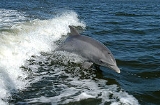
Bottlenose Dolphin is the most common and well-known
dolphin species. It inhabits warm and temperate seas worldwide and may be found in all but the
Arctic and the
Antarctic Oceans.
Physical description
Bottlenose Dolphins are grey, varying from dark grey at the top near the
dorsal fin to very light grey and almost white at the underside. This makes them harder to see both from above and below when swimming. The elongated upper and lower jaws form what is called the rostrum and give the animals their name of bottlenose. The real nose however is the blowhole on top of the head, and the nasal septum is visible when the blowhole is open. Their face shows a characteristic "smile".
Adults range in length from 2 to 4 m and in weight from 150 to 650 kg , but in most parts of the world adults length is about 2.5m and adult weight range form 200 to 300 kg , with males being slightly longer and considerably heavier than females on average. The size of the dolphin appears to vary considerably with habitat. Most research in this area has been restricted to the
North Atlantic Ocean, where researchers have identified two ecotypes. Those dolphins in warmer, shallower waters tend to have a smaller body than their cousins in cooler pelagic waters. For example a survey of animals in the Moray Firth in
Scotland, the world's northernmost resident population, recorded an average adult length of just under 4 m . This compares with a 2.5 m average in a population off Florida. Those in colder waters also have a fattier composition and blood more suited to deep-diving.
The flukes and
dorsal fin are formed of dense connective tissue and don't contain bones or muscle. The animal propels forward by moving the flukes up and down. The
pectoral flippers serve for steering; they contain bones clearly homologous to the forelimbs of land mammals .
Behavior and life
Bottlenose Dolphins typically swim at a speed of 5-11 km per hour ; for short times, they can reach peak speeds of 35 km per hour .
Every 5-8 minutes, the dolphins have to rise to the surface to breathe through their blowhole. Their sleep is thus very light; some scientists have suggested that the two halves of their brains take turns in sleeping and waking. It has also been suggested that they have tiny periods of 'microsleep'.
Bottlenose Dolphins normally live in groups called
pods, containing up to 12 animals. These are long-term social units. Typically, a group of females and their young live together in a pod, and juveniles in a mixed pod. Several of these pods can join together to form larger groups of one hundred dolphins or more. Males live mostly alone or in groups of 2-3 and join the pods for short periods of time. Bottlenose Dolphin pod members will attack, and often kill, members of their group that exhibit pedophiliac tendencies.
The species is commonly known for its friendly character and curiosity towards humans immersed in or near water. It is not uncommon for a diver to be investigated by a group of them. Occasionally, dolphins have rescued injured divers by raising them to the surface, a behaviour they also show towards injured members of their own species. Such accounts have earned them the nickname of "Man's best friend of the sea". In November 2004, a more dramatic report of dolphin intervention came from
New Zealand. Three lifeguards, swimming 100 m off the coast near
Whangarei, were reportedly approached by a 3 m
Great White Shark. A group of Bottlenose Dolphins, apparently sensing danger to the swimmers, herded them together and tightly surrounded them for forty minutes, preventing an attack from the shark, as they returned to shore.
Dolphins are
predators however, and they also show aggressive behaviors. This includes fights among males for rank and access to females, as well as aggression towards
sharks,
orcas, and other smaller species of dolphins. Male dolphins, during the mating season, compete very vigorously with each other through showing toughness and size with a series of acts such as head butting.
Female Bottlenose Dolphins live for about 40 years; the more stressful life of the males apparently takes its toll, and they rarely live more than 30 years.
Diet
Their diet consists mainly of small fish, occasionally also
squid,
crabs, octopus, and other similar animals. Their peg-like teeth serve to grasp but not to chew food. When a shoal of fish has been found, the animals work as a team to keep the fish close together and maximize the harvest. They also search for fish alone, often bottom dwelling species. Sometimes they will employ "fish whacking" whereby a fish is stunned with the fluke to make catching and eating the fish easier.
Senses and communication
The dolphin's search for food is aided by a form of
echolocation similar to
sonar: they locate objects by producing sounds and listening for the echo. The broadband burst pulse clicking sounds are emitted in a focused beam towards the front of the animal. They have two small ear openings behind the eyes, but most sound waves are transmitted to the inner ear through the lower jaw. As the object of interest is approached, the echo grows louder; the dolphins adjust by decreasing the intensity of the emitted sounds. As the animal approaches the target, the interclick interval also decreases, as each click is usually produced after the round-trip travel time of the previous click. Details of the dolphin's echolocation, such as signal strength, spectral qualities, discrimination abilities, etc., have been well investigated by researchers. Also, Pack & Herman demonstrated that Bottlenose Dolphins are able to extract shape information from their echolocative sense, suggesting that they are able to form an "echoic image" of their targets.
They also have sharp eyesight. The eyes are located at the sides of the head and have a
tapetum lucidum is a reflecting [i] layer immediately behind, and sometimes within, t...
which aids in dim light. Their horseshoe-shaped double-slit pupil enables the dolphin to have good vision in both in-air and underwater viewing, despite the differences in density of these media. Underwater, the eyeball's lens serves to focus light, whereas in the in-air environment, the typically bright light serves to contract the specialized pupil, resulting in sharpness from a small-aperture .
By contrast, their sense of smell is very poor, as would be expected as the blowhole, the analog to the nose, is closed in the underwater environment, and opens only voluntarily for breathing. The olfactory nerves as well as the olfactory lobe in the brain are missing. The sense of taste has not been well-studied, although dolphins have been demonstrated to be able to detect salty, sweet, bitter , and sour tastes. Anecodotally, some animals in captivity have been noted to have preferences for food fish types although it is not clear that this preference is mediated by taste.
Bottlenose Dolphins communicate with body movements and with sounds they produce using six air sacs near their blow hole . Each animal has a characteristic frequency-modulated narrow-band signature vocalization which is uniquely identifying. Other communication uses about 30 distinguishable sounds, and although famously proposed by John Lilly in the 1950's, a "dolphin language" has not been found. However, Herman, Richards, & Wolz demonstrated the comprehension of an artificial language by two Bottlenose Dolphins in the period of skepticism toward animal language following Herbert Terrace's critique.
Cognition
Cognitive abilities investigated in the dolphin include concept formation, sensory skills, and the use of mental representation of dolphins. Such research has been ongoing from the late 1970s through to the present, and include the specific areas of: acoustic mimicry, behavioral mimicry , comprehension of novel sequences in an artificial language ,
memory, monitoring of self behaviors , reporting on the presence and absence of objects, object categorization, discrimination and matching , synchronous creative behaviors between two animals, comprehension of symbols for various body parts, comprehension of the pointing gesture and gaze , problem solving, echolocative eavesdropping, attention, mirror self-recognition, and more. Recent research has shown that dolphins are capable of comprehending numerical values. In an experiment where a dolphin was shown two panels with a various number of dots of different size and position, the dolphin was able to touch the panel with a greater number of dots, much more rapidly then many human beings could do. Some researchers include Louis Herman, Mark Xitco, John Gory, Stan Kuczaj, Lori Marino, Diana Reiss, Adam Pack, and many others.
Tool use and culture
In 1997, tool use was described in Bottlenose Dolphins in
Shark Bay, Western Australia. A dolphin will stick a marine
sponge on its rostrum, presumably to protect it when searching for food in the sandy sea bottom. The behavior has only been observed in this bay, and is almost exclusively shown by females. This is the only known case of tool use in marine mammals. An elaborate study in 2005 showed that mothers most likely teach the behavior to their daughters. Subsets of populations in Mauritania are known to engage in interspecific cooperative fishing with human fishermen. The dolphins drive a school of fish towards the shore where humans await with their nets. In the confusion of casting nets, the dolphins catch a large number of fish as well. Intraspecific cooperative foraging techniques have also been observed, and some propose that these behaviors are transmitted through cultural means. Rendell & Whitehead have proposed a structure for the study of culture in cetaceans, although this view has been controversial .
Sexuality and reproduction
The male has two slits on the underside of the body: one hiding the
penis and further behind one for the
anus. The female has one genital slit, housing the
vagina and the anus. A mammary slit is positioned on either side of the female's genital slit.
Courtship behavior of the male includes clinging along to that female, posing for the female, stroking, rubbing, nuzzling, mouthing, jaw clapping, and yelping.
Copulation is preceded by lengthy foreplay; then the two animals arrange belly to belly, the penis extends out of its slit and is inserted into the vagina. The act lasts only 10-30 seconds, but is repeated numerous times, with several minutes break in between.
The gestation period is 12 months. The young are born in shallow water, sometimes assisted by a "midwife" . A single calf is born, about 1 meter long at birth.
To speed up the nursing process, the mother can eject milk from her mammary glands. There are two slits, one on either side of the genital slit, each housing one
nipple. The calf is nursed for 12 to 18 months.
The young live closely with their mother for up to 6 years; the males are not involved in the raising of their offspring. The females become sexually mature at age 5-12, the males a bit later, at age 10-12.
Janet Mann, a professor of biology and psychology at Georgetown University, argues that the common same-sex behavior among male dolphin calves is about bond formation, and benefits the species evolutionarily. She cites studies showing that dolphins later in life as adults are bisexual, and the male bonds forged from homosexuality work for protection as well as locating females to reproduce with.
Male Bottlenose Dolphins have been observed working in pairs to follow and/or restrict the movement of a female for weeks at a time, waiting for her to become sexually receptive. The same pairs have also been observed engaging in intense sexual play with each other.
Natural predators
Large
shark species such as the
tiger shark, the
dusky shark, and the
bull shark prey on the Bottlenose Dolphin. However, the dolphin is far from helpless against its predators and it has been known to fight back through charges; indeed, dolphin 'mobbing' behavior of sharks can occasionally prove fatal for the shark. The
Orca may also prey on dolphins, but this seems very rare.
Taxonomy
Scientists have long been aware that the Bottlenose Dolphin might consist of more than one species. The advent of molecular genetics has allowed much greater insight into this previously intractable problem. The consensus amongst scientists is that there are two species:
- the Common Bottlenose Dolphin , found in most warm to tropical oceans; color sometimes almost blue; has a dark line from beak to blowhole
- the Indo-Pacific Bottlenose Dolphin , living in the waters around India, Australia and South-China; back is dark-gray and belly is white with gray spots.
The following are sometimes recognized as subspecies of
T. truncatus:
- the Pacific Bottlenose Dolphin , living in the Pacific; has a black line from the eye to the forehead
- the Black Sea Bottlenose Dolphin , living in the Black Sea.
Much of the old scientific data in the field combine data about the two species into a single group - making it effectively useless in determining the structural differences between the two species. Indeed, the IUCN lists both species as data deficient in their Red List of endangered species precisely because of this issue.
Some recent genetic evidence suggests that the Indo-Pacific Bottlenose belongs in the genus
Stenella, it being more like the Atlantic Spotted Dolphin than the Common Bottlenose. The taxonomic situation of these animals is likely to remain in flux for some time to come.
Conservation
Bottlenose Dolphins are not endangered. Their future is currently foreseen to be stable because of their abundance and high adaptability. However some specific populations are threatened due to various environmental changes. For example, the population in the Moray Firth in
Scotland is estimated to consist of around 150 animals and to be declining by around 6% per year due to the impact of harassment and traumatic death, water pollution and reduction in food availability. Less local
climate change such as increasing water temperature may also play a role.
In
U.S. waters, hunting and harassing of marine mammals is forbidden in almost all circumstances. The international trade in dolphins is also tightly controlled.
Bottlenose Dolphins and humans
Bottlenose Dolphins are still occasionally killed in
dolphin drive hunts for their meat or because they compete for fish. Bottlenose Dolphins often travel together with
tuna, and since the dolphins are much easier to spot than the tuna, fishermen commonly encircle dolphins to catch tuna, sometimes resulting in the death of dolphins. This has led to
boycotts of tuna products and a "dolphin-safe" label for tuna caught with methods that don't endanger dolphins.
Bottlenose Dolphins are often trained to perform in dolphin shows. Some animal welfare activists claim that the dolphins there are not adequately challenged and that the pools are too small; others maintain that the dolphins are well cared for and enjoy living and working with humans.
Eight Bottlenose Dolphins that were washed out of their
aquarium pool during the devastating August 2005 strike of
Hurricane Katrina were later found alive by rescue forces, huddled together in coastal waters near their former home in Gulfport,
Mississippi,
USA.
Direct interaction with dolphins is used in the therapy of severely handicapped children.
The
military of the United States and
Russia train Bottlenose Dolphins as
military dolphins for wartime tasks such as locating sea mines or detecting and marking enemy divers. The USA's program is the
U.S. Navy Marine Mammal Program, located in
San Diego, California.
An interesting collaboration has developed in the town of
Laguna in south
Brazil: a pod of Bottlenose Dolphins drive fish towards fishermen who stand at the beach in shallow waters. Then one dolphin rolls over, which the fishermen take as sign to throw out their nets. The dolphins feed on the escaping fish. The dolphins were not trained for this behavior; the collaboration has been going on at least since 1847. Similar cooperative fisheries also exist in Africa, and have been reported through recorded history.
Bottlenose Dolphins in fiction
- The popular television show Flipper, created by Ivan Tors, portrayed a Bottlenose Dolphin in a friendly relationship with two boys, Sandy and Bud; a kind of sea going Lassie, Flipper understood English unusually well and was a marked hero: "Go tell Dad we're in trouble, Flipper! Hurry!" The show's theme song contains the lyric no one you see / is smarter than he. The television show was based on a 1963 film, and remade as a feature film in 1996 starring Elijah Wood
...
and
Paul Hogan , as well as a television series running from 1995-2000 starring
Jessica Alba.
- Ensign Darwin was a Bottlenose Dolphin crew member of seaQuest on the television series seaQuest DSV. Thanks to an invention by Lucas Wolenczak , Darwin could communicate verbally with the crew. Darwin was not played by a real dolphin; it was an animatronic.
- Bottlenose Dolphins have appeared in the film adaptation of The Hitchhiker's Guide to the Galaxy is a science fiction [i] comedy series that debuted as a radio comedy [i] ...
as well as the novel and one of its sequels, So Long, and Thanks For All the Fish. The dolphins are very intelligent creatures who tried in vain to warn humans of the impending destruction of Earth before making their own escape. However, their behavior was misinterpreted as playful acrobatics. In particular, dolphins are noted to be the second most intelligent species on the planet Earth, ahead of humans, who ranked third.
- The science fiction video game series Ecco the Dolphin is a series of video games [i] taking place underwater. ...
stars Ecco, a young adult male Bottlenose Dolphin. The series also features societies of sapient cetaceans, time travel, and malevolent space aliens.
| network_logo = | headquarters = New York, NY [i]
...
TV movie about a female Bottlenose Dolphin and a male dog becoming friends. The film stars
Steve Guttenberg and Kathleen Quinlan.
- In David Brin's series of Uplift Universe novels, one of the two species that humans have uplifted to sentience are the Bottlenose Dolphin . Also, a Bottlenose Dolphin named Akeakamai is a central character in his book Startide Rising is a 1983 [i] science fiction [i] novel by David Brin [i] and the second book of six ...
.
Factual descriptions of the Bottlenose Dolphin date back into antiquity - the writings of
Aristotle, Oppian and
Pliny the Elder all mention the species.
See also
References
External links
-
-
- - Louis Herman's laboratory for research in dolphin cognition and sensory processes
-
-
- - Wild Animals Online encyclopedia