

Siege of Lisbon

Encyclopedia
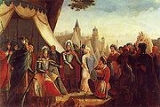
The Siege of Lisbon, from July 1 to October 25, 1147, was the military action that brought the city of Lisbon
under definitive Portuguese control and expelled its Moorish
overlords. The Siege of Lisbon was one of the few Christian victories of the Second Crusade
—it was "the only success of the universal operation undertaken by the pilgrim army," i.e. the Second Crusade, according to the contemporary historian Helmold
—and is seen as a pivotal battle of the wider Reconquista
.
The Fall of Edessa
in 1144 led to a call for a new crusade by Pope Eugene III
in 1145 and 1146. In the spring of 1147, the Pope authorized the crusade in the Iberian peninsula
. He also authorized Alfonso VII of León and Castile to equate his campaigns against the Moors with the rest of the Second Crusade
. In May 1147, the first contingents of crusaders left from Dartmouth
in England for the Holy Land
. Bad weather forced the ships to stop on the Portuguese coast, at the northern city of Porto
on June 16, 1147. There they were convinced to meet with King Afonso I of Portugal
.
The crusaders agreed to help the King attack Lisbon, with a solemn agreement that offered to the crusaders the pillage of the city's goods and the ransom money for expected prisoners. The siege began on July 1. After four months, the Almoravid rulers agreed to surrender on October 24, primarily because of hunger within the city. Most of the crusaders settled in the newly captured city, but some of the crusaders set sail and continued to the Holy Land. Lisbon eventually became capital city of the Kingdom of Portugal
, in 1255.
in 722. After the First Crusade
in 1095-1099, Pope Paschal II
urged Iberian crusaders (Portuguese, Castilians
, Leonese
, Aragonese
, and others) to remain at home, where their own warfare was considered just as worthy as that of crusaders travelling to Jerusalem.
The Fall of Edessa
in 1144 led to a call for a new crusade by Pope Eugene III
in 1145 and 1146. In the spring of 1147, the Pope also authorized a crusade in the Iberian peninsula
, where the war against the Moors
had been going on for hundreds of years. Eugene encouraged Marseille
, Pisa
, Genoa
, and other Mediterranean cities to fight in Iberia. He also authorized Alfonso VII of León and Castile to equate his campaigns against the Moors with the rest of the Second Crusade
.
On May 19, 1147, the first contingents of crusaders left from Dartmouth
in England, consisting of Flemish, Frisian, Norman
, English, and Scottish crusaders, and some from Cologne
, who collectively considered themselves "Franks". No prince or king led this part of the crusade, England at the time being in the midst of The Anarchy
. The fleet was commanded by Henry Glanville, Constable of Suffolk. Other crusader captains included Arnold III of Aerschot, Christian of Ghistelles, Simon of Dover, Andrew of London, and Saher of Archelle.
 According to Odo of Deuil
there were 164 ships bound for the Holy Land
, and there may have been as many as 200 by the time they reached the Iberian shore. Bad weather forced the ships to stop on the Portuguese coast, at the northern city of Porto
on June 16, 1147. There they were convinced by the bishop, Pedro II Pitões
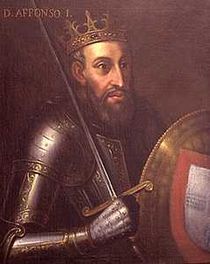
, to meet with King Afonso of Portugal
. The king, who had reached the Tagus River and conquered Santarém
in March, had also been negotiating with the pope for the recognition of his title of King. He was notified of the arrival of a first party and hastened to meet them.
The undisciplined multi-national group agreed to help him there, with a solemn agreement that offered to the crusaders the pillage of the city's goods and the ransom money for expected prisoners. For the city, "they shall have it and hold it until it has been searched and despoiled, both of prisoners for ransom and of everything else. Then, when it has been as thoroughly searched as they wish, they shall turn it over to me..." Afonso promised to divide the conquered territories as fiefs among the leaders. He reserved the power of advocatus
and released those who were at the siege and their heirs trading in Portugal from the commercial tax called the pedicata.
The English crusaders were at first unenthusiastic, but Henry Glanville convinced them to participate. Hostages were exchanged as sureties for the oaths.
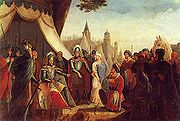 The siege began on July 1. The Christians soon captured the surrounding territories and besieged the walls of Lisbon itself. After four months, the Moorish rulers agreed to surrender (October 21), because the Crusaders' siege tower reached their wall (thus causing a one day standstill) and because of hunger within the city, which was sheltering populations displaced from Santarém
as well as "the leading citizens of Sintra
, Almada
, and Palmela
."
After a brief riotous insurrection the Anglo-Norman chronicler attributes to "the men of Cologne
and the Flemings", the city was entered by the Christian conquerors, on October 25. The terms of the surrender indicated that the Muslim garrison of the city would be allowed to keep their lives and property, but as soon as the Christians entered the city these terms were broken. According to the De expugnatione Lyxbonensi
,
was elected bishop
. This is seen as the beginning of the historic relationship between England and Portugal which would later form the Anglo-Portuguese Alliance
. In spite of the contractual nature of the city's surrender, a legend arose that the brave Portuguese warrior and nobleman, Martim Moniz
, sacrificed himself in order to keep the city doors open to the conquering Christian armies.
Lisbon eventually became the capital city of the Kingdom of Portugal in 1255. The victory was a turning-point in the history of Portugal
and the wider Reconquista
, which would be completed in 1492.
Lisbon
Lisbon is the capital city and largest city of Portugal with a population of 545,245 within its administrative limits on a land area of . The urban area of Lisbon extends beyond the administrative city limits with a population of 3 million on an area of , making it the 9th most populous urban...
under definitive Portuguese control and expelled its Moorish
Al-Andalus
Al-Andalus was the Arabic name given to a nation and territorial region also commonly referred to as Moorish Iberia. The name describes parts of the Iberian Peninsula and Septimania governed by Muslims , at various times in the period between 711 and 1492, although the territorial boundaries...
overlords. The Siege of Lisbon was one of the few Christian victories of the Second Crusade
Second Crusade
The Second Crusade was the second major crusade launched from Europe. The Second Crusade was started in response to the fall of the County of Edessa the previous year to the forces of Zengi. The county had been founded during the First Crusade by Baldwin of Boulogne in 1098...
—it was "the only success of the universal operation undertaken by the pilgrim army," i.e. the Second Crusade, according to the contemporary historian Helmold
Helmold
Helmold of Bosau was a Saxon historian of the 12th century and a priest at Bosau near Plön. He was a friend of the two bishops of Oldenburg in Holstein, Vicelinus and Gerold , who did much to Christianize the Polabian Slavs.Helmold was born near Goslar...
—and is seen as a pivotal battle of the wider Reconquista
Reconquista
The Reconquista was a period of almost 800 years in the Middle Ages during which several Christian kingdoms succeeded in retaking the Muslim-controlled areas of the Iberian Peninsula broadly known as Al-Andalus...
.
The Fall of Edessa
Siege of Edessa
The Siege of Edessa took place from November 28 to December 24, 1144, resulting in the fall of the capital of the crusader County of Edessa to Zengi, the atabeg of Mosul and Aleppo.- Background :...
in 1144 led to a call for a new crusade by Pope Eugene III
Pope Eugene III
Pope Blessed Eugene III , born Bernardo da Pisa, was Pope from 1145 to 1153. He was the first Cistercian to become Pope.-Early life:...
in 1145 and 1146. In the spring of 1147, the Pope authorized the crusade in the Iberian peninsula
Iberian Peninsula
The Iberian Peninsula , sometimes called Iberia, is located in the extreme southwest of Europe and includes the modern-day sovereign states of Spain, Portugal and Andorra, as well as the British Overseas Territory of Gibraltar...
. He also authorized Alfonso VII of León and Castile to equate his campaigns against the Moors with the rest of the Second Crusade
Second Crusade
The Second Crusade was the second major crusade launched from Europe. The Second Crusade was started in response to the fall of the County of Edessa the previous year to the forces of Zengi. The county had been founded during the First Crusade by Baldwin of Boulogne in 1098...
. In May 1147, the first contingents of crusaders left from Dartmouth
Dartmouth, Devon
Dartmouth is a town and civil parish in the English county of Devon. It is a tourist destination set on the banks of the estuary of the River Dart, which is a long narrow tidal ria that runs inland as far as Totnes...
in England for the Holy Land
Holy Land
The Holy Land is a term which in Judaism refers to the Kingdom of Israel as defined in the Tanakh. For Jews, the Land's identifiction of being Holy is defined in Judaism by its differentiation from other lands by virtue of the practice of Judaism often possible only in the Land of Israel...
. Bad weather forced the ships to stop on the Portuguese coast, at the northern city of Porto
Porto
Porto , also known as Oporto in English, is the second largest city in Portugal and one of the major urban areas in the Iberian Peninsula. Its administrative limits include a population of 237,559 inhabitants distributed within 15 civil parishes...
on June 16, 1147. There they were convinced to meet with King Afonso I of Portugal
Afonso I of Portugal
Afonso I or Dom Afonso Henriques , more commonly known as Afonso Henriques , nicknamed "the Conqueror" , "the Founder" or "the Great" by the Portuguese, and El-Bortukali and Ibn-Arrik by the Moors whom he fought, was the first King of Portugal...
.
The crusaders agreed to help the King attack Lisbon, with a solemn agreement that offered to the crusaders the pillage of the city's goods and the ransom money for expected prisoners. The siege began on July 1. After four months, the Almoravid rulers agreed to surrender on October 24, primarily because of hunger within the city. Most of the crusaders settled in the newly captured city, but some of the crusaders set sail and continued to the Holy Land. Lisbon eventually became capital city of the Kingdom of Portugal
Kingdom of Portugal
The Kingdom of Portugal was Portugal's general designation under the monarchy. The kingdom was located in the west of the Iberian Peninsula, Europe and existed from 1139 to 1910...
, in 1255.
Second Crusade
The traditional start of the Reconquista is identified with the defeat of the Muslims in the Battle of CovadongaBattle of Covadonga
The Battle of Covadonga was the first major victory by a Christian military force in Iberia following the Muslim Moors' conquest of that region in 711...
in 722. After the First Crusade
First Crusade
The First Crusade was a military expedition by Western Christianity to regain the Holy Lands taken in the Muslim conquest of the Levant, ultimately resulting in the recapture of Jerusalem...
in 1095-1099, Pope Paschal II
Pope Paschal II
Pope Paschal II , born Ranierius, was Pope from August 13, 1099, until his death. A monk of the Cluniac order, he was created cardinal priest of the Titulus S...
urged Iberian crusaders (Portuguese, Castilians
Kingdom of Castile
Kingdom of Castile was one of the medieval kingdoms of the Iberian Peninsula. It emerged as a political autonomous entity in the 9th century. It was called County of Castile and was held in vassalage from the Kingdom of León. Its name comes from the host of castles constructed in the region...
, Leonese
Kingdom of León
The Kingdom of León was an independent kingdom situated in the northwest region of the Iberian Peninsula. It was founded in AD 910 when the Christian princes of Asturias along the northern coast of the peninsula shifted their capital from Oviedo to the city of León...
, Aragonese
Kingdom of Aragon
The Kingdom of Aragon was a medieval and early modern kingdom in the Iberian Peninsula, corresponding to the modern-day autonomous community of Aragon, in Spain...
, and others) to remain at home, where their own warfare was considered just as worthy as that of crusaders travelling to Jerusalem.
The Fall of Edessa
Siege of Edessa
The Siege of Edessa took place from November 28 to December 24, 1144, resulting in the fall of the capital of the crusader County of Edessa to Zengi, the atabeg of Mosul and Aleppo.- Background :...
in 1144 led to a call for a new crusade by Pope Eugene III
Pope Eugene III
Pope Blessed Eugene III , born Bernardo da Pisa, was Pope from 1145 to 1153. He was the first Cistercian to become Pope.-Early life:...
in 1145 and 1146. In the spring of 1147, the Pope also authorized a crusade in the Iberian peninsula
Iberian Peninsula
The Iberian Peninsula , sometimes called Iberia, is located in the extreme southwest of Europe and includes the modern-day sovereign states of Spain, Portugal and Andorra, as well as the British Overseas Territory of Gibraltar...
, where the war against the Moors
Moors
The description Moors has referred to several historic and modern populations of the Maghreb region who are predominately of Berber and Arab descent. They came to conquer and rule the Iberian Peninsula for nearly 800 years. At that time they were Muslim, although earlier the people had followed...
had been going on for hundreds of years. Eugene encouraged Marseille
Marseille
Marseille , known in antiquity as Massalia , is the second largest city in France, after Paris, with a population of 852,395 within its administrative limits on a land area of . The urban area of Marseille extends beyond the city limits with a population of over 1,420,000 on an area of...
, Pisa
Republic of Pisa
The Republic of Pisa was a de facto independent state centered on the Tuscan city of Pisa during the late tenth and eleventh centuries. It rose to become an economic powerhouse, a commercial center whose merchants dominated Mediterranean and Italian trade for a century before being surpassed and...
, Genoa
Republic of Genoa
The Most Serene Republic of Genoa |Ligurian]]: Repúbrica de Zêna) was an independent state from 1005 to 1797 in Liguria on the northwestern Italian coast, as well as Corsica from 1347 to 1768, and numerous other territories throughout the Mediterranean....
, and other Mediterranean cities to fight in Iberia. He also authorized Alfonso VII of León and Castile to equate his campaigns against the Moors with the rest of the Second Crusade
Second Crusade
The Second Crusade was the second major crusade launched from Europe. The Second Crusade was started in response to the fall of the County of Edessa the previous year to the forces of Zengi. The county had been founded during the First Crusade by Baldwin of Boulogne in 1098...
.
On May 19, 1147, the first contingents of crusaders left from Dartmouth
Dartmouth, Devon
Dartmouth is a town and civil parish in the English county of Devon. It is a tourist destination set on the banks of the estuary of the River Dart, which is a long narrow tidal ria that runs inland as far as Totnes...
in England, consisting of Flemish, Frisian, Norman
Normans
The Normans were the people who gave their name to Normandy, a region in northern France. They were descended from Norse Viking conquerors of the territory and the native population of Frankish and Gallo-Roman stock...
, English, and Scottish crusaders, and some from Cologne
Cologne
Cologne is Germany's fourth-largest city , and is the largest city both in the Germany Federal State of North Rhine-Westphalia and within the Rhine-Ruhr Metropolitan Area, one of the major European metropolitan areas with more than ten million inhabitants.Cologne is located on both sides of the...
, who collectively considered themselves "Franks". No prince or king led this part of the crusade, England at the time being in the midst of The Anarchy
The Anarchy
The Anarchy or The Nineteen-Year Winter was a period of English history during the reign of King Stephen, which was characterised by civil war and unsettled government...
. The fleet was commanded by Henry Glanville, Constable of Suffolk. Other crusader captains included Arnold III of Aerschot, Christian of Ghistelles, Simon of Dover, Andrew of London, and Saher of Archelle.
Redirected efforts
Odo of Deuil
Odo, Odon, or Eudes of Deuil was an historian and participant of the Second Crusade .Born at Deuil to a modest family, he became a monk and was a confidant of Suger, abbot of Saint-Denis...
there were 164 ships bound for the Holy Land
Holy Land
The Holy Land is a term which in Judaism refers to the Kingdom of Israel as defined in the Tanakh. For Jews, the Land's identifiction of being Holy is defined in Judaism by its differentiation from other lands by virtue of the practice of Judaism often possible only in the Land of Israel...
, and there may have been as many as 200 by the time they reached the Iberian shore. Bad weather forced the ships to stop on the Portuguese coast, at the northern city of Porto
Porto
Porto , also known as Oporto in English, is the second largest city in Portugal and one of the major urban areas in the Iberian Peninsula. Its administrative limits include a population of 237,559 inhabitants distributed within 15 civil parishes...
on June 16, 1147. There they were convinced by the bishop, Pedro II Pitões
Pedro II Pitões, Bishop of Porto
Pedro II Pitões was the Bishop of Porto at the time of the Second Crusade. In June 1147, he convinced the Flemish, Frisian, Norman, English, and Scottish crusaders that had landed at Porto to advance to Lisbon with King Afonso I of Portugal....
, to meet with King Afonso of Portugal
Afonso I of Portugal
Afonso I or Dom Afonso Henriques , more commonly known as Afonso Henriques , nicknamed "the Conqueror" , "the Founder" or "the Great" by the Portuguese, and El-Bortukali and Ibn-Arrik by the Moors whom he fought, was the first King of Portugal...
. The king, who had reached the Tagus River and conquered Santarém
Santarém, Portugal
Santarém is a city in the Santarém Municipality in Portugal. The city itself has a population of 28,760 and the entire municipality has 64,124 inhabitants.It is the capital of Santarém District....
in March, had also been negotiating with the pope for the recognition of his title of King. He was notified of the arrival of a first party and hastened to meet them.
The undisciplined multi-national group agreed to help him there, with a solemn agreement that offered to the crusaders the pillage of the city's goods and the ransom money for expected prisoners. For the city, "they shall have it and hold it until it has been searched and despoiled, both of prisoners for ransom and of everything else. Then, when it has been as thoroughly searched as they wish, they shall turn it over to me..." Afonso promised to divide the conquered territories as fiefs among the leaders. He reserved the power of advocatus
Advocatus
An advocatus, or advocate, was generally a medieval term meaning "lawyer". The term was also used in continental Europe as the title of the lay lord charged with the protection and representation in secular matters of an abbey, known more fully as an advocatus ecclesiae.-Middle Ages:The office is...
and released those who were at the siege and their heirs trading in Portugal from the commercial tax called the pedicata.
The English crusaders were at first unenthusiastic, but Henry Glanville convinced them to participate. Hostages were exchanged as sureties for the oaths.
Fall of Lisbon
Santarém, Portugal
Santarém is a city in the Santarém Municipality in Portugal. The city itself has a population of 28,760 and the entire municipality has 64,124 inhabitants.It is the capital of Santarém District....
as well as "the leading citizens of Sintra
Sintra
Sintra is a town within the municipality of Sintra in the Grande Lisboa subregion of Portugal. Owing to its 19th century Romantic architecture and landscapes, becoming a major tourist centre, visited by many day-trippers who travel from the urbanized suburbs and capital of Lisbon.In addition to...
, Almada
Almada
Almada is a municipality in Portugal, covering an area of 70.2 km² located on the southern margin of the Tagus River. Its municipal population in 2008 was 164,844 inhabitants; the urbanized center had a population of 102,357.The seat is the city of Almada....
, and Palmela
Palmela
Palmela is a town and a municipality in Portugal with a total area of and a total population of 58,222 inhabitants.The municipality is composed of 5 parishes, and is located in Setúbal District, about south of Lisbon.The municipal holiday is June 1....
."
After a brief riotous insurrection the Anglo-Norman chronicler attributes to "the men of Cologne
Cologne
Cologne is Germany's fourth-largest city , and is the largest city both in the Germany Federal State of North Rhine-Westphalia and within the Rhine-Ruhr Metropolitan Area, one of the major European metropolitan areas with more than ten million inhabitants.Cologne is located on both sides of the...
and the Flemings", the city was entered by the Christian conquerors, on October 25. The terms of the surrender indicated that the Muslim garrison of the city would be allowed to keep their lives and property, but as soon as the Christians entered the city these terms were broken. According to the De expugnatione Lyxbonensi
De expugnatione Lyxbonensi
De expugnatione Lyxbonensi is an eyewitness account of the Siege of Lisbon at the start of the Second Crusade, and covers the expedition from the departure of the English contingent on 23 May 1147 until the fall of Lisbon on 28 June 1148...
,
Aftermath
Some of the crusaders set sail and continued to the Holy Land. Most of the crusaders however settled in the newly captured city; thus boosting the number of Spanish Christian supporters in Iberia, and Gilbert of HastingsGilbert of Hastings
Gilbert of Hastings was an English monk in the Christian army of the Second Crusade that fought in the siege of Lisbon. After the victory, he was chosen to be Bishop of Lisbon.-Notes:...
was elected bishop
Patriarch of Lisbon
The Patriarch of Lisbon is an honorary title possessed by the archbishop of the Archdiocese of Lisbon.The first patriarch of Lisbon was D. Tomás de Almeida, who was appointed in 1716 by Pope Clement XI...
. This is seen as the beginning of the historic relationship between England and Portugal which would later form the Anglo-Portuguese Alliance
Anglo-Portuguese Alliance
The Anglo-Portuguese Alliance, ratified at the Treaty of Windsor in 1386, between England and Portugal is claimed to be the oldest alliance in the world which is still in force — with the earliest treaty dating back to the Anglo-Portuguese Treaty of 1373.This alliance, which goes back to the...
. In spite of the contractual nature of the city's surrender, a legend arose that the brave Portuguese warrior and nobleman, Martim Moniz
Martim Moniz
Martim Moniz was a Portuguese knight of noble birth, and famous figure in the Siege of Lisbon in 1147.According to the legend, Martim Moniz was a knight participating in the Christian invasion force, led by king Afonso I of Portugal, in the Siege of Lisbon, during the Reconquista. At one point in...
, sacrificed himself in order to keep the city doors open to the conquering Christian armies.
Lisbon eventually became the capital city of the Kingdom of Portugal in 1255. The victory was a turning-point in the history of Portugal
History of Portugal
The history of Portugal, a European and an Atlantic nation, dates back to the Early Middle Ages. In the 15th and 16th centuries, it ascended to the status of a world power during Europe's "Age of Discovery" as it built up a vast empire including possessions in South America, Africa, Asia and...
and the wider Reconquista
Reconquista
The Reconquista was a period of almost 800 years in the Middle Ages during which several Christian kingdoms succeeded in retaking the Muslim-controlled areas of the Iberian Peninsula broadly known as Al-Andalus...
, which would be completed in 1492.
See also
- Lisbon Castle
- The Establishment of the Monarchy in Portugal
- Timeline of Portuguese historyTimeline of Portuguese historyThis is a historical timeline of Portugal.*Timeline of Iberian prehistory*Pre-Roman Iberia *Roman Lusitania and Gallaecia *Germanic Kingdoms...
- First Dynasty: Burgundy (12th to 14th Century)Timeline of Portuguese history (First Dynasty)This is a historical timeline of Portugal.-12th century:*1128, July 24 – Count Afonso Henriques defeats his mother, Theresa, Countess of Portugal, in the Battle of São Mamede and becomes sole ruler after demands for independence from the county's people, church and nobles.*1129 - April 6, Afonso...
- First Dynasty: Burgundy (12th to 14th Century)
Further reading
- Odo of DeuilOdo of DeuilOdo, Odon, or Eudes of Deuil was an historian and participant of the Second Crusade .Born at Deuil to a modest family, he became a monk and was a confidant of Suger, abbot of Saint-Denis...
. De profectione Ludovici VII in orientem. Edited and translated by Virginia Gingerick Berry. Columbia University Press, 1948. - Kenneth Setton, ed. A History of the Crusades, vol. I. University of Pennsylvania Press, 1958.
- Osbernus De expugnatione Lyxbonensi or The Capture of Lisbon On-line excerpt, in English.