

Battle of Covadonga

Encyclopedia
The Battle of Covadonga was the first major victory by a Christian
military force
in Iberia
following the Muslim Moors' conquest of that region in 711
. Taking place about a decade later, most likely in the summer of 722, the victory at Covadonga assured the survival of a Christian stronghold in northern Iberia, and today is regarded as the beginning of the Reconquista
.
From the perspective of the following seven centuries, this view of the battle has some validity - since the battle assured the independence of the Kingdom of Asturias
, and it is that kingdom which eventually became the nucleus of new Christian rule over the entire peninsula. There is no reason to assume, however, that contemporaries (either Christian or Muslim) regarded it as anything more than part of local rebellion in a marginal area.
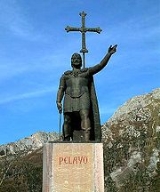
According to texts written by Mozarabs in northern Iberia during the ninth century, noble Visigoths, in 718 AD, elected a man named Pelagius (681-737) as their leader. Pelagius, a son of Favila, who had been a dignitary at the court of the Visigoth King Egica (687-700), established his headquarters at Cangas de Onís
, Asturias
and incited an uprising against the Umayyad
Muslims.
From the beginning of the Muslim invasion of Iberia, refugees and combatants from the south of the peninsula had been moving north to avoid Islamic authority. Some had taken refuge in the remote mountains of Asturias
in the northwestern part of the Iberian peninsula
. There, from among the dispossessed of the south, Pelagius recruited his band of fighters. His first acts were to refuse to pay the Jizya
(tax on non-Muslims) to the Moors any longer and to assault the small Berber
garrisons that had been stationed in the area. Eventually, he managed to expel a provincial governor named Munuza
from Asturias
. He held the territory against a number of attempts to re-establish Muslim control, and soon founded the Kingdom of Asturias
, which became a Christian stronghold against further Muslim expansion.
For the first few years, this rebellion posed no economic or strategic threat to the new masters of Iberia, whose seat of power had been established at Cordoba
. Consequently, there was only a quite perfunctory reaction. Pelagius was not always able to keep the Muslims out of Asturias, but neither could they defeat him, and as soon as the Muslims left, he would always re-establish control. Islamic forces were focused on raiding Narbonne
and Gaul
, and there was a shortage of manpower for putting down an inconsequential, albeit irritating, insurrection in the mountains. Pelagius never attempted to force the issue, and it was a Moorish defeat elsewhere that probably set the stage for the Battle of Covadonga. On July 9, 721, a Muslim force that had crossed the Pyrenees
and invaded the Kingdom of the Franks
was defeated by them in the Battle of Toulouse
, in present-day France. This was the first serious setback in the Muslim campaign in southwestern Europe. Reluctant to return to Cordoba with such unalloyed bad news, the Ummayad wāli
, Anbasa ibn Suhaym Al-Kalbi
, decided that putting down the rebellion in Asturias on his way home would afford his troops an easy victory and raise their flagging morale.
In 722, forces commanded by the Berbers Al Qama and Munuza
, accompanied by Bishop Oppas
of Seville, brother of the former Visigothic King Witiza
, were sent to Asturias. As Al Qama overran much of the region, Oppas attempted to broker the surrender of his fellow Christians, but he failed in the effort. Pelagius and his force retreated deep into the mountains of Asturias, eventually retiring into a narrow valley flanked by mountains, which was easily defensible due to the impossibility of launching a broad-fronted attack. Pelagius may have had as few as three hundred men with him.
Al Qama eventually arrived at Covadonga, and sent forward an envoy to convince Pelagius to surrender. He refused, so Al Qama ordered his best troops into the valley to fight. The Asturians opened fire from the slopes of the mountains, and then, at the climactic moment, Pelagius personally led some of his soldiers out into the valley. They had been hiding in a cave, unseen by the Moors. The Christian accounts of the battle claim that the slaughter among the Moors was horrific, while Moorish accounts describe it as a mere skirmish. Al Qama himself fell in the battle, and his soldiers fled from the battlefield.
In the aftermath of Pelagius' victory, the people of the conquered villages of Asturias now emerged with their weapons, and killed hundreds of Al Qama's fleeing troops. Munuza, learning of the defeat, organized another force, and gathered what was left of the survivors of Covadonga. At some later date, he confronted Pelagius and his now greatly augmented force, near the modern town of Proaza. Again Pelagius won, and Munuza was killed in the fighting. And although the Muslims in their own histories called Pelagius and his men "thirty Infidels left, what can they do", they never again seriously challenged the independence of the Kingdom of Asturias
. The battle is commemorated at the shrine of Our Lady of Covadonga
.
Christianity
Christianity is a monotheistic religion based on the life and teachings of Jesus as presented in canonical gospels and other New Testament writings...
military force
Force
In physics, a force is any influence that causes an object to undergo a change in speed, a change in direction, or a change in shape. In other words, a force is that which can cause an object with mass to change its velocity , i.e., to accelerate, or which can cause a flexible object to deform...
in Iberia
Iberian Peninsula
The Iberian Peninsula , sometimes called Iberia, is located in the extreme southwest of Europe and includes the modern-day sovereign states of Spain, Portugal and Andorra, as well as the British Overseas Territory of Gibraltar...
following the Muslim Moors' conquest of that region in 711
Umayyad conquest of Hispania
The Umayyad conquest of Hispania is the initial Islamic Ummayad Caliphate's conquest, between 711 and 718, of the Christian Visigothic Kingdom of Hispania, centered in the Iberian Peninsula, which was known to them under the Arabic name al-Andalus....
. Taking place about a decade later, most likely in the summer of 722, the victory at Covadonga assured the survival of a Christian stronghold in northern Iberia, and today is regarded as the beginning of the Reconquista
Reconquista
The Reconquista was a period of almost 800 years in the Middle Ages during which several Christian kingdoms succeeded in retaking the Muslim-controlled areas of the Iberian Peninsula broadly known as Al-Andalus...
.
From the perspective of the following seven centuries, this view of the battle has some validity - since the battle assured the independence of the Kingdom of Asturias
Kingdom of Asturias
The Kingdom of Asturias was a Kingdom in the Iberian peninsula founded in 718 by Visigothic nobles under the leadership of Pelagius of Asturias. It was the first Christian political entity established following the collapse of the Visigothic kingdom after Islamic conquest of Hispania...
, and it is that kingdom which eventually became the nucleus of new Christian rule over the entire peninsula. There is no reason to assume, however, that contemporaries (either Christian or Muslim) regarded it as anything more than part of local rebellion in a marginal area.
According to texts written by Mozarabs in northern Iberia during the ninth century, noble Visigoths, in 718 AD, elected a man named Pelagius (681-737) as their leader. Pelagius, a son of Favila, who had been a dignitary at the court of the Visigoth King Egica (687-700), established his headquarters at Cangas de Onís
Cangas de Onis
Cangas de Onís is a municipality in the eastern part of the province and autonomous community of Asturias in the northwest of Spain. The capital of the municipality is also Cangas de Onís....
, Asturias
Asturias
The Principality of Asturias is an autonomous community of the Kingdom of Spain, coextensive with the former Kingdom of Asturias in the Middle Ages...
and incited an uprising against the Umayyad
Umayyad
The Umayyad Caliphate was the second of the four major Arab caliphates established after the death of Muhammad. It was ruled by the Umayyad dynasty, whose name derives from Umayya ibn Abd Shams, the great-grandfather of the first Umayyad caliph. Although the Umayyad family originally came from the...
Muslims.
From the beginning of the Muslim invasion of Iberia, refugees and combatants from the south of the peninsula had been moving north to avoid Islamic authority. Some had taken refuge in the remote mountains of Asturias
Asturias
The Principality of Asturias is an autonomous community of the Kingdom of Spain, coextensive with the former Kingdom of Asturias in the Middle Ages...
in the northwestern part of the Iberian peninsula
Iberian Peninsula
The Iberian Peninsula , sometimes called Iberia, is located in the extreme southwest of Europe and includes the modern-day sovereign states of Spain, Portugal and Andorra, as well as the British Overseas Territory of Gibraltar...
. There, from among the dispossessed of the south, Pelagius recruited his band of fighters. His first acts were to refuse to pay the Jizya
Jizya
Under Islamic law, jizya or jizyah is a per capita tax levied on a section of an Islamic state's non-Muslim citizens, who meet certain criteria...
(tax on non-Muslims) to the Moors any longer and to assault the small Berber
Berber people
Berbers are the indigenous peoples of North Africa west of the Nile Valley. They are continuously distributed from the Atlantic to the Siwa oasis, in Egypt, and from the Mediterranean to the Niger River. Historically they spoke the Berber language or varieties of it, which together form a branch...
garrisons that had been stationed in the area. Eventually, he managed to expel a provincial governor named Munuza
Munuza
Uthman ibn Naissa better known as Munuza was the Moorish governor of northern Iberia in the early 8th century. He was subject to the Wāli of Al-Andalus, Anbasa ibn Suhaym Al-Kalbi. He was defeated in the Battle of Covadonga and killed by Pelayo of Asturias at the beginning of the Reconquista...
from Asturias
Asturias
The Principality of Asturias is an autonomous community of the Kingdom of Spain, coextensive with the former Kingdom of Asturias in the Middle Ages...
. He held the territory against a number of attempts to re-establish Muslim control, and soon founded the Kingdom of Asturias
Kingdom of Asturias
The Kingdom of Asturias was a Kingdom in the Iberian peninsula founded in 718 by Visigothic nobles under the leadership of Pelagius of Asturias. It was the first Christian political entity established following the collapse of the Visigothic kingdom after Islamic conquest of Hispania...
, which became a Christian stronghold against further Muslim expansion.
For the first few years, this rebellion posed no economic or strategic threat to the new masters of Iberia, whose seat of power had been established at Cordoba
Córdoba, Spain
-History:The first trace of human presence in the area are remains of a Neanderthal Man, dating to c. 32,000 BC. In the 8th century BC, during the ancient Tartessos period, a pre-urban settlement existed. The population gradually learned copper and silver metallurgy...
. Consequently, there was only a quite perfunctory reaction. Pelagius was not always able to keep the Muslims out of Asturias, but neither could they defeat him, and as soon as the Muslims left, he would always re-establish control. Islamic forces were focused on raiding Narbonne
Narbonne
Narbonne is a commune in southern France in the Languedoc-Roussillon region. It lies from Paris in the Aude department, of which it is a sub-prefecture. Once a prosperous port, it is now located about from the shores of the Mediterranean Sea...
and Gaul
Gaul
Gaul was a region of Western Europe during the Iron Age and Roman era, encompassing present day France, Luxembourg and Belgium, most of Switzerland, the western part of Northern Italy, as well as the parts of the Netherlands and Germany on the left bank of the Rhine. The Gauls were the speakers of...
, and there was a shortage of manpower for putting down an inconsequential, albeit irritating, insurrection in the mountains. Pelagius never attempted to force the issue, and it was a Moorish defeat elsewhere that probably set the stage for the Battle of Covadonga. On July 9, 721, a Muslim force that had crossed the Pyrenees
Pyrenees
The Pyrenees is a range of mountains in southwest Europe that forms a natural border between France and Spain...
and invaded the Kingdom of the Franks
Franks
The Franks were a confederation of Germanic tribes first attested in the third century AD as living north and east of the Lower Rhine River. From the third to fifth centuries some Franks raided Roman territory while other Franks joined the Roman troops in Gaul. Only the Salian Franks formed a...
was defeated by them in the Battle of Toulouse
Battle of Toulouse (721)
The Battle of Toulouse was a victory of an Aquitanian army led by Duke Odo of Aquitaine over an Umayyad army besieging the city of Toulouse, and led by the governor of Al-Andalus, Al-Samh ibn Malik al-Khawlani...
, in present-day France. This was the first serious setback in the Muslim campaign in southwestern Europe. Reluctant to return to Cordoba with such unalloyed bad news, the Ummayad wāli
Wali
Walī , is an Arabic word meaning "custodian", "protector", "sponsor", or authority as denoted by its definition "crown". "Wali" is someone who has "Walayah" over somebody else. For example, in Fiqh the father is wali of his children. In Islam, the phrase ولي الله walīyu 'llāh...
, Anbasa ibn Suhaym Al-Kalbi
Anbasa ibn Suhaym Al-Kalbi
Anbasa ibn Suhaym al-Kalbi was the Muslim wali of al-Andalus, also known as Moorish Hispania, from 721 to 726 CE....
, decided that putting down the rebellion in Asturias on his way home would afford his troops an easy victory and raise their flagging morale.
In 722, forces commanded by the Berbers Al Qama and Munuza
Munuza
Uthman ibn Naissa better known as Munuza was the Moorish governor of northern Iberia in the early 8th century. He was subject to the Wāli of Al-Andalus, Anbasa ibn Suhaym Al-Kalbi. He was defeated in the Battle of Covadonga and killed by Pelayo of Asturias at the beginning of the Reconquista...
, accompanied by Bishop Oppas
Oppas
Oppas or Oppa was a member of the Visigothic elite in the city of Toledo on the eve of the Muslim conquest of Hispania. He was a son of Egica and therefore a brother or half-brother of Wittiza....
of Seville, brother of the former Visigothic King Witiza
Wittiza
Wittiza was the Visigothic King of Hispania from 694 until his death, co-ruling with his father, Ergica, until 702 or 703.-Joint rule:...
, were sent to Asturias. As Al Qama overran much of the region, Oppas attempted to broker the surrender of his fellow Christians, but he failed in the effort. Pelagius and his force retreated deep into the mountains of Asturias, eventually retiring into a narrow valley flanked by mountains, which was easily defensible due to the impossibility of launching a broad-fronted attack. Pelagius may have had as few as three hundred men with him.
Al Qama eventually arrived at Covadonga, and sent forward an envoy to convince Pelagius to surrender. He refused, so Al Qama ordered his best troops into the valley to fight. The Asturians opened fire from the slopes of the mountains, and then, at the climactic moment, Pelagius personally led some of his soldiers out into the valley. They had been hiding in a cave, unseen by the Moors. The Christian accounts of the battle claim that the slaughter among the Moors was horrific, while Moorish accounts describe it as a mere skirmish. Al Qama himself fell in the battle, and his soldiers fled from the battlefield.
In the aftermath of Pelagius' victory, the people of the conquered villages of Asturias now emerged with their weapons, and killed hundreds of Al Qama's fleeing troops. Munuza, learning of the defeat, organized another force, and gathered what was left of the survivors of Covadonga. At some later date, he confronted Pelagius and his now greatly augmented force, near the modern town of Proaza. Again Pelagius won, and Munuza was killed in the fighting. And although the Muslims in their own histories called Pelagius and his men "thirty Infidels left, what can they do", they never again seriously challenged the independence of the Kingdom of Asturias
Kingdom of Asturias
The Kingdom of Asturias was a Kingdom in the Iberian peninsula founded in 718 by Visigothic nobles under the leadership of Pelagius of Asturias. It was the first Christian political entity established following the collapse of the Visigothic kingdom after Islamic conquest of Hispania...
. The battle is commemorated at the shrine of Our Lady of Covadonga
Our Lady of Covadonga
Our Lady of Covadonga is a title of the Virgin Mary, and a shrine devoted to her at Covadonga in the province of Asturias in north west Spain. The shrine rose to prominence following the Battle of Covadonga in 722, at which the Moorish invasion of Spain was first resisted...
.