
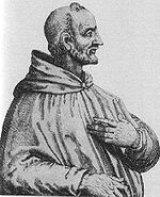
Pope Blessed Eugene III (died July 8, 1153), born
Bernardo da Pisa, was
PopeThe Pope is the Bishop of Rome, a position that makes him the leader of the worldwide Catholic Church . In the Catholic Church, the Pope is regarded as the successor of Saint Peter, the Apostle...
from 1145 to 1153. He was the first Cistercian to become Pope.
Early life
Bernardo was born in
PisaPisa is a city in Tuscany, Central Italy, on the right bank of the mouth of the River Arno on the Tyrrhenian Sea. It is the capital city of the Province of Pisa...
but little is known about his origins and family except that he was son of Godius. From the 16th century he is commonly identified as member of the family of
Paganelli di Montemagno, which belonged to the Pisan aristocracy, but this is not proven and contradicts the earlier testimonies, which suggest that he was a man of rather humble origins. In 1106 he was a canon of the cathedral chapter in Pisa and from 1115 is attested as subdeacon. 1133–1138 he acted as
vicedominus of the archdiocese of Pisa. Between May 1134 and February 1137 he was ordained to the priesthood by Pope Innocent II, who resided at that time in Pisa. Under the influence of
Bernard of ClairvauxBernard of Clairvaux, O.Cist was a French abbot and the primary builder of the reforming Cistercian order.After the death of his mother, Bernard sought admission into the Cistercian order. Three years later, he was sent to found a new abbey at an isolated clearing in a glen known as the Val...
he entered the Cistercian Order in monastery of
ClairvauxClairvaux can mean the following:*Clairvaux, a former commune in France, now part of Ville-sous-la-Ferté. It is the home of**Clairvaux Abbey in France**Clairvaux Prison, France, on the site of the abbey*Saint Bernard of Clairvaux...
in 1138. A year later he returned to Italy as leader of the Cistercian community in
ScandrigliaScandriglia is a comune in the Province of Rieti in the Italian region Latium, located about 40 km northeast of Rome and about 25 km south of Rieti....
. In Autumn 1140 Pope Innocent II named him abbot of the monastery of S. Anastasio alle Tre Fontane outside Rome. Some chronicles indicate that he was also elevated to the College of Cardinals, but these testimonies probably resulted from a confusion because Bernardo is not attested as cardinal in any document and from the letter of Bernard of Clairvaux addressed to the cardinals shortly after his election clearly appears that he was not a cardinal.
Pontificate
Bernardo was elected pope in February 1145 and took the name Eugene III. He owed his elevation partly to the fact that none were eager to accept an office the duties of which were at the time so difficult and dangerous, but chiefly to his being the friend and pupil of
Bernard of ClairvauxBernard of Clairvaux, O.Cist was a French abbot and the primary builder of the reforming Cistercian order.After the death of his mother, Bernard sought admission into the Cistercian order. Three years later, he was sent to found a new abbey at an isolated clearing in a glen known as the Val...
, the most influential ecclesiastic of the Western Church, and a strong assertor of the pope's temporal authority. The choice had not, however, the approval of Bernard, who remonstrated against the election on account of the "innocence and simplicity" of Eugene III; but after the choice was made he took advantage of the qualities in Eugene III which he objected to, so as to virtually rule in his name.
During nearly the whole of his pontificate Eugene III was unable to reside in
RomeRome is the capital of Italy and the country's largest and most populated city and comune, with over 2.7 million residents in . The city is located in the central-western portion of the Italian Peninsula, on the Tiber River within the Lazio region of Italy.Rome's history spans two and a half...
. Hardly had he left the city to be consecrated in the monastery of Farfa (about 40 km north of Rome), when the citizens, under the influence of
Arnold of BresciaArnold of Brescia , also known as Arnaldus , was an Italian monk from Lombardy who called on the Church to renounce ownership of property and participated in the failed Commune of Rome. Eventually arrested, he was hanged by the Church, burned posthumously, and then had his ashes thrown into the...
, the great opponent of the Pope's temporal power, established the old Roman constitution, the
Commune of RomeThe Commune of Rome was an attempt to establish a government like the old Roman Republic in opposition to the temporal power of the higher nobles and the popes beginning in 1144...
and elected
Giordano PierleoniGiordano Pierleoni was the son of the Consul Pier Leoni and therefore brother of Antipope Anacletus II and leader of the Commune of Rome which the people set up in 1143...
to be
patrician. Eugene III appealed for help to
Tivoli, ItalyTivoli , the classical Tibur, is an ancient Italian town in Lazio, about 30 km east-north-east of Rome, at the falls of the Aniene river where it issues from the Sabine hills...
, to other cities at feud with Rome, and to
Roger II of SicilyRoger II was King of Sicily, son of Roger I of Sicily and successor to his brother Simon. He began his rule as Count of Sicily in 1105, later became Duke of Apulia and Calabria , then King of Sicily...
(who sent his general
Robert of SelbyRobert of Selby was an Englishman, a courtier of Roger II and chancellor of the Kingdom of Sicily. His name possibly indicates that he hailed from Selby. He probably journeyed to Sicily about 1130...
), and with their aid was successful in making such conditions with the Roman citizens as enabled him for a time to hold the semblance of authority in his capital; but as he would not agree to a treacherous compact against Tivoli, he was compelled to leave the city in March 1146. He stayed for some time at
ViterboSee also Viterbo, Texas and Viterbo UniversityViterbo is an ancient city and comune in the Lazio region of central Italy, the capital of the province of Viterbo. It is approximately 80 driving / 80 walking kilometers north of GRA on the Via Cassia, and it is surrounded by the Monti Cimini and...
, and then at
SienaSiena is a city in Tuscany, Italy. It is the capital of the province of Siena.The historic centre of Siena has been declared by UNESCO a World Heritage Site. It is one of the nation's most visited tourist attractions, with over 163,000 international arrivals in 2008...
, but went ultimately to France.
On hearing of the
fall of EdessaThe Siege of Edessa took place from November 28 to December 24, 1144, resulting in the fall of the capital of the crusader County of Edessa to Zengi, the atabeg of Mosul and Aleppo.- Background :...
to the Turks, he had, in December 1145, addressed the
bullA Papal bull is a particular type of letters patent or charter issued by a Pope of the Catholic Church. It is named after the bulla that was appended to the end in order to authenticate it....
Quantum praedecessoresQuantum praedecessores is a papal bull issued on December 1, 1145, by Pope Eugenius III, calling for a Second Crusade. It was the first papal bull issued with a crusade as its subject....
to
Louis VII of FranceLouis VII was King of France, the son and successor of Louis VI . He ruled from 1137 until his death. He was a member of the House of Capet. His reign was dominated by feudal struggles , and saw the beginning of the long rivalry between France and England...
(1137–80), calling on him to take part in another crusade; and at a great
dietIn politics, a diet is a formal deliberative assembly. The term is mainly used historically for the Imperial Diet, the general assembly of the Imperial Estates of the Holy Roman Empire, and for the legislative bodies of certain countries.-Etymology:...
held at
SpeyerSpeyer is a city of Rhineland-Palatinate, Germany with approximately 50,000 inhabitants. Located beside the river Rhine, Speyer is 25 km south of Ludwigshafen and Mannheim. Founded by the Romans, it is one of Germany's oldest cities...
in 1146 the Emperor
Conrad IIIConrad III was the first King of Germany of the Hohenstaufen dynasty. He was the son of Frederick I, Duke of Swabia, and Agnes, a daughter of the Salian Emperor Henry IV.-Life and reign:...
(1138–52) also, and many of his nobles, were, by the eloquence of Bernard, incited to dedicate themselves to the Crusade.
He held synods in northern
EuropeEurope is, by convention, one of the world's seven continents. Comprising the westernmost peninsula of Eurasia, Europe is generally 'divided' from Asia to its east by the watershed divides of the Ural and Caucasus Mountains, the Ural River, the Caspian and Black Seas, and the waterways connecting...
, at
ParisParis is the capital and largest city in France, situated on the river Seine, in northern France, at the heart of the Île-de-France region...
, Rheims, and
TrierTrier, historically called in English Treves is a city in Germany on the banks of the Moselle. It is the oldest city in Germany, founded in or before 16 BC....
in 1147 and 1149 which were devoted to the reform of clerical life. He also considered and approved the works of
Hildegard of BingenBlessed Hildegard of Bingen , also known as Saint Hildegard, and Sibyl of the Rhine, was a German writer, composer, philosopher, Christian mystic, Benedictine abbess, visionary, and polymath. Elected a magistra by her fellow nuns in 1136, she founded the monasteries of Rupertsberg in 1150 and...
. In 1149, Eugene III returned to
ItalyItaly , officially the Italian Republic languages]] under the European Charter for Regional or Minority Languages. In each of these, Italy's official name is as follows:;;;;;;;;), is a unitary parliamentary republic in South-Central Europe. To the north it borders France, Switzerland, Austria and...
, and took up his residence at Viterbo. He fled to
Prince PtolemyPtolemy II was the count of Tusculum and consul of the Romans from 1126 to his death...
's fortress in
TusculumTusculum is a ruined Roman city in the Alban Hills, in the Latium region of Italy.-Location:Tusculum is one of the largest Roman cities in Alban Hills. The ruins of Tusculum are located on Tuscolo hill—more specifically on the northern edge of the outer crater ring of the Alban volcano...
on 8 April and remained there, where he met the returning Crusader king
Louis VII of FranceLouis VII was King of France, the son and successor of Louis VI . He ruled from 1137 until his death. He was a member of the House of Capet. His reign was dominated by feudal struggles , and saw the beginning of the long rivalry between France and England...
and his wife
Eleanor of AquitaineEleanor of Aquitaine was one of the wealthiest and most powerful women in Western Europe during the High Middle Ages. As well as being Duchess of Aquitaine in her own right, she was queen consort of France and of England...
. He stayed there until 7 November. In 1150, through the aid of the King of
SicilySicily is a region of Italy, and is the largest island in the Mediterranean Sea. Along with the surrounding minor islands, it constitutes an autonomous region of Italy, the Regione Autonoma Siciliana Sicily has a rich and unique culture, especially with regard to the arts, music, literature,...
, he was again able to enter
RomeRome is the capital of Italy and the country's largest and most populated city and comune, with over 2.7 million residents in . The city is located in the central-western portion of the Italian Peninsula, on the Tiber River within the Lazio region of Italy.Rome's history spans two and a half...
, but the jealousy of the republicans soon compelled him to retire.
The Emperor Frederick I Barbarossa (1152–90) had promised to aid him against his revolted subjects, but the death of Eugene III at Tivoli, on July 8, 1153, prevented the fulfillment of the engagement. Though the citizens of Rome were jealous of the efforts of Eugene III to assert his temporal authority, they were always ready to recognize him as their spiritual lord. Besides that they deeply reverenced his personal character. Accordingly he was buried in the
VaticanVatican City , or Vatican City State, in Italian officially Stato della Città del Vaticano , which translates literally as State of the City of the Vatican, is a landlocked sovereign city-state whose territory consists of a walled enclave within the city of Rome, Italy. It has an area of...
with every mark of respect, and his tomb soon acquired an extraordinary fame for miraculous cures.