


Ship canal

Encyclopedia
Canal
Canals are man-made channels for water. There are two types of canal:#Waterways: navigable transportation canals used for carrying ships and boats shipping goods and conveying people, further subdivided into two kinds:...
especially constructed to carry ocean
Ocean
An ocean is a major body of saline water, and a principal component of the hydrosphere. Approximately 71% of the Earth's surface is covered by ocean, a continuous body of water that is customarily divided into several principal oceans and smaller seas.More than half of this area is over 3,000...
-going ship
Ship
Since the end of the age of sail a ship has been any large buoyant marine vessel. Ships are generally distinguished from boats based on size and cargo or passenger capacity. Ships are used on lakes, seas, and rivers for a variety of activities, such as the transport of people or goods, fishing,...
s, as opposed to barge
Barge
A barge is a flat-bottomed boat, built mainly for river and canal transport of heavy goods. Some barges are not self-propelled and need to be towed by tugboats or pushed by towboats...
s. Ship canals can be enlarged barge canals, canalized or channelized river
Channel (geography)
In physical geography, a channel is the physical confine of a river, slough or ocean strait consisting of a bed and banks.A channel is also the natural or human-made deeper course through a reef, sand bar, bay, or any shallow body of water...
s, or canals especially constructed from the start to accommodate ships.
For a canal to qualify as a ship canal, it must have a minimum depth of at least 5 metres (16.4 feet), although many are much deeper. The purpose of a ship canal is:
- To create a shortcut and avoid lengthy detours.
- To create a navigable shipping link between two land-locked seas or lakes.
- To provide inland cities with a direct shipping link to the sea.
- To provide an economical alternative to other options.
Important ship canals (by length)
| Canal | Length | Lock depth | Dimensions | Location | Notes |
|---|---|---|---|---|---|
| White Sea – Baltic Canal | 141 mi (226.9 km) | 3.5 m (11.5 ft) |  Russia RussiaRussia Russia or , officially known as both Russia and the Russian Federation , is a country in northern Eurasia. It is a federal semi-presidential republic, comprising 83 federal subjects... |
|
|
| Rhine-Main-Danube Canal Rhine-Main-Danube Canal The Rhine–Main–Danube Canal , located in Bavaria, Germany, connects the Main and the Danube rivers across the European Watershed, running from Bamberg via Nuremberg to Kelheim... |
106 mi (170.6 km) | 4 m (13.1 ft) | lock dimensions: 190m x 11.45m x 4m |  Germany Germany |
Danube The Danube is a river in the Central Europe and the Europe's second longest river after the Volga. It is classified as an international waterway.... , and thus also the North Sea North Sea In the southwest, beyond the Straits of Dover, the North Sea becomes the English Channel connecting to the Atlantic Ocean. In the east, it connects to the Baltic Sea via the Skagerrak and Kattegat, narrow straits that separate Denmark from Norway and Sweden respectively... and the Black Sea Black Sea The Black Sea is bounded by Europe, Anatolia and the Caucasus and is ultimately connected to the Atlantic Ocean via the Mediterranean and the Aegean seas and various straits. The Bosphorus strait connects it to the Sea of Marmara, and the strait of the Dardanelles connects that sea to the Aegean... . |
| Suez Canal Suez Canal The Suez Canal , also known by the nickname "The Highway to India", is an artificial sea-level waterway in Egypt, connecting the Mediterranean Sea and the Red Sea. Opened in November 1869 after 10 years of construction work, it allows water transportation between Europe and Asia without navigation... |
100 mi (160.9 km) | 300 m (984.3 ft) wide |  Egypt EgyptEgypt Egypt , officially the Arab Republic of Egypt, Arabic: , is a country mainly in North Africa, with the Sinai Peninsula forming a land bridge in Southwest Asia. Egypt is thus a transcontinental country, and a major power in Africa, the Mediterranean Basin, the Middle East and the Muslim world... |
Mediterranean Sea The Mediterranean Sea is a sea connected to the Atlantic Ocean surrounded by the Mediterranean region and almost completely enclosed by land: on the north by Anatolia and Europe, on the south by North Africa, and on the east by the Levant... to the Red Sea Red Sea The Red Sea is a seawater inlet of the Indian Ocean, lying between Africa and Asia. The connection to the ocean is in the south through the Bab el Mandeb strait and the Gulf of Aden. In the north, there is the Sinai Peninsula, the Gulf of Aqaba, and the Gulf of Suez... . |
|
| Volga-Don Canal Volga-Don Canal Lenin Volga–Don Shipping Canal is a canal which connects the Volga River and the Don River at their closest points. The length of the waterway is 101 km .... |
62 mi (99.8 km) | 3.5 m (11.5 ft) | lock dimensions: 140m x 16.6m x 3.5m | Russia Russia Russia or , officially known as both Russia and the Russian Federation , is a country in northern Eurasia. It is a federal semi-presidential republic, comprising 83 federal subjects... |
Black Sea The Black Sea is bounded by Europe, Anatolia and the Caucasus and is ultimately connected to the Atlantic Ocean via the Mediterranean and the Aegean seas and various straits. The Bosphorus strait connects it to the Sea of Marmara, and the strait of the Dardanelles connects that sea to the Aegean... , Azov, and Caspian Sea Caspian Sea The Caspian Sea is the largest enclosed body of water on Earth by area, variously classed as the world's largest lake or a full-fledged sea. The sea has a surface area of and a volume of... s. |
| Kiel Canal Kiel Canal The Kiel Canal , known as the Kaiser-Wilhelm-Kanal until 1948, is a long canal in the German state of Schleswig-Holstein.The canal links the North Sea at Brunsbüttel to the Baltic Sea at Kiel-Holtenau. An average of is saved by using the Kiel Canal instead of going around the Jutland Peninsula.... |
60 mi (96.6 km) | 14 m (45.9 ft) | lock dimensions: 310m x 42m x 14m | Germany |
North Sea In the southwest, beyond the Straits of Dover, the North Sea becomes the English Channel connecting to the Atlantic Ocean. In the east, it connects to the Baltic Sea via the Skagerrak and Kattegat, narrow straits that separate Denmark from Norway and Sweden respectively... and the Baltic Sea Baltic Sea The Baltic Sea is a brackish mediterranean sea located in Northern Europe, from 53°N to 66°N latitude and from 20°E to 26°E longitude. It is bounded by the Scandinavian Peninsula, the mainland of Europe, and the Danish islands. It drains into the Kattegat by way of the Øresund, the Great Belt and... . |
| Houston Ship Channel Houston Ship Channel The Houston Ship Channel, located in Houston, Texas, is part of the Port of Houston—one of the United States's busiest seaports. The channel is the conduit for ocean-going vessels between the Houston-area shipyards and the Gulf of Mexico.-Overview:... |
56 mi (90.1 km) | 14 m (45.9 ft) | 161 m (528.2 ft) wide |  USA USAUnited States The United States of America is a federal constitutional republic comprising fifty states and a federal district... |
Houston, Texas Houston is the fourth-largest city in the United States, and the largest city in the state of Texas. According to the 2010 U.S. Census, the city had a population of 2.1 million people within an area of . Houston is the seat of Harris County and the economic center of , which is the ... to the Gulf of Mexico Gulf of Mexico The Gulf of Mexico is a partially landlocked ocean basin largely surrounded by the North American continent and the island of Cuba. It is bounded on the northeast, north and northwest by the Gulf Coast of the United States, on the southwest and south by Mexico, and on the southeast by Cuba. In... . |
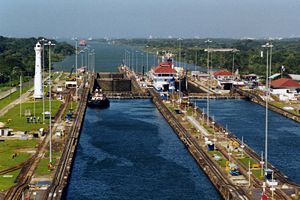
| Panama Canal Panama Canal The Panama Canal is a ship canal in Panama that joins the Atlantic Ocean and the Pacific Ocean and is a key conduit for international maritime trade. Built from 1904 to 1914, the canal has seen annual traffic rise from about 1,000 ships early on to 14,702 vessels measuring a total of 309.6... |
51 mi (82.1 km) | 25.9 m (85 ft) | lock dimensions: 320m x 33.53m x 25.9 m |  Panama PanamaPanama Panama , officially the Republic of Panama , is the southernmost country of Central America. Situated on the isthmus connecting North and South America, it is bordered by Costa Rica to the northwest, Colombia to the southeast, the Caribbean Sea to the north and the Pacific Ocean to the south. The... |
Caribbean Sea The Caribbean Sea is a sea of the Atlantic Ocean located in the tropics of the Western hemisphere. It is bounded by Mexico and Central America to the west and southwest, to the north by the Greater Antilles, and to the east by the Lesser Antilles.... to the Pacific Ocean Pacific Ocean The Pacific Ocean is the largest of the Earth's oceanic divisions. It extends from the Arctic in the north to the Southern Ocean in the south, bounded by Asia and Australia in the west, and the Americas in the east.At 165.2 million square kilometres in area, this largest division of the World... , creating a shortcut. |
| Danube-Black Sea Canal Danube-Black Sea Canal The Danube – Black Sea Canal is a canal in Romania which runs from Cernavodă on the Danube to Agigea and Năvodari on the Black Sea... |
40 mi (64.4 km) | 5.5 m (18 ft) | lock dimensions: 138m x 16.8m x 5.5m |  Romania RomaniaRomania Romania is a country located at the crossroads of Central and Southeastern Europe, on the Lower Danube, within and outside the Carpathian arch, bordering on the Black Sea... |
Danube The Danube is a river in the Central Europe and the Europe's second longest river after the Volga. It is classified as an international waterway.... to the Black Sea Black Sea The Black Sea is bounded by Europe, Anatolia and the Caucasus and is ultimately connected to the Atlantic Ocean via the Mediterranean and the Aegean seas and various straits. The Bosphorus strait connects it to the Sea of Marmara, and the strait of the Dardanelles connects that sea to the Aegean... . |
| Manchester Ship Canal Manchester Ship Canal The Manchester Ship Canal is a river navigation 36 miles long in the North West of England. Starting at the Mersey Estuary near Liverpool, it generally follows the original routes of the rivers Mersey and Irwell through the historic counties of Cheshire and Lancashire. Several sets of locks lift... |
36 mi (57.9 km) | 8.78 m (28.8 ft) | lock dimensions: 170.68m x 21.94m x 8.78m |  UK UKUnited Kingdom The United Kingdom of Great Britain and Northern IrelandIn the United Kingdom and Dependencies, other languages have been officially recognised as legitimate autochthonous languages under the European Charter for Regional or Minority Languages... |
Manchester Manchester is a city and metropolitan borough in Greater Manchester, England. According to the Office for National Statistics, the 2010 mid-year population estimate for Manchester was 498,800. Manchester lies within one of the UK's largest metropolitan areas, the metropolitan county of Greater... to Irish Sea Irish Sea The Irish Sea separates the islands of Ireland and Great Britain. It is connected to the Celtic Sea in the south by St George's Channel, and to the Atlantic Ocean in the north by the North Channel. Anglesey is the largest island within the Irish Sea, followed by the Isle of Man... . |
| Welland Canal Welland Canal The Welland Canal is a ship canal in Canada that extends from Port Weller, Ontario, on Lake Ontario, to Port Colborne, Ontario, on Lake Erie. As a part of the St... |
43.4 km (27 mi) | 8.2 m (26.9 ft) | lock dimensions: 225.5m x 2.3m x 8.2 m |  Canada CanadaCanada Canada is a North American country consisting of ten provinces and three territories. Located in the northern part of the continent, it extends from the Atlantic Ocean in the east to the Pacific Ocean in the west, and northward into the Arctic Ocean... |
Lake Erie Lake Erie is the fourth largest lake of the five Great Lakes in North America, and the tenth largest globally. It is the southernmost, shallowest, and smallest by volume of the Great Lakes and therefore also has the shortest average water residence time. It is bounded on the north by the... to Lake Ontario Lake Ontario Lake Ontario is one of the five Great Lakes of North America. It is bounded on the north and southwest by the Canadian province of Ontario, and on the south by the American state of New York. Ontario, Canada's most populous province, was named for the lake. In the Wyandot language, ontarío means... and is part of the Saint Lawrence Seaway Saint Lawrence Seaway The Saint Lawrence Seaway , , is the common name for a system of locks, canals and channels that permits ocean-going vessels to travel from the Atlantic Ocean to the North American Great Lakes, as far as Lake Superior. Legally it extends from Montreal to Lake Erie, including the Welland Canal... . |
| Saint Lawrence Seaway Saint Lawrence Seaway The Saint Lawrence Seaway , , is the common name for a system of locks, canals and channels that permits ocean-going vessels to travel from the Atlantic Ocean to the North American Great Lakes, as far as Lake Superior. Legally it extends from Montreal to Lake Erie, including the Welland Canal... |
8.2 m (26.9 ft) | lock dimensions: 225.5m x 2.3m x 8.2 m | Canada Canada Canada is a North American country consisting of ten provinces and three territories. Located in the northern part of the continent, it extends from the Atlantic Ocean in the east to the Pacific Ocean in the west, and northward into the Arctic Ocean... USA |
Montreal Montreal is a city in Canada. It is the largest city in the province of Quebec, the second-largest city in Canada and the seventh largest in North America... with Lake Superior Lake Superior Lake Superior is the largest of the five traditionally-demarcated Great Lakes of North America. It is bounded to the north by the Canadian province of Ontario and the U.S. state of Minnesota, and to the south by the U.S. states of Wisconsin and Michigan. It is the largest freshwater lake in the... . |
Navigability
The standard used in the European UnionEuropean Union
The European Union is an economic and political union of 27 independent member states which are located primarily in Europe. The EU traces its origins from the European Coal and Steel Community and the European Economic Community , formed by six countries in 1958...
for classifying the navigability of inland waterways is the European Agreement on Main Inland Waterways of International Importance (AGN) of 1996, adopted by The Inland Transport Committee of the United Nations
United Nations
The United Nations is an international organization whose stated aims are facilitating cooperation in international law, international security, economic development, social progress, human rights, and achievement of world peace...
Economic Commission for Europe (ECE), which defines the following classes: (This table is incomplete.)
| Class | Tonnage (t) | Draught (m) | Length (m) | Width (m) | Air Draught (m) | Description |
|---|---|---|---|---|---|---|
| Class III | 1,000 | |||||
| Class IV | 1,000–1,500 | 2.5 | 80–85 | 9.5 | 5.2–7.0 | Johann Welker |
| Class Va | 1,500–3,000 | 2.5–2.8 | 95–110 | 11.4 | 5.2–7.0–9.1 | Large Rhine |
| Class VIb | 6,400–12,000 | 3.9 | 140 | 15 | 9.1 | |
| Class VII | 14,500–27,000 | 2.5–4.5 | 275–285 | 33.0–34.2 | 9.1 |