
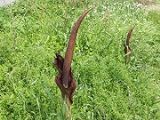
Konjac also known as
konjak,
konjaku,
konnyaku potato,
devil's tongue,
voodoo lily,
snake palm, or
elephant yam (though this name is also used for
A. paeoniifoliusAmorphophallus paeoniifolius, the Elephant foot yam or Whitespot giant arum or Stink lily, is a tropical tuber crop that offers excellent scope for adoption in the tropical countries as a cash crop due to its production potential and popularity as a vegetable in various delicious cuisines.Elephant...
), is a plant of the genus
AmorphophallusAmorphophallus is a large genus of some 170 tropical and subtropical tuberous herbaceous plants from the Arum family...
. It is native to warm subtropical to tropical eastern
AsiaAsia is the world's largest and most populous continent, located primarily in the eastern and northern hemispheres. It covers 8.7% of the Earth's total surface area and with approximately 3.879 billion people, it hosts 60% of the world's current human population...
, from
JapanJapan is an island nation in East Asia. Located in the Pacific Ocean, it lies to the east of the Sea of Japan, China, North Korea, South Korea and Russia, stretching from the Sea of Okhotsk in the north to the East China Sea and Taiwan in the south...
and
ChinaChinese civilization may refer to:* China for more general discussion of the country.* Chinese culture* Greater China, the transnational community of ethnic Chinese.* History of China* Sinosphere, the area historically affected by Chinese culture...
south to
IndonesiaIndonesia , officially the Republic of Indonesia , is a country in Southeast Asia and Oceania. Indonesia is an archipelago comprising approximately 13,000 islands. It has 33 provinces with over 238 million people, and is the world's fourth most populous country. Indonesia is a republic, with an...
.
Konjac also known as
konjak,
konjaku,
konnyaku potato,
devil's tongue,
voodoo lily,
snake palm, or
elephant yam (though this name is also used for
A. paeoniifoliusAmorphophallus paeoniifolius, the Elephant foot yam or Whitespot giant arum or Stink lily, is a tropical tuber crop that offers excellent scope for adoption in the tropical countries as a cash crop due to its production potential and popularity as a vegetable in various delicious cuisines.Elephant...
), is a plant of the genus
AmorphophallusAmorphophallus is a large genus of some 170 tropical and subtropical tuberous herbaceous plants from the Arum family...
. It is native to warm subtropical to tropical eastern
AsiaAsia is the world's largest and most populous continent, located primarily in the eastern and northern hemispheres. It covers 8.7% of the Earth's total surface area and with approximately 3.879 billion people, it hosts 60% of the world's current human population...
, from
JapanJapan is an island nation in East Asia. Located in the Pacific Ocean, it lies to the east of the Sea of Japan, China, North Korea, South Korea and Russia, stretching from the Sea of Okhotsk in the north to the East China Sea and Taiwan in the south...
and
ChinaChinese civilization may refer to:* China for more general discussion of the country.* Chinese culture* Greater China, the transnational community of ethnic Chinese.* History of China* Sinosphere, the area historically affected by Chinese culture...
south to
IndonesiaIndonesia , officially the Republic of Indonesia , is a country in Southeast Asia and Oceania. Indonesia is an archipelago comprising approximately 13,000 islands. It has 33 provinces with over 238 million people, and is the world's fourth most populous country. Indonesia is a republic, with an...
.
It is a
perennial plantA perennial plant or simply perennial is a plant that lives for more than two years. The term is often used to differentiate a plant from shorter lived annuals and biennials. The term is sometimes misused by commercial gardeners or horticulturalists to describe only herbaceous perennials...
, growing from a large
cormA corm is a short, vertical, swollen underground plant stem that serves as a storage organ used by some plants to survive winter or other adverse conditions such as summer drought and heat ....
up to 25 cm in diameter. The single
leafA leaf is an organ of a vascular plant, as defined in botanical terms, and in particular in plant morphology. Foliage is a mass noun that refers to leaves as a feature of plants....
is up to 1.3 m across, bipinnate, and divided into numerous leaflets. The
flowerA flower, sometimes known as a bloom or blossom, is the reproductive structure found in flowering plants . The biological function of a flower is to effect reproduction, usually by providing a mechanism for the union of sperm with eggs...
s are produced on a spathe enclosed by a dark purple
spadixIn botany, a spadix is a type of spike inflorescence having small flowers borne on a fleshy stem. Spadix are typical of the Family Araceae known as arums or aroids...
up to 55 cm long.
The
cormA corm is a short, vertical, swollen underground plant stem that serves as a storage organ used by some plants to survive winter or other adverse conditions such as summer drought and heat ....
of the konjac is often colloquially referred to as a
yamYam is the common name for some species in the genus Dioscorea . These are perennial herbaceous vines cultivated for the consumption of their starchy tubers in Africa, Asia, Latin America and Oceania...
, although it bears no marked relation to
tuberTubers are various types of modified plant structures that are enlarged to store nutrients. They are used by plants to survive the winter or dry months and provide energy and nutrients for regrowth during the next growing season and they are a means of asexual reproduction...
s of the family
DioscoreaceaeDioscoreaceae is a family of monocotyledonous flowering plants, with about 750 species in eight or nine genera. The best-known member of the family is the Yam ....
.
Cultivation and use
Konjac is grown in
IndiaIndia , officially the Republic of India , is a country in South Asia. It is the seventh-largest country by geographical area, the second-most populous country with over 1.2 billion people, and the most populous democracy in the world...
, China, Japan and
KoreaKorea ) is an East Asian geographic region that is currently divided into two separate sovereign states — North Korea and South Korea. Located on the Korean Peninsula, Korea is bordered by the People's Republic of China to the northwest, Russia to the northeast, and is separated from Japan to the...
for its large
starchStarch or amylum is a carbohydrate consisting of a large number of glucose units joined together by glycosidic bonds. This polysaccharide is produced by all green plants as an energy store...
y corms, used to create a
flourFlour is a powder which is made by grinding cereal grains, other seeds or roots . It is the main ingredient of bread, which is a staple food for many cultures, making the availability of adequate supplies of flour a major economic and political issue at various times throughout history...
and
jellyFruit preserves are preparations of fruits and sugar, often canned or sealed for long-term storage. The preparation of fruit preserves today often involves adding commercial or natural pectin as a gelling agent, although sugar or honey may be used, as well. Prior to World War II, fruit preserve...
of the same name. It is also used as a vegan substitute for
gelatinGelatin is a translucent, colorless, brittle , flavorless solid substance, derived from the collagen inside animals' skin and bones. It is commonly used as a gelling agent in food, pharmaceuticals, photography, and cosmetic manufacturing. Substances containing gelatin or functioning in a similar...
.
In
Japanese cuisineJapanese cuisine has developed over the centuries as a result of many political and social changes throughout Japan. The cuisine eventually changed with the advent of the Medieval age which ushered in a shedding of elitism with the age of shogun rule...
, konjac (known as konnyaku) appears in dishes such as
odenOden is a Japanese winter dish consisting of several ingredients such as boiled eggs, daikon radish, konnyaku, and processed fish cakes stewed in a light, soy-flavoured dashi broth. Ingredients vary according to region and between each household...
. It is typically mottled grey and firmer in consistency than most gelatins. It has very little taste; the common variety tastes vaguely like
saltIn chemistry, salts are ionic compounds that result from the neutralization reaction of an acid and a base. They are composed of cations and anions so that the product is electrically neutral...
. It is valued more for its
textureMouthfeel is a product's physical and chemical interaction in the mouth, an aspect of food rheology. It is a concept used in many areas related to the testing and evaluating of foodstuffs, such as wine-tasting and rheology. It is evaluated from initial perception on the palate, to first bite,...
than flavor.
Ito konnyaku (糸蒟蒻) is a type of Japanese food consisting of konjac cut into noodle-like strips. It is usually sold in plastic bags with accompanying water. It is often used in
sukiyakiSukiyaki is a Japanese dish in the nabemono style.It consists of meat which is slowly cooked or simmered at the table, alongside vegetables and other ingredients, in a shallow iron pot in a mixture of soy sauce, sugar, and mirin...
and oden. The name literally means "thread-konjac."
Japanese konnyaku is made by mixing konjac flour with water and limewater.
Hijikiis a brown sea vegetable growing wild on rocky coastlines around Japan, Korea, and China. The written kanji forms of its two names, which are examples of ateji, literally mean deer-tail grass and sheep-nest grass, respectively.Hijiki is a traditional food and has been a part of a balanced diet in...
is often added for the characteristic dark color and flavor. Without additives for color, konnyaku is pale white. It is then boiled and cooled to solidify. Konnyaku made in
noodleThe noodle is a type of food, made from any of a variety of doughs, formed into long thin ribbons, strips, curly-cues, waves, helices, pipes, tubes, strings, or other various shapes, sometimes folded. They are usually cooked in a mixture of boiling water and/or oil. Depending upon the type, noodles...
form is called
shirataki (see
shirataki noodlesare very low carbohydrate, low calorie, thin, translucent, gelatinous traditional Japanese noodles made from devil's tongue yam . The word "shirataki" means "white waterfall", describing the appearance of these noodles...
) and used in foods such as sukiyaki and
gyudon, , is a Japanese dish consisting of a bowl of rice topped with beef and onion simmered in a mildly sweet sauce flavored with dashi , soy sauce and mirin . It also often includes shirataki noodles, and is sometimes topped with a raw egg...
.
Konjac is consumed in parts of China's
Sichuan' , known formerly in the West by its postal map spellings of Szechwan or Szechuan is a province in Southwest China with its capital in Chengdu...
province; the corm is called
moyu (魔芋 or Devil's Taro), and the jelly is called "konjac tofu" (魔芋豆腐
moyu doufu) or "snow konjac" (雪魔芋
xue moyu).
The dried corm of the konjac plant contains around 40%
glucomannanGlucomannan is a water-soluble polysaccharide that is considered a dietary fiber. Glucomannan is a food additive used as an emulsifier and thickener. Products containing glucomannan, marketed under a variety of brand names, are also sold as nutritional supplements for constipation, obesity, high...
gum. This
polysaccharidePolysaccharides are long carbohydrate molecules, of repeated monomer units joined together by glycosidic bonds. They range in structure from linear to highly branched. Polysaccharides are often quite heterogeneous, containing slight modifications of the repeating unit. Depending on the structure,...
makes konjac jelly highly
viscousViscosity is a measure of the resistance of a fluid which is being deformed by either shear or tensile stress. In everyday terms , viscosity is "thickness" or "internal friction". Thus, water is "thin", having a lower viscosity, while honey is "thick", having a higher viscosity...
.
Konjac has almost 0 calories but is very high in fiber. Thus, it is often used as a
diet foodDiet food refers to any food or drink whose recipe has been altered in some way to make it part of a body modification diet...
. It can also be used for facial massage accessories which are currently popular in Korea.
The product Lipozene is made from the Konjac root.
Fruit jelly
Konjac can also be made into a popular Asian fruit jelly snack, known variously in the United States as lychee cups (after a typical flavor and
Nata de cocoNata de coco is a chewy, translucent, jelly-like food product produced by the fermentation of coconut water, which gels through the production of microbial cellulose by Acetobacter xylinus. Nata de coco is most commonly sweetened as a candy or dessert, and can accompany many things including...
cube suspended in the gel) or konjac candy, usually served in bite-sized plastic cups.
Choking risk
Perhaps due to several highly publicized deaths and near-deaths in the
San Francisco Bay AreaThe San Francisco Bay Area, commonly known as the Bay Area, is a populated region that surrounds the San Francisco and San Pablo estuaries in Northern California. The region encompasses metropolitan areas of San Francisco, Oakland, and San Jose, along with smaller urban and rural areas...
among children and elderly due to suffocation while eating konjac candy, there were U.S.
Food and Drug AdministrationThe Food and Drug Administration is an agency of the United States Department of Health and Human Services, one of the United States federal executive departments...
(FDA) product warnings in 2001 and subsequent recalls in the United States and Canada. Unlike gelatine and some other commonly used gelling agents, konjac fruit jelly does not melt readily in the mouth. Some products formed a gel strong enough such that only chewing, not tongue pressure or breathing pressure, could disintegrate the gel. Although the product is intended to be eaten by gently squeezing the gel's cup, a consumer could suck the product out with enough force to unintentionally lodge it in his or her trachea. Konjac fruit jelly was subsequently also banned in the European Union.
Some konjac jelly snacks are not of a size and consistency to pose any unusual choking risk but are nonetheless affected by the government bans. Some products that remain in Asian markets have an increased size, unusual shape, and more delicate consistency than the round plug-like gels that were associated with the choking incidents. The snacks usually have warning labels advising parents to make sure that their children chew the jelly thoroughly before swallowing. Japan's largest manufacturer of konjac snacks,
MannanLifeis a company in Japan that sells "Konnyaku Batake" fruit-flavoured konnyaku jelly. MannanLife holds a 60 to 70 percent share of the konnyaku jelly market in Japan....
, has temporarily stopped production of the jellies after it was revealed that a 21-month-old Japanese boy had choked to death on a frozen MannanLife konjac jelly. , seventeen people have died from choking on konjac since 1995.
External links