


Wagyu

Encyclopedia
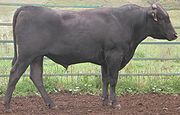
Beef cattle
Beef cattle are cattle raised for meat production . The meat of cattle is known as beef. When raised in a feedlot cattle are known as feeder cattle. Many such feeder cattle are born in cow-calf operations specifically designed to produce beef calves...
of cattle
Cattle
Cattle are the most common type of large domesticated ungulates. They are a prominent modern member of the subfamily Bovinae, are the most widespread species of the genus Bos, and are most commonly classified collectively as Bos primigenius...
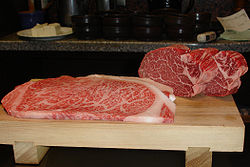
genetically predisposed to intense marbling
Marbled meat
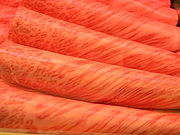
Marbled meat is meat, especially red meat, which contains various amounts of intramuscular fat, giving it an appearance similar to a marble pattern.- Selective breeding :Marbling can be influenced by selective breeding...
and to producing a high percentage of oleaginous unsaturated fat
Unsaturated fat
An unsaturated fat is a fat or fatty acid in which there is at least one double bond within the fatty acid chain. A fat molecule is monounsaturated if it contains one double bond, and polyunsaturated if it contains more than one double bond. Where double bonds are formed, hydrogen atoms are...
. The meat from wagyu cattle is known worldwide for its marbling characteristics, increased eating quality through a naturally enhanced flavor, tenderness and juiciness, and a high market value. In several areas of Japan, beef is shipped with area names. Some examples are Kobe
Kobe beef
refers to cuts of beef from the black Tajima-ushi breed of Wagyū cattle, raised according to strict tradition in Hyōgo Prefecture, Japan. The meat is generally considered to be a delicacy, renowned for its flavour, tenderness, and fatty, well-marbled texture. Kobe beef can be prepared as steak,...
, Mishima
Mishima beef
is a type of beef produced in Japan that is much rarer than Kobe beef. It is named after the tiny Mishima Island in the Sea of Japan 40 km northwest of Yamaguchi Prefecture....
, Matsusaka
Matsusaka beef
is black-haired wagyū , aka "Kuroge Washu" or "Japanese Black", originating in the Matsusaka region of Mie, Japan. It is one of the most famous beef types within Japan and internationally, with a high fat-to-meat ratio...
, Ōmi beef and Sanda beef. Highly prized for their rich flavor, these cattle produce arguably the finest beef in the world. These different breeds produce beef that range from expensive (by any measure) to extremely expensive (about US$
United States dollar
The United States dollar , also referred to as the American dollar, is the official currency of the United States of America. It is divided into 100 smaller units called cents or pennies....
50 per 150 grams of filet steak sold retail in Japan).
Wagyu cattle's genetic predisposition yields a beef that contains a higher percentage of omega-3 and omega-6 fatty acids than typical beef. The increased marbling also improves the ratio of monounsaturated fat
Monounsaturated fat
In biochemistry and nutrition, monounsaturated fats or MUFA are fatty acids that have one double bond in the fatty acid chain and all of the remainder of the carbon atoms in the chain are single-bonded...
s to saturated fat
Saturated fat
Saturated fat is fat that consists of triglycerides containing only saturated fatty acids. Saturated fatty acids have no double bonds between the individual carbon atoms of the fatty acid chain. That is, the chain of carbon atoms is fully "saturated" with hydrogen atoms...
s.
Japan
By order of the ShogunShogun
A was one of the hereditary military dictators of Japan from 1192 to 1867. In this period, the shoguns, or their shikken regents , were the de facto rulers of Japan though they were nominally appointed by the emperor...
, the cattle herd in Japan was closed and eating meat from any four-legged animal was prohibited from 1635 to 1838. Because of Japan's rugged terrain and isolated areas, different breeding and feeding techniques were used such as massaging or adding beer
Beer
Beer is the world's most widely consumed andprobably oldest alcoholic beverage; it is the third most popular drink overall, after water and tea. It is produced by the brewing and fermentation of sugars, mainly derived from malted cereal grains, most commonly malted barley and malted wheat...
or sake to their feeding regimen. It is suggested that this was done to aid in digestion and induce hunger during humid seasons, but it appears to have no effect on the meat's flavor. Massaging may have been introduced to prevent muscle cramping on small farms in Japan where the animals did not have sufficient room to use their muscles.
There are four major breeds of wagyu: , , , and . Japanese breed names include Tajima
Tajima cattle
is one of the types of black Wagyū cattle in Japan. Many tajima cattle are born in Hyōgo Prefecture and raised as stock for famous beef such as Kobe beef and Matsuzaka beef.Tajima cattle has been fed from old times in Tajima Province...
, Hida (Gifu Pref.), Tottori, Shimane, Kochi and Kumamoto. Kumamoto Prefecture
Kumamoto Prefecture
is a prefecture of Japan located on Kyushu Island. The capital is the city of Kumamoto.- History :Historically the area was called Higo Province; and the province was renamed Kumamoto during the Meiji Restoration. The creation of prefectures was part of the abolition of the feudal system...
is famous for its red wagyu cattle. The more famous black variety has its origins in Kobe.
Australia
The Australian Wagyu Association is the largest breed association outside Japan. Both Fullblood and Wagyu cross cattle are farmed in Australia for domestic and overseas markets, including Taiwan, China, Hong Kong, Singapore, Indonesia, the U.K., France, Germany, Denmark and the U.S.A.Australian Wagyu cattle are grain fed for the last 300–500 days of production. Wagyu bred in Western Australia's Margaret River region often have red wine added to their feed as well. Although less than 100,000 of the 28.8 million head of cattle in Australia are Wagyu or Wagyu infused, the long-feed nature of Wagyu production takes up 40% of Australian feedlot space in any given 12-month period.
United States
In the United States, Japanese wagyu cattle were bred with Angus cattleAngus cattle
Angus cattle are a breed of cattle much used in beef production. They were developed from cattle native to the counties of Aberdeenshire and Angus in Scotland, and are known as Aberdeen Angus in most parts of the world....
to create a crossbred animal that would be more able to survive the U.S. climate and ranching methods. The meat of this crossbreed was more marketable to the typical American buyer, for whom the meat of the Wagyu cow is "too white." The meat of the crossbreed provides the balance of marbling and red meat desired by them. This crossbreed has been named American Style Kobe Beef.
Designed to mimic the diet that Japanese cattle were receiving, wagyu cattle in the United States are fed a mixture of corn
Maize
Maize known in many English-speaking countries as corn or mielie/mealie, is a grain domesticated by indigenous peoples in Mesoamerica in prehistoric times. The leafy stalk produces ears which contain seeds called kernels. Though technically a grain, maize kernels are used in cooking as a vegetable...
, alfalfa
Alfalfa
Alfalfa is a flowering plant in the pea family Fabaceae cultivated as an important forage crop in the US, Canada, Argentina, France, Australia, the Middle East, South Africa, and many other countries. It is known as lucerne in the UK, France, Australia, South Africa and New Zealand, and known as...
, barley
Barley
Barley is a major cereal grain, a member of the grass family. It serves as a major animal fodder, as a base malt for beer and certain distilled beverages, and as a component of various health foods...
and wheat
Wheat
Wheat is a cereal grain, originally from the Levant region of the Near East, but now cultivated worldwide. In 2007 world production of wheat was 607 million tons, making it the third most-produced cereal after maize and rice...
straw
Straw
Straw is an agricultural by-product, the dry stalks of cereal plants, after the grain and chaff have been removed. Straw makes up about half of the yield of cereal crops such as barley, oats, rice, rye and wheat. It has many uses, including fuel, livestock bedding and fodder, thatching and...
.
As of 2007, the U.S. cannot ship wagyu beef to Japan, as Japan requires that beef imported from the U.S. be from cattle not older than 20 months; U.S. wagyu cattle are usually slaughtered at 30–35 months.
External links
- American Wagyu Association
- Australian Wagyu Association
- Canadian Wagyu Association
- European Wagyu Association
- German Wagyu Association
- Wagyu Research and Information Department of Animal Sciences, Washington State University
- "Breeding History of Japanese Beef Cattle...", Professor Kiyoshi Namikawa, Department of Animal Sciences, Kyoto University - Kyoto, Japan, circa 1985