

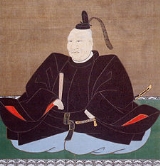
Todo Takatora

Encyclopedia
was a Japanese daimyo
of the Azuchi-Momoyama period
through Edo period
. He rose from relatively humble origins as an ashigaru
(a foot soldier) to become a daimyo. During his lifetime he changed his feudal master seven times and worked for ten people, but in the end he rendered loyalty to Tokugawa Ieyasu
, who became his last master.
 He was promoted rapidly under Hashiba Hidenaga, the younger brother of Toyotomi Hideyoshi
, and he participated in the invasions of Korea as a commander of Toyotomi's fleet. His fiefdom at that time was Iyo
-Uwajima. During the Edo period
, the wealth of each fiefdom was measured as a volume of rice production in koku
. Iyo-Uwajima was assessed at 70,000 koku
.
At the Battle of Sekigahara
in 1600, although he was one of Toyotomi's main generals, he sided with Tokugawa Ieyasu. After war he was given a larger fiefdom, Iyo-Imabari, assessed at 200,000 koku. Later in life he was made lord of Tsu (with landholdings in Iga
and Ise
), a domain of 320,000 koku.
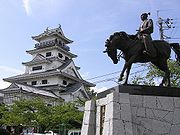
Todo Takatora is also famous for excelling in castle design. He is said to have been involved in building as many as twenty castles.
Daimyo
is a generic term referring to the powerful territorial lords in pre-modern Japan who ruled most of the country from their vast, hereditary land holdings...
of the Azuchi-Momoyama period
Azuchi-Momoyama period
The came at the end of the Warring States Period in Japan, when the political unification that preceded the establishment of the Tokugawa shogunate took place. It spans the years from approximately 1573 to 1603, during which time Oda Nobunaga and his successor, Toyotomi Hideyoshi, imposed order...
through Edo period
Edo period
The , or , is a division of Japanese history which was ruled by the shoguns of the Tokugawa family, running from 1603 to 1868. The political entity of this period was the Tokugawa shogunate....
. He rose from relatively humble origins as an ashigaru
Ashigaru
The Japanese ashigaru were foot-soldiers of medieval Japan. The first known reference to ashigaru was in the 1300s, but it was during the Ashikaga Shogunate-Muromachi period that the use of ashigaru became prevalent by various warring factions.-Origins:Attempts were made in Japan by the Emperor...
(a foot soldier) to become a daimyo. During his lifetime he changed his feudal master seven times and worked for ten people, but in the end he rendered loyalty to Tokugawa Ieyasu
Tokugawa Ieyasu
was the founder and first shogun of the Tokugawa shogunate of Japan , which ruled from the Battle of Sekigahara in 1600 until the Meiji Restoration in 1868. Ieyasu seized power in 1600, received appointment as shogun in 1603, abdicated from office in 1605, but...
, who became his last master.
Toyotomi Hideyoshi
was a daimyo warrior, general and politician of the Sengoku period. He unified the political factions of Japan. He succeeded his former liege lord, Oda Nobunaga, and brought an end to the Sengoku period. The period of his rule is often called the Momoyama period, named after Hideyoshi's castle...
, and he participated in the invasions of Korea as a commander of Toyotomi's fleet. His fiefdom at that time was Iyo
Iyo Province
was an old province of Japan in the area that is today Ehime Prefecture on Shikoku. Iyo bordered on Awa, Sanuki, and Tosa Provinces. It was sometimes called ....
-Uwajima. During the Edo period
Edo period
The , or , is a division of Japanese history which was ruled by the shoguns of the Tokugawa family, running from 1603 to 1868. The political entity of this period was the Tokugawa shogunate....
, the wealth of each fiefdom was measured as a volume of rice production in koku
Koku
The is a Japanese unit of volume, equal to ten cubic shaku. In this definition, 3.5937 koku equal one cubic metre, i.e. 1 koku is approximately 278.3 litres. The koku was originally defined as a quantity of rice, historically defined as enough rice to feed one person for one year...
. Iyo-Uwajima was assessed at 70,000 koku
Koku
The is a Japanese unit of volume, equal to ten cubic shaku. In this definition, 3.5937 koku equal one cubic metre, i.e. 1 koku is approximately 278.3 litres. The koku was originally defined as a quantity of rice, historically defined as enough rice to feed one person for one year...
.
At the Battle of Sekigahara
Battle of Sekigahara
The , popularly known as the , was a decisive battle on October 21, 1600 which cleared the path to the Shogunate for Tokugawa Ieyasu...
in 1600, although he was one of Toyotomi's main generals, he sided with Tokugawa Ieyasu. After war he was given a larger fiefdom, Iyo-Imabari, assessed at 200,000 koku. Later in life he was made lord of Tsu (with landholdings in Iga
Iga Province
was an old province of Japan in the area that is today western Mie Prefecture. It was sometimes called . Iga bordered on Ise, Ōmi, Yamato, and Yamashiro Provinces.-Geography:...
and Ise
Ise Province
or was a province of Japan including most of modern Mie Prefecture. Ise bordered Iga, Kii, Mino, Ōmi, Owari, Shima, and Yamato Provinces.The ancient provincial capital was at Suzuka...
), a domain of 320,000 koku.
Todo Takatora is also famous for excelling in castle design. He is said to have been involved in building as many as twenty castles.