

Battle of Qarqar

Encyclopedia
The Battle of Qarqar was fought in 853 BC when the army of Assyria
led by king Shalmaneser III
encountered an allied army of 12 kings at Qarqar led by Hadadezer
(also called Adad-idr and possibly to be identified with Benhadad II) of Damascus
and King Ahab of Israel. This battle, fought during the 854 BC-846 BC Assyrian Conquest of Syria
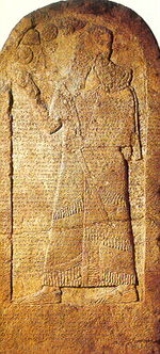
, is notable for having a larger number of combatants than any previous battle, and for being the first instance in which some peoples enter recorded history (such as the Arabs). The battle is recorded on The Kurkh Monolith. The ancient town of Qarqar at which the battle took place has generally been identified with the modern-day archaeological site of Tell Qarqur
.
According to an inscription later erected by Shalmaneser, he had started his annual campaign, leaving Nineveh
on the 14th day of Aiaru. He crossed both the Tigris
and Euphrates
without incident, receiving the submission and tribute of several cities along the way, including Aleppo
. Once past Aleppo he encountered his first resistance from troops of Iruleni, king of Hamath, whom he defeated; in retribution, he plundered both the palaces and the cities of Iruleni's kingdom. Continuing his march after having sacked Qarqar, he encountered the allied forces near the Orontes River
.
term meant to symbolize any kind of alliance. The most famous example is in the Kurkh Monolith
, where an alliance of 11 kings are listed as 12 in the Assyria
n document as fighting against Assyrian King Shalmaneser III
in the battle of Qarqar.
Shalmaneser's inscription describes the forces of his opponent Hadadezer in considerable detail as follows:
Assyria
Assyria was a Semitic Akkadian kingdom, extant as a nation state from the mid–23rd century BC to 608 BC centred on the Upper Tigris river, in northern Mesopotamia , that came to rule regional empires a number of times through history. It was named for its original capital, the ancient city of Assur...
led by king Shalmaneser III
Shalmaneser III
Shalmaneser III was king of Assyria , and son of the previous ruler, Ashurnasirpal II....
encountered an allied army of 12 kings at Qarqar led by Hadadezer
Hadadezer
Hadadezer ; also known as Adad-Idri and possibly the same as Bar-Hadad II ; Ben-Hadad II , was the king of Aram Damascus at the time of the battle of Qarqar against the Assyrian king Shalmaneser III in 853 BCE. He and Irhuleni of Hamath led a coalition of eleven kings at Qarqar...
(also called Adad-idr and possibly to be identified with Benhadad II) of Damascus
Aram Damascus
Aram Damascus was an Aramaean state around Damascus in Syria, from the late 12th century BCE to 734 BCE.Sources for this state come from texts that can be divided into three categories: Assyrian annals, Aramaean texts, and the Hebrew Bible....
and King Ahab of Israel. This battle, fought during the 854 BC-846 BC Assyrian Conquest of Syria
Assyrian Conquest of Syria
Assyrian Conquest of Syria was an invasion by the armies of Assyria led by King Shalmaneser III to conquer Syria. The war resulted in the formation of what became known as the 12 kings alliance against Assyria...
, is notable for having a larger number of combatants than any previous battle, and for being the first instance in which some peoples enter recorded history (such as the Arabs). The battle is recorded on The Kurkh Monolith. The ancient town of Qarqar at which the battle took place has generally been identified with the modern-day archaeological site of Tell Qarqur
Tell Qarqur
Tell Qarqur is a major archaeological site located in the Orontes River Valley of western Syria. Situated in a rich alluvial plain known as the Ghab valley, the double-mounded site lies near the modern Syrian town of Jisr ash-Shugur and the village of Qarqur....
.
According to an inscription later erected by Shalmaneser, he had started his annual campaign, leaving Nineveh
Nineveh
Nineveh was an ancient Assyrian city on the eastern bank of the Tigris River, and capital of the Neo Assyrian Empire. Its ruins are across the river from the modern-day major city of Mosul, in the Ninawa Governorate of Iraq....
on the 14th day of Aiaru. He crossed both the Tigris
Tigris
The Tigris River is the eastern member of the two great rivers that define Mesopotamia, the other being the Euphrates. The river flows south from the mountains of southeastern Turkey through Iraq.-Geography:...
and Euphrates
Euphrates
The Euphrates is the longest and one of the most historically important rivers of Western Asia. Together with the Tigris, it is one of the two defining rivers of Mesopotamia...
without incident, receiving the submission and tribute of several cities along the way, including Aleppo
Aleppo
Aleppo is the largest city in Syria and the capital of Aleppo Governorate, the most populous Syrian governorate. With an official population of 2,301,570 , expanding to over 2.5 million in the metropolitan area, it is also one of the largest cities in the Levant...
. Once past Aleppo he encountered his first resistance from troops of Iruleni, king of Hamath, whom he defeated; in retribution, he plundered both the palaces and the cities of Iruleni's kingdom. Continuing his march after having sacked Qarqar, he encountered the allied forces near the Orontes River
Orontes River
The Orontes or ‘Āṣī is a river of Lebanon, Syria and Turkey.It was anciently the chief river of the Levant, also called Draco, Typhon and Axius...
.
The Twelve Kings
Twelve Kings is an AkkadianAkkadian language
Akkadian is an extinct Semitic language that was spoken in ancient Mesopotamia. The earliest attested Semitic language, it used the cuneiform writing system derived ultimately from ancient Sumerian, an unrelated language isolate...
term meant to symbolize any kind of alliance. The most famous example is in the Kurkh Monolith
Kurkh Monolith
The Kurkh Monolith is an Assyrian document that contains a description of the Battle of Qarqar at the end. Today it stands in the British Museum but it was originally found at the Kurdish village of Kurkh , near the town of Bismil in the province of Diyarbakır, Turkey...
, where an alliance of 11 kings are listed as 12 in the Assyria
Assyria
Assyria was a Semitic Akkadian kingdom, extant as a nation state from the mid–23rd century BC to 608 BC centred on the Upper Tigris river, in northern Mesopotamia , that came to rule regional empires a number of times through history. It was named for its original capital, the ancient city of Assur...
n document as fighting against Assyrian King Shalmaneser III
Shalmaneser III
Shalmaneser III was king of Assyria , and son of the previous ruler, Ashurnasirpal II....
in the battle of Qarqar.
Shalmaneser's inscription describes the forces of his opponent Hadadezer in considerable detail as follows:
- King HadadezerHadadezerHadadezer ; also known as Adad-Idri and possibly the same as Bar-Hadad II ; Ben-Hadad II , was the king of Aram Damascus at the time of the battle of Qarqar against the Assyrian king Shalmaneser III in 853 BCE. He and Irhuleni of Hamath led a coalition of eleven kings at Qarqar...
himself commanded 1,200 chariots, 1,200 horsemen and 20,000 soldiers; - King Irhuleni of Hamath commanded 700 chariots, 700 horsemen and 10,000 soldiers;
- King AhabAhabAhab or Ach'av or Achab in Douay-Rheims was king of Israel and the son and successor of Omri according to the Hebrew Bible. His wife was Jezebel....
of Israel sent 2,000 chariots and 10,000 soldiers; - The land of KUR Gu-a-a (sometimes identified with Que - CiliciaCiliciaIn antiquity, Cilicia was the south coastal region of Asia Minor, south of the central Anatolian plateau. It existed as a political entity from Hittite times into the Byzantine empire...
) sent 500 soldiers; - The land of KUR Mu-us-ra- (sometimes identified with EgyptEgyptEgypt , officially the Arab Republic of Egypt, Arabic: , is a country mainly in North Africa, with the Sinai Peninsula forming a land bridge in Southwest Asia. Egypt is thus a transcontinental country, and a major power in Africa, the Mediterranean Basin, the Middle East and the Muslim world...
but possibly somewhere near Que) sent 1,000 soldiers; - The land of Irqanata (Tell Arqa) sent 10 chariots and 10,000 soldiers;
- The land of ArwadArwadArwad – formerly known as Arado , Arados , Arvad, Arpad, Arphad, and Antiochia in Pieria , also called Ruad Island – located in the Mediterranean Sea, is the only inhabited island in Syria. The town of Arwad takes up the entire island...
sent 200 soldiers; - The land of Usannata (in the Jeble region of Lebanon) sent 200 soldiers;
- The land of Shianu (in the Jeble region) - figures lost
- King GindibuGindibuGindibu led the Arab forces at the Battle of Qarqar , as an ally of Ben Haddad the king of the Aramean state of Damascus, as they fought against Assyria...
of ArabiaArabian PeninsulaThe Arabian Peninsula is a land mass situated north-east of Africa. Also known as Arabia or the Arabian subcontinent, it is the world's largest peninsula and covers 3,237,500 km2...
sent 1000 camelCamelA camel is an even-toed ungulate within the genus Camelus, bearing distinctive fatty deposits known as humps on its back. There are two species of camels: the dromedary or Arabian camel has a single hump, and the bactrian has two humps. Dromedaries are native to the dry desert areas of West Asia,...
-riders; - King Ba'asa, son of RuhubiRuhubiRuhubi was the father of Baasha ben Ruhubi, who was king of Ammon in the 850s BCE. Whether Ruhubi himself was king of Ammon is unclear, as no Ammonite inscriptions from his reign have been unearthed and he is not mentioned independently in any Assyrian sources. On the Kurkh Monolith Ammon may be...
, of the land of Aman (anti-Lebanon) - numbers lost.
Battle
Shalmaneser boasts that his troops inflicted 14,000 casualties upon the allied army, capturing countless chariots and horses, and describes the damage he inflicted on his opponents in savage detail. However, the royal inscriptions from this period are notoriously unreliable and never directly acknowledge defeats, and sometimes claim victories that were actually won by ancestors or predecessors. If Shalmaneser had won a clear victory at Qarqar, it did not immediately lead to further Assyrian conquests in Syria. Assyrian records make it clear that he campaigned in the region several more times in the following decade, engaging Hadadezer six times, who was supported by Iruleni of Hamath at least twice. Shalmaneser's opponents held on to their thrones after this battle: though Ahab of Israel died shortly afterwards in an unrelated battle, Hadadezer was king of Damascus until at least 841 BC.External links
- The Battle of Qarqar (853 BCE) at Livius.org