
All Topics  
Treaty of San Francisco

 
Treaty of San Francisco

   Email Print
   Bookmark   Link


Treaty of San Francisco


The Treaty of Peace with Japan (commonly known as the Treaty of San Francisco or San Francisco Peace Treaty), between the Allied Powers
Allies of World War II

The Allies of World War II were the countries officially opposed to the Axis powers of World War II during the World War II. Within the ranks of the Allies powers, the British Empire, the Soviet Union, and the United States of America were known as "The Big Three"....
 and Japan
Japan

Japan is an island country in East Asia. Located in the Pacific Ocean, it lies to the east of the Sea of Japan, People's Republic of China, North Korea, South Korea and Russia, stretching from the Sea of Okhotsk in the north to the East China Sea and Taiwan in the south....
, was officially signed by 49 nation
Nation

A nation is a cultural and social community. In as much as most members never meet each other, yet feel a common bond, it may be considered an imagined community....
s on September 8, 1951 in San Francisco, California
San Francisco, California

The City and County of San Francisco is the fourth most populous city in California and the List of United States cities by population in the United States, with a 2007 estimated population of 799,183....
. It came into force on April 28, 1952.

This treaty served officially to end World War II
World War II

World War II, or the Second World War , was a global military conflict which involved a Participants in World War II, including all of the great powers, organised into two opposing military alliances: the Allies of World War II and the Axis powers....
, to end formally Japan's position as an imperial power and to allocate compensation to Allied civilians and former prisoners of war who had suffered Japanese war crimes
Japanese war crimes

Japanese war crimes occurred during the period of Japanese expansionism. Some of the incidents have also been described as an Asian Holocaust and Japanese war atrocities....
.


Discussion
Ask a question about 'Treaty of San Francisco'
Start a new discussion about 'Treaty of San Francisco'
Answer questions from other users
Full Discussion Forum


Recent Posts


Encyclopedia


The Treaty of Peace with Japan (commonly known as the Treaty of San Francisco or San Francisco Peace Treaty), between the Allied Powers
Allies of World War II

The Allies of World War II were the countries officially opposed to the Axis powers of World War II during the World War II. Within the ranks of the Allies powers, the British Empire, the Soviet Union, and the United States of America were known as "The Big Three"....
 and Japan
Japan

Japan is an island country in East Asia. Located in the Pacific Ocean, it lies to the east of the Sea of Japan, People's Republic of China, North Korea, South Korea and Russia, stretching from the Sea of Okhotsk in the north to the East China Sea and Taiwan in the south....
, was officially signed by 49 nation
Nation

A nation is a cultural and social community. In as much as most members never meet each other, yet feel a common bond, it may be considered an imagined community....
s on September 8, 1951 in San Francisco, California
San Francisco, California

The City and County of San Francisco is the fourth most populous city in California and the List of United States cities by population in the United States, with a 2007 estimated population of 799,183....
. It came into force on April 28, 1952.

This treaty served officially to end World War II
World War II

World War II, or the Second World War , was a global military conflict which involved a Participants in World War II, including all of the great powers, organised into two opposing military alliances: the Allies of World War II and the Axis powers....
, to end formally Japan's position as an imperial power and to allocate compensation to Allied civilians and former prisoners of war who had suffered Japanese war crimes
Japanese war crimes

Japanese war crimes occurred during the period of Japanese expansionism. Some of the incidents have also been described as an Asian Holocaust and Japanese war atrocities....
. This treaty made extensive use of the UN Charter and the Universal Declaration of Human Rights
Universal Declaration of Human Rights

The Universal Declaration of Human Rights is a declaration adopted by the United Nations General Assembly . The Guinness Book of Records describes the UDHR as the "Most Translated Document" in the world....
 to enunciate the Allies' goals.

This treaty, along with the Security Treaty
Treaty of Mutual Cooperation and Security between the United States and Japan

The was signed between the United States and Japan in Washington DC on January 19, 1960. It strengthened Japan's ties to the "West" during the Cold War era....
 signed that same year, is said to mark the beginning of the "San Francisco System"; this term, coined by historian John W. Dower
John W. Dower

John W . Dower is an United States author, professor, and historian; his primary focus is modern Japan and U.S.-Japan relations. He is perhaps best known for his book, Embracing Defeat: Japan in the Wake of World War II, which won the Pulitzer Prize in Letters for General Nonfiction, the National Book Award in Nonfiction, the Bancroft Pr...
, signifies the effects of Japan's relationship with the United States and its role in the international arena as determined by these two treaties and is used to discuss the ways in which these effects have governed Japan's post-war history.

Attending countries

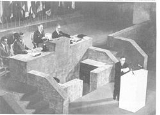
Shigeru Yoshida 1951
Argentina
Argentina

Argentina, officially the Argentine Republic , is a country in South America, constituted as a federation of 23 provinces and an autonomous city....
, Australia
Australia

Australia, officially the Commonwealth of Australia, is a country in the southern hemisphere comprising the Australia of the world's smallest continent, the major island of Tasmania, and numerous list of islands of Australia in the Indian Ocean and Pacific Oceans....
, Belgium
Belgium

* A small German-speaking Community of Belgium exists in eastern Wallonia. Belgium's linguistic diversity and related political and cultural conflicts are reflected in the history of Belgium and a complex Communities and regions of Belgium....
, Bolivia
Bolivia

The Republic of Bolivia , named after Sim?n Bol?var, is a landlocked country in central South America. It is bordered by Brazil on the north and east, Paraguay and Argentina on the south, and Chile and Peru on the west....
, Brazil
Brazil

Brazil , officially the Federative Republic of Brazil , is a country in South America. It is the List of countries and outlying territories by total area country by geographical area, occupying nearly half of South America, the List of countries by population country, and the fourth most populous democracy in the world....
, Cambodia
Cambodia

The Kingdom of Cambodia is a country in South East Asia with a population of over 13 million people. The kingdom's capital and largest city is Phnom Penh....
, Canada
Canada

Canada is a country occupying most of northern North America, extending from the Atlantic Ocean in the east to the Pacific Ocean in the west and northward into the Arctic Ocean....
, Chile
Chile

Chile, officially the Republic of Chile , is a country in South America occupying a long and narrow coastal strip wedged between the Andes mountains and the Pacific Ocean....
, Colombia
Colombia

Colombia , officially the Republic of Colombia , is a country in north-western South America. Colombia is bordered to the east by Venezuela and Brazil; to the south by Ecuador and Peru; to the north by the Caribbean Sea; to the north west by Panama; and to the west by the Pacific Ocean....
, Costa Rica
Costa Rica

Costa Rica, officially the Republic of Costa Rica is a country in Central America, bordered by Nicaragua to the north, Panama to the east and south, the Pacific Ocean to the west and south and the Caribbean Sea to the east....
, Cuba
Cuba

The Republic of Cuba is a country in the Caribbean. It consists of the island of Cuba , the island of Isla de la Juventud, and several adjacent small islands....
, Czechoslovakia
Czechoslovakia

Czechoslovakia was a sovereign state in Central Europe that existed from October 1918 until 1992 . On January 1, 1993, Czechoslovakia dissolution of Czechoslovakia into the Czech Republic and Slovakia....
, Dominican Republic
Dominican Republic

The Dominican Republic is a nation on the island of Hispaniola, part of the Greater Antilles archipelago in the Caribbean region. The western third of the island is occupied by the nation of Haiti, making Hispaniola one of two Caribbean islands that are List of divided islands, Saint Martin being the other....
, Ecuador
Ecuador

Ecuador , officially the , literally, "Republic of the equator") is a representative democratic republic in South America, bordered by Colombia on the north, by Peru on the east and south, and by the Pacific Ocean to the west....
, Egypt
Egypt

Egypt is a country mainly in North Africa, with the Sinai Peninsula forming a land bridge in Western Asia. Covering an area of about , Egypt borders the Mediterranean Sea to the north, the Gaza Strip and Israel to the northeast, the Red Sea to the east, Sudan to the south and Libya to the west....
, El Salvador
El Salvador

El Salvador is the smallest country in the Americas and Central America by size, and the most densely populated nation in Central America. It borders on the Pacific Ocean between Guatemala and Honduras....
, Ethiopia
Ethiopia

Ethiopia , officially the Federal Democratic Republic of Ethiopia, is a landlocked country situated in the Horn of Africa. Ethiopia is bordered by Eritrea to the north, Sudan to the west, Kenya to the south, Somalia to the east and Djibouti to the northeast....
, France
France

France , officially the French Republic , is a country whose Metropolitan France is located in Western Europe and that also comprises various Overseas departments and territories of France....
, Greece
Greece

Greece , officially the Hellenic Republic , is a country in southeastern Europe, situated on the southern end of the Balkans. It has borders with Albania, Bulgaria and the former Yugoslav Republic of Macedonia to the north, and Turkey to the east....
, Guatemala
Guatemala

Guatemala is a country in Central America bordered by Mexico to the north and west, the Pacific Ocean to the southwest, Belize and the Caribbean to the northeast, and Honduras and El Salvador to the southeast....
, Haiti
Haiti

Haiti , officially the Republic of Haiti , is a Haitian Creole language- and French language-speaking Caribbean country. Along with the Dominican Republic, it occupies the island of Hispaniola, in the Greater Antilles archipelago....
, Honduras
Honduras

Honduras is a democratic republic in Central America. It was formerly known as Spanish Honduras to differentiate it from British Honduras ....
, Indonesia
Indonesia

The Republic of Indonesia , is a transcontinental country in Southeast Asia and Oceania. Comprising Islands of Indonesia, it is the world's largest Archipelago state....
, Iran
Iran

Iran , officially the Islamic Republic of Iran and formerly known internationally as Persian Empire until 1935, is a country in Central Eurasia, located on the northeastern shore of the Persian Gulf and the southern shore of the Caspian Sea....
, Iraq
Iraq

Iraq , officially the Republic of Iraq , is a country in Western Asia spanning most of the northwestern end of the Zagros Mountains, the eastern part of the Syrian Desert and the northern part of the Arabian Desert....
, Japan
Japan

Japan is an island country in East Asia. Located in the Pacific Ocean, it lies to the east of the Sea of Japan, People's Republic of China, North Korea, South Korea and Russia, stretching from the Sea of Okhotsk in the north to the East China Sea and Taiwan in the south....
, Laos
Laos

Laos , officially the Lao People's Democratic Republic, is a landlocked country in southeast Asia, bordered by Burma and People's Republic of China to the northwest, Vietnam to the east, Cambodia to the south, and Thailand to the west....
, Lebanon
Lebanon

Lebanon , officially the Republic of Lebanon or Lebanese Republic , is a country in Western Asia, on the eastern shore of the Mediterranean Sea....
, Liberia
Liberia

Liberia , officially the Republic of Liberia, is a country on the west coast of Africa, bordered by Sierra Leone, Guinea, C?te d'Ivoire, and the Atlantic Ocean....
, Luxembourg
Luxembourg

Luxembourg , officially the Grand Duchy of Luxembourg , is a small landlocked country in western Europe, bordered by Belgium, France, and Germany....
, Mexico
Mexico

The United Mexican States , commonly known as Mexico , is a federalism constitutionalism republic in North America. It is bordered on the north by the United States; on the south and west by the Pacific Ocean; on the southeast by Guatemala, Belize, and the Caribbean Sea; and on the east by the Gulf of Mexico....
, The Netherlands, New Zealand
New Zealand

New Zealand is an island country in the south-western Pacific Ocean comprising two main landmasses , and numerous Islands of New Zealand, most notably Stewart Island/Rakiura and the Chatham Islands....
, Nicaragua
Nicaragua

Nicaragua officially the Republic of Nicaragua , is a representative democracy republic. It is the largest state in Central America with an area of 130,000 km2, about the size of the state of New York....
, Norway
Norway

Norway , officially the Kingdom of Norway, is a constitutional monarchy in Northern Europe that occupies the western portion of the Scandinavian Peninsula....
, Pakistan
Pakistan

Pakistan , officially the Islamic Republic of Pakistan, is a country located in South Asia and borders Central Asia and the Middle East. It has a 1,046 kilometre coastline along the Arabian Sea and Gulf of Oman in the south, and is bordered by Afghanistan and Iran in the west, India in the east and People's Republic of China in th...
, Panama
Panama

Panama, officially the Republic of Panama , is the southernmost country of Central America and, in turn, North America. Situated on an isthmus connecting North and South America, some categorize it as a transcontinental nation....
, Paraguay
Paraguay

Paraguay, officially the Republic of Paraguay , is one of the only two landlocked countries in South America . It lies on both banks of the Paraguay River and is bordered by Argentina to the south and southwest, Brazil to the east and northeast, and Bolivia to the northwest....
, Peru
Peru

Peru , officially the Republic of Peru , is a country in western South America. It is bordered on the north by Ecuador and Colombia, on the east by Brazil, on the southeast by Bolivia, on the south by Chile, and on the west by the Pacific Ocean....
, The Philippines, Poland
Poland

Poland , officially the Republic of Poland , is a country in Central Europe. Poland is bordered by Germany to the west; the Czech Republic and Slovakia to the south; Ukraine, Belarus and Lithuania to the east; and the Baltic Sea and Kaliningrad Oblast, a Russian Enclave and exclave, to the north....
, Saudi Arabia
Saudi Arabia

The Kingdom of Saudi Arabia, KSA , is an Arab country and the largest country of the Arabian Peninsula. It is bordered by Jordan on the northwest, Iraq on the north and northeast, Kuwait, Qatar, Bahrain, and the United Arab Emirates on the east, Oman on the southeast, and Yemen on the south....
, the Soviet Union
Soviet Union

The Union of Soviet Socialist Republics was a Constitution of the Soviet Union socialist state that existed in Eurasia from 1922 to 1991.The name is a translation of the , romanization of Russian Soyuz Sovetskikh Sotsialisticheskikh Respublik, abbreviated ????, SSSR....
, Sri Lanka
Sri Lanka

Sri Lanka, officially the Democratic Socialist Republic of Sri Lanka is an island country in South Asia, located about off the southern coast of India....
, South Africa
South Africa

The Republic of South Africa, also known by Official names of South Africa, is a country located at the southern tip of the continent of Africa....
, Syria
Syria

Syria , officially the Syrian Arab Republic , is an Arab-majority country in Southwest Asia, bordering Lebanon and the Mediterranean Sea to the west, Israel to the southwest, Jordan to the south, Iraq to the east, and Turkey to the north....
, Turkey
Turkey

Turkey , known officially as the Republic of Turkey , is a Eurasian country that stretches across the Anatolian peninsula in southwest Asia and Thrace in the Balkans region of Southern Europe....
, the United Kingdom
United Kingdom

The United Kingdom of Great Britain and Northern Ireland, commonly known as the United Kingdom , the UK or Britain,is a sovereign state located off the northwestern coast of continental Europe....
, the United States
United States

The United States of America is a Federal government constitutional republic comprising U.S. state and a federal district. The country is situated mostly in central North America, where its Contiguous United States and Washington, D.C., the Capital districts and territories, lie between the Pacific Ocean and Atlantic Oceans, Borders of the U...
, Uruguay
Uruguay

Uruguay is a country located in the southeastern part of South America. It is home to 3.46 million people, of whom 1.7 million live in the capital Montevideo and its metropolitan area....
, Venezuela
Venezuela

Venezuela , officially the Bolivarian Republic of Venezuela , is a country on the northern coast of South America.The country comprises a continental mainland and numerous islands located off the Venezuelan coastline in the Caribbean Sea....
, Vietnam
Vietnam

Vietnam , officially the Socialist Republic of Vietnam , is the easternmost country on the Indochina Peninsula in Southeast Asia. It is bordered by People's Republic of China to the north, Laos to the northwest, Cambodia to the southwest, and the South China Sea to the east....
.

Burma, India
India

India, officially the Republic of India , is a country in South Asia. It is the List of countries and outlying territories by total area country by geographical area, the List of countries by population country, and the most populous liberal democracy in the world....
 and Yugoslavia
Yugoslavia

File:LocationYugoslavia2.pngYugoslavia is a term that describes three political entities that existed successively on the Balkan Peninsula in Europe, during most of the 20th century....
 were also invited, but did not participate. Neither the Republic of China
Republic of China

The Republic of China , also known as Nationalist China is a country in East Asia that has evolved from a single-party state with full global recognition into a multi-party democratic state with Political status of Taiwan....
 in Taiwan
Taiwan

Taiwan is an island in East Asia. "Taiwan" is also commonly used to refer to the country governed by the Republic of China and to the ROC itself, which governs the island of Taiwan, Orchid Island and Green Island, Taiwan in the Pacific Ocean off the Taiwan coast, the Penghu islands in the Taiwan Strait, and Kinmen and the Matsu Islands...
 nor the People's Republic of China
People's Republic of China

The People's Republic of China , commonly known as China, is the largest country in East Asia and the List of countries by population in the world with over 1.3 billion people, approximately a fifth of the world's population....
 in mainland China
Mainland China

Mainland China, Continental China, the Chinese mainland or simply the mainland, is a geopolitical term refers to the area under the jurisdiction of the People's Republic of China , excluding Hong Kong and Macau, which run on One Country, Two Systems....
 were invited because of the Chinese Civil War
Chinese Civil War

The Chinese Civil War or , which lasted from April 1927 to May 1950, was a civil war in China between the Kuomintang and the Chinese Communist Party ....
 and the controversy over which government was legitimate, and as a consequence of U.S.-U.K. disagreement over the Chinese participation, neither North Korea
North Korea

North Korea, officially the Democratic People's Republic of Korea , is a state in East Asia, occupying the northern half of the Korean Peninsula....
 nor South Korea
South Korea

South Korea, officially the Republic of Korea , ), often referred to as Korea and the "names of Korea#Revival of the names", is a Semi-presidential system republic in East Asia, located in the southern half of the Korean Peninsula....
 were invited. Italy
Italy

Italy , officially the Italian Republic , is a country located on the Italian Peninsula in Southern Europe and on the two largest islands in the Mediterranean Sea, Sicily and Sardinia....
 was not invited either, notwithstanding the fact that the anti-fascist Badoglio
Pietro Badoglio

Pietro Badoglio, 1st Duke of Addis Abeba, 1st Marquess of el Sabotino , was an Italy soldier and politician. He was a member of the National Fascist Party and commanded his nation's troops under Italian dictator Benito Mussolini in the Second Italo-Abyssinian War; his efforts gained him the title Duke of Addis Abeba....
 cabinet had issued a formal declaration of war to Japan on July 14 1945, just a few weeks before the end of the war. Pakistan was a state that had not existed at the time of the war, but was invited since it was one of the successor states of British India; which was a major combatant against Japan.

Soviet Union's opposition to the Treaty


The Soviet Union took part in the San Francisco conference and the Soviet delegation was led by the Soviet Deputy Foreign Minister Andrei Gromyko
Andrei Gromyko

Andrei Andreyevich Gromyko was a Soviet Union politician and diplomat. He served as Foreign Minister of Russia and Chairman of the Presidium of the Supreme Soviet ....
. From the start of the conference the Soviet Union expressed vigorous and vocal opposition to the draft treaty text prepared by the U.S. and Great Britain. The Soviet delegation made several unsuccessful procedural attempts to stall the proceedings. The Soviet Union's objections were detailed in a lengthy September 8, 1951 statement by Gromyko. The statement contained a number of Soviet Union's claims and assertions: that the treaty did not provide any guarantees against the rise of Japanese militarism; that Communist China was not invited to participate despite being one of the main victims of the Japanese aggression; that the Soviet Union was not properly consulted when the treaty was being prepared; that the treaty sets up Japan as an American military base and draws Japan into a military coalition directed against the Soviet Union; that the treaty was in effect a separate peace treaty; that the draft treaty violated the rights of China to Taiwan and several other islands; that several Japanese islands were ceded by the treaty to the United States despite the U.S. having no legitimate claim to them; that the draft treaty, in violation of the Yalta agreement, did not recognize the Soviet Union's sovereignty over South Sakhalin and the Kuril Islands; and other objections.

Signatories and ratification

Of the 52 participating countries 49 signed the treaty. Czechoslovakia
Czechoslovakia

Czechoslovakia was a sovereign state in Central Europe that existed from October 1918 until 1992 . On January 1, 1993, Czechoslovakia dissolution of Czechoslovakia into the Czech Republic and Slovakia....
, Poland
Poland

Poland , officially the Republic of Poland , is a country in Central Europe. Poland is bordered by Germany to the west; the Czech Republic and Slovakia to the south; Ukraine, Belarus and Lithuania to the east; and the Baltic Sea and Kaliningrad Oblast, a Russian Enclave and exclave, to the north....
 and the Soviet Union
Soviet Union

The Union of Soviet Socialist Republics was a Constitution of the Soviet Union socialist state that existed in Eurasia from 1922 to 1991.The name is a translation of the , romanization of Russian Soyuz Sovetskikh Sotsialisticheskikh Respublik, abbreviated ????, SSSR....
 denied the treaty. Colombia, Indonesia and Luxembourg signed the treaty but did not ratify it.

The signatories to the treaty were: Argentina, Australia, Belgium, Bolivia, Brazil, Cambodia, Canada, Ceylon, Chile, Colombia, Costa Rica, Cuba, Dominican Republic, Ecuador, Egypt, El Salvador, Ethiopia, France, Greece, Guatemala, Haiti, Honduras, Indonesia, Iran, Iraq, Laos, Lebanon, Liberia, the Grand Duchy of Luxembourg, Mexico, the Netherlands, New Zealand, Nicaragua, Norway, Pakistan, Panama, Peru, the Republic of the Philippines, Saudi Arabia, Syria, Turkey, the Union of South Africa, the United Kingdom of Great Britain and Northern Ireland, the United States of America, Uruguay, Venezuela, Viet-Nam and Japan.

Neither the Republic of China nor the People's Republic of China were invited to the San Francisco Peace Conference, and thus neither were parties to the San Francisco Treaty. The Treaty of Taipei
Treaty of Taipei

Sino-Japanese Peace Treaty , commonly known as the Treaty of Taipei as it was signed in Taipei, was a peace treaty between Japan and the Republic of China concluded on April 28, 1952....
, formally known as the Sino-Japanese Peace Treaty, was signed in Taipei on 28 April 1952 between Japan and the Republic of China.

The fate of Japanese overseas territories

The document officially renounces Japan
Japan

Japan is an island country in East Asia. Located in the Pacific Ocean, it lies to the east of the Sea of Japan, People's Republic of China, North Korea, South Korea and Russia, stretching from the Sea of Okhotsk in the north to the East China Sea and Taiwan in the south....
's treaty rights derived from the Boxer Protocol
Boxer Protocol

The Boxer Protocol was an unequal treaty signed on September 7, 1901 between the Qing Dynasty of China and the Eight-Nation Alliance?Austria-Hungary, France, Germany, Italy, Japan, Russia, the United Kingdom, and the United States?plus Belgium, Spain and the Netherlands after China's defeat in the Boxer Rebellion at the hands of the Eight-Pow...
 of 1901 and its rights to Korea
Korea

Korea is a geographic area composed of two sovereign countries, a civilization, and a former state situated on the Korean Peninsula in East Asia....
, Formosa (Taiwan
Taiwan

Taiwan is an island in East Asia. "Taiwan" is also commonly used to refer to the country governed by the Republic of China and to the ROC itself, which governs the island of Taiwan, Orchid Island and Green Island, Taiwan in the Pacific Ocean off the Taiwan coast, the Penghu islands in the Taiwan Strait, and Kinmen and the Matsu Islands...
), Hong Kong
Hong Kong

Hong Kong , officially the Hong Kong Special Administrative Region, is a territory located in Southern China in East Asia, bordering the province of Guangdong to the north and facing the South China Sea to the east, west and south....
 (a British colony), the Kuril Islands
Kuril Islands

The Kuril Islands or Kurile Islands in Russia's Sakhalin Oblast region, is a volcanic archipelago that stretches approximately 1,300 km northeast from Hokkaido, Japan, to Kamchatka Peninsula, Russia, separating the Sea of Okhotsk from the North Pacific Ocean....
, the Pescadores
Pescadores

The Penghu islands are an archipelago off the western coast of Taiwan in the Taiwan Strait consisting of 90 small islands and islets covering an area of 141 square kilometers....
, the Spratly Islands
Spratly Islands

The Spratly Islands are a group of more than 650 reefs, islets, atolls, cays and islands in the South China Sea between the Philippines and Vietnam....
, Antarctica
Antarctica

Antarctica is Earth's southernmost continent, overlying the South Pole. It is situated in the Antarctica of the southern hemisphere, almost entirely south of the Antarctic Circle, and is surrounded by the Southern Ocean....
 and Sakhalin
Sakhalin

Sakhalin , also Saghalien, is a large elongated island in the North Pacific, lying between 45?50' and 54?24' N. It is part of Russia and is its largest island, administered as part of Sakhalin Oblast....
 Island.

Article 3 of the treaty formally put the Bonin Islands and the Ryukyu Islands
Ryukyu Islands

The Ryukyu Islands are part of the . From around 1800 on, they have spelled Luchu, Loo-choo, or Lewchew, from the Chinese Liuqiu. They consist of a chain of Islands of Japan in the western Pacific Ocean at the eastern limit of the East China Sea and stretch southwest from the island of Kyushu to the island of Taiwan....
, which included Okinawa and the Amami
Amami Islands

The are part of the Ryukyu Islands. They consist of:*Amami Oshima *Kikai, Kagoshima *Kakeromajima *Yoroshima *Ukeshima *Tokunoshima *Okinoerabujima ...
, Miyako
Miyako-jima

Miyakojima is the largest and the most populous island among the Miyako Islands of Okinawa Prefecture, Japan. It lies approximately 400 kilometres east of Taipei, Taiwan....
 and Yaeyama Islands
Yaeyama Islands

The Yaeyama Islands are an archipelago in the Okinawa Prefecture, a part of the nation of Japan.The isles are the remotest part of Japan from the main islands and contains both the most southern and most western inhabited islands of the island nation of Japan....
 groups, under U.S.
United States

The United States of America is a Federal government constitutional republic comprising U.S. state and a federal district. The country is situated mostly in central North America, where its Contiguous United States and Washington, D.C., the Capital districts and territories, lie between the Pacific Ocean and Atlantic Oceans, Borders of the U...
 trusteeship. The Amami Islands were eventually restored to Japan on December 25, 1953 and the Bonin Islands were on April 5, 1968. In 1969 U.S.-Japan negotiations authorized the transfer of authority over the Ryukyus to Japan to be implemented in 1972. In 1972, the United States "reversion" of the Ryukyus occurred along with the ceding of control over the nearby (uninhabited) Senkaku Islands
Senkaku Islands

The , also known as Di?oy?t?i Q?ndao , or the Pinnacle Islands, are a group of territorial dispute, uninhabited islands currently controlled by Japan, but also claimed by the Republic of China and the People's Republic of China....
. Both the People's Republic of China
People's Republic of China

The People's Republic of China , commonly known as China, is the largest country in East Asia and the List of countries by population in the world with over 1.3 billion people, approximately a fifth of the world's population....
 and the Republic of China
Republic of China

The Republic of China , also known as Nationalist China is a country in East Asia that has evolved from a single-party state with full global recognition into a multi-party democratic state with Political status of Taiwan....
 (Taiwan) argue that this agreement did not determine the ultimate sovereignty of the Senkaku Islands
Senkaku Islands

The , also known as Di?oy?t?i Q?ndao , or the Pinnacle Islands, are a group of territorial dispute, uninhabited islands currently controlled by Japan, but also claimed by the Republic of China and the People's Republic of China....
.

By Article 11 Japan accepted the judgments of the International Military Tribunal for the Far East
International Military Tribunal for the Far East

The International Military Tribunal for the Far East , also known as the Tokyo Trial, the Tokyo War Crimes Tribunal or simply as the Tribunal, was convened to criminal procedure the leaders of the Empire of Japan for three types of crimes: "Class A" , "Class B" , and "Class C" , committed during World War II....
 and of other Allied War Crimes Courts both within and outside Japan and agreed to carry out the sentences imposed thereby upon Japanese nationals imprisoned in Japan.

The document further set guidelines for repatriation of prisoners of war and renounces future military aggression under the guidelines set by the UN Charter. The document nullifies prior treaties and lays down the framework for Japan's current status of retaining a military that is purely defensive in nature.

There is also some ambiguity as to over which islands Japan has renounced sovereignty. This has led to both the Kuril Island conflict
Kuril Islands dispute

The Kuril Island dispute is a dispute between Japan and Russia over sovereignty over the southernmost Kuril Islands. The disputed islands, which were occupied by Soviet forces during the Manchurian Strategic Offensive Operation at the end of World War II, are currently under Russian administration as part of the Sakhalin Oblast , but are c...
 and the Diaoyutai/Senkaku dispute
Senkaku Islands

The , also known as Di?oy?t?i Q?ndao , or the Pinnacle Islands, are a group of territorial dispute, uninhabited islands currently controlled by Japan, but also claimed by the Republic of China and the People's Republic of China....
.

Neither the Nationalist Republic of China
Republic of China

The Republic of China , also known as Nationalist China is a country in East Asia that has evolved from a single-party state with full global recognition into a multi-party democratic state with Political status of Taiwan....
 nor the Communist People's Republic of China
People's Republic of China

The People's Republic of China , commonly known as China, is the largest country in East Asia and the List of countries by population in the world with over 1.3 billion people, approximately a fifth of the world's population....
 were invited to the San Francisco Peace Conference and therefore neither signed this treaty. The Republic of China, however, enacted a separate Treaty of Taipei
Treaty of Taipei

Sino-Japanese Peace Treaty , commonly known as the Treaty of Taipei as it was signed in Taipei, was a peace treaty between Japan and the Republic of China concluded on April 28, 1952....
 with Japan on April 28,1952 just hours before the Treaty of San Francisco went into effect, which acknowledged the terms of the San Francisco Treaty but added that all residents of Taiwan, the Pescadores were nationals of the Republic of China. Since the Treaty of Taipei did not come into force until August 5, 1952, almost 3 months after the San Francisco Peace Treaty came into force, whether the treaty of Taipei conclusively addresses the disposition of Taiwan is disputed.

Some supporters of Taiwan independence
Taiwan independence

Taiwan independence is a political movement whose goal is primarily to create an independent and sovereign Republic of Taiwan out of the lands currently governed by the Republic of China and claimed by the People's Republic of China....
 argue that the Treaty of San Francisco justifies Taiwan independence by not explicitly granting Taiwan to either the Republic of China or the People's Republic of China. This legal justification is rejected by both the PRC and ROC governments, both of which base their legal claims on Taiwan on the Instrument of Surrender of Japan which they argue incorporates the Potsdam Declaration
Potsdam Declaration

The Potsdam Declaration or the Proclamation Defining Terms for Japanese Surrender was a statement issued on July 26 for the surrender of Japanese forces, 1945, by United States President of the United States Harry S....
 and the Cairo Declaration
Cairo Declaration

The Cairo Declaration was the outcome of the Cairo Conference in Cairo, Egypt, on November 27, 1943. President Franklin Delano Roosevelt of the United States, Prime Minister Winston Churchill of the United Kingdom, and Generalissimo Chiang Kai-shek of the Republic of China were present....
. In addition, in more recent years supporters of Taiwan independence have more often relied on arguments based on self-determination
Self-determination

Self-determination is defined as free choice of one?s own acts without external compulsion, and especially as the freedom of the people of a given territory to determine their own political status or independence from their current state....
 and popular sovereignty
Popular sovereignty

Popular sovereignty or the sovereignty of the people is the belief that the legitimacy of the state is created by the will or Consent of the governed, who are the source of all political power....
.

The Soviet Union
Soviet Union

The Union of Soviet Socialist Republics was a Constitution of the Soviet Union socialist state that existed in Eurasia from 1922 to 1991.The name is a translation of the , romanization of Russian Soyuz Sovetskikh Sotsialisticheskikh Respublik, abbreviated ????, SSSR....
 refused to sign the Treaty of San Francisco. In October 1956 the Soviet Union and Japan signed a Joint Declaration
Soviet-Japanese Joint Declaration of 1956

Japan and the Soviet Union issued a joint declaration in October 1956 providing for the restoration of diplomatic relations. The two parties also agreed to continue negotiations for a peace treaty, including territorial issues....
 which ended the state of war between the two countries and provided for the restoration of normal diplomatic relations. However, no separate peace treaty has been signed with Japan even after the Soviet Union collapsed in 1991. This has prevented the Russo-Japanese territorial disputes from being resolved.

Compensation to Allied civilians and POWs


Transfer of Japanese overseas assets

Japanese overseas assets refers to all assets owned by the Japanese government, firms, organisation and private citizens, in colonised or occupied countries. In accordance with Clause 14 of the Treaty, Allied forces confiscated all Japanese overseas assets, except those in China, which were dealt with under Clause 21. China repossessed all Japanese assets in Manchuria
Manchuria

Manchuria is a historical name given to a vast geographic region in northeast Asia. Depending on the definition of its extent, Manchuria either falls entirely within People's Republic of China, or is divided between China and Russia....
 and Inner Mongolia
Inner Mongolia

Inner Mongolia is the Mongols autonomous region of China of the People's Republic of China, located in the country's north.Inner Mongolia borders, from east to west, the provinces of Heilongjiang, Jilin, Liaoning, Hebei, Shanxi, Shaanxi, Ningxia, and Gansu, while to the north it borders Mongolia and Russia....
, which included mineworks and railway infrastructure. Moreover, Clause 4 of the treaty stated that "the disposition of property of Japan and of its nationals...and their claims...against the authorities presently administering such areas and the residents...shall be the subject of special arrangements between Japan and such authorities." Consequently, it is considered that Korea was also entitled to the rights provided by Clause 21.

Japanese overseas assets in 1945 (1945, ¥15=1US$)
Country/region Value (Yen) Value (US Dollars)
Korea 7,025,600,000 468,370,000
Taiwan 42,542,000,000 2,846,100,000
North East China 146,532,000,000 9,768,800,000
North China 55,437,000,000 3,695,800,000
Central South China 36,718,000,000 2,447,900,000
Others 28,014,000,000 1,867,600,000
Total ¥379,499,000,000 $25,300,000,000


Compensation to Allied POWs

Clause 16 of the San Francisco Treaty states:

As an expression of its desire to indemnify those members of the armed forces of the Allied Powers who suffered undue hardships while prisoners of war of Japan, Japan will transfer its assets and those of its nationals in countries which were neutral during the war, or which were at war with any of the Allied Powers, or, at its option, the equivalent of such assets, to the International Committee of the Red Cross which shall liquidate such assets and distribute the resultant fund to appropriate national agencies, for the benefit of former prisoners of war and their families on such basis as it may determine to be equitable. The categories of assets described in Article 14(a)2(II)(ii) through (v) of the present Treaty shall be excepted from transfer, as well as assets of Japanese natural persons not residents of Japan on the first coming into force of the Treaty. It is equally understood that the transfer provision of this Article has no application to the 19,770 shares in the Bank for International Settlements presently owned by Japanese financial institutions.


Accordingly, Japan paid £
Pound sterling

----The pound sterling , subdivided into 100 pence , is the currency of the United Kingdom, its Crown dependency and the British Overseas Territories of South Georgia and the South Sandwich Islands and British Antarctic Territory....
4,500,000 to the Red Cross
International Red Cross and Red Crescent Movement

The International Red Cross and Red Crescent Movement is an international Humanitarianism movement with approximately 97 million volunteers worldwide which started to protect human life and health, to ensure respect for the human being, and to prevent and alleviate human suffering, without any discrimination based on nationality, Race , relig...
.

Clause 16 has served as a bar against subsequent lawsuits filed by former Allied prisoners of war against Japan. In 1998, a Tokyo court ruled against a suit brought by former Allied POW's, citing the San Francisco Treaty.

According to historian Linda Goetz Holmes, many funds used by the government of Japan were not japanese funds but relief funds contributed by the governments of USA, UK and Netherlands and sequestred in the Yokohama Specie Bank during the final year of the war.

Allied territories occupied by Japan

Clause 14 of the treaty stated that "Japan will promptly enter into negotiations with Allied Powers so desiring, whose present territories were occupied by Japanese forces and damaged by Japan, with a view to assisting to compensate those countries for the cost of repairing the damage done, by making available the services of the Japanese people in production, salvaging and other work for the Allied Powers in question."

Accordingly, the Philippines and South Vietnam received compensation in 1956 and 1959 respectively. Burma and Indonesia were not original signatories, but they later signed bilateral treaty in accordance with Clause 14 of the San Francisco Treaty.

Japanese compensation to countries occupied during 1941–45
Country Amount in Yen Amount in US$ Date of treaty
Burma 72,000,000,000 200,000,000 November 5, 1955
Philippines 198,000,000,000 550,000,000 May 9, 1956
Indonesia 80,388,000,000 223,080,000 January 20, 1958
Vietnam 14,400,000,000 38,000,000 May 13, 1959
Total ¥364,348,800,000 US$1,012,080,000


The last payment was made to the Philippines on July 22, 1976.

See also

  • Potsdam Agreement
    Potsdam Agreement

    The Potsdam Agreement was an agreement on policy for the occupation and reconstruction of Germany and other nations after fighting in the European Theatre of World War II had ended with the German surrender of May 8, 1945....
    , a similar agreement dealing with Germany.
  • Paris Peace Treaties, 1947
    Paris Peace Treaties, 1947

    The Paris Peace Conference resulted in the Paris Peace Treaties signed on February 10, 1947. The victorious wartime Allied powers negotiated the details of treaties with Italy, Romania, Hungary, Bulgaria, and Finland....
    , a similar treaty dealing with other countries in the European theatre.
  • Treaty on the Final Settlement with Respect to Germany
    Treaty on the Final Settlement with Respect to Germany

    The Treaty on the Final Settlement With Respect to Germany was negotiated in 1990 between the West Germany , the East Germany , and the Allied Control Council which Military occupation Germany at the end of World War II in Europe: France, the United Kingdom, the United States of America, and the Soviet Union ....
    , a 1990 treaty on the reunification of Germany.


External links