

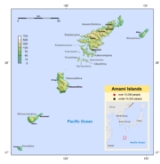
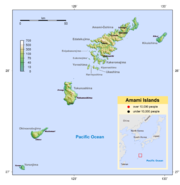
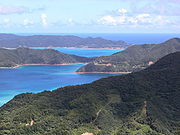
Amami Islands

Encyclopedia
Kagoshima Prefecture
is a prefecture of Japan located on the island of Kyushu. The capital is the city of Kagoshima.- Geography :Kagoshima Prefecture is located at the southwest tip of Kyushu and includes a chain of islands stretching further to the southwest for a few hundred kilometers...
, in the Kyūshū
Kyushu
is the third largest island of Japan and most southwesterly of its four main islands. Its alternate ancient names include , , and . The historical regional name is referred to Kyushu and its surrounding islands....
region of Japan
Japan
Japan is an island nation in East Asia. Located in the Pacific Ocean, it lies to the east of the Sea of Japan, China, North Korea, South Korea and Russia, stretching from the Sea of Okhotsk in the north to the East China Sea and Taiwan in the south...
. They consist of:
- Amami ŌshimaAmami Oshimais a semi-tropical island in the Amami Islands, which is part of the larger Nansei Islands in Japan. Ōshima literally means big island, and it is the largest of the Amami Islands. It lies roughly halfway between the islands of Okinawa and Kyūshū. Briefly part of the Ryūkyū Kingdom, in 1624 it was...
(奄美大島) - Kikaijima (喜界島)
- Kakeromajima (加計呂麻島)
- Yoroshima (与路島)
- Ukeshima (請島)
- TokunoshimaTokunoshimais an island in the Amami Islands of southwestern Japan. Administatively it belongs to Kagoshima Prefecture. Three towns are located on the island: Tokunoshima, Isen, and Amagi...
(徳之島) - OkinoerabujimaOkinoerabujimais an island in the political boundaries of Ōshima District, Kagoshima Prefecture, Japan and in the Amami Islands.Two towns, Wadomari and China, govern portions of the island.Okinoerabu Airport, in Wadomari, is located on the island.-References:...
(沖永良島) - YoronjimaYoronjimais one of the Amami Islands of Japan. Yoron lies 22 km north of Hedo Point, the northernmost point on Okinawa Island. Situated along the line between the East China Sea and the Pacific Ocean, it is the southernmost island in Kagoshima Prefecture. It is also informally known as...
(aka Yorontō unofficially) (与論島)
The name of Amami is probably cognate with or , a goddess often featured in Okinawan legends.
Amami period
Islanders started to produce earthenwareEarthenware
Earthenware is a common ceramic material, which is used extensively for pottery tableware and decorative objects.-Types of earthenware:Although body formulations vary between countries and even between individual makers, a generic composition is 25% ball clay, 28% kaolin, 32% quartz, and 15%...
from 6000 years ago, affected by the Jōmon culture
Jomon period
The is the time in Japanese prehistory from about 14,000 BC to 300 BC.The term jōmon means "cord-patterned" in Japanese. This refers to the pottery style characteristic of the Jōmon culture, and which has markings made using sticks with cords wrapped around them...
in Mainland Kyūshū
Kyushu
is the third largest island of Japan and most southwesterly of its four main islands. Its alternate ancient names include , , and . The historical regional name is referred to Kyushu and its surrounding islands....
. Initially the styles were similar to those of mainland Japan, but later a style original to Amami known as Usuki Lower Style was developed.
Among Japanese literature, the islands first appeared in the 7th century. The Nihon Shoki
Nihon Shoki
The , sometimes translated as The Chronicles of Japan, is the second oldest book of classical Japanese history. It is more elaborate and detailed than the Kojiki, the oldest, and has proven to be an important tool for historians and archaeologists as it includes the most complete extant historical...
mentions in 657, and in 682. The Shoku Nihongi
Shoku Nihongi
The is an imperially commissioned Japanese history text. Completed in 797, it is the second of the Six National Histories, coming directly after the Nihon Shoki and followed by Nihon Kōki. Fujiwara no Tsugutada and Sugano no Mamichi served as the primary editors...
refers to in 699 and in 714. All of these are believed to be identical to the current Amami. The tenth kentō-shi mission (Japanese Imperial embassies to China
Imperial embassies to China
The Japanese Missions to Imperial China were diplomatic embassies which were intermittently sent to the Chinese court. Any distinction amongst diplomatic envoys sent from the Imperial Japanese court or from any of the Japanese shogunates was lost or rendered moot when the ambassador was received in...
) traveled to Tang Dynasty
Tang Dynasty
The Tang Dynasty was an imperial dynasty of China preceded by the Sui Dynasty and followed by the Five Dynasties and Ten Kingdoms Period. It was founded by the Li family, who seized power during the decline and collapse of the Sui Empire...
China via Amami Ōshima.
Among locals, this prehistoric period is called .
Aji period
AgricultureAgriculture
Agriculture is the cultivation of animals, plants, fungi and other life forms for food, fiber, and other products used to sustain life. Agriculture was the key implement in the rise of sedentary human civilization, whereby farming of domesticated species created food surpluses that nurtured the...
came to the islands around the 12th century, and the people shifted to farming from hunting. As agriculture caused a divide between the rich and poor, those with power eventually became the ruling class. They were called aji
Anji (Ryukyu)
thumb|AjiAn aji, anji, or azu was a ruler of a petty kingdom in the history of the Ryukyu Islands. The word later became a title and rank of nobility in the Ryūkyū Kingdom. It is said to be related to the Japanese aruji , and the pronunciation varied throughout the islands. It ranked next below a...
like in Okinawa, residing in castles called gusuku
Gusuku
, or just , is the term used for the distinctive Okinawan form of castles or fortresses. In standard Japanese, the same kanji is pronounced "shiro", but the word is probably cognate with a different Japanese word, "soko" , which means "fortress"...
. Famous gusuku included Beru Gusuku in Kasari, Amami City
Amami, Kagoshima
is a city located on Amami Ōshima in Kagoshima, Japan.The city was formed on March 20, 2006 from the merger of the old city of Naze with the town of Kasari, and the village of Sumiyō, both from Ōshima District....
, and Yononushi Gusuku in Wadomari
Wadomari, Kagoshima
is a town located in Ōshima District, Kagoshima, Japan.As of 2008, the town has an estimated population of 7,159 and the density of 177 persons per km². The total area is 40.37 km²....
. Stronger aji battled each other to expand their territories. Local folklore states that some of Taira clan
Taira clan
The was a major Japanese clan of samurai in historical Japan.In reference to Japanese history, along with Minamoto, Taira was a hereditary clan name bestowed by the emperors of the Heian Period to certain ex-members of the imperial family when they became subjects...
members, lost to the battle of Dan-no-ura
Battle of Dan-no-ura
The ' was a major sea battle of the Genpei War, occurring at Dan-no-ura, in the Shimonoseki Strait off the southern tip of Honshū. On March 24, 1185, the Genji clan fleet, led by Minamoto no Yoshitsune, defeated the Heike clan fleet, during a half-day engagement.The Taira were outnumbered, but...
in 1185, fled to Amami Ōshima. The historical accuracy of this is unknown.
This gusuku period is sometimes called the , while others include this time as part of the Amami period as well.
Naha period
When Amami aji became strong enough in the islands, they started to pay tributeTribute
A tribute is wealth, often in kind, that one party gives to another as a sign of respect or, as was often the case in historical contexts, of submission or allegiance. Various ancient states, which could be called suzerains, exacted tribute from areas they had conquered or threatened to conquer...
s to stronger nations around. Okinawan books say Amami aji paid tribute to Eiso, the king of Chūzan
Chuzan
Chūzan was one of three kingdoms which controlled Okinawa in the 14th century. Okinawa, previously controlled by a number of local chieftains or lords, loosely bound by a paramount chieftain or king of the entire island, split into these three more solidly defined kingdoms within a few years after...
in Sanzan period
Sanzan period
The is a period of history of the Ryūkyū Kingdom that lasted from 1322 until 1429.The early 13th century saw a growth in the construction of Gusuku by a number of powerful kings leading to the emergence of three kingdoms in the 14th century: , and...
Okinawa. Okinoerabu and Yoron went under Hokuzan
Hokuzan
Hokuzan was one of three kingdoms which controlled Okinawa in the 14th century. Okinawa, previously controlled by a number of local chieftains or lords, loosely bound by a paramount chieftain or king of the entire island, split into these three more solidly defined kingdoms within a few years...
's control. However, since Okinawa itself was still unsettled with civil wars, they could not control the northern part of Amami Islands. Tokunoshima and further north island aji just paid tributes to Okinawa, and continued to control the islands by themselves. After 1429, Shō Hashi
Sho Hashi
Shō Hashi was the first king of the Ryūkyū Kingdom , uniting the three kingdoms of Chūzan, Hokuzan, and Nanzan by conquest...
unified Okinawa Island
Okinawa Island
Okinawa Island is the largest of the Okinawa Islands and the Ryukyu Islands of Japan, and is home to Naha, the capital of Okinawa Prefecture. The island has an area of...
, founding the Ryukyu Kingdom
Ryukyu Kingdom
The Ryūkyū Kingdom was an independent kingdom which ruled most of the Ryukyu Islands from the 15th century to the 19th century. The Kings of Ryūkyū unified Okinawa Island and extended the kingdom to the Amami Islands in modern-day Kagoshima Prefecture, and the Sakishima Islands near Taiwan...
. Okinoerabu and further south islands were directly controlled by Ryūkyū, while northern parts were also treated as the outer territories of the kingdom. The fourth king, Shō Sei
Sho Sei
*For the 19th century king of Ryūkyū , see Shō Sei .Shō Sei was king of the Ryūkyū Kingdom from 1526 to 1555...
, tried to occupy Amami Ōshima in 1537, but failed. The next king, Shō Gen
Sho Gen
Shō Gen was king of the Ryūkyū Kingdom from 1556 to 1572. He was called "Gen, the mute." the king required considerable support from the Sanshikan , the chief council of royal advisors...
, won the battle in 1571, and the entire group of islands went under Ryūkyū's control. According to folklore, 3 gusuku and 4 communities fiercely resisted the invasion, and were all eliminated.
This period is called , after the capital city
Naha, Okinawa
is the capital city of the Japanese prefecture of Okinawa.Naha is a coastal city located on the East China Sea coast of the southern part of Okinawa Island, the largest of the Ryukyu Islands...
of Ryūkyū.
Edo period
Ryukyu's direct control didn't last long. The Japanese Tokugawa shogunateTokugawa shogunate
The Tokugawa shogunate, also known as the and the , was a feudal regime of Japan established by Tokugawa Ieyasu and ruled by the shoguns of the Tokugawa family. This period is known as the Edo period and gets its name from the capital city, Edo, which is now called Tokyo, after the name was...
planned to trade with Ming Dynasty
Ming Dynasty
The Ming Dynasty, also Empire of the Great Ming, was the ruling dynasty of China from 1368 to 1644, following the collapse of the Mongol-led Yuan Dynasty. The Ming, "one of the greatest eras of orderly government and social stability in human history", was the last dynasty in China ruled by ethnic...
China. They allowed Shimazu Tadatsune
Shimazu Tadatsune
was a tozama daimyo of Satsuma, the first to hold it as a formal fief under the Tokugawa shogunate, and the first Japanese to rule over the Ryūkyū Kingdom...
, a ruler of Satsuma Domain, to invade the Ryukyu Kingdom in order to retain the shipping route between Japan and China. In March 1609, Shimazu attacked the kingdom on Amami Ōshima, then Tokunoshima, Okinoerabu, and Okinawa itself. At the time, the king controlled all the guns in Ryukyu, while the Shimazu force survived all the (gun) battles in the Sengoku period
Sengoku period
The or Warring States period in Japanese history was a time of social upheaval, political intrigue, and nearly constant military conflict that lasted roughly from the middle of the 15th century to the beginning of the 17th century. The name "Sengoku" was adopted by Japanese historians in reference...
. Shimazu easily won the battle within a month, and Ryukyu Kingdom made peace with Satsuma Domain.
The Ryūkyū Kingdom was troubled by the Amami Islands even before the invasion by Satsuma, as the islanders often demonstrated independence movements from the kingdom. Ryūkyū ceded the islands to the Satsuma Domain. Satsuma started to directly rule the islands from 1613, sending a commissioner. However, it was still nominally treated as Ryūkyū territory, and bureaucrats from the kingdom were dispatched as well.
At first, Satsuma's administration was a mild one, but as the financial deterioration of the domain became worse, the administration changed to one of exploitation. Satsuma let islanders plant sugarcane
Sugarcane
Sugarcane refers to any of six to 37 species of tall perennial grasses of the genus Saccharum . Native to the warm temperate to tropical regions of South Asia, they have stout, jointed, fibrous stalks that are rich in sugar, and measure two to six metres tall...
to make sugar, and sold it to the shogunate or merchants. Because of this monoculture
Monoculture
Monoculture is the agricultural practice of producing or growing one single crop over a wide area. It is also known as a way of farming practice of growing large stands of a single species. It is widely used in modern industrial agriculture and its implementation has allowed for large harvests from...
, islanders were struck by severe famines when there were bad harvests.
During these hard times, the Amami people found their joys in local liquors made from sugarcanes, awamori
Awamori
Awamori is an alcoholic beverage indigenous to and unique to Okinawa, Japan. It is made from rice, and is not a direct product of brewing but of distillation ....
bought from Ryukyu, and folk songs sung with sanshin
Sanshin
The sanshin is an Okinawan musical instrument and precursor of the Japanese shamisen. Often likened to a banjo, it consists of a snakeskin-covered body, neck and three strings....
. Their folk songs evolved to in a style different to that of Ryukyu, and this still remains as a part of their culture today. Under Satsuma's rule, names of Amami people
Amami name
As Japanese citizens, people of the Amami Islands today have family names and given names. They are known for many unique one-character surnames that date back to the Edo period...
underwent a great change, and they are today known for many unique one-character surnames.
In 1879, after the Meiji Restoration
Meiji Restoration
The , also known as the Meiji Ishin, Revolution, Reform or Renewal, was a chain of events that restored imperial rule to Japan in 1868...
, the Amami Islands were incorporated into Ōsumi Province
Osumi Province
was an old province of Japan in the area that is today the eastern part of Kagoshima Prefecture. It was sometimes called . Ōsumi bordered on Hyūga and Satsuma Provinces.Osumi's ancient capital was near modern Kokubu...
, and then into Kagoshima Prefecture
Kagoshima Prefecture
is a prefecture of Japan located on the island of Kyushu. The capital is the city of Kagoshima.- Geography :Kagoshima Prefecture is located at the southwest tip of Kyushu and includes a chain of islands stretching further to the southwest for a few hundred kilometers...
. During World War II
World War II
World War II, or the Second World War , was a global conflict lasting from 1939 to 1945, involving most of the world's nations—including all of the great powers—eventually forming two opposing military alliances: the Allies and the Axis...
, when there were fierce battles in Okinawa, more than 20,000 Japanese soldiers guarded the neighboring Amami Islands. Throughout the war, however, the Amami Islands experienced only small scale airstrike
Airstrike
An air strike is an attack on a specific objective by military aircraft during an offensive mission. Air strikes are commonly delivered from aircraft such as fighters, bombers, ground attack aircraft, attack helicopters, and others...
s.
This period, until 1945, is called , after Yamato
Yamato people
is a name for the dominant native ethnic group of Japan. It is a term that came to be used around the late 19th century to distinguish the residents of the mainland Japan from other minority ethnic groups who have resided in the peripheral areas of Japan, such as the Ainu, Ryukyuan, Nivkh, Ulta, as...
, the Amami exonym for mainland Japanese.
American period
After the Japanese defeat in the war, the islands were divided from mainland Japan, and went under American control. At the signing ceremony of surrender, the Japanese contingent found that the document prepared by the U.S. referred to Amami as "Northern Ryukyu". The Japanese believed this showed the American intention to cede the islands from Japan. In response, the Japanese claimed that the islands belonged to Kagoshima Prefecture.In February 1946, the Amami Islands were officially separated from Japan. In October, the Provisional Government of Northern Ryukyu Islands was founded, formed by local leaders. It changed its name to the Amami Gunto Government in 1950. However, under a democratic election, the local electorate chose a governor who pledged restoration to Japan. (This also happened in other Gunto Governments of Ryukyu, namely those of Okinawa, Miyakojima, and Yaeyama
Yaeyama Islands
The Yaeyama Islands are a group of islands in Okinawa Prefecture, Japan.The isles are the remotest part of Japan from the main islands and contains Japan's most southern and most western inhabited islands.The islands form the southern part of the volcanic Nansei Islands...
.) The American administration (United States Civil Administration of the Ryukyu Islands, USCAR) unhappy with these developments reduced the power of Gunto Governments. In 1952, USCAR founded another governmental body called the Government of the Ryukyu Islands, in which they could choose "local leaders" by themselves.
Amami residents were dissatisfied with these controls by the U.S. Moreover, the Amami economy suffered from their separation from the Mainland Japanese market. Public funds of the U.S. administration were mostly used for heavily damaged Mainland Okinawa. The Amami Islands Homeland Restoration Movement, which had started right after the separation, became stronger. Among locals over 14 years old, 99.8% of them signed in a bid toward restoration. Some municipalities and communities went on a hunger strike
Hunger strike
A hunger strike is a method of non-violent resistance or pressure in which participants fast as an act of political protest, or to provoke feelings of guilt in others, usually with the objective to achieve a specific goal, such as a policy change. Most hunger strikers will take liquids but not...
after the example of Mahatma Gandhi
Mahatma Gandhi
Mohandas Karamchand Gandhi , pronounced . 2 October 1869 – 30 January 1948) was the pre-eminent political and ideological leader of India during the Indian independence movement...
.
The Treaty of San Francisco
Treaty of San Francisco
The Treaty of Peace with Japan , between Japan and part of the Allied Powers, was officially signed by 48 nations on September 8, 1951, at the War Memorial Opera House in San Francisco, California...
in 1952 put the islands under trusteeship as part of the Ryukyu Islands. The U.S. returned the Tokara Islands
Tokara Islands
The Tokara Islands is a group of islands in part of the Satsunan Islands, which is part of the Nansei Islands. The whole island group belongs to Toshima Village, Kagoshima Prefecture, Japan....
in February 1952, and the Amami Islands on December 25, 1953. The U.S. government called it "a Christmas
Christmas
Christmas or Christmas Day is an annual holiday generally celebrated on December 25 by billions of people around the world. It is a Christian feast that commemorates the birth of Jesus Christ, liturgically closing the Advent season and initiating the season of Christmastide, which lasts twelve days...
present to Japan". They became part of Kagoshima prefecture.
This period is called the .
After the restoration
After the return of the islands to Japan in 1953, Okinawa was still under American control until 1972. Because of this, Amami people who worked in Okinawa suddenly became "foreigners", making their situations difficult.The Japanese government promulgated the Amami Islands Promotion and Development Special Measures Law. However, the economic gap between the islands and the mainland still exists to this day. The law did help residents by improving the island's infrastructure. However its bureaucratic system has been criticized as causing unnecessary destruction of nature.
Language
Idiolects spoken in a large part of the Amami Islands are collectively known as the Amami language/dialectAmami language
The Amami language Shimayumuta) is spoken in the Amami Islands south of Kyūshū. The number of competent native speakers is not known, but native speakers can be found mostly among old people—as a result of Japanese language policy, the younger generations speaks mostly Japanese as their first...
. It has several dialects: the Kikai dialect, North Amami dialect, South Amami dialect, and Tokunoshima dialect. Dialects spoken in the southern islands of Okinoerabu and Yoron are closer to those of Kunigami of northern Okinawa, and hence called Okinoerabu-Yoron-Northern Okinawan dialect
Kunigami language
The Kunigami language is an Okinawan language spoken largely in the north of Okinawa Island. Like other Okinawan languages, Kunigami is part of the Ryukyuan family...
.
These dialects all belong to the North Ryukyuan group of the Ryukyuan languages
Ryukyuan languages
The Ryukyuan languages are spoken in the Ryukyu Islands, and make up a subgroup of the Japonic, itself controversially a subgroup of Altaic....
. Although the Ryukyuan languages belong to the Japonic family
Japonic languages
Japonic languages is a term which identifies and characterises the Japanese which is spoken on the main islands of Japan and the Ryukyuan languages spoken in the Ryukyu Islands. This widely accepted linguistics term was coined by Leon Serafim....
along with Japanese
Japanese language
is a language spoken by over 130 million people in Japan and in Japanese emigrant communities. It is a member of the Japonic language family, which has a number of proposed relationships with other languages, none of which has gained wide acceptance among historical linguists .Japanese is an...
, they are mutually unintelligible. There is a dispute about the status of these languages, with some thinking that these are different (independent) languages from Japanese, while others think these are merely dialects.
Just as anywhere else in Japan, standard Japanese is used in all the formal situations. The de facto common speech among locals under 60, on the other hand, is Amami-accented Mainland Japanese called . The speech is different from Uchinā-Yamatuguchi (Okinawan Japanese
Okinawan Japanese
is the Japanese language as spoken by people of Okinawa Prefecture. Okinawan Japanese's accents and words are influenced by traditional Ryukyuan languages. Okinawan Japanese has some loanwords from American English due to the United States administration after the Battle of Okinawa.- Vocabulary and...
), an Okinawan
Okinawan language
Central Okinawan, or simply Okinawan , is a Northern Ryukyuan language spoken primarily in the southern half of the island of Okinawa, as well as in the surrounding islands of Kerama, Kumejima, Tonaki, Aguni, and a number of smaller peripheral islands...
-accented Mainland Japanese used in Okinawa. Ton-futsūgo is affected not only by standard Japanese, but also by the Satsugū (Mainland Kagoshima) dialect and the Kansai dialect.
Communities on the Amami Islands using sign language
Sign language
A sign language is a language which, instead of acoustically conveyed sound patterns, uses visually transmitted sign patterns to convey meaning—simultaneously combining hand shapes, orientation and movement of the hands, arms or body, and facial expressions to fluidly express a speaker's...
as their primary mode of communication have been described.
Culture
As a part of Ryukyu cultural sphere, Amami culture is closer to that of Okinawa PrefectureOkinawa Prefecture
is one of Japan's southern prefectures. It consists of hundreds of the Ryukyu Islands in a chain over long, which extends southwest from Kyūshū to Taiwan. Okinawa's capital, Naha, is located in the southern part of Okinawa Island...
than to that of Mainland Kagoshima. However, the islands' history is different from Okinawa as well. Okinawa, including Sakishima
Sakishima Islands
The are an island chain located at the southernmost end of the Japanese Archipelago. They are part of the Nansei Islands and include the Miyako Islands and the Yaeyama Islands...
, had strong cultural influences from China, whereas Amami was affected more by Mainland Japan. Because of this, the Amami people themselves believe their culture is distinct from that of Okinawa. The mainland Amami people treat the area between Kikai, Amami Ōshima, and Tokunoshima as the part of their own cultural sphere.
On the other hand, Yoron Islanders, just 22 km away from Mainland Okinawa, have much closer culture ties to Okinawa.
Music
The local folk songs are called shimauta. Although shima means "island" in Japanese, it means "community" in Amami. Thus shimauta literally means "communities' songs". Singers of shimauta are called utasha (lit. "singer"). Some utasha also sing pop songsJ-pop
, an abbreviation for Japanese pop, is a musical genre that entered the musical mainstream of Japan in the 1990s. Modern J-pop has its roots in 1960s music, such as The Beatles, and replaced kayōkyoku in the Japanese music scene...
as well, examples include Chitose Hajime
Chitose Hajime
is a singer from Japan. She is from Amami Ōshima and sings in a style particular to that region, with distinctive falsetto effects.-Early life:Chitose Hajime began learning shamisen under her mother's encouragement from a young age...
, Kousuke Atari
Kousuke Atari
Kousuke Atari is a J-Pop artist, born July 13, 1980, on Amami island, Japan. Hailing from Amami-Oshima in southern Japan, Atari Kousuke is a folk singer currently signed to Epic Records Japan...
, RIKKI
RIKKI
, professionally known as , is a Japanese folk singer.Born in Amami Ōshima, Japan, she began to sing traditional Japanese music when she was four years old. Later, at the age of 15, Rikki was the youngest winner ever to win the "Grand Prix" of the Japanese traditional folk music awards...
, and Anna Sato.
While Okinawan folk songs use the pentatonic scale
Pentatonic scale
A pentatonic scale is a musical scale with five notes per octave in contrast to a heptatonic scale such as the major scale and minor scale...
of C, Db, Eb, G, Ab, Amami folk songs use the scale of C, D, E, G, A. Singers use a falsetto
Falsetto
Falsetto is the vocal register occupying the frequency range just above the modal voice register and overlapping with it by approximately one octave. It is produced by the vibration of the ligamentous edges of the vocal folds, in whole or in part...
voice when singing. Amami folk songs are rarely sold outside of the islands, except by mail order or Internet.
Some believe that the word shimauta originally referred to Amami folk songs only, and is therefore now mistakenly used for Okinawan folk songs. The Japanese rock band The Boom
The Boom
The Boom is a Japanese rock band. Its members are Kazufumi Miyazawa , Kobayashi Takashi , Yamakawa Hiromasa , and Tochigi Takao .-History:...
's 1992 hit song called Shima Uta
Shima uta
is a 1992 song by the Japanese band The Boom. It was written by the lead singer, Kazufumi Miyazawa, based on his impressions from visiting Okinawa for a photo shoot. It is the band's best selling song, well-known throughout Japan and Argentina, and one of the most widely known songs associated with...
, which incorporated some Okinawan styles and thus causes confusion as to the precision of the term. Others argue the word was used for Okinawan folk songs as well even before 1992.
Religion
Each community has multiple shrines, while there are not many Buddhist temples. As in Okinawa, female priests called noro exist, and the people worship according to the local religiousRyukyuan religion
Ryukyuan religion is the indigenous belief system of the Ryukyu Islands. While specific legends and traditions may vary slightly from place to place and island to island, the Ryukyuan religion is generally characterized by ancestor worship and the respecting of relationships between the living, the...
norms.
The current tomb style is same as those in Mainland Japan, unlike those in Okinawa. However, there are tombs called Shiroma Tofuru Tombs, which were built 400 years ago, showing the style of Okinawan tombs before the current "house" style there.
Region
- Its regional center is Amami CityAmami, Kagoshimais a city located on Amami Ōshima in Kagoshima, Japan.The city was formed on March 20, 2006 from the merger of the old city of Naze with the town of Kasari, and the village of Sumiyō, both from Ōshima District....
in Amami ŌshimaAmami Oshimais a semi-tropical island in the Amami Islands, which is part of the larger Nansei Islands in Japan. Ōshima literally means big island, and it is the largest of the Amami Islands. It lies roughly halfway between the islands of Okinawa and Kyūshū. Briefly part of the Ryūkyū Kingdom, in 1624 it was...
. - There are no universities or colleges in the islands. From 2004, The Graduate School of Humanistic-Sociological Sciences of Kagoshima UniversityKagoshima University, or is a Japanese national university located in Kagoshima, Kagoshima Prefecture, Japan.There are three campuses:* Shimoarata: Faculty of Fisheries* Sakuragaoka: Faculty of Medicine...
started satellite schooling in Amami City. - There are repeaterRepeaterA repeater is an electronic device that receives asignal and retransmits it at a higher level and/or higher power, or onto the other side of an obstruction, so that the signal can cover longer distances.-Description:...
s of televisionTelevisionTelevision is a telecommunication medium for transmitting and receiving moving images that can be monochrome or colored, with accompanying sound...
and AMAM broadcastingAM broadcasting is the process of radio broadcasting using amplitude modulation. AM was the first method of impressing sound on a radio signal and is still widely used today. Commercial and public AM broadcasting is carried out in the medium wave band world wide, and on long wave and short wave...
radioRadioRadio is the transmission of signals through free space by modulation of electromagnetic waves with frequencies below those of visible light. Electromagnetic radiation travels by means of oscillating electromagnetic fields that pass through the air and the vacuum of space...
. Among FMFM broadcastingFM broadcasting is a broadcasting technology pioneered by Edwin Howard Armstrong which uses frequency modulation to provide high-fidelity sound over broadcast radio. The term "FM band" describes the "frequency band in which FM is used for broadcasting"...
stations, only NHKNHKNHK is Japan's national public broadcasting organization. NHK, which has always identified itself to its audiences by the English pronunciation of its initials, is a publicly owned corporation funded by viewers' payments of a television license fee....
-FM has a repeater, but there is a local community FM station as well. - There are two local newspapers, namely Nankainichinichi Shimbun and Ōshima Shinbun.
See also
- Amami RabbitAmami RabbitThe Amami Rabbit , or , also known as the Ryukyu Rabbit, is a primitive dark-furred rabbit which is only found in Amami Ōshima and Toku-no-Shima, two small islands in between southern Kyūshū and Okinawa in Kagoshima Prefecture in Japan...
, a rabbit endemic to Amami Ōshima and Toku-no-Shima - Amami WoodcockAmami WoodcockThe Amami Woodcock, Scolopax mira, is a medium sized wader. It is slightly larger and longer-legged than Eurasian Woodcock, and may be .This species is a Restricted-range endemic found only in forests on two small islands of the Amami Islands chain in South Japan. Insofar as its habits are known,...
External links
Amaminchu.com Nankainichinichi Shimbun Central Gakki, Amami folk song distributor Amami FM- Amami Wordlist at the Austronesian Basic Vocabulary Database
- Japan MintJapan MintThe is an Incorporated Administrative Agency of the Japanese government. This agency has its Head office in Osaka with branches in Tokyo and Hiroshima.-History:...
: Commemorative Silver Proof Coin of the 50th Anniversary of the Restoration of the Amami Islands to Japan