


1994 Winter Olympics

Encyclopedia
The 1994 Winter Olympics, officially known as the XVII Olympic Winter Games, was a winter multi-sport event
celebrated from 12 to 27 February 1994 in and around Lillehammer
, Norway
. Lillehammer failed to win the bid for the 1992 event
. Lillehammer was awarded the games in 1988, after having beat Anchorage, United States; Östersund
, Sweden; and Sofia
, Bulgaria. The games were the first to be held in a different year than the Summer Olympics, the only to be held two years after the previous games, and the last to be held in a small town. The games were the second hosted in Norway, and the second Winter Olympics in the Nordic Countries
, after the 1952 Winter Olympics
in Oslo.
While many events took place in Lillehammer, skating took place in Hamar
, some ice hockey
matches were placed in Gjøvik
, while Alpine skiing
was held in Øyer
and Ringebu
. Sixty-seven countries and 1,737 athletes participated in six sports
and sixty-one events. Fourteen countries made their debut in the Winter Olympics, of which nine were former Soviet republics. The games also saw the introduction of stricter qualifying rules, reducing the number of under-performing participants from warm-weather countries. New events were two new distances in short track speed skating
and aerials
, while speed skating
was moved indoors. Nearly two million people spectated the games, which were the first to have the Olympic truce
in effect. The games were succeeded by the 1994 Paralympics from 10 to 19 March.
Manuela Di Centa
and Lyubov Yegorova
dominated women's cross-country skiing
, taking five and four medals, respectively. A crowd of over 100,000 saw Italy
beat Norway
by 0.4 seconds on the men's 4 x 10 km relay. Vreni Schneider
won a complete set of medals in Alpine skiing, while Norway took a medal sweep in the men's combined. Nancy Kerrigan
had before the games been clubbed by Tonya Harding's
associate, but managed to take silver in ladies' singles. Johann Olav Koss
won three speed skating events, while 13-year-old Kim Yoon-Mi became the youngest-ever Olympic gold medalist. Sweden
beat Canada
in a dramatic penalty shootout
in the ice hockey final. With 11 gold medals, Russia
won the most events, while with 26, Norway collected the most medals overall.
, Sweden's failed bid for the 1988 Winter Olympics
. It was supported by the government largely to help stimulate the economy of the inland counties. Lillehammer originally bid for the 1992 Games
, but came fourth in the voting. In 1986, the International Olympic Committee
(IOC) voted to separate the Summer and Winter Games, which had been held in the same year since the latter's inception in 1924, and arrange them in alternating even-numbered years. A new bid was launched for the 1994 Games, modified with an indoor speed skating venue and an additional ice hall in Lillehammer. Additional government guarantees were secured.
Three other locations bid for the games: Östersund, Anchorage in Alaska
, and Sofia. The 94th IOC Session, held in Seoul
on 15 September 1988, voted Lillehammer the host for the Games. The Lillehammer Olympics were the last Winter Games to date to be held in a town, rather than be centered around a city.
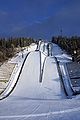
The overall responsibility for the games was held by the Lillehammer Olympic Organization Committee, which was created on 14 November 1988 and led by Gerhard Heiberg
. It was reorganized several times with various subsidiaries, but from 1993 consisted of a single company owned 51% of Lillehammer Municipality, 24.5% by the Government of Norway and 24.5% by the Norwegian Olympic Committee. The government had issued a guarantee for the games, and also covered the expenses related to infrastructure. The total costs of the games was 7.4 billion Norwegian krone
(NOK), of which NOK 0.95 billion was expenditure by the ministries, NOK 4.48 billion was for operations and event expenses, and NOK 1.67 billion was for investments. The games had a revenue of NOK 2.71 billion, of which NOK 1.43 billion was from television rights, NOK 0.65 billion was from sponsors, and NOK 0.15 billion was from ticket sales.
Production of the broadcasting, which costs NOK 462 million, was the responsibility of the Norwegian Broadcasting Corporation (NRK), with assistance from the Canadian Television
(CTV) and the European Broadcasting Union
(EBU). NRK had 1,424 people working at the Olympics, while international broadcasters sent an additional 4,050 accredited broadcasting personnel. The transmission rights for the games were held by EBU in Europe, CBS
in the United States, NHK
in Japan, CTV in Canada, the Asia-Pacific Broadcasting Union
, Nine Network
in Australia, as well as other broadcasters in other countries. The total transmission rights price was 350 million United States dollars. In part because of the Harding–Kerrigan affair, the viewship in the United States is still the highest ever for Winter Olympics.
NOK 460 million was used on information technology, with the main system running on an IBM AS/400. 3,500 terminals were in use during the game based on the Info '94 system; it was the first Olympics to have terminals installed abroad. Seiko
delivered the time-keeping devices. Telecommunications were delivered by Norwegian Telecom, including signal transmission. This included a mobile radio network with nine base stations.
joik, Telemark skiing
, fiddlers and folk dancing, simulations of traditional weddings and their processions, and vetter
from Norse mythology
. After speeches by Heiberg and IOC president Juan Antonio Samaranch
, the games were officially declared opened by King Harald V
. The Olympic Flame
was to be skied down the skijump before lighting the cauldron. Originally this task had rested upon Ole Gunnar Fidjestøl
, but after he was injured in a practice jump, his back-up Stein Gruben received the honor. The cauldron was lit by Crown Prince Haakon Magnus. The Olympic oath
s were issued by Vegard Ulvang
for the athletes and Kari Kåring
for the officials.
won two disciplines, giant slalom and super-G, finishing ahead of the United States's Tommy Moe
on the super-G. Moe won the downhill ahead of Norway's Kjetil André Aamodt
, who came in third in the super-G. Austria's Thomas Stangassinger
won the slalom ahead of Italy's Alberto Tomba
. In the combined, Norway took a medal sweep, with Lasse Kjus
winning ahead of Aamodt and Harald Christian Strand Nilsen
.
In the women's events, Switzerland's Vreni Schneider
was the most successful, winning the slalom, taking silver in combined and taking bronze in giant slalom. The only other athlete to take multiple medals was Italy's Isolde Kostner
, who took a third place in both downhill and super-G. The downhill was won by Germany's Katja Seizinger
, super-G by the United States' Diann Roffe
, the giant slalom by Italy's Deborah Compagnoni
, and the combined by Sweden's Pernilla Wiberg
.
and Sven Fischer
. Germany easily revenged itself by winning the 4 × 7.5 km relay ahead of Russia and France. In the women's class, Canada's Myriam Bédard
won both the individual events, finishing ahead of Belarus' Svetlana Paramygina
on the 7.5 km sprint and ahead of France's Anne Briand
on the 15 km individual. In the 4 × 7.5 km relay, the format since 1992 was changed from three to four participants. Russia, with a clean sheet, won ahead of Germany, who made six misses, with France taking the bronze.
, Switzerland took the top two places, with Gustav Weder
, Donat Acklin
winning 0.05 seconds ahead of Reto Götschi
and Guido Acklin
, who were again 0.15 seconds ahead of Italy's Günther Huber
and Stefano Ticci
placing third. In four-man
, Germany-II, consisting of Harald Czudaj
, Karsten Brannasch
, Olaf Hampel
and Alexander Szelig
, finished 0.06 seconds ahead of Switzerland-I and 0.23 ahead of Germany-II.
was watched by a crowd of nearly 150,000. Norway, Italy and Finland followed each other tightly for three and a half rounds, with the second and third exchange of the three talking place within 1.1 seconds of each other. Finland fell behind in the end, and Norwegian Bjørn Dæhlie
and Italian Silvio Fauner
battled to the end, with Italy beating Norway by 0.4 seconds. Dæhlie won the 10 km classical and 15 km pursuit, while taking silver in the 30 km freestyle. Kazakhstan's Vladimir Smirnov
won the 50 km classical, in addition to silver on th 10 km and the 15 km. Norway's Thomas Alsgaard
won the 30 km, while Finland's Mika Myllylä
took an individual silver and a bronze.
Italy's Manuela Di Centa
and Russia's Lyubov Yegorova
dominated the women's events. They took five and four medals each, respectively, and between them winning all the races. Yegorova finished ahead of Di Contra on the 5 km classical and the 10 km pursuit, while Di Centa finished ahead of Yegorova on the 15 km freestyle, and also won the 30 km classical ahead of Norway's Marit Wold. Finland's Marja-Liisa Kirvesniemi
took two bronze medals, in 5 km and 30 km. In the 4 × 5 km relay, Norway and Russia kept up with each other until the final stage, in which Anita Moen
lost to Yegorova, with Italy finishing third. With Yegorova's sixth career gold, she was tied as the most-wining Winter Olympic participant.
ex-husband Jeff Gillooly hired Shane Stant to club fellow female figure skater Nancy Kerrigan
in the knee. Both Harding and Kerrigan were selected for the Olympic team. After Harding admitted to helping to cover up the attack, the United States Olympic Committee
initiated proceedings to remove her from the Olympic team, but Harding retained her place after threatening legal action. The ladies' singles, Ukraine's Oksana Baiul
won ahead of Kerrigan, with Harding finishing eighth. In the men's singles, Russia's Aleksei Urmanov won ahead of Canada's Elvis Stojko
. Relaxation of the amateurism rules led to several former stars returning, such as ice dancing 1984 Champions Great Britain's Jayne Torvill
and Christopher Dean
, who took a bronze behind Russians' Oksana Grishuk and Evgeny Platov
, and Maya Usova
and Alexander Zhulin
. In pair skating, the Russian's also took a double, with Ekaterina Gordeeva
and Sergei Grinkov
winning ahead of Natalia Mishkutenok
and Artur Dmitriev
.
at the previous two games. Ski ballet, which had been a demonstration sport in 1992, was dropped. Canada dominated the men's events, with Jean-Luc Brassard
winning the men's aerials ahead of Russian Sergey Shupletsov
. In the men's moguls, Switzerlands's Andreas Schönbächler
won ahead of Canada's Philippe LaRoche
and Lloyd Langlois
, with Canadians also claiming the fourth and sixth places. In the women's disciplines, Norway was the only nation to take two medals; Stine Lise Hattestad
won the moguls ahead of the United State's Liz McIntyre
. In the aerials, Lina Cheryazova
won, claiming Uzbekistan's only medal, ahead of Sweden's Marie Lindgren
and Norway's Hilde Synnøve Lid
.
, with the four best advancing to the single elimination medal tournament. Group A saw Finland win all five matches, while the host nation lost all theirs. Also Germany, the Czech Republic and Russia advanced from the group, all with three victories. Group B was won by Slovakia ahead of Canada, Sweden and the United States. The quarter-finals saw the Czech Republic, the United States, Germany and Slovakia eliminated. In the semi-finals, Canada beat Finland 5–3, while Sweden beat Russia 4–3. After the final period of the final, the match was a 2–2 tie, resulting in a shoot-out. After six shoots, it was a tie 2–2 until Sweden's Peter Forsberg
beat Corey Hirsch
, making the Swedes win after Paul Kariya
failure. This led to Tomas Jonsson
, Håkan Loob
and Mats Näslund
becoming the first three members of the Triple Gold Club
.
won the men's singles, making him the first to defend an Olympic title in the event in thirty years. He finished ahead of Austria's Markus Prock
and Italy's Armin Zöggeler
. In the doubles, the two Italian teams finished on top, with Kurt Brugger
and Wilfried Huber
winning ahead of Hansjörg Raffl
and Norbert Huber
. In the women's singles, Italy's Gerda Weissensteiner
won ahead of Germany's Susi Erdmann
and Austria's Andrea Tagwerker
.
had only lost a single event in the season's World Cup, but came in sixth on the hill, which was won by Norway's Fred Børre Lundberg
. He won the even after finishing eight-best in the skiing, ahead of Japan's Takanori Kono
, Norway's Bjarte Engen Vik
and Ogiwara in fourth. In the team normal hill/3 x 10 km, Japan finished first, third and fifth among the jumpers, giving them a 5:07 minute lead over Norway and finishing 4:49 minutes ahead. Switzerland took the bronze.
, who won four of the six events. After the discipline's debut in 1992, the 1994 featured two new events, the men's 500 meters and the women's 1000 meters. South Korea's Chae Ji-Hoon
won the men's 500 meters, while taking silver on the 1000 meters behind countryman Kim Ki-Hoon
, who defended his 1992 gold. The bronze was won by Canada's Marc Gagnon
, who won the B final. In the A final, countryman Derrick Campbell
was abstracted by Great Britain's Nicky Gooch
, who was disqualified. Campbell got up and started celebrating his bronze medal, when he discovered he had not completed the race.
In the men's 5000 meter relay, South Korea did not enter after a fall in the sole qualifying event, which took place in March 1993. Canada fell during the final, which saw Italy take a clear victory ahead of a the United States, who were marginally ahead of Australia
. The United State's Eric Flaim
became the first to take Olympic medals in both short track and long track speed skating, while Australia took its first Winter Olympic medal ever. Six people took the individual medals in the women's events, with the United State's Cathy Turner
defending her 1992 gold on the 500 meters and South Korea's Chun Lee-Kyung
taking the gold in 1000 meters. South Korea won the 3000 meter relay with a team of four girls under 19. At 13, Kim Yoon-Mi became the world's youngest Olympic gold medalist.
winning the normal hill
ahead of Norway's Lasse Ottesen
and Germany's Dieter Thoma
. In the large hill
, Germany's Jens Weißflog won ahead of Bredesen and Austria's Andreas Goldberger
. In the
large hill team
, the 1994 Games introduced new rules whereby all four jumps in each round counted, and not just the best three. Neither Norway nor Finland, who between them had won all but one former Olympic team jump, managed to collect a medal. The even became a duel between Germany an Japan, with only a point separating them after the first round of jumps. Masahiko Harada
had the last jump, and would secure a gold if he managed 102 meters, but mistimed his leap and landed at 97.5 meters, giving the gold to the Germans.
and women's 3000 meters
to 32, and only allowing the 16 best in that even to participate in the men's 10000 meters
and the women's 5000 meters
. Norway's Johann Olav Koss
took three golds, in the men's 1,500 meters
, 5000 meters and 10000 meters. In the latter two, he finished ahead of fellow countryman Kjell Storelid
. The men's 500 meters
was won by Russia's Aleksandr Golubev ahead of fellow countryman Sergey Klevchenya
, while the men's 1000 meters
was won by American Dan Jansen
. For women, American Bonnie Blair
defended her two 1992 golds in 500 meters
and 1000 meters
. Austria's Emese Hunyady
won the 1500 meters
ahead of Russia's Svetlana Bazhanova
and Germany's Gunda Niemann. However, Bazhanova took gold ahead of Nemeth-Hunyady on the 3000 meters, with Germany's Claudia Pechstein
in third. Pechstein would go on to win the 5000 meters ahead of Niemann.
which was at the heart of the Bosnian War
. The first entrants on the stage were Liv Ullmann
and Thor Heyerdahl
, followed by the athletes' precession. After the flag had been transferred to Nagano mayor Tasuka Tsukada, speeches were held by Lillehammer mayor Audun Tron
, Heiberg and Samaranch. The latter used his speech to remind about Sarajevo's situation, before giving Heiberg IOC's gold medal, and declaring the games "the best Olympic Winter Games ever". Artistic presentations followed with many of the themes from the opening ceremony. The 1998 Winter Games'
mascot, Snowlet, was also presented. Of the 2,200 people performing in the opening and closing ceremonies, only 50 were professionals.
, ice sledge speed racing
, biathlon
and cross-country skiing
; the games also introduced ice sledge hockey
. The Paralympics used the same venues as the Olympics, and were the second in Norway, after the 1980 Winter Paralympics
in Geilo
. 471 athletes from 31 countries participated, with Norway claiming the most gold medals ahead of Germany. The Paralympics featured their own logo, the amputee mascot Sondre, but retained the same overall design as the Olympics.
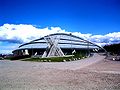 The games were spread out over ten venues in five municipalities
in two counties
, Oppland
and Hedmark
. Lillehammer
, with 25,000 inhabitants, and Hamar
and Gjøvik
, both with 27,000 inhabitants, are all situated on the lake Mjøsa
. Gjøvik and Hamar are located 45 kilometre south of Lillehammer. Hunderfossen is located 15 kilometres (9.3 mi) north of Lillehammer, but lies within the municipality. Øyer and Ringebu, both with just under 5,000 inhabitants, are located 18 kilometre north of Lillehammer, in the valley Gudbrandsdalen. Lillehammer had four venues, Hamar had two venues, while Hunderfossen, Gjøvik, Øyer and Ringebu had one venue each.
In Lillehammer, Lysgårdsbakken features twin ski jumping hill
s. The large hill has a hill size of 138 and a critical point of 120, while the normal hill has a hill size of 100 and a critical point of 90. The hill has capacity for 35,000 spectators and hosted, in addition to the ski jumping events, the opening and closing ceremonies. Birkebeineren Skistadion
featured cross-country skiing and biathlon, with the stadium itself having a capacity for 31,000 spectators during cross-country skiing and 13,500 during biathlon. In addition, spectators could watch from along the tracks. Kanthugen Freestyle Arena
featured a capacity for 15,000 spectators. All the outdoor skiing arenas had free areas, which saw up to 25,000 extra spectators at the team jump and 75,000 extra spectators at the 50 km.
Lillehammer Olympic Bobsleigh and Luge Track is located at Hunderfossen
. It had a capacity for 10,000 spectators and is the only bobsleigh and luge track in the Nordic countries
. Ice hockey was played at two venues, in Håkons Hall in Lillehammer and Gjøvik Olympic Cavern Hall
in Gjøvik. Håkons Hall has a capacity for 10,500 spectators, and also features the Norwegian Olympic Museum
. The Cavern Hall is built as a man-made cave and had a capacity for 5,300 spectators. Skating events took place at two venues in Hamar. Vikingskipet had a capacity for 10,600 spectators and featured speed skating events, while figure skating and short-track speed skating were held at Hamar Olympic Amphitheatre. Alpine skiing was split between two ski resorts: Hafjell
in Øyer and Kvitfjell
in Ringebu. The former was used for the slalom and giant slalom, while the latter hosted downhill and super-G.
Transport was dominated by the use of buses and trains for spectators, although LOOC had 1,200 automobiles at its disposition. Downtown Lillehammer and the axis between Lillehammer and Oslo were the most limiting areas, and the Norwegian State Railways
ran up to 22 trains per day between Oslo and Lillehammer. Trains were also used northwards towards Trondheim
, while other areas were served by bus. All the venues were located along railway lines, making use of spectators walking from the stations to the venues to limit road congestion, although special services were available for disabled people. Shuttle buses were established between venues and also connected to park and ride
facilities.
, Monaco
, Trinidad and Tobago
and Jamaica
to compete in that sport. On 25 October 1993, the United Nations General Assembly
urged its members to observe the Olympic truce
from seven days before to seven days after the Olympic games, making the Lillehammer games the first to observe the truce. IOC appealed for a truce in the ongoing Bosnian War
and the Siege of Sarajevo
, the city that had hosted the 1984 Winter Olympics
.
The Unified Team
, which had represented participants from former Soviet Union
states, was broken up, and the nine former Soviet republics of Belarus
, Georgia
, Kazakhstan
, Kyrgyzstan
, Moldova
, Russia
, Ukraine
and Uzbekistan
participated as nations. The break-up of Czechoslovakia
resulted in the Czech Republic
and Slovakia
participating for the first time. Bosnia and Herzegovina
participated for the first time, after their independence from Yugoslavia
. The composition of the Bosnia and Herzegovina four-man bob team was one Croat, two Bosniaks and a Serb, mirroring the ethnic diversity of the country. Three "warm countries", American Samoa
, Israel
and Trinidad and Tobago
, made their debuts.
Winter Olympic Games
The Winter Olympic Games is a sporting event, which occurs every four years. The first celebration of the Winter Olympics was held in Chamonix, France, in 1924. The original sports were alpine and cross-country skiing, figure skating, ice hockey, Nordic combined, ski jumping and speed skating...
celebrated from 12 to 27 February 1994 in and around Lillehammer
Lillehammer
is a town and municipality in Oppland county, Norway, globally known for hosting the 1994 Winter Olympics. It is part of the traditional region of Gudbrandsdal. The administrative centre of the municipality is the town of Lillehammer. As of May 2011, the population of the town of Lillehammer was...
, Norway
Norway
Norway , officially the Kingdom of Norway, is a Nordic unitary constitutional monarchy whose territory comprises the western portion of the Scandinavian Peninsula, Jan Mayen, and the Arctic archipelago of Svalbard and Bouvet Island. Norway has a total area of and a population of about 4.9 million...
. Lillehammer failed to win the bid for the 1992 event
1992 Winter Olympics
The 1992 Winter Olympics, officially known as the XVI Olympic Winter Games, were a winter multi-sport event celebrated from 8 to 23 February 1992 in Albertville, France. They were the last Winter Olympics to be held the same year as the Summer Olympics, and the first where the Winter Paralympics...
. Lillehammer was awarded the games in 1988, after having beat Anchorage, United States; Östersund
Östersund
Östersund is an urban area in Jämtland in the middle of Sweden. It is the seat of Östersund Municipality and the capital of Jämtland County. Östersund is located at the shores of Sweden's fifth largest lake, Storsjön, opposite the island Frösön, and is the only city in Jämtland. Östersund is the...
, Sweden; and Sofia
Sofia
Sofia is the capital and largest city of Bulgaria and the 12th largest city in the European Union with a population of 1.27 million people. It is located in western Bulgaria, at the foot of Mount Vitosha and approximately at the centre of the Balkan Peninsula.Prehistoric settlements were excavated...
, Bulgaria. The games were the first to be held in a different year than the Summer Olympics, the only to be held two years after the previous games, and the last to be held in a small town. The games were the second hosted in Norway, and the second Winter Olympics in the Nordic Countries
Nordic countries
The Nordic countries make up a region in Northern Europe and the North Atlantic which consists of Denmark, Finland, Iceland, Norway and Sweden and their associated territories, the Faroe Islands, Greenland and Åland...
, after the 1952 Winter Olympics
1952 Winter Olympics
The 1952 Winter Olympics, officially known as the VI Olympic Winter Games, took place in Oslo, Norway, from 14 to 25 February 1952. Discussions about Oslo hosting the Winter Olympic Games began as early as 1935; the city wanted to host the 1948 Games, but World War II made that impossible...
in Oslo.
While many events took place in Lillehammer, skating took place in Hamar
Hamar
is a town and municipality in Hedmark county, Norway. It is part of the traditional region of Hedmarken. The administrative centre of the municipality is the town of Hamar. The municipality of Hamar was separated from Vang as a town and municipality of its own in 1849...
, some ice hockey
Ice hockey at the 1994 Winter Olympics
Ice hockey at the 1994 Winter Olympics was held at the Fjellhallen in Gjøvik and the Håkons Hall in Lillehammer, Norway. The competition, held from February 12 to February 27, was won by Sweden and Canada as runner-up.-Final rankings:Source:* Gold -...
matches were placed in Gjøvik
Gjøvik
is a town and a municipality in Oppland county, Norway. The administrative centre of the municipality is the town of Gjøvik.In 1861, the village of Gjøvik in the municipality of Vardal was granted town status and was separated from Vardal to form a separate municipality...
, while Alpine skiing
Alpine skiing at the 1994 Winter Olympics
Alpine skiing at the 1994 Winter Olympics consisted of ten events held near Lillehammer, Norway. The speed events were held at Kvitfjell and the technical events at Hafjell, from February 13-27, 1994.-Downhill:February 13, 1994-Super G:February 17, 1994...
was held in Øyer
Øyer
Øyer is a municipality in Oppland county, Norway. It is part of the traditional region of Gudbrandsdal. The administrative centre of the municipality is the village of Tingberg....
and Ringebu
Ringebu
is a municipality in Oppland county, Norway. It is part of the traditional region of Gudbrandsdal. The administrative centre of the municipality is the village of Vålebru.The municipality of Ringebu was established on 1 January 1838...
. Sixty-seven countries and 1,737 athletes participated in six sports
Olympic sports
Olympic sports, as defined by the International Olympic Committee, are all the sports contested in the Summer and Winter Olympic Games. The Summer Olympics, as of 2012, will include 26 sports, with two additionall sports due to be added in 2016...
and sixty-one events. Fourteen countries made their debut in the Winter Olympics, of which nine were former Soviet republics. The games also saw the introduction of stricter qualifying rules, reducing the number of under-performing participants from warm-weather countries. New events were two new distances in short track speed skating
Short track speed skating at the 1994 Winter Olympics
The 1994 Winter Olympic Games Short Track results-500m:-1,000m:This unique race was one of the most unusual in the short history of short track speed skating. The bronze medal was won by an athlete that was not even in the final race. Derrick Campbell of Canada was obstructed by the Briton Nicky...
and aerials
Freestyle skiing at the 1994 Winter Olympics
-Aerials:February 24, 1994-Moguls:February 16, 1994-Aerials:February 24, 1994-Moguls:February 16, 1994-External links:*...
, while speed skating
Speed skating at the 1994 Winter Olympics
The 1994 Winter Olympic Games Speed Skating results.-500 m:Monday February 14, 1994 — 40 competitors from 16 countries-1,000 m:Friday February 18, 1994 — 43 competitors from 17 countries-1,500 m:...
was moved indoors. Nearly two million people spectated the games, which were the first to have the Olympic truce
Olympic truce
The Olympic Truce is a sacred tradition originating from Ancient Greece that dates back to the 9th century BC. A Truce was announced before and during the Olympic Games to ensure athletes and spectators could travel safely to the Games and peacefully return to their respective countries...
in effect. The games were succeeded by the 1994 Paralympics from 10 to 19 March.
Manuela Di Centa
Manuela Di Centa
Manuela Di Centa is an Italian cross-country skier and former Olympic athlete. She is the cousin of former track and field athlete Venanzio Ortis and the sister of cross-country skier Giorgio Di Centa.-Career:...
and Lyubov Yegorova
Lyubov Yegorova
Lyubov Ivanovna Yegorova , name also spelled Ljubov Jegorova, is a Russian former cross-country Olympic ski champion, many times world champion , winner of the World Cup and Hero of Russia. Lyubov Yegorova is an honorary citizen of Seversk , Saint Petersburg , and Tomsk Oblast...
dominated women's cross-country skiing
Cross-country skiing at the 1994 Winter Olympics
-10 km:17 February 1994-15 km pursuit:19 February 1994-30 km:14 February 1994-50 km:27 February 1994-4 x 10 km relay:22 February 1994...
, taking five and four medals, respectively. A crowd of over 100,000 saw Italy
Italy at the 1994 Winter Olympics
-Medalists:- Alpine skiing:MenMen's combinedWomenWomen's combined- Biathlon:MenMen's 4 x 7.5 km relayWomen1A penalty loop of 150 metres had to be skied per missed target. 2One minute added per missed target....
beat Norway
Norway at the 1994 Winter Olympics
Norway was the host nation for the 1994 Winter Olympics in Lillehammer. It was the second time that Norway had hosted the Winter Olympic Games, after the 1952 Games in Oslo. In 1994, Norway finished second in the medal ranking to Russia, with strong results in the skiing events.During the games,...
by 0.4 seconds on the men's 4 x 10 km relay. Vreni Schneider
Vreni Schneider
Verena Schneider is a former ski racer from Switzerland. She is the most successful alpine ski racer of her country, the second most successful female ski racer ever and was elected "Swiss Sportswoman of the Century".She won the overall alpine skiing World Cup three times and eleven discipline...
won a complete set of medals in Alpine skiing, while Norway took a medal sweep in the men's combined. Nancy Kerrigan
Nancy Kerrigan
Nancy Ann Kerrigan is a two-time American Olympic figure skating medalist and 1993 U.S. champion.-Early life and skating career:...
had before the games been clubbed by Tonya Harding's
Tonya Harding
Tonya Maxine Harding is an American figure skating champion. In 1991 she won the U.S. Figure Skating Championships and placed second in the World Championships. She was the second woman, and the first American woman, to complete a triple axel jump in competition...
associate, but managed to take silver in ladies' singles. Johann Olav Koss
Johann Olav Koss
Johann Olav Koss is a former speed skater from Norway, considered to be one of the best in history, and current assistant coach of Norway's speed skating team.-Biography:...
won three speed skating events, while 13-year-old Kim Yoon-Mi became the youngest-ever Olympic gold medalist. Sweden
Sweden at the 1994 Winter Olympics
-Medalists:- Alpine skiing:MenMen's combinedWomenWomen's combined- Biathlon:MenMen's 4 x 7.5 km relayWomenWomen's 4 x 7.5 km relay1A penalty loop of 150 metres had to be skied per missed target....
beat Canada
Canada at the 1994 Winter Olympics
Canada competed at the 1994 Winter Olympics in Lillehammer, Norway. Canada has competed at every Winter Olympic Games.-Medalists:-Alpine skiing:*Rob Crossan** Men's Giant Slalom: 2:56.10 - 20th place** Men's Slalom: Did not finish 2nd run...
in a dramatic penalty shootout
Penalty shootout
The shootout is a method of determining a winner in sports matches that would have otherwise been drawn or tied. The rules for penalty shootouts vary between sports and even different competitions; however, the usual form is similar to penalty shots in that a single player takes one shot on goal...
in the ice hockey final. With 11 gold medals, Russia
Russia at the 1994 Winter Olympics
Russia competed at the 1994 Winter Olympics in Lillehammer, Norway. It was the first time the nation had competed at the Winter Olympic Games since the dissolution of the Soviet Union in 1991...
won the most events, while with 26, Norway collected the most medals overall.
Host city selection
Planning of the Lillehamer bid started in 1981, following FalunFalun
Falun is a city and the seat of Falun Municipality in Dalarna County, Sweden, with 36,447 inhabitants in 2005. It is also the capital of Dalarna County...
, Sweden's failed bid for the 1988 Winter Olympics
1988 Winter Olympics
The 1988 Winter Olympics, officially known as the XV Olympic Winter Games, were a winter multi-sport event celebrated in and around Calgary, Alberta, Canada from 13 to 28 February 1988. The host was selected in 1981 after having beat Falun, Sweden and Cortina d'Ampezzo, Italy...
. It was supported by the government largely to help stimulate the economy of the inland counties. Lillehammer originally bid for the 1992 Games
Lillehammer bid for the 1992 Winter Olympics
The Lillehammer bid for the 1992 Winter Olympics and Paralympics was an unsuccessful campaign launched in 1984. It bid ended fourth of seven at the 91st IOC Session on 17 September 1986, who awarded the 1992 Winter Olympics to Albertville, France...
, but came fourth in the voting. In 1986, the International Olympic Committee
International Olympic Committee
The International Olympic Committee is an international corporation based in Lausanne, Switzerland, created by Pierre de Coubertin on 23 June 1894 with Demetrios Vikelas as its first president...
(IOC) voted to separate the Summer and Winter Games, which had been held in the same year since the latter's inception in 1924, and arrange them in alternating even-numbered years. A new bid was launched for the 1994 Games, modified with an indoor speed skating venue and an additional ice hall in Lillehammer. Additional government guarantees were secured.
Three other locations bid for the games: Östersund, Anchorage in Alaska
Alaska
Alaska is the largest state in the United States by area. It is situated in the northwest extremity of the North American continent, with Canada to the east, the Arctic Ocean to the north, and the Pacific Ocean to the west and south, with Russia further west across the Bering Strait...
, and Sofia. The 94th IOC Session, held in Seoul
Seoul
Seoul , officially the Seoul Special City, is the capital and largest metropolis of South Korea. A megacity with a population of over 10 million, it is the largest city proper in the OECD developed world...
on 15 September 1988, voted Lillehammer the host for the Games. The Lillehammer Olympics were the last Winter Games to date to be held in a town, rather than be centered around a city.
| 1994 Winter Olympics bidding results | ||||||
|---|---|---|---|---|---|---|
| City | Country | Round 1 | Round 2 | Round 3 | ||
| Lillehammer Lillehammer is a town and municipality in Oppland county, Norway, globally known for hosting the 1994 Winter Olympics. It is part of the traditional region of Gudbrandsdal. The administrative centre of the municipality is the town of Lillehammer. As of May 2011, the population of the town of Lillehammer was... |
 Norway Norway |
25 | 30 | 45 | ||
| Östersund Östersund Östersund is an urban area in Jämtland in the middle of Sweden. It is the seat of Östersund Municipality and the capital of Jämtland County. Östersund is located at the shores of Sweden's fifth largest lake, Storsjön, opposite the island Frösön, and is the only city in Jämtland. Östersund is the... |
 Sweden Sweden |
19 | 33 | 39 | ||
| Sofia Sofia Sofia is the capital and largest city of Bulgaria and the 12th largest city in the European Union with a population of 1.27 million people. It is located in western Bulgaria, at the foot of Mount Vitosha and approximately at the centre of the Balkan Peninsula.Prehistoric settlements were excavated... |
 Kingdom of Bulgaria Kingdom of Bulgaria |
23 | 22 | — | ||
| Anchorage Anchorage, Alaska Anchorage is a unified home rule municipality in the southcentral part of the U.S. state of Alaska. It is the northernmost major city in the United States... |
 United States United States |
17 | — | — | ||
Organization
- 1.21 million tickets were sold for the games. LOOC estimated that an additional 500,000 viewed the games for free along the courses. In addition, 180,000 seats were used by the media and VIPs.
The overall responsibility for the games was held by the Lillehammer Olympic Organization Committee, which was created on 14 November 1988 and led by Gerhard Heiberg
Gerhard Heiberg
Jens Gerhard Heiberg is a Norwegian industrialist who was head of the Lillehammer Olympic Organising Committee and the Lillehammer Paralympic Organizing Committee and member of the International Olympic Committee....
. It was reorganized several times with various subsidiaries, but from 1993 consisted of a single company owned 51% of Lillehammer Municipality, 24.5% by the Government of Norway and 24.5% by the Norwegian Olympic Committee. The government had issued a guarantee for the games, and also covered the expenses related to infrastructure. The total costs of the games was 7.4 billion Norwegian krone
Norwegian krone
The krone is the currency of Norway and its dependent territories. The plural form is kroner . It is subdivided into 100 øre. The ISO 4217 code is NOK, although the common local abbreviation is kr. The name translates into English as "crown"...
(NOK), of which NOK 0.95 billion was expenditure by the ministries, NOK 4.48 billion was for operations and event expenses, and NOK 1.67 billion was for investments. The games had a revenue of NOK 2.71 billion, of which NOK 1.43 billion was from television rights, NOK 0.65 billion was from sponsors, and NOK 0.15 billion was from ticket sales.
Production of the broadcasting, which costs NOK 462 million, was the responsibility of the Norwegian Broadcasting Corporation (NRK), with assistance from the Canadian Television
CTV television network
CTV Television Network is a Canadian English language television network and is owned by Bell Media. It is Canada's largest privately-owned network, and has consistently placed as Canada's top-rated network in total viewers and in key demographics since 2002, after several years trailing the rival...
(CTV) and the European Broadcasting Union
European Broadcasting Union
The European Broadcasting Union is a confederation of 74 broadcasting organisations from 56 countries, and 49 associate broadcasters from a further 25...
(EBU). NRK had 1,424 people working at the Olympics, while international broadcasters sent an additional 4,050 accredited broadcasting personnel. The transmission rights for the games were held by EBU in Europe, CBS
Olympics on CBS
The Olympics on CBS was a sports telecast that aired on CBS Sports. The last airing of the telecast was for the 1998 Winter Games in Nagano.-1960s coverage:...
in the United States, NHK
NHK
NHK is Japan's national public broadcasting organization. NHK, which has always identified itself to its audiences by the English pronunciation of its initials, is a publicly owned corporation funded by viewers' payments of a television license fee....
in Japan, CTV in Canada, the Asia-Pacific Broadcasting Union
Asia-Pacific Broadcasting Union
The Asia-Pacific Broadcasting Union , formed in 1964, is a non-profit, professional association of broadcasting organisations. It currently has 200 members in 57 countries and regions, reaching a potential audience of about 3 billion people....
, Nine Network
Nine Network
The Nine Network , is an Australian television network with headquarters based in Willoughby, a suburb located on the North Shore of Sydney. For 50 years since television's inception in Australia, between 1956 and 2006, it was the most watched television network in Australia...
in Australia, as well as other broadcasters in other countries. The total transmission rights price was 350 million United States dollars. In part because of the Harding–Kerrigan affair, the viewship in the United States is still the highest ever for Winter Olympics.
NOK 460 million was used on information technology, with the main system running on an IBM AS/400. 3,500 terminals were in use during the game based on the Info '94 system; it was the first Olympics to have terminals installed abroad. Seiko
Seiko
, more commonly known simply as Seiko , is a Japanese watch company.-History and ongoing developments:The company was founded in 1881, when Kintarō Hattori opened a watch and jewelry shop called in the Ginza area of Tokyo, Japan. Eleven years later, in 1892, he began to produce clocks under the...
delivered the time-keeping devices. Telecommunications were delivered by Norwegian Telecom, including signal transmission. This included a mobile radio network with nine base stations.
Opening ceremony
The opening ceremony was held at the ski jumping hill Lysgårdsbakken. Artistic content was made to present a range of Norwegian culture, included SamiSami people
The Sami people, also spelled Sámi, or Saami, are the arctic indigenous people inhabiting Sápmi, which today encompasses parts of far northern Sweden, Norway, Finland, the Kola Peninsula of Russia, and the border area between south and middle Sweden and Norway. The Sámi are Europe’s northernmost...
joik, Telemark skiing
Telemark skiing
Telemark skiing is a form of skiing using the Telemark turn. Unlike alpine skiing equipment, the skis used for telemarking either have a binding that only connects the boot to the ski at the toes, just as in cross-country skiing, or may be released to only connect there.Telemark turns are led with...
, fiddlers and folk dancing, simulations of traditional weddings and their processions, and vetter
Vættir
Vættir or wights are nature spirits in the Norse religion. These nature spirits divide up into 'families', including the Álfar , Dvergar , Jötnar , and even gods, the Æsir and Vanir, who are understood to be prominent families among them. The term 'families' is often translated as 'clans' or...
from Norse mythology
Norse mythology
Norse mythology, a subset of Germanic mythology, is the overall term for the myths, legends and beliefs about supernatural beings of Norse pagans. It flourished prior to the Christianization of Scandinavia, during the Early Middle Ages, and passed into Nordic folklore, with some aspects surviving...
. After speeches by Heiberg and IOC president Juan Antonio Samaranch
Juan Antonio Samaranch
Don Juan Antonio Samaranch y Torelló, 1st Marquis of Samaranch, Grandee of Spain , known in Catalan as Joan Antoni Samaranch i Torelló , was a Catalan Spanish sports administrator who served as the seventh President of the International Olympic Committee from 1980 to 2001...
, the games were officially declared opened by King Harald V
Harald V of Norway
Harald V is the king of Norway. He succeeded to the throne of Norway upon the death of his father Olav V on 17 January 1991...
. The Olympic Flame
Olympic Flame
The Olympic Flame or Olympic Torch is a symbol of the Olympic Games. Commemorating the theft of fire from the Greek god Zeus by Prometheus, its origins lie in ancient Greece, where a fire was kept burning throughout the celebration of the ancient Olympics. The fire was reintroduced at the 1928...
was to be skied down the skijump before lighting the cauldron. Originally this task had rested upon Ole Gunnar Fidjestøl
Ole Gunnar Fidjestøl
Ole Gunnar Fidjestøl is a Norwegian ski jumper who competed from 1983 to 1992 representing Vikersund IF...
, but after he was injured in a practice jump, his back-up Stein Gruben received the honor. The cauldron was lit by Crown Prince Haakon Magnus. The Olympic oath
Olympic Oath
The Olympic Oath is a solemn promise made by one athlete -- as a representative of each of the participating Olympic competitors; and by one judge -- as a representative of each officiating Olympic referee or other official, at the opening ceremonies of each Olympic Games...
s were issued by Vegard Ulvang
Vegard Ulvang
Vegard Ulvang is a Norwegian former cross-country skier who won three Olympic gold medals. At the opening ceremony of the 1994 Winter Olympic Games, he took the ceremonial Olympic Oath on part of all the athletes...
for the athletes and Kari Kåring
Kari Karing
Kari Kåring is a Norwegian speed skater and sports official.She was born in Lillehammer, and represented the club Lillehammer SK...
for the officials.
Alpine skiing
Since the 1992 Games, the rules for combined changed, where the winner was determined by total time instead of points. The women's downhill was originally scheduled for Hafjell, but after protests it was moved to Kvitfjell, which also hosted the men's downhill and super-G. In the men's events, Germany's Markus WasmeierMarkus Wasmeier
Markus Wasmeier is a former alpine ski racer.At the 1985 World Championships at Bormio, Italy, he surprisingly won the Giant Slalom at age 21, before recording a World Cup victory....
won two disciplines, giant slalom and super-G, finishing ahead of the United States's Tommy Moe
Tommy Moe
Tommy Moe is a former alpine ski racer. He is now retired from international competition and lives in Wilson, Wyoming...
on the super-G. Moe won the downhill ahead of Norway's Kjetil André Aamodt
Kjetil André Aamodt
Kjetil André Aamodt is a Norwegian former alpine ski racer, and is the most decorated in history....
, who came in third in the super-G. Austria's Thomas Stangassinger
Thomas Stangassinger
Thomas Stangassinger is an Austrian former alpine skier.In the 1990s he belonged to the slalom elite. He won a silver medal in the World Ski Championships in Saalbach and a bronze medal in the World Ski Championships in Morioka...
won the slalom ahead of Italy's Alberto Tomba
Alberto Tomba
Alberto Tomba is an Italian retired alpine ski racer. He was the dominant technical skier in the late 1980s and 1990s. Tomba won three Olympic gold medals, two World Championships, and nine World Cup season titles; four in slalom, four in giant slalom, and one overall title...
. In the combined, Norway took a medal sweep, with Lasse Kjus
Lasse Kjus
Lasse Kjus is a retired Norwegian alpine skier who has won the overall World Cup twice, an Olympic gold medal, and several World Championships...
winning ahead of Aamodt and Harald Christian Strand Nilsen
Harald Christian Strand Nilsen
Harald Christian Strand Nilsen is a retired Norwegian alpine skier.The all rounder won no World Cup Races during his active career, but gained several podiums, especially 1994/95 season. At the end of that season he made thirdplace in the Giant Slalom World Cup behind Alberto Tomba of Italy, and...
.
In the women's events, Switzerland's Vreni Schneider
Vreni Schneider
Verena Schneider is a former ski racer from Switzerland. She is the most successful alpine ski racer of her country, the second most successful female ski racer ever and was elected "Swiss Sportswoman of the Century".She won the overall alpine skiing World Cup three times and eleven discipline...
was the most successful, winning the slalom, taking silver in combined and taking bronze in giant slalom. The only other athlete to take multiple medals was Italy's Isolde Kostner
Isolde Kostner
Isolde Kostner is an Italian former Alpine skier who won two bronze medals at the 1994 Winter Olympics and 1 silver medal at 2002 Winter Olympics...
, who took a third place in both downhill and super-G. The downhill was won by Germany's Katja Seizinger
Katja Seizinger
Katja Seizinger , a former alpine ski racer, is the most successful alpine skier from Germany. She won three Olympic gold and two bronze medals, and won the World Cup championship three times...
, super-G by the United States' Diann Roffe
Diann Roffe
Diann Roffe, also known as Diann Roffe-Steinrotter is an American alpine skier who learned to ski at tiny Brantling Ski Center near Rochester, yet reached the pinnacle of her sport, winning an Olympic Gold Medal at the 1994 Lillehammer Olympics.-Career highlights:*1985 World Championships in...
, the giant slalom by Italy's Deborah Compagnoni
Deborah Compagnoni
Deborah Compagnoni is an Italian former Alpine skier who won three gold medals at the 1992, 1994 and 1998 Winter Olympics.-Career:Deborah Compagnoni was born in Bormio, northern Lombardy....
, and the combined by Sweden's Pernilla Wiberg
Pernilla Wiberg
Pernilla Wiberg is a Swedish former alpine ski racer, who competed on the World Cup circuit between 1990 and 2002. On club level, she represented Norrköpings SK.-Career:...
.
Biathlon
Russia and Germany split all the individual men's medals. In the 10 km sprint, Russia's Sergey Chepikov won ahead of Ricco Groß, both with a clean sheet. Bronze winner Sergey Tarasov won the 20 km individual ahead of Germany's Frank LuckFrank Luck
Frank Luck is a former German biathlete. Frank Luck started early with cross country skiing, but in 1980 he went over to biathlon. By 1988 at the age of 21 he had already qualified for the Winter Olympics in Calgary, where he finished sixth in the sprint event...
and Sven Fischer
Sven Fischer
Sven Fischer is a former German biathlete. He trained with the WSV Oberhof club, and was coached by Frank Ullrich and Fritz Fischer and Klaus Siebert...
. Germany easily revenged itself by winning the 4 × 7.5 km relay ahead of Russia and France. In the women's class, Canada's Myriam Bédard
Myriam Bédard
Myriam Bédard, MSC is a Canadian biathlete , winner of two Olympic gold medals.-Olympic career:Born in Neufchâtel, Quebec, Bédard learned marksmanship as a member of the Royal Canadian Army Cadets' 2772 cadet corps, which she joined at the age of 15, and participated in her first biathlon event at...
won both the individual events, finishing ahead of Belarus' Svetlana Paramygina
Svetlana Paramygina
Svetlana Paramygina . is a former Belarusian biathlete. Her international biathlon career began in 1983. In the 1993/1994 season she won the overall World Cup. The following year she finished second overall. At the 1994 Winter Olympics in Lillehammer...
on the 7.5 km sprint and ahead of France's Anne Briand
Anne Briand
Anne Briand . Is a former French biathlete. She belonged to the world's best biathletes in the early 1990s. At the 1992 Olympics in Albertville, the first time this competition was introduced at the olympic level she won a gold medal with the French relay team...
on the 15 km individual. In the 4 × 7.5 km relay, the format since 1992 was changed from three to four participants. Russia, with a clean sheet, won ahead of Germany, who made six misses, with France taking the bronze.
Bobsleigh
In two-manBobsleigh at the 1994 Winter Olympics – Two-man
Two-man bobsleigh at the 1994 Winter Olympics took place on 19 and 20 February 1994 at Lillehammer Olympic Bobsleigh and Luge Track....
, Switzerland took the top two places, with Gustav Weder
Gustav Weder
Gustav Weder is a Swiss bobsledder who competed from the late 1980s to the early 1990s...
, Donat Acklin
Donat Acklin
Donat Acklin is a Swiss bobsledder who competed in the late 1980s and early 1990s. Competing in two Winter Olympics, he won four medals with two gold , one silver , and one bronze .Acklin also won three medals at the FIBT World Championships with one gold and two silvers...
winning 0.05 seconds ahead of Reto Götschi
Reto Götschi
Reto Götschi is a Swiss bobsledder who competed in the 1990s. He won a silver medal in the two-man event with teammate Guido Acklin at the 1994 Winter Olympics in Lillehammer....
and Guido Acklin
Guido Acklin
Guido Acklin is a Swiss bobsledder who competed in the 1990s. At the 1994 Winter Olympics in Lillehammer, he won a silver medal in the two-man event with his teammate Reto Götschi....
, who were again 0.15 seconds ahead of Italy's Günther Huber
Günther Huber
Günther Huber is an Italian of German descent bobsledder who competed in the 1990s. He competed in four Winter Olympics and won two medals in the two-man event with one gold and one bronze .Huber also won two medals in the two-man event at the FIBT World Championships with a gold in 1999 and a...
and Stefano Ticci
Stefano Ticci
Stefano Ticci is an Italian bobsledder who competed in the early 1990s. Competing in two Winter Olympics, he won a bronze medal in the two-man event at Lillehammer in 1994.-References:**...
placing third. In four-man
Bobsleigh at the 1994 Winter Olympics – Four-man
Four-man bobsleigh at the 1994 Winter Olympics took place on 26 and 27 February 1994 at Lillehammer Olympic Bobsleigh and Luge Track....
, Germany-II, consisting of Harald Czudaj
Harald Czudaj
Harald Czudaj is an East German-German bobsledder who competed during the 1990s. Competing in three Winter Olympics, he won a gold medal in the four-man event at Lillehammer in 1994....
, Karsten Brannasch
Karsten Brannasch
Karsten Brannasch is a German bobsledder who competed in the early 1990s. He won a gold medal in the four-man event with his teammates Harald Czudaj, Olaf Hampel and Alexander Szelig at the 1994 Winter Olympics in Lillehammer.-References:* *...
, Olaf Hampel
Olaf Hampel
Olaf Hampel is a German bobsledder who competed during the 1990s...
and Alexander Szelig
Alexander Szelig
Alexander Szelig is an East German-German bobsledder who competed in the early 1990s. Competing in three Winter Olympics, he won a gold medal in the four-event event with teammates Harald Czudaj, Karsten Brannasch and Olaf Hampel at Lillehammer in 1994.Szelig also won three medals in the four-man...
, finished 0.06 seconds ahead of Switzerland-I and 0.23 ahead of Germany-II.
Cross-country skiing
Participants from five countries took all the medals of the ten events. Starting in 1994, the Olympics alternated which of the medium-distance and long-distance races had classical and freestyle. men's 4 × 10 km relayCross-country skiing at the 1994 Winter Olympics – Men's 4 × 10 kilometre relay
The men's 4 × 10 km relay, a part of the cross-country skiing at the 1994 Winter Olympics, took place on 22 February at Birkebeineren Ski Stadium in Lillehammer, Norway. The race saw Italy beat Norway by 0.4 seconds on the finish line, with Finland finishing third...
was watched by a crowd of nearly 150,000. Norway, Italy and Finland followed each other tightly for three and a half rounds, with the second and third exchange of the three talking place within 1.1 seconds of each other. Finland fell behind in the end, and Norwegian Bjørn Dæhlie
Bjørn Dæhlie
Bjørn Erlend Dæhlie is a Norwegian businessman and retired cross-country skier. With 8 olympic gold medals, Dæhlie is the most winning winter olympic champion of all time. With nine gold medals in the Nord World Ski Championships he is in addition the most winning World Champion skier...
and Italian Silvio Fauner
Silvio Fauner
Silvio Fauner is an Italian former cross country skier who competed from 1988. His best known victory was part of the 4 × 10 km relay team that upset Norway at the 1994 Winter Olympics in Lillehammer...
battled to the end, with Italy beating Norway by 0.4 seconds. Dæhlie won the 10 km classical and 15 km pursuit, while taking silver in the 30 km freestyle. Kazakhstan's Vladimir Smirnov
Vladimir Smirnov (skier)
Vladimir Mikhaylovich Smirnov is an Kazakhstani former cross-country skier who raced from the mid-1980s until 1988 for the USSR and, later, for his native country...
won the 50 km classical, in addition to silver on th 10 km and the 15 km. Norway's Thomas Alsgaard
Thomas Alsgaard
Thomas Alsgaard is a retired Norwegian cross-country skier. Alsgaard is regarded by many as the best performer of the skate-style in cross-country skiing and many of today's best skiers have studied his technique...
won the 30 km, while Finland's Mika Myllylä
Mika Myllylä
Mika Kristian Myllylä was a Finnish cross country skier who competed from 1992 to 2005. He won six medals at the Winter Olympics, earning one gold , one silver , and four bronzes .Myllylä also won a total of nine medals at the...
took an individual silver and a bronze.
Italy's Manuela Di Centa
Manuela Di Centa
Manuela Di Centa is an Italian cross-country skier and former Olympic athlete. She is the cousin of former track and field athlete Venanzio Ortis and the sister of cross-country skier Giorgio Di Centa.-Career:...
and Russia's Lyubov Yegorova
Lyubov Yegorova
Lyubov Ivanovna Yegorova , name also spelled Ljubov Jegorova, is a Russian former cross-country Olympic ski champion, many times world champion , winner of the World Cup and Hero of Russia. Lyubov Yegorova is an honorary citizen of Seversk , Saint Petersburg , and Tomsk Oblast...
dominated the women's events. They took five and four medals each, respectively, and between them winning all the races. Yegorova finished ahead of Di Contra on the 5 km classical and the 10 km pursuit, while Di Centa finished ahead of Yegorova on the 15 km freestyle, and also won the 30 km classical ahead of Norway's Marit Wold. Finland's Marja-Liisa Kirvesniemi
Marja-Liisa Kirvesniemi
Marja-Liisa Kirvesniemi is a former Finnish cross country skier. She was the big figure at the 1984 Olympics in Sarajevo, winning all three individual cross country skiing events , and a bronze medal for Finland in the relay...
took two bronze medals, in 5 km and 30 km. In the 4 × 5 km relay, Norway and Russia kept up with each other until the final stage, in which Anita Moen
Anita Moen
Anita Moen, sometimes shown as Anita Moen-Guidon is a former Norwegian Cross-country skier who competed from 1987 to 2003...
lost to Yegorova, with Italy finishing third. With Yegorova's sixth career gold, she was tied as the most-wining Winter Olympic participant.
Figure skating
On 6 January, Tonya Harding'sTonya Harding
Tonya Maxine Harding is an American figure skating champion. In 1991 she won the U.S. Figure Skating Championships and placed second in the World Championships. She was the second woman, and the first American woman, to complete a triple axel jump in competition...
ex-husband Jeff Gillooly hired Shane Stant to club fellow female figure skater Nancy Kerrigan
Nancy Kerrigan
Nancy Ann Kerrigan is a two-time American Olympic figure skating medalist and 1993 U.S. champion.-Early life and skating career:...
in the knee. Both Harding and Kerrigan were selected for the Olympic team. After Harding admitted to helping to cover up the attack, the United States Olympic Committee
United States Olympic Committee
The United States Olympic Committee is a non-profit organization that serves as the National Olympic Committee and National Paralympic Committee for the United States and coordinates the relationship between the United States Anti-Doping Agency and the World Anti-Doping Agency and various...
initiated proceedings to remove her from the Olympic team, but Harding retained her place after threatening legal action. The ladies' singles, Ukraine's Oksana Baiul
Oksana Baiul
Oksana Serhiyivna Baiul is a Ukrainian professional figure skater. She is the 1994 Olympic Champion in Ladies' Singles and 1993 World Champion.-Early and personal life:...
won ahead of Kerrigan, with Harding finishing eighth. In the men's singles, Russia's Aleksei Urmanov won ahead of Canada's Elvis Stojko
Elvis Stojko
Elvis Stojko, MSC, MSM is a Canadian figure skater. He is a three-time World champion , two-time Olympic silver medalist , and seven-time Canadian champion ....
. Relaxation of the amateurism rules led to several former stars returning, such as ice dancing 1984 Champions Great Britain's Jayne Torvill
Jayne Torvill
Jayne Torvill, OBE is a British ice dancer. With Christopher Dean, she won a gold medal at the 1984 Winter Olympics and a bronze medal at the 1994 Winter Olympics.-Early life:...
and Christopher Dean
Christopher Dean
Christopher Colin Dean, OBE is a famous British ice dancer who won a gold medal at the 1984 Winter Olympics with his skating partner Jayne Torvill...
, who took a bronze behind Russians' Oksana Grishuk and Evgeny Platov
Evgeny Platov
Evgeny Arkadievich Platov is a Russian former ice dancer. He is best known for his partnership with Oksana Grishuk from 1989–1998...
, and Maya Usova
Maya Usova
Maya Valentinovna Usova , born 22 May 1964 in Gorky is a Russian ice dancer. With Alexander Zhulin, she is the 1993 World champion, 1994 Olympic silver medalist, 1992 Olympic bronze medalist.- Career :...
and Alexander Zhulin
Alexander Zhulin
Alexander Viacheslavovich Zhulin is a retired Russian ice dancer who represented the Soviet Union, the Unified Team, and Russia. With Maya Usova, he is the 1993 World champion, 1994 Olympic silver medalist, and 1992 Olympic bronze medalist....
. In pair skating, the Russian's also took a double, with Ekaterina Gordeeva
Ekaterina Gordeeva
Ekaterina "Katia" Alexandrovna Gordeeva is a Russian figure skater. Together with her late partner and husband Sergei Grinkov, she was the 1988 and 1994 Olympic Champion and four-time World Champion in pair skating...
and Sergei Grinkov
Sergei Grinkov
Sergei Mikhailovich Grinkov was a Russian pair skater. Together with partner Ekaterina Gordeeva, he was the 1988 and 1994 Olympic Champion and four-time World Champion.-Biography:...
winning ahead of Natalia Mishkutenok
Natalia Mishkutenok
Natalia Yevgenievna Mishkutenok is a retired Russian pair skater who now works as a coach. With former partner Artur Dmitriev, she is the 1992 Olympic Champion.-Biography:...
and Artur Dmitriev
Artur Dmitriev
Artur Valeryevich Dmitriev is a Ukrainian-born Russian pair skater who competed internationally for the Soviet Union, the Unified Team, and Russia. He is a two-time Olympic Champion with Natalia Mishkutenok and Oksana Kazakova in 1992 and 1998 respectively, and also won Olympic silver in 1994...
.
Freestyle skiing
Aerials was added as a discipline, after it had been a demonstration sportDemonstration sport
A demonstration sport is a sport which is played to promote itself, most commonly during the Olympic Games, but also at other sporting events.Demonstration sports were officially introduced in 1912 Summer Olympics, when Sweden decided to include glima, traditional Icelandic wrestling, in the...
at the previous two games. Ski ballet, which had been a demonstration sport in 1992, was dropped. Canada dominated the men's events, with Jean-Luc Brassard
Jean-Luc Brassard
Jean-Luc Brassard is a French Canadian freestyle skier, winning the gold medal at the 1994 Winter Olympics in the sport's debut as a medal event. Brassard has been credited with popularizing the wearing of bright knee pads to show off absorption and leg position for mogul skiers to best show...
winning the men's aerials ahead of Russian Sergey Shupletsov
Sergey Shupletsov
Sergey Shupletsov was a Russian freestyle skier and Olympic medalist. He received a silver medal at the 1994 Winter Olympics in Lillehammer, in moguls. He died in a motorcycle accident....
. In the men's moguls, Switzerlands's Andreas Schönbächler
Andreas Schönbächler
Andreas Schönbächler is a Swiss freestyle skier and Olympic champion. He won a gold medal at the 1994 Winter Olympics in Lillehammer.-References:...
won ahead of Canada's Philippe LaRoche
Philippe LaRoche
Philippe LaRoche is a Canadian freestyle skier and Olympic medalist. He received a silver medal at the 1994 Winter Olympics in Lillehammer, in aerials....
and Lloyd Langlois
Lloyd Langlois
Lloyd Langlois is a Canadian freestyle skier and Olympic medalist. He received a bronze medal at the 1994 Winter Olympics in Lillehammer, in aerials....
, with Canadians also claiming the fourth and sixth places. In the women's disciplines, Norway was the only nation to take two medals; Stine Lise Hattestad
Stine Lise Hattestad
Stine Lise Hattestad Bratsberg is a former Norwegian freestyle skier. She won an Olympic gold medal in the 1994 Olympics on Lillehammer and bronze from the Albertville Olympics. She also won the overall World Cup in 1988 and 1993....
won the moguls ahead of the United State's Liz McIntyre
Elizabeth McIntyre
Elizabeth McIntyre is an American freestyle skier and Olympic medalist. She received a silver medal at the 1994 Winter Olympics in Lillehammer, in moguls.She finished 8th at the 1998 Winter Olympics in Nagano.-References:...
. In the aerials, Lina Cheryazova
Lina Cheryazova
Lina Cheryazova , is a retired Uzbek freestyle skier who competed in aerials.Cheryazova won a bronze medal at the 1990 European Championship and a gold medal at the 1993 World Cup before winning the gold medal at the 1994 Winter Olympics with a score of 166.84. So far she is the only Winter...
won, claiming Uzbekistan's only medal, ahead of Sweden's Marie Lindgren
Marie Lindgren
Marie Lindgren is a Swedish freestyle skier and Olympic medalist. She received a silver medal at the 1994 Winter Olympics in Lillehammer, in aerials....
and Norway's Hilde Synnøve Lid
Hilde Synnøve Lid
Hilde Synnøve Lid is a Norwegian freestyle skier and Olympic medalist. She received a bronze medal at the 1994 Winter Olympics in Lillehammer. She finished 6th at the 1998 Winter Olympics in Nagano.-References:...
.
Ice hockey
Twelve teams participated in the ice hockey tournament, divided into two groups. Each played as a single round robinRound-robin
The term round-robin was originally used to describe a document signed by multiple parties in a circle to make it more difficult to determine the order in which it was signed, thus preventing a ringleader from being identified...
, with the four best advancing to the single elimination medal tournament. Group A saw Finland win all five matches, while the host nation lost all theirs. Also Germany, the Czech Republic and Russia advanced from the group, all with three victories. Group B was won by Slovakia ahead of Canada, Sweden and the United States. The quarter-finals saw the Czech Republic, the United States, Germany and Slovakia eliminated. In the semi-finals, Canada beat Finland 5–3, while Sweden beat Russia 4–3. After the final period of the final, the match was a 2–2 tie, resulting in a shoot-out. After six shoots, it was a tie 2–2 until Sweden's Peter Forsberg
Peter Forsberg
Peter Mattias "Foppa" Forsberg is a retired Swedish professional ice hockey player and currently an assistant general manager of Modo Sports. Known for his on-ice vision and physical play, Forsberg is considered one of the most complete players of his generation...
beat Corey Hirsch
Corey Hirsch
Corey Hirsch is a retired Canadian ice hockey goaltender. He spent the majority of his National Hockey League career with the Vancouver Canucks. He is currently the goaltending coach for the St...
, making the Swedes win after Paul Kariya
Paul Kariya
Paul Tetsuhiko Kariya is a Canadian retired professional ice hockey winger who played 15 seasons in the National Hockey League . Known as a skilled and fast-skating offensive player, he played in the NHL for the Mighty Ducks of Anaheim, Colorado Avalanche, Nashville Predators and St...
failure. This led to Tomas Jonsson
Tomas Jonsson
Tomas Jonsson, is a former ice hockey player from Sweden. He is the current head coach of EfB Ishockey in the Danish AL-Bank Ligaen and assistant coach for the Danish national ice hockey team...
, Håkan Loob
Håkan Loob
Per Håkan Loob is a retired Swedish professional ice hockey player who is currently the president of hockey operations of Färjestads BK in the Swedish Elitserien, for whom he played much of his playing career....
and Mats Näslund
Mats Näslund
Mats Näslund , nicknamed "Le Petit Viking", is a retired Swedish ice hockey player. He played as a left wing.-NHL career:...
becoming the first three members of the Triple Gold Club
Triple Gold Club
The Triple Gold Club is a term used to describe ice hockey players and coaches who have won an Olympic Games gold medal, a World Championship gold medal, and the Stanley Cup, the championship trophy of the National Hockey League...
.
Luge
Italy, Germany and Austria collected all the medals in the luge events. Germany's Georg HacklGeorg Hackl
Georg Hackl is a German former luger who was three time Olympic and World Champion. He is known affectionately as Hackl-Schorsch or as the Speeding Weißwurst a reference to what he looks like in his white bodysuit coming down the luge at fast speeds.Hackl was born in Berchtesgaden, Bavaria.He won...
won the men's singles, making him the first to defend an Olympic title in the event in thirty years. He finished ahead of Austria's Markus Prock
Markus Prock
Markus Prock is an Austrian luger who competed between 1983 and 2002. Born in Innsbruck, Prock competed in six Winter Olympics winning three medals in the men's singles event with two silvers and one bronze .At the FIL World Luge Championships, Prock won 13 medals, including five gold Markus...
and Italy's Armin Zöggeler
Armin Zöggeler
Armin Zöggeler is a luger and double Olympic champion who is an Italian national. He is one of the most successful men in the sport, nicknamed Il Cannibale , for his notable series of victories, or The Iceblood Champion, for his always cold, rational approach to the races.Zöggeler was born in...
. In the doubles, the two Italian teams finished on top, with Kurt Brugger
Kurt Brugger
Kurt Brugger is an Italian luger who competed from 1987 to 2003. Together with Wilfried Huber, he won the men's doubles event at the 1994 Winter Olympics in Lillehammer....
and Wilfried Huber
Wilfried Huber
Wilfried Huber is an Italian luger who has competed since 1985. Together with Kurt Brugger, he won the men's doubles event at the 1994 Winter Olympics in Lillehammer....
winning ahead of Hansjörg Raffl
Hansjörg Raffl
Hansjörg Raffl is an Italian luger who competed from the late 1970s to the mid 1990s. Competing in five Winter Olympics, he won two medals in the men's doubles event with a silver in 1994 and a bronze in 1992....
and Norbert Huber
Norbert Huber
Norbert Huber is an Italian luger who competed from the early 1980s to the late 1990s...
. In the women's singles, Italy's Gerda Weissensteiner
Gerda Weissensteiner
Gerda Weissensteiner is an Italian luger and bobsleigh pilot who has competed from the late 1980s to 2006...
won ahead of Germany's Susi Erdmann
Susi Erdmann
Susi Erdmann is an East German-German luger and bobsledder who competed from 1977 to 1998 in luge, then since 1999 in bobsleigh...
and Austria's Andrea Tagwerker
Andrea Tagwerker
Andrea Tagwerker is an Austrian luger who competed from the late 1980s to the early 1990s. Competing in four Winter Olympics, she won the bronze medal in the women's singles luge event at the 1994 Winter Olympics in Lillehammer...
.
Nordic combined
While the events were the same, since the 1992 Games there was a rule change so that instead of jumping three times and taking the points for the best two, the competitors only jumped twice. In the individual normal hill/15 km, Japan's Kenji OgiwaraKenji Ogiwara
is a former Japanese Nordic combined skier who won several medals at the Winter Olympics, the FIS Nordic World Ski Championships, and the Holmenkollen ski festival....
had only lost a single event in the season's World Cup, but came in sixth on the hill, which was won by Norway's Fred Børre Lundberg
Fred Børre Lundberg
Fred Børre Lundberg is a former Nordic combined skier from Bardu, Norway...
. He won the even after finishing eight-best in the skiing, ahead of Japan's Takanori Kono
Takanori Kono
is a former Japanese nordic combined skier who competed during the 1990s, winning at the FIS Nordic World Ski Championships, the Winter Olympics, and the Holmenkollen ski festival....
, Norway's Bjarte Engen Vik
Bjarte Engen Vik
Bjarte Engen Vik is a former Norwegian nordic combined athlete. He won the FIS World Cup overall twice, in 1997/98 and 1998/99 with a total of 24 wins...
and Ogiwara in fourth. In the team normal hill/3 x 10 km, Japan finished first, third and fifth among the jumpers, giving them a 5:07 minute lead over Norway and finishing 4:49 minutes ahead. Switzerland took the bronze.
Short track speed skating
Short track speed skating was dominated by South KoreaSouth Korea at the 1994 Winter Olympics
South Korea, as Korea, competed at the 1994 Winter Olympics in Lillehammer, Norway.-Medalists:-Alpine skiing:Men-Cross-country skiing:Men-Figure skating:MenWomen-Short track speed skating:Men...
, who won four of the six events. After the discipline's debut in 1992, the 1994 featured two new events, the men's 500 meters and the women's 1000 meters. South Korea's Chae Ji-Hoon
Chae Ji-Hoon
Chae Ji-Hoon is a retired South Korean short track speed skater-Playing career:...
won the men's 500 meters, while taking silver on the 1000 meters behind countryman Kim Ki-Hoon
Kim Ki-hoon
Kim Ki-hoon is the first gold medalist in Winter Olympics for Korea. He is a three-time Olympic Champion and 1992 Overall World Champion....
, who defended his 1992 gold. The bronze was won by Canada's Marc Gagnon
Marc Gagnon
Marc Gagnon is a French Canadian short track speed skater. He is a four-time Overall World Champion for 1993, 1994, 1996 and 1998, and winner of three Olympic gold medals....
, who won the B final. In the A final, countryman Derrick Campbell
Derrick Campbell
Derrick Nathan Campbell is a Canadian short track speed skater who competed in the 1994 Winter Olympics and in the 1998 Winter Olympics.He was born in Cambridge, Ontario....
was abstracted by Great Britain's Nicky Gooch
Nicky Gooch
Nicholas "Nicky" John Gooch is a British short track speed skater who competed in the 1992 Winter Olympics, 1994 Winter Olympics, 1998 Winter Olympics and 2002 Winter Olympics....
, who was disqualified. Campbell got up and started celebrating his bronze medal, when he discovered he had not completed the race.
In the men's 5000 meter relay, South Korea did not enter after a fall in the sole qualifying event, which took place in March 1993. Canada fell during the final, which saw Italy take a clear victory ahead of a the United States, who were marginally ahead of Australia
Australia at the 1994 Winter Olympics
Australia competed at the 1994 Winter Olympics in Lillehammer, Norway.Australia won a bronze medal in the men's 5000 metres short track relay, the first medal at the Winter Olympic Games for the nation...
. The United State's Eric Flaim
Eric Flaim
Eric Joseph Flaim is a former US speed skater.-Biography:Eric Flaim began skating at the age of 5 on the tiny pond next to his home on Fairwood Drive, Pembroke...
became the first to take Olympic medals in both short track and long track speed skating, while Australia took its first Winter Olympic medal ever. Six people took the individual medals in the women's events, with the United State's Cathy Turner
Cathy Turner
Cathy Ann Turner is an American short track speed skater, who won gold medals at the 1992 Winter Olympics and 1994 Winter Olympics....
defending her 1992 gold on the 500 meters and South Korea's Chun Lee-Kyung
Chun Lee-kyung
Chun Lee-Kyung is a retired South Korean short track speed skater. She is a four-time Olympic Champion and three-time Overall World Champion for 1995-1997...
taking the gold in 1000 meters. South Korea won the 3000 meter relay with a team of four girls under 19. At 13, Kim Yoon-Mi became the world's youngest Olympic gold medalist.
Ski jumping
Norway won three of the six individual medals, with Norway's Espen BredesenEspen Bredesen
Espen Bredesen is a Norwegian ski jumper who competed from 1990 to 2000 representing Oppsal IL/Kollenhopp in Oslo.At the 1992 Winter Olympics, he performed badly, coming last in the normal hill and 57th out of 59 on the large hill. He had converted from the classical to the V-style just a month...
winning the normal hill
Ski jumping at the 1994 Winter Olympics – Normal hill individual
The normal hill individual ski jumping at the 1994 Winter Olympics was held at Lysgårdsbakken on 25 February 1994.-Results:...
ahead of Norway's Lasse Ottesen
Lasse Ottesen
Lasse Ottesen is a former Norwegian ski jumper who competed from 1991 to 2002. He grew up in the little town of Aurskog in Aurskog-Høland municipality in eastern Norway....
and Germany's Dieter Thoma
Dieter Thoma
-Biography:Dieter Thoma is a German ski jumper who competed in the 1990s. In the 1990,s he was the second best German ski jumper after Jens Weißflog. Thoma wasn't the first known ski jumper in the family: His uncle Georg Thoma was both world and Olympic champion in the nordic combined...
. In the large hill
Ski jumping at the 1994 Winter Olympics – Large hill individual
The large hill individual ski jumping at the 1994 Winter Olympics was held at Lysgårdsbakken on 25 February 1994.-Results:...
, Germany's Jens Weißflog won ahead of Bredesen and Austria's Andreas Goldberger
Andreas Goldberger
Andreas Goldberger is a former ski jumper.He was one of the best in his sport during the 1990s...
. In the
large hill team
Ski jumping at the 1994 Winter Olympics – Large hill team
The large hill team ski jumping at the 1994 Winter Olympics was held at Lysgårdsbakken on 22 February 1994.-Results:...
, the 1994 Games introduced new rules whereby all four jumps in each round counted, and not just the best three. Neither Norway nor Finland, who between them had won all but one former Olympic team jump, managed to collect a medal. The even became a duel between Germany an Japan, with only a point separating them after the first round of jumps. Masahiko Harada
Masahiko Harada
is a Japanese ski jumper. He is best remembered for a meltdown at the 1994 Winter Olympics in Lillehammer and his subsequent redemption at the 1998 Winter Olympics in Nagano....
had the last jump, and would secure a gold if he managed 102 meters, but mistimed his leap and landed at 97.5 meters, giving the gold to the Germans.
Speed skating
The long track speed skating events moved indoors, after they had been held outdoors in 1992. The 1994 Games introduced new qualification rules, limiting the number of participants in the men's 5000 metersSpeed skating at the 1994 Winter Olympics – Men's 5000 metres
The men's 5000 meter speed skating at the 1994 Winter Olympics was held at Vikingskipet on 13 February 1994.-Results:...
and women's 3000 meters
Speed skating at the 1994 Winter Olympics – Women's 3000 metres
The women's 3000 meter speed skating at the 1994 Winter Olympics was held at Vikingskipet on 25 February 1994.-Results:...
to 32, and only allowing the 16 best in that even to participate in the men's 10000 meters
Speed skating at the 1994 Winter Olympics – Men's 10000 metres
The men's 10000 meter speed skating at the 1994 Winter Olympics was held at Vikingskipet on 20 February 1994.-Results:...
and the women's 5000 meters
Speed skating at the 1994 Winter Olympics – Women's 5000 metres
The women's 5000 meter speed skating at the 1994 Winter Olympics was held at Vikingskipet on 25 February 1994.-Results:...
. Norway's Johann Olav Koss
Johann Olav Koss
Johann Olav Koss is a former speed skater from Norway, considered to be one of the best in history, and current assistant coach of Norway's speed skating team.-Biography:...
took three golds, in the men's 1,500 meters
Speed skating at the 1994 Winter Olympics – Men's 1500 metres
The men's 1500 meter speed skating at the 1994 Winter Olympics was held at Vikingskipet on 16 February 1994.-Results:...
, 5000 meters and 10000 meters. In the latter two, he finished ahead of fellow countryman Kjell Storelid
Kjell Storelid
Kjell Storelid is a former speed skater from Norway. Storelid's best achievement on the ice was two silver medals on 5,000 m and 10,000 m at the Winter Olympics 1994 in Lillehammer - behind Johann Olav Koss. In the two next Olympic games Storelid came 5th and 8th on 10,000 m...
. The men's 500 meters
Speed skating at the 1994 Winter Olympics – Men's 500 metres
The men's 500 meter speed skating at the 1994 Winter Olympics was held at Vikingskipet on 14 February 1994.-Results:...
was won by Russia's Aleksandr Golubev ahead of fellow countryman Sergey Klevchenya
Sergey Klevchenya
200pxSergey Konstantinovich Klevchenya is a Russian speed skater who competed for the Unified Team in the 1992 Winter Olympics and for Russia in the 1994 Winter Olympics, in the 1998 Winter Olympics, and in the 2002 Winter Olympics....
, while the men's 1000 meters
Speed skating at the 1994 Winter Olympics – Men's 1000 metres
The men's 1000 meter speed skating at the 1994 Winter Olympics was held at Vikingskipet on 18 February 1994.-Results:...
was won by American Dan Jansen
Dan Jansen
Daniel Erwin Jansen is a former speed skater, best known for winning a gold medal in his final Olympic race after suffering through years of heartbreak. He graduated from West Allis Central High School....
. For women, American Bonnie Blair
Bonnie Blair
Bonnie Kathleen Blair is a retired American speedskater. She is one of the top skaters of her time, and one of the most decorated athletes in Olympic history. Blair competed for the United States in four Olympics, and in her Olympic career won five gold medals and one bronze medal.-Career:Blair...
defended her two 1992 golds in 500 meters
Speed skating at the 1994 Winter Olympics – Women's 500 metres
The women's 500 meter speed skating at the 1994 Winter Olympics was held at Vikingskipet on 19 February 1994.-Results:...
and 1000 meters
Speed skating at the 1994 Winter Olympics – Women's 1000 metres
The women's 1000 meter speed skating at the 1994 Winter Olympics was held at Vikingskipet on 23 February 1994.-Results:...
. Austria's Emese Hunyady
Emese Hunyady
Emese Hunyady is a former speed skater.At age 10, Hunyady participated at the 1977 Hungarian Sprint Championships for Juniors, finishing sixth. Representing Hungary, she had her first international competition in 1979 and in the following years, although still a junior, she entered several senior...
won the 1500 meters
Speed skating at the 1994 Winter Olympics – Women's 1500 metres
The women's 1500 meter speed skating at the 1994 Winter Olympics was held at Vikingskipet on 21 February 1994.-Results:...
ahead of Russia's Svetlana Bazhanova
Svetlana Bazhanova
Svetlana Valeryevna Bazhanova is a former speed skater.Svetlana Bazhanova married Vadim Sayutin, a fellow speed skater in 1994.-Personal records:...
and Germany's Gunda Niemann. However, Bazhanova took gold ahead of Nemeth-Hunyady on the 3000 meters, with Germany's Claudia Pechstein
Claudia Pechstein
Claudia Pechstein is a German speed skater. With a total of five Olympic gold medals, two silver, and two bronze medals, she is the most successful German Winter Olympian of all time...
in third. Pechstein would go on to win the 5000 meters ahead of Niemann.
Closing ceremony
At the closing ceremonies, also held at Lysgårdsbakken, all spectators were handed a flashlight with the inscription "Remember Sarajevo"—the host of the 1984 Winter Olympics1984 Winter Olympics
The 1984 Winter Olympics, officially known as the XIV Olympic Winter Games, was a winter multi-sport event which was celebrated from 8–19 February 1984 in Sarajevo, Yugoslavia. Other candidate cities were Sapporo, Japan; and Gothenburg, Sweden...
which was at the heart of the Bosnian War
Bosnian War
The Bosnian War or the War in Bosnia and Herzegovina was an international armed conflict that took place in Bosnia and Herzegovina between April 1992 and December 1995. The war involved several sides...
. The first entrants on the stage were Liv Ullmann
Liv Ullmann
Liv Johanne Ullmann is a Norwegian actress and film director, as well as one of the "muses" of the Swedish director Ingmar Bergman...
and Thor Heyerdahl
Thor Heyerdahl
Thor Heyerdahl was a Norwegian ethnographer and adventurer with a background in zoology and geography. He became notable for his Kon-Tiki expedition, in which he sailed by raft from South America to the Tuamotu Islands...
, followed by the athletes' precession. After the flag had been transferred to Nagano mayor Tasuka Tsukada, speeches were held by Lillehammer mayor Audun Tron
Audun Tron
Audun Tron is a Norwegian politician for the Labour Party.From 1987 to 1999, Tron was the mayor of Lillehammer. As such he played a role in the 1994 Winter Olympics...
, Heiberg and Samaranch. The latter used his speech to remind about Sarajevo's situation, before giving Heiberg IOC's gold medal, and declaring the games "the best Olympic Winter Games ever". Artistic presentations followed with many of the themes from the opening ceremony. The 1998 Winter Games'
1998 Winter Olympics
The 1998 Winter Olympics, officially the XVIII Olympic Winter Games, was a winter multi-sport event celebrated from 7 to 22 February 1998 in Nagano, Japan. Seventy-two nations and 2,176 participans contested in seven sports and 72 events at 15 venues. The games saw the introduction of Women's ice...
mascot, Snowlet, was also presented. Of the 2,200 people performing in the opening and closing ceremonies, only 50 were professionals.
Paralympics
The VI Winter Paralympics were run as an independent tournament, but organized by LOOC from 10 to 19 March. Competitions were held in Alpine skiingAlpine skiing at the 1994 Winter Paralympics
Alpine skiing at the 1994 Winter Paralympics, in Lillehammer , consisted of 66 events, 46 for men and 20 for women.-Medal table:- Medal summary :The competition events were:*Downhill: men - women*Super-G: men - women...
, ice sledge speed racing
Ice sledge speed racing at the 1994 Winter Paralympics
Ice sledge speed racing at the 1994 Winter Paralympics consisted of eight events, four for men and four for women.Although seven countries took part, Norway pulled off an almost complete clean sweep of the medals, winning all eight gold medals, all eight silver, and seven of the eight bronze -...
, biathlon
Biathlon at the 1994 Winter Paralympics
Biathlon at the 1994 Winter Paralympics consisted of ten events.-Medal table:- Medal summary :The competition event was:*7.5 km: men - womenThe event had separate standing, sitting, or visually impaired classifications:...
and cross-country skiing
Cross-country skiing at the 1994 Winter Paralympics
Cross-country skiing at the 1994 Winter Paralympics consisted of 48 events, 29 for men and 19 for women.-Medal table:- Medal summary :The competition events were:*2.5 km: - women*5 km: men - women*10 km: men - women*15 km: men*20 km: men...
; the games also introduced ice sledge hockey
Ice sledge hockey at the 1994 Winter Paralympics
- Medal summary :- References :...
. The Paralympics used the same venues as the Olympics, and were the second in Norway, after the 1980 Winter Paralympics
1980 Winter Paralympics
The 1980 Winter Paralympic Games, the second Winter Paralympics, were held from 1 to 7 February 1980 in Geilo, Norway. Eighteen countries took part with 299 athletes. A demonstration event was held in sledge downhill racing. All classes of athletes with locomotor disabilities were able to...
in Geilo
Geilo
is a centre in the municipality of Hol in Norway, in the valley of Hallingdal, with around 2300 inhabitants.Geilo is primarily a ski resort town, but also offers summer activities. Geilo is in a valley with mountain ranges on each side. The center of the town lies at 800 meters above sea level, and...
. 471 athletes from 31 countries participated, with Norway claiming the most gold medals ahead of Germany. The Paralympics featured their own logo, the amputee mascot Sondre, but retained the same overall design as the Olympics.
Venues
Municipalities of Norway
Norway is divided into 19 administrative regions, called counties , and 430 municipalities...
in two counties
Counties of Norway
Norway is divided into 19 administrative regions, called counties . The counties form the primary first-level subdivisions of Norway and are further divided into 430 municipalities...
, Oppland
Oppland
is a county in Norway, bordering Sør-Trøndelag, Møre og Romsdal, Sogn og Fjordane, Buskerud, Akershus, Oslo and Hedmark. The county administration is in Lillehammer. Oppland is, together with Hedmark, one of the only two landlocked counties of Norway....
and Hedmark
Hedmark
is a county in Norway, bordering Sør-Trøndelag, Oppland and Akershus. The county administration is in Hamar.Hedmark makes up the northeastern part of Østlandet, the southeastern part of the country. It includes a long part of the borderline with Sweden, Dalarna County and Värmland County. The...
. Lillehammer
Lillehammer
is a town and municipality in Oppland county, Norway, globally known for hosting the 1994 Winter Olympics. It is part of the traditional region of Gudbrandsdal. The administrative centre of the municipality is the town of Lillehammer. As of May 2011, the population of the town of Lillehammer was...
, with 25,000 inhabitants, and Hamar
Hamar
is a town and municipality in Hedmark county, Norway. It is part of the traditional region of Hedmarken. The administrative centre of the municipality is the town of Hamar. The municipality of Hamar was separated from Vang as a town and municipality of its own in 1849...
and Gjøvik
Gjøvik
is a town and a municipality in Oppland county, Norway. The administrative centre of the municipality is the town of Gjøvik.In 1861, the village of Gjøvik in the municipality of Vardal was granted town status and was separated from Vardal to form a separate municipality...
, both with 27,000 inhabitants, are all situated on the lake Mjøsa
Mjøsa
Mjøsa is Norway's largest lake, as well as one of the deepest lakes in Norway and in Europe as a whole, after Hornindalsvatnet. It is located in the southern part of Norway, about 100 km north of Oslo...
. Gjøvik and Hamar are located 45 kilometre south of Lillehammer. Hunderfossen is located 15 kilometres (9.3 mi) north of Lillehammer, but lies within the municipality. Øyer and Ringebu, both with just under 5,000 inhabitants, are located 18 kilometre north of Lillehammer, in the valley Gudbrandsdalen. Lillehammer had four venues, Hamar had two venues, while Hunderfossen, Gjøvik, Øyer and Ringebu had one venue each.
In Lillehammer, Lysgårdsbakken features twin ski jumping hill
Ski jumping hill
A ski jumping hill is a sports venue used for ski jumping. They vary in size from temporary hand-made snow structures to permanent competition venues. At the top is an in-run where the jumper runs down to generate sufficient speed, before reaching the jump. The skier is then airborne until landing...
s. The large hill has a hill size of 138 and a critical point of 120, while the normal hill has a hill size of 100 and a critical point of 90. The hill has capacity for 35,000 spectators and hosted, in addition to the ski jumping events, the opening and closing ceremonies. Birkebeineren Skistadion
Birkebeineren Skistadion
Birkebeineren Ski Stadium is a cross-country skiing and biathlon venue located in Lillehammer, Norway. Situated from the town center and at above mean sea level, it has two stadium areas, one for cross-country and one for biathlon. The former has a capacity for 31,000 spectators, and the latter...
featured cross-country skiing and biathlon, with the stadium itself having a capacity for 31,000 spectators during cross-country skiing and 13,500 during biathlon. In addition, spectators could watch from along the tracks. Kanthugen Freestyle Arena
Kanthugen Freestyle Arena
Kanthaugen Freestyle Arena is a sports venue located in Lillehammer, Norway. Part of Lillehammer Olympiapark AS, it hosted the freestyle skiing events for the 1994 Winter Olympics....
featured a capacity for 15,000 spectators. All the outdoor skiing arenas had free areas, which saw up to 25,000 extra spectators at the team jump and 75,000 extra spectators at the 50 km.
Lillehammer Olympic Bobsleigh and Luge Track is located at Hunderfossen
Hunderfossen
Lillehammer Olympic Bobsleigh and Luge Track is a bobsleigh, luge, and skeleton in Hunderfossen, Lillehammer, Norway. It was built in 1992 and hosted the bobsleigh and luge competitions for the 1994 Winter Olympics...
. It had a capacity for 10,000 spectators and is the only bobsleigh and luge track in the Nordic countries
Nordic countries
The Nordic countries make up a region in Northern Europe and the North Atlantic which consists of Denmark, Finland, Iceland, Norway and Sweden and their associated territories, the Faroe Islands, Greenland and Åland...
. Ice hockey was played at two venues, in Håkons Hall in Lillehammer and Gjøvik Olympic Cavern Hall
Fjellhallen
Gjøvik Olympic Cavern Hall is an ice hockey rink located within a mountain hall in Gjøvik, Norway. With a capacity for 5,500 spectators, the hall also features a 25-meter swimming pool and telecommunications installations. Opened in 1993 and costing 134.6 million Norwegian krone , it was built for...
in Gjøvik. Håkons Hall has a capacity for 10,500 spectators, and also features the Norwegian Olympic Museum
Norwegian Olympic Museum
Norwegian Olympic Museum is located in Håkons Hall, Lillehammer, Norway.Norwegian Olympic Museum in Hakon's Hall in Lillehammer, was officially opened by King Harald V and Queen Sonja on November 27, 1997. It is the only museum in northern Europe that presents the entire history of the Olympic...
. The Cavern Hall is built as a man-made cave and had a capacity for 5,300 spectators. Skating events took place at two venues in Hamar. Vikingskipet had a capacity for 10,600 spectators and featured speed skating events, while figure skating and short-track speed skating were held at Hamar Olympic Amphitheatre. Alpine skiing was split between two ski resorts: Hafjell
Hafjell
Hafjell is a village and a ski resort in Norway, in the Øyer municipality in the county of Oppland.Hafjell hosted the alpine skiing technical events at the 1994 Winter Olympics; the speed events were held at Kvitfjell, a regular stop on the World Cup tour for men's speed events in March...
in Øyer and Kvitfjell
Kvitfjell
Kvitfjell is a ski resort in the municipality of Ringebu, Norway. Kvitfjell is one of the most modern resorts in the world, with 85% of the alpine skiing pistes covered in artificial snow. Based near the river Gudbrandsdalslågen, the resort offers 23 pistes: 5 green , 9 blue , 6 red , and 3 black...
in Ringebu. The former was used for the slalom and giant slalom, while the latter hosted downhill and super-G.
Transport was dominated by the use of buses and trains for spectators, although LOOC had 1,200 automobiles at its disposition. Downtown Lillehammer and the axis between Lillehammer and Oslo were the most limiting areas, and the Norwegian State Railways
Norwegian State Railways (1883–1996)
The Norwegian State Railways was a state-owned railway company that operated most of the railway network in Norway. The government agency was created in 1883 to oversee the construction and operation of all state-owned railways in Norway...
ran up to 22 trains per day between Oslo and Lillehammer. Trains were also used northwards towards Trondheim
Trondheim
Trondheim , historically, Nidaros and Trondhjem, is a city and municipality in Sør-Trøndelag county, Norway. With a population of 173,486, it is the third most populous municipality and city in the country, although the fourth largest metropolitan area. It is the administrative centre of...
, while other areas were served by bus. All the venues were located along railway lines, making use of spectators walking from the stations to the venues to limit road congestion, although special services were available for disabled people. Shuttle buses were established between venues and also connected to park and ride
Park and ride
Park and ride facilities are car parks with connections to public transport that allow commuters and other people wishing to travel into city centres to leave their vehicles and transfer to a bus, rail system , or carpool for the rest of their trip...
facilities.
Politics and participating nations
A record 67 nations participated in the 1994 Winter Olympic Games. The games were the first following the implementation of stricter qualifying standards, which prevented representatives of low-performing countries from competing without meeting minimum standards. As a consequence, eleven "warm-weather countries" signed up to participate in the Games, but were ultimately absent as none of their athletes succeeded in qualifying. The number of African athletes fell from nineteen in 1992 to three in 1994. These rules were, however, not applied to bobsled events, enabling the United States Virgin IslandsVirgin Islands at the 1994 Winter Olympics
The United States Virgin Islands competed at the 1994 Winter Olympics in Lillehammer, Norway.-Bobsleigh:*Keith Sudziarski / Todd Schultz** Men's Two-Man bob: 3:40.78 - 38th place*Zachary Zoller / Paul Zar** Men's Two-Man bob: 3:45.01 - 42nd place...
, Monaco
Monaco at the 1994 Winter Olympics
Monaco competed at the 1994 Winter Olympics in Lillehammer, Norway.Among the country's athletes was Prince Albert, in the bobsled event.- Alpine skiing:Men- Bobsleigh:-References:**...
, Trinidad and Tobago
Trinidad and Tobago at the 1994 Winter Olympics
Trinidad and Tobago competed at the Winter Olympic Games for the first time at the 1994 Winter Olympics in Lillehammer, Norway.-Bobsleigh:*Gregory Sun / Curtis Harry** Men's Two-Man bob: 3:40.24 - 37th place-References:*...
and Jamaica
Jamaica at the 1994 Winter Olympics
Jamaica competed at the 1994 Winter Olympics in Lillehammer, Norway. Six years after their famous first appearance at the Winter Olympics, the Jamaican four sled stunned many of their critics by finishing in 14th place, ahead of the United States, Russia, France and one sled from Italy.* Chris...
to compete in that sport. On 25 October 1993, the United Nations General Assembly
United Nations General Assembly
For two articles dealing with membership in the General Assembly, see:* General Assembly members* General Assembly observersThe United Nations General Assembly is one of the five principal organs of the United Nations and the only one in which all member nations have equal representation...
urged its members to observe the Olympic truce
Olympic truce
The Olympic Truce is a sacred tradition originating from Ancient Greece that dates back to the 9th century BC. A Truce was announced before and during the Olympic Games to ensure athletes and spectators could travel safely to the Games and peacefully return to their respective countries...
from seven days before to seven days after the Olympic games, making the Lillehammer games the first to observe the truce. IOC appealed for a truce in the ongoing Bosnian War
Bosnian War
The Bosnian War or the War in Bosnia and Herzegovina was an international armed conflict that took place in Bosnia and Herzegovina between April 1992 and December 1995. The war involved several sides...
and the Siege of Sarajevo
Siege of Sarajevo
The Siege of Sarajevo is the longest siege of a capital city in the history of modern warfare. Serb forces of the Republika Srpska and the Yugoslav People's Army besieged Sarajevo, the capital city of Bosnia and Herzegovina, from 5 April 1992 to 29 February 1996 during the Bosnian War.After Bosnia...
, the city that had hosted the 1984 Winter Olympics
1984 Winter Olympics
The 1984 Winter Olympics, officially known as the XIV Olympic Winter Games, was a winter multi-sport event which was celebrated from 8–19 February 1984 in Sarajevo, Yugoslavia. Other candidate cities were Sapporo, Japan; and Gothenburg, Sweden...
.
The Unified Team
Unified Team
The Unified Team was the name used for the sports team of the former Soviet Union at the 1992 Winter Olympics in Albertville and the 1992 Summer Olympics in Barcelona. The IOC country code was EUN, after the French name, Équipe Unifiée...
, which had represented participants from former Soviet Union
Soviet Union
The Soviet Union , officially the Union of Soviet Socialist Republics , was a constitutionally socialist state that existed in Eurasia between 1922 and 1991....
states, was broken up, and the nine former Soviet republics of Belarus
Belarus at the 1994 Winter Olympics
Belarus competed in the Winter Olympic Games as an independent nation for the first time at the 1994 Winter Olympics in Lillehammer, Norway...
, Georgia
Georgia at the 1994 Winter Olympics
Georgia competed in the Winter Olympic Games as an independent country for the first time at the 1994 Winter Olympics in Lillehammer, Norway.- Alpine skiing :Men- Luge :- Ski jumping :-References:*...
, Kazakhstan
Kazakhstan at the 1994 Winter Olympics
Kazakhstan competed in the Winter Olympic Games as an independent nation for the first time at the 1994 Winter Olympics in Lillehammer, Norway...
, Kyrgyzstan
Kyrgyzstan at the 1994 Winter Olympics
Kyrgyzstan competed in the Winter Olympic Games as an independent nation for the first time at the 1994 Winter Olympics in Lillehammer, Norway.An interesting curiosity was that unfortunately the Kyrgyz team did not arrive in time for the opening ceremony...
, Moldova
Moldova at the 1994 Winter Olympics
Moldova competed in the Winter Olympic Games as an independent nation for the first time at the 1994 Winter Olympics in Lillehammer, Norway.- Biathlon:MenWomen1A penalty loop of 150 metres had to be skied per missed target....
, Russia
Russia at the 1994 Winter Olympics
Russia competed at the 1994 Winter Olympics in Lillehammer, Norway. It was the first time the nation had competed at the Winter Olympic Games since the dissolution of the Soviet Union in 1991...
, Ukraine
Ukraine at the 1994 Winter Olympics
Ukraine competed in the Winter Olympic Games as an independent nation for the first time at the 1994 Winter Olympics in Lillehammer, Norway...
and Uzbekistan
Uzbekistan at the 1994 Winter Olympics
Uzbekistan competed in the Winter Olympic Games as an independent nation for the first time at the 1994 Winter Olympics in Lillehammer, Norway. Previously, Uzbek athletes competed for the Unified Team at the 1992 Winter Olympics.-Medalists:...
participated as nations. The break-up of Czechoslovakia
Czechoslovakia at the Olympics
Czechoslovakia first participated at the Olympic Games in 1920, after having competed as Bohemia from 1900 to 1912. The nation sent athletes to compete in every Summer Olympic Games since then, except for the 1984 Games when they participated in the Soviet-led boycott of the 1984 Summer...
resulted in the Czech Republic
Czech Republic at the 1994 Winter Olympics
The Czech Republic competed at the 1994 Winter Olympics in Lillehammer, Norway.It was the first Winter Games since the dissolution of Czechoslovakia, and so the Czech Republic and Slovakia competed as independent teams....
and Slovakia
Slovakia at the 1994 Winter Olympics
Slovakia competed at the 1994 Winter Olympics in Lillehammer, Norway.It was the first Winter Games since the dissolution of Czechoslovakia, and so the Czech Republic and Slovakia competed as independent teams.- Alpine skiing:Women...
participating for the first time. Bosnia and Herzegovina
Bosnia and Herzegovina
Bosnia and Herzegovina , sometimes called Bosnia-Herzegovina or simply Bosnia, is a country in Southern Europe, on the Balkan Peninsula. Bordered by Croatia to the north, west and south, Serbia to the east, and Montenegro to the southeast, Bosnia and Herzegovina is almost landlocked, except for the...
participated for the first time, after their independence from Yugoslavia
Yugoslavia at the Olympics
Teams from Yugoslavia first participated at the Olympic Games in 1920. Previously, several athletes from Croatia, Slovenia and Vojvodina had competed for Austria or Hungary when those countries were part of the Empire of Austria-Hungary...
. The composition of the Bosnia and Herzegovina four-man bob team was one Croat, two Bosniaks and a Serb, mirroring the ethnic diversity of the country. Three "warm countries", American Samoa
American Samoa at the 1994 Winter Olympics
American Samoa competed in the Winter Olympic Games for the first time at the 1994 Winter Olympics in Lillehammer, Norway.-2 Man Bob:Faauuga Tia Muagututia - DriverBrad Kiltz...
, Israel
Israel at the 1994 Winter Olympics
Israel competed in the Winter Olympic Games for the first time at the 1994 Winter Olympics in Lillehammer, Norway.The lone Israeli competitor was Michael Shmerkin in men's figure skating.-Figure Skating:Men-References:**...
and Trinidad and Tobago
Trinidad and Tobago at the 1994 Winter Olympics
Trinidad and Tobago competed at the Winter Olympic Games for the first time at the 1994 Winter Olympics in Lillehammer, Norway.-Bobsleigh:*Gregory Sun / Curtis Harry** Men's Two-Man bob: 3:40.24 - 37th place-References:*...
, made their debuts.
Medal count
Russia won the most golds, while Norway won the most medals overall. The following table presents the top ten nations, sorted by gold medals, with the host nation highlighted.| 1 | 11 | 8 | 4 | 23 | |
| 2 | 10 | 11 | 5 | 26 | |
| 3 | 9 | 7 | 8 | 24 | |
| 4 | 7 | 5 | 8 | 20 | |
| 5 | 6 | 5 | 2 | 13 | |
| 6 | 4 | 1 | 1 | 6 | |
| 7 | 3 | 6 | 4 | 13 | |
| 8 | 3 | 4 | 2 | 9 | |
| 9 | 2 | 3 | 4 | 9 | |
| 10 | 2 | 1 | 0 | 3 |