


Republic of Ireland national football team

Encyclopedia
The Republic of Ireland national football team represents Ireland
in association football. It is run by the Football Association of Ireland
(FAI) and currently plays home fixtures at Aviva Stadium
in Dublin, which opened in May 2010.
The team made its debut at the 1924 Summer Olympics
, reaching the quarter-finals, it also participated at the 1948 Summer Olympics
. Between 1924 and 1936, the team competed as the Irish Free State and from then until 1950, it was referred to by the FAI as Éire or Ireland. In 1953, FIFA decreed that for competitive matches in tournaments that both Irish teams may enter, the FAI team would be officially called the Republic of Ireland while the IFA
team was to be named Northern Ireland
(The IFA continued to use the name "Ireland" until 1970 for non-FIFA competitions).
Under the guidance of Jack Charlton
and his successor Mick McCarthy
, the team enjoyed its most successful era, qualifying for UEFA Euro 1988 in their first appearance at the UEFA European Championship, reaching the quarterfinals of the 1990 FIFA World Cup
in their first ever appearance at the finals, and making the last 16 at both the 1994
and 2002
FIFA World Cups. Under the guidance of Giovanni Trapattoni
, the team narrowly lost out on qualification for the 2010 FIFA World Cup
during a controversial play-off
but went on to qualify for UEFA Euro 2012.
The side was the first team from outside the United Kingdom to defeat
England
on home soil, at a fixture played at Goodison Park
, Liverpool
, in 1949. The team also reached the quarter-finals of the 1964 European Nations' Cup.
organised by the Belfast
-based Irish Football Association
(IFA). In 1920, Ireland was partitioned
into Northern Ireland
and The Irish Free State (the latter in turn becoming Éire
or Ireland after adopting a new Constitution
in 1937, followed by declaring itself a republic). Following the initial political upheavals surrounding Partition, a Dublin-based organisation calling itself the Football Association of the Irish Free State (FAIFS) split from the IFA in 1921 and began organising its own league
and national football team.
In 1923, the FAIFS was recognised by FIFA
as the governing body of the Irish Free State and at the 1924 Summer Olympics
, the Irish Free State made their international debut. On 28 May, at the Stade Olympique
, they beat Bulgaria
1–0, with Paddy Duncan
scoring the team's first ever goal. As a result of this they qualified for the quarter-finals. On 14 June 1924, the Irish Free State made their home debut against the United States
, who had embarked on a brief European tour after competing in the same Summer Olympics. Ed Brookes
scored a hat-trick
in a 3–1 home win at Dalymount Park
.
The Irish Free State did not play their next game until 21 March 1926. This was an away game against Italy
which they lost 3–0. In subsequent years the status of the Olympic Games football competition was downgraded and as a result this game is widely regarded as the Irish Free State's first official game. On 25 February 1934, the Irish Free State made their FIFA World Cup
debut, drawing 4–4 with Belgium at Dalymount Park in a 1934 FIFA World Cup qualifier
. Paddy Moore
scored all four of the Free State's goals and became the first player ever to score four goals in a FIFA World Cup game.
were selected to represent both teams, however the overwhelming majority of these were Southerners who also agreed to play for the IFA team, with only a bare handful "crossing the border" in the other direction.
FIFA eventually intervened when both teams entered 1950 FIFA World Cup qualification
, the first time they had entered the same competition. Four players – Tom Aherne
, Reg Ryan
, Davy Walsh
and Con Martin
– actually played for the two different teams in the same FIFA World Cup tournament. All four players concerned had been born in the Irish Free State and made their full international debut in FAI colours before agreeing to represent the IFA team. This may have alarmed the FAI, since they subsequently lobbied FIFA to prevent the IFA from picking Southern-born players (as well as attempting to exert pressure on the players themselves, sometimes through their clubs). FIFA's response was to restrict the eligibility of players on the basis of the (political) border, further ruling in 1953 that neither team could be referred to as Ireland in competitions which both teams were eligible to enter i.e. initially the FIFA World Cup and subsequently the European Nations Cup (now the UEFA European Football Championship). FIFA decreed that the FAI team officially be called the Republic of Ireland while the IFA team was to be named Northern Ireland
.
over England
at Goodison Park
on 21 September 1949, was the first time England suffered a home defeat by a team outside the Home Countries
of Scotland
, Wales
and the Ireland
team run by the Belfast based Irish FA
.
The 1958 FIFA World Cup
qualifiers saw the Republic of Ireland drawn with England. In their home game against England, Alf Ringstead
put the hosts 1-0 up before John Atyeo
equalised in the last minute to salvage a 1–1 draw for England. Under the rules of the day, a win for the Republic of Ireland would have meant a play-off with England for a place in the FIFA World Cup.
After reaching the quarter-finals of the 1964 European Nations' Cup, the Republic of Ireland were drawn to face Spain
and Syria
in 1966 FIFA World Cup qualification
. Despite Syria's withdrawal, this was still considered a qualifying group with the Irish winning 1–0 at home and losing 4–1 away. This meant a play-off at the Parc des Princes
in Paris
, which Spain won 1–0, thanks to a José Ufarte goal, to take their place in the 1966 FIFA World Cup
. Eamon Dunphy
made his Ireland début in this game. The play-off was originally scheduled to take place at Wembley Stadium
in London
, home to a large Irish diaspora
, but the FAI agreed with the Spanish FA to have the match moved to Paris, where a large Spanish diaspora lived. The FAI was criticised for this move to boost revenue from gate receipts.
A run of poor results in the late 1960s and early 1970s followed until Johnny Giles
became their first player-manager in the 1970s. This was followed by the debut of a young Liam Brady
and results improved markedly. The side missed out on the 1978 FIFA World Cup
by two points, having defeated France
at home during qualification
.
Eoin Hand
took over as manager for the 1982 FIFA World Cup
qualifiers, and once more the Republic of Ireland narrowly missed out on qualification, this time on goal difference behind France who they had defeated at home once more. Disappointing qualifying campaigns for both the 1984 European Championship and 1986 FIFA World Cup
followed, ending Hand's time in charge.
, a top rated English manager and FIFA World Cup winner as a player. He had recently built Middlesbrough
into a side which provided many players to the Liverpool
team of the time. Charlton influenced changes in the Republic of Ireland team which went on to produce a comparatively successful spell of its history, winning the Iceland Triangular Tournament
by defeating Iceland
and Czechoslovakia
in May 1986 and and qualifying for two FIFA World Cups and a European Championship.
Ireland's first appearance at a major finals tournament came in UEFA Euro 1988, with qualification being secured through Gary Mackay
's famous goal in Sofia
that meant Scotland
beat Bulgaria
1-0 and left Ireland on top of the group. In the finals in West Germany
, Ireland beat England 1–0 in Stuttgart
with a header from Ray Houghton
, drew 1–1 with the Soviet Union in Hannover, with Ronnie Whelan
the scorer, and lost to Holland
1–0 in Gelsenkirchen
, coming within 8 minutes of a draw that would have meant a semi-final place.
The Republic of Ireland's longest competitive winning streak was achieved in 1989 during the 1990 FIFA World Cup qualification
campaign. Five games against Spain, Northern Ireland, Hungary
and Malta
twice, were all wins for the Irish. Subsequently the side made it to the 1990 FIFA World Cup
(Italia '90). Three draws in the group stage against England, Egypt and Holland was enough to make the knockout stage. Virtually the whole country watched as they beat Romania
on penalties with Packie Bonner making a vital save and David O'Leary
scoring the decisive spot-kick. Ireland were then beaten 1–0 by Italy
in the quarter final in the Olympic Stadium, Rome
. During the tournament the team had an audience with Pope John Paul II
, and were the only team to do so.
After missing out on UEFA Euro 1992 (despite being unbeaten in qualifying), the Republic of Ireland qualified for the 1994 FIFA World Cup
(USA '94), beating an opponent from the last FIFA World Cup, Italy, in their opening game. The side made it to the second round, eventually losing 2–0 to Holland. Ireland finished second behind Portugal
in UEFA Euro 1996 qualifying Group 6
but narrowly missed out on UEFA Euro 1996 after losing by a score of 2-0 a play-off at Anfield
between the two worst group runners-up to Holland, the other worst runner-up, with Patrick Kluivert
scoring both goals to send his team through. It was Jack Charlton's final game as manager.
but Ireland still missed out on the next two major tournaments. Ireland just managed to finish second to Romania in their 1998 FIFA World Cup qualification
campaign after Tony Cascarino
scored a late goal to win the away match with Lithuania
. A play-off with Belgium followed, with the match at Lansdowne Road finishing in a 1-1 draw, the match in Belgium finishing 2-1 to the home team and substitute David Connolly
being sent off in the latter, preventing Ireland from progressing to the 1998 FIFA World Cup
. FIFA awarded the FIFA Fair Play Award
for 1997 to the Irish supporters "for their exemplary behaviour at Ireland team matches, especially the FIFA World Cup qualifying play-offs against Belgium". Ireland's opponents in UEFA Euro 2000 qualifying Group 8 were Yugoslavia
, Croatia
, Malta
and Macedonia. Macedonia scored a last-minute equaliser that denied Ireland top spot in the group, instead they faced Turkey
in a play-off to decide which team would participate in UEFA Euro 2000. The match in Dublin finished in a 1-1 draw and, after a logistical nightmare which saw Ireland traipse across Europe to Bursa, Turkey qualified with the away goal after a 0-0 draw at the end of which Tony Cascarino became involved in a fight and retired from international football.
Ireland took on both Portugal and the Netherlands in 2002 FIFA World Cup qualification – UEFA Group 2 and ended the group in second place with 24 points from ten matches; seven victories and three draws. Despite this unbeaten run, Ireland were drawn in a play-off with Iran
. The match in Dublin finished in a 2-0 victory to Ireland with goals from Ian Harte
(penalty) and Robbie Keane
, while the match in Tehran
, played in front of 100,000 spectators, finished in a 1-0 for Iran, not enough to send them through. So McCarthy did manage to lead Ireland to the 2002 FIFA World Cup
(Japan/Korea '02), only for the team to lose inspirational captain Roy Keane
due to the pair's infamous public spat in Saipan
. 1-1 draws with Cameroon
and Germany
were followed by a 3-0 victory over Saudi Arabia
in Group E. The Irish once again progressed to the knockout stage, only losing narrowly 3-2 on penalties to Spain in Suwon
after Robbie Keane's last minute equalising penalty kick forced the game into extra-time.
in Germany and was sacked in October 2005. Kerr was replaced by Steve Staunton
(assisted by Bobby Robson
in the position of "international football consultant") in January 2006. Under Staunton, results varied widely but the team still failed to qualify for UEFA Euro 2008 and Staunton lost the position in October 2007. His reign included a humiliating 5-2 defeat to Cyprus during UEFA Euro 2008 qualifying Group D, one of the worst defeats in the team's history.
was then appointed manager in February 2008 following a spell with assistant coach Don Givens
in charge. Trapattoni went through all ten first round 2010 FIFA World Cup qualifying games unbeaten, winning four of the ten games. Ireland lost out on a place in the 2010 FIFA World Cup
after a controversial narrow loss to France in the play-offs. Ireland went down 0–1 in the first leg, and lost 2–1 on aggregate
, with William Gallas
scoring a controversial goal in extra time in the second leg after Thierry Henry
had handballed twice before crossing the ball. This followed another controversy over FIFA's last-minute decision to seed
the play-off draw. Following an international political and media furore over the behaviour of Thierry Henry, FIFA later offered Ireland a Fair Play Award which FAI President John Delaney
respectfully declined and said FIFA President Sepp Blatter
was "an embarrassment to himself and an embarrassment to FIFA". The only consolation for Ireland was that they had put on one of the best performances in their history and France's FIFA World Cup was soiled by woeful performances and a players mutiny.
After the disappointment of not qualifying for the 2010 FIFA World Cup, Ireland made a positive start to their UEFA Euro 2012 qualifying
campaign with a 1-0 win in Yerevan
against Armenia
thanks to a strike by Keith Fahey
, followed by a 3-1 win against Andorra
at home. Ireland then lost to Russia
at home, drew with Slovakia
in Zilina
and won a crucial qualifying game against Macedonia to keep their hopes of qualifying alive. In May 2011, Ireland won the Nations Cup against Wales, Northern Ireland, and Scotland without conceding a goal. In June 2011, with a makeshift side, Ireland beat Macedonia 2-0 in Skopje
as their UEFA Euro 2012 qualifying campaign resumed, with Robbie Keane
netting his fiftieth and fifty-first international goals. Ireland finished UEFA Euro 2012 qualifying Group B
in second place after Richard Dunne
's heroic performance against Russia in Moscow
followed by the 2-1 home defeat of Armenia in the crucial last game in October 2011. This meant that Ireland were through to the play-offs and were drawn against Estonia
, with Ireland securing qualification on 15 November 2011 courtesy of an unprecedented 5-1 aggregate play-off win
, which left them just outside the top twenty in the FIFA World Rankings. UEFA Euro 2012 (Poland/Ukraine '12) is to be Ireland's first major tournament since 2002
.
Ireland have been drawn in 2014 FIFA World Cup qualification – UEFA Group C
alongside Germany, Sweden
, Austria
, Farie Islands
and Khazahkstan
.
(RTÉ), usually on RTÉ Two
. RTÉ briefly lost its broadcast rights in 2002 when the FAI controversially sold them in a multi-million deal to Sky Sports
, a channel not available terrestrially in the Republic of Ireland. The decision was criticised by fans and politicians alike. The Consumers' Association of Ireland
(CAI) described the FAI as "greedy". The FAI was eventually forced to backtrack on its decision and to allow RTÉ to continue its broadcasts after the government intervened to put a stop to the sale of important Irish sporting events to foreign broadcasters.
, Dublin, the national rugby stadium owned by the Irish Rugby Football Union
(IRFU). The ground was closed for redevelopment in 2007, with the replacement ground, the Aviva Stadium
, opening on 14 May 2010. Aviva Stadium is jointly owned by the IRFU and FAI, although it will return to solely IRFU ownership on expiry of the current 60 year lease. The first football international played at Lansdowne Road was a friendly against Italy
in 1971; a 5-0 victory over San Marino
in a UEFA Euro 2008 qualifying Group D match on 15 November 2006 was the last game there before the reconstruction.
The all-seater capacity of Lansdowne Road prior to the renovation was 36,000, although higher attendances, using the standing only areas, were permitted for friendly matches. The Aviva Stadium's status as an all-seater increased capacity for competitive games to 51,700. The opening game at the Aviva Stadium, a controversial 1-0 friendly defeat to Argentina
, was noted for Robbie Keane
securing his membership in the FIFA Century Club and manmanager Giovanni Trapattoni
's absence due to surgery, with assistant manger Marco Tardelli taking charge.
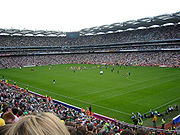
With the announcement of the rebuilding of Lansdowne Road, a new venue was required to stage the Republic of Ireland's home internationals. The only stadium in Ireland deemed suitable to stage international football was the 82,500 capacity Croke Park
, home of the Gaelic Athletic Association
(GAA). To accommodate this, the GAA temporarily relaxed its rule governing the playing of "foreign" games on its property. Initially, four UEFA Euro 2008 qualifying Group D matches were played at Croke Park in 2007, resulting in two wins and two draws. The GAA initially agreed to allow the FAI use until the end of 2008, and later extended the permission until the completion of Aviva Stadium. The Hill 16
end of Croke Park is a terrace, which means like Lansdowne Road before it, the capacity of the stadium was reduced to around 74,500 for competitive matches as temporary seating must be used.
, home of Bohemians
, but progressively more games were played at Lansdowne Road following a safety review which reduced Dalymount's capacity. The last international match played there was against Morocco
in 1990. The Republic of Ireland have also played home matches in Tolka Park
(twice) and the RDS Arena
in Dublin as well at the Mardyke
and Flower Lodge grounds in Cork. These games in Cork were, until 2009, the only two home Irish internationals played outside of Dublin. During the construction of the Aviva Stadium
, two friendly games were played in Thomond Park
, Limerick
, in 2009. Two further friendlies were played in the RDS Arena in May 2010.
Currently, the kit is supplied by Umbro
, and has been since 1994. In March 2009, Umbro signed a deal with the FAI to keep them as kit suppliers to the team until 2020.
Previously O'Neills
and Adidas
made the team's kit. Shirts carry the logo of telecommunications company 3
across the chest as per terms of a sponsorship agreement, but in all official international games, as per FIFA law, this advertising is absent.
Squad numbers are either white with an orange trim, as is the case with the home shirts, or green with an orange trim. At the bottom of the numbering there is a logo of the FAI.
There is also a limited edition grey shirt available. The team have only ever used it once and that was in a 2-2 draw with Wales on 17 November 2007. A black jersey with a green stripe across the chest was worn in the final game of the 2011 Nations Cup against Scotland and in a friendly which Ireland won 2-0 against Italy
in Liège
, Belgium
.
After finishing as runners-up in Group 8 of World Cup qualification
, Ireland were drawn to play France
in a play-off over two legs. Ireland lost 2–1 on aggregate after extra time
. The winning goal led to controversy
after replays showed Sébastien Squillaci
offside and in the line of play, and Thierry Henry
controlling the ball twice with his forearm and hand before passing to William Gallas
to score the winning goal. Desperate protests from Irish players were waved away by the referee. The FAI lodged an official appeal to FIFA, which was denied.
For UEFA Euro 2012 qualifying
, Ireland were placed in the third of six pots, organised by rankings in the UEFA national team coefficients. They were drawn into Group B
with , , , , and . Ireland finished second in their group and in the play-off drew Estonia, whom they beat by a 5-1 aggregate score to secure qualification for Poland/Ukraine '12.
against Estonia
on 11 and 15 November 2011.
Caps and goals updated as of November 15, 2011.
|-
! colspan="10" style="background:#b0d3fb; text-align:left;"|
|- style="background:#dfedfd;"
|-
! colspan="10" style="background:#b0d3fb; text-align:left;"|
|- style="background:#dfedfd;"
|-
! colspan="9" style="background:#b0d3fb; text-align:left;"|
|- style="background:#dfedfd;"
|}
|-
! colspan="9" style="background:#b0d3fb; text-align:left;"|
|- style="background:#dfedfd;"
|-
! colspan="9" style="background:#b0d3fb; text-align:left;"|
|- style="background:#dfedfd;"
|-
! colspan="9" style="background:#b0d3fb; text-align:left;"|
|- style="background:#dfedfd;"
UEFA European Football Championship squads:
Players in bold are still active.
was the first manager to actually select the team. Managers from the periods in which the national side was known as the Irish Free State or simply Ireland are obscure and many are not current known, however it is known that Val Harris
and Bill Lacey managed the side in the 1930s. Below is a list of managers from 1951 onwards, around the time when the national side became known as the Republic of Ireland:
Republic of Ireland
Ireland , described as the Republic of Ireland , is a sovereign state in Europe occupying approximately five-sixths of the island of the same name. Its capital is Dublin. Ireland, which had a population of 4.58 million in 2011, is a constitutional republic governed as a parliamentary democracy,...
in association football. It is run by the Football Association of Ireland
Football Association of Ireland
The Football Association of Ireland is the governing body for the sport of association football in the Republic of Ireland. It should not to be confused with the Irish Football Association , which is the organising body for the sport in Northern Ireland.For the full history, statistics and records...
(FAI) and currently plays home fixtures at Aviva Stadium
Aviva Stadium
The Aviva Stadium is a sports stadium located in Dublin, Ireland, with a capacity for 50,000 spectators. The stadium is built on the site of the old Lansdowne Road venue, which was demolished in 2007, and replaces that stadium as home to its chief tenants: the Irish rugby union team and the...
in Dublin, which opened in May 2010.
The team made its debut at the 1924 Summer Olympics
Ireland at the 1924 Summer Olympics
Ireland, then known as the Irish Free State, competed as an independent nation for the first time at the 1924 Summer Olympics in Paris, France....
, reaching the quarter-finals, it also participated at the 1948 Summer Olympics
Ireland at the 1948 Summer Olympics
Ireland competed at the 1948 Summer Olympics in London, England. A dispute between rival Irish Athletics governing bodies saw many Irish athletes barred from taking part in the Athletics competitions...
. Between 1924 and 1936, the team competed as the Irish Free State and from then until 1950, it was referred to by the FAI as Éire or Ireland. In 1953, FIFA decreed that for competitive matches in tournaments that both Irish teams may enter, the FAI team would be officially called the Republic of Ireland while the IFA
Irish Football Association
The Irish Football Association is the organising body for association football in Northern Ireland, and was historically the governing body for Ireland...
team was to be named Northern Ireland
Northern Ireland national football team
The Northern Ireland national football team represents Northern Ireland in international association football. Before 1921 all of Ireland was represented by a single side, the Ireland national football team, organised by the Irish Football Association...
(The IFA continued to use the name "Ireland" until 1970 for non-FIFA competitions).
Under the guidance of Jack Charlton
Jack Charlton
John "Jack" Charlton, OBE, DL is a former footballer and manager who played for Leeds United in the 1950s, 1960s and 1970s, and was part of the England team who won the 1966 World Cup...
and his successor Mick McCarthy
Mick McCarthy
Michael Joseph "Mick" McCarthy is an English-born former Irish international footballer who is currently the manager of Premier League club Wolverhampton Wanderers, where he has been in charge since July 2006....
, the team enjoyed its most successful era, qualifying for UEFA Euro 1988 in their first appearance at the UEFA European Championship, reaching the quarterfinals of the 1990 FIFA World Cup
1990 FIFA World Cup
The 1990 FIFA World Cup was the 14th FIFA World Cup, the quadrennial international football world championship tournament. It was held from 8 June to 8 July 1990 in Italy, the second country to host the event twice. Teams representing 116 national football associations from all six populated...
in their first ever appearance at the finals, and making the last 16 at both the 1994
1994 FIFA World Cup
The 1994 FIFA World Cup, the 15th staging of the FIFA World Cup, was held in nine cities across the United States from June 17 to July 17, 1994. The United States was chosen as the host by FIFA on July 4, 1988...
and 2002
2002 FIFA World Cup
The 2002 FIFA World Cup was the 17th staging of the FIFA World Cup, held in South Korea and Japan from 31 May to 30 June. It was also the first World Cup held in Asia, and the last in which the golden goal rule was implemented. Brazil won the tournament for a record fifth time, beating Germany 2–0...
FIFA World Cups. Under the guidance of Giovanni Trapattoni
Giovanni Trapattoni
Giovanni Trapattoni , sometimes known as "Trap" or "Il Trap", is an Italian football coach and former player, considered the most successful club coach in the history of Serie A. As a player he was part of Italy's squad at the 1962 FIFA World Cup....
, the team narrowly lost out on qualification for the 2010 FIFA World Cup
2010 FIFA World Cup
The 2010 FIFA World Cup was the 19th FIFA World Cup, the world championship for men's national association football teams. It took place in South Africa from 11 June to 11 July 2010...
during a controversial play-off
France vs Republic of Ireland 2010 FIFA World Cup play-off
The France vs Republic of Ireland 2010 FIFA World Cup play-off, dubbed by the media as the Hand of Frog affair, was a controversial association football game played on 18 November 2009 in the Stade de France outside Paris between the national teams of France and the Republic of Ireland...
but went on to qualify for UEFA Euro 2012.
The side was the first team from outside the United Kingdom to defeat
England v Ireland (1949)
England v Ireland. On 21 September 1949 at Goodison Park, Liverpool, the home of Everton, England were defeated 2-0 by Ireland in a friendly international...
England
England national football team
The England national football team represents England in association football and is controlled by the Football Association, the governing body for football in England. England is the joint oldest national football team in the world, alongside Scotland, whom they played in the world's first...
on home soil, at a fixture played at Goodison Park
Goodison Park
Goodison Park is a football stadium located in Walton, Liverpool, England. The stadium has been home to Everton F.C. since its completion in 1892 and is one of the world's first purpose-built football grounds...
, Liverpool
Liverpool
Liverpool is a city and metropolitan borough of Merseyside, England, along the eastern side of the Mersey Estuary. It was founded as a borough in 1207 and was granted city status in 1880...
, in 1949. The team also reached the quarter-finals of the 1964 European Nations' Cup.
Irish Free State
Between 1882 and 1924, Ireland was represented by a single national football teamIreland national football team (IFA)
The Ireland national football team represented Ireland at association football, it was organised by the Irish FA , and is the fourth oldest international team in the world. It mainly played in the British Home Championship against England, Scotland and Wales...
organised by the Belfast
Belfast
Belfast is the capital of and largest city in Northern Ireland. By population, it is the 14th biggest city in the United Kingdom and second biggest on the island of Ireland . It is the seat of the devolved government and legislative Northern Ireland Assembly...
-based Irish Football Association
Irish Football Association
The Irish Football Association is the organising body for association football in Northern Ireland, and was historically the governing body for Ireland...
(IFA). In 1920, Ireland was partitioned
Partition of Ireland
The partition of Ireland was the division of the island of Ireland into two distinct territories, now Northern Ireland and the Republic of Ireland . Partition occurred when the British Parliament passed the Government of Ireland Act 1920...
into Northern Ireland
Northern Ireland
Northern Ireland is one of the four countries of the United Kingdom. Situated in the north-east of the island of Ireland, it shares a border with the Republic of Ireland to the south and west...
and The Irish Free State (the latter in turn becoming Éire
Éire
is the Irish name for the island of Ireland and the sovereign state of the same name.- Etymology :The modern Irish Éire evolved from the Old Irish word Ériu, which was the name of a Gaelic goddess. Ériu is generally believed to have been the matron goddess of Ireland, a goddess of sovereignty, or...
or Ireland after adopting a new Constitution
Constitution of Ireland
The Constitution of Ireland is the fundamental law of the Irish state. The constitution falls broadly within the liberal democratic tradition. It establishes an independent state based on a system of representative democracy and guarantees certain fundamental rights, along with a popularly elected...
in 1937, followed by declaring itself a republic). Following the initial political upheavals surrounding Partition, a Dublin-based organisation calling itself the Football Association of the Irish Free State (FAIFS) split from the IFA in 1921 and began organising its own league
League of Ireland
The League of Ireland is the national association football league of the Republic of Ireland. Founded in 1921, as a league of eight clubs, it has expanded over time into a two-tiered league of 22 clubs. It is currently split into the League of Ireland Premier Division and the League of Ireland...
and national football team.
In 1923, the FAIFS was recognised by FIFA
FIFA
The Fédération Internationale de Football Association , commonly known by the acronym FIFA , is the international governing body of :association football, futsal and beach football. Its headquarters are located in Zurich, Switzerland, and its president is Sepp Blatter, who is in his fourth...
as the governing body of the Irish Free State and at the 1924 Summer Olympics
Ireland at the 1924 Summer Olympics
Ireland, then known as the Irish Free State, competed as an independent nation for the first time at the 1924 Summer Olympics in Paris, France....
, the Irish Free State made their international debut. On 28 May, at the Stade Olympique
Stade Olympique Yves-du-Manoir
The Stade Olympique Yves-du-Manoir - stadium in Colombes, near Paris, France . Named in memory of French rugby player Yves du Manoir in 1928. Was the main stadium for the 1924 Summer Olympics and had a capacity of 45,000 at the time...
, they beat Bulgaria
Bulgaria national football team
The FIFA Bulgaria national football team is an association football team fielded by the Bulgarian Football Union, a member association of UEFA. The team's home ground is Vasil Levski in Sofia and Luboslav Penev is in charge manager after replacement of Lothar Matthäus...
1–0, with Paddy Duncan
Paddy Duncan
Paddy Duncan was an Irish footballer. At the 1924 Olympics Games he scored the Irish Free State’s first ever goal in a senior international.-Club career:During his career Duncan was known by the nickname Dirty Duncan...
scoring the team's first ever goal. As a result of this they qualified for the quarter-finals. On 14 June 1924, the Irish Free State made their home debut against the United States
United States men's national soccer team
The United States men's national soccer team represents the United States in international association football competitions. It is controlled by the United States Soccer Federation and competes in CONCACAF...
, who had embarked on a brief European tour after competing in the same Summer Olympics. Ed Brookes
Ed Brookes
Edward A. Brooks , also known as Ed Brooks or Ned Brooks, was an Irish footballer who played as centre-forward or inside-left for, among others, Shelbourne, Bohemians, Stockport County and Athlone Town...
scored a hat-trick
Hat-trick
A hat-trick or hat trick in sport is the achievement of a positive feat three times during a game, or other achievements based on threes. The term was first used in 1858 in cricket to describe HH Stephenson's feat of taking three wickets in three balls. A collection was held for Stephenson, and he...
in a 3–1 home win at Dalymount Park
Dalymount Park
Dalymount Park is an Irish football stadium situated on Dublin's Northside. It is the home of Bohemian F.C., who have played there since the early 20th century. Affectionately known as 'Dalyer' by fans, it was also historically the "home of Irish football" holding Irish internationals and FAI Cup...
.
The Irish Free State did not play their next game until 21 March 1926. This was an away game against Italy
Italy national football team
The Italy National Football Team , represents Italy in association football and is controlled by the Italian Football Federation , the governing body for football in Italy. Italy is the second most successful national team in the history of the World Cup having won four titles , just one fewer than...
which they lost 3–0. In subsequent years the status of the Olympic Games football competition was downgraded and as a result this game is widely regarded as the Irish Free State's first official game. On 25 February 1934, the Irish Free State made their FIFA World Cup
FIFA World Cup
The FIFA World Cup, often simply the World Cup, is an international association football competition contested by the senior men's national teams of the members of Fédération Internationale de Football Association , the sport's global governing body...
debut, drawing 4–4 with Belgium at Dalymount Park in a 1934 FIFA World Cup qualifier
1934 FIFA World Cup qualification
Estonia v Lithuania was not played, since neither team could qualify with a win.Sweden qualified.-Group 2:----Spain qualified.-Group 3:Italy qualified, as Greece withdrew after the first match.-Group 4:--------...
. Paddy Moore
Paddy Moore
Paddy Moore was an Irish footballer who played for, among others, Shamrock Rovers and Aberdeen. Moore was a dual internationalist and played for both Ireland teams - the FAI XI and the IFA XI.In February 1934 Moore scored four goals for the FAI XI in a World Cup qualifier against Belgium...
scored all four of the Free State's goals and became the first player ever to score four goals in a FIFA World Cup game.
Republic of Ireland
Immediately after Partition, the Association in Dublin styled itself the "Football Association of Ireland", but changed to the "Football Association of the Irish Free State" ("FAIFS") following its admission to FIFA in 1924, at which time its representative team called itself the "Irish Free State". However after 1936, they reverted to the designation "Football Association of Ireland" and began to refer to their team as Éire or "Ireland". During this whole period, there were two Irish international football teams, chosen by two rival Associations. Both Associations, the Northern Ireland - based IFA and the Irish Free State - based FAI claimed jurisdiction over the whole of Ireland and considered themselves entitled to select players from the whole island. At least thirty-eight dual internationalsDual Irish international footballers
Dual Irish international footballers are a group of Irish international footballers who, between 1908 and March 1950, played for the international teams selected by both the Irish Football Association and the Football Association of Ireland...
were selected to represent both teams, however the overwhelming majority of these were Southerners who also agreed to play for the IFA team, with only a bare handful "crossing the border" in the other direction.
FIFA eventually intervened when both teams entered 1950 FIFA World Cup qualification
1950 FIFA World Cup qualification
-First round:Syria withdrew, and remaining match was not played.Turkey advanced to the Final Round.-Final round:Austria withdrew, so Turkey qualified automatically. But Turkey later also withdrew, and FIFA offered the place to Portugal, the runner-up of Group 6, but they declined...
, the first time they had entered the same competition. Four players – Tom Aherne
Tom Aherne
Thomas Aherne , also referred to as Bud Aherne, is a former Irish footballer and hurler. He played football for Belfast Celtic and Luton Town and was a dual internationalist, playing for both Ireland teams – the IFA XI and the FAI XI...
, Reg Ryan
Reg Ryan
Reginald Alphonso Ryan , also referred to as Paddy Ryan, is a former Irish footballer who played for West Bromwich Albion, Derby County and Coventry City. Ryan was also a dual international, playing for both Ireland teams - the FAI XI and the IFA XI. He was the last player to represent both teams...
, Davy Walsh
Davy Walsh
David Joseph Walsh , commonly referred to as Davy Walsh or Dave Walsh, is a former Irish footballer who played as a centre forward for, among others, Linfield, West Bromwich Albion and Aston Villa. Walsh was a dual international and played for both Ireland teams – the FAI XI and the IFA XI...
and Con Martin
Con Martin
Cornelius Joseph Martin , commonly referred to as Con Martin, is a former Irish footballer. Martin initially played Gaelic football with Dublin before switching codes and embarking on a successful soccer career, playing for, among others, Drumcondra, Glentoran, Leeds United and Aston Villa...
– actually played for the two different teams in the same FIFA World Cup tournament. All four players concerned had been born in the Irish Free State and made their full international debut in FAI colours before agreeing to represent the IFA team. This may have alarmed the FAI, since they subsequently lobbied FIFA to prevent the IFA from picking Southern-born players (as well as attempting to exert pressure on the players themselves, sometimes through their clubs). FIFA's response was to restrict the eligibility of players on the basis of the (political) border, further ruling in 1953 that neither team could be referred to as Ireland in competitions which both teams were eligible to enter i.e. initially the FIFA World Cup and subsequently the European Nations Cup (now the UEFA European Football Championship). FIFA decreed that the FAI team officially be called the Republic of Ireland while the IFA team was to be named Northern Ireland
Northern Ireland national football team
The Northern Ireland national football team represents Northern Ireland in international association football. Before 1921 all of Ireland was represented by a single side, the Ireland national football team, organised by the Irish Football Association...
.
1949 - 1985
A 2–0 winEngland v Ireland (1949)
England v Ireland. On 21 September 1949 at Goodison Park, Liverpool, the home of Everton, England were defeated 2-0 by Ireland in a friendly international...
over England
England national football team
The England national football team represents England in association football and is controlled by the Football Association, the governing body for football in England. England is the joint oldest national football team in the world, alongside Scotland, whom they played in the world's first...
at Goodison Park
Goodison Park
Goodison Park is a football stadium located in Walton, Liverpool, England. The stadium has been home to Everton F.C. since its completion in 1892 and is one of the world's first purpose-built football grounds...
on 21 September 1949, was the first time England suffered a home defeat by a team outside the Home Countries
Home Nations
Home Nations is a collective term with one of two meanings depending on the context. Politically, it means the nations of the constituent countries of the United Kingdom...
of Scotland
Scotland national football team
The Scotland national football team represents Scotland in international football and is controlled by the Scottish Football Association. Scotland are the joint oldest national football team in the world, alongside England, whom they played in the world's first international football match in 1872...
, Wales
Wales national football team
The Wales national football team represents Wales in international football. It is controlled by the Football Association of Wales , the governing body for football in Wales, and the third oldest national football association in the world. The team have only qualified for a major international...
and the Ireland
Ireland national football team (IFA)
The Ireland national football team represented Ireland at association football, it was organised by the Irish FA , and is the fourth oldest international team in the world. It mainly played in the British Home Championship against England, Scotland and Wales...
team run by the Belfast based Irish FA
Irish Football Association
The Irish Football Association is the organising body for association football in Northern Ireland, and was historically the governing body for Ireland...
.
The 1958 FIFA World Cup
1958 FIFA World Cup
The 1958 FIFA World Cup, the sixth staging of the World Cup, was hosted by Sweden from 8 June to 29 June. The tournament was won by Brazil, who beat Sweden 5–2 in the final for their first title. To date, this marks the only occasion that a World Cup staged in Europe was not won by a European...
qualifiers saw the Republic of Ireland drawn with England. In their home game against England, Alf Ringstead
Alf Ringstead
Alfred Ringstead son of jockey Charlie Ringstead was a professional footballer who played in the position of outside right for Sheffield United between 1950 and 1959....
put the hosts 1-0 up before John Atyeo
John Atyeo
John Atyeo was an English football striker who spent the majority of his career at Bristol City. He won six England caps between 1955 and 1957, scoring five goals...
equalised in the last minute to salvage a 1–1 draw for England. Under the rules of the day, a win for the Republic of Ireland would have meant a play-off with England for a place in the FIFA World Cup.
After reaching the quarter-finals of the 1964 European Nations' Cup, the Republic of Ireland were drawn to face Spain
Spain national football team
The Spain national football team represents Spain in international association football and is controlled by the Royal Spanish Football Federation, the governing body for football in Spain. The current head coach is Vicente del Bosque...
and Syria
Syria national football team
The Syria national football team represents Syria in association football and is controlled by the Syrian Football Association, the governing body for football in Syria. Syria's home grounds are Abbasiyyin Stadium and Aleppo International Stadium...
in 1966 FIFA World Cup qualification
1966 FIFA World Cup qualification
A total of 74 teams entered the 1966 FIFA World Cup qualification rounds, competing for a total of 16 spots in the final tournament. , as the hosts, and , as the defending champions, qualified automatically, leaving 14 spots open for competition....
. Despite Syria's withdrawal, this was still considered a qualifying group with the Irish winning 1–0 at home and losing 4–1 away. This meant a play-off at the Parc des Princes
Parc des Princes
The Parc des Princes is an all-seater football stadium located in the southwest of Paris, France. The venue, with a seating capacity of 48,712 spectators, has been the home of French football club Paris Saint-Germain since 1974. The current Parc des Princes was inaugurated on 4 June 1972, endowed...
in Paris
Paris
Paris is the capital and largest city in France, situated on the river Seine, in northern France, at the heart of the Île-de-France region...
, which Spain won 1–0, thanks to a José Ufarte goal, to take their place in the 1966 FIFA World Cup
1966 FIFA World Cup
The 1966 FIFA World Cup, the eighth staging of the World Cup, was held in England from 11 July to 30 July. England beat West Germany 4–2 in the final, winning the World Cup for the first time, so becoming the first host to win the tournament since Italy in 1934.-Host selection:England was chosen as...
. Eamon Dunphy
Eamon Dunphy
Eamon Martin Dunphy is an Irish media personality, radio and television presenter, author, sports pundit, as well as a former professional football player. He is best known as a soccer analyst on Raidió Teilifís Éireann 's coverage of the Premier League and the UEFA Champions League. He was paid...
made his Ireland début in this game. The play-off was originally scheduled to take place at Wembley Stadium
Wembley Stadium
The original Wembley Stadium, officially known as the Empire Stadium, was a football stadium in Wembley, a suburb of north-west London, standing on the site now occupied by the new Wembley Stadium that opened in 2007...
in London
London
London is the capital city of :England and the :United Kingdom, the largest metropolitan area in the United Kingdom, and the largest urban zone in the European Union by most measures. Located on the River Thames, London has been a major settlement for two millennia, its history going back to its...
, home to a large Irish diaspora
Irish diaspora
thumb|Night Train with Reaper by London Irish artist [[Brian Whelan]] from the book Myth of Return, 2007The Irish diaspora consists of Irish emigrants and their descendants in countries such as the United Kingdom, the United States, Canada, Australia, Argentina, New Zealand, Mexico, South Africa,...
, but the FAI agreed with the Spanish FA to have the match moved to Paris, where a large Spanish diaspora lived. The FAI was criticised for this move to boost revenue from gate receipts.
A run of poor results in the late 1960s and early 1970s followed until Johnny Giles
Johnny Giles
Michael John "Johnny" Giles is a former association footballer and manager best remembered for his time as a midfielder with Leeds United in the 1960s and 1970s...
became their first player-manager in the 1970s. This was followed by the debut of a young Liam Brady
Liam Brady
Liam Brady is a former Irish association football player, and former assistant manager of the Republic of Ireland national football team....
and results improved markedly. The side missed out on the 1978 FIFA World Cup
1978 FIFA World Cup
The 1978 FIFA World Cup, the 11th staging of the FIFA World Cup, was held in Argentina between 1 June and 25 June. The 1978 World Cup was won by Argentina who beat the Netherlands 3–1 after extra time in the final. This win was the first World Cup title for Argentina, who became the fifth...
by two points, having defeated France
France national football team
The France national football team represents the nation of France in international football. It is fielded by the French Football Federation , the governing body of football in France, and competes as a member of UEFA, which encompasses the countries of Europe...
at home during qualification
1978 FIFA World Cup qualification
A total of 107 teams entered the 1978 FIFA World Cup qualification rounds, competing for a total of 16 spots in the final tournament. , as the hosts, and , as the defending champions, qualified automatically, leaving 14 spots open for competition....
.
Eoin Hand
Eoin Hand
Eoin Kevin Joseph Colin Hand is a former footballer and football manager. As a player, his normal position was centre-half. He works as a television and radio football commentator for RTÉ in Ireland.-Playing career:...
took over as manager for the 1982 FIFA World Cup
1982 FIFA World Cup
The 1982 FIFA World Cup, the 12th FIFA World Cup, was held in Spain from 13 June to 11 July. The tournament was won by Italy, after defeating West Germany 3–1 in the final.-Host selection:...
qualifiers, and once more the Republic of Ireland narrowly missed out on qualification, this time on goal difference behind France who they had defeated at home once more. Disappointing qualifying campaigns for both the 1984 European Championship and 1986 FIFA World Cup
1986 FIFA World Cup
The 1986 FIFA World Cup, the 13th FIFA World Cup, was held in Mexico from 31 May to 29 June. The tournament was the second to feature a 24-team format. Colombia had been originally chosen to host the competition by FIFA but, largely due to economic reasons, was not able to do so and officially...
followed, ending Hand's time in charge.
1986 - 1995 (The Charlton Years)
In the late 1980s, the Republic of Ireland appointed Jack CharltonJack Charlton
John "Jack" Charlton, OBE, DL is a former footballer and manager who played for Leeds United in the 1950s, 1960s and 1970s, and was part of the England team who won the 1966 World Cup...
, a top rated English manager and FIFA World Cup winner as a player. He had recently built Middlesbrough
Middlesbrough F.C.
Middlesbrough Football Club , also known as Boro, are an English football club based in Middlesbrough, who play in the Football League Championship. Formed in 1876, they have played at the Riverside Stadium since August 1995, their third ground since turning professional in 1889...
into a side which provided many players to the Liverpool
Liverpool F.C.
Liverpool Football Club is an English Premier League football club based in Liverpool, Merseyside. Liverpool has won eighteen League titles, second most in English football, seven FA Cups and a record seven League Cups...
team of the time. Charlton influenced changes in the Republic of Ireland team which went on to produce a comparatively successful spell of its history, winning the Iceland Triangular Tournament
Iceland Triangular Tournament
The Iceland Triangular Tournament was an international football tournament in 1986. All matches were played in Laugardalsvöllur, Reykjavík. The three teams competing were Ireland, Iceland and Czechoslovakia. Ireland won the competition, the first time that country won an international football...
by defeating Iceland
Iceland national football team
The Iceland national football team is the national football team of Iceland and is controlled by the Football Association of Iceland. It has never advanced to the finals of any major international competition....
and Czechoslovakia
Czechoslovakia national football team
The Czechoslovakia national football team was the national association football team of Czechoslovakia from 1922 to 1993. At the dissolution of Czechoslovakia at the end of 1992, the team was participating in UEFA qualifying Group 4 for the 1994 World Cup; it completed this campaign under the name...
in May 1986 and and qualifying for two FIFA World Cups and a European Championship.
Ireland's first appearance at a major finals tournament came in UEFA Euro 1988, with qualification being secured through Gary Mackay
Gary Mackay
Gary Mackay is a former Scottish international association football player, who is now a SFA–registered agent. He also managed for a year.-Club career:...
's famous goal in Sofia
Sofia
Sofia is the capital and largest city of Bulgaria and the 12th largest city in the European Union with a population of 1.27 million people. It is located in western Bulgaria, at the foot of Mount Vitosha and approximately at the centre of the Balkan Peninsula.Prehistoric settlements were excavated...
that meant Scotland
Scotland national football team
The Scotland national football team represents Scotland in international football and is controlled by the Scottish Football Association. Scotland are the joint oldest national football team in the world, alongside England, whom they played in the world's first international football match in 1872...
beat Bulgaria
Bulgaria national football team
The FIFA Bulgaria national football team is an association football team fielded by the Bulgarian Football Union, a member association of UEFA. The team's home ground is Vasil Levski in Sofia and Luboslav Penev is in charge manager after replacement of Lothar Matthäus...
1-0 and left Ireland on top of the group. In the finals in West Germany
West Germany
West Germany is the common English, but not official, name for the Federal Republic of Germany or FRG in the period between its creation in May 1949 to German reunification on 3 October 1990....
, Ireland beat England 1–0 in Stuttgart
Stuttgart
Stuttgart is the capital of the state of Baden-Württemberg in southern Germany. The sixth-largest city in Germany, Stuttgart has a population of 600,038 while the metropolitan area has a population of 5.3 million ....
with a header from Ray Houghton
Ray Houghton
Raymond James "Ray" Houghton is a retired Scottish-born footballer who represented the Republic of Ireland at international level, qualifying through his Irish father...
, drew 1–1 with the Soviet Union in Hannover, with Ronnie Whelan
Ronnie Whelan
Ronald Andrew "Ronnie" Whelan is a former Irish football midfielder, and sometimes defender, who was an integral part of the dominant Liverpool side of the 1980s...
the scorer, and lost to Holland
Netherlands national football team
The Netherlands National Football Team represents the Netherlands in association football and is controlled by the Royal Dutch Football Association , the governing body for football in the Netherlands...
1–0 in Gelsenkirchen
Gelsenkirchen
Gelsenkirchen is a city in North Rhine-Westphalia, Germany. It is located in the northern part of the Ruhr area. Its population in 2006 was c. 267,000....
, coming within 8 minutes of a draw that would have meant a semi-final place.
The Republic of Ireland's longest competitive winning streak was achieved in 1989 during the 1990 FIFA World Cup qualification
1990 FIFA World Cup qualification
The qualification competition for the 1990 FIFA World Cup was a series of tournaments organised by the six FIFA confederations. Each confederation — the AFC , CAF , CONCACAF , CONMEBOL , OFC , and UEFA — was allocated a certain number of the 24 places at the tournament...
campaign. Five games against Spain, Northern Ireland, Hungary
Hungary national football team
The Hungary national football team represents Hungary in international football and is controlled by the Hungarian Football Federation....
and Malta
Malta national football team
The Malta national football team is the national football team of Malta and is controlled by the Malta Football Association. Malta played its first international game in February 1957, and began competing for qualification to major tournaments in 1962. The side's first competitive victory came in...
twice, were all wins for the Irish. Subsequently the side made it to the 1990 FIFA World Cup
1990 FIFA World Cup
The 1990 FIFA World Cup was the 14th FIFA World Cup, the quadrennial international football world championship tournament. It was held from 8 June to 8 July 1990 in Italy, the second country to host the event twice. Teams representing 116 national football associations from all six populated...
(Italia '90). Three draws in the group stage against England, Egypt and Holland was enough to make the knockout stage. Virtually the whole country watched as they beat Romania
Romania national football team
The Romania national football team is the national football team of Romania and is controlled by the Romanian Football Federation.Romania is one of only four national teams, the other three being Brazil, France, and Belgium, that took part in the first three World Cups.However, after that...
on penalties with Packie Bonner making a vital save and David O'Leary
David O'Leary
David Anthony O'Leary is an Irish football manager and former player. His managerial career began at Leeds United and later he managed Aston Villa. He most recently worked as the manager of Al-Ahli Dubai...
scoring the decisive spot-kick. Ireland were then beaten 1–0 by Italy
Italy national football team
The Italy National Football Team , represents Italy in association football and is controlled by the Italian Football Federation , the governing body for football in Italy. Italy is the second most successful national team in the history of the World Cup having won four titles , just one fewer than...
in the quarter final in the Olympic Stadium, Rome
Stadio Olimpico
The Stadio Olimpico is the main and largest sports facility of Rome, Italy. It is located within the Foro Italico sports complex on the north of the city. An asset of the Italian National Olympic Committee, the structure is intended primarily for football...
. During the tournament the team had an audience with Pope John Paul II
Pope John Paul II
Blessed Pope John Paul II , born Karol Józef Wojtyła , reigned as Pope of the Catholic Church and Sovereign of Vatican City from 16 October 1978 until his death on 2 April 2005, at of age. His was the second-longest documented pontificate, which lasted ; only Pope Pius IX ...
, and were the only team to do so.
After missing out on UEFA Euro 1992 (despite being unbeaten in qualifying), the Republic of Ireland qualified for the 1994 FIFA World Cup
1994 FIFA World Cup
The 1994 FIFA World Cup, the 15th staging of the FIFA World Cup, was held in nine cities across the United States from June 17 to July 17, 1994. The United States was chosen as the host by FIFA on July 4, 1988...
(USA '94), beating an opponent from the last FIFA World Cup, Italy, in their opening game. The side made it to the second round, eventually losing 2–0 to Holland. Ireland finished second behind Portugal
Portugal national football team
The Portugal national football team represents Portugal in association football and is controlled by the Portuguese Football Federation, the governing body for football in Portugal. Portugal's home ground is Estádio Nacional in Oeiras, and their head coach is Paulo Bento...
in UEFA Euro 1996 qualifying Group 6
UEFA Euro 1996 qualifying Group 6
-Standings:-Results and fixtures:------------------------------------------------...
but narrowly missed out on UEFA Euro 1996 after losing by a score of 2-0 a play-off at Anfield
Anfield
Anfield is an association football stadium in the district of Anfield, Liverpool, England, with a seating capacity of 45,522. It has been the home of Liverpool F.C. since their formation in 1892 and was originally the home of Everton F.C. from 1884 to 1892, before they moved to Goodison Park...
between the two worst group runners-up to Holland, the other worst runner-up, with Patrick Kluivert
Patrick Kluivert
Patrick Stephan Kluivert is a former Dutch footballer, currently head coach of the youth side of FC Twente. He played as a striker for AFC Ajax, A.C. Milan, FC Barcelona, Newcastle United, Valencia CF, PSV Eindhoven, and Lille OSC. Kluivert played for the Dutch national team from 1994 to 2004. He...
scoring both goals to send his team through. It was Jack Charlton's final game as manager.
1996 - 2002 (The McCarthy Years)
Charlton was replaced by Mick McCarthyMick McCarthy
Michael Joseph "Mick" McCarthy is an English-born former Irish international footballer who is currently the manager of Premier League club Wolverhampton Wanderers, where he has been in charge since July 2006....
but Ireland still missed out on the next two major tournaments. Ireland just managed to finish second to Romania in their 1998 FIFA World Cup qualification
1998 FIFA World Cup qualification (UEFA)
Listed below are the dates and results for the 1998 FIFA World Cup qualification rounds for the European zone .A total of 50 UEFA teams entered the competition. The European zone was allocated 15 places in the final tournament...
campaign after Tony Cascarino
Tony Cascarino
Anthony Guy 'Tony' Cascarino is an former association football player who played as a forward for various British and French clubs and internationally for the Republic of Ireland national team, with whom he competed in the 1988 European Football Championship and two World Cups in 1990 and...
scored a late goal to win the away match with Lithuania
Lithuania national football team
The national football team of Lithuania is under the auspices of the Lithuanian Football Federation. It played its first match in 1923. In 1940, Lithuania was occupied by the Soviet Union; the country regained its independence in 1990 and played their first match as a new nation against Georgia on...
. A play-off with Belgium followed, with the match at Lansdowne Road finishing in a 1-1 draw, the match in Belgium finishing 2-1 to the home team and substitute David Connolly
David Connolly
David James Connolly is a professional footballer who plays as a striker for Southampton. He has previously played for various clubs including Feyenoord and Excelsior in the Netherlands as well as Wigan Athletic and Sunderland in the Premier League.Although born in England, Connolly has...
being sent off in the latter, preventing Ireland from progressing to the 1998 FIFA World Cup
1998 FIFA World Cup
The 1998 FIFA World Cup, the 16th FIFA World Cup, was held in France from 10 June to 12 July 1998. France was chosen as host nation by FIFA on 2 July 1992. The tournament was won by France, who beat Brazil 3-0 in the final...
. FIFA awarded the FIFA Fair Play Award
FIFA Fair Play Award
The FIFA Fair Play Award is a FIFA recognition of good or sporting behaviour or other actions by people or bodies involved in :association football around the world. First awarded in 1987, it has been presented to individuals , teams, fans, spectators, football associations/federations and even...
for 1997 to the Irish supporters "for their exemplary behaviour at Ireland team matches, especially the FIFA World Cup qualifying play-offs against Belgium". Ireland's opponents in UEFA Euro 2000 qualifying Group 8 were Yugoslavia
Yugoslavia national football team
The Yugoslavia national football team represented the Kingdom of Yugoslavia and the Socialist Federal Republic of Yugoslavia in association football. It enjoyed a modicum of success in international competition. In 1992, during the Yugoslav wars, the team was suspended from international...
, Croatia
Croatia national football team
The Croatia national football team represents Croatia in international football. The team is controlled by the Croatian Football Federation, the governing body for football in the country, and has been managed since 2006 by former player Slaven Bilić...
, Malta
Malta national football team
The Malta national football team is the national football team of Malta and is controlled by the Malta Football Association. Malta played its first international game in February 1957, and began competing for qualification to major tournaments in 1962. The side's first competitive victory came in...
and Macedonia. Macedonia scored a last-minute equaliser that denied Ireland top spot in the group, instead they faced Turkey
Turkey national football team
The Turkey national football team represents Turkey in association football and is controlled by the Turkish Football Federation, the governing body for football in Turkey. They are affiliated with UEFA...
in a play-off to decide which team would participate in UEFA Euro 2000. The match in Dublin finished in a 1-1 draw and, after a logistical nightmare which saw Ireland traipse across Europe to Bursa, Turkey qualified with the away goal after a 0-0 draw at the end of which Tony Cascarino became involved in a fight and retired from international football.
Ireland took on both Portugal and the Netherlands in 2002 FIFA World Cup qualification – UEFA Group 2 and ended the group in second place with 24 points from ten matches; seven victories and three draws. Despite this unbeaten run, Ireland were drawn in a play-off with Iran
Iran national football team
The national football team of Iran represents Iran in international football competitions and is controlled by the Football Federation Islamic Republic of Iran...
. The match in Dublin finished in a 2-0 victory to Ireland with goals from Ian Harte
Ian Harte
Ian Patrick Harte is an Irish international footballer who plays for Reading in the Football League Championship. Best known for his spell at Leeds United and also his ability to score goals from long range, including being a free kick specialist...
(penalty) and Robbie Keane
Robbie Keane
Robert David "Robbie" Keane is an Irish association football player who plays as a striker for Los Angeles Galaxy in Major League Soccer and captains the Irish national football team....
, while the match in Tehran
Tehran
Tehran , sometimes spelled Teheran, is the capital of Iran and Tehran Province. With an estimated population of 8,429,807; it is also Iran's largest urban area and city, one of the largest cities in Western Asia, and is the world's 19th largest city.In the 20th century, Tehran was subject to...
, played in front of 100,000 spectators, finished in a 1-0 for Iran, not enough to send them through. So McCarthy did manage to lead Ireland to the 2002 FIFA World Cup
2002 FIFA World Cup
The 2002 FIFA World Cup was the 17th staging of the FIFA World Cup, held in South Korea and Japan from 31 May to 30 June. It was also the first World Cup held in Asia, and the last in which the golden goal rule was implemented. Brazil won the tournament for a record fifth time, beating Germany 2–0...
(Japan/Korea '02), only for the team to lose inspirational captain Roy Keane
Roy Keane
Roy Maurice Keane is an Irish former footballer and manager. In his 18-year playing career, he played for Cobh Ramblers in the League of Ireland, Nottingham Forest and Manchester United, before ending his career at Celtic in Scotland....
due to the pair's infamous public spat in Saipan
2002 Roy Keane incident
The Roy Keane incident was a public quarrel in May 2002 between Republic of Ireland national football team's captain Roy Keane and manager Mick McCarthy when the team was preparing for its matches in Japan in the 2002 FIFA World Cup. It resulted in Keane, the key player, leaving the squad...
. 1-1 draws with Cameroon
Cameroon national football team
The Cameroon national football team, nicknamed Les Lions Indomptables , is controlled by the Fédération Camerounaise de Football and is Africa's most successful side in FIFA world cup; having qualified for the FIFA World Cup six times – in 1982, 1990, 1994, 1998, 2002 and 2010– more than any...
and Germany
Germany national football team
The Germany national football team is the football team that has represented Germany in international competition since 1908. It is governed by the German Football Association , which was founded in 1900....
were followed by a 3-0 victory over Saudi Arabia
Saudi Arabia national football team
Saudi Arabia national football team is the national team of Saudi Arabia and is controlled by the Saudi Arabia Football Federation...
in Group E. The Irish once again progressed to the knockout stage, only losing narrowly 3-2 on penalties to Spain in Suwon
Suwon
Suwon is the provincial capital of Gyeonggi-do, South Korea. A major city of over a million inhabitants, Suwon lies approximately south of Seoul. It is traditionally known as "The City of Filial Piety"....
after Robbie Keane's last minute equalising penalty kick forced the game into extra-time.
2003 - 2007 (Kerr and Staunton)
After a poor start to qualifying for UEFA Euro 2004, McCarthy was replaced by Brian Kerr but he also struggled to guide the side to the tournament or the following 2006 FIFA World Cup2006 FIFA World Cup
The 2006 FIFA World Cup was the 18th FIFA World Cup, the quadrennial international football world championship tournament. It was held from 9 June to 9 July 2006 in Germany, which won the right to host the event in July 2000. Teams representing 198 national football associations from all six...
in Germany and was sacked in October 2005. Kerr was replaced by Steve Staunton
Steve Staunton
Stephen "Steve" Staunton is an Irish association football manager and former professional footballer, who was most recently manager of Darlington...
(assisted by Bobby Robson
Bobby Robson
Sir Robert William "Bobby" Robson, CBE was an English footballer and manager, who coached seven European clubs and the England national team during his career....
in the position of "international football consultant") in January 2006. Under Staunton, results varied widely but the team still failed to qualify for UEFA Euro 2008 and Staunton lost the position in October 2007. His reign included a humiliating 5-2 defeat to Cyprus during UEFA Euro 2008 qualifying Group D, one of the worst defeats in the team's history.
2008 - present (The Trapattoni Era)
Giovanni TrapattoniGiovanni Trapattoni
Giovanni Trapattoni , sometimes known as "Trap" or "Il Trap", is an Italian football coach and former player, considered the most successful club coach in the history of Serie A. As a player he was part of Italy's squad at the 1962 FIFA World Cup....
was then appointed manager in February 2008 following a spell with assistant coach Don Givens
Don Givens
Daniel Joseph "Don" Givens is a football player and coach, and former Republic of Ireland U21 team manager...
in charge. Trapattoni went through all ten first round 2010 FIFA World Cup qualifying games unbeaten, winning four of the ten games. Ireland lost out on a place in the 2010 FIFA World Cup
2010 FIFA World Cup
The 2010 FIFA World Cup was the 19th FIFA World Cup, the world championship for men's national association football teams. It took place in South Africa from 11 June to 11 July 2010...
after a controversial narrow loss to France in the play-offs. Ireland went down 0–1 in the first leg, and lost 2–1 on aggregate
France vs Republic of Ireland 2010 FIFA World Cup play-off
The France vs Republic of Ireland 2010 FIFA World Cup play-off, dubbed by the media as the Hand of Frog affair, was a controversial association football game played on 18 November 2009 in the Stade de France outside Paris between the national teams of France and the Republic of Ireland...
, with William Gallas
William Gallas
William Eric Gallas is a French footballer who plays for Tottenham Hotspur.Gallas began his career in France, before being signed by English club Chelsea in 2001. He transferred to rivals Arsenal as part of an exchange deal in 2006...
scoring a controversial goal in extra time in the second leg after Thierry Henry
Thierry Henry
Thierry Daniel Henry is a French professional footballer who plays for the New York Red Bulls in Major League Soccer.Henry was born in Les Ulis, Essonne where he played for an array of local sides as a youngster and showed great promise as a goal-scorer. He was spotted by AS Monaco in 1990 and...
had handballed twice before crossing the ball. This followed another controversy over FIFA's last-minute decision to seed
Seed (sports)
A seed is a preliminary ranking that can be used in arranging a sports tournament. It is called a seed because of the analogy with plants where the seed might grow into a top rank at the end of that tournament, or might instead wither away...
the play-off draw. Following an international political and media furore over the behaviour of Thierry Henry, FIFA later offered Ireland a Fair Play Award which FAI President John Delaney
John Delaney (football administrator)
John Delaney is the current chief executive of the Football Association of Ireland .His father Joe was previously FAI treasurer. Delaney became acting chief executive of the FAI in December 2004 and took up the role full-time in March 2005. In November 2006, his contract was extended to 2012...
respectfully declined and said FIFA President Sepp Blatter
Sepp Blatter
Joseph S. Blatter , commonly known as Sepp Blatter, is a Swiss football administrator, who serves as the 8th and current President of FIFA . He was elected on 8 June 1998, succeeding João Havelange. He was re-elected as President in 2002, 2007, and 2011...
was "an embarrassment to himself and an embarrassment to FIFA". The only consolation for Ireland was that they had put on one of the best performances in their history and France's FIFA World Cup was soiled by woeful performances and a players mutiny.
After the disappointment of not qualifying for the 2010 FIFA World Cup, Ireland made a positive start to their UEFA Euro 2012 qualifying
UEFA Euro 2012 qualifying
The qualifying competition for UEFA Euro 2012 is a series of parallel association football competitions held over 2010 and 2011 to decide the qualifiers for UEFA Euro 2012, to be held in Poland and Ukraine...
campaign with a 1-0 win in Yerevan
Yerevan
Yerevan is the capital and largest city of Armenia and one of the world's oldest continuously-inhabited cities. Situated along the Hrazdan River, Yerevan is the administrative, cultural, and industrial center of the country...
against Armenia
Armenia national football team
The Armenia national football team represents Armenia in association football and is controlled by the Football Federation of Armenia, the governing body for football in Armenia...
thanks to a strike by Keith Fahey
Keith Fahey
Keith Declan Fahey is an Republic of Ireland international footballer who plays for English club Birmingham City. With Ireland he was part of the team that secured qualification for UEFA Euro 2012....
, followed by a 3-1 win against Andorra
Andorra national football team
The Andorra national football team represents Andorra in association football and is controlled by the Andorran Football Federation, the governing body for football in Andorra. The team has enjoyed very little success due to the Principality's tiny population, the fourth smallest of any UEFA...
at home. Ireland then lost to Russia
Russia national football team
The Russia national football team represents Russia in association football and is controlled by the Russian Football Union , the governing body for football in Russia. Russia's home grounds are Luzhniki Stadium, Lokomotiv Stadium , and Petrovsky Stadium in St.Petersburg and their head coach is...
at home, drew with Slovakia
Slovakia national football team
The Slovakia national football team represents Slovakia in association football and is controlled by the Slovak Football Association , the governing body for football in Slovakia. Slovakia's home stadium is Štadión Pasienky and their head coach is Vladimír Weiss...
in Zilina
Žilina
Žilina is a city in north-western Slovakia, around from the capital Bratislava, close to both the Czech and Polish borders. It is the fourth largest city of Slovakia with a population of approximately 85,000, an important industrial center, the largest city on the Váh river, and the seat of a...
and won a crucial qualifying game against Macedonia to keep their hopes of qualifying alive. In May 2011, Ireland won the Nations Cup against Wales, Northern Ireland, and Scotland without conceding a goal. In June 2011, with a makeshift side, Ireland beat Macedonia 2-0 in Skopje
Skopje
Skopje is the capital and largest city of the Republic of Macedonia with about a third of the total population. It is the country's political, cultural, economic, and academic centre...
as their UEFA Euro 2012 qualifying campaign resumed, with Robbie Keane
Robbie Keane
Robert David "Robbie" Keane is an Irish association football player who plays as a striker for Los Angeles Galaxy in Major League Soccer and captains the Irish national football team....
netting his fiftieth and fifty-first international goals. Ireland finished UEFA Euro 2012 qualifying Group B
UEFA Euro 2012 qualifying Group B
This page shows the standings and results for Group B of the UEFA Euro 2012 qualifying tournament.-Standings:- Results and fixtures :...
in second place after Richard Dunne
Richard Dunne
Richard Patrick Dunne is an Irish footballer who plays as a defender for Aston Villa and the Republic of Ireland national football team. With Ireland he was a member of the 2002 FIFA World Cup squad and helped his team qualify for UEFA Euro 2012.Dunne began his professional career at Everton...
's heroic performance against Russia in Moscow
Moscow
Moscow is the capital, the most populous city, and the most populous federal subject of Russia. The city is a major political, economic, cultural, scientific, religious, financial, educational, and transportation centre of Russia and the continent...
followed by the 2-1 home defeat of Armenia in the crucial last game in October 2011. This meant that Ireland were through to the play-offs and were drawn against Estonia
Estonia national football team
The Estonia national football team represents Estonia in international association football. Team members are selected by the head coach of Estonian Football Association . Estonia play their home matches at the A. Le Coq Arena in Tallinn, Estonia....
, with Ireland securing qualification on 15 November 2011 courtesy of an unprecedented 5-1 aggregate play-off win
UEFA Euro 2012 qualifying play-offs
The UEFA Euro 2012 qualifying play-off ties were played over two legs, with the first legs on 11 November and the second legs on 15 November 2011...
, which left them just outside the top twenty in the FIFA World Rankings. UEFA Euro 2012 (Poland/Ukraine '12) is to be Ireland's first major tournament since 2002
2002 FIFA World Cup
The 2002 FIFA World Cup was the 17th staging of the FIFA World Cup, held in South Korea and Japan from 31 May to 30 June. It was also the first World Cup held in Asia, and the last in which the golden goal rule was implemented. Brazil won the tournament for a record fifth time, beating Germany 2–0...
.
Ireland have been drawn in 2014 FIFA World Cup qualification – UEFA Group C
2014 FIFA World Cup qualification – UEFA Group C
The 2014 FIFA World Cup qualification UEFA Group C is a UEFA qualifying group for the 2014 FIFA World Cup. The group comprises Germany, Sweden, Republic of Ireland, Austria, Faroe Islands and Kazakhstan....
alongside Germany, Sweden
Sweden national football team
The Swedish national football team represents Sweden in association football and is controlled by the Swedish Football Association, the governing body for Football in Sweden. Sweden's home ground is Råsunda Stadium in Stockholms län and their head coach is Erik Hamrén. Sweden made their first...
, Austria
Austria national football team
The Austria national football team is the association football team that represents the country of Austria in international competition and is controlled by the Austrian Football Association ....
, Farie Islands
Faroe Islands national football team
The Faroe Islands national football team represents the Faroe Islands in association football and is controlled by the Faroe Islands Football Association, the governing body for football in the Faroe Islands. The Faroe Islands became a member of FIFA in 1988 and UEFA in 1990 and are the third...
and Khazahkstan
Kazakhstan national football team
The Kazakhstan national football team represents Kazakhstan in international men's association football and is directed by Football Federation of Kazakhstan. They split from the Soviet Union national football team after independence in 1991 and joined the Asian Football Confederation's Central and...
.
Media coverage
Ireland matches are currently broadcast by Raidió Teilifís ÉireannRaidió Teilifís Éireann
Raidió Teilifís Éireann is a semi-state company and the public service broadcaster of Ireland. It both produces programmes and broadcasts them on television, radio and the Internet. The radio service began on January 1, 1926, while regular television broadcasts began on December 31, 1961, making...
(RTÉ), usually on RTÉ Two
RTÉ Two
RTÉ Two is a free-to-air general entertainment channel operated by Irish state broadcaster Raidió Teilifís Éireann. RTÉ Two is available throughout the island of Ireland through digital terrestrial service Saorview, VHF and UHF bands, and is also available via satellite to Irish subscribers of...
. RTÉ briefly lost its broadcast rights in 2002 when the FAI controversially sold them in a multi-million deal to Sky Sports
Sky Sports
Sky Sports is the brand name for a group of sports-oriented television channels operated by the UK and Ireland's main satellite pay-TV company, British Sky Broadcasting. Sky Sports is the dominant subscription television sports brand in the United Kingdom and Ireland...
, a channel not available terrestrially in the Republic of Ireland. The decision was criticised by fans and politicians alike. The Consumers' Association of Ireland
Consumers' Association of Ireland
The Consumers' Association of Ireland Ltd. was set up in 1966 to protect and educate consumers. It's represent consumer members who subcribe to Consumer Choice Magazine....
(CAI) described the FAI as "greedy". The FAI was eventually forced to backtrack on its decision and to allow RTÉ to continue its broadcasts after the government intervened to put a stop to the sale of important Irish sporting events to foreign broadcasters.
Stadium
Lansdowne Road and the Aviva Stadium
Since the 1980s, most home matches have been played at Lansdowne RoadLansdowne Road
Lansdowne Road was a stadium in Dublin owned by the Irish Rugby Football Union that has been the location of a number of sports stadiums. It was used primarily for rugby union and for association football matches as well as some music concerts...
, Dublin, the national rugby stadium owned by the Irish Rugby Football Union
Irish Rugby Football Union
The Irish Rugby Football Union is the body managing rugby union in Ireland. The IRFU has its head office at 10/12 Lansdowne Road and home ground at Aviva Stadium, where Irish rugby union international matches are played...
(IRFU). The ground was closed for redevelopment in 2007, with the replacement ground, the Aviva Stadium
Aviva Stadium
The Aviva Stadium is a sports stadium located in Dublin, Ireland, with a capacity for 50,000 spectators. The stadium is built on the site of the old Lansdowne Road venue, which was demolished in 2007, and replaces that stadium as home to its chief tenants: the Irish rugby union team and the...
, opening on 14 May 2010. Aviva Stadium is jointly owned by the IRFU and FAI, although it will return to solely IRFU ownership on expiry of the current 60 year lease. The first football international played at Lansdowne Road was a friendly against Italy
Italy national football team
The Italy National Football Team , represents Italy in association football and is controlled by the Italian Football Federation , the governing body for football in Italy. Italy is the second most successful national team in the history of the World Cup having won four titles , just one fewer than...
in 1971; a 5-0 victory over San Marino
San Marino national football team
The San Marino national football team is the national football team of San Marino, controlled by the San Marino Football Federation...
in a UEFA Euro 2008 qualifying Group D match on 15 November 2006 was the last game there before the reconstruction.
The all-seater capacity of Lansdowne Road prior to the renovation was 36,000, although higher attendances, using the standing only areas, were permitted for friendly matches. The Aviva Stadium's status as an all-seater increased capacity for competitive games to 51,700. The opening game at the Aviva Stadium, a controversial 1-0 friendly defeat to Argentina
Argentina national football team
The Argentina national football team represents Argentina in association football and is controlled by the Argentine Football Association , the governing body for football in Argentina. Argentina's home stadium is Estadio Monumental Antonio Vespucio Liberti and their head coach is Alejandro...
, was noted for Robbie Keane
Robbie Keane
Robert David "Robbie" Keane is an Irish association football player who plays as a striker for Los Angeles Galaxy in Major League Soccer and captains the Irish national football team....
securing his membership in the FIFA Century Club and manmanager Giovanni Trapattoni
Giovanni Trapattoni
Giovanni Trapattoni , sometimes known as "Trap" or "Il Trap", is an Italian football coach and former player, considered the most successful club coach in the history of Serie A. As a player he was part of Italy's squad at the 1962 FIFA World Cup....
's absence due to surgery, with assistant manger Marco Tardelli taking charge.
Croke Park
With the announcement of the rebuilding of Lansdowne Road, a new venue was required to stage the Republic of Ireland's home internationals. The only stadium in Ireland deemed suitable to stage international football was the 82,500 capacity Croke Park
Croke Park
Croke Park in Dublin is the principal stadium and headquarters of the Gaelic Athletic Association , Ireland's biggest sporting organisation...
, home of the Gaelic Athletic Association
Gaelic Athletic Association
The Gaelic Athletic Association is an amateur Irish and international cultural and sporting organisation focused primarily on promoting Gaelic games, which include the traditional Irish sports of hurling, camogie, Gaelic football, handball and rounders...
(GAA). To accommodate this, the GAA temporarily relaxed its rule governing the playing of "foreign" games on its property. Initially, four UEFA Euro 2008 qualifying Group D matches were played at Croke Park in 2007, resulting in two wins and two draws. The GAA initially agreed to allow the FAI use until the end of 2008, and later extended the permission until the completion of Aviva Stadium. The Hill 16
Hill 16
Hill 16 officially called Dineen/Hill 16 is a terrace on the railway end of Croke Park, the show piece stadium of the Gaelic Athletic Association in Dublin City, Ireland. It is considered a national icon....
end of Croke Park is a terrace, which means like Lansdowne Road before it, the capacity of the stadium was reduced to around 74,500 for competitive matches as temporary seating must be used.
Other venues
Prior to the 1980s, the Republic of Ireland played most home games at Dalymount ParkDalymount Park
Dalymount Park is an Irish football stadium situated on Dublin's Northside. It is the home of Bohemian F.C., who have played there since the early 20th century. Affectionately known as 'Dalyer' by fans, it was also historically the "home of Irish football" holding Irish internationals and FAI Cup...
, home of Bohemians
Bohemian F.C.
Bohemian F.C. , more commonly referred to as Bohemians, is a professional football club from Dublin, Ireland. Bohemians compete in the Premier Division of the League of Ireland and are the third most successful club in League of Ireland football history, having won the League of Ireland title 11...
, but progressively more games were played at Lansdowne Road following a safety review which reduced Dalymount's capacity. The last international match played there was against Morocco
Morocco national football team
The Morocco national football team , nicknamed أسود الأطلس , is the national team of Morocco and is managed by Eric Gerets. Winners of the African Nations Cup in 1976, they were the first African team to win a group at the World Cup, which they did in 1986, finishing ahead of Portugal, Poland, and...
in 1990. The Republic of Ireland have also played home matches in Tolka Park
Tolka Park
Tolka Park is an Irish football ground located in the north Dublin suburb of Drumcondra, on the northern banks of the River Tolka. It is currently the home ground of League of Ireland club Shelbourne...
(twice) and the RDS Arena
RDS Arena
RDS Arena is a multi-purpose sports stadium, owned by the Royal Dublin Society and located in the Dublin suburb of Ballsbridge, Ireland.The arena was originally developed to host equestrian events, including the annual Dublin Horse Show, which was first held there in 1868. The site was acquired in...
in Dublin as well at the Mardyke
Mardyke
The Mardyke is an area in Cork city, on the northern half of the long western part of the island formed by the two channels of the River Lee near the city centre. It comprises several large open spaces...
and Flower Lodge grounds in Cork. These games in Cork were, until 2009, the only two home Irish internationals played outside of Dublin. During the construction of the Aviva Stadium
Aviva Stadium
The Aviva Stadium is a sports stadium located in Dublin, Ireland, with a capacity for 50,000 spectators. The stadium is built on the site of the old Lansdowne Road venue, which was demolished in 2007, and replaces that stadium as home to its chief tenants: the Irish rugby union team and the...
, two friendly games were played in Thomond Park
Thomond Park
Thomond Park is a stadium located in Limerick in the Irish province of Munster. The stadium is owned by the Irish Rugby Football Union and count Munster Rugby, Shannon RFC and UL Bohemian RFC as tenants. The capacity of the stadium is 26,500 following its large scale redevelopment in...
, Limerick
Limerick
Limerick is the third largest city in the Republic of Ireland, and the principal city of County Limerick and Ireland's Mid-West Region. It is the fifth most populous city in all of Ireland. When taking the extra-municipal suburbs into account, Limerick is the third largest conurbation in the...
, in 2009. Two further friendlies were played in the RDS Arena in May 2010.
Kit
Traditionally, the team plays in a home strip of green shirt, white shorts and green socks. The second strip is usually the reverse of these colours, although there have been exceptions, such as an orange shirt in the late 1990s.Currently, the kit is supplied by Umbro
Umbro
Umbro is an English sportswear and football equipment supplier based in Cheadle, Greater Manchester, England. The company is now part of Nike. Umbro designs, sources, and markets sport-related apparel, footwear, and equipment...
, and has been since 1994. In March 2009, Umbro signed a deal with the FAI to keep them as kit suppliers to the team until 2020.
Previously O'Neills
O'Neills
O'Neills Irish International Sports Company Ltd. was established in 1918. It is the largest manufacturer of sportswear in Ireland and has manufacturing plants in Dublin and Strabane....
and Adidas
Adidas
Adidas AG is a German sports apparel manufacturer and parent company of the Adidas Group, which consists of the Reebok sportswear company, TaylorMade-Adidas golf company , and Rockport...
made the team's kit. Shirts carry the logo of telecommunications company 3
Hutchison 3G
3 is a brand name under which several UMTS-based mobile phone networks and Broadband Internet Providers are operated in Australia, Austria, Denmark, Hong Kong, Macau, Indonesia, Ireland, Italy, Sweden, and the United Kingdom...
across the chest as per terms of a sponsorship agreement, but in all official international games, as per FIFA law, this advertising is absent.
Squad numbers are either white with an orange trim, as is the case with the home shirts, or green with an orange trim. At the bottom of the numbering there is a logo of the FAI.
There is also a limited edition grey shirt available. The team have only ever used it once and that was in a 2-2 draw with Wales on 17 November 2007. A black jersey with a green stripe across the chest was worn in the final game of the 2011 Nations Cup against Scotland and in a friendly which Ireland won 2-0 against Italy
Italy national football team
The Italy National Football Team , represents Italy in association football and is controlled by the Italian Football Federation , the governing body for football in Italy. Italy is the second most successful national team in the history of the World Cup having won four titles , just one fewer than...
in Liège
Liège
Liège is a major city and municipality of Belgium located in the province of Liège, of which it is the economic capital, in Wallonia, the French-speaking region of Belgium....
, Belgium
Belgium
Belgium , officially the Kingdom of Belgium, is a federal state in Western Europe. It is a founding member of the European Union and hosts the EU's headquarters, and those of several other major international organisations such as NATO.Belgium is also a member of, or affiliated to, many...
.
Competitive record
FIFA World Cup record
| FIFA World Cup record FIFA World Cup The FIFA World Cup, often simply the World Cup, is an international association football competition contested by the senior men's national teams of the members of Fédération Internationale de Football Association , the sport's global governing body... |
FIFA World Cup Qualification record | |||||||||||||
|---|---|---|---|---|---|---|---|---|---|---|---|---|---|---|
| Year | Round | Position | ||||||||||||
 1930 19301930 FIFA World Cup The 1930 FIFA World Cup was the inaugural FIFA World Cup, the world championship for men's national association football teams. It took place in Uruguay from 13 July to 30 July 1930... |
Did not enter | – | – | – | – | – | – | |||||||
 1934 19341934 FIFA World Cup The 1934 FIFA World Cup was the second FIFA World Cup, the world championship for men's national association football teams. It took place in Italy from 27 May to 10 June 1934.... |
Did not qualify | 2 | 0 | 1 | 1 | 6 | 9 | |||||||
 1938 19381938 FIFA World Cup The 1938 FIFA World Cup was the third staging of the World Cup, and was held in France from 4 June to 19 June. Italy retained the championship, beating Hungary 4–2 in the final.-Host selection:... |
2 | 0 | 1 | 1 | 5 | 6 | ||||||||
 1950 19501950 FIFA World Cup The 1950 FIFA World Cup, held in Brazil from 24 June to 16 July, was the fourth FIFA World Cup. It was the first World Cup since 1938, the planned 1942 and 1946 competitions having been canceled owing to World War II... |
4 | 1 | 1 | 2 | 6 | 7 | ||||||||
 1954 19541954 FIFA World Cup The 1954 FIFA World Cup, the fifth staging of the FIFA World Cup, was held in Switzerland from 16 June to 4 July. Switzerland was chosen as hosts in July 1946. The tournament set a number of all-time records for goal-scoring, including the highest average goals scored per game... |
4 | 2 | 0 | 2 | 8 | 6 | ||||||||
 1958 19581958 FIFA World Cup The 1958 FIFA World Cup, the sixth staging of the World Cup, was hosted by Sweden from 8 June to 29 June. The tournament was won by Brazil, who beat Sweden 5–2 in the final for their first title. To date, this marks the only occasion that a World Cup staged in Europe was not won by a European... |
4 | 2 | 1 | 1 | 6 | 7 | ||||||||
 1962 19621962 FIFA World Cup The 1962 FIFA World Cup, the seventh staging of the World Cup, was held in Chile from 30 May to 17 June. It was won by Brazil, who retained the championship by beating Czechoslovakia 3–1 in the final... |
4 | 0 | 0 | 4 | 3 | 17 | ||||||||
 1966 19661966 FIFA World Cup The 1966 FIFA World Cup, the eighth staging of the World Cup, was held in England from 11 July to 30 July. England beat West Germany 4–2 in the final, winning the World Cup for the first time, so becoming the first host to win the tournament since Italy in 1934.-Host selection:England was chosen as... |
3 | 1 | 0 | 2 | 3 | 4 | ||||||||
 1970 19701970 FIFA World Cup The 1970 FIFA World Cup, the ninth staging of the World Cup, was held in Mexico, from 31 May to 21 June. The 1970 tournament was the first World Cup hosted in North America, and the first held outside South America and Europe. In a match-up of two-time World Cup champions, the final was won by... |
6 | 0 | 1 | 5 | 3 | 14 | ||||||||
 1974 19741974 FIFA World Cup The 1974 FIFA World Cup, the tenth staging of the World Cup, was held in West Germany from 13 June to 7 July. The tournament marked the first time that the current trophy, the FIFA World Cup Trophy, created by the Italian sculptor Silvio Gazzaniga, was awarded... |
4 | 1 | 1 | 2 | 4 | 5 | ||||||||
 1978 19781978 FIFA World Cup The 1978 FIFA World Cup, the 11th staging of the FIFA World Cup, was held in Argentina between 1 June and 25 June. The 1978 World Cup was won by Argentina who beat the Netherlands 3–1 after extra time in the final. This win was the first World Cup title for Argentina, who became the fifth... |
4 | 1 | 1 | 2 | 2 | 4 | ||||||||
 1982 19821982 FIFA World Cup The 1982 FIFA World Cup, the 12th FIFA World Cup, was held in Spain from 13 June to 11 July. The tournament was won by Italy, after defeating West Germany 3–1 in the final.-Host selection:... |
8 | 4 | 2 | 2 | 17 | 11 | ||||||||
| 1986 1986 FIFA World Cup The 1986 FIFA World Cup, the 13th FIFA World Cup, was held in Mexico from 31 May to 29 June. The tournament was the second to feature a 24-team format. Colombia had been originally chosen to host the competition by FIFA but, largely due to economic reasons, was not able to do so and officially... |
8 | 2 | 2 | 4 | 5 | 10 | ||||||||
 1990 19901990 FIFA World Cup The 1990 FIFA World Cup was the 14th FIFA World Cup, the quadrennial international football world championship tournament. It was held from 8 June to 8 July 1990 in Italy, the second country to host the event twice. Teams representing 116 national football associations from all six populated... |
Quarter final | 7th | 5 | 0 | 4 | 1 | 2 | 3 | 8 | 5 | 2 | 1 | 10 | 2 |
 1994 19941994 FIFA World Cup The 1994 FIFA World Cup, the 15th staging of the FIFA World Cup, was held in nine cities across the United States from June 17 to July 17, 1994. The United States was chosen as the host by FIFA on July 4, 1988... |
Round of 16 | 15th | 4 | 1 | 1 | 2 | 2 | 4 | 12 | 7 | 4 | 1 | 19 | 6 |
| 1998 1998 FIFA World Cup The 1998 FIFA World Cup, the 16th FIFA World Cup, was held in France from 10 June to 12 July 1998. France was chosen as host nation by FIFA on 2 July 1992. The tournament was won by France, who beat Brazil 3-0 in the final... |
Did not qualify | 12 | 5 | 4 | 3 | 25 | 11 | |||||||
  2002 20022002 FIFA World Cup The 2002 FIFA World Cup was the 17th staging of the FIFA World Cup, held in South Korea and Japan from 31 May to 30 June. It was also the first World Cup held in Asia, and the last in which the golden goal rule was implemented. Brazil won the tournament for a record fifth time, beating Germany 2–0... |
Round of 16 | 12th | 4 | 1 | 3 | 0 | 6 | 3 | 12 | 8 | 3 | 1 | 25 | 6 |
 2006 20062006 FIFA World Cup The 2006 FIFA World Cup was the 18th FIFA World Cup, the quadrennial international football world championship tournament. It was held from 9 June to 9 July 2006 in Germany, which won the right to host the event in July 2000. Teams representing 198 national football associations from all six... |
Did not qualify | 10 | 4 | 5 | 1 | 12 | 5 | |||||||
 2010 20102010 FIFA World Cup The 2010 FIFA World Cup was the 19th FIFA World Cup, the world championship for men's national association football teams. It took place in South Africa from 11 June to 11 July 2010... |
12 | 4 | 7 | 1 | 13 | 10 | ||||||||
| Total | 3/19 | 13 | 2 | 8 | 3 | 10 | 10 | 119 | 47 | 36 | 36 | 141 | 177 | |
- '*Draws include knockout matches decided by penalty shootout.
| FIFA World Cup History | ||||
|---|---|---|---|---|
| Year | Round | Score | Result | Republic of Ireland scorers |
| 1990 1990 FIFA World Cup The 1990 FIFA World Cup was the 14th FIFA World Cup, the quadrennial international football world championship tournament. It was held from 8 June to 8 July 1990 in Italy, the second country to host the event twice. Teams representing 116 national football associations from all six populated... |
Round 1 | 1 – 1 | Draw | Kevin Sheedy |
| Round 1 | 1 – 1 | Draw | Niall Quinn Niall Quinn Niall John Quinn honorary MBE is a former Irish international footballer, and the ex-chairman of Sunderland AFC. He still works at the club as an overseas manager. He is also heavily involved in the management side of horse racing... |
|
| Round 2 | 0(5) – 0(4) | Draw | ||
| Quarter-finals | 0 – 1 | Loss | ||
| 1994 1994 FIFA World Cup The 1994 FIFA World Cup, the 15th staging of the FIFA World Cup, was held in nine cities across the United States from June 17 to July 17, 1994. The United States was chosen as the host by FIFA on July 4, 1988... |
Round 1 | 1 – 0 | Win | Ray Houghton Ray Houghton Raymond James "Ray" Houghton is a retired Scottish-born footballer who represented the Republic of Ireland at international level, qualifying through his Irish father... |
| Round 1 | 1 – 2 | Loss | John Aldridge John Aldridge John William Aldridge is a former Republic of Ireland international footballer and football manager... |
|
| Round 1 | 0 – 0 | Draw | ||
| Round 2 | 0 – 2 | Loss | ||
| 2002 2002 FIFA World Cup The 2002 FIFA World Cup was the 17th staging of the FIFA World Cup, held in South Korea and Japan from 31 May to 30 June. It was also the first World Cup held in Asia, and the last in which the golden goal rule was implemented. Brazil won the tournament for a record fifth time, beating Germany 2–0... |
Round 1 | 1 – 1 | Draw | Matt Holland Matt Holland Matthew Rhys "Matt" Holland is a former English-born Irish footballer, who represented Republic of Ireland at international level... |
| Round 1 | 1 – 1 | Draw | Robbie Keane Robbie Keane Robert David "Robbie" Keane is an Irish association football player who plays as a striker for Los Angeles Galaxy in Major League Soccer and captains the Irish national football team.... |
|
| Round 1 | 3 – 0 | Win | Robbie Keane Robbie Keane Robert David "Robbie" Keane is an Irish association football player who plays as a striker for Los Angeles Galaxy in Major League Soccer and captains the Irish national football team.... Gary Breen Gary Breen Gary Patrick Breen is an Irish footballer who made more than 500 appearances in the Football League and Premier League. He played for numerous clubs over a 20-year career, including more than 100 appearances each for Coventry City and Sunderland... Damien Duff Damien Duff Damien Anthony Duff is an Irish footballer who plays for Premier League team Fulham and the Republic of Ireland national football team. With Ireland he has participated in the 2002 FIFA World Cup and helped his team qualify for UEFA Euro 2012... |
|
| Round 2 | 1(2) – 1(3) | Draw | Robbie Keane Robbie Keane Robert David "Robbie" Keane is an Irish association football player who plays as a striker for Los Angeles Galaxy in Major League Soccer and captains the Irish national football team.... |
|
UEFA European Championship record
| UEFA Euro Championship record UEFA European Football Championship The UEFA European Football Championship is the main football competition of the men's national football teams governed by UEFA . Held every four years since 1960, in the even-numbered year between World Cup tournaments, it was originally called the UEFA European Nations Cup, changing to the current... |
UEFA Euro Championship Qualification record | |||||||||||||
|---|---|---|---|---|---|---|---|---|---|---|---|---|---|---|
| Year | Round | Position | ||||||||||||
| 1960 |
Did not qualify | 2 | 1 | 0 | 1 | 2 | 4 | |||||||
 1964 1964 |
6 | 2 | 2 | 2 | 9 | 12 | ||||||||
| 1968 |
6 | 2 | 1 | 3 | 5 | 8 | ||||||||
 1972 1972 |
6 | 0 | 1 | 5 | 3 | 17 | ||||||||
 1976 1976 |
6 | 3 | 1 | 2 | 11 | 5 | ||||||||
| 1980 |
8 | 2 | 3 | 3 | 9 | 8 | ||||||||
| 1984 |
8 | 4 | 1 | 3 | 20 | 10 | ||||||||
| 1988 |
Group stage | 5th | 3 | 1 | 1 | 1 | 2 | 2 | 8 | 4 | 3 | 1 | 10 | 5 |
| 1992 |
Did not qualify | 6 | 2 | 4 | 0 | 13 | 6 | |||||||
| 1996 |
11 | 5 | 2 | 4 | 17 | 13 | ||||||||
 2000 2000 |
10 | 5 | 3 | 2 | 15 | 7 | ||||||||
 2004 2004 |
8 | 3 | 2 | 3 | 10 | 11 | ||||||||
 2008 2008 |
12 | 4 | 5 | 3 | 17 | 14 | ||||||||
  2012 2012 |
Qualified | 12 | 7 | 4 | 1 | 20 | 8 | |||||||
| Total | Group Stage | 1/13 | 3 | 1 | 1 | 1 | 2 | 2 | 101 | 44 | 31 | 33 | 148 | 128 |
| UEFA Euro History | ||||
|---|---|---|---|---|
| Year | Round | Score | Result | Republic of Ireland scorers |
| 1988 | Round 1 | 1 – 0 | Win | Ray Houghton Ray Houghton Raymond James "Ray" Houghton is a retired Scottish-born footballer who represented the Republic of Ireland at international level, qualifying through his Irish father... |
| Round 1 | 1 – 1 | Draw | Ronnie Whelan Ronnie Whelan Ronald Andrew "Ronnie" Whelan is a former Irish football midfielder, and sometimes defender, who was an integral part of the dominant Liverpool side of the 1980s... |
|
| Round 1 | 0 – 1 | Loss | ||
Recent results and forthcoming fixtures
| UEFA Euro 2012 qualifying Group B UEFA Euro 2012 qualifying Group B This page shows the standings and results for Group B of the UEFA Euro 2012 qualifying tournament.-Standings:- Results and fixtures :... standings |
After finishing as runners-up in Group 8 of World Cup qualification
2010 FIFA World Cup qualification (UEFA)
The European zone of qualification for the 2010 FIFA World Cup saw 53 teams competing for 13 places at the finals. The qualification process started on 20 August 2008, after UEFA Euro 2008, and ended on 18 November 2009. The qualification process saw the first competitive matches of...
, Ireland were drawn to play France
France national football team
The France national football team represents the nation of France in international football. It is fielded by the French Football Federation , the governing body of football in France, and competes as a member of UEFA, which encompasses the countries of Europe...
in a play-off over two legs. Ireland lost 2–1 on aggregate after extra time
Overtime (sports)
Overtime or extra time is an additional period of play specified under the rules of a sport to bring a game to a decision and avoid declaring the match a tie or draw. In most sports, this extra period is only played if the game is required to have a clear winner, as in single-elimination...
. The winning goal led to controversy
France vs Republic of Ireland 2010 FIFA World Cup play-off
The France vs Republic of Ireland 2010 FIFA World Cup play-off, dubbed by the media as the Hand of Frog affair, was a controversial association football game played on 18 November 2009 in the Stade de France outside Paris between the national teams of France and the Republic of Ireland...
after replays showed Sébastien Squillaci
Sébastien Squillaci
Sébastien Squillaci is a French international footballer who plays for Arsenal. He plays as a central defender and is described as a player who "reads the game well" and is "strong in the air and on the ground"...
offside and in the line of play, and Thierry Henry
Thierry Henry
Thierry Daniel Henry is a French professional footballer who plays for the New York Red Bulls in Major League Soccer.Henry was born in Les Ulis, Essonne where he played for an array of local sides as a youngster and showed great promise as a goal-scorer. He was spotted by AS Monaco in 1990 and...
controlling the ball twice with his forearm and hand before passing to William Gallas
William Gallas
William Eric Gallas is a French footballer who plays for Tottenham Hotspur.Gallas began his career in France, before being signed by English club Chelsea in 2001. He transferred to rivals Arsenal as part of an exchange deal in 2006...
to score the winning goal. Desperate protests from Irish players were waved away by the referee. The FAI lodged an official appeal to FIFA, which was denied.
For UEFA Euro 2012 qualifying
UEFA Euro 2012 qualifying
The qualifying competition for UEFA Euro 2012 is a series of parallel association football competitions held over 2010 and 2011 to decide the qualifiers for UEFA Euro 2012, to be held in Poland and Ukraine...
, Ireland were placed in the third of six pots, organised by rankings in the UEFA national team coefficients. They were drawn into Group B
UEFA Euro 2012 qualifying Group B
This page shows the standings and results for Group B of the UEFA Euro 2012 qualifying tournament.-Standings:- Results and fixtures :...
with , , , , and . Ireland finished second in their group and in the play-off drew Estonia, whom they beat by a 5-1 aggregate score to secure qualification for Poland/Ukraine '12.
Match results and fixtures
Matches from the past 12 months as well as any future scheduled matches.Current squad
The following players were called up for the UEFA Euro 2012 qualifying play-offsUEFA Euro 2012 qualifying play-offs
The UEFA Euro 2012 qualifying play-off ties were played over two legs, with the first legs on 11 November and the second legs on 15 November 2011...
against Estonia
Estonia national football team
The Estonia national football team represents Estonia in international association football. Team members are selected by the head coach of Estonian Football Association . Estonia play their home matches at the A. Le Coq Arena in Tallinn, Estonia....
on 11 and 15 November 2011.
Caps and goals updated as of November 15, 2011.
|-
! colspan="10" style="background:#b0d3fb; text-align:left;"|
|- style="background:#dfedfd;"
|-
! colspan="10" style="background:#b0d3fb; text-align:left;"|
|- style="background:#dfedfd;"
|-
! colspan="9" style="background:#b0d3fb; text-align:left;"|
|- style="background:#dfedfd;"
|}
Recent call-ups
The following players have been called up on the past 12 months.|-
! colspan="9" style="background:#b0d3fb; text-align:left;"|
|- style="background:#dfedfd;"
|-
! colspan="9" style="background:#b0d3fb; text-align:left;"|
|- style="background:#dfedfd;"
|-
! colspan="9" style="background:#b0d3fb; text-align:left;"|
|- style="background:#dfedfd;"
Previous squads
FIFA World Cup squads:- 1990 FIFA World Cup squad
- 1994 FIFA World Cup squad
- 2002 FIFA World Cup squad
UEFA European Football Championship squads:
- UEFA Euro 1988 squad
Most-capped players
, 33 Republic of Ireland players have been capped on more than 50 occasions; four have made 100 or more appearances and are members of the FIFA Century Club.Players in bold are still active.
| Rank | Name | Career | Caps | Goals |
|---|---|---|---|---|
| 1 | Shay Given Shay Given Séamus John James "Shay" Given is an Irish footballer who plays for Aston Villa and the Republic of Ireland national team as a goalkeeper. He won the PFA's Player of the Year in 2002.... |
1996– | 120 | 0 |
| 2 | Robbie Keane Robbie Keane Robert David "Robbie" Keane is an Irish association football player who plays as a striker for Los Angeles Galaxy in Major League Soccer and captains the Irish national football team.... |
1998– | 114 | 53 |
| 3 | Kevin Kilbane Kevin Kilbane Kevin Daniel Kilbane is an English-born Irish association footballer who plays as a left back or left winger for Derby County, on loan from Hull City.... |
1997– | 110 | 8 |
| 4 | Steve Staunton Steve Staunton Stephen "Steve" Staunton is an Irish association football manager and former professional footballer, who was most recently manager of Darlington... |
1988–2002 | 102 | 7 |
| 5 | Damien Duff Damien Duff Damien Anthony Duff is an Irish footballer who plays for Premier League team Fulham and the Republic of Ireland national football team. With Ireland he has participated in the 2002 FIFA World Cup and helped his team qualify for UEFA Euro 2012... |
1998– | 94 | 8 |
| 6 | Niall Quinn Niall Quinn Niall John Quinn honorary MBE is a former Irish international footballer, and the ex-chairman of Sunderland AFC. He still works at the club as an overseas manager. He is also heavily involved in the management side of horse racing... |
1986–2002 | 91 | 21 |
| 7 | Tony Cascarino Tony Cascarino Anthony Guy 'Tony' Cascarino is an former association football player who played as a forward for various British and French clubs and internationally for the Republic of Ireland national team, with whom he competed in the 1988 European Football Championship and two World Cups in 1990 and... |
1986–2000 | 88 | 19 |
| 8 | Paul McGrath Paul McGrath (footballer) Paul McGrath is a retired Irish footballer, who played as a defender. McGrath is widely recognised as one of the greatest players to have ever come out of Ireland.... |
1985–1997 | 83 | 8 |
| 9 | Packie Bonner Packie Bonner Patrick Joseph "Packie" Bonner is an Irish former football goalkeeper for Celtic and the Republic of Ireland, who earned 80 caps after making his debut on his 21st birthday... |
1981–1996 | 80 | 0 |
| 10 | John O'Shea John O'Shea John O'Shea can refer to:*John O'Shea, Irish footballer with Sunderland*John O'Shea , New Zealand film director*John O'Shea *John O'Shea , Wales international rugby union footballer*John O'Shea... |
2001– | 74 | 1 |
| 11 | Ray Houghton Ray Houghton Raymond James "Ray" Houghton is a retired Scottish-born footballer who represented the Republic of Ireland at international level, qualifying through his Irish father... |
1986–1998 | 73 | 6 |
| 12 | Kenny Cunningham Kenny Cunningham Kenneth Edward "Kenny" Cunningham is an Irish former footballer who played as a defender. He played international football for the Republic of Ireland until his retirement in 2005... |
1996–2005 | 72 | 0 |
| Liam Brady Liam Brady Liam Brady is a former Irish association football player, and former assistant manager of the Republic of Ireland national football team.... |
1975–1990 | 72 | 9 | |
| 14 | Kevin Moran | 1980–1994 | 71 | 6 |
| 15 | Frank Stapleton Frank Stapleton Francis Anthony "Frank" Stapleton is an Irish former football player and manager. He is best remembered for his time at Arsenal, Manchester United and as a pivotal player for the Republic of Ireland... |
1977–1990 | 71 | 20 |
| Richard Dunne Richard Dunne Richard Patrick Dunne is an Irish footballer who plays as a defender for Aston Villa and the Republic of Ireland national football team. With Ireland he was a member of the 2002 FIFA World Cup squad and helped his team qualify for UEFA Euro 2012.Dunne began his professional career at Everton... |
2000– | 71 | 8 | |
| 17 | Andy Townsend Andy Townsend Andrew "Andy" David Townsend is a former professional footballer, who played in two World Cups for the Republic of Ireland and is now a television and radio pundit.... |
1989–1997 | 70 | 7 |
| 18 | John Aldridge John Aldridge John William Aldridge is a former Republic of Ireland international footballer and football manager... |
1986–1997 | 69 | 19 |
| 19 | David O'Leary David O'Leary David Anthony O'Leary is an Irish football manager and former player. His managerial career began at Leeds United and later he managed Aston Villa. He most recently worked as the manager of Al-Ahli Dubai... |
1977–1993 | 68 | 1 |
| 20 | Roy Keane Roy Keane Roy Maurice Keane is an Irish former footballer and manager. In his 18-year playing career, he played for Cobh Ramblers in the League of Ireland, Nottingham Forest and Manchester United, before ending his career at Celtic in Scotland.... |
1991–2005 | 67 | 9 |
Record goal scorers
As of 15 November 2011| Rank | Name | Goals (Caps) |
|---|---|---|
| 1 | Robbie Keane Robbie Keane Robert David "Robbie" Keane is an Irish association football player who plays as a striker for Los Angeles Galaxy in Major League Soccer and captains the Irish national football team.... |
53 (114) |
| 2 | Niall Quinn Niall Quinn Niall John Quinn honorary MBE is a former Irish international footballer, and the ex-chairman of Sunderland AFC. He still works at the club as an overseas manager. He is also heavily involved in the management side of horse racing... |
21 (91) |
| 3 | Frank Stapleton Frank Stapleton Francis Anthony "Frank" Stapleton is an Irish former football player and manager. He is best remembered for his time at Arsenal, Manchester United and as a pivotal player for the Republic of Ireland... |
20 (71) |
| 4 | Don Givens Don Givens Daniel Joseph "Don" Givens is a football player and coach, and former Republic of Ireland U21 team manager... |
19 (56) |
| Tony Cascarino Tony Cascarino Anthony Guy 'Tony' Cascarino is an former association football player who played as a forward for various British and French clubs and internationally for the Republic of Ireland national team, with whom he competed in the 1988 European Football Championship and two World Cups in 1990 and... |
19 (88) | |
| John Aldridge John Aldridge John William Aldridge is a former Republic of Ireland international footballer and football manager... |
19 (69) | |
| 7 | Noel Cantwell Noel Cantwell Noel Euchuria Cornelius Cantwell was an Irish cricketer and football player born in County Cork, Irish Free State... |
14 (36) |
| 8 | Gerry Daly Gerry Daly Gerard Anthony Daly was an Irish football player.Daly started his football career in Drumcondra with the famous schoolboy nursery Stella Maris... |
13 (48) |
| Jimmy Dunne Jimmy Dunne James Dunne , commonly referred to as Jimmy Dunne, was an Irish footballer who played for, among others, Shamrock Rovers, Sheffield United, Arsenal and Southampton... |
13 (15) | |
| 10 | Ian Harte Ian Harte Ian Patrick Harte is an Irish international footballer who plays for Reading in the Football League Championship. Best known for his spell at Leeds United and also his ability to score goals from long range, including being a free kick specialist... |
11 (64) |
Managers
Between 1921 and 1969 a committee of selectors chose the team, on occasions a coach or team manager was appointed; Mick MeaganMick Meagan
Michael Kevin "Mick" Meagan is a former professional footballer. He was the first manager of the Republic of Ireland national football team to be given total control over selecting players.-Early days:Meagan grew up in Dublin, Ireland...
was the first manager to actually select the team. Managers from the periods in which the national side was known as the Irish Free State or simply Ireland are obscure and many are not current known, however it is known that Val Harris
Val Harris
Valentine Harris , commonly referred to as Val Harris, was an Irish footballer who played Gaelic football for Dublin and soccer for, among others Shelbourne, Everton and Ireland...
and Bill Lacey managed the side in the 1930s. Below is a list of managers from 1951 onwards, around the time when the national side became known as the Republic of Ireland:
| Manager | Career | Played | Won | Drawn | Lost | Win % | Loss % | Notes |
|---|---|---|---|---|---|---|---|---|
 |
1951–1953 | |||||||
 |
1953–1955 | |||||||
| |
1955–1967 | |||||||
| |
1967 | |||||||
| |
1967–1969 | |||||||
| |
1969–1971 | 12 | 0 | 3 | 9 | 0.00 | 75.00 | |
| |
1971–1973 | 10 | 3 | 1 | 6 | 30.00 | 60.00 | |
| (caretaker) |
1973 | 1 | 0 | 1 | 0 | 0.00 | 0.00 | |
| |
1973–1980 | 37 | 14 | 9 | 14 | 37.84 | 37.84 | |
| (caretaker) |
1980 | 1 | 1 | 0 | 0 | 100.00 | 0.00 | |
| |
1980–1985 | 40 | 11 | 9 | 20 | 27.50 | 50 | |
| |
1986–1995 | 94 | 47 | 30 | 17 | 50.00 | 18.1 | Iceland Triangular Tournament Iceland Triangular Tournament The Iceland Triangular Tournament was an international football tournament in 1986. All matches were played in Laugardalsvöllur, Reykjavík. The three teams competing were Ireland, Iceland and Czechoslovakia. Ireland won the competition, the first time that country won an international football... , Qualified for the UEFA Euro 1988, 1990 FIFA World Cup 1990 FIFA World Cup The 1990 FIFA World Cup was the 14th FIFA World Cup, the quadrennial international football world championship tournament. It was held from 8 June to 8 July 1990 in Italy, the second country to host the event twice. Teams representing 116 national football associations from all six populated... , 1994 FIFA World Cup 1994 FIFA World Cup The 1994 FIFA World Cup, the 15th staging of the FIFA World Cup, was held in nine cities across the United States from June 17 to July 17, 1994. The United States was chosen as the host by FIFA on July 4, 1988... |
| |
1996–2002 | 68 | 29 | 19 | 20 | 42.65 | 29.4 | Qualified for the 2002 FIFA World Cup 2002 FIFA World Cup The 2002 FIFA World Cup was the 17th staging of the FIFA World Cup, held in South Korea and Japan from 31 May to 30 June. It was also the first World Cup held in Asia, and the last in which the golden goal rule was implemented. Brazil won the tournament for a record fifth time, beating Germany 2–0... |
| (caretaker) |
2002 | 1 | 0 | 1 | 0 | 0 | 0 | |
| |
2003–2005 | 32 | 17 | 11 | 4 | 53.13 | 12.5 | |
| |
2006–2007 | 17 | 6 | 5 | 6 | 35.29 | 35.29 | |
| (caretaker) |
2007–2008 | 2 | 0 | 1 | 1 | 0 | 50 | |
| |
2008–present | 42 | 19 | 15 | 8 | 43.28 | 19.51 | Carling Nations Cup, Qualified for the UEFA Euro 2012 |
Current staff
The senior men's management team are as follows:- Manager: Giovanni TrapattoniGiovanni TrapattoniGiovanni Trapattoni , sometimes known as "Trap" or "Il Trap", is an Italian football coach and former player, considered the most successful club coach in the history of Serie A. As a player he was part of Italy's squad at the 1962 FIFA World Cup....
- Assistant Manager: Marco Tardelli
- Goalkeeping Coach: Alan Kelly
- Fitness Coach: Fausto Rossi
- Scout: Frank StapletonFrank StapletonFrancis Anthony "Frank" Stapleton is an Irish former football player and manager. He is best remembered for his time at Arsenal, Manchester United and as a pivotal player for the Republic of Ireland...
Friendly titles
- Carling Nations Cup
- Winners (1): 2011
- Iceland Triangular TournamentIceland Triangular TournamentThe Iceland Triangular Tournament was an international football tournament in 1986. All matches were played in Laugardalsvöllur, Reykjavík. The three teams competing were Ireland, Iceland and Czechoslovakia. Ireland won the competition, the first time that country won an international football...
- Winners (1): 1986Iceland Triangular TournamentThe Iceland Triangular Tournament was an international football tournament in 1986. All matches were played in Laugardalsvöllur, Reykjavík. The three teams competing were Ireland, Iceland and Czechoslovakia. Ireland won the competition, the first time that country won an international football...
- Winners (1): 1986
See also
- Republic of Ireland B national football teamRepublic of Ireland B national football teamRepublic of Ireland B is the reserve team of the Republic of Ireland national football team. There are no competitions for B teams. However since 1957 the Football Association of Ireland has arranged occasional friendlies.-Early B internationals:...
- Republic of Ireland national under-21 football teamRepublic of Ireland national under-21 football teamThe Republic of Ireland national under-21 football team, is the national under-21 football team of the Republic of Ireland and is controlled by the Football Association of Ireland and competes in the biennial European Under-21 Football Championship and has competed since 1978.-Competition...
- :Category:Republic of Ireland national football team results