

1954 FIFA World Cup

Encyclopedia
The 1954 FIFA World Cup, the fifth staging of the FIFA World Cup
, was held in Switzerland
from 16 June to 4 July. Switzerland was chosen as hosts in July 1946. The tournament set a number of all-time records for goal-scoring, including the highest average goals scored per game. The tournament was won by West Germany
, who defeated Hungary
3–2 in the final, giving them their first title.
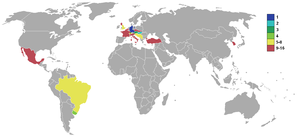
The hosts (Switzerland) and the defending champions (Uruguay) qualified automatically. Of the remaining 14 places, 11 were allocated to Europe (including Egypt, Turkey and Israel), 2 to the Americas, and one to Asia.
Scotland, Turkey and South Korea made their World Cup debuts at this tournament (Turkey and Scotland had qualified for the 1950 competition but both withdrew). Austria appeared for the first time since 1934. Turkey would not participate at a finals again until the 2002 competition, while South Korea's next appearance would be in 1986.
The third and fourth place teams from 1950, Sweden and Spain, both failed to qualify. In a shock result, Spain was eliminated by Turkey: after the two countries had tied a three-game series, Turkey progressed by drawing of lots.
German teams were allowed to qualify again, after having been banned from the 1950 FIFA World Cup
. West Germany
qualified against fellow Germans from the Saarland
(which then was a French protectorate), while East Germany had not entered, cancelling international football games after the East German uprising of 1953
.
in which every team plays every other team, which would have resulted in six matches in each group). In a further oddity, extra time would be played if the teams were level after ninety minutes in the group games, with the result being a draw if the scores were still level after 120 minutes.
Two points were awarded for a win and one for a draw. The two teams with the most points from each group would progress to the knockout stage. If the first and second placed teams were level on points, lots would be drawn to decide which team would top the group. However, if the second and third placed teams were level on points, they would participate in a playoff to decide which team would progress to the next stage.
It turned out that two of the four groups required playoffs, and the other two required drawing of lots between the two top teams. The playoffs were between Switzerland and Italy, and Turkey and West Germany: in both matches the unseeded teams (Switzerland and West Germany) repeated earlier victories against the seeds (Italy and Turkey) to progress. In the two groups that did not require playoffs, there was drawing of lots to determine the first-place teams: resulting in Uruguay and Brazil finishing above Austria and Yugoslavia, respectively.
A further unusual feature of the format was that the four group-winning teams were drawn against each other in the knockout stages to provide one finalist, and the four second-placed teams played against each other to provide the second finalist. In subsequent tournaments it has become customary to draw group winners against non-group-winners in the initial knockout stage.
If a knockout game was tied after ninety minutes, then thirty minutes of extra time would be played. If the score was still tied after extra time, lots would have been drawn to decide which team progressed. However, if the final was tied after extra time, it would have been replayed, with lots deciding the World Champion only if the replay was also tied after extra time.
, Brazil
, England
, France
, Hungary
, Italy
, Turkey
and Uruguay
), plus two unseeded teams. With seeding determined before the teams had even qualified for the final tournament, the organizers had to replace Spain with Turkey, the team that unexpectedly knocked the Spaniards out.
, who had been reinstated as full FIFA members only in 1950 and were unseeded, won the first of two encounters with the seeded Turkish convincingly in Bern at Wankdorf stadium. The Koreans, as the other unseeded team, lost 0–7 and 0–9, with Germany being denied the chance to play such an easy opponent. Sepp Herberger
the German coach gambled against the seeded team of Hungary by sending in a reserve side to take an expected 3–8 loss, with the only consequence being the additional playoff game against Turkey that was won with ease. Hungary's team captain Ferenc Puskás
, considered by many as the best player in the world in that time, was injured by German defender Werner Liebrich
, and had to miss the next two matches of his team, only to show up in the final again, still being in a questionable condition.
The quarter-finals saw the favourites Hungary beat Brazil 4–2 in one of the most violent matches in football history, which became infamous as the Battle of Berne
. Meanwhile, the World Cup holders Uruguay sent England out of the tournament, also by 4–2. Germany dispatched Yugoslavia
2–0, and Austria beat the host nation Switzerland in the game
that saw the most goals in any World Cup match, 7–5.
In the first semi-final, West Germany beat Austria 6–1.
The other semi-final, one of the most exciting games of the tournament, saw Hungary go into the second half leading Uruguay 1–0, only for the game to be taken to extra time with a score after 90 minutes of 2–2. The deadlock was broken by Sándor Kocsis
with two late goals to take Hungary through to the final, with Uruguay finally losing its unbeaten record in World Cup Final matches. Uruguay then went on to be beaten for a second time as Austria secured third place.
Final: "The Miracle of Berne
The Wankdorf Stadion in Bern saw 60,000 people cram inside to watch the final between West Germany and Hungary, a rematch of a first round game, which Hungary had won 8–3 against the reserves of the German team. The Golden Team of the Hungarians were favourites, as they were unbeaten for a record of 32 consecutive matches but they had two tough play-off matches. It had started raining on game day – in Germany this was dubbed "Fritz-Walter-Wetter" (Fritz Walter's weather) because the German team captain Fritz Walter
was said to play his best in rainy weather. Adi Dassler had provided shoes with exchangeable studs.
 The final saw Hungary's Ferenc Puskás playing again even though he was not fully fit. Despite this he put his team ahead after only 6 minutes and with Zoltán Czibor
adding another two minutes later it seemed that the pre-tournament favourites would take the title. However, with a quick goal from Max Morlock
in the 10th and the equalizer of Helmut Rahn
in the 19th, the tide began to turn.
The second half saw telling misses from the Hungarian team. Barely 6 minutes before the end of the match, the popular German radio reporter Herbert Zimmermann gave the most famous German piece of commentary, recommending Rahn should kick from the backfield, which he did. The second goal from Rahn gave Germany a 3–2 lead while the Hungarian reporter György Szepesi
burst into tears. Later, Zimmermann called Puskás offside before he kicked the ball into Toni Turek
's net with 2 minutes left. While referee Ling
pointed to the centre spot, linesman Griffiths signalled offside. After a one-minute consultation, referee Ling disallowed the claimed equalizer.
The Germans were handed the Jules Rimet trophy and the title of World Cup winners while the crowd sang along to the tunes of the national anthems of Germany. In Germany the success is known as The Miracle of Bern
, upon which a 2003 film of the same name was based. For the Hungarians, the defeat was a disaster, and remains controversial due to referee errors and claims of doping.
One controversy concerns the 2–2. Hungarian goalie Gyula Grosics
jumped to catch Fritz Walter
's corner shot, but in plain sight of the camera, Hans Schäfer
obstructed him, thus the ball could reach Rahn unhindered. The second controversy concerns allegations of doping to explain the better condition of the German team in the second half. Though teammates steadfastly denied this rumour, German historian Guido Knopp claimed in a 2004 documentary for German public channel ZDF
that the players were injected with shots of vitamin C at half-time, using a needle earlier taken from a Soviet sports doctor, which would also explain the wave of jaundice
among team members following the tournament. A university study in 2010 revealed that the Germany players had been injected with the banned substance methamphetamine.
Most controversial was the offside ruling for Puskás's intended 87th minute equalizer. The camera filming the official footage was in a bad position to judge the situation, only eyewitnesses claimed that the referee was wrong, including German replacement player Alfred Pfaff
. However, since then, footage evidencing no offside surfaced (shown on North German regional public channel NDR
in 2004).
The 11 goals scored by Kocsis of Hungary not only led the World Cup but bettered the previous record (set by Brazilian Ademir
in the previous tournament) by two goals. Kocsis' mark was then broken by Just Fontaine
's 13 goals in 1958
. Despite not winning the 1954 tournament, the fourth place finish and their two previous World Cup titles made Uruguay the most successful World Cup nation for eight years, until Brazil won their second title in 1962
. Hungary's 9–0 result against Korea during the group stages remains to this day the biggest margin of victory in FIFA World Cup history, later equalled by Yugoslavia winning 9–0 against Zaire in 1974
and again Hungary winning 10–1 against El Salvador in 1982
.
West Germany's totals of 25 goals scored and 14 goals conceded are both all-time record highs for a World Cup winning team, and some distance ahead of the second highest totals (19 scored and 7 conceded, both by Brazil in 1970). However, Hungary's 27 goals scored and +17 aggregate goal difference are all-time records for any team participating in a World Cup tournament, even though Hungary played only five matches (in subsequent World Cups, the final four teams would play six or seven matches).
West Germany also became the first team to win the World Cup after having lost a match at the finals (losing 8–3 to Hungary in the group stage). This feat was subsequently repeated by West Germany in 1974, Argentina in 1978 and Spain in 2010, who all lost group matches 1–0. Coincidentally, all three teams won against Netherlands sides in the final. The 1954 competition remains the only World Cup tournament in which no team was undefeated.
West Germany's 1954 victory remains the only time that a team has won the World Cup without playing any team from outside its own continent (Turkey is geographically partly in Asia, but qualified from Europe and has always been affiliated with UEFA).
Germany's victory in the match is considered one of the greatest upsets of all time and one of the finest achievements in German sporting history. The German team was made up of amateur players as Germany did not have a professional league at this time, while the Hungarians were de jure amateurs, like in any communist country that time, and playing football as professionals, mainly for Budapesti Honvéd FC and later for major clubs like Real Madrid and Barcelona in Spain, and were ranked best in the world. This is the only time a team has won the World Cup with amateur footballers.
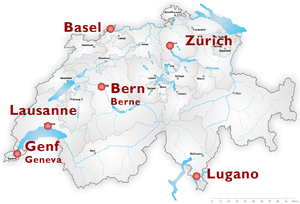 Six cities hosted the tournament:
.
Esteban Marino
Arthur Edward Ellis
Laurent Franken Vincenzo Orlandini
Vasa Stefanovic Mario Vianna Emil Schmetzer Carl Erich Steiner István Zsolt
----
----
----
----
----
----
----
----
----
----
----
----
----
----
6 goals Erich Probst
Max Morlock
Josef Hügi
4 goals
Helmut Rahn
Hans Schäfer
Ottmar Walter
Nándor Hidegkuti
Ferenc Puskás
Robert Ballaman
Carlos Borges
3 goals
Ernst Stojaspal
Theodor Wagner
Léopold Anoul
Nat Lofthouse
Fritz Walter
Zoltán Czibor
Burhan Sargun
Suat Mamat
Juan Hohberg
Oscar Míguez
2 goals
Robert Körner
Ernst Ocwirk
Didi
Julinho
Pinga
Ivor Broadis
Mihály Lantos
Péter Palotás
Lefter Küçükandonyadis
Julio Abbadie
Juan Alberto Schiaffino
1 goal
Henri Coppens
Baltazar Djalma Santos
Tom Finney
Jimmy Mullen Dennis Wilshaw
Raymond Kopa
Jean Vincent Richard Herrmann
Bernhard Klodt
Alfred Pfaff
József Tóth
Giampiero Boniperti
Amleto Frignani
Carlo Galli
Benito Lorenzi
Fulvio Nesti
Egisto Pandolfini
Tomás Balcázar
José Luis Lamadrid
Jacques Fatton
Mustafa Ertan
Erol Keskin
Javier Ambrois
Obdulio Varela
Miloš Milutinović
Branko Zebec
Own goals Jimmy Dickinson
(for Belgium) Raúl Cárdenas
(for France) Luis Cruz
(for Austria) Ivica Horvat (for Germany)
Final
3rd and 4th place
Eliminated in the quarter-finals
Eliminated at the group stage
's film The Marriage of Maria Braun
takes place during the finals of the 1954 World Cup; in the scene's background, the sports announcer is celebrating West Germany's victory and shouting "Deutschland ist wieder was!" (Germany is something again); the film uses this as the symbol of Germany's recovery from the ravages of the Second World War.
Sönke Wortmann
's 2003 German box-office hit The Miracle of Bern
(in German: Das Wunder von Bern) re-tells the story of the German team's route to victory through the eyes of a young boy who admires the key player of the final, Helmut Rahn
.
FIFA World Cup
The FIFA World Cup, often simply the World Cup, is an international association football competition contested by the senior men's national teams of the members of Fédération Internationale de Football Association , the sport's global governing body...
, was held in Switzerland
Switzerland
Switzerland name of one of the Swiss cantons. ; ; ; or ), in its full name the Swiss Confederation , is a federal republic consisting of 26 cantons, with Bern as the seat of the federal authorities. The country is situated in Western Europe,Or Central Europe depending on the definition....
from 16 June to 4 July. Switzerland was chosen as hosts in July 1946. The tournament set a number of all-time records for goal-scoring, including the highest average goals scored per game. The tournament was won by West Germany
Germany national football team
The Germany national football team is the football team that has represented Germany in international competition since 1908. It is governed by the German Football Association , which was founded in 1900....
, who defeated Hungary
Hungary national football team
The Hungary national football team represents Hungary in international football and is controlled by the Hungarian Football Federation....
3–2 in the final, giving them their first title.
Host selection
Switzerland was awarded the tournament unopposed on 26 July 1946, the same day that Brazil was selected for the 1950 World Cup, in Luxembourg City.Qualification
The hosts (Switzerland) and the defending champions (Uruguay) qualified automatically. Of the remaining 14 places, 11 were allocated to Europe (including Egypt, Turkey and Israel), 2 to the Americas, and one to Asia.
Scotland, Turkey and South Korea made their World Cup debuts at this tournament (Turkey and Scotland had qualified for the 1950 competition but both withdrew). Austria appeared for the first time since 1934. Turkey would not participate at a finals again until the 2002 competition, while South Korea's next appearance would be in 1986.
The third and fourth place teams from 1950, Sweden and Spain, both failed to qualify. In a shock result, Spain was eliminated by Turkey: after the two countries had tied a three-game series, Turkey progressed by drawing of lots.
German teams were allowed to qualify again, after having been banned from the 1950 FIFA World Cup
1950 FIFA World Cup
The 1950 FIFA World Cup, held in Brazil from 24 June to 16 July, was the fourth FIFA World Cup. It was the first World Cup since 1938, the planned 1942 and 1946 competitions having been canceled owing to World War II...
. West Germany
qualified against fellow Germans from the Saarland
Saarland national football team
The Saarland national football team was the association football team representing Saarland from 1950 to 1956 during the French occupation following World War II...
(which then was a French protectorate), while East Germany had not entered, cancelling international football games after the East German uprising of 1953
Uprising of 1953 in East Germany
The Uprising of 1953 in East Germany started with a strike by East Berlin construction workers on June 16. It turned into a widespread anti-Stalinist uprising against the German Democratic Republic government the next day....
.
Format
The 1954 tournament used a unique format. The sixteen qualifying teams were divided into four groups of four teams each. Each group contained two seeded teams and two unseeded teams. Only four matches were scheduled for each group, each pitting a seeded team against an unseeded team. (This contrasts with a conventional round-robinRound-robin tournament
A round-robin tournament is a competition "in which each contestant meets all other contestants in turn".-Terminology:...
in which every team plays every other team, which would have resulted in six matches in each group). In a further oddity, extra time would be played if the teams were level after ninety minutes in the group games, with the result being a draw if the scores were still level after 120 minutes.
Two points were awarded for a win and one for a draw. The two teams with the most points from each group would progress to the knockout stage. If the first and second placed teams were level on points, lots would be drawn to decide which team would top the group. However, if the second and third placed teams were level on points, they would participate in a playoff to decide which team would progress to the next stage.
It turned out that two of the four groups required playoffs, and the other two required drawing of lots between the two top teams. The playoffs were between Switzerland and Italy, and Turkey and West Germany: in both matches the unseeded teams (Switzerland and West Germany) repeated earlier victories against the seeds (Italy and Turkey) to progress. In the two groups that did not require playoffs, there was drawing of lots to determine the first-place teams: resulting in Uruguay and Brazil finishing above Austria and Yugoslavia, respectively.
A further unusual feature of the format was that the four group-winning teams were drawn against each other in the knockout stages to provide one finalist, and the four second-placed teams played against each other to provide the second finalist. In subsequent tournaments it has become customary to draw group winners against non-group-winners in the initial knockout stage.
If a knockout game was tied after ninety minutes, then thirty minutes of extra time would be played. If the score was still tied after extra time, lots would have been drawn to decide which team progressed. However, if the final was tied after extra time, it would have been replayed, with lots deciding the World Champion only if the replay was also tied after extra time.
Seeding
The eight seeded teams were based on world rankings (AustriaAustria national football team
The Austria national football team is the association football team that represents the country of Austria in international competition and is controlled by the Austrian Football Association ....
, Brazil
Brazil national football team
The Brazil national football team represents Brazil in international men's football and is controlled by the Brazilian Football Confederation , the governing body for football in Brazil. They are a member of the International Federation of Association Football since 1923 and also a member of the...
, England
England national football team
The England national football team represents England in association football and is controlled by the Football Association, the governing body for football in England. England is the joint oldest national football team in the world, alongside Scotland, whom they played in the world's first...
, France
France national football team
The France national football team represents the nation of France in international football. It is fielded by the French Football Federation , the governing body of football in France, and competes as a member of UEFA, which encompasses the countries of Europe...
, Hungary
Hungary national football team
The Hungary national football team represents Hungary in international football and is controlled by the Hungarian Football Federation....
, Italy
Italy national football team
The Italy National Football Team , represents Italy in association football and is controlled by the Italian Football Federation , the governing body for football in Italy. Italy is the second most successful national team in the history of the World Cup having won four titles , just one fewer than...
, Turkey
Turkey national football team
The Turkey national football team represents Turkey in association football and is controlled by the Turkish Football Federation, the governing body for football in Turkey. They are affiliated with UEFA...
and Uruguay
Uruguay national football team
The Uruguayan national football team represents Uruguay in international association football and is controlled by the Uruguayan Football Association, the governing body for football in Uruguay. The current head coach is Óscar Tabárez...
), plus two unseeded teams.
Results
The GermansGermany national football team
The Germany national football team is the football team that has represented Germany in international competition since 1908. It is governed by the German Football Association , which was founded in 1900....
, who had been reinstated as full FIFA members only in 1950 and were unseeded, won the first of two encounters with the seeded Turkish convincingly in Bern at Wankdorf stadium. The Koreans, as the other unseeded team, lost 0–7 and 0–9, with Germany being denied the chance to play such an easy opponent. Sepp Herberger
Sepp Herberger
Josef "Sepp" Herberger was a German football player and manager...
the German coach gambled against the seeded team of Hungary by sending in a reserve side to take an expected 3–8 loss, with the only consequence being the additional playoff game against Turkey that was won with ease. Hungary's team captain Ferenc Puskás
Ferenc Puskás
Ferenc Puskás was a Hungarian footballer and manager. He scored 84 goals in 85 international matches for Hungary, and 514 goals in 529 matches in the Hungarian and Spanish leagues. He became Olympic champion in 1952 and was a World Cup finalist in 1954...
, considered by many as the best player in the world in that time, was injured by German defender Werner Liebrich
Werner Liebrich
Werner Liebrich was a German footballer who played in the centre back position. He is notable for his role in West Germany's triumph in the 1954 FIFA World Cup, and spending his entire playing career of almost twenty years with hometown club Kaiserslautern, with whom he also briefly coached.-Early...
, and had to miss the next two matches of his team, only to show up in the final again, still being in a questionable condition.
The quarter-finals saw the favourites Hungary beat Brazil 4–2 in one of the most violent matches in football history, which became infamous as the Battle of Berne
Battle of Berne
The Battle of Berne is used to refer to a quarter-final match at the 1954 World Cup between Hungary and Brazil, played on June 27, 1954 at the Wankdorf Stadium in Berne, Switzerland....
. Meanwhile, the World Cup holders Uruguay sent England out of the tournament, also by 4–2. Germany dispatched Yugoslavia
Yugoslavia national football team
The Yugoslavia national football team represented the Kingdom of Yugoslavia and the Socialist Federal Republic of Yugoslavia in association football. It enjoyed a modicum of success in international competition. In 1992, during the Yugoslav wars, the team was suspended from international...
2–0, and Austria beat the host nation Switzerland in the game
Austria v Switzerland (1954)
On June 26, 1954, in a quarterfinal match of the 1954 Football World Cup, Austria beat Switzerland 7–5 in Lausanne, Switzerland. The 12 goals scored in the match set a World Cup record, unequalled to date, for the highest scoring match ever...
that saw the most goals in any World Cup match, 7–5.
In the first semi-final, West Germany beat Austria 6–1.
The other semi-final, one of the most exciting games of the tournament, saw Hungary go into the second half leading Uruguay 1–0, only for the game to be taken to extra time with a score after 90 minutes of 2–2. The deadlock was broken by Sándor Kocsis
Sándor Kocsis
Sándor Kocsis Péter was a Hungarian footballer who played for Ferencváros TC, Budapest Honvéd, Young Fellows Zürich, FC Barcelona and Hungary. During the 1950s, along with Ferenc Puskás, Zoltán Czibor, József Bozsik and Nándor Hidegkuti, he was a member of the Mighty Magyars...
with two late goals to take Hungary through to the final, with Uruguay finally losing its unbeaten record in World Cup Final matches. Uruguay then went on to be beaten for a second time as Austria secured third place.
Final: "The Miracle of Berne1954 FIFA World Cup Final- External links :* - fifa.com, FIFA, 2002.*...
"
The Wankdorf Stadion in Bern saw 60,000 people cram inside to watch the final between West Germany and Hungary, a rematch of a first round game, which Hungary had won 8–3 against the reserves of the German team. The Golden Team of the Hungarians were favourites, as they were unbeaten for a record of 32 consecutive matches but they had two tough play-off matches. It had started raining on game day – in Germany this was dubbed "Fritz-Walter-Wetter" (Fritz Walter's weather) because the German team captain Fritz WalterFritz Walter
Friedrich "Fritz" Walter was a German footballer. In his time with the German national team, he won 61 caps and scored 33 goals.-Early club career:...
was said to play his best in rainy weather. Adi Dassler had provided shoes with exchangeable studs.
Zoltán Czibor
Zoltán Czibor Suhai , also referred to as Czibor Zoltán, was a Hungarian footballer who played for several Hungarian clubs, including Ferencváros TC and Honvéd, and Hungary before joining CF Barcelona. Czibor played as a left-winger or striker and was notable for having a powerful shot, good...
adding another two minutes later it seemed that the pre-tournament favourites would take the title. However, with a quick goal from Max Morlock
Max Morlock
Maximilian Morlock was one of the most popular German football players in the 1950s and early 1960s. In his time with the West German national team, he earned 26 caps and scored 21 goals...
in the 10th and the equalizer of Helmut Rahn
Helmut Rahn
Helmut Rahn, known as Der Boss , was a German football player. He became a legend for having scored the winning goal in the final game of the 1954 FIFA World Cup .- Career :...
in the 19th, the tide began to turn.
The second half saw telling misses from the Hungarian team. Barely 6 minutes before the end of the match, the popular German radio reporter Herbert Zimmermann gave the most famous German piece of commentary, recommending Rahn should kick from the backfield, which he did. The second goal from Rahn gave Germany a 3–2 lead while the Hungarian reporter György Szepesi
György Szepesi
György Szepesi is a Hungarian radio personality, journalist and sports executive.-Early life:...
burst into tears. Later, Zimmermann called Puskás offside before he kicked the ball into Toni Turek
Toni Turek
Toni Turek, real name Anton Turek, was a German football goalkeeper.-Biography:Turek was born in Duisburg....
's net with 2 minutes left. While referee Ling
William Ling (referee)
William Ling was an English football referee from Stapleford, Cambridgeshire, who refereed the 1954 FIFA World Cup Final.-1948 Olympic Games:Ling rose quickly through the ranks as a referee...
pointed to the centre spot, linesman Griffiths signalled offside. After a one-minute consultation, referee Ling disallowed the claimed equalizer.
The Germans were handed the Jules Rimet trophy and the title of World Cup winners while the crowd sang along to the tunes of the national anthems of Germany. In Germany the success is known as The Miracle of Bern
The Miracle of Bern
The Miracle of Bern is a 2003 film by Sönke Wortmann, which tells the story of a German family and the unexpected West German miracle victory in the 1954 World Cup Final in Bern, Switzerland.The film can be regarded as a portrait of post-war Germany...
, upon which a 2003 film of the same name was based. For the Hungarians, the defeat was a disaster, and remains controversial due to referee errors and claims of doping.
One controversy concerns the 2–2. Hungarian goalie Gyula Grosics
Gyula Grosics
Gyula Grosics is a Hungarian former football goalkeeper who played 86 times for the Hungarian national football team and was part of the legendary Golden Team of the 1950s. He was nicknamed the Black Panther ....
jumped to catch Fritz Walter
Fritz Walter
Friedrich "Fritz" Walter was a German footballer. In his time with the German national team, he won 61 caps and scored 33 goals.-Early club career:...
's corner shot, but in plain sight of the camera, Hans Schäfer
Hans Schäfer
Hans Schäfer is a former German footballer. He played for 1. FC Köln between 1948 and 1965. He also played for the West-Germany national football team, earning 39 caps and scoring 15 goals. He played in three World Cups, in 1954, 1958, and 1962, earning a winner's medal in 1954 and scoring a total...
obstructed him, thus the ball could reach Rahn unhindered. The second controversy concerns allegations of doping to explain the better condition of the German team in the second half. Though teammates steadfastly denied this rumour, German historian Guido Knopp claimed in a 2004 documentary for German public channel ZDF
ZDF
Zweites Deutsches Fernsehen , ZDF, is a public-service German television broadcaster based in Mainz . It is run as an independent non-profit institution, which was founded by the German federal states . The ZDF is financed by television licence fees called GEZ and advertising revenues...
that the players were injected with shots of vitamin C at half-time, using a needle earlier taken from a Soviet sports doctor, which would also explain the wave of jaundice
Jaundice
Jaundice is a yellowish pigmentation of the skin, the conjunctival membranes over the sclerae , and other mucous membranes caused by hyperbilirubinemia . This hyperbilirubinemia subsequently causes increased levels of bilirubin in the extracellular fluid...
among team members following the tournament. A university study in 2010 revealed that the Germany players had been injected with the banned substance methamphetamine.
Most controversial was the offside ruling for Puskás's intended 87th minute equalizer. The camera filming the official footage was in a bad position to judge the situation, only eyewitnesses claimed that the referee was wrong, including German replacement player Alfred Pfaff
Alfred Pfaff
Alfred Pfaff was a German football player and World Cup winner with West Germany in 1954.- Life :Pfaff was capped seven times between 1953 and 1956 for the West German national team, scoring two goals as an inside forward....
. However, since then, footage evidencing no offside surfaced (shown on North German regional public channel NDR
Norddeutscher Rundfunk
Norddeutscher Rundfunk is a public radio and television broadcaster, based in Hamburg. In addition to the city-state of Hamburg, NDR transmits for the German states of Lower Saxony, Mecklenburg-Vorpommern and Schleswig-Holstein...
in 2004).
Records
For the first time there was television coverage, and special coins were issued to mark the event.The 11 goals scored by Kocsis of Hungary not only led the World Cup but bettered the previous record (set by Brazilian Ademir
Ademir Marques de Menezes
Ademir Marques de Menezes , best known as Ademir , was a Brazilian footballer, regarded as one of the best centre forwards in the history of the Brazil national team. His prominent jawbone earned him the nickname Queixada, which means "Jaw".He is best known for his exploits in the World Cup 1950...
in the previous tournament) by two goals. Kocsis' mark was then broken by Just Fontaine
Just Fontaine
Just "Justo" Fontaine is a former French football player.-Football career:He holds the record for most goals scored in a single FIFA World Cup finals tournament, with 13 in 1958...
's 13 goals in 1958
1958 FIFA World Cup
The 1958 FIFA World Cup, the sixth staging of the World Cup, was hosted by Sweden from 8 June to 29 June. The tournament was won by Brazil, who beat Sweden 5–2 in the final for their first title. To date, this marks the only occasion that a World Cup staged in Europe was not won by a European...
. Despite not winning the 1954 tournament, the fourth place finish and their two previous World Cup titles made Uruguay the most successful World Cup nation for eight years, until Brazil won their second title in 1962
1962 FIFA World Cup
The 1962 FIFA World Cup, the seventh staging of the World Cup, was held in Chile from 30 May to 17 June. It was won by Brazil, who retained the championship by beating Czechoslovakia 3–1 in the final...
. Hungary's 9–0 result against Korea during the group stages remains to this day the biggest margin of victory in FIFA World Cup history, later equalled by Yugoslavia winning 9–0 against Zaire in 1974
1974 FIFA World Cup
The 1974 FIFA World Cup, the tenth staging of the World Cup, was held in West Germany from 13 June to 7 July. The tournament marked the first time that the current trophy, the FIFA World Cup Trophy, created by the Italian sculptor Silvio Gazzaniga, was awarded...
and again Hungary winning 10–1 against El Salvador in 1982
1982 FIFA World Cup
The 1982 FIFA World Cup, the 12th FIFA World Cup, was held in Spain from 13 June to 11 July. The tournament was won by Italy, after defeating West Germany 3–1 in the final.-Host selection:...
.
West Germany's totals of 25 goals scored and 14 goals conceded are both all-time record highs for a World Cup winning team, and some distance ahead of the second highest totals (19 scored and 7 conceded, both by Brazil in 1970). However, Hungary's 27 goals scored and +17 aggregate goal difference are all-time records for any team participating in a World Cup tournament, even though Hungary played only five matches (in subsequent World Cups, the final four teams would play six or seven matches).
West Germany also became the first team to win the World Cup after having lost a match at the finals (losing 8–3 to Hungary in the group stage). This feat was subsequently repeated by West Germany in 1974, Argentina in 1978 and Spain in 2010, who all lost group matches 1–0. Coincidentally, all three teams won against Netherlands sides in the final. The 1954 competition remains the only World Cup tournament in which no team was undefeated.
West Germany's 1954 victory remains the only time that a team has won the World Cup without playing any team from outside its own continent (Turkey is geographically partly in Asia, but qualified from Europe and has always been affiliated with UEFA).
Germany's victory in the match is considered one of the greatest upsets of all time and one of the finest achievements in German sporting history. The German team was made up of amateur players as Germany did not have a professional league at this time, while the Hungarians were de jure amateurs, like in any communist country that time, and playing football as professionals, mainly for Budapesti Honvéd FC and later for major clubs like Real Madrid and Barcelona in Spain, and were ranked best in the world. This is the only time a team has won the World Cup with amateur footballers.
Venues
- BaselBaselBasel or Basle In the national languages of Switzerland the city is also known as Bâle , Basilea and Basilea is Switzerland's third most populous city with about 166,000 inhabitants. Located where the Swiss, French and German borders meet, Basel also has suburbs in France and Germany...
, St. Jakob StadiumSt. Jakob StadiumThe St. Jakob Stadium was a football stadium in Basel, Switzerland and the former home of Swiss club FC Basel. It was built in 1954, and as well as serving as a club stadium, it hosted several important matches, including a 1954 FIFA World Cup semi-final and four Cup Winners' Cup finals.Tickets and... - Bern, Wankdorf StadiumWankdorf StadiumThe Wankdorf Stadium was a football stadium in the Wankdorf quarter of Bern, Switzerland, and the former home of Swiss club BSC Young Boys. It was built in 1925, and as well as serving as a club stadium, it hosted several important matches, including the 1954 FIFA World Cup Final, the 1961...
- GenevaGenevaGeneva In the national languages of Switzerland the city is known as Genf , Ginevra and Genevra is the second-most-populous city in Switzerland and is the most populous city of Romandie, the French-speaking part of Switzerland...
, Charmilles StadiumCharmilles StadiumCharmilles Stadium was a multi-purpose stadium in Geneva, Switzerland. It was used mostly for football matches, and was the home venue for Servette FC. The stadium was able to hold 9,250 people and was built in 1930 for the Coupe des Nations 1930 tournament. During the 1954 FIFA World Cup the... - LausanneLausanneLausanne is a city in Romandy, the French-speaking part of Switzerland, and is the capital of the canton of Vaud. The seat of the district of Lausanne, the city is situated on the shores of Lake Geneva . It faces the French town of Évian-les-Bains, with the Jura mountains to its north-west...
, Stade Olympique de la PontaiseStade Olympique de la PontaiseStade Olympique de la Pontaise is a multi-purpose stadium in Lausanne, Switzerland. The stadium holds 15,850 people and was built in 1904.During the 1954 FIFA World Cup, the stadium hosted five games.It is used mostly for football matches... - LuganoLuganoLugano is a city of inhabitants in the city proper and a total of over 145,000 people in the agglomeration/city region, in the south of Switzerland, in the Italian-speaking canton of Ticino, which borders Italy...
, Cornaredo StadiumCornaredo StadiumCornaredo Stadium is a multi-purpose stadium in Lugano, Switzerland. It is used mostly for football matches. It is a home ground of AC Lugano. The stadium is able to hold 15,000 people and was built in 1951. The stadium has 5,000 seats and 10,000 standing places... - ZürichZürichZurich is the largest city in Switzerland and the capital of the canton of Zurich. It is located in central Switzerland at the northwestern tip of Lake Zurich...
, Hardturm Stadium
Squads
For a list of all squads that appeared in the final tournament, see 1954 FIFA World Cup squads1954 FIFA World Cup squads
Below are the squads for the 1954 FIFA World Cup tournament in Switzerland. This was the first World Cup where the players were assigned squad numbers.-Brazil :Head coach: Zezé Moreira-Yugoslavia :...
.
Match officials
Raymon Wyssling Benjamin Griffiths Charlie Faultless Manuel Asensi Jose da Costa Vieira Raymond Vincenti William LingWilliam Ling (referee)
William Ling was an English football referee from Stapleford, Cambridgeshire, who refereed the 1954 FIFA World Cup Final.-1948 Olympic Games:Ling rose quickly through the ranks as a referee...
Esteban Marino
Esteban Marino
Esteban Marino was a Uruguayan football referee. He refereed in the Primera División de Uruguay. He is most famous for refereeing the first leg of the 1968 Copa Libertadores finals. As a World Cup linesman he got one match in 1950 World Cup and three matches in 1962.-References:...
Arthur Edward Ellis
Arthur Edward Ellis
Arthur Edward Ellis was an English football referee.Ellis was a referee in The Football Association competitions and in FIFA international competitions...
Laurent Franken Vincenzo Orlandini
Vincenzo Orlandini
Vincenzo Orlandini was the first Italian to officiate in a FIFA World Cup final match when he ran the line to William Ling in the 1954 World Cup final between Hungary and West Germany....
Vasa Stefanovic Mario Vianna Emil Schmetzer Carl Erich Steiner István Zsolt
István Zsolt
Istvan Zsolt was a Hungarian international football referee. He officiated at the 1954, 1958 and 1966 World Cup tournaments and the Olympic Games of 1952, 1960, 1964 and 1968.-References:*****...
Seeding
| Pot 1 | Pot 2 | Pot 3 | Pot 4 |
|---|---|---|---|
| (hosts) (defending champions) (Olympic champions) |
Group 1
| Team | |||||||
|---|---|---|---|---|---|---|---|
| 2 | 1 | 1 | 0 | 6 | 1 | 3 | |
| 2 | 1 | 1 | 0 | 2 | 1 | 3 | |
| 2 | 1 | 0 | 1 | 3 | 3 | 2 | |
| 2 | 0 | 0 | 2 | 2 | 8 | 0 |
- Brazil finished ahead of Yugoslavia on drawing of lots
----
----
----
Group 2
| Team | |||||||
|---|---|---|---|---|---|---|---|
| 2 | 2 | 0 | 0 | 17 | 3 | 4 | |
| 2 | 1 | 0 | 1 | 7 | 9 | 2 | |
| 2 | 1 | 0 | 1 | 8 | 4 | 2 | |
| 2 | 0 | 0 | 2 | 0 | 16 | 0 |
- West Germany finished ahead of Turkey by winning a play-off
----
----
----
Play-off
Group 3
| Team | |||||||
|---|---|---|---|---|---|---|---|
| 2 | 2 | 0 | 0 | 9 | 0 | 4 | |
| 2 | 2 | 0 | 0 | 6 | 0 | 4 | |
| 2 | 0 | 0 | 2 | 0 | 7 | 0 | |
| 2 | 0 | 0 | 2 | 0 | 8 | 0 |
- Uruguay finished ahead of Austria on drawing of lots
----
----
----
Group 4
| Team | |||||||
|---|---|---|---|---|---|---|---|
| 2 | 1 | 1 | 0 | 6 | 4 | 3 | |
| 2 | 1 | 0 | 1 | 2 | 3 | 2 | |
| 2 | 1 | 0 | 1 | 5 | 3 | 2 | |
| 2 | 0 | 1 | 1 | 5 | 8 | 1 |
- Switzerland finished ahead of Italy by winning a play-off
----
----
----
Play-off
Knockout stage
Quarter-finals
--------
----
Semi-finals
----Third-place match
Final
Scorers
11 goals Sándor KocsisSándor Kocsis
Sándor Kocsis Péter was a Hungarian footballer who played for Ferencváros TC, Budapest Honvéd, Young Fellows Zürich, FC Barcelona and Hungary. During the 1950s, along with Ferenc Puskás, Zoltán Czibor, József Bozsik and Nándor Hidegkuti, he was a member of the Mighty Magyars...
6 goals Erich Probst
Erich Probst
Erich Probst was an Austrian footballer.-International career:Probst made his debut for Austria in a May 1951 friendly match against Scotland and was a participant at the 1954 FIFA World Cup tournament 1954 in Switzerland, where he was one of the foremost strikers...
Max Morlock
Max Morlock
Maximilian Morlock was one of the most popular German football players in the 1950s and early 1960s. In his time with the West German national team, he earned 26 caps and scored 21 goals...
Josef Hügi
Josef Hügi
Josef "Sepp" Hügi was a Swiss international footballer who played as a striker during the late 1940s, 1950s and early 1960s....
4 goals
Helmut Rahn
Helmut Rahn
Helmut Rahn, known as Der Boss , was a German football player. He became a legend for having scored the winning goal in the final game of the 1954 FIFA World Cup .- Career :...
Hans Schäfer
Hans Schäfer
Hans Schäfer is a former German footballer. He played for 1. FC Köln between 1948 and 1965. He also played for the West-Germany national football team, earning 39 caps and scoring 15 goals. He played in three World Cups, in 1954, 1958, and 1962, earning a winner's medal in 1954 and scoring a total...
Ottmar Walter
Ottmar Walter
Ottmar Kurt Herrmann Walter is a former German footballer.He played together with his brother, Fritz Walter, at the club 1. FC Kaiserslautern. They also played together for the Germany national football team in the 1954 FIFA World Cup. Ottmar scored 4 goals in the tournament as West Germany won...
Nándor Hidegkuti
Nándor Hidegkuti
Nándor Hidegkuti was a Hungarian football player and manager. He played as a forward or attacking midfielder and spent the majority of his playing career at MTK Hungária FC. During the 1950s he was also a member of the Hungarian National Team team known as the Golden Team...
Ferenc Puskás
Ferenc Puskás
Ferenc Puskás was a Hungarian footballer and manager. He scored 84 goals in 85 international matches for Hungary, and 514 goals in 529 matches in the Hungarian and Spanish leagues. He became Olympic champion in 1952 and was a World Cup finalist in 1954...
Robert Ballaman
Robert Ballaman
Robert Ballaman was a Swiss footballer.-Career:Ballaman earned 50 caps and scored 18 goals for the Switzerland national football team...
Carlos Borges
Carlos Borges
Carlos Ariel Borges is a former Uruguayan footballer, best known for scoring the first goal ever in a Copa Libertadores.He earned 35 caps and scored 10 goals for the Uruguay national football team from 1954 to 1959...
3 goals
Ernst Stojaspal
Ernst Stojaspal
Ernst Stojaspal was an Austrian football player. He was born in Vienna.-Club career:A prolific striker, the left-footed Stojaspal played for Austria Wien for 10 years, winning three league titles and 2 domestic cups. Also, he topped the final goalscoring charts 5 times...
Theodor Wagner
Theodor Wagner (footballer)
Theodor "Turl" Wagner is a former Austrian footballer.-International career:He made his debut for Austria in a November 1946 friendly match against Switzerland and was a participant at the 1954 FIFA World Cup, where he scored a hat-trick in the 7-5 quarterfinal win over Switzerland.He earned 46...
Léopold Anoul
Léopold Anoul
Léopold Anoul , aka Pol Anoul, was a Belgian footballer.During his club career he played for Royal FC Liegeois and Standard Liège...
Nat Lofthouse
Nat Lofthouse
Nathaniel "Nat" Lofthouse, OBE was an English professional footballer who played for Bolton Wanderers for his whole career...
Fritz Walter
Fritz Walter
Friedrich "Fritz" Walter was a German footballer. In his time with the German national team, he won 61 caps and scored 33 goals.-Early club career:...
Zoltán Czibor
Zoltán Czibor
Zoltán Czibor Suhai , also referred to as Czibor Zoltán, was a Hungarian footballer who played for several Hungarian clubs, including Ferencváros TC and Honvéd, and Hungary before joining CF Barcelona. Czibor played as a left-winger or striker and was notable for having a powerful shot, good...
Burhan Sargun
Suat Mamat
Suat Mamat
Suat İsmail Mamat is a retired Turkish professional footballer who played in Turkey for Ankara Demirspor, Galatasaray S.K., Beşiktaş J.K...
Juan Hohberg
Juan Hohberg
Juan Eduardo Hohberg was an Argentine - Uruguayan football player and coach.-Club career:...
Oscar Míguez
Oscar Míguez
Óscar Omar Miguez Antón was a Uruguayan footballer. He was part of the Uruguay team in the 1950 and 1954 World Cups, where he played as a striker, and is Uruguay's all-time record World Cup goalscorer with eight goals....
2 goals
Robert Körner
Robert Körner
Robert Körner was an Austrian footballer.-Club career:He played for and skippered SK Rapid Wien, and later managed SK Rapid Wien , SV Waldhof Mannheim , and 1...
Ernst Ocwirk
Ernst Ocwirk
Ernst Ocwirk was an Austrian football player and coach. He is considered one of the greatest Austrian footballers of all time....
Didi
Valdir Pereira
Waldyr Pereira , nicknamed Didi , was a Brazilian footballer who played midfielder. He played in three World Cups: 1954, 1958, and 1962, winning the latter two. He is considered to be one of the greatest midfielders in the sport renowned for his range of passing, stamina and flawless technique...
Julinho
Júlio Botelho
Júlio Botelho, also known as Julinho was a Brazilian football player....
Pinga
José Lázaro Robles
José Lázaro Robles, best known as Pinga was a Brazilian footballer.He was born in São Paulo. During his career he played for Juventus, Portuguesa and Vasco da Gama, where played 466 matches from 1953 to 1962 and scoring 250 goals...
Ivor Broadis
Ivor Broadis
Ivan Arthur Broadis is a former England international footballer. Broadis' clubs were Carlisle United, Sunderland, Manchester City, Newcastle United and Queen of the South. Broadis played at inside forward...
Mihály Lantos
Mihály Lantos
Mihály Lantos , also known as Lantos Mihály or Mihály Lendenmayer, was a Hungarian footballer and manager. He played as a defender, spending the majority of his career at MTK Hungária FC. During the 1950s he was also a member of the Hungary team known as the Mighty Magyars...
Péter Palotás
Péter Palotás
Péter Palotás , also referred to as Péter Poteleczky and Palotás Péter, was a Hungarian footballer who played as a forward for MTK Hungária FC and Hungary...
Lefter Küçükandonyadis
Lefter Küçükandonyadis
Lefter Küçükandonyadis , born 22 December 1925 in Istanbul, is a Turkish football player of Greek descent, who is recognised as one of the greatest footballers to play for Turkey.-Early life and club career:...
Julio Abbadie
Julio Abbadie
Julio César Abbadie Gismero was a Uruguayan footballer who played as a forward. During his career, he played for Peñarol, where he won the 1966 Copa Libertadores and the Intercontinental Cup....
Juan Alberto Schiaffino
Juan Alberto Schiaffino
Juan Alberto "Pepe" Schiaffino Villano was an Italian Uruguayan football player. He played inside forward, in particular with CA Peñarol and AC Milan, and won the 1950 FIFA World Cup with the Uruguayan national team...
1 goal
Henri Coppens
Henri Coppens
Henri 'Rik' François Coppens is a former Belgian football striker. His parents owned and ran a fishmonger's shop there....
Baltazar Djalma Santos
Djalma Santos
Djalma Pereira Dias dos Santos known simply as Djalma Santos is a former Brazilian footballer who started for the Brazil national team in four World Cups, winning two, in 1958 and 1962. Santos is considered to be one of the greatest right-backs of all time...
Tom Finney
Tom Finney
Sir Thomas Finney, OBE is a former English footballer, famous for his loyalty to his league club, Preston North End, and for his performances in the English national side....
Jimmy Mullen Dennis Wilshaw
Dennis Wilshaw
Dennis James Wilshaw was an English international footballer. He scored 172 goals in 379 appearances in the Football League, and also scored ten goals in twelve appearances for the England national team.-Playing style:...
Raymond Kopa
Raymond Kopa
Raymond Kopa , is a former French football offensive midfielder, integral to the French national team of the 1950s....
Jean Vincent Richard Herrmann
Richard Herrmann
Richard Herrmann was a German football player. He played for the clubs 1. FC Kattowitz and FSV Frankfurt ....
Bernhard Klodt
Bernhard Klodt
Bernhard "Berni" Klodt was a German football player. He was born in Gelsenkirchen-Bismarck; the goalkeeper Hans Klodt was his brother....
Alfred Pfaff
Alfred Pfaff
Alfred Pfaff was a German football player and World Cup winner with West Germany in 1954.- Life :Pfaff was capped seven times between 1953 and 1956 for the West German national team, scoring two goals as an inside forward....
József Tóth
József Tóth (footballer born 1929)
József Tóth, also Hungarian Tóth József and in line-ups as Tóth II , was a Hungarian footballer, position forward, who played in the 1954 FIFA World Cup....
Giampiero Boniperti
Giampiero Boniperti
Giampiero Boniperti is an Italian former football player who played his entire career at Juventus between 1946 and 1961. He also played for the Italian national football team...
Amleto Frignani
Amleto Frignani
Amleto Frignani was an Italian footballer.He played 9 seasons in the Serie A for A.C. Milan, Udinese Calcio and Genoa C.F.C....
Carlo Galli
Carlo Galli
Giancarlo Galli, commonly known as Carlo Galli is an Italian retired footballer.He played for 16 seasons in the Serie A for U.S. Città di Palermo, A.S. Roma, A.C. Milan, Udinese Calcio, Genoa C.F.C. and S.S...
Benito Lorenzi
Benito Lorenzi
Benito "Veleno" Lorenzi was an Italian football player born in Borgo a Buggiano, province of Pistoia. He played as a striker....
Fulvio Nesti
Fulvio Nesti
Fulvio Nesti was an Italian footballer.During his club career he played for ACF Fiorentina, S.S. Scafatese Calcio 1922, SPAL 1907, F.C. Internazionale Milano, and A.C. Prato. He earned 5 caps and scored 1 goal for the Italian national team from 1953 to 1954, and participated in the 1954 FIFA World...
Egisto Pandolfini
Egisto Pandolfini
Egisto Pandolfini is an Italian retired footballer.He played for 12 seasons in the Serie A for ACF Fiorentina, A.S. Roma, F.C. Internazionale Milano and SPAL 1907....
Tomás Balcázar
Tomás Balcázar
Tomás Balcázar is a former Mexican footballer. He played at club level for C.D. Guadalajara, and internationally for Mexico.-Football career:...
José Luis Lamadrid
José Luis Lamadrid
José Luis Lamadrid is a Mexican football forward who played for Mexico in the 1954 FIFA World Cup. He also played for Club Necaxa.-External links:*...
Jacques Fatton
Jacques Fatton
Jacques "Jacky" Fatton was a Swiss footballer.-Career:Fatton, who was born in Exincourt, France, was capped 53 times and scored 29 goals for the Switzerland national football team. He played in two FIFA World Cups, scoring twice in 1950 and once in 1954.During his club career, Fatton played for...
Mustafa Ertan
Mustafa Ertan
Mustafa Ertan is a Turkish football defender who played for Turkey in the 1954 FIFA World Cup. He also played for MKE Ankaragücü.-External links:* *...
Erol Keskin
Erol Keskin
Erol Keskin is a Turkish football forward who played for Turkey in the 1954 FIFA World Cup. He also played for Adalet SK Istanbul.-External links:*...
Javier Ambrois
Javier Ambrois
Javier Ambrois is a former Uruguayan footballer currently played for clubs of Uruguay, Argentina and Brazil and the Uruguay national football team in the FIFA World Cup Switzerland 1954.He and Humberto Maschio , are the all-time top scorers of the 1957 South American Championship, with 9...
Obdulio Varela
Obdulio Varela
Obdulio Jacinto Muiños Varela was a Uruguayan football player. He was the captain of the Uruguayan national team that won the 1950 World Cup after beating Brazil in the decisive final round match popularly known as the Maracanazo...
Miloš Milutinović
Miloš Milutinovic
Miloš Milutinović was a Serbian football player and manager...
Branko Zebec
Branko Zebec
Branislav "Branko" Zebec was a Croatian football player and coach...
Own goals Jimmy Dickinson
Jimmy Dickinson
James William 'Jimmy' Dickinson was an English football player.Dickinson holds the record for number of league appearances for Portsmouth...
(for Belgium) Raúl Cárdenas
Raúl Cárdenas
Raúl Cárdenas de la Vega is a former Mexican football player and coach. He represented the Mexico national football team as a player in three FIFA World Cups: 1954, 1958 and 1962. He also coached the national team when they reached the quarterfinals at home in the 1970 FIFA World Cup, and managed...
(for France) Luis Cruz
Luis Cruz (footballer)
Luis Cruz is a Uruguayan football midfielder who played for Uruguay in the 1954 FIFA World Cup. He also played for Club Nacional de Football.-External links:*...
(for Austria) Ivica Horvat (for Germany)
FIFA retrospective ranking
In 1986, FIFA published a report that ranked all teams in each World Cup up to and including 1986, based on progress in the competition, overall results and quality of the opposition. The rankings for the 1954 tournament were as follows:Final
3rd and 4th place
Eliminated in the quarter-finals
Eliminated at the group stage
In film
The final scene of Rainer Werner FassbinderRainer Werner Fassbinder
Rainer Werner Maria Fassbinder was a German movie director, screenwriter and actor. He is considered one of the most important representatives of the New German Cinema.He maintained a frenetic pace in film-making...
's film The Marriage of Maria Braun
The Marriage of Maria Braun
The Marriage of Maria Braun is a 1979 West German film directed by Rainer Werner Fassbinder. The film stars Hanna Schygulla as Maria, whose marriage with the soldier Hermann remained unfulfilled due to World War II and his post-war imprisonment...
takes place during the finals of the 1954 World Cup; in the scene's background, the sports announcer is celebrating West Germany's victory and shouting "Deutschland ist wieder was!" (Germany is something again); the film uses this as the symbol of Germany's recovery from the ravages of the Second World War.
Sönke Wortmann
Sönke Wortmann
Sönke Wortmann is a German film director and producer.- Biography :Wortmann’s father was a miner. After Wortmann’s A-Levels he wanted to become a professional football player and started playing with Westfalia Herne at the third best category and with SP Vgg Erkenschwick...
's 2003 German box-office hit The Miracle of Bern
The Miracle of Bern
The Miracle of Bern is a 2003 film by Sönke Wortmann, which tells the story of a German family and the unexpected West German miracle victory in the 1954 World Cup Final in Bern, Switzerland.The film can be regarded as a portrait of post-war Germany...
(in German: Das Wunder von Bern) re-tells the story of the German team's route to victory through the eyes of a young boy who admires the key player of the final, Helmut Rahn
Helmut Rahn
Helmut Rahn, known as Der Boss , was a German football player. He became a legend for having scored the winning goal in the final game of the 1954 FIFA World Cup .- Career :...
.